

















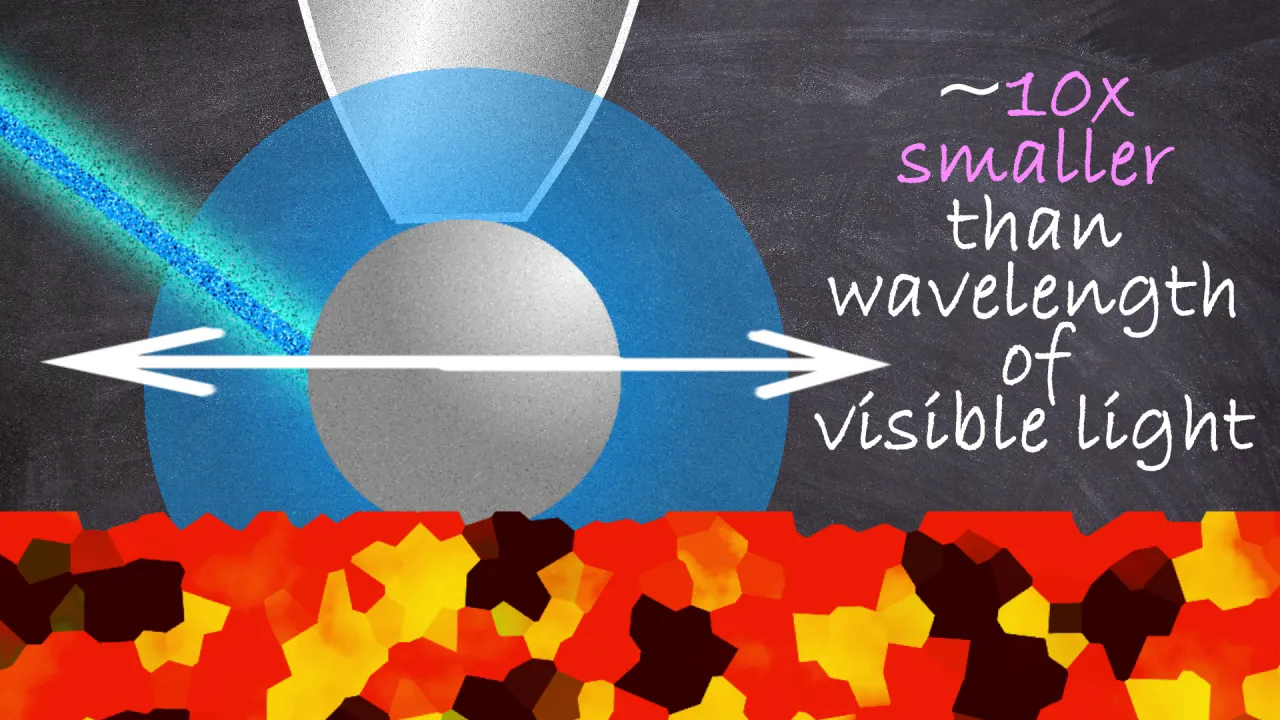









Surface plasmon resonance is a phenomenon where free electrons in metal nanoparticles oscillate collectively in response to incident light, creating strong electromagnetic field enhancements that depend on particle size, shape, and local dielectric environment; this effect enables applications in biosensing, imaging, lithography, and photothermal therapy, as demonstrated by the ability to detect single molecules through spectral shifts and focus light beyond the diffraction limit.
Surface Plasmon Resonance in Nanomanufacturing | Lecture 11
Added:Fundamental Electromagnetism: Mastery of Maxwell's equations and how electromagnetic waves propagate through and interact with different media.
Wave Optics and Evanescent Fields: Understanding total internal reflection, phase matching, and the behavior of evanescent waves at dielectric-metal interfaces.
Solid-State Physics Basics: Comprehension of the Drude model of metals, free electron gas behavior, and the concept of plasma frequency.
Introductory Nanotechnology: Basic knowledge of nanofabrication concepts and how material properties change at the nanoscale.
Localized Surface Plasmon Resonance (LSPR): Studying plasmonic effects in metallic nanoparticles and their unique optical properties.
Plasmonic Biosensors and Diagnostics: Exploring the design, fabrication, and practical deployment of SPR-based sensors for real-time biomolecular interaction analysis.
Metamaterials and Transformation Optics: Investigating artificially engineered structures that manipulate electromagnetic waves in unconventional ways (e.g., negative refractive index).
High-Resolution Nanofabrication Techniques: Learning advanced lithographic methods (like Electron Beam Lithography and Focused Ion Beam) to manufacture sub-wavelength plasmonic devices.
70.5K views541likes1:18:26Original Release: 2012-01-26
okay good morning today we'll talk about uh the last Topic in the section on interactions which is uh surface Plasma on resonance and Aon and I are going to share the lecture today uh I do have a few announcements uh of course you know the problem set two is due on Monday uh I'm going to be out of town on Monday so I've decided to to cancel Monday's lecture and then we're going to revise the lecture schedule later I'll post a revised syllabus later this week and uh there may be an optional act extra session I'm not sure but things will just kind of get shift ahead of bit uh there is a possibility that the midterm exam will be one uh lecture later than planned but I'm not sure I'll let you know uh so the homework is still due Monday at 10:40 a.m. and for this uh we're going to have a box outside of my office 2278 GG Brown along the main GG Brown hallway the hallway that overlooks the the parking lot north of the building uh and uh you know for example it'd be great if you use the leure time to work on the video assignment to get together uh in your groups and also as I said last time I'd like you to sign up for your video topic no later than Monday and then you know uh get your thoughts started uh and also you know take time to talk with maafa or me if you have questions about the scope of the topic the papers we've chosen you know other ideas you have really you know if you think that the topic should go in a different direction than suggested by the papers feel free to suggest that but just kind of talk to us about it first uh uh I think you know you'll do more thinking specifically about how the topic will be presented when you start meeting as groups than we did in creating the topics although I think we chose a set of topics that are are useful and important Concepts you know you'll immediately have probably uh deeper thoughts about how to put it together than we did uh so far uh so feel free to ask if you have questions or suggestions uh also uh next week I will be posting the description of the course project uh and then uh the process is going to be that uh I'll ask each of you to individually write a project proposal kind of a one to two page thing to describe an IDE you have and and the scope of that will be defined and then uh that'll be part that's part of the project a small part of the project and then after that you'll work in teams for the project and so now with these things in mind I think next month is going to be a going to be a busy month in terms of assignments because you know after the spring break we'll have one more problem set before the exam the video assignment is due before the exam uh and then also we'll have the project proposal so there are a lot of assignments but then after March there's just a fourth problem set and then there's a project and that's still a big thing but it's but it's just that one thing as the culmination for the course but you know just keep keep your eyes on things as we are go going forward because after the break uh there going to be a few things right after the other one another question individual but the project itself yeah so so I'm going to ask you to make individual proposals and then I'll comment on those proposals and you'll be able to choose your teams but in some cases if you tell me what your team is going to be I might suggest you know hey I think these three proposals might fit together in a particular way or if you don't have a team set then if there are kind of some you know some really you know individual proposals I might be able to suggest some some alignment in terms of topics and interests uh but I like to keep it individual before you get together doesn't mean you can't talk about your topics with others or you can't you know kind of guess who your team is going to be but I do want the proposal to be individual and and basically you don't I don't want you to propose the same thing as the other people that you would plan to work with uh so you maybe also is kind of lets us have a funneling process if you have similar interests you can propose three different things and then through that process of reading and writing can maybe come up with a with a with a better idea for a joint topic uh and there'll be more details on that next week okay so a quick recap of of last time uh where we talked about electrostatics and solution and developed the the basic representation for What's called the electrostatic double layer so you recall that we discussed that uh in soltion most surfaces become charged uh either by absorption of ions from solution or dissociation of part of the molecules on the surface and if we take a case that we have a surface like so in solution with a negative surface charge be uh there is a uh to enforce the requirement of electrical neutrality you have a distribution in the concentrations of the ions away from the surface and because you can't fit all the counter ions to neutralize the surface right on the surface or it's not you know thermodynamically favorable to do that uh you end up with a distribution in ion concentration this means that the equivalent potential or voltage that is associated with the specific number of charges per area you have here gets uh neutralized over a distance and this is the profile the resulting profile of surface potential away from the wall and where this action happens is what we refer to as the Deb layer and we were able to develop a simple model which says that the surface potential decays exponentially from the wall and we can use that model to realize for example how the thickness of the layer uh decays when under cert constant surface potential for example as the concentration of ions in the solution increases so in this example where uh when we increase the concentration of ions in solution the uh uh thickness of the debay or the rate of decay of the surface potential decreases because you have more ions available to uh neutralize uh the potential and and you have ADD distribution of both the counter ions and the co- ions the co- ions having lesser concentration near the surface because you have the counter ions trying to neutralize and the total number of ions per unit volume uh is the same throughout and when you get farther away kind of like the analogy I tried to paint about being in the middle of the room you don't see anything it just looks like you see equal numbers of ions of both types moving around and we went through this exercise to understand the reasons for uh electrostatics and and and and the principle of developing the charge neutrality over a distance and the application of this for us is to think about how nanor structures interact and uh we closed discussing how we can superimpose the interaction Potential from electrostatics with the interaction Potential from for example Vander wal's forces and get an additive to additive relation that lets us both qualitatively and quantitatively predict whether an arrangement of particles in solution or you know generic objects you could derive these for different shapes is stable and for example when there is enough electrostatic repulsion to counteract the Vander walls interactions or create a sufficiently high energy barrier uh to forbid the situation from collapsing or coagulating then you have a stable solution and uh in a in a certain case you could for example go from a stable solution to unstable Solution by increasing that salt concentration so you decrease the range or the the the B length govern the distance over which the surface potential and electrostatic interactions Decay and therefore essentially convert the net potential relationship from the case of a to the case uh of D below and uh one of the last things I showed was this example which comes from calculation of you know cases where we saw changing for example the size of gold particles in solution uh under otherwise the same conditions you know a certain hammock constant which is a term in the vaner wals equation uh a certain concentration of salt a fixed surface potential uh uh as a function and and plotting it as a function of Separation change the changes the uh case of the the curves here and uh for example what we're seeing here is that the uh effect the the effective barrier height and uh the barrier height because what's creating the barrier height is the repulsion electrostatic repulsion is getting higher as the particle size increases and then at the end there was a question about why this peak isn't moving to the right uh I mean to me it's moving to the right very slightly but it's not moving to the right a lot uh as the as the size increases and I think you know we can generally just look at this by seeing how the the two terms in the equation scale and I'm not sure exactly I didn't get to check what model they're using here whether saying the particles behave like planes or the particles behave like spheres spheres but if you looked at the scaling of the two terms of the vand walls attraction term and the electrostatic repulsion term which comes from the electrostatics the derivation of the force and then the integration of the force to get a potential you could write out for example how uh this should scale and in the case of treating them as uh spheres uh where treating them as spheres uh according to the approximation where the radius is much larger than the separation you would derive that the position of this peak doesn't change but in this case you can see clearly here that this sphere the the the the radius being 10 anrs is in fact smaller than the separation so the curvature of the surfaces is very important but I I just I just wrote down the results for the case of spheres where the separation d d is much less than the radius a and uh this assumption is in the the calculation of the electrostatic repulsion uh and in this case the repulsion du due to electrostatic forces ends up being proportional to the radius times uh the uh exponential to minus the separation in fact it's minus the separation times the Debby thickness Kappa but the Debby layer thickness isn't uh isn't changing with size assuming where in a planer case here and then for spheres the Vander walls just scales as R over the separation so that says that if you in this in in in the cases that we derived in class if you change the radius then the position of the maximum isn't going to change because you know they're both terms you would be adding them are linear in the radius but if you looked into the relationships for uh spheres with high curvature there was a slide showing those last time uh that may not exactly be the case and to close the topic I just have a few other short uh comments uh one is we really didn't talk about how the surface potential is is measured uh or talk about another thing which is the fact that in a real case you know I said you can't pack all the counter ions up against the surface but you do get some packing of ions against the surface and uh therefore you actually have a a a layer of counter ions that kind of sticks there and then you start getting into the real double layer potential Decay that we talked about and this layer is called what's called the stern layer or the stern plane and then uh you have the diffuse layer where the potential Decay smoothly as we derived so in practice uh what is typically called the surface potential is something that can be measured by doing experiments for example uh changing the pH of a solution and looking at the electrostatics of the solution and that sometimes is what's called The Zeta potential and you can actually use then use this potential in the uh equation for the double layer to calculate how the potential decays it's because these ions stick to the surface it's actually really difficult to know what the real surface potential is but in practice if you think about things like slip and flow if these ions are effectively stuck at the surface the real interfacial action is actually not happening right at the surface but at the edge of this layer where you may have some ions stuck against it so in reality what we may physically be talking about is the the net surface potential resulting from the surface charge plus the ions that are physically there and not the ions that are moving around and I think there is also an interesting overlap uh between electrostatics and solution and fluidics in the case where you know in in in in in our derivation we said well we have you know a surface where uh it's just one surface and we assume it's infinitely far away from everything or it's many many many dib layers far away from everything and then when we talked about forces we said well they have to be sufficiently close but not say within a debayer separation to feel an electro electrostatic force with one another but some even perhaps more interesting things happen and there's some opportunity for devices and applications when you consider what happens when you bring two surfaces close enough together such that their Deb layers are interacting you know this in principle happens if we have the two particles in solution and they're kind of feeling each other but we didn't really say well what you know other than stabilization other than balancing those force force is what's in application of that but you know for example if we consider that we might be able to construct a gap between two surfaces where the separation is smaller than the Deb layer thicknesses then the Deb layers overlap and and you know you could say well maybe I'm going to make an additive approximation here where I'm going to add the potential from one surface and add the potential to the other surface and get a net curve well what turns out is there's a there's a saturation where you have a constant surface potential across the Gap and this uh you know is interesting for example for measurements of the electric of the of the dialectric properties of fluids one application of this is doing impedance spectroscopy in small gaps and another application of it is uh using ionics or using electrostatic effect and solution to control the flow of fluids and these pictures are from the last paper that I asked you to read last time and also it's one of the video topics and uh this is worked done at Berkeley a few years ago and what these researchers they did is they they wanted to make a device uh analogous to a Field Effect transistor that you know uses a semiconductor uh and applies a voltage to change the charge density in it uh they wanted to make an analogous device using fluidics so what they have here uh this this this diagram isn't really to relative scale but they have uh say two fluidic reservoirs uh that contain fluid and in fact they're micr channels that go here and here and then they're connected by uh nanochannels so they actually make silicon dioxide nanot tubes by uh kind of uh capturing them in a template we'll learn about that in a couple weeks right after the break and they're able to get them between these micr channels and so Flo can come in here and then go this way and come out there and they have three electrodes in the device just like a transistor there's one on the left there's one on the right and then there's one on top and by applying a voltage between this top gate electrode and the fluidic environment they can alter the surface charge of the tube so it's like a little Nano Channel with diameter or with width that is uh that is you know in proximity to the Debby layer thickness at the concentrations they're working at and they can modulate the conductance or the flow of ions through the channel by changing the surface charge basically if you have you know surface charge of one charge or another relative to the bias you're applying across the device you can change how much pressure you might need to flow the ions across because the ions the the the charges on the surface and the ions that absorb on the surface are exerting forces in that environment and there are a bunch of results in this paper but one of the uh just you know basic uh Concepts that they demonstrate is that if you uh you know first for example consider a static case a if you you know say if there's a static case where there's if you have ideally zero surface potential which really doesn't happen uh then the liquid is going to flow if it you know if it wants to wet the nanot tube it's going to flow in and you're going to have an equal concentration of positive and negative ions but if you have a surface potential either positive or negative then just like in the you know case of one surface we're going to have a higher concentration of the opposite Ion on it and they can manipulate the surface potential by changing this gate voltage so you can see that if the gate voltage is positive you end up with a positive surface potential and then you end up with more negative ions in the channel to effectively neutralize that situation uh likewise if the gate voltage is negative then you end up with more positive ions in the channel and uh and uh and that's what that's what happens and uh one uh measurement that can be done with this is at a particular bias voltage I think this was 5 volts uh you can see that they were able to uh measure the concentration of one of the ions as a function of the gate voltage they applied and so what they they had is they had their negatively charged ions in solution were a d so they were a Charged molecule that was fluoresent and by measuring the fluoresence intensity coming from this channel uh which is an effective way you know uh to to relate concentration because the brightness of the light is like the concentration they showed that as you make the gate voltage positive you draw more negative ions into the channel or you decrease the flow resistance to the flow of the negative ions and the intensity increases and based on the intensity and and some calibration experiments they did probably they were able to estimate the concentration of the ions in the solution so this is one interesting example and there are all Al other applications that are interest of using for example carbon nanot tubes as fluidic transistors or for example the effect of charge on flow through carbon nanot tubes uh one recent work from Livermore lab is trying to use carbon nanot tube membranes for desalination of water uh taking advantage of the low flow rate through the nanot tube with the high flow rate through the nanot tubes the high slip uh to decrease the pressure drop across the membrane and if they can combine that with this kind of electrostatic selection effect uh by by say putting charged groups on the ends of the nanot tubes that exclude the salt ions then it may be possible to make a uh more efficient or uh lower energy consuming desalination membrane because if you can flow more flow through a membrane at a the same pressure drop you can decrease the energy consumption needed to for that separation but what turns out is that the the concept of the Deb length is very important in that problem because the uh practical salt concentrations for what's called brackish water which is like lightly salty water you might find in a a saltwater uh Lake uh from there all the way to sea water uh is so high that the dib length is very small in fact less than a nanometer and that means that something even such as a carbon nanot tube is not really uh a nanofluidic a device in the nanofluidic transistor regime so it's in fact difficult practically difficult to do this kind of ion sorting from uh from water that has practically relevant salt concentrations even using channels of the carbon carbon nanot tube size uh but that's something that is an interesting topic of of research and there are some startup companies working on it uh that are that are going on now okay are there any questions about uh fluidics and electrostatics all right we'll move on to today's agenda where we're going to talk about uh surface plasm on resonance so totally different topic uh talking about how light uh interact and with electric fields in small metal particles and we'll talk about some applications of that in imaging and in uh sensing and lithography and uh we at the end there and we'll also talk about using very fast laser pulses to heat metals and some applications of that as well and there's some some reference there to uh his previous lecture on thermal properties so the references we have today are two review papers uh that talk about surface plasma on resonance uh the first one is more detail on the optical properties of metal nanop particles the introductory example where where building our understanding from and then the second one is broader talking talking about principles and applications of plasmonics and some more applications and then the third paper is the on the use of you know the fact that you can use this spr effect as we'll see today to create very narrow Optical Fields smaller than the wavelength of light so you can essentially beat the defraction and there's some interesting work on that uh with application to doing very fine lithography and there are a couple of books that uh I'm not really considering these extra readings we just wanted to let you know that if this is a topic you're interested in we think that these two books are particularly useful for uh for study of this topic but everything we want you to know will be captured in what we discussed today and uh in the references that are posted okay so eron's going to take over for a little while and we're kind of go going to go back and forth uh a couple times okay so like John said the topic for today is uh plasmons and if you've been uh reading the literature the last few years you'll notice that plasmons are a really hot topic uh this is the number of Publications using the word surface plasmon in the abstract or the title and you can see it's kind of like the new carbon Nano tube where the number of of mentions just goes up exponentially and it was uh discovered quite a while ago but only recently with the ability to make very small Nano particles and nanor structures have people been able to start to use these uh effects in in devices and that's why it's getting a lot of attention lately so first question what is a plasmon and the word plasmon comes from plasma which is like a a gas of charged particles and in the context of a plasmon or a surface plasmon we're talking about the electrons as the gas of charged particles uh responding to an electric field so if you take a small metal particle where the field can penetrate most of the way into the particle uh so it has to be maybe 20 nmet 30 nmet uh that's kind of the depth that the field will go into the metal then uh the electrons will respond to the field and kind of SOS back and forth inside the the particle and depending on how long it takes for the electron to travel from one side of the particle to the other that might be in resonance with the applied field and when that happens uh you get a resonance we call it a surface plasmon resonance uh and that charge density wave moves back and forth and will cause very strong absorption or scattering at particular frequencies uh and it depends a lot on the shape of the particle uh you can see from the geometry how long it would take the electron to travel back and forth or uh if there's a unique shape like a rod or a square there might be different resonances at different frequencies uh and in addition if particles are close together they might be coupling so all these things uh affect the resonances and make it very sensitive to small changes in the environment and so the whole field of plasmonics is really exploiting these small changes uh to detect certain things about either the shape of the particle or what's around it in response to a field so just a a quick introduction of what it looks like to visualize surface plasmon resonance uh this figure on the left these small black dots are nanop particles of gold and impinging from the left is uh laser light at 800 nanm and you can see in the far field uh there's this electric field and then in the region immediately between the nanop particles it gets very bright and very intense and that's a a near field surface resonance effect so this field at 800 NM is exciting the Resonance of these nanop particles and causing this very strong local field and on the right here's a very old example of surface plasmons this is a stained glass window and this has been around for for hundreds of years what people would do is they would take metal salts like gold and and silver and mix them with molten glass and then once they're in the glass the uh metal particles would coagulate into small nanop particles and when you get the right size and the right mixture then uh there'll be resonances at certain colors so for example gold will produce bright red glass or silver will make yellow glass and uh depending on the angle that the light hits it you'll see these fantastic colors so even though people didn't understand really what was happening they've been using this effect for a long time so just really General picture of what is absorption what is scattering uh you can think of these processes for a general particle where you have a field coming in as uh there's an incident field electric and magnetic field and when they interact with a particle the atoms inside the particle and the electrons will oscillate in response to it and they will in turn radiate uh a field uh that will combine with the incident field and produce what we call the the scattered field and in addition there's also some of that energy gets turns into heat or other forms of energy so we have any energy that's reiated uh we call scattered light and then energy that's converted is absorbed and the way people represent uh this process is something called a cross-section is a common term uh you'll see different scattering cross-sections so for example uh for scattering we Define it as the power that's scattered divided by the intensity of the incoming radiation and this has units of uh area likewise you can define a scattering cross-section or absorption cross-section uh that will Define the amount of power that's absorbed versus the incoming intensity and the total amount of energy is the scattering plus absorption is called the extinction and you can define an Extinction cross-section which is just the sum of the other two uh so in general you have all these processes going on you have scattering uh and absorption and sometimes you're interested in both sometimes just one actually if we go back for a minute in this case depending on if the light is coming straight through the glass and hits your eye you might only see the effects of uh absorption where as if the light came in at a a glancing angle and Scattered into all directions then you would see certain colors due to scattering so depending on where you stand some of the colors might change in this glass window okay so uh in general when you have a particle or a collection of particles the solution is pretty complex uh and basically it involves solving Maxwell's equations for a particular geometry and a particular incoming field uh and there have been a few Exact Solutions worked out uh the most common one is is called Mi theory for a sphere in a an infinite medium and I'll just kind of run through the solution but we won't go through it in any detail uh the idea is that you'd start with Maxwell's equations and uh you'd write them down for the particle and inside you have a dialectric constants so the permitivity and the susceptibility that's Epsilon and U and then you have those properties outside the sphere and if you take Max equations and uh there it is if you take Maxwell's equations and you take the curl of these bottom two terms and then you apply a vector identity uh you get these two wave equations for the electric in the magnetic field so this is a vector wave equation it has answer in all directions and uh you can apply boundary conditions at the sphere uh surface where you require that the tangential components be zero and I won't talk about the solution it's just a bunch of math but basically uh you can go through and solve this exactly and you can get expressions for the scattering and the absorption cross-sections uh and those uh take this form where you have uh the wave vector and then uh it's an infinite sum of these terms where they're given by uh this collection of functions and the S and The Zeta are called uh vessel functions uh that you get from from expanding these infinite uh series and the important thing to notice here is uh the solution depends on this parameter M which relates the uh dialectric properties of the particle and the medium and also the size of the particle and uh if you take just the first term of the sum so if you truncate it then you get What's called the the limit which is for a very small particle compared to the wavelength and that's that takes a much simpler form uh shown here and the form of this solution you can see depends on uh the radius so for absorption or Extinction depends on the radius cubed and the scattering depends on the radius to the 6th power uh and likewise there's um the K is the wave Vector so it depends on uh the wave Vector for absorption and the wave Vector to the fourth power for scattering so as you get much much smaller particles it will scatter uh with the fourth power so that's that's kind of the takeaway point and then you can see that even for a sphere it's very complicated so you can imagine for a rod or an arbitrary shape it would be even more complicated but in principle there's nothing new going on yeah uh these are for the a crosssection of the sphere right right and then do day some cross makees sense to try to take a varation across the whole integrate across the whole sphere this is a it's kind of an effective cross-section so it's what it if you were to represent it as a cross-section this is the number you would get does that does that make sense okay uh yeah let's see so let me just show you a couple plots of the solution uh this is for uh absorption scattering and Extinction for two different particles the one on the left has a radius of 10 NM and the one on the right is 30 NM uh I think in this case it's gold and the index of refraction around the gold particle is 1.5 uh so you can see that there's a strong Peak around 550 NM and for the small particle uh there's almost no scattering that's because it's got that strong dependence on size uh and the absorption and the extinction then are basically the same and now if you have a larger particle in this case 30 NM then the contributions from scattering and absorption are different and you can see that the total Extinction is just the sum of the two so if you're measuring just one or the other in your in a measurement for example you would get different answers and changing the size will change that parameter uh likewise here we can we can take that same solution and just vary the size of the part that's done on the left so this is the effective crosssection again for absorption and we can see that as we increase the size of the particle the extinction uh goes up although the peak doesn't move very much at all so we're just increasing the efficiency with which it will uh absorb and and scatter light uh likewise if we change the environment around it so we add some particles or some different medium to the solution around the particle that will also shift uh both the amount that it absorbs and also you can see it starts to shift the peak uh to longer wavelengths so you can see how by changing the the environment you can get a peak that you can measure and that Peak is uh something that you could quantify and use as a a sensor of some kind so as you add say a certain chemical surrounding your particle your Peak would shift and you could somehow relate that back to something you're looking for uh and just another comment uh for the the solution for this sphere we talked about how you get this big complicated series of terms and we can truncate it and just look at uh the first term and the first term is is called like a dipole resonance it's basically has the same uh solution as a positive and a negative charge separated in Space by some distance and you can see these poles in the solution uh when the particle gets bigger it can support these higher order modes uh say like four poles or eight poles and so on and in larger particles you actually do see some of these resonances so this is the quadripole mode where you have these different lobes here and if you look at the solution uh for the full the full solution you'll actually see different resonances at different points so there's the higher order resonance and then the dipole resonance and as you shrink the particle down the higher order modes start to disappear and you're left with only uh this one over here the main dipole resonance okay and we've talked about small particles but you also can get this effect for planer surfaces if you have the right material so if you have a metal and a dialectric and you send in some light then you'll get this uh effect at the surface of the metal where you have charges responding to the field in a resonant way so you'll get this this strong absorption Peak at a certain frequency and you can imagine by using a rough surface or giving some texture you can see how that would modify that absorption uh and this this effect is used in something called uh surface enhanced Ramen spectroscopy where you'll have a surface then you'll add some molecule and this resonant frequency will match one of the frequencies of your measurement and uh amplify that effect a lot uh and you know again you can imagine that the mathematics of how you would deal with this are pretty complicated yeah geometry dependent thing this is a material property if there's a certain resonance for a plane for a certain metal yes definitely uh there's uh geometry so this the size and then you've got the dialectric constants of the particle and the surrounding and uh I didn't talk about it yet I will in a little bit but we've assumed that that you can use the properties of bulk materials when talking about uh say the nanop particle or the surface and that's generally true as long as the particle is bigger than a few nanometers then you're usually okay using bulk properties and if you don't want to think about it at all you can just go and look up these properties as a function of frequency for a bunch of common materials uh although there are some more detailed models to kind of give you insight about why there are certain resonances uh for practical uh purposes people use typically gold silver copper uh Metals with a lot of free electrons because you need to have the free electrons to have this resonance okay yeah so kind of following along with that question if we want to understand how the material actually causes this effect uh and how that shows up in the dialectric constant we can take a really simple model uh this is called the the druda model for free electrons where you have the electrons floating around in the lattice and they have some Mass so each electron has a mass and it has some damping so the electrons will bounce around and Collide off each other and that will effectively uh limit the speed with which they can respond uh and in in Maxwell's equations instead of the electric field uh typically you'll see uh this quantity D the dialectric displacement which is related to the electric field uh plus a constant the polarizability per unit volume which basically gives you like the dipole moment uh per unit volume so essentially as the the particle moves around you get a displacement and a force in that direction or a field in that direction so in the end you look for for a term that looks like this where you have the electric field and then there's this dialectric constant the relative permitivity we call it uh so a really simple model for this would be just to write down the equation of motion for a single electron and to pretend that it doesn't see the other electrons this turns out to be a pretty decent approximation uh so like I said you have the mass term you have a damping term and you have the applied field so this is the force actually so you have the the uh charge and the field and the stamping term is related to the time it takes for an electron to bump into another electron it's called the the Collision frequency and it's just related like this to the relaxation time uh and if we assume that we drive it with a periodic Source then the result will also have this periodic uh form where it's uh some displacement uh that's also uh periodic at the same frequency as the driving field and this this turn is going to be a complex number so they'll have a phase and an amplitude in response to your driving field and you've seen this kind of equation uh before I'm sure and the solution is uh just takes this this form where you have the the electric charge the mass of the electron and then on the bottom you have uh the frequency and the damping so we can take that solution for X we put it into the uh polarizability and we substitute the whole thing into uh the dialectric displacement and the result will look like this so This collection of terms here is uh going to give us the permitivity and the quantity on the top this Omega subp is called the plasma frequency so you'll see this uh tabulated for different metals and it's given by this collection of terms the number of electrons per unit volume uh the electron charge squared and uh the permitivity of vacuum and the mass of the electron so that that plasma frequency kind of gives a a scale for for this uh resonance effect and we can take that permitivity and we can separate it out into real and imaginary Parts uh just like this just mathematically and you can also take it and relate it to the index of refraction so sometimes if you look up the optical properties instead of finding the dialectric properties you find the index of refraction tabulated and it's easy to convert from one to the other uh so if you want to ask how well does this kind of simple model work you can see that for very low energy uh oscillations it works pretty well so you're driving the electrons with a low frequency and they basically follow this simple model and then this is uh data from gold you can see that as you begin to approach higher energy IES the model breaks down and the reason is because there's more complicated interactions between the electrons and the lattice around it so you can imagine as you take the electrons and you displace them they're not completely free even if you have a lot of electrons if you displace them far enough you've left behind a lot of positive ion cores that will pull them back and depending on the band structure and all these other things it might be pretty complicated so a a very basic model that would start to back to that uh that would take that into account would be to add some kind of spring term and this is called the lorence model you'll see where it looks exactly the same as the previous case except now we've added uh this Force term with the displacement just some kind of generalized spring constant and you can go through the same exercise just deriving it as the equation of motion and you find that the answer is similar except now you have this uh natural frequency that's given by K M the square root of k m and if you look at then what happens for the uh parts of your dialectric function you see a strong Peak uh right around this natural frequency that means you get very strong uh response and strong absorption at this natural frequency so this isn't really that important to know the details of this or why this model breaks down and how to derive it and to get more details you'd even need some quantum mechanics but it should give you just a picture of where the material constants come from and how they relate to what's really happening inside the material and just one more thing uh if you want to know kind of what's what's going on the plasma frequency is a useful number to keep in mind so that frequency will relate to uh the frequency of light that you're putting in and you can see that if you know the plasma frequency so for example for a bulk metal or for a planer surface or for a sphere you can relate the plasma frequency to uh the resonant frequ quy in these simple models so for example for a bulk metal it equals the plasma frequency and then for the sphere for example it's related by the square root of three and and so on and so you see it even from more complicated geometries the plasma frequency will show up so if you look up the plasma frequency you'll say okay at least I know the ballpark area of where the uh resonant frequencies will be okay so now John's going to talk about some examples of this okay so so given this quick understanding of how the optical properties of metal nanop particles change with size and environment there are a number of interesting relations to for example fabrication of nanor structures and also characterization of properties and one really important and and uh you know aspect that is driving this field is that to take advantage of these effects in a controlled way you you know a not only need to make really small structures but you need to make really small structures very precisely uh and and and if you can do that then you can take advantage of this effect as a sensor and you can also use the very precise structures you make to understand more about how the effect scales with size because it scales with size and you can imagine another effect can be the roughness of the surface of your particle or its proximity to another particle and so on and so I'll talk about a number of examples uh that that that that help relate to that and also uh lead to some additional insights to to the process itself and uh one process that uh we'll learn more about later uh when we talk about self assembly uh is uh for example a means of using an array of spheres as a mask for uh essentially lithography process and this process shown here is what's called nanosphere lithography and uh here you uh basically uh by uh evaporation of solution containing microspheres so typically polystyrene spheres that are made by a chemical process uh you can arrange layers of spheres that are hexagonally packed so kind of like a layer of oranges on the table we'll learn about the mechanism of this assembly later uh but what this process does is it uses this array of microspheres as a mask for deposition of metal and say if it's possible to purchase these microspheres in a bottle dispersed in water uh they have charges on their surface so they're stable uh so the Spheres are say a micron in diameter and because the Spheres are a micron the spaces between the Spheres where you can basically see down to the substrate or a lot smaller so you can then uh assemble this layer deposit metal Say by evaporation or sputtering and then lift off the Spheres and you're left with array an array of nanop particles or you could say small islands of metal film that are in the uh submicron size range in this case maybe it's uh about uh 125 ners here so it's about a tenth the diameter of the sphere and there are a few things that are interesting about uh these these structures one of course they're in a size range where these plasma and resonances become important second they don't have this ideal spherical shape so we'll be able to gain insights from the theory ER and discussed but we'll also see that the shape is important and uh third uh they're in proximity to other particles and in fact uh the fact that they are close to another particle can affect the pl the resonant spectrum because you know kind of like the double layer you you know you can have interactions between the fields from one object to the other and the effect you observe whether you look at one particle or two or a whole field of particles can be different because you sort of see it as an effective medium uh another thing that can be done is there are ways that these groups and there's one group uh Richard vany's group at Northwestern that invented this and has really taken it to the limits to understand the fabric a and and plasmon resonance uh uh they can deposit another layer of spheres on top and then before they do the metal deposition and then they end up with smaller dots that are smaller and more separated uh and so for example by uh tuning the nanosphere lithography process by using spheres with different diameters so that's the big D here and also by changing the thickness of the metal that they deposit just based on the film film dep position system uh and also by doing this single layer lithography or double layer lithography basically getting spherical particles or triangular particles you know they're not perfect perfect spheres or triangles uh they then experimentally observe that they can tune the position of the primary spr Peak uh and uh they for example characterized the Topography of the substrate uh like basically around where each sphere was where where it would be you know uh contacting another sphere like here and here in between those two contact points there's a particle and you can see for these different conditions the size of the particle varies uh and also the shape of the particle varies when you go from the single layer process to the double layer process and uh right here uh the lines represent where they took an AFM tip an atomic Force microscope to scan the profile and this is the technique they use to measure the height of the particle and the spacing of the particles but uh you know you can see that what they did here is they they tried a whole bunch of different conditions based on their expertise in the theography process and this paper talks about the scaling and talks about their ability to tune it over a wide range but you know this is really kind of Mastery of this technique but even with their Mastery the limitations of using an AFM for example to scan over these particles you know because of the the effect of the tip shape on the image and the relation like the fact that if the tip has a certain angle it's hard to measure the exact edge profile of the particle means that these estimates of very small gaps between particles are only an approximation so it really is hard to get an idea of the real true shape of the particle uh at a fine fine level but certainly this ability to tune uh is there and you would see experimentally that the the the the position of the peak would depend on the height of the particles the width of the particles and the spacing of the particles another thing that can be shown is that you get interesting effects and effectively field concentrations uh whether you have sharp particles or rounded particles and it just relates to you know how the electric fields are moving inside the material and the fact that you get very high field concentrations at points and so this is just a result of a computation uh from the same group where they uh used a model of a single particle that was triangular and effectively looked at if it's triangular or if they snip off the corners and you can see that another means of tuning this spectrum is by changing the shape of the particle uh in this way and they called that this is in the case silver and called that a nanoprism now both in terms of the theory and in terms of experiment uh this Behavior will also depend on the environment and effectively here you're changing the dialectric constant of the material that's around your particle so and the way Aaron described that you know these effects uh interact with the medium within a certain Dimension uh you know on on a dimension that's you know say tens of nanometers if you change what's around your surface plasmon resonant uh object then you can get a shift in the effective spectrum of that object and here are uh examples from the same group where they took their arrays of metal Islands fabricated by the nanosphere lithography process and and uh repeated the same experiment where for example they uh did the same experiment in different atmospheres and here they were immersing it in different solvents so in this case acetone cyclohex pyodine and also uh doing it as a control in a gas atmosphere and showed that the Spectrum depends on what molecules are actually around the surface and then another way that they were say able to more controllably study this effect of the thickness and the properties of the medium around the metal is by depositing a thin layer of silicon oxide on the surface of the particles and here they can actually correlate the shift in the peak relative to its native position with the thickness of this oxide layer going from zero to 100 nanm and in fact showed they got a pretty uh significant shift as they added a dialectric to uh the surface and I think this for example is just sh uh the different Peaks that are obtained with different thicknesses of oxide on the surface so we really don't need to do the math to understand exactly how this scales but certainly the effect of the environment is important in governing the optical properties of this system so you can consider the the metal particle to be kind of like a people call it a beacon or a very sensitive sensor for what is around it and what it's on its surface in addition to its shape and another thing interest uh as as we saw in the case of the nanosphere lithography process is that uh the uh position of the peak or the spectrum is also very sensitive to uh the spacing between objects because the fields that are created in one particle can interact with the fields that are created with another particle so you know it's it's challenging or pushing the limits of fabrication uh to you know make say one of these metal structures with Precision of say a few few nanometers and we'll learn you know get more numerical bounds for size control later on uh but you know you could say it's challenging to control and know the size of this island with nanom nanometer position it's even more challenging say to control and know the size of of the the size of a gap between one Island and another Island but it it's interesting for example to study how this spectrum might depend on the spacing between a pair of particles so what these researchers did is they uh used the nanosphere lithography process uh to create just one single pair of particles or one single pair of triangular islands and uh if you uh assemble spheres but you use a very low concentration they won't form a uniform layer they'll kind of form little islands and and and what they did is they did it in that way and they just looked for a place where they had only four spheres and therefore they were able to create only one pair and so you can see here this is an AFM image of uh two gold Islands on a surface and these are kind of like the Shadows of the of the Spheres that were there and then they took this substrate which you know it's it's a lot smaller than this but ideally it's shown and probably not this clean to be two little triangles of gold up there under an AFM tip and they had an apparatus uh using Optics where they were able to make a very very sensitive measurement of the spectrum of the optical spectrum and they were also able to take images at the same time and believe it or not what they did is they made this pair of particles and then they used the AFM take tip to take images and they also use the FM tip to push one of them around so you know it's probably tricky and I don't know how many experiments they did and how many times you know the particle stuck to the tip but they were basically able to do it in one case and they tried to build a map of how the Spectrum changes as the spacing changes and they compared for example the spectrum of one particle which they made from just three spheres together to the Spectra of two particles uh where you have say a spacing of 85 nanometers just measured by the AFM image 45 and then 5 Z and then they actually were able to get uh a case where they thinks they they think they're overlapping and they're touching you can see a big difference in the Spectrum in that case and I think here they're using the uh the Spectrum for an isolated particle as a reference and you can see that you know in in relation to the general effects we've talked about the effects of dipole or quadripole resonances in shape and spacing uh the spectrum is is very different based on how much space there is between these two particles and then the intensity of the spectrum drops down quite a lot when the particles touch indicating that this this Gap this very small gap between two very sharp features is a zone of very strong enhancement uh and I just think it's an interesting you know uh way that really is kind of pushing the limits of the particle fabrication and the ability to change their separation but it shows that if you could for example change this distance in a very repeatable and controllable way you might be able to make a very effective and useful device that could study what's going on in this Gap and maybe optimize the enhancement you could get by you know putting something else of interest in there and the paper also did some computations uh you know uh just basically starting with maxell's equations and doing a more involved calculation of the uh scattered intensity as a function of wavelength and I think they did a couple of uh uh uh calculations one where they assumed they had particles with straight walls uh and another case where they had particles with with tilted walls and you can see here both the theoretically predicted effect of the shape and of the spacing and as the spacing changes they're calling it the antenna Gap you know saying this kind of acts like a little antenna or a beacon uh the uh position of the resonance Peak shifts and in their uh you know theoretical case where they had these these kind of trapezoidal particles they saw the emergence of two peaks which is a result of the the the different shape and the and the resonance that is resonance that is supported in that shape I don't think if you look back at their experiments they saw as much of a shift as they predict uh theoretically but uh the shift itself was certainly was certainly there and you know they don't know exactly because the limits of the AFM technique to measure the shapes you don't they don't know exactly what the shape of their particles is but it shows that the same types of things they have experimentally would be predicted as general Trends based on the theory and it turns out there's also another study that uh that that that that tries to attack this problem in a bit of a different way uh using Electron Beam lithography uh which is able to basically uh pattern pairs of particles uh by uh by uh modifying a polymer and then depositing the film in there uh this group was able to create pairs of you could say metal discs with different separation and here instead of having one pair of particles and changing the separation they analyzed the uh spectrum of different pairs of particles each with different separations and uh uh they were able to see that they get the same kind of effect that there is a shift uh to the red to the lower wavelength as the uh particle size or as a shift to the higher wavelength as the as the gap between the particles gets smaller and uh you can also look and uh calculate for example the shift as the Gap gets smaller and it and and it agrees very well in uh in comparison to their computation of what this Behavior Uh should be and another uh another topic that's being studied widely as well is you know for example what happens as you put a molecule inside this gap between pairs of particles and uh in fact the enhancement that can be obtained to an optical Spectrum obtained from uh a molecule is extremely high and so it's in fact possible with certain uh molecules and certain dyes to uh obtain significant gains in the amount of of intensity you would get uh from an from uh from Optical characterization of these molecules so uh this is an example of a die called ramine 6G uh which has a well-known Ramen Spectrum uh basically relating to the vibrational modes of the bonds inside this molecule and if these molecules are placed inside a gap or in fact if you take the ramen spectrum of a say a cluster of gold particles that have been coated with this molecule it has in fact been shown that you can detect the the resonance or the presence of exactly one molecule or you can get enough signal from one molecule such that you can see it's Ramen spectrum and we'll we'll see a bit more about Ramen spectroscopy when we talk about carbon nanot tubes in a couple weeks but the idea that you can get a very strong uh electric field inside a space between two metal Nano structures has been showing is is being shown to be extremely important for detecting small quantities of chemicals and if we can actually like map out this relationship between shape and size and spacing in a controllable way and if we could reproducibly create these pairs of particles in a way that you could say change their spacing we might have an entirely uh new tool for for for for doing these kinds of measurements and maybe obtaining information uh from things like individual molecules or say monitoring events where a molecule might come out from solution and stick down at a surface and one in fact one very practically useful uh application is like what I just described uh using the surface plasmon resonance to do biosensing and there are commercial instruments that you can buy now that just use the you know the native properties of a metal film so not necessarily nanop particles but just look at the fact that if you look at a thin gold film you'll see the effect of this plasmon resonance due to the electrons at the surface and because changing the dialectric environment around it changes the Spectrum you can say see when a certain molecule of Interest comes to the surface and sticks and changes your spectrum and this is facilitated by for example taking a a piece of gold or a slide with a gold film on it and uh modifying it so it has say uh biomolecular receptors to a certain antigen or a certain molecule that's in in in of interest and one of the uh one of the biggest applications of this is detection of markers for prostate cancer what's called prostate specific antigen or or or or or PSA uh it's well known for example that you can use a particular antibody and you can immobilize that on the surface and then if you inject a solution containing you know a certain concentration of PSA you can relate the shift in the plasmon resonance spectrum of the gold to The Binding of the PSA molecule on the surface this doesn't have anything to do specifically with the the fact that it's a PSA molecule but it's the fact that you've modified the surface to have these receptors that selectively grab the PSA and the fact that that then relates in uh relates in a change of the refractive index of the surface and another modification upon that or a modification that might increase the sensitivity is to uh to not only bring in the PSA but for example uh have a a a step before that that takes your solution with the PSA that you're interested in and and attaches it to gold nanoparticles and then you can bring in the nanop particles with the PSA on them and those will kind of further amplify the signal that you get by this interaction so then you're imagine bringing one gold piece next to another and then you can get perhaps a more sensitive Center uh sensor and what is done practically is you might for example have a substrate with a thin metal film on it and you can use a beam of light and bring that upon the back of your thin metal film and then by getting this binding reaction to happen you'll see a shift in the uh surface Plasma on resonant spectrum of the film and I think what's done I don't know if this is this is correct but uh you can use a prism for example and because a prism essentially spreads light out you can turn a change in the Spectrum into a change in the angle of light that's reflected Upon A detector so you can use a very simple detection scheme you can just look at a change in angle on a detector and relate that qualitatively to a concentration or the amount of shift that's happening and if you have you know say only a few molecules then you might get less of a shift than if you have a lot of molecules that modify the dialectric constant a whole bunch and that you know effectively how much of a shift you can measure uh determines the detection limit of your Technique and here is a plot of the results and this is the change in the uh the the the the uh the angle of light coming off the sensor as a function of the concentration of PSA in the solution and uh they were able to show in know really nicely that they can detect uh this change over a concentration that's uh from 300 fto moles to three nanal so this is a pretty wide range uh range detection scheme and there's for example a lot of literature that talks about the use of these uh techniques to uh to detect biomolecules and in fact you know here uh they're comparing this paper is solely on uh use of different sensors to detect prostate specific anen and you can see you know uh if you know you're welcome to look at this as a reference for example how the sensitivities of different detection schemes compare and you can see for example uh you know typical spr instruments commercial commercial chips that uh that use this kind of what's called a sandwich assay so has something resonant and you attach this PSA to that and you bring that in proximity to the surface can detect concentrations on the sort of you know nanog or per milliliter format which is getting to be competitive with other uh techniques uh that have been used for a while as well and for things like biosensing you know other things of concern are for example how much sample volume you would need and how much time you need to do the instrument basically how much time you need to collect a signal to get enough uh information okay so another example that that that that I I think is pretty interesting is how uh this principle can be used for example to process materials and can also be used used to characterize the production of materials because if you have for example a solution in which you're making some nanoparticles uh along the lines of the process of say nucleation growth that we'll address later uh and you're making structures that have these properties you could use the uh the the principle of surface plasmon on resonance or this change in Optical properties to monitor your process uh and so uh this is a these are pictures from a paper from Chad murkin's group at Northwestern about 10 years ago and they worked on a synthesis of nanop particles and solution and they were looking at uh how to make silver nanop particles in Solution by taking a salt uh dispersed in a in a liquid and uh learning how to change the conditions the temperature and so on to produce particles of certain size and uh this all happened completely by accident unexpectedly because they basically left their solution which they hadn't done their process on yet out in the lab in the fluorescent light over the weekend and they observed that when they came back on Monday uh this is a true story it was a different color and then they're like well what's going on because typically when we make our structures we don't see a different color happening and what turned out is that the interaction between the fluorescent light and the silver ions and small clusters in solution caused a caused growth of of these triangular-shaped prisms and as the prisms grew you took you observed this size dependence effect of the of the spectrum and you saw Peaks appear and disappear and the peak position change and they were able to then go back and do the research and study for example what W under what wavelengths of light this happened they took fluorescent bulbs and they put a filter on it uh at 700 NM and they saw that the wavelength of light between 300 and 700 NM was actually what was at work here and they were able to relate the spectral Evolution to the shapes of the particles versus time and it's not completely clear what's going on here but certain energies and certain wavelengths or light are effectively reducing the uh silver or causing a light mediated reduction reaction in solution which uh which my interpretation is in combination with the effect the fact that you have a higher concentration at the tips of these particles causes them to grow into these triangular prisms and they found that you when they had effectively exhausted all the silver from the solution all the source material then the size increase of this of the of the structure stopped and so it was a pretty slow process it took a few days like as you can see it kind of happened over a weekend about 50 hours or so but they can in then then produce these structures and uh they also uh published uh some some follow-up work when they were studying this process in further detail that uh if they uh continued the process and I think if what they did is if they changed the wavelength of light they were also able to mediate the assembly of their initial prisms into these larger structures and you can see that having a different prisms in proximity uh allowed them to assemble into these kind of platelets where you had four triangles together and that was also you know well observed in a an evolution in this spectum from the initial Peak where you had isolated triangles to the assembly into these larger triangles where now you can draw an analogy between the dipole effect and the quadripole effect where you're having different modes supported in the structure and this is also also mediated by exposing uh the material uh to light and this is a and it and ends up where you have a a bimodal size distribution where you have pieces that have four triangles and pieces that just have one triangle and you can see that there is a distribution but they have these two sizes in the solution in the end and this is a TM image just showing the individual prisms that they made and also ways that you know if the solution isn't stable or there interactions between the faces the ways they might stack up okay I think there's one one last example and then Erin has a few closing slides and this is the uh the emerging area of using these large field enhancements for uh possible ways possible means of lithography and as you know in in typical photo lithography you have a mask or you have a plate uh that has some openings in it or transparent areas in it and you use for example ultraviolet light to expose a photosensitive polymer and to then create a pattern and the idea Advanced by this recent paper is that because we can get very strong local fields and basically focus light beneath its wavelength using this plasmonic effect we could possibly use a substrate of Nano structures say Nano particles or a metal film with holes to create uh very strong uh and and small fields of light that could be used to do lithography and so what this paper did is they took uh ultraviolet light and created what they're calling here as a flying head but basically it's a hard drive mechanism with a rotating substrate uh with a small piece of material that has uh has has metallic rings and therefore focuses the plasmons to expose a photosensitive material and create a pattern and you can see here it was spinning on a substrate and they had the light coming from a laser that was being switched at high frequency so they could pulse it on and off and by spinning the substrate and moving the head they could create patterns and their ability to create very fine patterns is solely based on the ability to focus light into very very small spots and so here are some some some some pictures uh creating metal rings uh with this shape they were able to by computation Focus the light down to a very very very small area and then they were able to use this uh this apparatus to uh modify uh this is a special oxide photo resist basically one that will uh will be exposed when uh when it gets heated up and in fact under this tip things got pretty hot and they were able to pattern lines as small as 80 NM and uh it's just a demonstration of the ability to focus Fields using this effect and to maybe combine it with some engineering to create particular patterns you know incidentally at the level of demonstration it's you know it's it's possible to use Advanced Optical lithography uh as used in the semiconductor industry to achieve Dimensions smaller than this but this is a really interesting demonstration where this type of interaction the interaction between the beam and a and a metal mask because of the near field is what causes this patterning ability and they made you know structures in Grid patterns over relatively large areas and we're able to write dots by switching by pulsing on and off and coordinating the motion and then this is the finest line that they showed in their paper a couple years ago all right I think we only have five minutes do you want to finish up or okay go for it so just one more example and this uh kind of relates to some of the stuff we talked about earlier with uh thermal transport and also some of the surface plasma and stuff so the example I'm going to use is uh cooking tumors using gold nanop particles and uh exciting them with an ultra fast laser pulse so Ultra fast usually means say less than a Pico second and uh because it's happening so fast like we talked about before you can't treat the material as a Continuum you have to consider the energy carriers separately so you have the light come in and then initially the light interacts with the electrons and this is the part where you would get the surface plasmon uh resonance effect and that would happen basically on the time scale of the light pulse so maybe 100 or 200 ftto uh then the electrons interact with themselves and then gradually they interact with the lattice and heat it up and uh then they that heat gets distributed to the surrounding medium uh so really quickly what people want to do is use gold nanor rods and uh attach some kind of binding mechanism and then have them stick to a cell for example a cancer cell and then you could send in this light that would go through your body tissue but be absorbed by the nanop particle and they would heat up and selectively uh destroy the cancer cell uh and people like nanor rods because as you change the aspect ratio when you fabricate them uh you can effectively tune the resonance over a wide range uh so for example you'll have two different modes a longitudinal one along the rod and then a transverse mode and you can see that for a given Rod you'll have these two very distinct Peaks and the strong one is the one we're usually interested in is the longitudinal mode so you have the electron sloshing around along the length of the rod uh and in this example I'm going to talk about we have the rod and then we put some kind of surfactant mole on the surface uh so in this case we have this molecule called cab that has a hydrophilic head and a hydrophobic tail and in solution they arrange themselves in these kind of bylayer structures so the Tails kind of line up and the heads point out and they'll either form these uh structures by themselves or if you put a particle in they'll form one around the surface the same thing that uh say cell membranes are made of and that kind of thing and what we want to do is see the effect of this membrane on the particle both in terms of how it does affect the surface plasmon resonance and how does it affect the way that heat gets transferred to the surroundings so when we shine the laser light on we see this kind of complicated Dynamic effect where initially you have the electrons responding to The Light Within the first Pico second and then this oscillation and that's due to the whole particle kind of getting hot and then rapidly expanding and it it shakes and from this you can figure out the the elastic properties of the particle and the size and then after that there's this kind of long thermal diffusion as the heat gets from the gold out into the particle and then from there out into the surroundings where it would affect the cell and just really quickly we can see this uh Behavior as we start to increase the concentration of this surfactant molecule in solution so we go from having no no particles in the solution and you get this one kind of curve so there's excitement and decay and then as you start to increase the concentration of surfactant uh the shape changes and then above a certain concentration in this case 100 millars it stops changing again so that indicates that you've kind of been assembling this by layer and then once you get this critical concentration it's stable and it's not going to do anything else and uh this curve from the the Decay you can figure out the thermal conductance of that layer and you can also map that to a shift in the uh plasmon reson Peak and if we plot those together you see that they coincide really nicely so the blue uh is the interface conductance so it's very high initially when there's no molecule on the outside and then as you form this by layer it interferes with the heat flow and you see that the interface conductance drops down and then here is where the by layer forms and then it's basically constant as you increase the concentration and this corresponds in the red curve with the shift in the absorption Peak from around 760 NM up to 770 so that's again because you're changing the local dialectric constant around it so this just shows how the both using resonance and also the thermal part you can really see what's going on at the molecular scale so how the the molecules are interacting and when a certain chemical change is taking place so that that's it uh any questions
Up Next

4:37
Electron Microscopes: SEM vs TEM Explained
@learnersisland2969
910 views•2024-11-29

48:00
Clean Water, Green Concrete & Nickel from Plants: Sustainable Inventions Explained
@business
94.3K views•2025-11-06
54:16
Polymer Environmental Degradation: Mechanisms & Stabilization
@iit
1.8K views•2012-07-10
33:39
How a Student's Question Saved a NYC Skyscraper from Collapse
@veritasium
22.8M views•2025-04-26
Related Study Plans & Knowledge Roadmaps
Structured learning paths in Engineering
engineering
Building Acoustic Levitators: Physics & Arduino
01The Physics of Sound and Standing Waves
02Piezoelectric Transducers and H-Bridge Drivers
03Arduino Programming: Generating 40 kHz Signals
+ 2 more learning modules
14h5 modules
Explore Roadmap
engineering
Building Peltier Cloud Chambers: Particle Tracks
01Cosmic Rays & Cloud Chamber Physics
02Thermoelectric Cooling (TEC) Fundamentals
03Custom Liquid-Cooling Loop Design
+ 2 more learning modules
18h5 modules
Explore Roadmap
engineering
Yagi-Uda Antennas: Modeling, Build & VNA Test
01Introduction to RF and Antenna Fundamentals
02Yagi-Uda Antenna Design Principles
03Antenna Modeling and Simulation in 4NEC2
+ 2 more learning modules
18h5 modules
Explore Roadmap
engineering
ECG Monitor Design: Op-Amps, Filters & Noise
01Electronics & Breadboard Basics
02Op-Amps and Instrumentation Amplifiers
03Bioelectricity and ECG Fundamentals
+ 2 more learning modules
18h5 modules
Explore Roadmap