







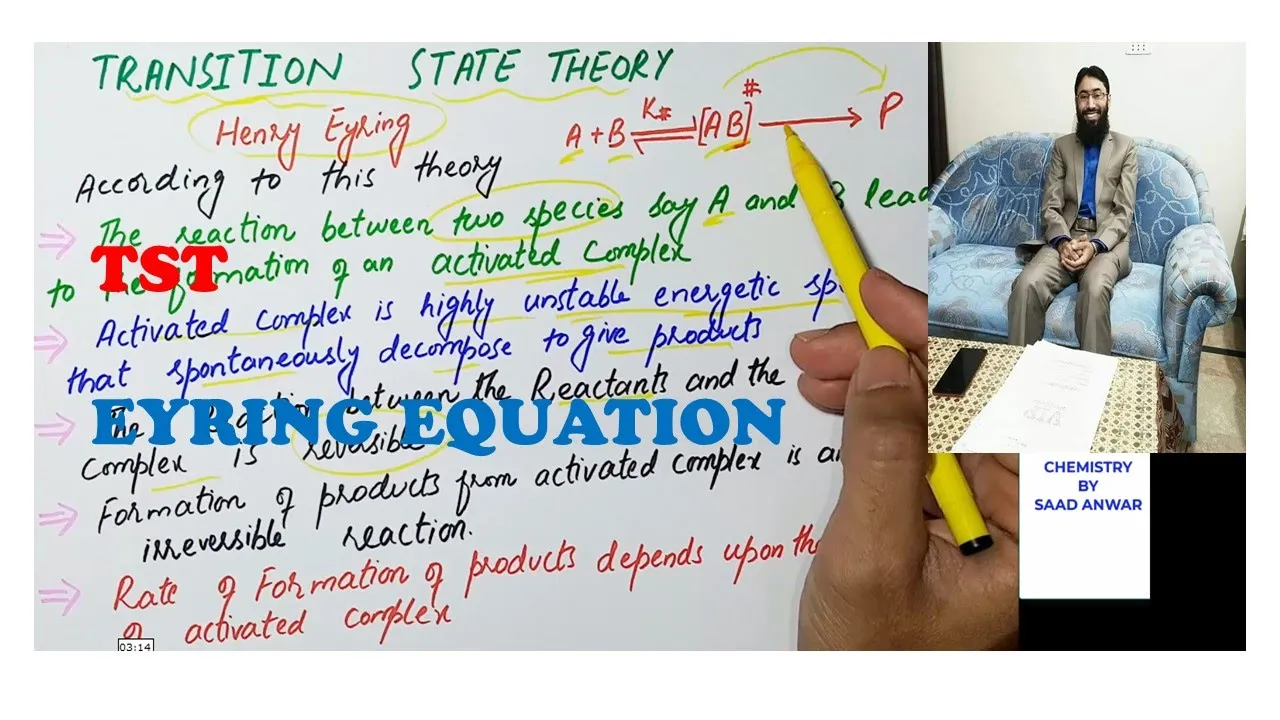



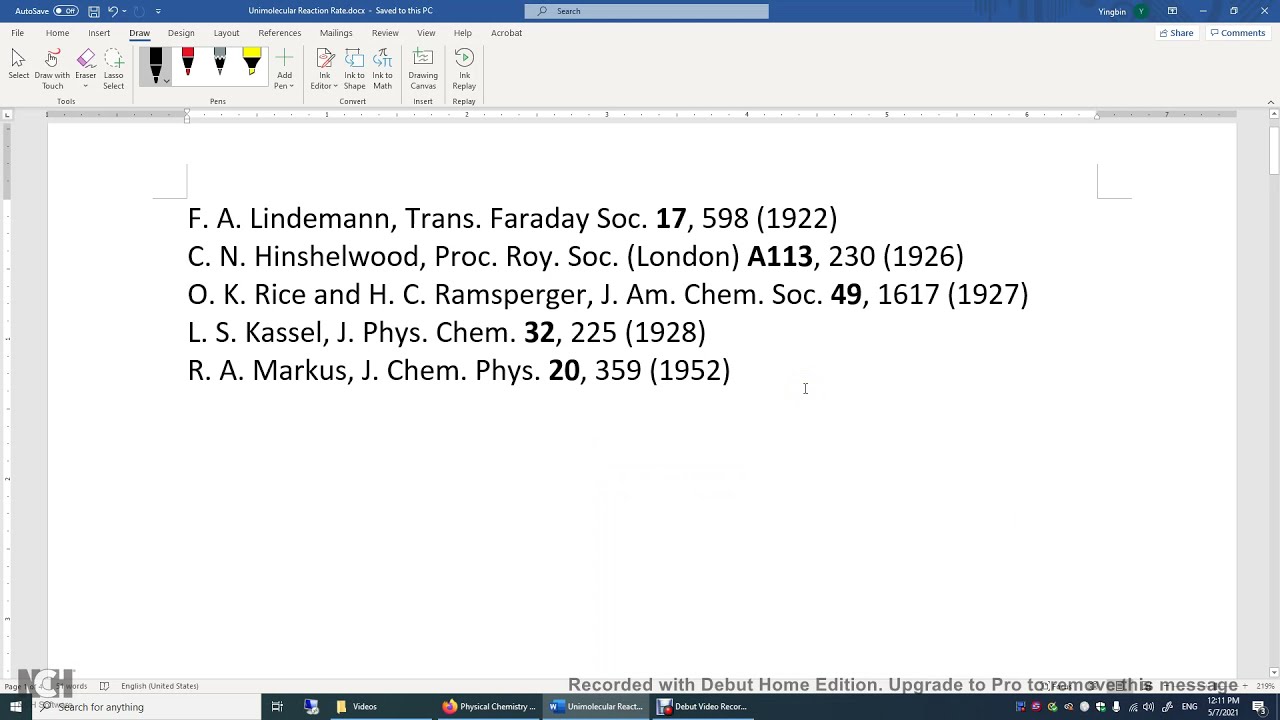






This video provides comprehensive solutions to CSIR NET Chemical Kinetics questions from 2011-2025, covering essential topics including Jablonski diagram processes (intersystem crossing, fluorescence, phosphorescence), transition state theory with vibrational degrees of freedom (3n-7 for nonlinear transition states), quantum yield calculations, second-order reaction kinetics (quarter-life = 3/(k[A])), primary salt effect in ionic reactions, Arrhenius equation temperature dependence, Lindemann mechanism for unimolecular reactions, collision theory activation energy relationships, fluorescence quenching (Stern-Volmer equation), and overall activation energy in multi-step reactions (E_a(overall) = E_a1 + E_a3 - E_a2).
CSIR NET Chemical Kinetics PYQ 2011-2025 | Part 5 Solved
Added:Fundamental rate laws, including the derivation of zero, first, second, and nth-order integrated rate equations and their respective half-life expressions.
The Steady-State Approximation (SSA) and Equilibrium Approximation used to analyze complex, multi-step reaction mechanisms.
The Arrhenius equation and theories of reaction rates, specifically Collision Theory and Transition State Theory (Eyring equation).
Basic mathematical skills in calculus (differentiation and integration) and logarithmic relations commonly used to solve kinetics graphs.
Advanced Unimolecular Reaction Theories, such as the Lindemann-Hinshelwood mechanism and RRKM theory.
Kinetics of complex phenomena, including enzyme-catalyzed reactions (Michaelis-Menten kinetics) and heterogeneous surface catalysis (Langmuir-Hinshelwood mechanism).
Fast reaction dynamics and experimental techniques like flash photolysis, flow methods, and relaxation methods (T-jump/P-jump).
Solving full-length physical chemistry mock tests to practice time-management and application of kinetics shortcut tricks under exam conditions.
239 views23likes1:01:03Original Release: 2025-12-03
Hello everyone, welcome back to the channel. I hope you all are doing great.
So we were discussing about the previous year questions of the CSI NET exam and in that the chapter we were discussing was the kinetics right. So already four of the parts of this unit we have discussed. If you have not watched playlist I have made on the channel you can check that or I'll provide the link in the description even from that you can get the assess to it. So let us begin with the part number five in which the remaining questions we are going to cover it. Okay. So let us begin with the solutions. So these are the questions from the CSI June exam conducted in the year 2023. before this all the year's questions that is from 2011 to the year 2022 all the questions we have discussed in the previous four parts. Okay. So this question it says that in the jibaloski diagram which is shown as below the initial excitation it takes place from the singlet ground state to the second singlet excited state which is from s to the s_ub_2 match the processes of the events which are marked as a b and the c. So this is your let me just highlight this is the process A this is the process B and this is the process C they are saying it. So the A process in that so let me just draw this velocity diagram firstly this is from the S not this is here is S_sub_1 and here is this s_sub_2. So from the snot to the s_ub_2 this excitation of the molecule has taken place. The A process is here are two of the triplet states that are present here. It is T1 and this is the T2 state. So the first A process that is taking place in which this particle is coming from the S1 to the T2 state it is coming. So here you see the molecule is coming from the one of the state to the another state. So this process it is called as the intersystem crossing right that is called as is C.
In the B process the particle is returning from the T2 to the T_1. So here the states are remaining the same and this is the radiative process.
Generally the radiative processes are denoted like this. This is radiative processes and this denotes like this that you are having. This is the non-radiative process and the radiative processes we are having only the two that is the fluosense and the phosphorusence. If between the same spin states this transition is taking place that is fluosense and if it is between the different spin states that becomes the phosphorusense. Okay. So here now it is from the T2 to the T1 which means the same spin states it is taking place. So the B process it will be called as the fluosense.
luro sets. Okay. And in the next step what is coming? This particle is returning from the T1 to the S not state. It is returning again. This is your radiative process and the state of the change of the spin states it is taking place. So this is called as the phosphorusence.
So these are the processes. A is which is interc crossing. B is fluosense and C is the phosphorus. So this is the C one.
So isc fluorosence and the phosphorusence. The correct answer is the option D in this case. Okay. Next is this question. The transition state theory was developed to explain the empirical arheneius expression for the rate constants for a nonlinear transition state with n number of atoms.
the effective number of the vibrational degrees of freedom which is used in calculating the vibrational parameter.
So according to the transition state theory we have that that the reactant molecules is in equilibrium with the transition state right this equilibrium is present. Now they are saying it is the nonlinear transition state has been developed over here. Now to discuss about this transition state theory you two of the approaches you use thermodynamical and the statistical approach and in statistical approach you find the partition functions. So for the nonlinear molecules the number of the vibrational degrees of freedom you have it that is 3 n minus of the seven. In generally we have it says the number of vibrational degrees of freedom is 3 n minus of six. But in the transition state theory there is presence of one loose vibrational degree of freedom. So that is subtracted from this. Okay. So it is 3 and minus of the seven. If it would have been the linear in that case number of vibrational degrees of freedom would have been 3 and minus of the six.
Okay. So now it is the nonlinear one. So 3 n minus 7 that means the b option it becomes the correct answer. Okay.
Next is this question. It says an acetone under goes the photo dissociation upon the absorption of 330 nanometers of the light. Exposure of a gaseous sample of the acetone to the radiate radiant power of 20 m millatt at 330 nanome for a period of 3 hours result in a photo dissociation of 75 microar of the moles of the acetone.
What is the quantum yield? So quantum yield it is defined as amount of the reactant reacted amount of the reactant that is dissociated upon the amount of the photons amount of the photons. Now how do we find this amount of photons?
amount of photons.
This is equal to energy observed energy that is observed upon the energy of the 1 mole of photon.
1 mole of photon. This we take it as E observed upon this energy of 1 mole of photon. we write it as 12 upon the lambda in the cm.
Okay. So now here just substitute these values now and find the value of the quantum yield. So here it is shown that the dissociation of this much amount of the acetone is taking place which reflects that the amount of the reactant which is dissociated is given to us.
This value is 75 micro moles of it.
Right? and E observe that we have to find it out. This is power is given to us and time period it is 20 m watt for a span of 3 hours right. So power into the time so it will become 20 into 10 ^ of minus of 3. This will become the what is joule per second only into the time which is of the 3 hours.
So converted into the second 60 minutes and 60 seconds. So this is converted time period in the second. So this second and per second it is getting been cancelled out. You're getting the energy in terms of the Jew upon 12 upon the wavelength which is 330 nanome. So it becomes 330 into 10 ^ of minus of 7.
This is in the cm.
Okay. So these are the values you will be getting. So on solving all of this we will be getting the value as 0.00594.
This is the value we will be getting.
Now to find the quantum yield just take the ratio of the amount of the substance that has dissociated to this value.
So here we will be having the five value as 75 into 10 ^ of minus of 6 upon the 0.0.0 594. On solving this the value we will be getting it as 0.126 which becomes 1.26 into 10 ^ of minus of 1. So this is going to be our quantum field. Okay. So the answer is in the option B we are having it right.
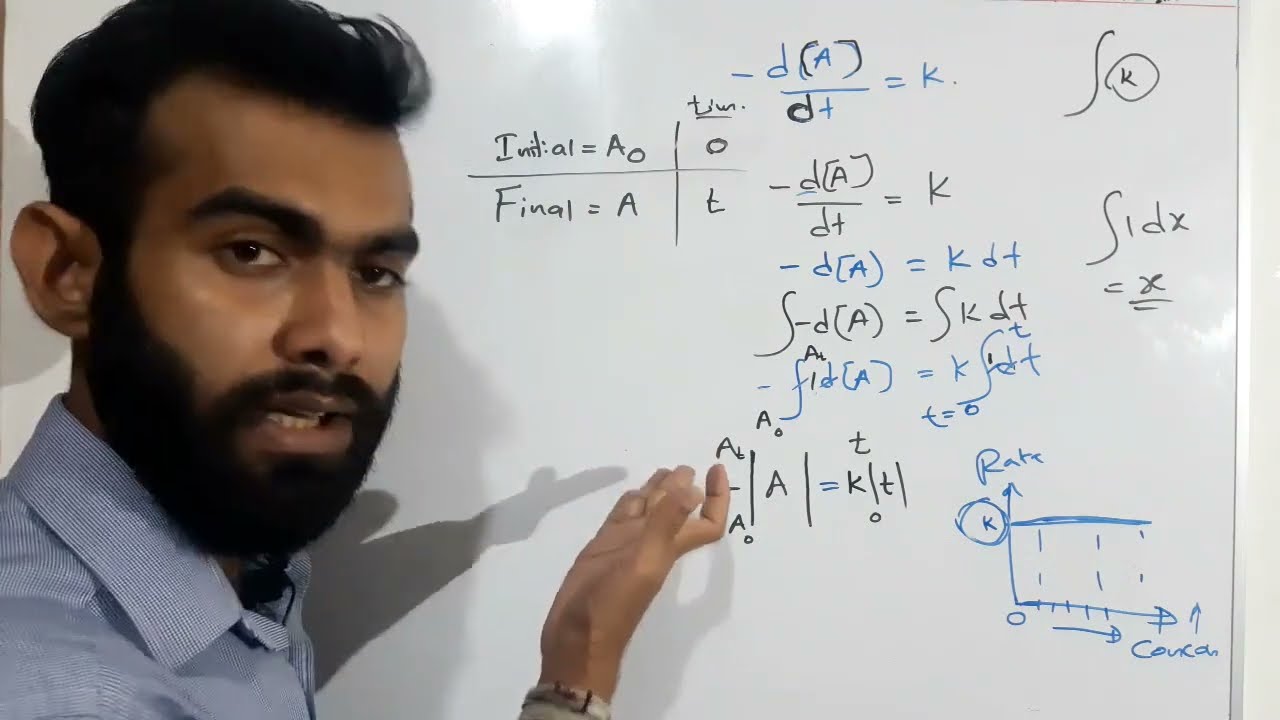
Moving up on to the next one. This question is that it says a reaction it follows the rate order rate law in which minus of da by dt. This is giving us the k a raised to the power of two of it which means it is the second order reaction starting from an initial concentration a not the time taken for the concentration to reduce to a not by the four namely the quarter life of the a. So the reaction order we are writing it minus of da by dt of the a this is equal to k into the a² that means the reaction is following the second order kinetics right so for the second order the integrated rate law expression is 1 by a minus the 1 by a is equal to the kt now the remaining concentration has reduced to a by 4 so a's value it will be a by the 4 minus of 1 by a this is equal to k t quarter of it. So this become 3x the a that is equal to kt quarter of it. So from here the t quarter this is equal to 3x a into the k.
This is going to be the value that means the option D that is 3 by A into DK it becomes the correct answer. Okay.
Next one is this question.
So the rate of the acid catalyzed reaction in the aqua solution follows the rate equation given given by this rate expression. Three of the ionic species are involved in it. That is your x positive, y2 negative and we are having as h positive. The rate constant for the reaction at ionic strength are ionic strength of 16 moles per liter and 9 moles per liter are k1 and the k2. The values of the log of k1 by the k2 in the units of the divide huckle constant bs.
So this question is belonging to the primary salt effect.
Primary salt effect according to which when three of the ionic species are present we write the expression of the rate constant like log of the K1 this is equal to log of the K plus of the 2B why B because the bihuckle constant in terms of the B over here. So that is why B we are using. Now here three ionic species are involved. So the rate will be this it includes the Z A into the Z B plus of the Z B into the Z C plus of the Z C into the Z A this into the root of the ionic strength. Here Z A Z B and Z C these are the charges present on the ions.
These are charges on the ions.
Okay. So now it's given when the ionic strength is 16 moles per liter, the rate constant is K1. So that you can write it as log of K1 and substitute the values of the charges and the ionic strength.
It becomes 2B. Now Z A is X + 1 is there. So it will be + one. Z B charge is minus of two. So that we can substitute plus of the minus of 2 into the + of 1 plus of the + 1 into the + one into the root of ionic strength is 16. So this we have substituted. So this becomes equal to log of the k plus of 2 b * this will become minus of 2 minus of 2 plus of the 1 into the 4.
So this becomes 2 b into the minus of 3 into the 4 that is 24 b negative sign and here this log of the k not is as it is.
So this is the value of the log of the k1 we are having it right now. The next is ionic strength is of 9 moles per liter. In that case log of the k2 this will be equal to log of the k plus of the 2b * the z a z b plus of the z b z c plus of the z c into the z a into the root of the ionic strength. Now ionic strength is 9. So that we can substitute plus these charges which were it was + 1 + 1 - 2 + 1 into the minus of 2 + of the minus of 2 into the + of 1 + of the + 1 into the + 1 into the root of the ionic strength which is of the 9. Right? So on solving this the value will be log of k plus of 2 b * this will become minus of 3 into the 3. So this becomes 9 2 18 that is minus of the 18 b. So this was log of k that is equal to log of the k2.
So log of k1 and the k2 value you have calculated it.
So we need is the ratios of these two because log of k1 by the log of k2 value is being asked. So subtract both of them log of k1 minus the log of k2. This will be equal to log of a kn minus of the 24 b minus of log of the k minus of the 18 b. So this log k gets cancelled out. it becomes -4 B plus of the 18 B that means it becomes the minus of the 6 B. So this is the value of the log of K1 upon the K2. So this is the answer we will be getting. So here if I'm seeing in from the options you can see none of the options is matching with the given with this answer and not you can see that the Dubai huckle constant B in terms of that the answers would have been given and that is not given in any of the options. So when this question was asked that was in the paper that was for the June exam that was conducted in the December and this 2023 June exam a must cycle this paper was conducted and in that this this question it was omitted from that because none of the options was correct. So the correct answer will be the minus of 6P only.
Okay. Next one we are having is this one. So this is from your December 2023 exam. according to the arheneius equation the plot that correctly describes the temperature dependence on the rate constants. So this is from the arhenius equation arenous equation we have that rate constant k is equal to a e ra to the power of minus of the ea upon the rt of it ea upon the r into the t. So if I see the values if I am increasing the temperature this is RT. So if I'm increasing the temperature the value of 1 by T it decreases right or we can say the value of minus of EA or this EA upon the RT value it's going to increase because negative sign it has been placed over here. So 1x t it was decreasing and this negative sign it shows that this value it is increasing. So if I make a plot that is for the this rate constant k value it will be increasing in that case. Right? So here we can see if I see a plot that is for the temperature versus the rate constant that implies if temperature it increases the rate constant value it is going to increase in that case. But here the plots are for the temp k versus the 1x t which you can see 1x t it is decreasing and the rate constant value it is increasing in that case. So if 1x t it is increasing rate constant k it is going to decrease in that case right. So here I if I see it that in the options in a if you see with the increase in this 1x t value the value of the rate constant k it is decreasing and that is exponential decrease as per our equation that is k is equal to a * e to the power of minus of ea upon the rt. So 1x t value if you are increasing this exponential term e ra to the power of minus of the ea upon the rt this value it is decreasing in that case which implies that the rate constant it is decreasing this is when 1 by t we are increasing it right so this is what you are observing an exponential decrease in the value so the option a it becomes the correct one so make sure it is k versus 1x t and not the K versus DT with that in with the increasing temperature it constant is increasing but with the 1 byt it's going to decrease over here. Okay. Next is this question.
It says two reactions they have the same pre-exponential factor but their activation energy of the first reaction is lower than that of the second reaction by 5 kilo calories per mole.
What it implies? The first and first reaction is lower. So EA one that I'm having this is 5 kilo calories per mole lower than that of the second one. Which implies the difference between these two activation energy of the second reaction minus of the first one. The difference between them it is of the 5 kilo calories per mole of it.
How can we write the rate expressions?
K1 it will be A * E ra to the power of minus of E A1 upon the RT and the rate constant K2 this will be equal to same pre-exponential so a into E ra to the power of minus of the E A2 upon the RT of it so they are asking us the ratios of the rate constant of the first and the second reaction is that means K1 upon the K2 value is being asked that becomes A * E ra to the power of minus of the E A1 upon the RT and here it will be A into E RA to the power of minus of E A2 upon the RT. This gets cancelled out. This will become EA to the power of EA2 minus of the EA1 upon the RT of it.
These values are given to us which is the difference between two is 5,000 calories per mole calories per mole and the R value in terms of calories it will be 2 calorie per mole per kelvin per kelvin and the temperature it is given to us as 298 Kelvin.
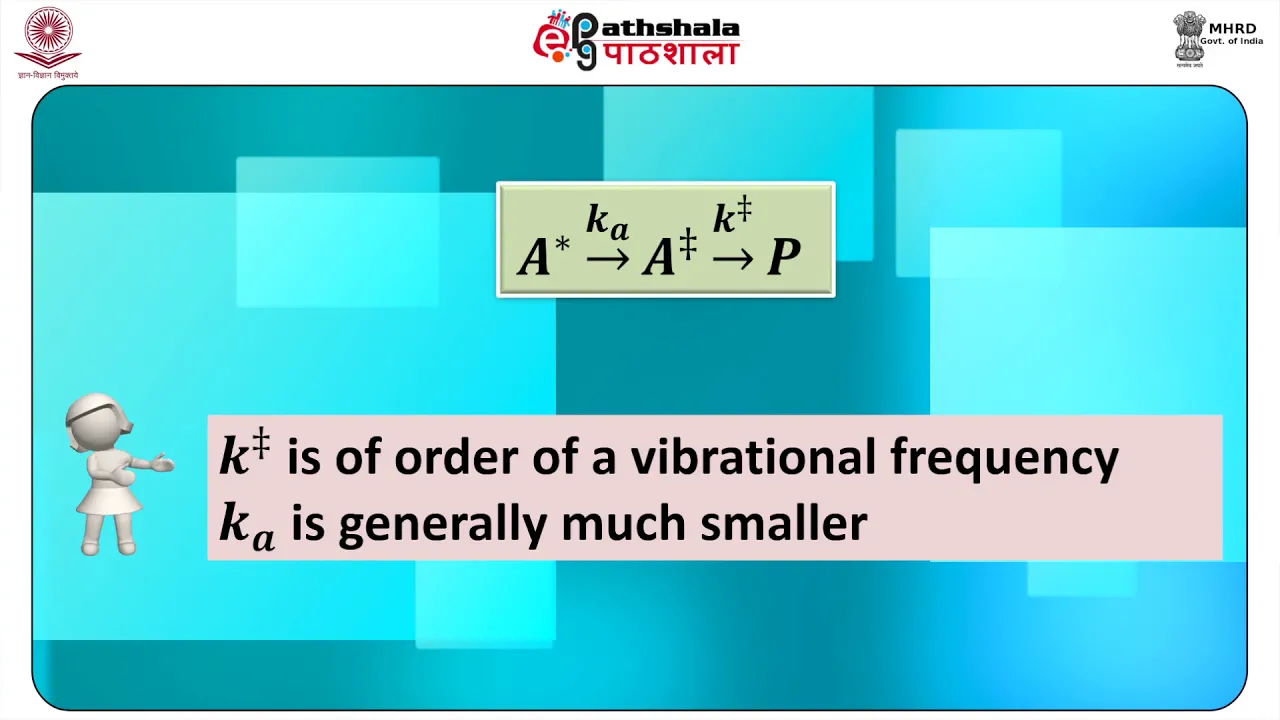
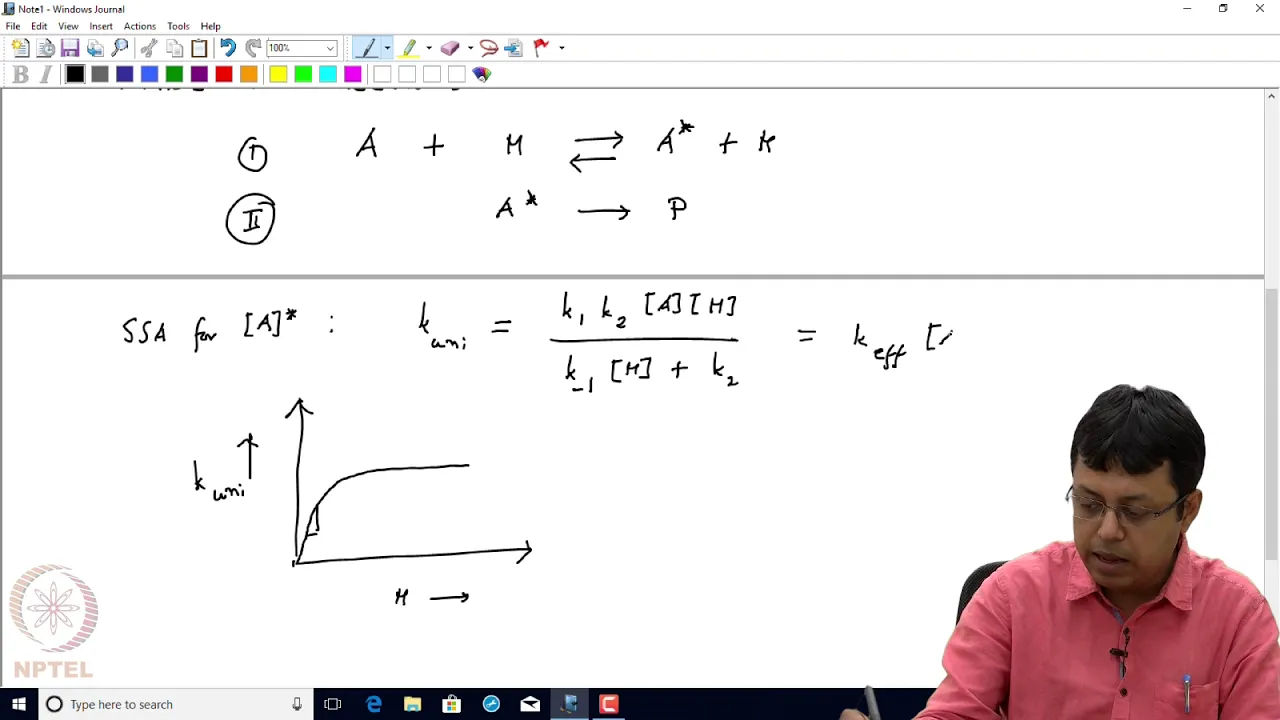
Right? So this value just you have to find this out and you will be getting your answer. Right? So on solving this the answer we will be getting it. It will be close to the option which is 4 6 5 0. So this is going to be the ratio between these two. So the option A it becomes the correct answer. The exact value if you want to see it that is going to be around 4 6 28. So the closest answer match is the option A only in this case. Okay. Next one is this question. It says that the isomerization of cyclopropane to the propane it follows the lindaman mechanism and is carried out in high pressure high pressure limit it is being carried out the ratios. So firstly it is the lindamman mechanism. So what is the lindaman mechanism? We have two of the molecules A and A. They are activated with the rate constant K1 giving us one of the activated molecule plus of the A and the backward direction of it at K inverse and in the second step this A* with the rate constant K2 this gets converted into the product P. The rate expression for this we get it k1 into the k2 into the a² upon the k inverse of a plus of the k2.
This is what it is given what the value of the rate you will be get rate value you will be getting now it is at the high pressure limit at the high pressure which means the value of the K inverse of A it is much greater than that of the K2 right so this condition we can apply it that the rate value it will be K1 into the K2 into the A² upon the K inverse of the A. This is what we will be getting. So with this a1 of the a it will get cancelled out. We will be getting the rate as k1 into the k2 into the a upon the k inverse. This is going to be there. Now the next statement it says the ratios of the rate constant of the activation to the deactivation step is 10. So the activation step rate constant is k1 and for the deactivation the rate constant is k inverse. Right.
So the first step that is the activation. This is the activation.
And the reverse of it it is deactivation.
Deactivation.
And the third step this is called as the decomposition.
Decomposition.
Okay. So K1 to the K inverse ratio it is given to us as N. and that of the product formation to the deactivation step is 50.
That means K2 upon the K inverse value.
This is equal to the 15. Given that the effective rate constant is this much 152nd inverse we are having the rate constant for the deactivation step is.
So the exact value of this K inverse it is being asked and the effective rate constant that is this one K effective it is K1 into the K2 in upon the K inverse this value is given which is 150 inverse. So this is the effective rate constant after imposing the condition.
So now k1 by the k inverse ratio and k2 by the k inverse ratio that is given to us that we will be making use to find the value of k inverse.
So K1 upon the K inverse this was 10 and K2 upon the K inverse this was equal to 15 and the overall effective rate constant is K1 into the K2 upon the K inverse this is equal to 150 second inverse. So K1 value in terms of the K1 value in terms of the K inverse it will be equal to 10 * the K inverse and K2 value in terms of K inverse it is going to be equal to 15 * the K inverse upon the K inverse this is equal to 150.
So from here one of the K inverse will get cancelled out. So it becomes 150 k inverse this is equal to 150 only this is equal to 150 which implies the value of k inverse is 150 upon the 150 that is equal to the unity. So this is the answer for the k inverse. So that is given to us in the option b. Okay. So the next question now we are having is that is this one. So this is from your June exam conducted in the year 2024. The question it says the reaction A to P it consists of the following three elementary steps with their respective activation energies.
So A to the I this is with the activation energy E A1. This we can say that the rate constant for it it is K1.
This second step that is I to the A which is with the activation energy EA2 and the third one is also given the activation energy of the overall reaction. For that we need to find the overall rate constant of the reaction.
Rate of the reaction firstly we will be finding. So the rate of a reaction it is dependent upon the slowest step of it and in the brackets it is already shown that these steps are the fast and this is the slow step. The slowest step it will include that is K3 * the I. This is going to be the rate expression. Now here the I value that I'm having this is the intermediate. So we have to find its concentration so that we can substitute in the rate expression. So for that we are going to apply the SSA over the I.
So on this side we are applying it SSA on the I. That means di by the dt value it will be equal to the zero or we can also make use of the equilibrium approximation in this because here the reaction is a to the i this is given and I to the a this is with the rate constant k1 and this is with the rate constant k2 and both of this they are the first step. So equilibrium it is present why this equilibrium because in the first step I was being formed and in the second it was being consumed. So these are the fast steps and the equilibrium will be present having the rate constants K1 and the K2 of it. So this first process when it where it we are having an equilibrium as a first one. So in that case equilibrium approximation can be used.
equilibrium approximation is used. So for that the value of the rate constant to of the forward to the backward direction this is equal to the product concentration upon the reactant concentration. So from here I value this will be equal to K1 * the K2 * the A concentration. So this is going to be the I value that you can substitute in your rate expression. So overall rate it will become it was K3 * the I that means it will become K3 * the K1 into the K2 into the I of this is going to be the overall rate expression and the K overall that is the overall rate constant this is equal to K1 into the K3 into upon the K2 of it right. So to find the overall activation energy K value is K1 into the K3 upon the K2 of it. This directly you can also write if you know it but I'll showing you I'll be showing you the complete this derivative part of it. So how we can do this? Take the ln of the K overall. This will be equal to ln of the K1 plus the ln of the K3 minus of the ln of the K2. differentiate it with respect to temperature with respect to the temperature. It will become d ln k by the dt. This is equal to dl ln of the k1 upon the dt plus of the d ln k3 upon the dt plus of the d minus of the minus of d ln of the k2 upon the dt of it. Now according to the van 1/2 equation dl ln k by the dt this is equal to ea upon the rt² so that you can substitute so it will become ea which is the overall upon the rt² this is equal to e1 a1 upon the rt² plus of the ea 2 upon the rt² minus of the EA EA1 plus of the EA3 it was there minus of the EA2 upon the RT². So on solving overall activation energy overall it is equal to EA1 plus of the EA3 minus of the EA2. So this is going to be the overall activation energy and the complete derivation part of it. So directly also you could write this that K was equal to K1 into the K3 upon the K2. So the one that are in the multiplication their activation energies addition we have to do it and the one which is in the denominator that we have to subtract it. This is the direct you can use it. Okay. So the answer becomes the option EA1 plus EA3 minus of the EA2 option D it becomes the correct answer in this. Okay, next one is this question statement based it is there it says the correct statement about the preexponential factor in the arhenius equation according to the arinius equation rate constant k is a into e raised to the power of minus of the ea upon the rt this is the preexponential factor the first statement it says that it is your dimensionless quantity so is correct or not this exponential power that I'm having this is unitless or the dimensionless this is dimensionless okay but this k value that you are having this is equal to the a that means the a it is having the units of the k only right based upon the what order kinetics we are having this k units are going to be varying so k units and a units are same only. So it is not the dimensionless.
It is not dimensionless.
Okay. E ra to the power of minus of a by e rt is there. This factor it is dimensionless.
Okay. Next statement it says it is necessarily has the second inverse in its dimension regardless of the order of the reaction. This statement if you see the rate constant suppose it is of the zero order kinetics if we are having in that case the units of the rate constant it is going to be equal to mole per liter per second and this only is going to be the units of the A also right if I have the first order so in that case the units of the rate constant is second inverse and that will be the units of the pre-exponential factor also So in the second order if you see the units are going to be mole inverse liter per second of it. Same goes for the any order of the reaction you can write this. So as per the statement it is necessarily has second inverse in its dimensions. Regardless of the order of reaction this statement is the true because in the C0 order you see second inverse it is present for the first order also second inverse term is present and in the second order also the second inverse term it is present. So irrespective of what the order of reaction it is there the units of this a pre-exponential factor it contains the second inverse dimension. So this statement is the true word. Okay. Next one also you see it does not necessarily have the second inverse in its dimension. So this is the reverse of it.
So becomes the incorrect. Fourth statement it has a concentration in its dimension regardless of the second order regardless of the order of reaction. So this is not the true because in the first order if you see only the second inverse term is present and concentration term it is not present in its dimensions. Right? So this again becomes the incorrect. So B is the correct statement in this case. Okay.
Next is this one.
The order of a reaction which is going through the A to the P is two when the concentration of A is small and at the higher concentration it goes to the one the mechanism of the reaction is. So we know that the unimolecular reaction uni molecular reaction for this if you see the mechanism that we have it is a plus of the a this is an equilibrium with the a* plus of the a. This follows the rate constant k1 and the k inverse and the a star to the product p. This is with the rate constant k2. The rate expression for this that I have it is k1 into the k2 into the a² upon the k inverse of the a plus of the k2. This we have this we already do this in the theory the theory part right. So if I take this at the low concentration at the low concentration which means K inverse of A it is less than that of the K2. So in this case the rate expression it will become K1 into K2 into the A² upon the K2 value. So this K2 K2 gets cancelled out rate it will be K1 * the A² right this is what you are getting.
So with respect to the concentration of a this is raised to the power of two that means at the low concentration the rate is of the second order right whereas for the higher concentration it will be we will be observing at the higher concentration that is K inverse of A it is more as compared to that of the K2. So rate it will be equal to k1 into the k2 into the a² upon the k inverse of the a right. So this one of the a will be getting cancelled out. So the rate it becomes k1 into the k2 upon the k inverse into the a. So rate is proportional to the a's concentration raised to the power of 1. So r is proportional to a to the power of 1.
that means it is following the first order kinetics. So this is the mechanism. So from the statement also you see it is second order when the concentration it is small and it is at the higher concentration the order changes to the unity. This is what is happening at the higher concentration the second order and at the sorry at the lower concentration it is of the second order and at the higher concentration it is following the first order kinetics.
Right? So this is going to be the correct mechanism in which a plus a is in equilibrium giving the a star plus of the a then the a star gives the product b the option c it is shown this mechanism. So c will be the right answer in this case. Okay.
Next one is this question. The rate constants for a biomolecular reaction according to the collision theory is given by E not is related to the activation energy of the arheneius equation as. So this is from your gardener equation.
Gardener equation with which the rate constant K is equal to A into T to the power of M E ra to the power of minus of the E not upon the RT according to this the EA value that is the activation energy this is equal to M RT plus of the E not this is the value. So here m is the power of the temperature that we are having at power of the t. So in the given expression of the rate constant k this is of the collision theory it is na into 8 kbt upon the pi mu. This is raised to the power of half of it into the sigma into e raised to the power of minus of e upon the rt. So here if I see temperature is raised to the power of half of it in this case which implies activation energy EA it will be equal to now M here is the power of T. So that is half into the RT plus of the E not.
So this is going to be the activation energy right E not plus of the RT by the two that means the option D it becomes the correct answer.
Okay, moving up on to the next one. This question it says the fluoresence of a A is quenched by 10% in the presence of 10 molar of the B. So what is happening the molecule A you are having its fluosense is getting being quenched by the other molecule that is the B whose concentration is this much. So A is the molecule which is showing us the fluosense and B is the molecule which is the quencher.
Right? So now here the concentration of B it is given if the fluoresence lifetime of A in the absence of the B it is 5 nconds. So that is the fluesence lifetime that we denote it as to F. This is defined as the ratio of 1 upon the KF plus of the KIC plus of the KI SC c.
This value it is given to us as 5 nano seconds.
The rate constant for the interaction between the B and the photoexited molecule A. So that means they are asking the rate constant for the quenching because when A is in coming in contact with the B this activated molecule you can say it it is coming in contact with the B. So here the process that is taking place is the quenching right. So the rate constant for it it is suppose the KQ it will be there right.
So now if I write the value of the quantum yield quantum yield in the absence of the in the absence of the quencher in that case the value it's going to be KF upon the KF plus of the KISC plus of the KIC this is going to be the one this is the quantum yield of lorosence in the absence of the quencher. Now if you have the presence of the quencher in that case the quantum yield value that we obtain it it is equal to KF upon the KF plus of the KISC plus of the KIC plus of the KQ which is the quenchers quenching process rate constant into the amount of the quencher which is B in this case right so if I take the ratios of this so this is basically from your stern polymer plot in that you define the ratios of this quantum yield that is in the fluoresence in the absence of the quencher to that of the quantum yield of the fluosense in the presence of the quencher. Right. This will be equal to so in the absence it was KF upon this. So 1 upon the KF plus of the KIC plus of the KI SC c this it will become and in the numerator we will be having the value of that is of the presence it will become KF plus of the KIC plus of the KI SC plus of the KQ times the amount of the quencher right this KQ amount they are asking us to find this out. So now we are having this quantum yield in the absence and in the presence. This becomes equal to KF plus of the KIC plus of the KI SC c plus of the KQ * the B upon the KF plus of the KIC plus of the KI S that we can write it as 1 upon the 1 + of the KQ * the B upon the KF plus of the KIS SC plus of the KI C this is going to be there this is equal to 1 + of the KQ * the quenchers amount and this one upon the KF plus of the KIS SC this is the lifetime of the fluosense that is this to F right so now this value which is of the to F in the absence quantum yield in the absence and in the presence so if in the absence of it it is 100% suppose it is there. Now in the presence of it they are saying that this process gets 10% it is getting being quenched. So the remaining fluoresence yield it is going to be 90%. Right. So this value it is equal to 1 + of the KQ * the B into the tof of this. Okay. So this it will become 10 upon the 9 minus of the 1.
This is equal to KQ. This we have to find it out. Quenchers amount it is given to us that was uh 10 molar of the B. So it was 10 mm 10 raised to the power of 3 and the tof value that is given to us as 5 nano seconds. So it will be 5 into 10 ^ of minus of the 9. This is what is given to us. So you can just solve this. It will become 1 by the 9 upon the 10 to the^ of minus of 3 into the 5 into 10 to the^ of minus of 9. This is going to give us this KQ value that we will be getting it as 2.2 into 10 ^ of 2.2 into 10 ^ of 9 the value you will be getting it. So this is the value of the KQ.
Okay. So I hope it's clear how is the process taking place. So you were having the fluosense technique. You were carrying it out first time in the absence and then in the presence. When in the absence you were having the relaxation time it is given to us. So at the quantum yield value we know. So that we have taken and in the presence how much fluosense we fluosense quantum yield we will be having that we took it.
Then we took the ratios of this the amounts that were known to us and then we just substitutions were made and the KQ value we could easily find this out.
Okay. So now moving upon to our next question that is this one. So this is from your latest paper that is conducted in the June 2025.
application. It says the activation energy and the enthalpy change for the reaction which is H2 plus the I2 giving us the 2 HI are this and this. Okay, so the reaction is H2 plus the I2 giving us the 2 HI. Okay, for this the activation energy value it is 167 kiloj per mole and the enthalpy that is delta h it is minus of the 8 kiloj per mole which shows that this reaction it is exothermic in the nature because delta h value we are having it as the negative.
If we draw a reaction plot for this, it's going to look like this. Here it's going to be the energy and this is the reaction progress reaction progress. So here I'm having the H2 plus the I2. This is with some activation energy. This is giving us the product value P which is my HI. Right?
So the activation energy in this case this is the one from this to this level right this is the activation energy for the formation of the hi this value it is 167 kilojoule per mole of it and the enthalpy which is the difference between this level and this level this gap value we are having it as it is 8 kiloj per mole of Right. Now they are next statement they are saying is assuming that the pre-exponential factors of the production and the decomposition of the HI to be the same.
The correct options is okay. So the forward reaction it is of the production of this. So this activation energy of the production of the HI was equal to 167 kiloJ per mole. But now for the decomposition of it for the decomposition it's going in the backward that is from HI we will be getting is H2 plus the I2. So for that this is the total activation energy which we have to provide it. So that is going to be 167 plus of the 8 right that is going to be 70 175 kiloj per mole that implies the activation energy for the production it is less but for the decomposition of it it is more this is what we are getting based upon this the statements have been given let us have a look to that so rate constant values also they are saying so KP will be the one that is for the production ction a * e ra to the power of minus of the e a upon the rt and for the decomposition it is a into e ra to the power of minus of the this is for the decomposition upon the rt now about this the statement it says kp and kd have the same temperature dependence is it true or the false one so we have to find us the correct statement in this now so KP and the KD does they have the same temperature dependence. So the answer is no because activation energies are here different over here. Right?
That means their dependence on the temperature. It basically means if you are increasing the temperature suppose this reaction which is of the production you are carrying it initially at suppose 298 Kelvin and then you change the temperature to the 10° centigrade you are increasing. So 308 Kelvin it is there. So if the rate constant value change that we will be getting that will be at K 308 Kelvin upon the K 298 Kelvin for the production this process when you are carrying it out and for the other one that is for the decomposition the same process you repeat it that is at 300 Kelvin you carry it out and that at the 298 Kelvin this ratios you take it these are the rate constants for the decomposition. So their dependence on the temperature is being basically asked. So here more is the activation energy. Basically more is the effect of the temperature on the ratios of these rate constants. More is the activation energy. More is the effect of the temperature.
More is the effect of the temperature.
Which means for the decomposition the rate constants that I'm having this is going to be more as compared to the production one because we have seen that activation energy for the decomposition it is more as compared to that of the production which means their dependence on the temperature it is not going to be the same. Right. Next statement it says KD changes more rapidly with the temperature than the KP. This statement is the correct because KD when you are taking this ratio change that is at two different temperatures having due to due to the fact it is having the more amount of the activation energy. So more effect of the change of the temperature you will be observing in their rate constants ratio. Okay. So B will be the correct answer in this case. Right. Next question is this one. It says for a reaction which is K plus the Br2 giving us KBR plus of the Br. The rate constant is described by this. Choose the correct option regarding the activation energy and the pre-exponential factor where AE it is obtained from the experiment and A that is the pre-exponential factor which is obtained using the collision theory.
So this question it is from the harpoon mechanism.
Harpoon mechanism according to this the stic factor that you have this is the star factor which describes the ratios of the pre-exponential factor that is obtained experimentally to that which is obtained by the collision theory. Okay for the this one the row value that you have that is of the stric factor it is greater than the one okay and in that means ae by the 80 ratio that I'm having this is greater than the one so ae value it is more than that of the 80 so this is the condition we are getting it now other thing they are asking us is about the activation energies so there for this activation energy it is always either greater than or it is equal to the zero. Okay. So let us check this a value is greater than the 80 and either of the conditions where activation energy is greater than zero or it is equal to zero. Right? So here in the first option it says 80 is more than that of the AE. So this is the incorrect. Second it says EA is negative and AE is more than that of A. This condition it is okay. But EA it is less than zero. It is saying it is not possible activation energy for this process. It is always either going to be greater than zero or the equal to zero.
Okay. Third one it is saying activation energy is zero and AE is greater than the 80. So this is the correct one. One of the condition of the activation energy is being satisfied and other is AE is greater than that of 80. Right?
Next is EA is greater than the equal to zero and A is greater than the AE. So this is a a and a inverse relation has been given. So this is the incorrect one. Okay. So this is how this question was to be solved. Next one is this. It says that in a photochemical reaction 2.5 mles of A is converted into DB on irradiation with the 100 W light of the wavelength 300 nanome for 66 seconds.
What is the quantum yield? So the quantum yield we define it as it is the amount of the reactant dissociated amount of reactant dissociated dissociated to the amount of the photons amount of photons.
So now amount of the reactant that is dissociating it is given that 2.5 m moles of A is converted into the B. So this value it is 2.5 into 10 ^ of minus of 3. Right? Now this amount of photons we have to find it out that is going to be equal to amount of the energy observed upon the energy of the one mole of one Einstein one mole of photon or one Einstein one Einstein or one mole of photons that we can find it as this will be energy observed upon the 12 upon the wavelength that is in the cm. Right? Now E observed is now power value it is given us as 100 W which is 100 Joule per second only time span it is of the 66 seconds right and upon the 12 upon the wavelength which is given to us as 300 into 10 raised to the power of minus of 7 that will be in the cm. So this per second per second will get cancelled and this value of the energy you will be getting in the jewels and this jewel it will get cancelled out. So from here we can find the number of the or the amount of the photons and take its ratio with the amount of the reactant that dissociated will give us the value of the quantum field. Right? So on solving the solving this the number of photons we will be getting it as 0.0165.
This is going to be the photons. So the quantum yield value it comes out to be as 2.5 into 10 raised to the power of minus of 3 upon 0.0165 that comes out to be as 0.15.
So this is going to be the quantum yield value. The option B it becomes the correct answer. Okay. Next is this one.
The rate law for this reaction which is N2O2 getting being converted to 2 N O is first order in the concentration of N2O2.
If the initial concentration of N2O2 is 1 mole per decimeter cube, the expression for the time dependent behavior of the concentration of the NOS. So how is the reaction proceeding?
we are having is this is N2O2 giving us the 2 N O 2 N at time t is equal to zero you will be having only the initial concentration of N20o2 and this formed as negligible after the time t this is going to be a minus of dx and this is going to be 2x right now the initial ical concentration value it is given to us as 1 mole per decime cube.
So a not value it is 1. So the concentration of the N2O2 it will be 1 minus of the X in this case and this is going to be 2X only. Right? Now the reaction it is following the first order kinetics with respect to the N2O2 concentration. This is given to us. So according to the first order we have a is equal to a * e ra to the power of minus of kt of it. Now the remaining concentration which is a minus of x this is equal to a into e to the power of minus of kt of it. Right? This is 1 minus of x this is equal to e ra to the power of minus of kt of it. So from here the x value we are getting it as 1 minus e ra to the power of minus of the k this is this x value. So that means the concentration of the node it will be equal to it was 2 * the x that is going to be 2 * 1 - e ra to the power of minus of the kt. So this is going to be the value of the n as a function of the time. So the answer it becomes the option one in this case.
Okay, I hope it's clear. So this is first order with respect to the node it was there N202. So that we have all substituted and from that this x value we got it and at time t is equal to t 2x amount of it you were having. So that is you are getting the answer. Okay. So this was the last question that was from your chapter which was the kinetics. So from the year 2011 to the year 2025 all the questions of this unit we are done with this. I hope all the questions that we have discussed are clear to you.
But if you still have doubted any of the questions that you can ask me in the comment section. I'll surely reply to that. And if you have understood the concepts then make sure you hit the like button for the video and share it with your friends as well. And do let me know in the comment section how was this discussion and next chapter which one you want to learn it that we we can start it. Okay. So thank you so much for watching. I'll be meeting you in the next video now with some new topic.
Okay.
Up Next
22:57
Photochemistry Basics: Jablonski Diagram Explained
@letmeteachyouchemistry
355 views•2024-10-02
83:56
Biocatalysis and Catalysis in Islatravir Synthesis | Merck Webinar
@SCIwheresciencemeetsbusiness
675 views•2020-10-08
10:06
1H NMR: Determining Number of Peaks from Structure
@MSJChem
59.2K views•2017-04-06

17:31
Edible Water Bottles: A DIY Guide to Sodium Alginate Spherification
@ryan
10.5M views•2019-06-21
Related Study Plans & Knowledge Roadmaps
Structured learning paths in Chemistry
chemistry
Nuclear Chemistry: Decay, Meds & Fuel Cycle
01Introduction to Nuclear Structure and Radioactivity
02Decay Dynamics and Kinetics
03Radiation Interaction and Detection
+ 2 more learning modules
24h5 modules
Explore Roadmap
chemistry
Supramolecular Chemistry: Forces & Machines
01Foundations of Chemical Bonding and Intermolecular Forces
02Introduction to Host-Guest Chemistry
03Thermodynamics and Dynamics of Self-Assembly
+ 2 more learning modules
16h5 modules
Explore Roadmap
chemistry
Photochemistry: Excited States & Reactions
01Foundations of Light-Matter Interactions
02Molecular Orbitals and Electronic States
03Photophysical Processes and Jablonski Diagrams
+ 2 more learning modules
18h5 modules
Explore Roadmap
chemistry
Coordination Chemistry: Bonding & Properties
01Introduction to Transition Metals and Ligands
02Crystal Field Theory (CFT) and Geometry
03Magnetic Behavior and Spin States
+ 2 more learning modules
14h5 modules
Explore Roadmap