















![Inorganic Spectroscopy &Magnetism: Electronic Spectrum of Ti[(H2O)6]3+ Ion @NOBLECHEMISTRY](https://i.ytimg.com/vi/7u4V-5a_crY/hqdefault.jpg)


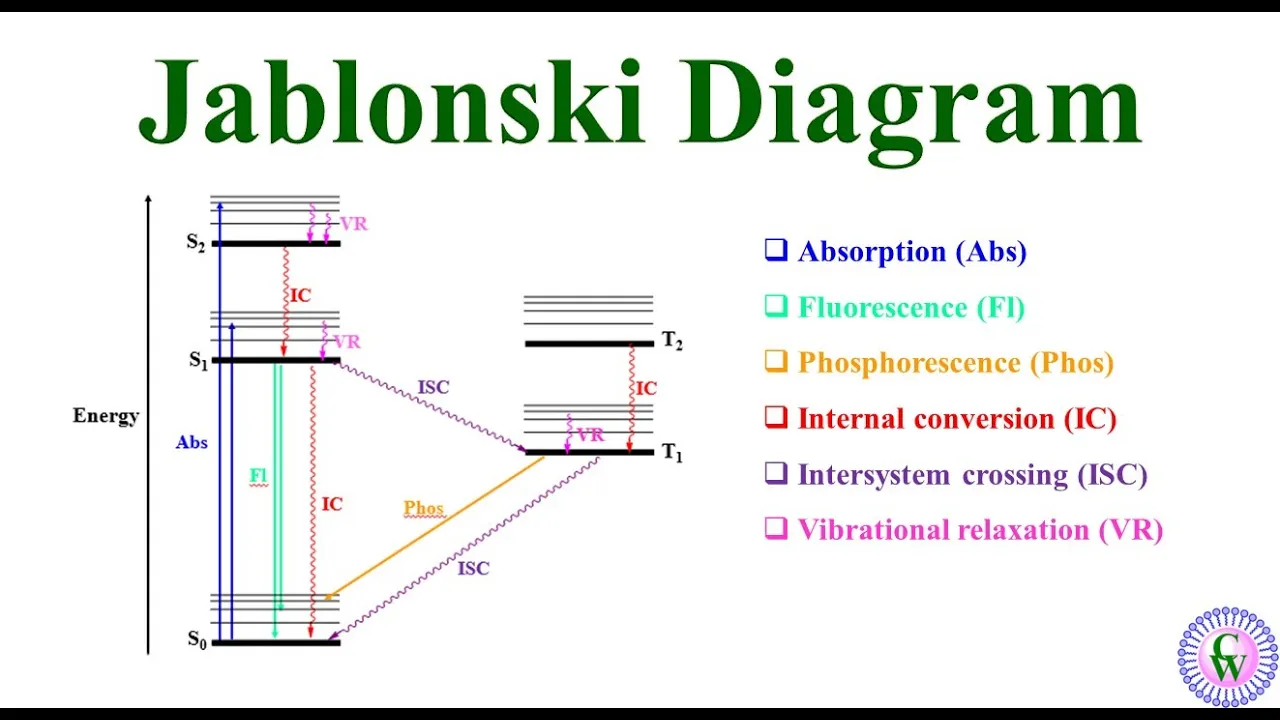








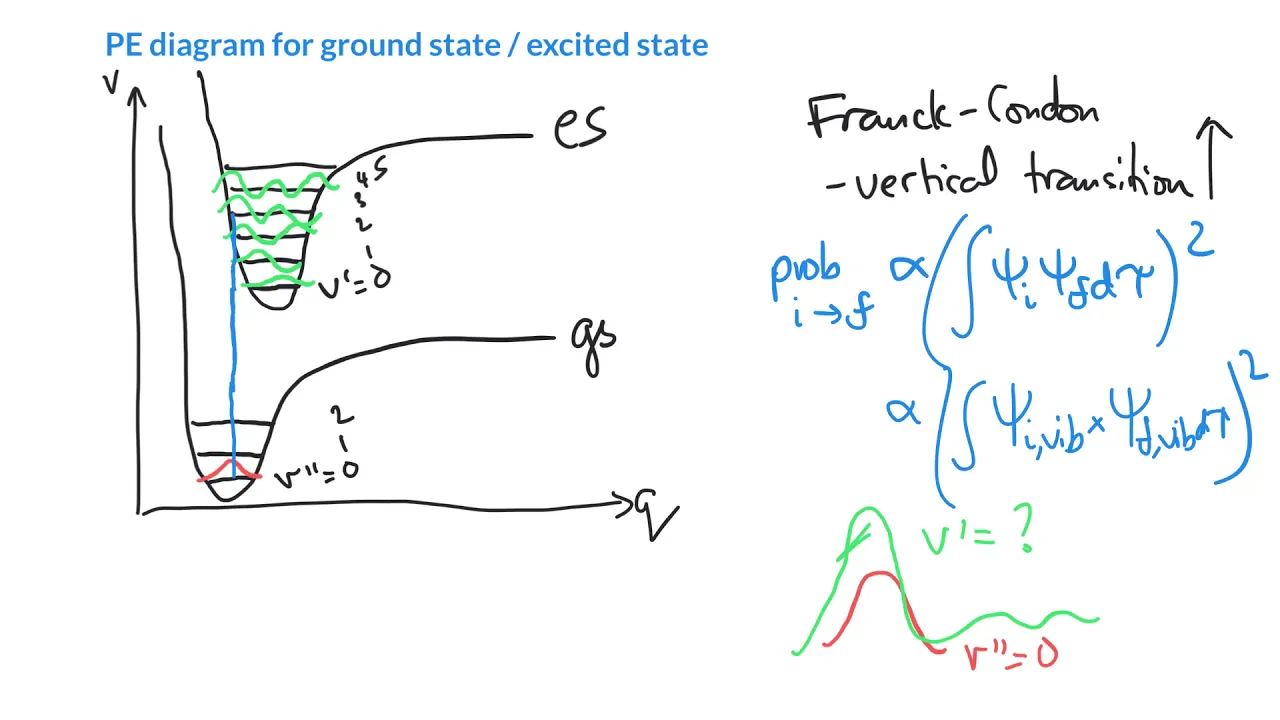
Electronic transitions in molecules are governed by selection rules where transitions are classified as allowed or forbidden based on the transition dipole moment; a transition is allowed only when the transition dipole moment is non-zero, which depends on the overlap between initial and final electronic states and their symmetry properties. Spin-forbidden transitions (involving spin state changes) have zero intensity, while spin-allowed transitions have intensity proportional to the squared modulus of the transition dipole moment. The Franck-Condon principle states that electronic transitions are vertical, meaning nuclear coordinates remain unchanged due to the extremely short timescale (~10^-15 seconds) of electronic transitions, making vibrational overlap between initial and final states critical for transition intensity.
Electronic Transitions & Selection Rules in Quantum Chemistry
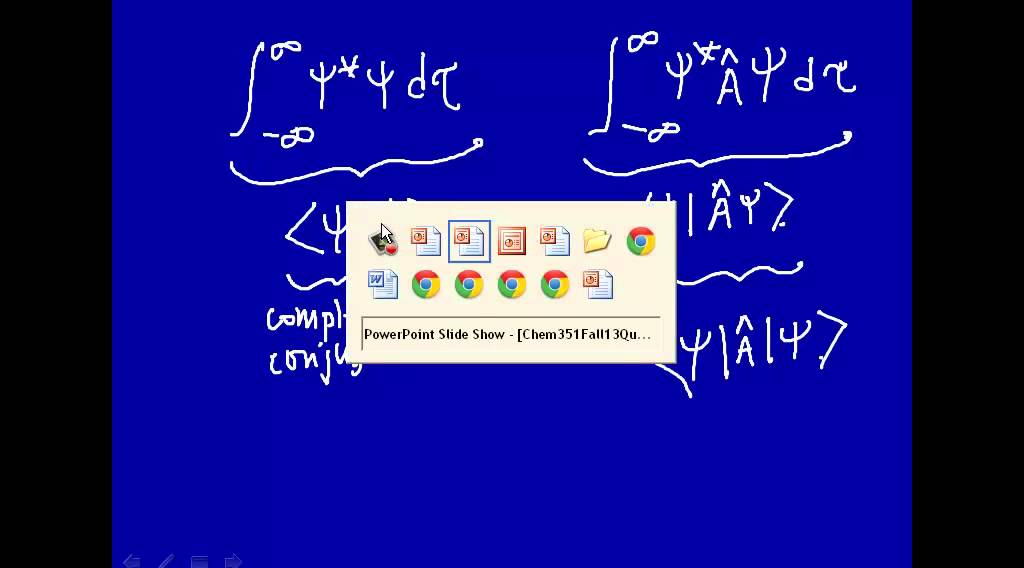
Added:chapter 22 electronic and NMR Spectra of molecules section 22.2 electronic Transitions and selection rules any electronic transition that involves the change of the electron spin state is forbidden with nearly zero intensity because the integral of alpha star beta is zero the integral of beta star Alpha is also zero star denotes the complex conjugate the intensity of a spin allowed transition such as from alpha to Alpha or from beta to Beta in an atom or molecule is proportional to the squared modulus of the transition dipole moment which is a vector here mu superscript MN with an arrow and the intensity is proportional to squared modulus of this Vector uh we can prove this statement if you like to watch this 23 minute proof here in my uh YouTube channel the transition dipole moment can be uh expressed as the sum of three components in the X Y and Z directions i k are the unit factors in the X Y and Z directions and then mu superscript MN subx is the X component y component and Z comp component here let's look at the X component of the transition dipole moment it's the integral of the wave function of the M electronic State multiply by this x component of dipole moment multiply by the wave function of the nth uh ex uh electronic state so we can evaluate this mu subx mu sub y mu Sub C uh separately and again XYZ are the XYZ Z components over here mux mu y mu Z are the components of the electric dipole moment expressed here and with M and N in the superscript it's the so-called transition dipo moment which is also a three-dimensional factor with three components in the X Y and Z Direction electronic transition is allowed only if this transition dipole moment is non zero as long as it's non zero it's squared modul is positive and then we have a finite intensity to observe this transition but if this is zero then we say the electronic transition is forbidden but how can we determine if the transition dipo moment is zero or non zero well we will have to evaluate three integrals the three the X Y and Z components of the transition dipo moment if all three are zero then the vector of transition dip moment is zero the uh electronic transition is going to be forbidden if any one of these three integrals is non zero then the transition dipole moment Vector is non zero we will be able to observe this transition uh as long as it's also spin allowed the intensity of a spin allowed transition in atom or molecule is proportional to the squared modulus of the transition type moment here's example if we're looking at the electronic transition from 1 s Alpha to 2s Alpha in hydrogen ATM this is going to be forbidden because its transition di moment is zero the squared modulus is also zero however if you have a electronic transition from 1s Alpha to 2px Alpha that's actually allowed both spin allowed and spatial allowed now let's look at this two examples in detail from 1s Alpha to 2s Alpha it's being allowed from alpha to Alpha now let's look at the U uh spatial uh intensity spatial probability so let's look at this x components uh this is Mu subx with m in the super script M and N uh represent the initial and final electronic state so now let's plug in all those equations uh C is a constant now we need to integrate this integral and also a SP integral the SP integral is just one because the integral of alpha star Alpha is is just one alpha is normalized really we need to focus on this integral and see if this integral is zero or non zero this integral is actually zero because 1 s function and 2s function are even functions of X and then in the middle we have odd function of X so if we look at the product this entire product is an odd function of X what does that mean if we change the sign of X we're going to change the sign of this product and that means the integral is going to be zero the integral of any odd function from negative Infinity to positive Infinity is zero only because if you look at uh the graph of the integral uh the left hand side and the right hand side have the same magnitudes but opposite signs so overall the integral should be zero and similarly we can determine the Y component and Z component of the transition dipole moment they are both zero you just plug in y here it's going to be a OD function of Y the integral of that uh product with respect to Dy is zero you can also replace this x with Z to get the Z component again the integral of the product with respect to DZ is going to be zero so that's why we actually cannot observe the electronic transition from 1s Alpha to uh 2s Alpha if it's Photon induced um now let's look at this uh B from y Alpha to 2p X Alpha this this electronic transition is allowed uh this is because now we still look at this integral uh and multiply by the Spin integral the speed integral is just one so we focus on this spatial function we look at here plug in all the way functions over here and here you can see this one s w function is a even function of X that means when X changes sign it does nothing to to this wave function but this 2px is proportional to X so therefore 1 * x * 2px is together is a even function of X and that means uh this integral is not going to be uh zero again uh you can even just use a more specific function for 1 s it's e to^ r and then 2 PX is x * e to^ R2 if you integrate this from negative Infinity to positive Infinity I think you'll get a positive integral value that means this x component is non zero and that means the transition Temple moment is non zero when the transition type of moment is non zero its squared modulus is non Zer and the intensity is proportional to this and therefore the intensity of observing this 1 s Alpha to 2px Alpha electronic transition is positive we can observe this this is a allow transition more generally speaking the selection rule for the electronic transition in the hydrogen atom is Delta L is plus minus one the angular Quantum momentum number must change by one the intensity of a spin allow transition in atom or molecule is proportional to the transition dipole moment squared for example if we look at a electronic transition in water the electronic transition from a A1 M Mo to a B1 m is allowed but from B1 to B2 that's forbidden because uh we can actually look up the Symmetry for X Y and Z vectors uh because uh when you have a electric Dio moment that's the charge times the XY Z Vector so somehow we can determine the symmetry of the electronic dipole moment in the X Y and Z directions uh again XYZ let's look it up X is B1 Y is B2 and Z is A1 there for XYZ correspond to B1 B2 A1 irreducible representations now in the X Direction the A1 to B1 electronic transition dou moment is the integral of a totally symmetric function so A1 * B1 * B1 all right uh this is initial excited uh initial electronic State this is a final electronic State and this is the X component of the electric typ of moment so uh A1 * B1 * B1 is A1 is completely symmetrical and the integral of a completely symmetrical function is non zero so the X component is non zero therefore the entire Vector cannot be zero the transition is allowed however from B1 to P2 it's completely forbidden because none of the XYZ Vector has a A2 symmetry uh we can see if you have B1 and B2 in the integral this is initial this is final electronic state in the middle we need a A2 we need a A2 so that the product is A1 so that integral of this product is non zero however you can see A2 over over here uh neither X or Y or Z correspond to this uh A2 symmetry therefore the electronic transition from a B1 molecular orbital to a B2 molecular orbital in water is forbidden in the X Y and Z Direction the B1 to B2 electronic transition typle moment is integral of B2 B1 and A1 function we can do this here again the transition is from B1 to B2 and then in Middle we have the Symmetry for the X Vector y vector or Z Vector they correspond to the symmetry of the electric dipole moment and X is B1 Y is B2 and Z is A1 so you can see when we do this product we get B2 so B * B * B is B all right B correspond to kind of just the inti uh symmetric uh with with back to rotation one two are uh referring to uh symmetric versus antisymmetric about reflection so BBB you get a b b a b you get a a cuz B * B is a and then you know you get a over here and then let's look at 1 one two one means symmetric two means anti-symmetric so you can replace one with + one two with netive 1 so + 1 + 1 1 the product is- 1 so put a b here + 1 - 1 1 - one so we put a one here + 1 + 1 2 means negative 1 so we have uh + 1 * + one plus * uh netive 1 we get a negative one here so the result is B2 symmetry B1 symmetry A2 symmetry now of this three is totally symmetric so the integral of a b B2 function is going to be zero the integral of B1 function is zero the integral of A2 function is also zero that means uh the X component y component and Z component they're all zero the transition Dio moment Factor has to be zero if it's three components are all zero therefore B1 to B2 electronic transition in water is forbidden and not only in water just in any molecule with the c2v point group The B1 to B2 electronic transition is forbidden uh using the character table we can also determine if a vibrational transition is infrared allowed or uh Ramen allowed for example we can look at the uh uh symmetry of the vibrational modes um the A1 B1 B2 vibrational modes are infrared allowed in any molecule that belongs to the c2v group because you can look up the three electric dipole moment in the XY uh in Z Direction X is B1 Y is B2 and Z is A1 so uh you just need A1 uh vibration mode to be allowed in a z Direction B1 B1 look up B1 uh then this is going to be allowed in the X Direction and also there's a B2 uh you see B2 here uh this uh vibration will be allowed in the Y Direction all right so this is how we uh determine if a vibrational transition is infrared allowed again this molecule absorbs a photon and it can be excited or de exited along as long as it's it's infrared allowed to determine whether it's infrared allowed you need to look up the symmetry of X Y and Z uh they correspond to the symmetry of the electric dipole moment so if you have B1 B2 or A1 symmetry it's going to be allowed uh all vibration modes of a molecule in a c2v point group are ramen allowed because uh for this to be Ren allowed you need a vibrational mode with uh the same symmetry as one of this either x 2 or y^ 2 or z^ s or XY YZ ZX uh you can see x² y s z s those are A1 XY is A2 XZ is B1 YZ is B2 so uh pretty much no matter what you have if you have A1 A2 B1 or B2 uh it's going to be Ramen allowed to check if it's Ramen allowed or forbidden you look for uh the uh second order uh functions uh such as x² y^ s z^2 or x y y XZ YZ you look for them and see if they allowed or not one a molecule processes a inversion Center XYZ are always use symmetry while the components in The pability Matrix are always G symmetry all right so when you have a inversion Center uh XY Z are always uh anti-symmetric with respect to the center however if you're looking at the second order functions they are symmetric with respect to the inversion Center so what does that mean well as long as you have a molecule with a inversion Center uh XYZ will always be U Symmetry and uh all those second order functions will always be G symmetry what does that mean that means we can make a prediction no vibration mode of a molecule with a uh symmetry Center or inversion Center can be both infrared and ramen active if it's uh infrared active it's definitely Ramen inactive if a vibration mode is Rama active that means it has a g symmetry it cannot be infrared active uh but also uh I just want to remind you that a uh one infrared uh uh one vibration mode can be both uh in uh infrared inactive and also Ramen inactive all right so over here it's just uh infrared and ramen uh um cannot be both active if you have a molecule with a uh Center uh inversion Center uh the intensity of a spin allowed transitioning molecule uh not only depends on the uh value of the square modulus of the transition dipole moment it also depends on the overlap between the vibrational wave functions of the initial and final electronic state uh the FR counton principles St said the electronic transitions are vertical transitions what does that mean that means well uh in a potential energy surface when we do electronic transition we draw the arrow up uh perpendicular to the horizontal axis which is the nucleus uh coordinates and simply it means the nuclear coordinates remain unchanged when you draw a vertical line that means over here uh the positions remain unchanged why is that it's just because the electronic transition is super fast it takes about 10 to ^5 seconds I think this is 1 FAL second and within such a short time period all those nuclei do not have enough time to move I mean even if they do uh they can move uh maybe a distance of maybe one picometer or even less uh one Pomer is 0.01 enstrom so typically the bond distance is between one and three enroms and if you just change it by 0.01 and roughly we can say well the bound distance is unchanged now let's look at some vertical excitations let's say we have uh ground electronic State and this is also the ground vibrational uh uh state with a wave function now we're going to do vertical uh excitation so from here to here not only we need to look at the transition dep moment we need to look at uh the overlap between this vibration wave function and this VI vibration wave function so you can see we are from this uh uh really large uh value of vibrational function to a large vibrational function here this is a maximum of a a gaussian function this is also a maximum of a gaan function right here so very likely from uh 0er to two transition you will have a larger intensity than any other intensities all right and now let's look at examing from zero to zero well this from 0 to zero you need the least amount of energy but look at the overlap over here you have a maximum but over here very low intensity from the vibrational wave function all right so that's why the intensity should be small from 0 to one it's also small because if you look at this this is uh quite close to the tail of this gussian function so not much but from 0 to two in this graph you can see this is the maximum of this gin function and this is the maximum of this gin function so from 0 to two you probably will see the largest intensity for this electronic transition again the transition intensity is not only proportional to the square modulus of the uh transition dipo moment it also is proportional to the squar mod squared modulus of the overlap between the initial vibrational function and the final vibrational function that's why the transition is like that uh so uh when you look at this kind of transitions uh so uh in this diagram I said from 0 to two you have the largest overlap between this vibrational function and this vibration function so from 0 to two you probably will see a larger uh transition intensity
Up Next

Jablonski Diagrams & Electronic Spectroscopy | PES
@dw-pchem
226 views•2022-10-26

Biocatalysis and Catalysis in Islatravir Synthesis | Merck Webinar
@SCIwheresciencemeetsbusiness
675 views•2020-10-08

Jablonski Diagram Explained: Photochemistry Transitions
@physicalchemistry_pchem
109 views•2023-11-16

Edible Water Bottles: A DIY Guide to Sodium Alginate Spherification
@ryan
10.5M views•2019-06-21
Related Study Plans & Knowledge Roadmaps
Structured learning paths in Chemistry