
![Introduction to Density Functional Theory [Part One] Background](https://i.ytimg.com/vi_webp/Ez_Fm4iTUeo/maxresdefault.webp)

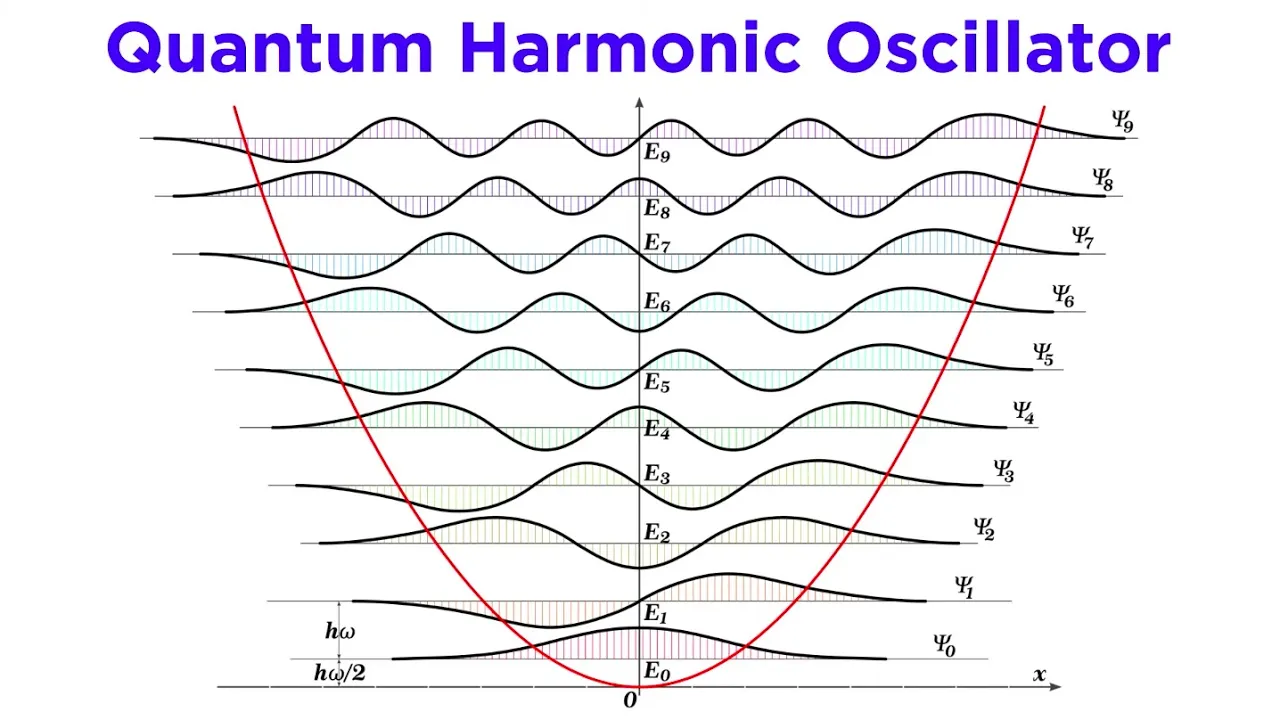











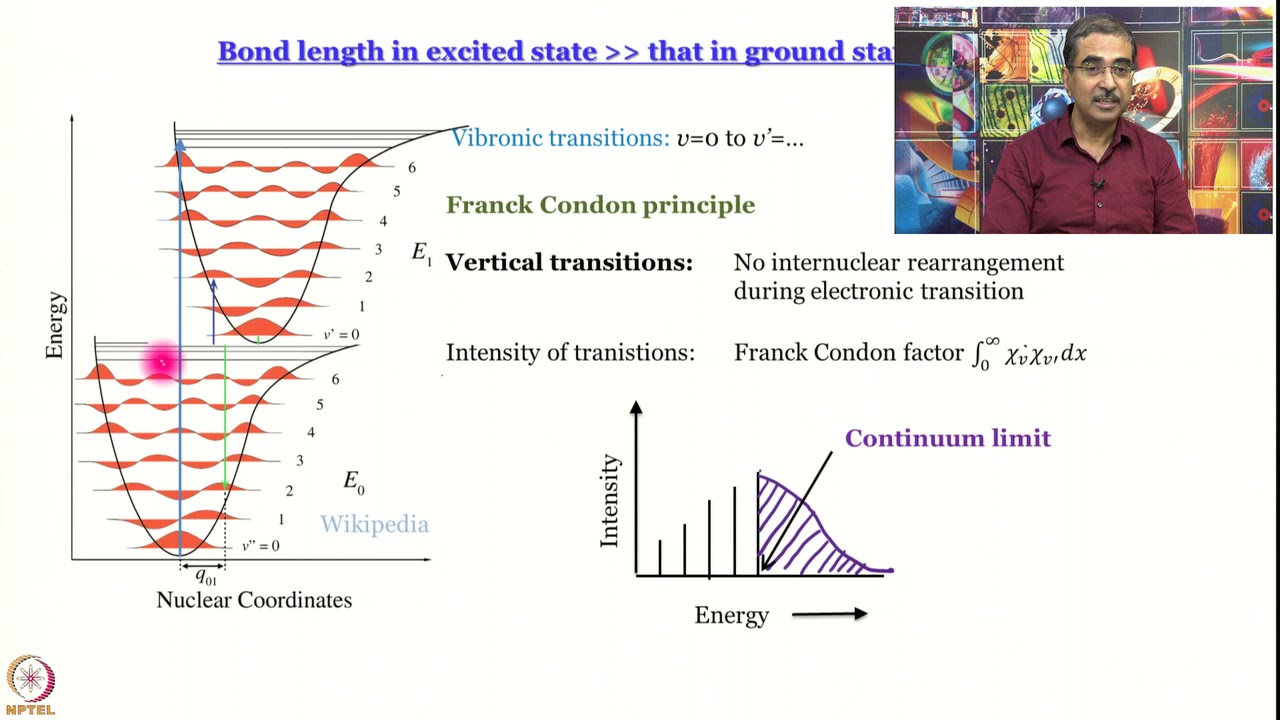
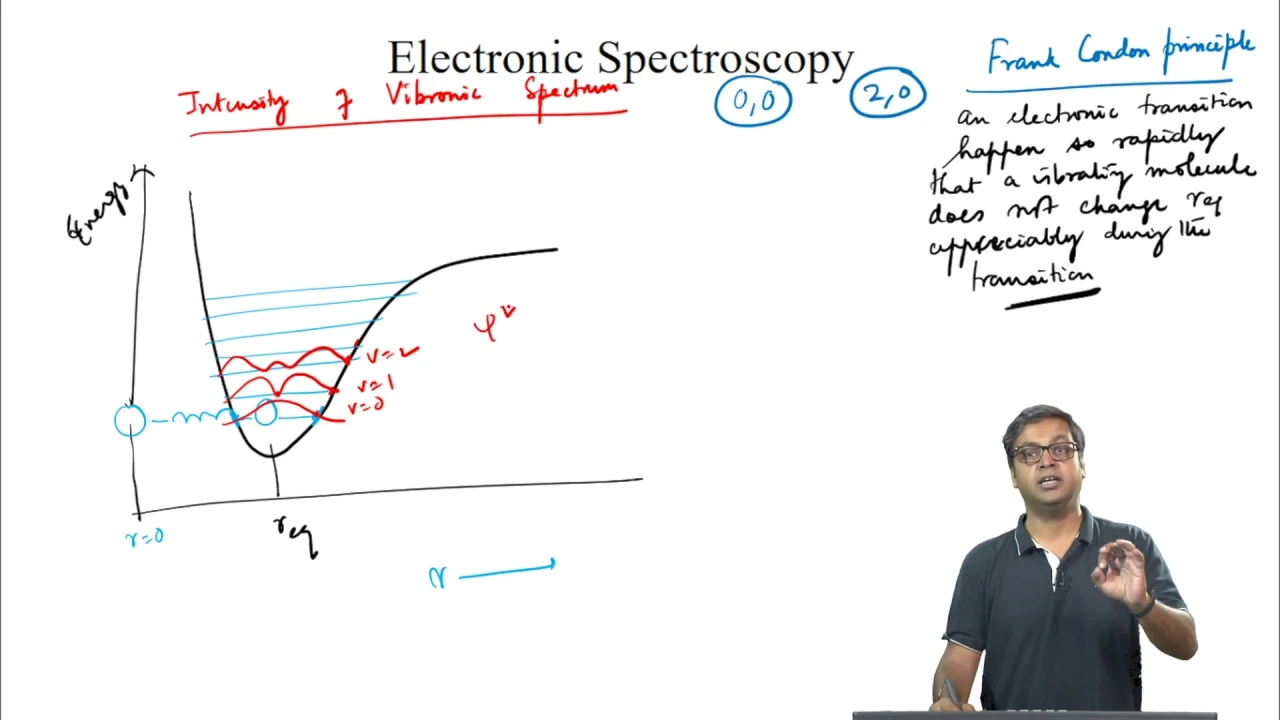



The Franck-Condon principle states that electronic transitions between molecular states occur vertically (instantaneously) because electrons move much faster than nuclei, meaning the transition probability depends on the overlap between vibrational wave functions at the same nuclear coordinate; this results in characteristic vibronic progressions in UV-VIS spectra where transitions from the ground vibrational state (v''=0) to excited vibrational states (v'=0,1,2,3...) show varying intensities based on wave function overlap, with maximum intensity typically occurring when the vertical transition intersects a vibrational node or high-probability region in the excited state.
Franck-Condon Principle Explained: Vibrational Transitions & UV-Vis Spectra
Added:The Born-Oppenheimer approximation and the separation of nuclear and electronic motion.
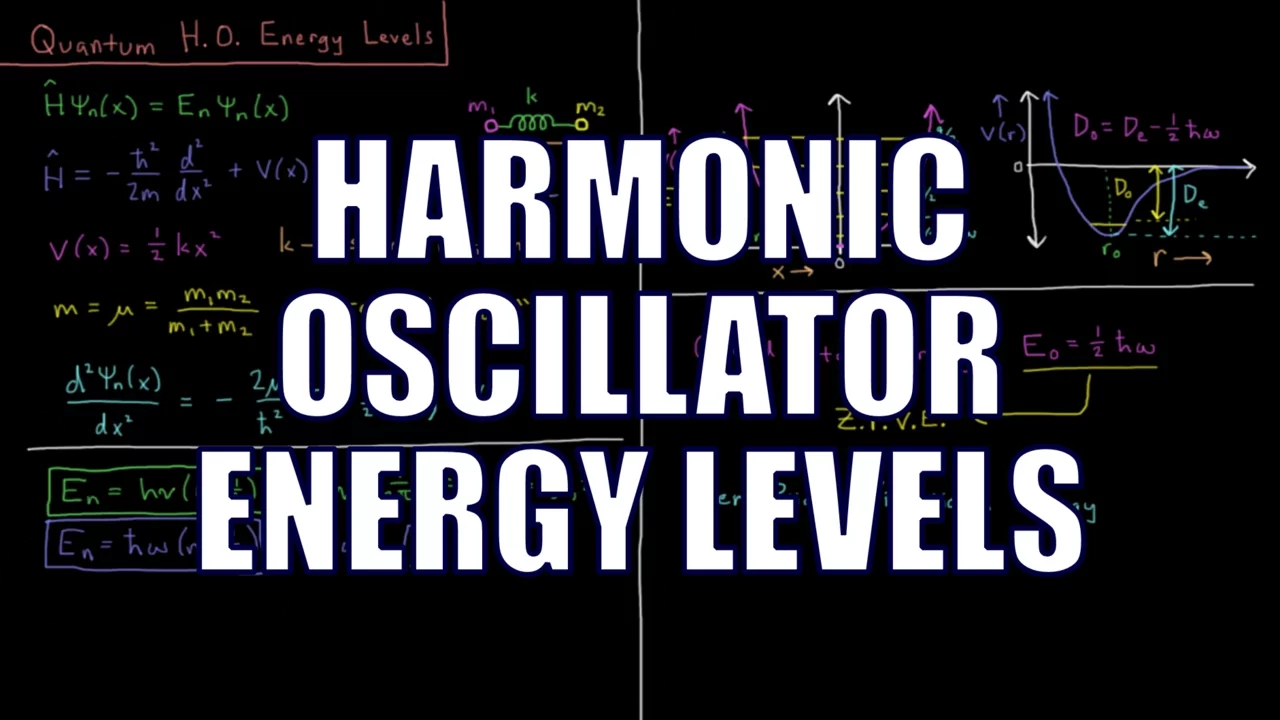
Fundamentals of quantum harmonic oscillators, including vibrational energy levels and wavefunctions.
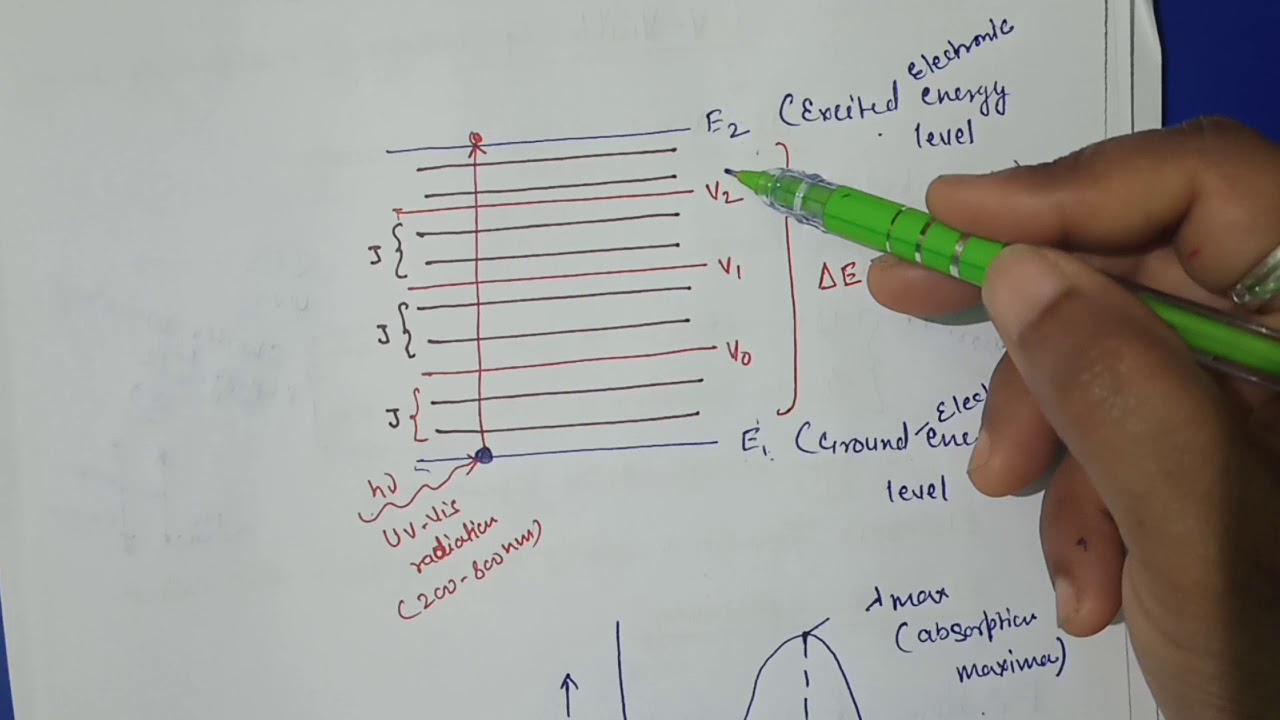
Basic principles of electronic transitions, photon absorption, and UV-Vis spectroscopy.
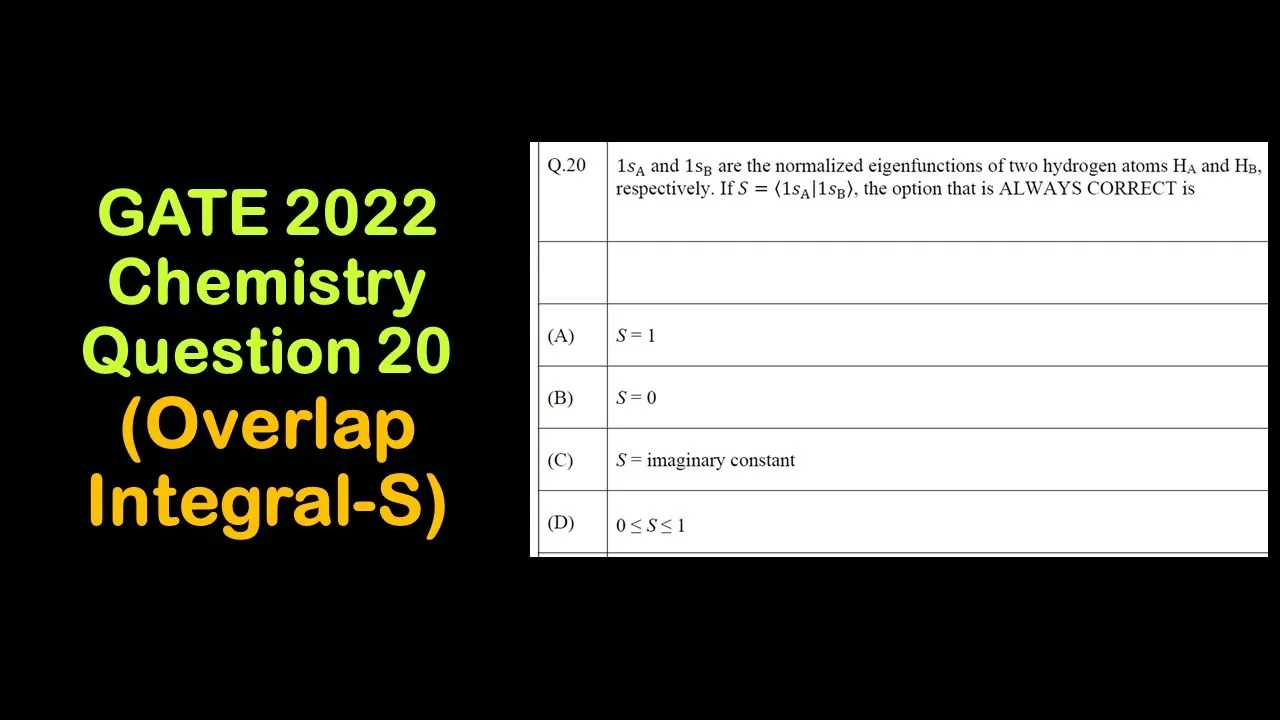
The physical meaning of quantum mechanical overlap integrals and transition dipole moments.
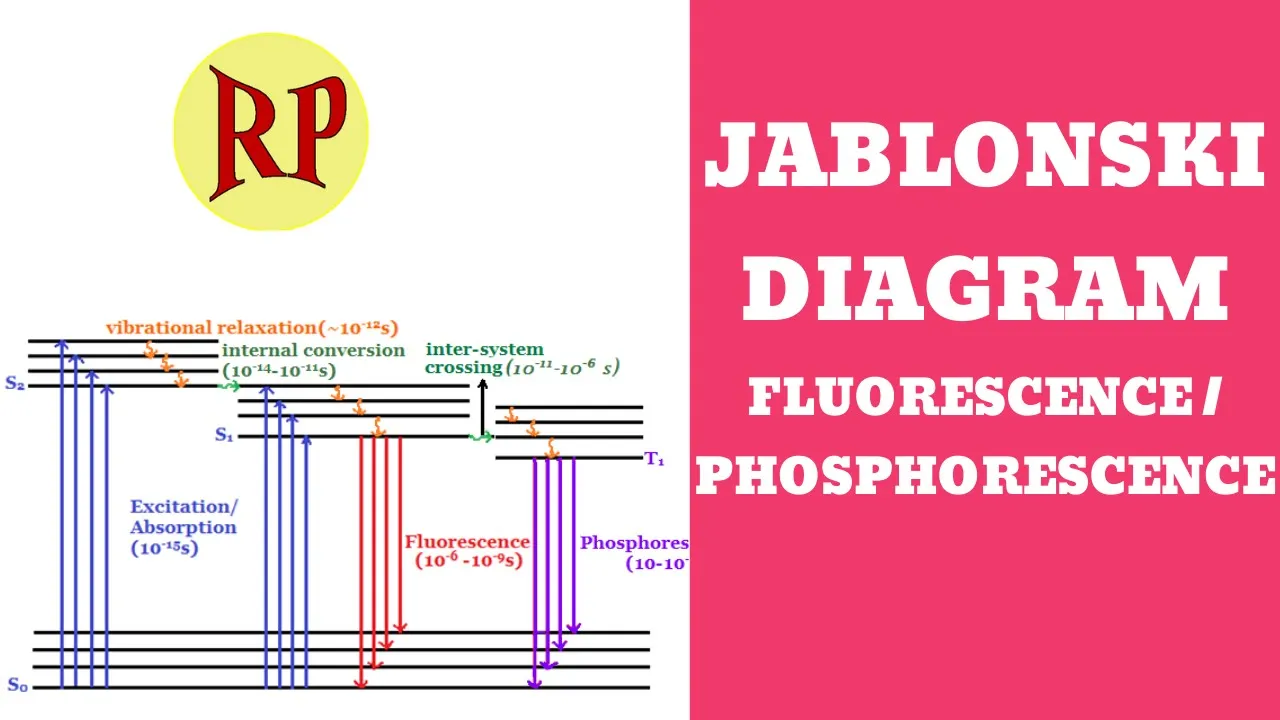
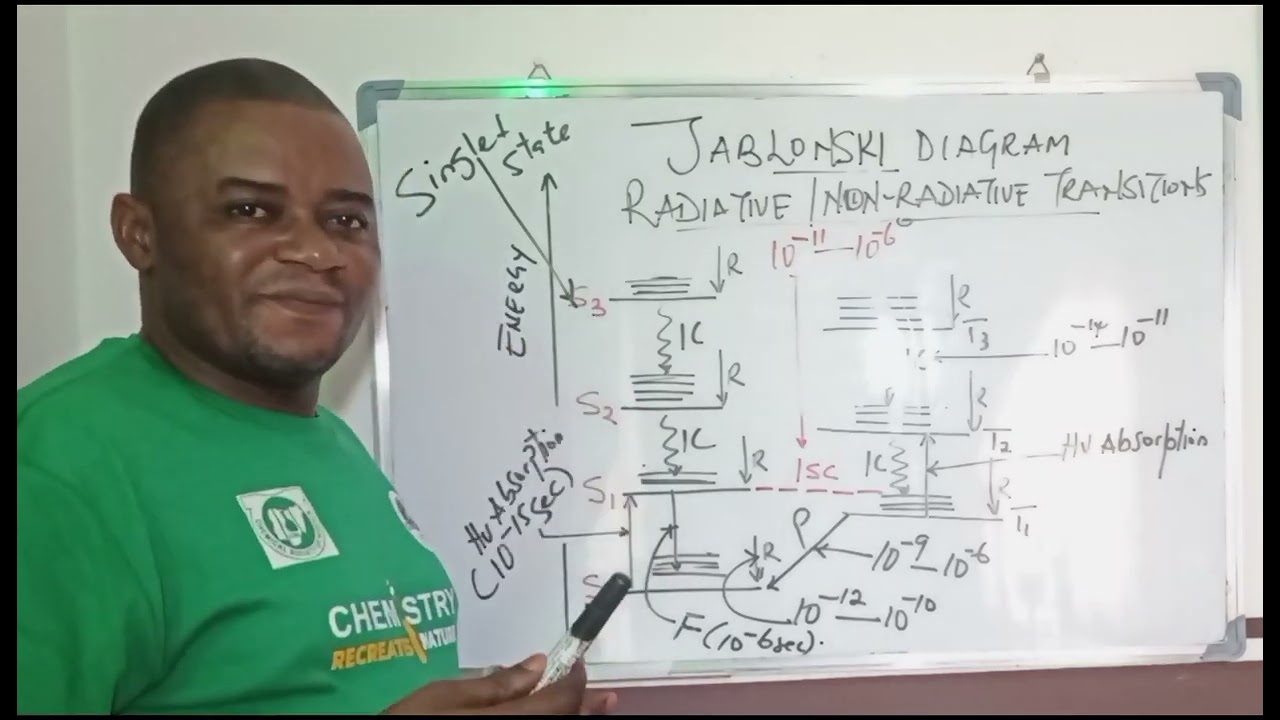
Constructing and interpreting Jablonski diagrams to map out radiative and non-radiative decay pathways.
The physics of fluorescence, phosphorescence, and their corresponding emission spectra.
Analyzing vibronic progression patterns to determine excited-state molecular geometries.
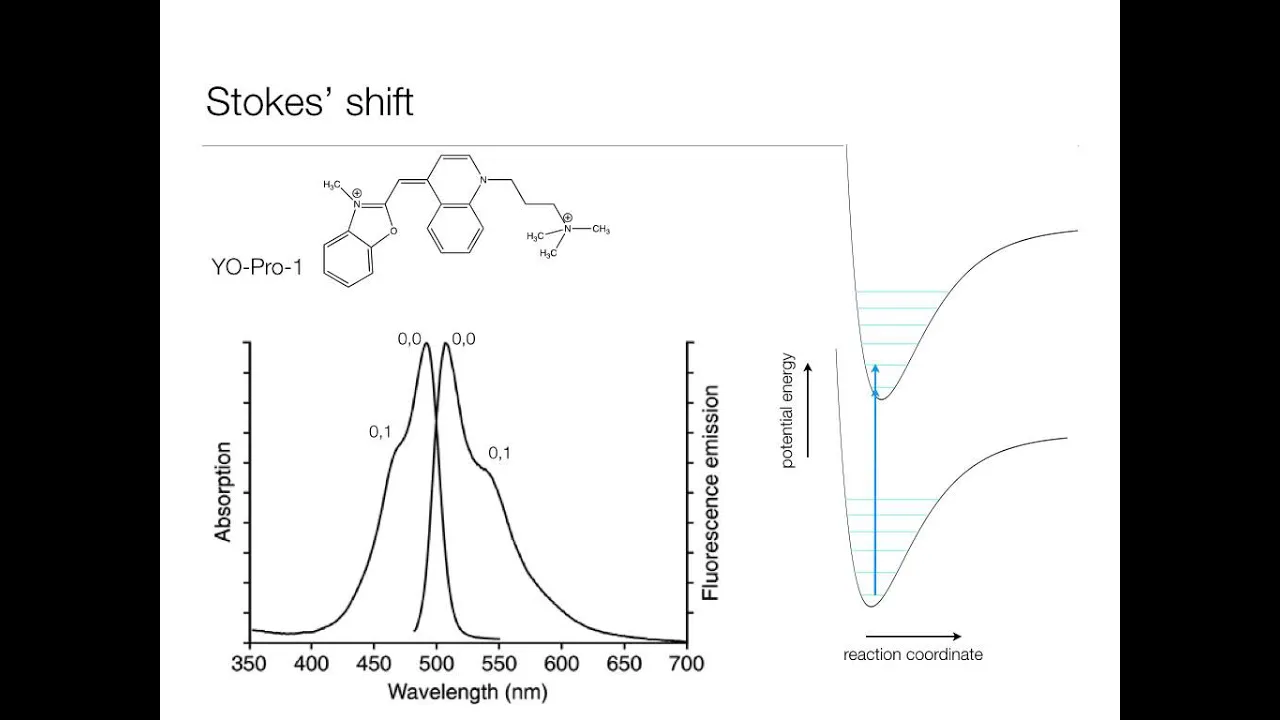
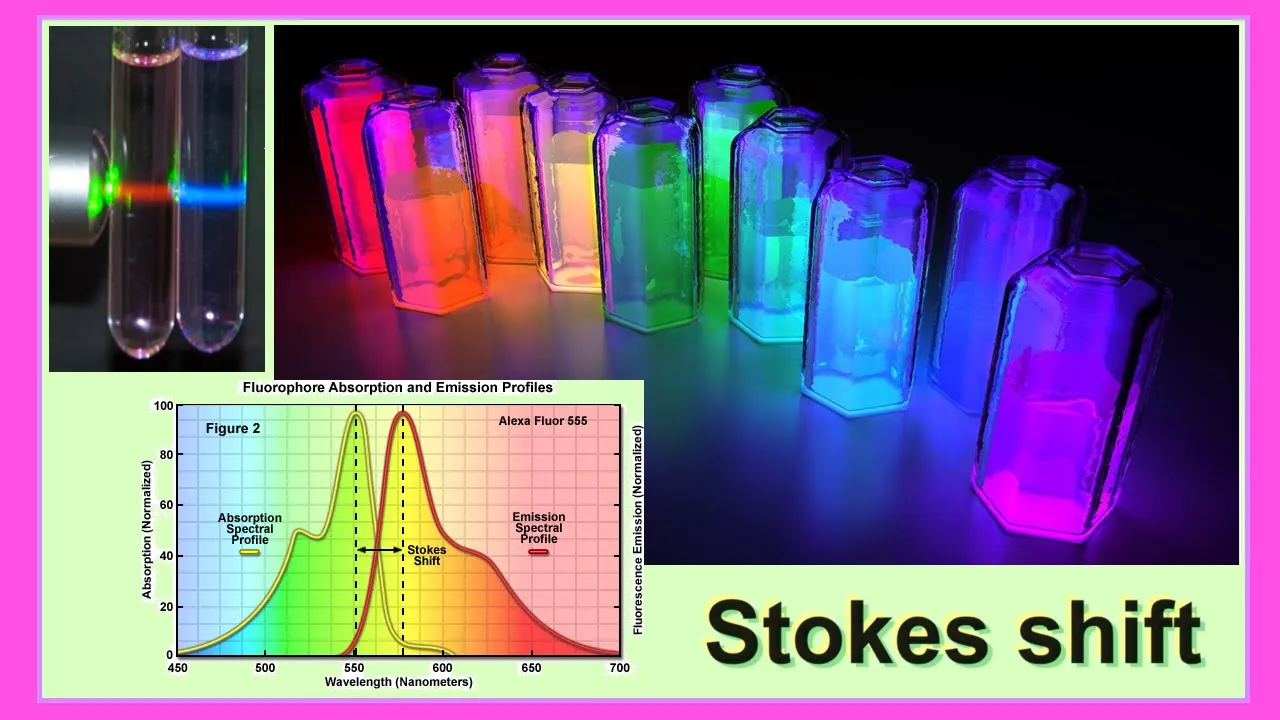
Understanding solvent effects, solvent relaxation, and the structural origin of Stokes shifts.
30.1K views505likes10:31Original Release: 2020-03-30
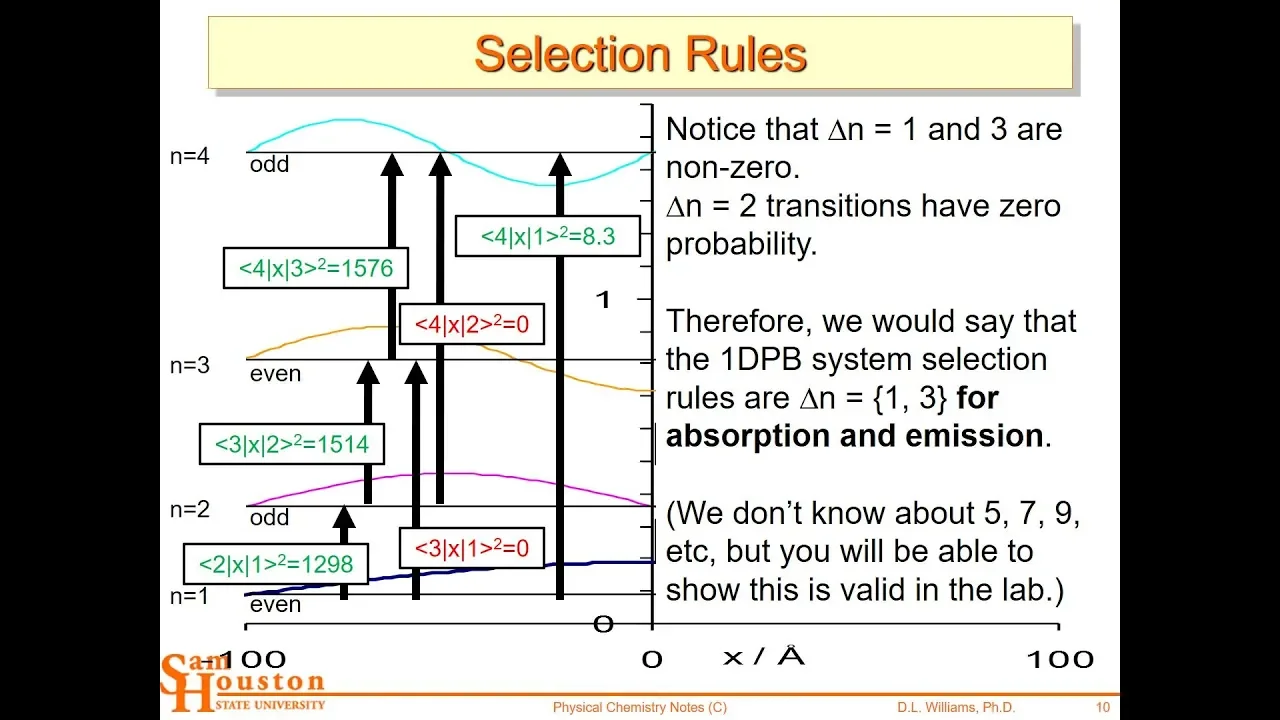
we can understand electronic spectroscopy a little bit better if we look at the potential energy diagrams and so I'm going to go ahead and sketch out a potential energy diagram here so I've gone ahead and and sneakily drawn a quick potential energy diagrams of potential energies on the vertical axis the horizontal axis is sort of this generalized coordinate so if it's a diatomic it's just a bond length if it's a polyatomic at some function of all the bond lengths and angles in the molecule the bottom curve here corresponds to my ground state or GS for short and the upper curve here corresponds to my first excited state or actually any kind of excited state I should say we control the vibrational energy levels in I'm going to go ahead and draw those in black for the grain state so we know that it is a ladder that looks something like this so this is V double prime equals zero one two and so on so remember we use that notation where the double prime is the initial and the single prime is the final and we're going to go up to an excited state here so let's go ahead and draw the excited States in so if the bond is a little bit different in the excited state these levels could be different distances apart so we'll talk about that later so these are my V prime equals zero one two three four five and there's probably a whole bunch more excited States up there now one of the things we have to remember is that the spacing between the vibrational levels is very great at room temperature almost all molecules are in the ground vibrational state so we're going to be starting off in this grain vibrational State this video will prime equals zero we have to go ahead and write the wave function for vibrational motion and this is going to look something like this it basically is just an exponential curve right so and we have to remember something here that we've got a principle called the Frank calmed on principle after Frank and calm down and basically we can interpret this as saying we have vertical transitions so when we transition from one electronic state to another we're going to go straight up and straight down and so why are we going straight up and straight down while horizontally this is telling us about the motion of the atoms themselves and electrons move super fast in fact the electrons move like the gnats would on the back of an elephant so the electrons move instantaneously we're gonna see him compared to the nuclei so what this means is that the electrons are gonna move up and they're gonna move into an excited state somewhere up here and the atoms don't have time to move while the electrons are moving so all our transitions are going to be vertical I've sketched the vibrational wave functions here we got from solving the Schrodinger equation and if you remember the square of the wave function tells us the probability we can also see that the wave function is peaked in the center so the highest probability location is in the center that tells us that the atoms are likely to be in this horizontal position right here so our transition is going to be vertically going directly through the center of that vibrational wave function so let's start by drawing that sketching that vertical motion like so before we finish it off though we should talk about the probability of a transition so very roughly the probability of a transition between a grain state and an excited state or any two states initial and final I suppose is directly proportional to the square of the overlap of their wave functions so we're just going to overlap the initial and the final wave function and this whole thing actually I believe we're going to square and we can show here that this should be proportional to the overlap of the initial vibrational wave function times by the final vibrational wave function all squared as well so we're really looking for very nice overlap of those two wave functions so I'm going to go ahead and draw the vibrational wave functions in the excited state so the vibrational wave functions we've got one that looks like that so no nodes here's the first one with a single node and then the second one with two nodes and so on so we've got three nodes for this one and one two three four nodes for this one if I draw it right so those are our vibrational wave functions here we're looking for our max and we'll overlap so I'm going to draw this vertical line on up and what I'm going to go ahead and do is look for that point where those wave functions overlap and at the lower right-hand corner right I'm going to draw the V double prime equals zero wavefunction and I'm gonna look for an excited state vibrational wave function that overlaps and so what I'm looking for is something that's gonna have sort of a high kind of bump here and we're gonna try and figure out where this is so we're just going to keep going up vertically and as we go on up we can get to the tail of V prime equals one it overlaps a smidgen and we can go on up it's starting to overlap pretty good and we get up to here actually and it probably overlaps super duper and so we've got that strong overlap here between I guess this is the V prime equals three state and the V double prime equals zero state so we've just kind of brought those two vibrational wave functions over top of each other and where they overlap strongly is the place where we're going to see an enhanced probability of transition notice for the excited state apart from in the grain vibrational State well the excited States vibrational excited states have a large lobe towards the end of the potential energy curve and so on this side and on this side these are the classical turning points and it makes sense if a bone is vibrating right it's gonna elongate and then it's gonna turn around it's gonna compress and it's gonna compress to its minimal point right and it's gonna uncompress and turn around and so these points here these are our classical turning points we might expect a bomb to be more likely to be either at full extension or full compression and somewhere in the middle and this is true actually for every vibrational state apart from the grain vibrational state where quantum mechanics says strangely enough it's most likely to find in the center and on it there's classical turning points so if we're gonna go ahead and apply the franck-condon principle we normally just draw the vertical line up so the electrons move rapidly and actually where we intersect the turning points where we intersect the point with a vibrational energy level cuts the potential energy curve we normally say as long as you can get to one of those that is your highest probability transition and we can see that this one here corresponds to V double prime equals zero going to V Prime equals three so we can go ahead and we can sketch and a electronic spectrum for this we'll go ahead and sketch it down below so I'm gonna draw from left to right increasing wave numbers or frequency or inversely related to wavelengths I'm gonna go ahead and I'm gonna draw some lines here so this is zero frequency right here we are going to go ahead and have our spectrum so we're gonna have a transition here this is corresponding to V double prime going to V prime this would be the zero zero the zero zero is a pretty low probability the overlap of the V prime equals zero with the V double prime equals zero is pretty wimpy right that tail is barely right there the overlap between the V prime equals one state is a little bit better V prime equals two is really quite good and then three is optimal for is pretty darn good and as we go to higher and higher we actually get worse overlaps so I'm gonna go ahead and draw this spectrum here the zero zero is a pretty wimpy so if this is absorption going up here low absorption zero one is actually starting to look fairly decent so this is zero one zero two without much higher overlap has a much higher probability so this is pretty good and we said that it peaks at 0 3 so 0 3 is our highest probability 0 4 is pretty good and as we go on further right we should expect to see lower and lower probability transitions this is called by the way a vibronic progression in the gas phase you might see these outlines they're nice and sharp but of course in the condensed phase the molecules are colliding with one another so we've got some sort of lifetime broadening going on here so what we see is it is a broadening of the spectrum so it doesn't look nearly as sharp maybe as before ok and maybe it looks something like that or you know maybe just see little ripples that look something like that in a normal UV vis spectrum of course we plot increasing wavelength to the right we plot decreasing wavelength to the left so I guess nu prime goes that way and increasing wavelength goes this way so this means our spectra would be backwards I suppose so we start with low energy so 0 0 0 1 0 2 0 3 0 4 0 5 0 6 and so on so a uv-vis spectrum might look something like that we go ahead and we can take a molecule like benzene and this is a very old uv-vis spectrum we've actually got the wavelength in angstroms here so we're going from right to left to decreasing wavelength to increasing wave numbers or increasing energy so we can see the vibronic progression here so we're going from the ground state v double prime equals 0 to the excited state so this is V prime equals 0 this is V prime equals 1 V prime equals 2 we can see this is the highest probability V prime equals 3 4 5 6 7 8 and we've got some other electronic transitions sneaking in on the side here so you've got these fingers in your spectrum right so they are commonly called fingers and just because they kind of remind us of the fingers on our hand if we were super cool right we could go ahead and we can take the gaps here the gaps here are telling us about HC times by the vibrational frequency in the excited state so the excited state right those vibrational energy levels we are basically climbing up and so we're learning about those so we can learn if the excited state is more tightly bonded together than the ground state or vice versa so we can actually look at the vibrational excited States which is pretty hard to imagine because it's awfully hard to take an excited state molecule and put it in the infrared spectrometer and yet we can just take a grin state molecule put it in a UV vis the UV energy kicks it up to an excited state and we see that progression as we go along with different vibrational States in the excited state pretty awesome huh
Up Next

45:42
Electronic Spectroscopy: UV-Visible & Jablonski Diagrams Explained
@dw-pchem
640 views•2020-10-21
83:56
Biocatalysis and Catalysis in Islatravir Synthesis | Merck Webinar
@SCIwheresciencemeetsbusiness
675 views•2020-10-08
10:06
1H NMR: Determining Number of Peaks from Structure
@MSJChem
59.2K views•2017-04-06
17:31
Edible Water Bottles: A DIY Guide to Sodium Alginate Spherification
@ryan
10.5M views•2019-06-21
Related Study Plans & Knowledge Roadmaps
Structured learning paths in Chemistry
chemistry
Nuclear Chemistry: Decay, Meds & Fuel Cycle
01Introduction to Nuclear Structure and Radioactivity
02Decay Dynamics and Kinetics
03Radiation Interaction and Detection
+ 2 more learning modules
24h5 modules
Explore Roadmap
chemistry
Supramolecular Chemistry: Forces & Machines
01Foundations of Chemical Bonding and Intermolecular Forces
02Introduction to Host-Guest Chemistry
03Thermodynamics and Dynamics of Self-Assembly
+ 2 more learning modules
16h5 modules
Explore Roadmap
chemistry
Photochemistry: Excited States & Reactions
01Foundations of Light-Matter Interactions
02Molecular Orbitals and Electronic States
03Photophysical Processes and Jablonski Diagrams
+ 2 more learning modules
18h5 modules
Explore Roadmap
chemistry
Coordination Chemistry: Bonding & Properties
01Introduction to Transition Metals and Ligands
02Crystal Field Theory (CFT) and Geometry
03Magnetic Behavior and Spin States
+ 2 more learning modules
14h5 modules
Explore Roadmap