








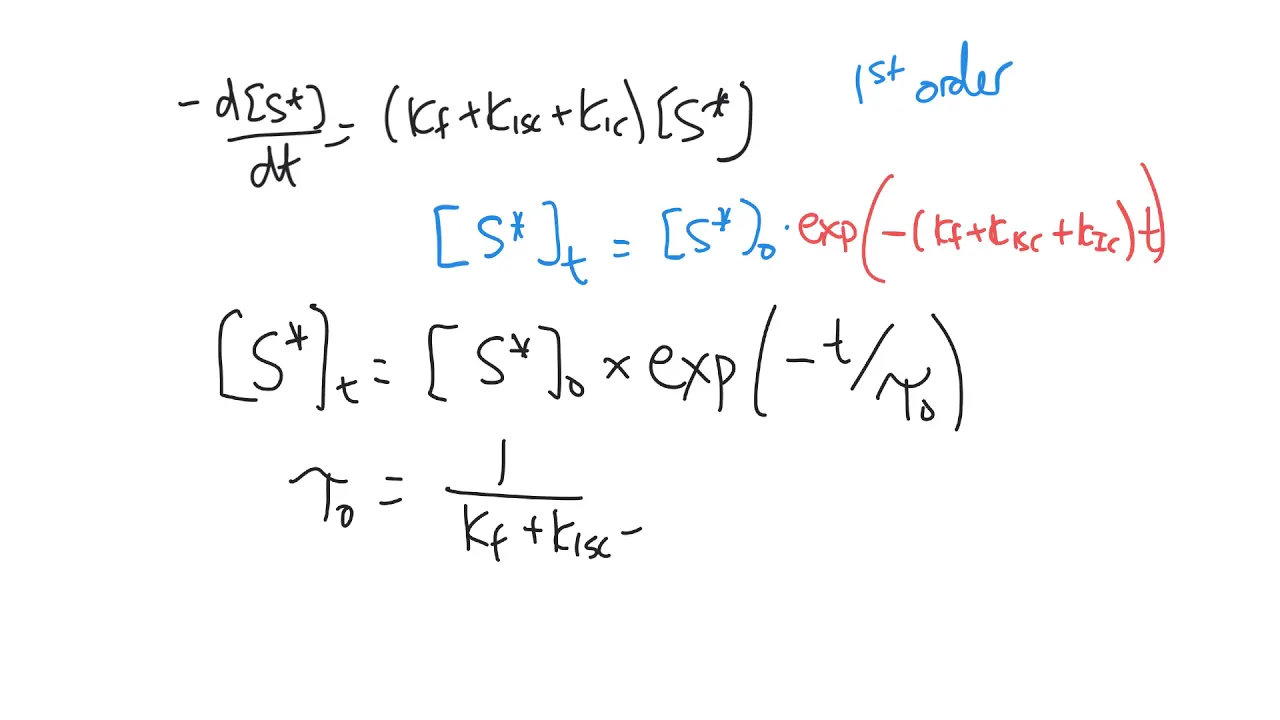

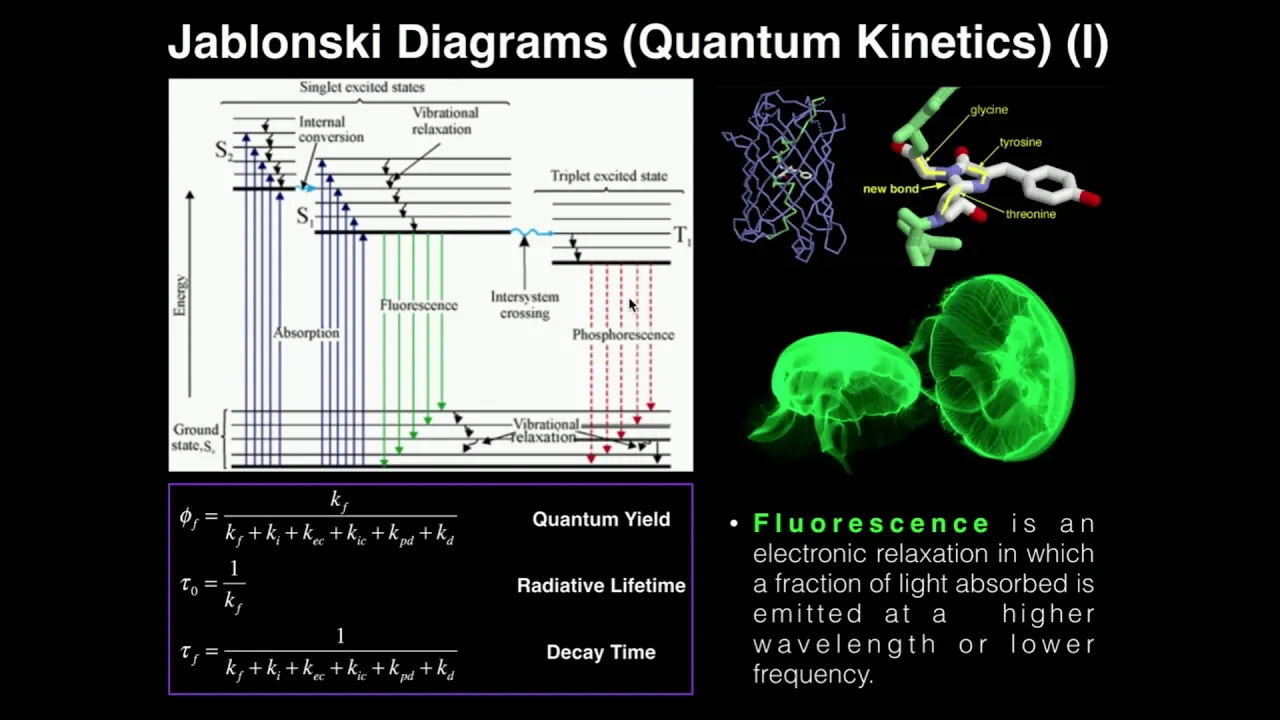
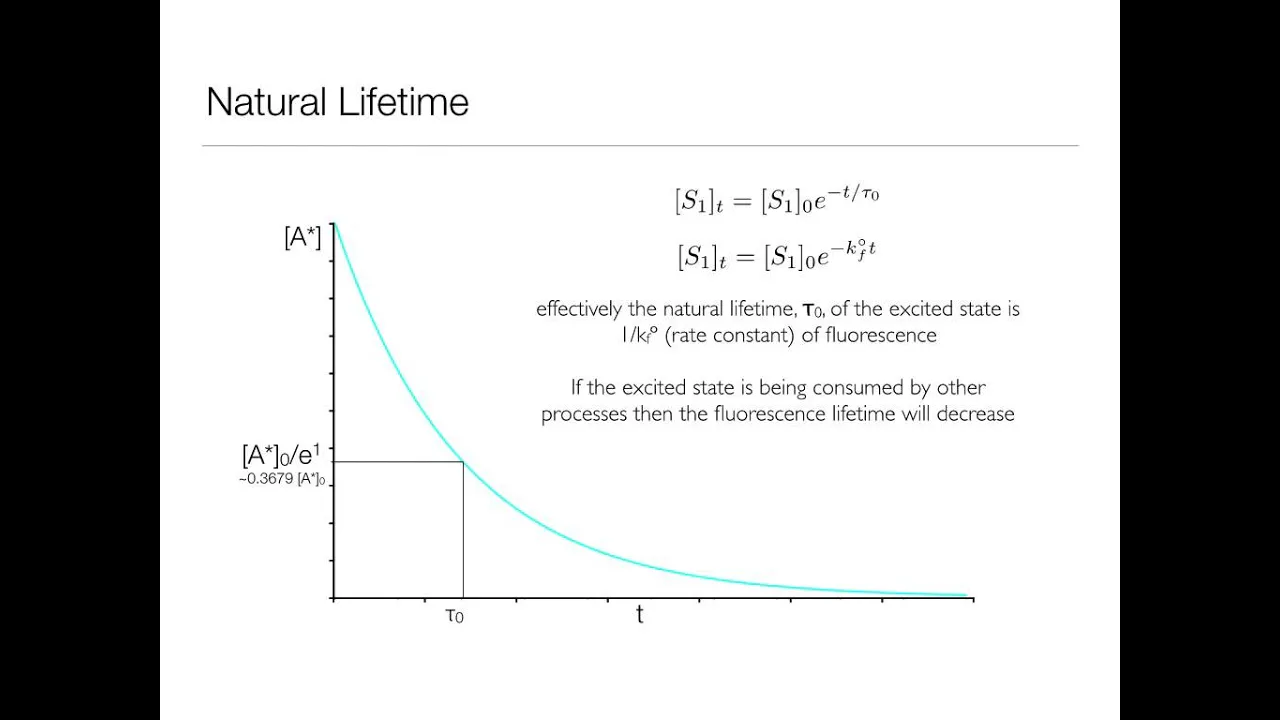







The Jablonski diagram illustrates how excited molecules relax through various processes including vibrational relaxation (10⁻¹² s), internal conversion (10⁻⁹ s), and intersystem crossing (spin-forbidden, 10⁻³ to 10⁻⁵ s). Two main electronic transitions in photochemistry are π→π* (symmetry-allowed, higher energy) and n→π* (symmetry-forbidden, lower energy). Selection rules dictate that electronic transitions are spin-allowed only when total spin multiplicity remains unchanged (ΔS=0), and symmetry-allowed only when orbital symmetry doesn't change. The triplet state (T₁) is crucial for photochemistry due to its long lifetime (10⁻³ to 10⁻⁵ s), enabling most photochemical reactions to occur via this state. Intersystem crossing efficiency varies significantly between compound classes—carbonyl compounds show nearly 100% ISC efficiency due to small S₁-T₁ energy gaps (~5 kcal/mol), while olefins have inefficient ISC due to large energy gaps (~50 kcal/mol).
Photochemistry: Jablonski Diagram & Selection Rules
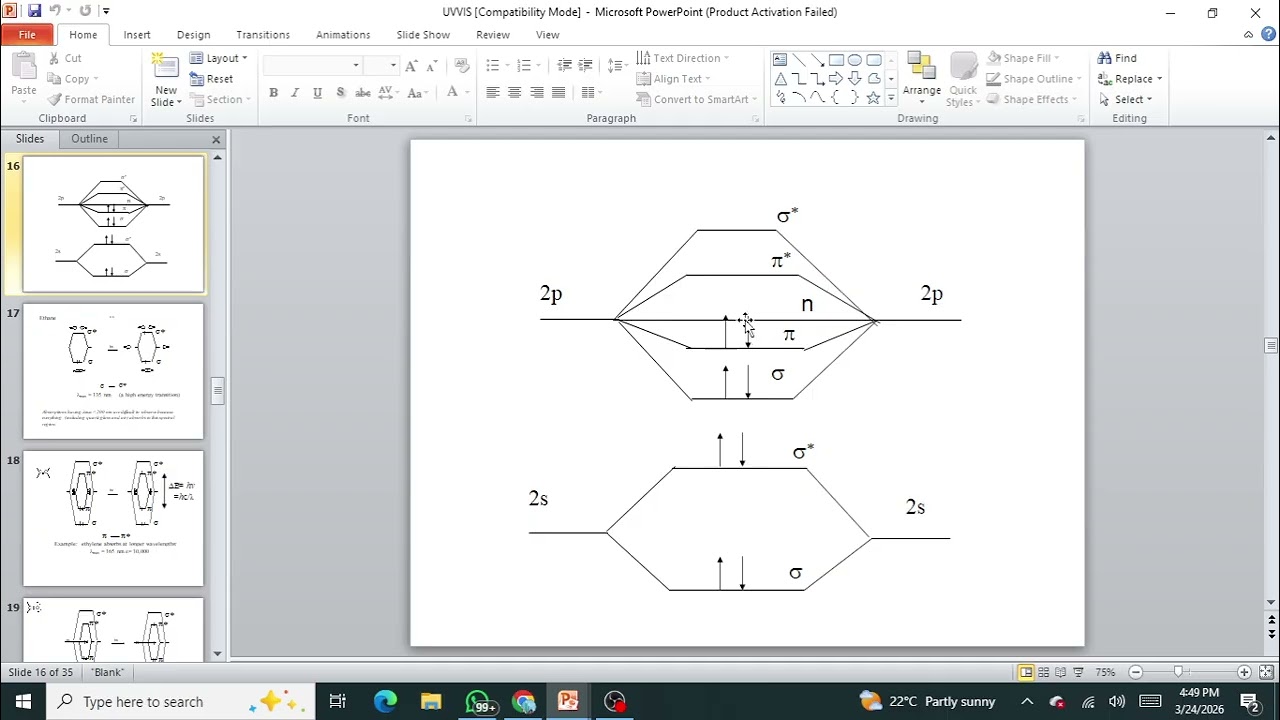
Added:hello welcome you all in organic photochemistry today I will explain jablonski diagram in which I will tell how the excited molecule can undergo relaxation by various process in my previous lecture I gave you the introduction of photochemistry and I I explained various laws which governs the photochemistry like growth stepper law Stark Einstein law Bloomberg's law Frank Quantum principle now in jablonski diagram with the help of diagram we can explain the feed of a second molecule or how the molecule can and can undergo relaxation so here the fate of excited molecule is described with the help of this diagram feed of excited molecule so if molecule absorbs the energy then it will undergo excitation after absorbing the this light the molecule undergo excitation from bonding molecular orbital to the antibondic molecular orbital and suppose various um molecular orbitals molecule is having various molecular orbitals and suppose it is Sigma then Pi star non-bonding molecular orbitals then as Pi star and this Sigma star having the highest energy of this molecular orbital so in photochemistry we are mainly concerned with two type of electronic transition one is one is Pi to Pi star these are this and another is the n two Pi star so we are mainly concerned with the two type of electronic transition in photochemistry so Pi 2 pi star and N2 y star so as you can see n 2 pi star it requires less energy and and it means higher wavelength whereas pi to Pi star it requires more energy that is less wavelength so usually in photochemistry we are going to discuss two type of organic molecules that is the this olifens photochemistry of Ole friends and photochemistry of a carbonate compound and photochemistry of aromatic compounds so they are in such a compounds way we have two type of electronic transitions mainly two top type of electronic transitions we are going to discuss and these are the two main important electronic transition one is Pi to Pi star transition because it is having the both these type of compound is having the double bond and in colonial compounds and this with this pi to Pi star transition you you will also have the Enterprise Star transition so that is c c double bond and C double bond either any this hair two atom may be there so such time of electronic transitions we are concerned in photochemistry now after absorbing the energy suppose any molecule is absorbs the energy then first of all it would be in ground state suppose this is s naught is in ground state and after absorbing this energy that is light energy then it will undergo excitation and from this round State the electron will go into the excited state so this is the position S1 it is going into the first excited state S1 and two electrons are initially present in the ground state and now after getting this energy light energy it will go into the excited state and here these are opposite pin here also it is having after going into the excited state the spins are opposite now there is another possibility that molecule may undergo the here the electron the spin and it may undergo this there this inversion or this is being made takes place so suppose if one of the spin is like this and inversion will takes place and another spring is also enough same manner so this these are the two ways that and finally again that electrician for this excited electron will again undergo relaxation so here you will see if you see here then the total spin multiplicity the total is speed multiplicity for this total is spin Multiplicity so we know that this is equal to 2 S Plus 1 and where this H is the total spin as is the total speed so for in as zero State as zero State because two electrons are in opposite spin that is S1 so this two S capital S this is equal to S 1 plus H2 and 2 up are in opposite direction that is half minus half and this comes out to be zero so therefore in ground state in ground state is 2 S Plus 1 that is total spin multiplicity this comes out to be 2 multiplied by 0 plus 1 and this comes out to be one so this is in ground state so in ground state we have the total spin multiplicity in ground state is one now what about this in excited state that is this is singulate excited state okay this is a singlet excited history and now if we calculate the total speed multiplicity over here then this is 2 and in this case this capital S is equal to again S1 plus H2 and both are in same direction space so half plus half and this comes out to be the one so total speed multiplicity this is equal to 2 multiplied by 1 plus uh this is this comes out to be because this is in opposite spin again this half plus half but two spins are in opposite direction sorry so this is half minus half and it comes out to be 0 and again this 2 multiplied by 0 plus 1 comes out to equal so here also in ground state in ground state total spring multiplicity is one and in excited singlet state so this is in ground state this spin multiplicity is in the wrong State this spin multiplicity in excited simulated State excited singlet State and here the electrons finally it may the electron spin undergo flipping and now if it's flipped then total spin this is equal to S1 plus H2 again and this comes out to be half plus half that is equal to 1 and here the total is female multiplicity is equal to 2 multiplied one plus one and it comes out to be three okay so this is electron in ground state electrons when they are present in excited singlet State total multiplicity is one when electron is now coming into the uh this in this the flipping of electrons that takes place then in that case a total display multiplicity comes out to be three and molecule is said to be present in excited excited triplet state okay so it may be called as this S1 it may be called as this T1 this state is called that S1 this state is called as the T1 now this S1 state so here this is this is our T1 State this is our S1 State and this is our s0 state so so P1 State T1 state is the triplet State and the lifetime of electron the lifetime of electron in triplet state is very high so this is the very important state where in photochemistry this is one of very important is creative and here the lifetime the lifetime of electron is so much higher and it is around 10 to the power minus 3 to 10 to the power minus 5 Second is the lifetime in the triplet stage whereas in excited singlet State the lifetime is less in comparison to here in it it is around 10 to the power minus nine seconds so as the lifetime of molecules in in triplet state is long so that's what is one of the important state in photochemistry and most of the photochemical reaction occur via this triplet okay now we can we can now if you see what are the main uh well if we talk about the selection rule what are the selection rule uh for the electronic transition so if you so the two selection women here I am going to discuss selection rule for electronic condition so one of the selection rule that is that is one is the spin selection rule and this in the spin selection rule it tells Delta s that is total it's been change in total spin multiple multiplicity should be equal to zero so Delta s is the change in total spin Multiplicity and we have found already the total speed multiplicity in singlet ground state is one total spin multiplication singlet excited state either in one total spin multiplicity in triplet State excited to Plate state is three so according to this rule the change in during electronic transition so during electronic transition Delta s should be equal to 0 means change in spin multiplicity during electronic transition that should be zero means the electron electron can undergo this relaxation or this excitation is very easily when the spin multiplicity is same so electronic transition is possible when the spin multiplicity Remains the Same it should not change so what type of electronic condition is possible it means from S1 to this means same in a state of same multiplicity that is H2 to S1 electronic transition is possible or from S3 to X2 or H2 to S1 here they let the spin multiplicity remains same here the speed multiplicity is 1 here also spin multiplicity is one here also speed multiplicity is one and here also speed multiplication one so electronic conditions are possible between the same spin multiplicity because they are and they are set to be the skin allowed transition so they are all such type of transition they are spin allowed condition spring allowed condition so but it doesn't mean that electron May and may not undergo or transition from the state of different multiplicity so here means from S1 to T1 also the transition can occur but this transition this is spring forbidden conditions such type of transition is called as the spring forbidden transition and okay so so this is the spill forbidden transition and it doesn't mean that it is not the important one so such transitions are the important transitions also such print forbidden interventions are also very important for forbidden condition okay next that is the selection rule first selection rule then the spin multiplicity transitions are only possible when the speed multiplicity does not change and another one is the Symmetry selection rule which is the spin selection rule another is this symmetry selection rule so according to this symmetry selection rule the tweeting electronic transition during electronic transition is possible when ah between the orbitals offered between the orbitals of and this suppose the Symmetry symmetry should not change during the electronic transition so if you have if you have suppose the trans the Symmetry symmetry means from s to p has to be here like with transitions taking free place from H to P or from P to D here the symmetry of the orbital changes it is also called as the orbital selection rule so the Symmetry changes that's why this is this is said to be the this is said to be the Symmetry forbidden this is symmetry condition okay whereas if H2S foreign they are symmetry allow transition symmetry allows transitions or suppose I have told you the two main transitions are there in photochemistry we are going to discuss now out of this two transition pi to Pi star transition is Phi to condition this is symmetry allowed transmission symmetry allow condition whereas this set and to Pi star transition having different orbital symmetry so this is this is symmetry symmetry forbidden conditions so but it doesn't mean that it is N2 Pi star transition is not the important one so N2 Pi star transition was pi to both are very important condition in the organic photochemistry okay now after that I should I should explain the jablonski diagram now let me first drawing diagram suppose if uh any molecule is in Sound State and I represent this round state by S 0 and after absorbing this energy light energy molecule may undergo electronic condition and suppose this is the excited state and this is second excited singlet State okay this is ground simulated state after getting the light energy the molecule will go into the electron will go into the excited excited simulated State and then it may come to the first excited simulated state that is suppose this represented by S1 you see it's S1 and then it may come to the next that is triplet State I represented by T1 now corresponding to this ground and this is electronic State this is sound electronic State this is excited electronic States so corresponding to this ground electronic State we may have a different many in vibrational States as well as the rotational state so here I am only representing the vibrational state so corresponding to this ground singlet state the molecule will have different vibrational state from vibrational States so this is suppose the zero V1 V2 V3 like this these are the ground vibrational state in the same way corresponding to this excited States excited electronic State okay we may have a different excited vibrational States these are the different excited vibrational States and also here also we have different excited vibrational States responding to this one we may have different excited by Krishna Estates okay now here also we may have triplet state vibration excited vibrational States in this triplet State we have the excited vibrational States also now after absorbing the energy suppose molecules absorbs energy and it is absorbing so much of high energy that it go to the second excited singlet state so it will go into the like this it can go into the I get about this now after going into this excited singletage state excited English Street second excited singletage state now molecule will undergo relaxation so various uh various ways various physical uh photophysical process are there that molecule may undergo relaxation so one of the we may describe this into two feet one is called as the non-radiative don't radiative relaxation process is non-relative relaxation process means the relaxation or the emission of lie even without without emitting the light okay so here it means during the less session the light is not emitted only heat heat will be limited during the relaxation so heat emits out here yeah light will not emit out heat emits out during relaxation and it is called as the non-derivative relaxation this non-reditive relaxation one of the non-editive relaxation is the by vibrational relaxation vibrational relaxation and this vibrational relaxation is also called as the vibrational Cascade so as you can see here after getting excited now the molecule will undergo relaxation so Molly or electron will undergo relaxation and electron will not directly come into this lower state electron will not or electron will not directly come to its triplet state so first of all electron will undergo relaxation it will come to its this state from higher vibrational excited state so this is higher vibrational excited state now it will come down to its the next lower vibrational excited state next lower next lower and like this it comes to itself lower vibrational excitation so these are called as the vibrational relaxation this is called as the this relaxation is called as the vibrational relaxation okay this is called as the vibrational relaxation or vibrational Cascade and here the lifetime of this relaxation is very less very easily it may undergo relaxation so one of the thing this is spin allowed process it's been allowed and it takes very less time to undergo relaxation and the lifetime here is only only 10 to the power minus 12 second is the lifetime okay so after relaxing to here in a ground excited singlet State okay now so molecule will come to its endless so suppose here as you can see the energy matches to the this next excited scene logistic lower excited similarity this is S1 so here the energy matches to the this lower extracted singlet state so that's why now molecule or electron can come to itself crossed from this state to the another state and it will go here and it will again undergo relaxation to the lower excited vibrational state so these all process this is called as the vibrational relaxation now the when molecule cross from the first second excited singlet state to the next excited simulator State and this process is called as the internal conversion or this is represented by this is called as the IC IC that is called the internal conversion and this is also non-reditive process so I may write the second one here second one here is the sorry foreign internal conversion and this internal conversion and this is suppose from here you can see from H2 to S1 it is electron relaxes from H2 to S1 similarly molecule or electron may go to the next excited signality state also for example if it goes to the third one then the relaxation during relaxation first of all it will come to the H2 and from this S2 with S1 and M2 so this internal conversion it is also you can see it takes place between the state of same multiplicity this SP h2s1 they are having the same multiplicity and total spin multiplicity as I found that is equal to 1 so this is also a spin allowed this is also screen allowed transition and here the lifetime the lifetime here is is 10 to the power minus 9 seconds okay now as you may see now from after coming to the this S1 State x minus State then here the energy of this S one state matches to the energy of the Steven State here one of the uh this is the excited vibrational state of this and and this is the ground excited signal it is first ground excited singletage state energy matches over here and the molecule or electron may cross from this state to the this state and it is called as the ISC this process is called as the iesc or inter system Crossing okay so electron cross from between two different between two different states that is Intel system Crossing and after coming here now the electron undergo relaxation and it's come to its ground excited triplet State like this okay so this process so this first process this is also a uh this is also a non-editive process and it is inter system closing called as intersystem Crossing or we may represent it by ISC here will be represented by IC that is internal conversion so electron is coming from excited this singlet state or from first excited seniority state to the first accepted triplet State like this or otherwise it is also possible that from second to the second triplet state so this process this process here S1 and T1 is having the total multiplicity different total spring multiplicity that's why this one is the spin forbidden process speed forbidden condition okay and here the lifetime of this T1 speed 51 is very very high it is longer lifetime so lifetime of T1 state is 10 to the power minus 3 to 10 to the power minus 5 seconds so so what is the what we can say what is the driving force for this inter system Crossing or otherwise because they are discipline forbidden process then only but the electron are the electron crosses this barrier so the driving force for this is that the lifetime of the triplet state is very high and that is 10 to the power minus 3 to 10 to the power minus 5 Second due to the higher lifetime of this triplet State most of the physics most of the photochemical process in occurs via this state okay so now there are some molecules where the inter system Crossing is very efficient there are where there are some molecules the inter system Crossing is not so much efficient in carbonyl compound The inter-system Crossing is very efficient so if we see example some about this carbonyl compounds ISC is very efficient means it occurs very rapidly and by what is the why this inter system Crossing is very efficient because in carbonyl compound the the energy gap between this S1 and T1 is very less so this is due to small energy gap between S1 and T1 or you can see small energy gap between s and t okay and this energy gap is around see the energy gap is around 5 kilo calorie per mole only so this is the reason that quickly small energy gap the few carbonyl compounds in the system Crossing is very efficient whereas in polyphens in all essence the inter system Crossing is not efficient ISC is not efficient here means in Cardinal compound iscs we can say around 100 percent whereas in olifants the ISC is very less okay so and due to what the reason may be due to large energy gap between [Music] has and T state that is around around how much around we can say 50. kilo calorie per mole so that's why due to less inter-system Crossing and the in olyphens the T1 state is not highly populated so here in carbon compound due to efficient inter-system crossing the T1 state is highly populated and the photo all the photochemical reaction can go via triplet State very easily whereas in olefins the inter-system crossing is not very efficient that's why triplet that's why triplet state is not so much populated and the reaction fire triplet state is not so much easily easy so that's why in case of olefin we need the energy transfer so in my next lecture I will discuss the energy transfer process mainly in Holyfield type of molecule so high the energy transfer takes place and usually some tonal molecule can gives the energy to the polyphen so that the triplet State can easily be populated and reaction can takes place via electricity so these are three non-relative relaxation which occurs via the emission of heat now another two relaxation process which are deductive transition next one is the radiative relaxation so this radiative relaxation so light emits during the here heat emits during the relaxation process a light is emitted during relaxation so either one of the ways when the electron is present in the accented singletage State then it can relax back from here to the ground singlet State like this and this process is called as the fluorescence and finally it will undergo relaxation via vibrational relaxation called vibrational Cascade which lowest energy communist state or otherwise if electron has come to this triplet May undergo relaxation and that is called as the phosphor distance and finally it will relax to its lowest ground state like this so two type of relative relaxation one is the one is fluorescence and this fluorescence as you can see it is uh it is via S12 as 0.
okay and both is having the same spin multiplicity which is equal to 1 so such type of relaxation is spoon allowed relaxation and and this spinal relaxation as as given you this allowed to spin allowed relaxation it takes place normally in the approximately 10 to the power minus side nine seconds so here the lifetime is 10 to the power minus 9 seconds oh another one is the fluorescence now this is fluorescence now phosphorescence and this is taking place from this T1 state to the as zero state and we know that this T1 State and I zero state is having the different total spin multiplicity this is having totally multiplicity is equal to 1 this is having total speed multiplicity is equal to it is having three and this is having one so this is spin forbidden process this has been forbidden process and so the lifetime of this lifetime of this T1 state so as I have told you the lifetime is around 10 to the power minus 3 to 10 to the power minus 5 Second so here the lifetime is 10 to the power minus 3 to 10 to the power minus 5 Seconds so I have discussed the various relaxation forces and out of this all relaxation process this inter-system Crossing is one of the very important one in photochemistry so most of the photochemical reaction it occurs via the triplet State because triplet state is the highly populated state due to its higher lifetime so it doesn't mean that the photochemical reaction may not take space via S1 state but triplet State being the efficient one the most of the photochemical reaction will take satisfy this process now in my next lecture I will explain the energy transfer process in this olefins in olefins where the inter system Crossing is not efficient thank you foreign
Up Next
Understanding Fluorescence: Jablonski Diagrams, Lifetimes, and Quenching Effects
@iit
15.9K views•2019-05-13
Biocatalysis and Catalysis in Islatravir Synthesis | Merck Webinar
@SCIwheresciencemeetsbusiness
675 views•2020-10-08

Photochemistry Laws Explained: Grothus-Draper to Franck-Condon
@pgchemistrylectures177
635 views•2022-11-25

Edible Water Bottles: A DIY Guide to Sodium Alginate Spherification
@ryan
10.5M views•2019-06-21
Related Study Plans & Knowledge Roadmaps
Structured learning paths in Chemistry