
























A rate law expresses the relationship between reaction rate and reactant concentrations, with the general form rate = k[A]^m[B]^n, where k is the rate constant and m/n are the reaction orders with respect to each reactant; to determine a rate law from experimental data, compare trials where only one reactant concentration changes while others remain constant, then calculate the order by finding what exponent makes the concentration change match the rate change (e.g., if concentration doubles and rate quadruples, the order is 2), and finally calculate the rate constant using k = rate/[A]^m[B]^n, with the units of k depending on the overall reaction order (M/s for zero-order, s⁻¹ for first-order, M⁻¹s⁻¹ for second-order).
Rate Laws Explained: How to Calculate Reaction Orders
Added:Understanding the basic definition of chemical reaction rate as the change in concentration of reactants or products over time.
Familiarity with balanced chemical equations, stoichiometry, and how reactants convert to products.
Basic algebraic skills, particularly manipulating exponents and utilizing logarithms to solve for unknown variables.
An introductory understanding of collision theory and how concentration affects molecular collisions.
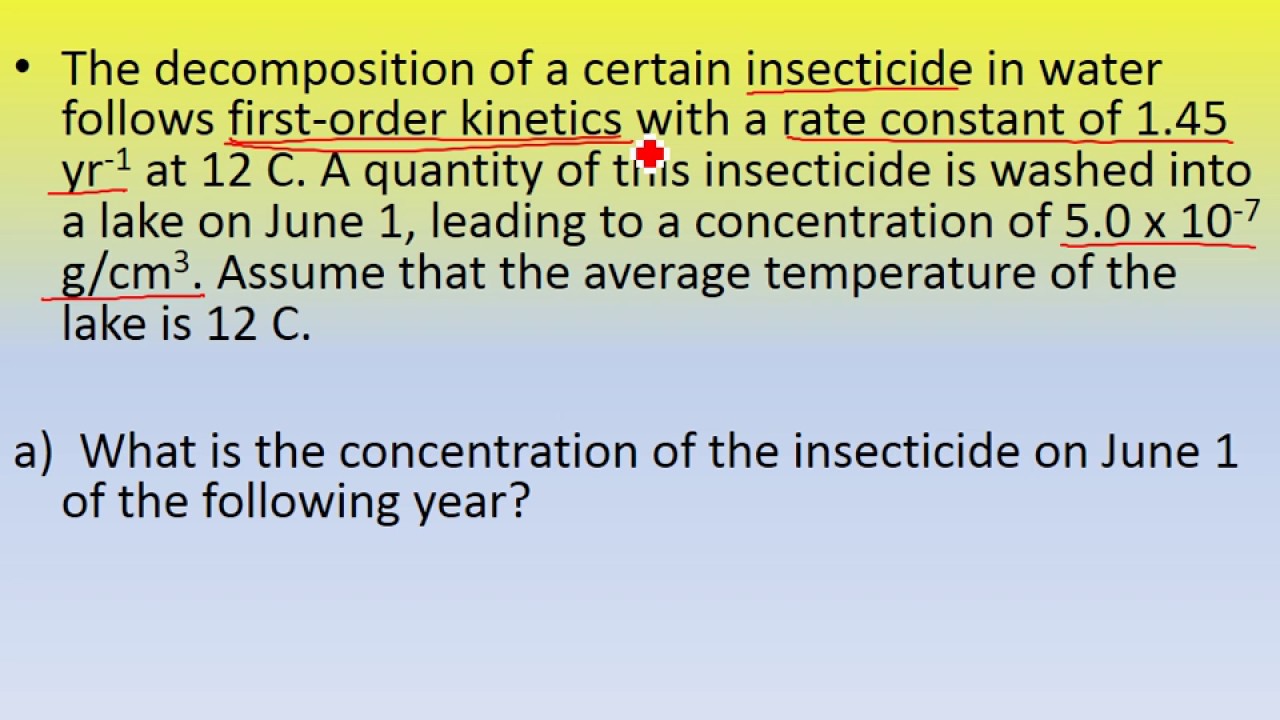
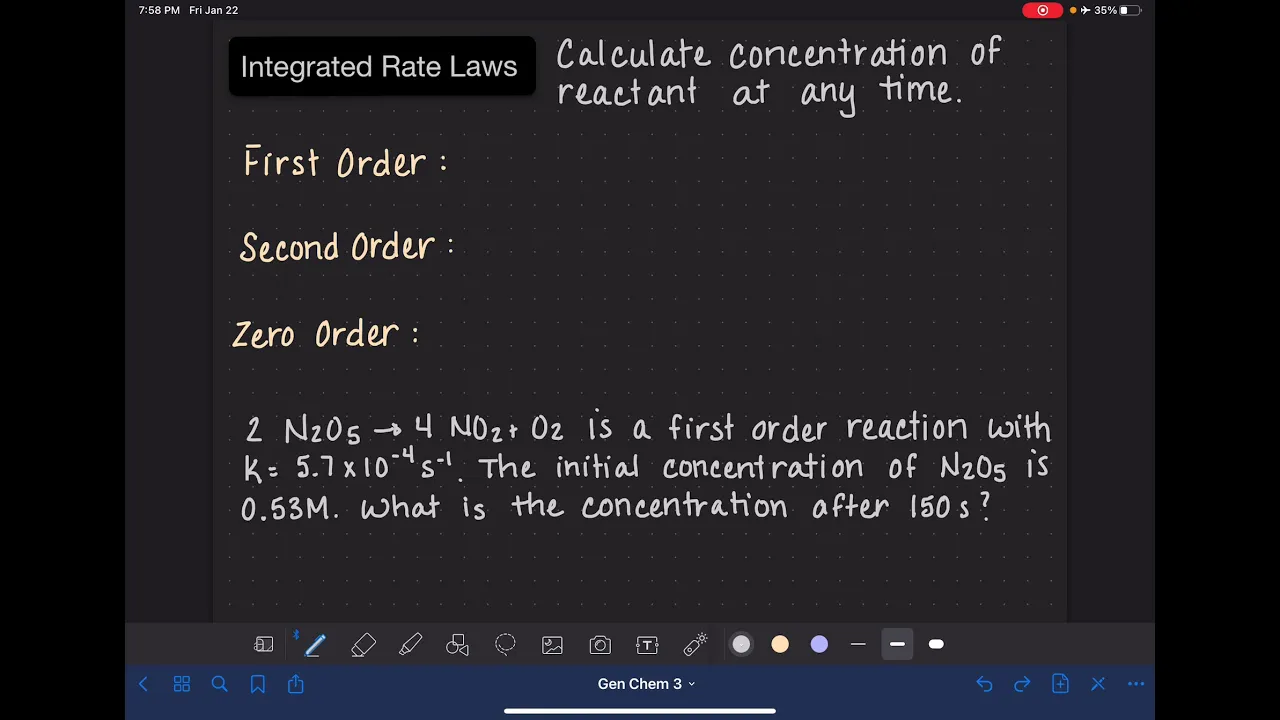
Applying Integrated Rate Laws to calculate reactant concentration as a function of elapsed time for zero, first, and second-order reactions.
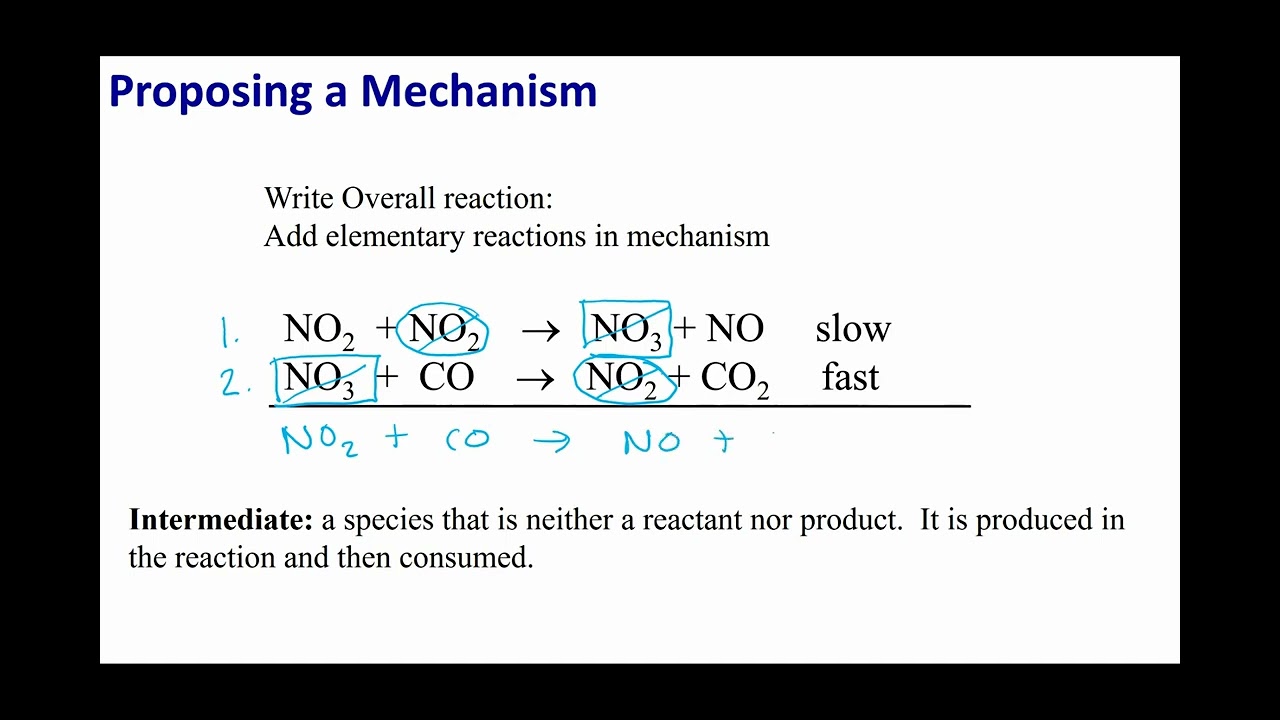
Exploring reaction mechanisms, including identifying elementary steps, reaction intermediates, and the rate-determining step.
Studying the temperature dependence of reaction rates using the Arrhenius Equation to determine activation energy.
Understanding half-life calculations, particularly for first-order radioactive decay and pharmaceutical drug clearance.
220.6K views6.7Klikes25:16Original Release: 2022-01-18
rate law is going to be the topic of this lesson and we're going to talk about rate constants we'll talk about reactant orders in the overall reaction order but the most important part is we are going to determine the rate law of a reaction based on experimental data and this is something students often struggle with a little bit initially but we're going to make it simple i promise my name is chad and welcome to chad's prep where my goal is to take the stress out of learning science now in addition to high school and college science prep we also do dat mcat and oat prep as well i'll leave some links in the description now this lesson is part of my new general chemistry playlist i'm releasing several lessons a week throughout the school year so if you want to be notified every time i post one subscribe to the channel and click the bell notification all right so let's dive in we've got some vocab to talk about first and uh so first let's talk about what a rate law is and a a rate law when you think of like the laws of nature like the law of gravity well what laws ultimately allow us to do is make predictions if i say if i let go of this marker what's going to happen well the prediction is it's going to fall so and that's based on the law of gravity and so that's what laws ultimately let us do is they make let us make predictions that's what's going to be true of a rate law as well and so this is what a typical rate law looks like and it starts off with a rate constant lowercase k uh and it's important to note that it is a lowercase k not a capital k because in the next chapter we're going to see something else we use the letter k for but a capital k to as an abbreviation for or a symbol for so to be careful this is a lowercase k it's a rate constant it is simply a proportionality constant we'll talk more about it in a little bit and then typically reactant concentrations are going to show up so it's typically just reactants not products although that's not exclusive it's just what's usual uh and then you have these exponents right here and these exponents are called the orders and so x would be called the order with respect to reactant a y would be called the order with respect to reactant b and then there's also what's called the overall reaction order which is the sum of all the individual reactant orders and so in this case the overall reaction order would be x plus y now these orders are very commonly integers and they're sometimes related to how many of that particular molecule is involved in what we're going to call the slow step at a reaction not necessarily in the overall reaction and so it turns out you know sometimes these are going to match up with the coefficients in reaction and sometimes they're not so you can't just look at the coefficients in reaction be like oh those are the orders it sometimes just happens to work out that way but it's not necessarily going to be the case so it turns out you're going to have to determine these and get the rest of the rate law here from experimental data you can't necessarily just tell by looking at a reaction what those are going to be all right so again these are very often integers and 0 1 and 2 are the most common by far however in principle like with a you know if you're using some actual kinetics experimental data you know these can come out to fractions or decimals and things of this sort however you're going to find in your typical freshman general chemistry course most commonly you're going to see 0 1 or 2. however if i make the statement that reactant orders are always integers you should know that that is false so however almost exclusively the ones you're going to see in this chapter are going to be integers which is why that makes that statement a tricky true false evaluation so but they don't have to be integers just most commonly that's what we're going to see and again they're most commonly 0 1 or 2. so we're going to take a look at a few reactions here and so let's say i've got a reaction of a going to b and i tell you that the rate equals k times a to the zero power now i'm telling you it's k times a to the 0 power that's telling you there that the reactant order with respect to a is zero so however with only one reactant here so notice that's the only reactant showing up in the rate law then the overall reaction order is zero as well and that's what i really want to focus on here is something that is zero order and so in this case also notice that anything to the zero power equals one and anything times one notice k times one and again it doesn't matter what concentration of a you plug in anything you plug in there to the zero power equals one and k times one is just equal to k and so often times you'll just see this written without any reactant concentration listed there at all because it doesn't matter and that is the hallmark of a zero order reactant is that its concentration doesn't affect the rate at all you want to put in 1 molar a the rate equals k you want to put in 10 molar a the rate equals k and so the rate is not affected by a zero order reactant all right next we're going to take a look at a first order reactant so and for this one we're going to take a look at a fictitious reaction m going to n i prefer to actually just do a going to b every time but i really want to distinguish this and i don't want this to get confusing so but m going to n here and so again m is typically going to be what shows up in the rate law and so here we're going to have rate equals k times the concentration of m to some power here and that power again you know is often integers doesn't have to be but if i'm telling you it's a first order reactance or reaction in this case then i'm telling you that that right there is going to be a one so we'll substitute a one in there that's what makes it a first order reaction here with only one reactant that one reactant is going to be first order but notice anything to the one power is itself so like three to the one power is three five to the one power is five well the concentration of m to the one power is just the concentration of m and so you often see that completely omitted so it's just implied that there's an exponent of one there and so this is what typically a first order reaction looks like and what you see here is that the rate is proportional to the concentration of m if you double the concentration of m it doubles the rate notice if i have 1 molar m well 1 times k is k and then if i do a second trial of this but i use twice as much twice the concentration of m so 2 molar m well 2 times k is 2k and 2k is double the value of 1k and so doubling the concentration of m doubled the rate of the reaction and so this is the hallmark of a first order reactant where you know again in contrast to the zero where the concentration of that reactant doesn't affect the rate at all so here with the first order the rate of the reaction is proportional that concentration you double the concentration of m the rate doubles you triple the concentration of m the rate triples you increase the concentration of m by a factor of 10 the rate's going to go up by a factor of 10.
so and that is the hallmark again our first order and so when you're looking at experimental data if you look at how you know what we typically are going to do is run two independent trials where we say vary the concentration of m we might double it or triple it or quadruple it or cut it in half or we're just going to have two different concentrations and then we're going to see what happens with the rate would actually measure the rate of the reaction and see what happens and if the rate does exactly what that concentration does that's the hallmark of a first-order reactant so again if you double that concentration of m and the rate doubles first order if you triple it and the rate triples first order all right last but not least we'll take a look at second order reactions so in this case i'm going to do x going to y and so x being the reactants typically what's going to show up in the rate law so and in this case what makes it second order is it's going to have an exponent of 2.
and so in this case what this ultimately means is that now the rate is not proportional to the concentration of x now it's proportional to the concentration of x squared and so this has this means that you know the reactant x has an even bigger impact so then the reactant m here had on the rate so now if you double the concentration of x well doubling squared is four and so if you double the concentration of x it's actually going to increase the rate by a factor of four and so whatever you do to the concentration the same thing is going to happen to the rate but squared and so if you triple the concentration of x well 3 squared is 9. that means the rate's going to go up by a factor of 9. if you increase the concentration of x by a factor of 10 well then the rate's going to go up by a factor of 10 squared or a hundred in that case and so again we're going back and looking at some experimental data when we look at two different trials and we say oh look at those two trials the the concentration of whatever tripled there so and then the rate went up by a factor of nine well tripled squared is nine and that's how we'd determine if it's a second order reactant now in principle you can also have say a third order reactant they're super rare super uncommon and you're not likely to see them but in principle it would work the same way if you had a third order reactant well then you know doubling its concentration would cause the rate to go up by double to the third power and double to the third power two times two times two is eight times eightfold increase in the rate in that case now again you're not likely to see that but in principle it works in in kind of the same sense of what we're doing here as well okay so these are the three most common orders but once again fractions are possible decimals are possible but again in this chapter this is probably all you're likely to see if you end up doing any kind of kinetics experiment in your lab all bets are off though just an fyi all right let's take a look at examining some experimental data all right so before we look at some experimental data here to determine a rate law i want to kind of give an analogy here and so let's say that i've got a vehicle and i walk out and i turn the key on my vehicle and this actually happened to me this week and nothing happens no engine turnover not make doesn't make a sound so and the question is well what could be the problem so and don't say out of gas if you see you know if i was out of gas the engine would still try to turn over just wouldn't start so but here's nothing doesn't make a sound so what could be the problem well i could have a dead battery that could definitely be the issue or other common option would be i have a dead starter so and those are probably the two most likely scenario and so the question is well which one is the problem so and let's say i can't afford to take this to a mechanic and i need to fix it myself but i don't know how to diagnose which one it is i don't have a battery tester i don't know how to test a starter you know with a volt meter or anything like this so how do i figure this out and how do i replace this the most economical way well what you do is you go to your local auto parts store and you buy a brand new starter free vehicle and a brand new battery for your vehicle and you replace them both and that's the most cost effective way okay that's not the most cost effective way because why replace both of them if only one of them is the problem so again you can't afford to take a mechanic so you can't afford just to replace parts you don't need to replace and so what you're going to do here is you're actually still going to again buy both of them brand new and you hold on to that receipt and so what you're going to do is you're just going to replace one at a time because if you replace both and then your truck starts well then you still don't know which one was the problem but let's say you just replaced the battery and the truck starts well then you know the battery was the problem but let's say you replace the battery and the truck doesn't start well then you know the battery wasn't the problem in that case you'd put the old battery back in and then you'd swap out the starter and if replacing only the starter and the truck starts well then you know the starter was the problem and the idea is that you want to only change out one of the variables here battery or starter at a time so you know what impact it actually has notice by switching them both out at the same time i don't you know if it fixes the problem that's great but i just don't know which one was really the one that fixed it and i don't know which one to return back to the auto parts store to get my money back so it's kind of the idea here so what we're going to do is we're going to look at a reaction here between no and cl2 to make an ocl so and we're going to look at three different trials we ran so what we're going to do is we're going to do three independent trials we've got three different test tubes or three different beakers or you know something like that and we're going to put in different concentrations of the reactants no and cl2 and by differing those reactants we're going to see then well what impact does that have on the rate we'll measure the rate going on in each one of these beakers test tubes whatever and so in this case what we want to do then is compare two trials and in the second trial we just want to change just one of the reactants only one if we change them both and the rate changes i don't know which one to attribute the change to was it because we changed the no was it because we changed the cl2 i don't know was it both who knows but if i change only one of them and the rate changes i know which one is responsible for that change in the rate the only one that i changed and so in this case like if we take a look at no if i want to pick two trials either the first trial the second trial and the third trial two out of those three and i want out of the two initial concentrations on that little zero there means at time zero just means initial so initial no concentration initial cl2 concentration and if i want to pick two trials where only this is different and notice the first two that's not going to work now the second and the third looks like it'll work but i've got to make sure that it's the only one changing and that is totally the case notice these aren't any particular order i could have compared the first to the third but that would have been a problem if i compare the first trial to the third trial the no changes and that's good because i can evaluate whether that change has an effect the problem is it's not the only change because the cl2 concentration was changed as well so that would not be a comparison that's going to benefit us at this point but comparing trial two to trial three that is going to help us the only change is the change in the no concentration and so in this case as we go from trial two to trial three we can see that the overall concentration here is going to double and so if we take a look at what this rate law might look like here we've got rate equals k and again we expect our reactants to show up here so no we don't know the order and then cl2 and again we don't know the order you can't just assume that these coefficients in the balanced reaction are the orders it sometimes works out that way it commonly doesn't there's no way to know although we'll see one caveat to that in a little while later in this chapter so but the experimental data is ultimately what's going to tell you those are and so in this case we can see that the overall concentration of no doubled and so in this case that no concentration is doubling now the rate constant isn't changing we'll find out that you can change this if you change the temperature or something like that but it's not changing in this case in principle and we didn't change the cl2 concentration going from trial 2 to trial 3. so this is not changing and so the only thing that's changing here is that no concentration and the rate's going to have a corresponding change to that power but if that's a 0 well then it's not going to change at all because anything to zero power is one and anything times one is itself and so if it's zero order then the rate's not going to change well if we compare trial two to trial three the rate changed okay well then it's not zero order now in this case if it's first order and again we're really just going to consider zero one and two the integers so again in principle they could be fractions or things of this sort in that case like in the lab we'd have a different way of kind of going about to solve what these orders are but in this in kind of in the lecture it's either 0 or it's going to be 1 or it's going to be 2 and maybe 3 and we don't have to worry about you know some complex stuff involving log calculations and stuff like this to figure it out we're just going to assume it's either 0 1 or 2 to begin with or possibly three and so in this case if i know that you know the no concentration doubled well the rate's either gonna go up by a factor of two to the zero two to the one two to the two or really rare two to the third power and the question is really just which one did it do well going from point three six to one point four four it turns out point three six times four is one point four four or if you wanna do one point four four divided by point three six equals four probably the better way but this is a four-fold increase not necessarily the easiest one to see in your head but notice 36 times 2 is 72 and 72 times 2 is 144 so 36 times 4 is 144. if you want to look at that way but definitely use your calculator but this increased by a factor of four and so the question is what exponent lines up with that so the concentration of no again doubled but the rate went up by a factor of four well two squared equals four and that's how we know that it's second order and so the key was you know you could have gone back and said okay well so what did the concentration do well the concentration doubled so to the x power according to the rate law and then what did the rate do well the rate went up by a factor of four then what must that exponent be two to what power equals four well two to the two power two squared equals four and now we know that this order right here is a 2.
okay so so far so good now if we want to find the order with respect to cl2 again if we can find two trials where cl2 is the only concentration of either reactant that we change that we allowed to be changed then we got a comparison we can make and so again notice two to three that's not going to work and again we said comparing trial one to trial three where they both change is not really going to be the most helpful but going from trial one to trial two so the cl2 concentration once again doubles so just like the no did the comparison we made and the no concentration is not changing and so in this case only the concentration of cl2 is differed between these two trials and so if the rate changes and it does i know that cl2 is responsible and so in this case if we take a look at going from 0.18 to 0.36 what did that rate do well it also doubled and so in this case the concentration of cl2 doubled to some power and what did the rate do well the rate also doubled so the rate doubled concentration doubled what order is that consistent with 2 equals two to what power well in this case that's a one two to the one power equals two and so we just figured out that the order with respect to cl2 is a one or technically we wouldn't even have to write it in essentially again if there's no order written it's implied that it's a one so in this case we've now figured out that the order with respect to no is second order we figured out the order with respect to cl2 is first order and if i said what's the overall reaction order it would be a grand total of three cool now the last question you might get asked here from experimental data and you'd have to figure out the orders first but the last question could be what is the value of the rate constant and so now that we've figured out the orders we can rearrange this expression to solve for k and so if we do that here we've got k equals the rate all over concentration of no squared times concentration of cl2 that's the expression for the rate constant so to be able to figure out the rate constant i need a situation where i know the rate and both concentrations well great i actually have three different situations where i know all three of those i know the rate and i know the concentrations of the reactants and i can just pick any one of these trials and plug them in now again if you did this in the lab you might not get exactly the same k value trial to trial but they should come out close it is a constant as long as we're not varying the temperature here so but here when i make up the data and i make the data fit the equation no matter which trial you use here the k value is going to come out exactly the same and so in your case i would pick whichever trial has the easiest numbers to work with and i'm just going to use the first one i like point ones uh you know multiplying by point one is dividing by ten or dividing by point one is multiplying by 10 and just makes the math easy without easy access to a calculator for me here uh but you should be using a calculator all right so in this case the rate is 0.18 in that first trial and i'm going to put the units on i didn't put units here but on there on the study guide it's molarity per second for the rates and then the concentrations are all molarity and so the no concentration is 0.1 molar so and then the cl2 concentration is also 0.1 molar and i'm going to almost make a mistake here and forget to square this cool and we're just going to keep track of the units here and so if you look we're dividing by 0.1 squared which is the same thing as dividing by 0.01 which same thing as multiplying by 100 and multiplying by 100 we get this to 18.
dividing by another point one multiplying by another 10 gets us to 180.
and if you look at how the units work out one of these molarities is going to cancel but the other two aren't and so we got a molarity squared on the bottom and one over molarity squared is more commonly in these kind of cases can be written as m to the minus two and then a per second is the same thing as seconds to the minus one and so what you find out if you take the absolute value of adding up the exponent for molarity in seconds or molarity and time whatever time it is it's commonly seconds if you add those together and take the absolute value it actually is just going to correspond to the overall order it turns out so it turns out the units on these rate constants can be different depending on the overall order of the reaction so however again negative 2 and negative 1 is negative 3 and the absolute value of that is 3 and this just happened to correspond to third order overall so there is a kind of a way if if you see the units on your rate constant of knowing the overall reaction order and so if you kind of see the way this works if you have molarity seconds to the minus one well molarity without a any kind of exponent is familiar to the one that would correspond to zero order if i just had seconds to the minus one you're always going to have time like a per second or a per minute you're always going to have time to the minus 1 power and that would correspond to first order and if i had m to the minus 1 s to the minus 1 that's going to correspond to second order or as in the case here we had m to the minus 2 s to the minus 1 and that corresponds to an overall reaction order of third order and so the units on your rate constant can tell you what order what's the overall order of a reaction as well and so sometimes you're going to have to calculate a k value and sometimes they're mean enough to give you just a difference in units so and either you can keep track of your units when you're doing the math or you can realize well if i look at my units this corresponds to zero order this corresponds to first order this corresponds to second order so if you know your order you can pick the right units or sometimes they'll give you a rate constant and you can look at the units and they're expecting you based on the units to know what order it is as well cool so one last time here we're going to write this overall rate law now now knowing the value of the rate constant and so if we take a look here we're going to get rate equals 180 we'll put the units on there as well so molarity to the minus 2 seconds to the minus 1 times the concentration of no squared times the concentration of cl2 to the 1 power which is implied again and that's our rate law and we said the beginning of this lesson that the whole point of having rate law is it allows us to make predictions and so now if i said hey if you started off with a concentration of no of two molar and a concentration of cl2 of three molar how fast would the reaction go well i mean you could just put those into a beaker and then measure the rate and figure it out but now that you know the law just like the law of gravity allows us to make predictions now that you know the law for this reaction for the kinetics of it you don't actually have to run the reaction you have the law if i know that you know the initial concentration of no is two the initial concentration of cl2 is three molar i can plug those values in and calculate out a rate it allows me to predict the rate of this reaction now without actually having to run it in the lab anymore now again turns out we can't get these rate laws without having this kind of experimental data so but once we have it now i don't actually have to run that reaction anymore to know the rate of the reaction i just plug it into that formula now one thing to note i said earlier that the coefficients in the balanced reaction don't necessarily have to correspond to the orders in this one it does and we'll find out that that's going to be a special case but again don't just assume it's always going to be that way it will sometimes it won't you really have to determine them from the experimental data most of the time again we'll see one exception later in this chapter now if you found this lesson helpful and you want to support the channel consider naming your firstborn chat not really please just hit that thumbs up button lets youtube's algorithm know that other students should be seeing this lesson as well if there was anything particularly helpful in this lesson or if anything is still unclear just let me know in the comments section below and if you're looking for practice problems on kinetics and how to determine rate laws from experimental data check out my general chemistry master course includes video solutions so if you're still struggling you can have me work it out for you the course includes over 1200 practice questions free trial is available i'll leave a link in the description happy studying
Up Next
11:45
Arrhenius Equation: Calculate Activation Energy | Chemistry Tutorial
@AlleryChemistry
157.9K views•2016-10-16
83:56
Biocatalysis and Catalysis in Islatravir Synthesis | Merck Webinar
@SCIwheresciencemeetsbusiness
675 views•2020-10-08
19:50
Kinetics of Nuclear Decay: Half-Life & Radiocarbon Dating
@ChadsPrep
16.5K views•2022-04-13

17:31
Edible Water Bottles: A DIY Guide to Sodium Alginate Spherification
@ryan
10.5M views•2019-06-21
Related Study Plans & Knowledge Roadmaps
Structured learning paths in Chemistry
chemistry
Nuclear Chemistry: Decay, Meds & Fuel Cycle
01Introduction to Nuclear Structure and Radioactivity
02Decay Dynamics and Kinetics
03Radiation Interaction and Detection
+ 2 more learning modules
24h5 modules
Explore Roadmap
chemistry
Supramolecular Chemistry: Forces & Machines
01Foundations of Chemical Bonding and Intermolecular Forces
02Introduction to Host-Guest Chemistry
03Thermodynamics and Dynamics of Self-Assembly
+ 2 more learning modules
16h5 modules
Explore Roadmap
chemistry
Photochemistry: Excited States & Reactions
01Foundations of Light-Matter Interactions
02Molecular Orbitals and Electronic States
03Photophysical Processes and Jablonski Diagrams
+ 2 more learning modules
18h5 modules
Explore Roadmap
chemistry
Coordination Chemistry: Bonding & Properties
01Introduction to Transition Metals and Ligands
02Crystal Field Theory (CFT) and Geometry
03Magnetic Behavior and Spin States
+ 2 more learning modules
14h5 modules
Explore Roadmap