





















![МИ НАБЛИЗИЛИСЬ ДО ТЕОРІЇ ВСЬОГО [VERITASIUM]](https://i.ytimg.com/vi/FhQXcvnR-0U/maxresdefault.jpg)
In classical mechanics, constraints are equations that restrict the motion of a system, reducing its degrees of freedom; for a plane pendulum, the constraint x² + y² = L² reduces the system from 2 degrees of freedom (in 2D space) to 1 degree of freedom, allowing us to use a single generalized coordinate (the angle θ) instead of multiple Cartesian coordinates to describe the system's configuration.
Classical Mechanics: Constraints and Generalized Coordinates
Added:Newtonian Mechanics and Equations of Motion: A solid grasp of Newton's laws of motion and solving mechanical systems in standard Cartesian coordinate systems.
Concept of Coordinates and Dimensionality: Familiarity with standard coordinate systems (Cartesian, polar, cylindrical) and describing position vectors in 2D and 3D space.
Multivariable Calculus: Basic proficiency with partial derivatives, total derivatives, and the chain rule, which are essential for coordinate transformations.
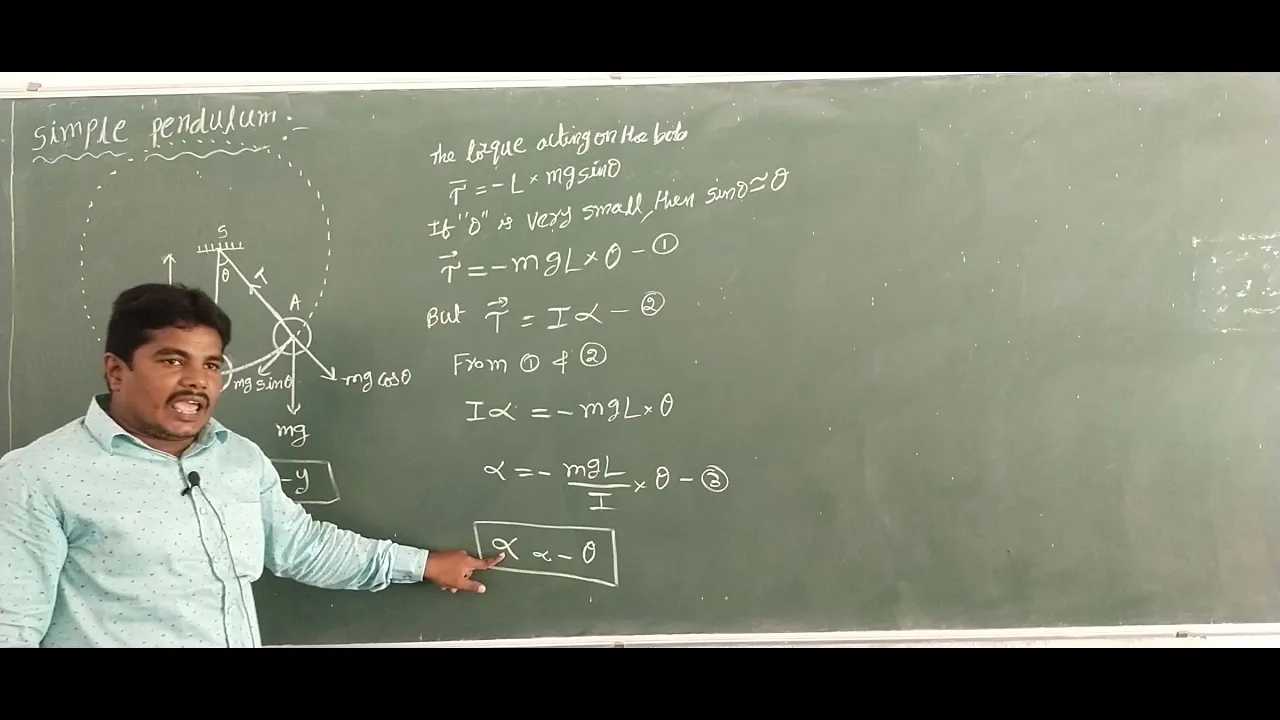
Elementary Pendulum Physics: Understanding the basic dynamics, forces (tension, gravity), and equations of a simple plane pendulum in a Newtonian framework.
Classification of Constraints: Exploring the differences between holonomic, non-holonomic, scleronomic, and rheonomic constraints and how they affect system dynamics.
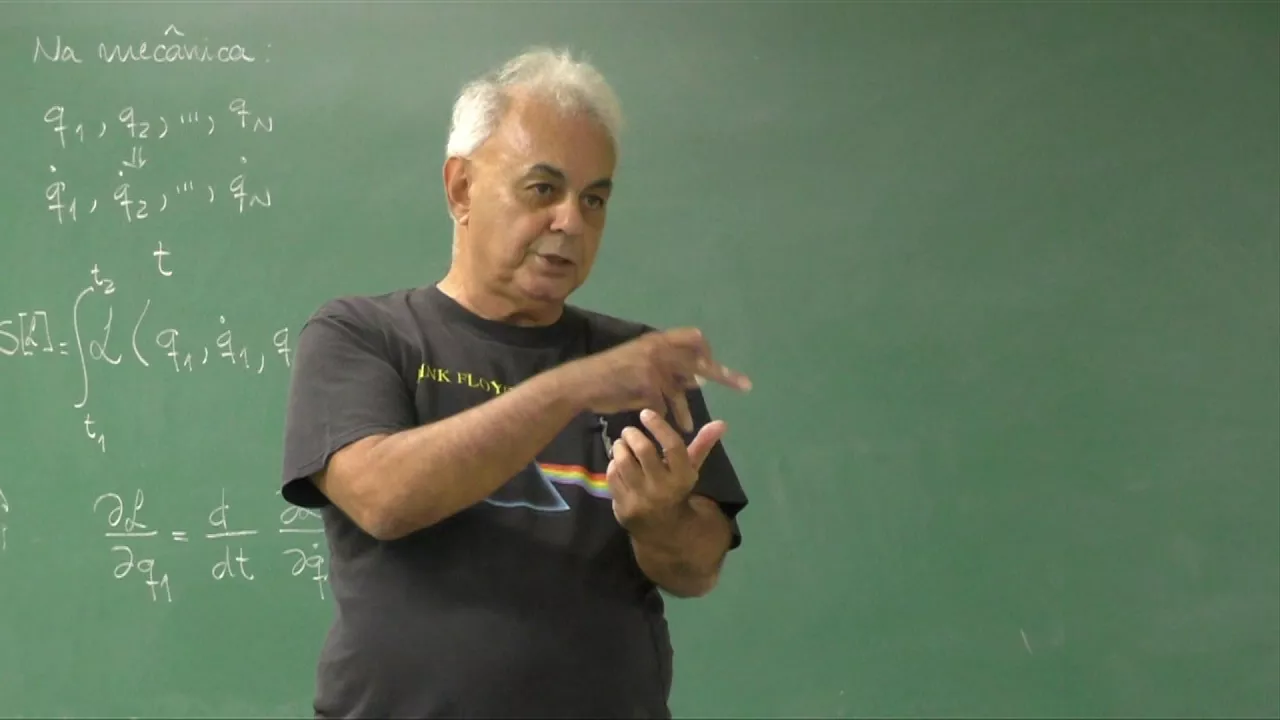
Lagrangian Formulation of Mechanics: Learning how to define the Lagrangian (L = T - V) using generalized coordinates to simplify equations of motion.
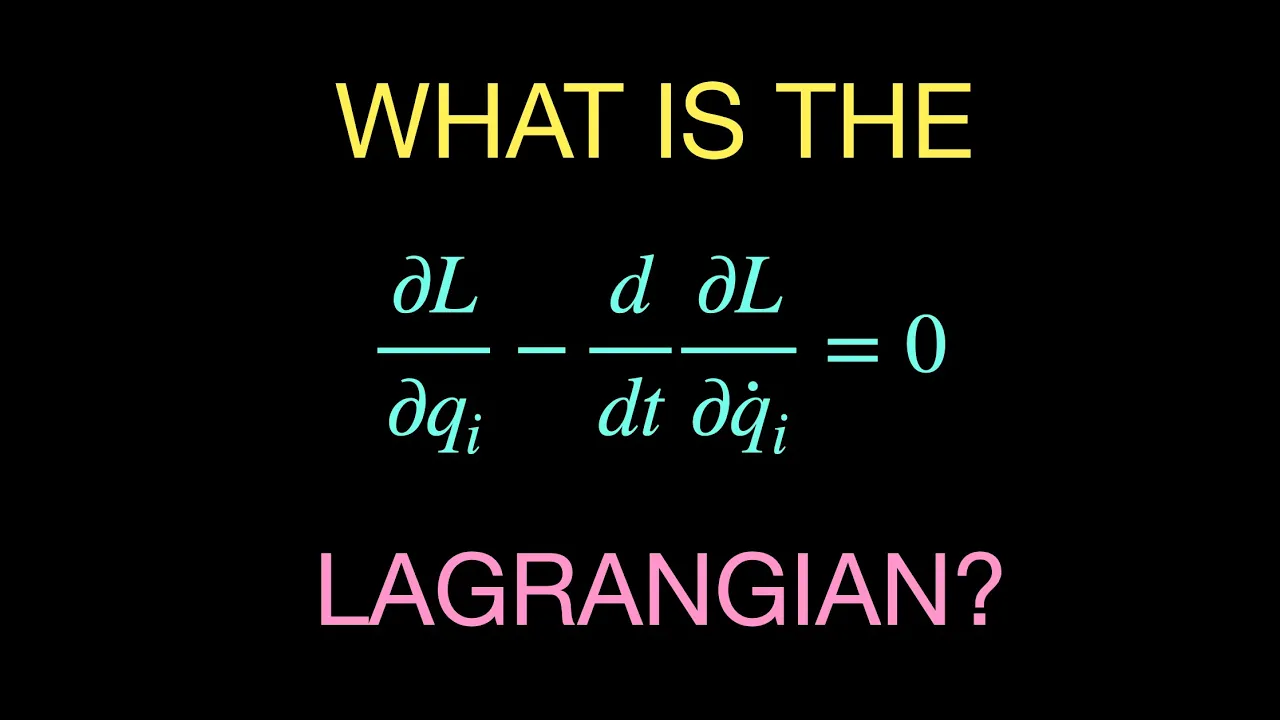
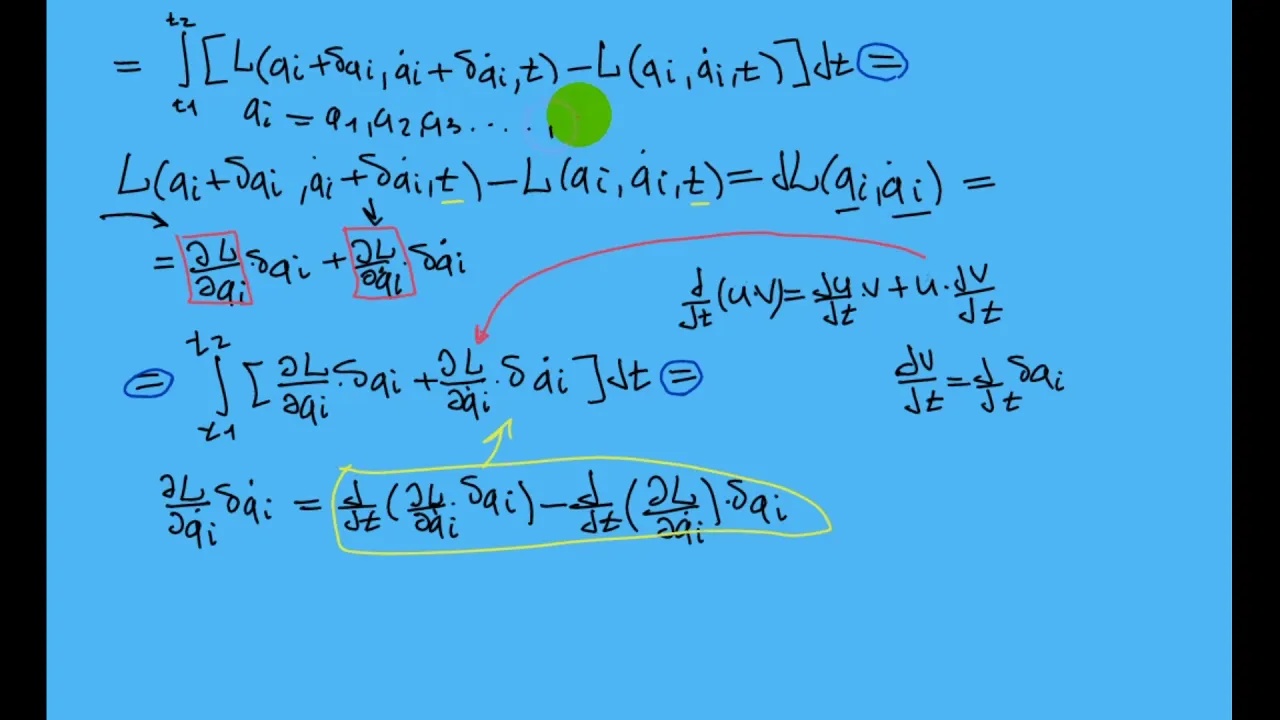
The Euler-Lagrange Equations: Deriving and applying the fundamental differential equations of Lagrangian mechanics to complex physical systems.
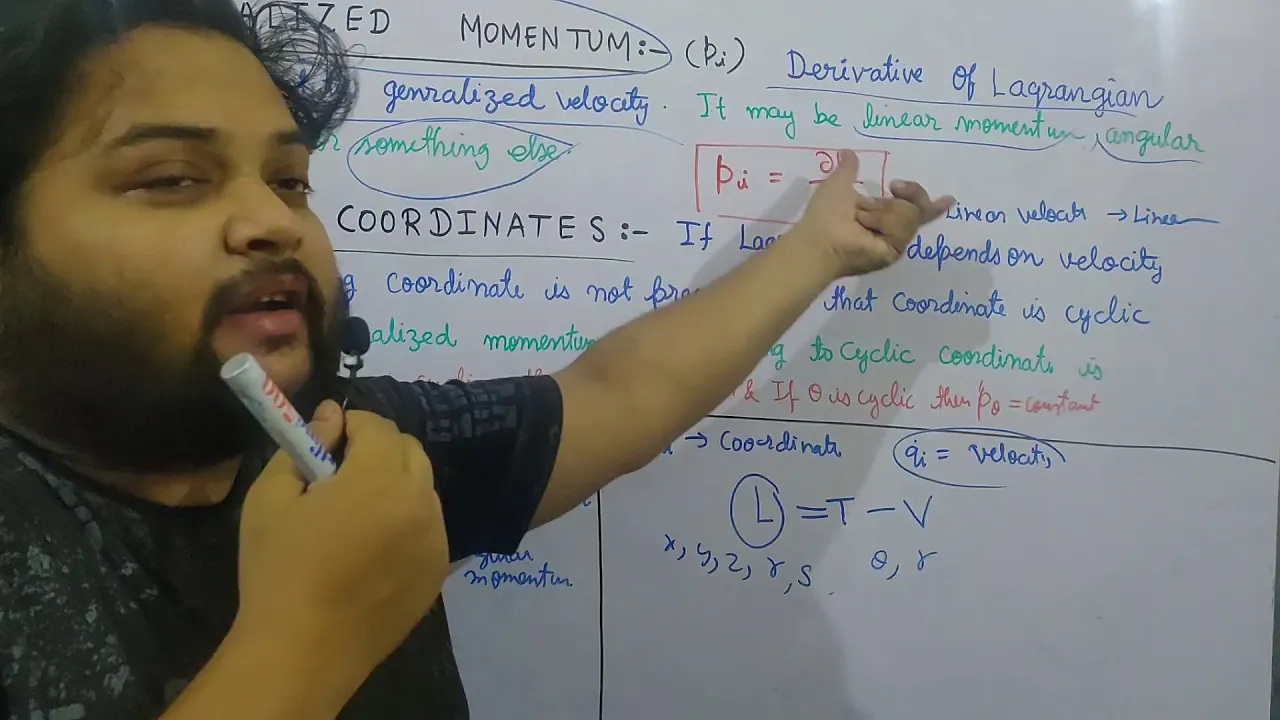
Generalized Momentum and Cyclic Coordinates: Understanding conjugate momenta, ignorable coordinates, and their direct relation to physical conservation laws.
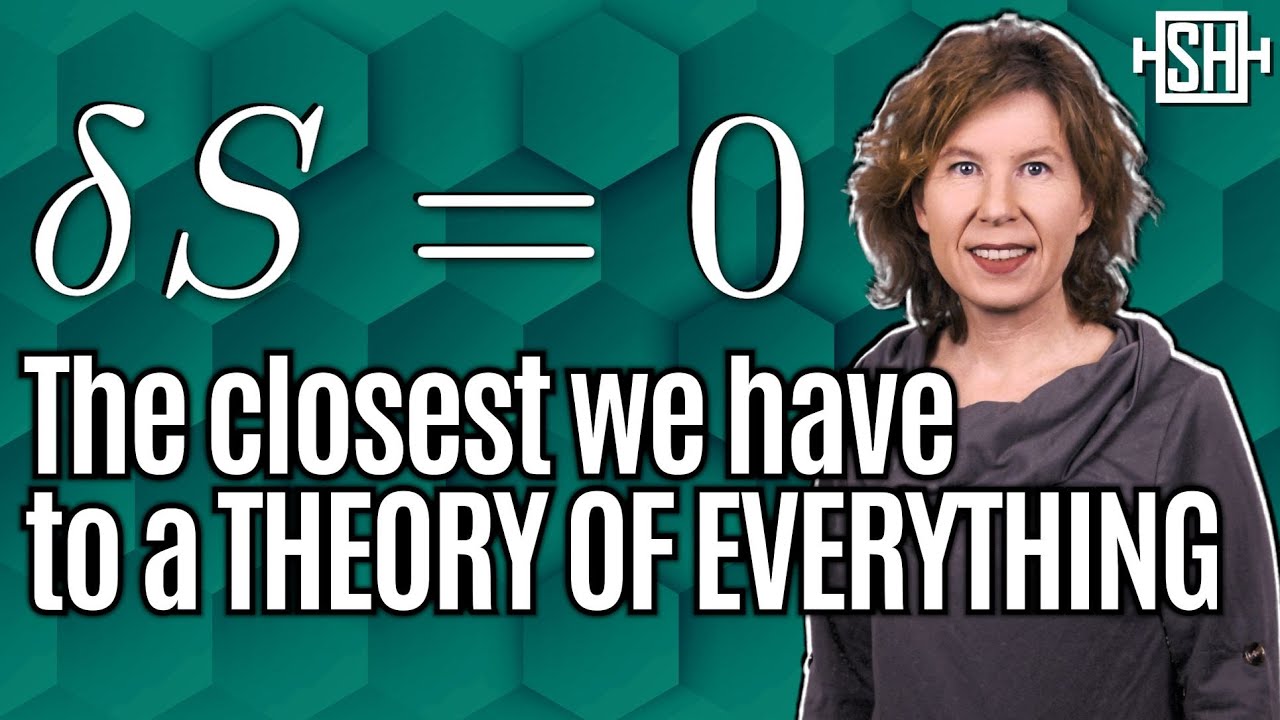
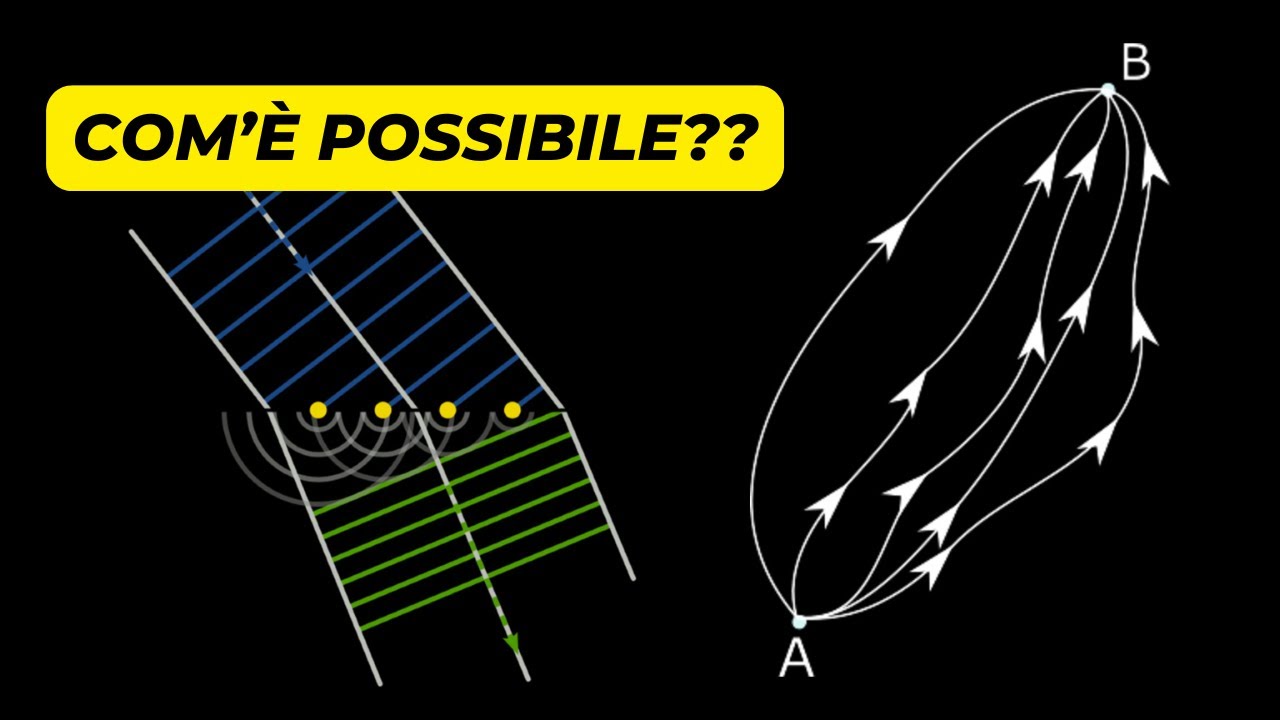
Hamilton's Principle of Least Action: Investigating the variational formulation of mechanics that serves as the theoretical foundation for Lagrangian dynamics.
95.7K views688likes7:35Original Release: 2013-05-12
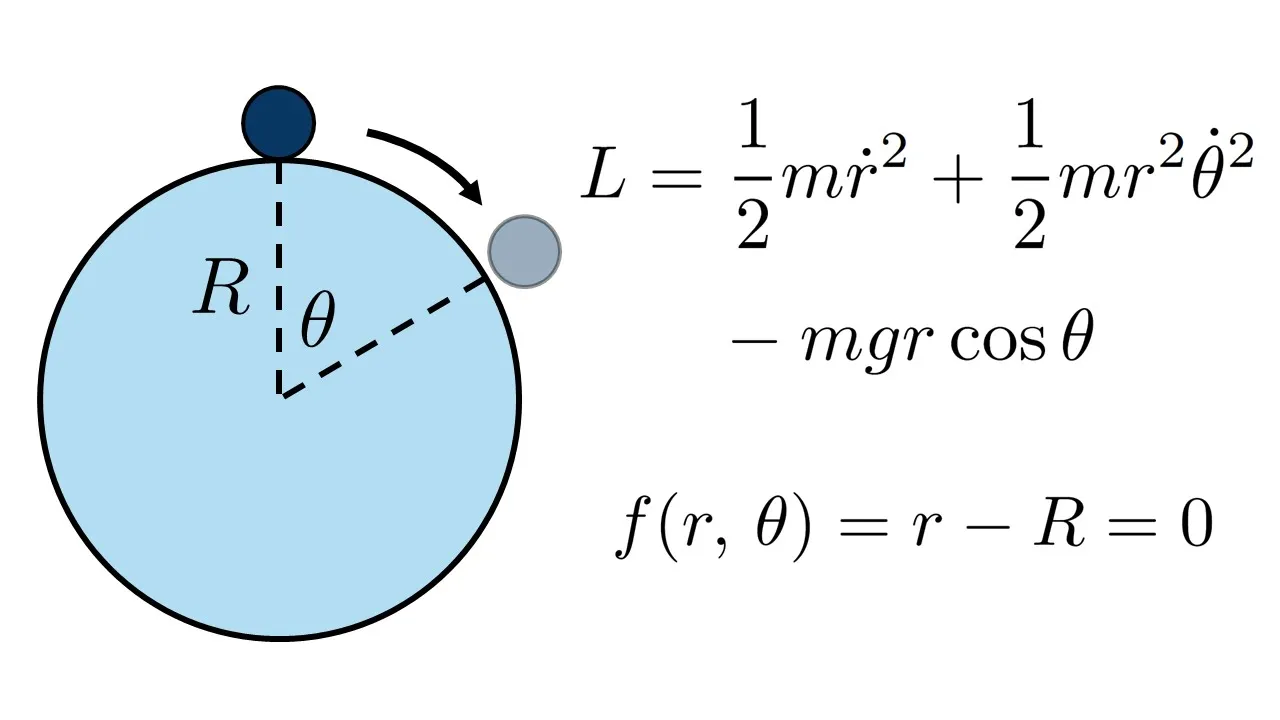
in this video I want to talk about constraints and generalized coordinates and we'll use this example of a pendulum that we've already solved to sort of see the ideas and and I'll link them to the more formal language you might see in a textbook so what did we start with we started out with this pendulum that's in two Dimensions right it has it can move in the X Direction and it can move in the y direction right it swings side to side and in the process it goes up and down so one way we could have solved this is we could have found equations for X and Y that had derivatives of X and Y and then we could solve those differential equations to find the equations of motion in X and Y and then put them together to get the total motion of this pendulum right and that would have been kind of hard right this isn't this isn't a very easy problem to do in X and Y coordinates and rectangular or cartisian coordinates but we said hey we know that this pulum is going to move along a circular path right it's going to stay a fixed distance from this point here where the the string is tied and a convenient thing to do would be to use polar coordinates right we'll have a fixed distance L and this angle Theta will change so it'll just move in this circle and now we only have one variable to use and that actually makes things a lot simpler so what did we do here we started out with two degrees of freedom right two degrees of freedom Freedom I'll just write it out two degrees of freedom and then we used some of our knowledge right we know that this thing is going to move along a circular path so we use our knowledge and that knowledge is called the constraint this this lives in a two-dimensional space but it's constrained by the by the fact that it's moving in a circular path because the string isn't stretching or bouncing or anything it's smoothly swinging back and forth so we had two degrees of freedom and we had one constraint one constraint right and we have an equation for this constraint right it's the equation of a circle so we have that L2 actually I'll use green since it's in green green here L2 equals x^2 + y^2 right that's our equation of constraint so I'll write it here equation eqn equation of constraint actually I should probably use a different word here I shouldn't say degrees of freedom here I should say not degrees of freedom two Dimensions two Dimensions right the vertical Direction and the horizontal Direction Direction and then we have two Dimensions so without any constraints that would be two degrees of freedom but with a constraint there's only one degree of Freedom so one degree of Freedom one degree of Freedom so all of this is just a long way of saying that we can just use Theta to specify the motion of this pendulum just one degree of freedom we only need one variable one differential equation for that variable and that's all we need so to be more general actually Let's cross this out too so so this whole thing I wrote initially is crossed out and say it's actually three dimensions three dimensions because in general things can move in three dimensions so we can write down a a sort of General equation that says S and S is the degrees of freedom degrees of Freedom degrees of freedom d f degrees of freedom equals three three for three dimensions so number of dimensions number of dimensions and then I'll write n 3 n n is the number of particles we're looking at so here we only looked at this one Mass on the end of the this string but maybe there are two pendulums running around or maybe it's a gas with many many many atoms in it in that case n would be very large but but each object can move in three dimensions so we'll need three times the number of particles variables to specify the Motions of the entire system so that's what this 3n is three dimensions for each particle but from that we can subtract our number of constraint equations and I'll use the letter M here m is the number of constraint equations so constraints and here our constraint equation was this the equation that says we know this thing will be on a circle right the equation of a circle so for this example we have one pendulum and and we could say actually we could say we have since we said this is in three dimensions right we can make another constraint equation and say that uh Z equals z right and this this equation of constraint is just saying that we know this thing is just going to stay in a plane it's just a two-dimensional motion so we have three dimensions generally in space but we're saying that one of them doesn't change so we can set it to zero or we can set it to any constant but now we have two equations of constraints so two equations of constraint hopefully all this Crossing out isn't too confusing so we we had three dimensions one object two equations of constraint and so we end up with one degree of Freedom so we only needed one coordinate Theta to specify the motion of this pendulum so in this case Theta takes the role of our generalized coordinate since s is one here there's one degree of Freedom we only need one generalized coordinate so Theta is our generalized coordinate and we're not always going to be so lucky that there's only one generalized coordinate is our generalized coordinate and I guess I should add some arrows to this just to try to make it more clear number of particles number of particles right so we'll do some examples where where things are a little more complicated than this and then we'll use this to sort of figure out how many generalized coordinates we need and then we'll use our equations of constraint to find those generalized coordinates and then once we do that we will we'll be in good shape for the rest of the problem and we can just apply our Lan and put it in the in the oiler lrange formula and get our differential equations of motion
Up Next

45:49
Classical Mechanics: Generalized Coordinates | Lecture 2
@NTNUundervisning
71.7K views•2012-12-17

12:53
21cm Hyperfine Transition in Neutral Hydrogen: Radio Astronomy Basics
@AaronRobertParsons
12.4K views•2011-10-13

32:32
NMR Spin Physics I: Zeeman Effect, Resonance Condition & Larmor Frequency
@nptel-indianinstituteofsci8064
2.3K views•2024-01-17

27:14
Entropy and the Second Law of Thermodynamics Explained
@veritasium
27.5M views•2023-07-01
Related Study Plans & Knowledge Roadmaps
Structured learning paths in Physics
physics
Nuclear Physics (Decay, Fission & Reactors)
01Atomic Structure and the Binding Force
02Radioactive Decay and Half-Life
03Nuclear Fission Mechanics and Chain Reactions
+ 2 more learning modules
12h5 modules
Explore Roadmap
physics
Soft Matter (Polymers, Colloids & Rheology)
01Foundations of Soft Matter & Thermal Forces
02Polymer Physics and Macromolecules
03Colloids, Surfactants, and Self-Assembly
+ 2 more learning modules
38h5 modules
Explore Roadmap
physics
Analytical Mechanics: Lagrangian & Hamiltonian
01Mathematical Foundations: Calculus of Variations
02From Newtonian Mechanics to Constraint Dynamics
03The Principle of Least Action & Lagrangian Mechanics
+ 3 more learning modules
28h6 modules
Explore Roadmap
physics
General Relativity (Spacetime & Cosmology)
01Foundations of Relativity: Special Relativity
02The Geometry of Spacetime: Equivalence Principle & Curvature
03Einstein's Field Equations: The Mathematics of Gravity
+ 2 more learning modules
55h5 modules
Explore Roadmap