
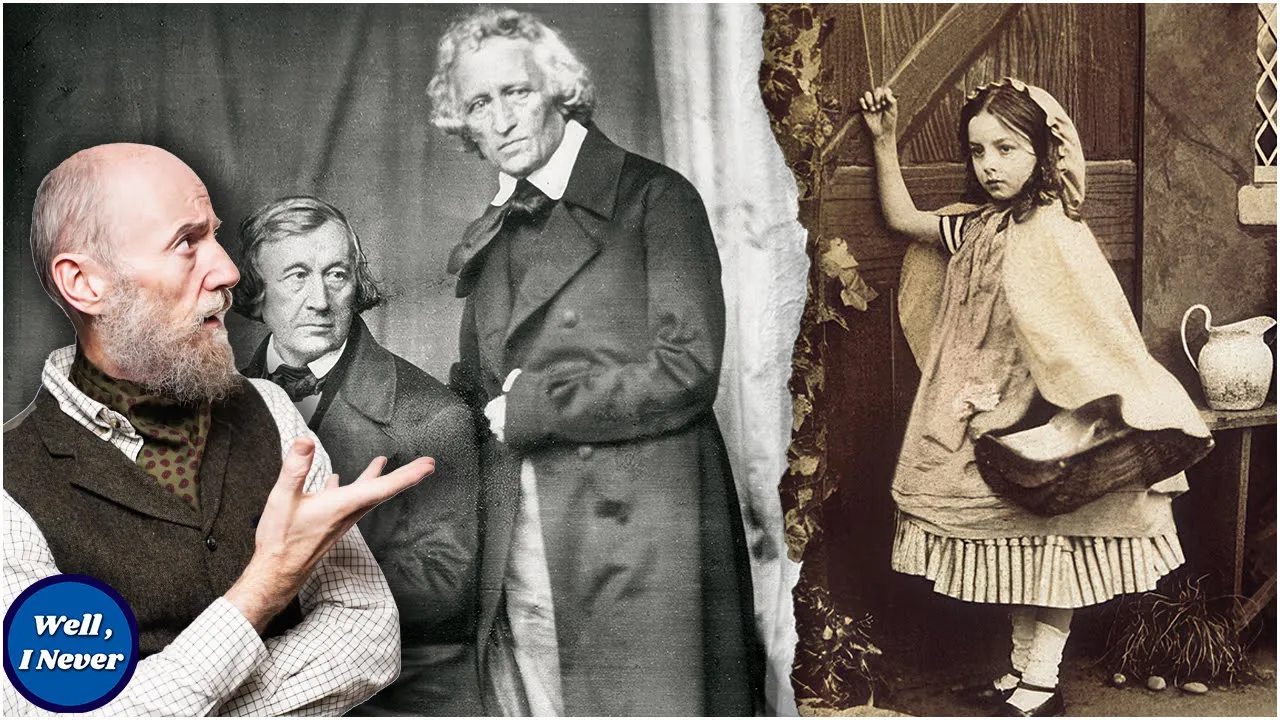

















The Brothers Grimm did not write stories out of thin air. Instead, they went around (mostly through their graduate students) to rural areas and asked old people to tell their stories, which they then wrote down. Wilhelm, who suffered from chronic illness (asthma and heart conditions), was particularly interested in these stories as fragments of an ancient faith that had not been obliterated by Christianity or the Reformation. Wilhelm believed that fairy tales held perennial symbolism representing an ancient faith expressed in poetry. He saw that certain elements like trees have consistent symbolism across different religious traditions (ancient Germanic mythology's World Tree, Christianity's Tree of Life). This gave him a mystical approach to fairy tales that recognized perennial symbolism recognizable to both Christians and ancient pagans.
Grimm Fairy Tales: Sleeping Beauty and The Juniper Tree | Mythology Analysis
Added:[Music] [Music] Greetings all you lovers of lore and legend, whether student, teacher, parent, teller of tales, millstone bombardier pilot, or forlororn wander of the narrative wastelands of our time.
>> The Great Tales is a podcast about myths and legends from both inside and outside the Christian tradition. And we come to you live twice a month to talk about these great stories that Christians have been reading and passing on for centuries and sometimes even longer than that. So now having been exhausted by the glory, the grandeur and the horror of the hash hottheban summer, we turn now in autuminal relief, except for those of you in Texas, to the cozy Germanic north, the land 91 degrees here >> to look at two tales.
Hey, it's your own fault. Somehow it's your fault. uh to look at two tales, one familiar, one less familiar, one bright and one rather darker, but both featuring death and resurrection. Today we will explore Sleeping Beauty, or as it's more traditionally and properly called, the tale of Little Brier Rose and The Juniper Tree, two stories published in the early 19th century by The Brothers Grim. Is this our first Grim tale?
>> It is. It is. Um although I think it's very ambitious of you to say that uh one of them will be bright. Um I will try my best to ruin Sleeping Beauty for everyone today.
>> Uh but yes, that's right. Uh we're going to be introducing the Brothers Grim. And I think it's probably time to first ruin every everybody's conceptions of the Brothers Grim, who they were, and what they were actually doing. Um and since they essentially invented Germanic foly uh this is a topic uh which uh which is quite uh uh um uh personal to me. Um so if you haven't already seen the wonderful 1962 film The Wonderful World of the Brothers Grimm which has a bunch of great stopotion animation um uh and uh was definitely had a a significant place in my childhood. Uh, I'm going to try to tell you a little bit about the Brothers Grim and maybe also pop some burst some bubbles, pop some balloons, uh, buff some myths myth myths. Boy, >> I feel like this is the point now in the podcast where more than any other point before this, I should simply go and take a nap on one of the >> No, no, no. I'm going to be really Listen, I I uh People can't see it, but I' i've got like a really tight uh outline for this section in the So, we're >> No, no, I just >> We're very restrained.
>> I just meant that you're going to be geeking out on a level uh that has not yet been geeked here on this podcast before. You know, you feel like this is your moment.
>> We'll see. I I uh I feel like uh I feel like it could be a lot worse, but I'm going to give just like a very kind of a top level thing here. So the brothers grim were born in the latter part of the 18th century. So that's the late 1700s.
Yak Yakob was born in 1785 and Wilhelm was born in 1786.
>> And they are um German scholars and uh uh uh >> German scholars.
>> They're German scholars and German scholars and German scholars >> um in all the senses of those terms. Um and uh they among the things they produced neither the most important uh at least in you know in their mind not the most important thing that they produced also not the longest thing they produced but certainly the most famous thing which they produced uh as far as history is concerned is their collection Kinder House me uh this is children's and household tales which are sometimes mislabeled as everybody knows uh I really don't like this labeling um but they're sometimes is mislabeled as the the fairy tales of the Brothers Grim, which is wrong on two counts. One, they are not fairy tales, and two, they were not written by the Brothers Grim, although they were heavily revised, as we will explain.
>> And I'm sure they made a pretty penny off of them. So, >> uh, yeah, I mean, it was definitely the thing that sold, uh, more than anything else. So, yeah. So, um, their project is really deeply rooted in, uh, a combination of of kind of personal religious beliefs. Wilhelm in particular and um also their academic pursuits and the just the sort of general intellectual interest of 19th century Germany which had a sort of a mixed result uh as far as history is concerned. Um and um yeah so uh their uh the brothers grim were uh their father died when they were quite young. They grew up very strictly reformed kind of in the sort of the Calvinist. So they weren't Lutherans is what I'm trying to say. They grew up very kind of strictly uh reformed in the Calvinist persuasion of things and Yakob remained that sort of strict Calvinist uh uh legal education uh >> can can anything good come out of Calvinism? Apparently something >> well I mean so so that the the the the stories that they collected are not actually the product of Calvinism. uh which is so the the thing is that the thing is that Yakob although he remains kind of very strictly Calvinist his entire life uh which is why he's also the the the like the least fun one if you go through their notes which is something that I've done uh all the snide comments come from Yakob. So anyway take that for which >> that could be that could be pretty fun though. I >> Yeah. Well, you know, I I I I feel like Jakob Grim was probably not a lot of fun at parties, although he did actually have a uh >> Oh, boy. I'm forgetting the name of it now. When when basically the new the the the first new um >> um my gosh, I'm forgetting the German name for this, but it's basically their version of Parliament. Uh when they had their inaugural session, they actually had a seat there in Parliament for Yakob Grim. um even though he was not an elected official but it was because philology was so important to the formation of a German national identity that he actually had a seat of honor there in the first German parliament.
I'll think of the name later. Um but in any case, Wilhelm on the other hand, >> that it no >> no no. Anyway, in any case, uh uh Wilhelm is um >> bring out words. He's the He's the younger. He's the more kind of mystical woo woo uh brother. and he's definitely got um uh he's he's really kind of trying to supplement his Calvinism with uh kind of like these mystical devotions and um you know um and also just kind of the general um you know at this particular point in time 19th century German Protestantism has like a lot of they have there's like a a a sort of textual criticism side of things um that's developing and there's also like a kind of a mystical side of things that's developing. So, so he's he's got a certain kind of pyotist streak in him.
>> Yeah. Yeah. Pyotist, but also um uh uh Yeah. Yeah. Potist. I mean I mean if you think of somebody like the the Methodists or the Moravian brothers or something like that, it's it's kind of more in that general direction. But also he's really interested in the idea of which we'll talk about here more in a moment. um he's really interested in the idea of this idea of a kind of a you could say it's an almost per perennialist approach to European religion.
>> So both brothers are uh very distinguished professors. They're librarians. Uh they're well read in medieval literature. They basically invent Germanic philology with something called Grim's law uh which describes certain sound shifts in the Germanic language family. Yakob in particular specializes in law and linguistics.
Remember I said he was the Calvinist uh the the dedicated Calvinist of the two.
So of course he's interested in law. And then Wilhelm is focused on stories and literature.
>> I I I just want to pause you here for a second because >> I mean it's possible that people have been listening to us all this time and have and have already picked this up.
But in case you're new in case you've showed up on the great tales because you're like, "Wow, they're talking about the Brothers Grim and this is cool." Um, a lot of folks may not know what exactly philology is or what how important the work that the brothers grim and others like them in that period really was. Like up until this time roughly, the idea that most human languages or that many of the world's languages all had developed from some single ancient language was relatively unknown.
You know the people of course had noticed that words changed but the idea that for instance that Greek and German ultimately came from I what we call protoindouropean was just not a thing that people knew and it was the study of of these philologists who um who started doing essentially the the homework the leg work to actually say this changed into this and this changed into this and so that's why you're me you know when you mentioned Grim's law which is about as you said sound changes in Germanic languages um you know that gets um these ideas get very very broadly applied and so uh you know there's this this discipline is essentially being invented in this period and I mean it's a revelation to the world in a lot of ways you know it's it's it is an it makes people rethink about humanity in in um in ways that they had not yet and so that's why I think it's important to underline this is that while of course as you said that they're known for this collection of stories um they're actually really significant in the history of scholarship and and and and a discipline that most people don't even know what it is these days.
Philology, which is not just about language changes. It's sort of about, you know, linguistics embedded within stories and and history kind of all of this stuff all together as one language world I guess probably. So the the early philologists, so you could say generations before the Grimms. Um I mean everybody in the Middle Ages believes that uh all languages in the world go back to the Tower of Babel. And early philologists, what they're actually trying to do is is prove that on like scientific grounds.
>> Yeah.
>> And um what the with the you could say before the Grimms. So philology is philology is the study of language and literature through time.
That's the easiest way to kind of express it. And so there are people who are like more like technically u mainly focused on diconic linguistics and there are people who are mainly more focused on the literature side of things. But >> basically it's the it's the study of those things through time and how they change through time. Whereas you could say somebody who's just a pure linguist would be focused on just like a particular slice of time usually the present. Um, a philologist is is basically looking and trying to track things on a historical uh uh on a on historical lines, but early philology, and this is especially true of the Grimms, is not looking at linguistics as its own subject for its own sake. Um, and so and the the term philologist, which just means like a lover of words, um, had been used well before them.
Typically speaking, a philologist in in old Europe meant somebody who studied Greek and Latin, maybe also Hebrew. And so these and the reason is because these are the classical languages. These are the languages of the ancient world.
These are languages that have prestige.
Well, with the fragmentation of the medieval consensus and the development of nationalism, it becomes very like European nationalism. It becomes very important for people. Uh there's this saying in German that basically uh means um to have a language is to have a nation. So what you need to do if you want to say actually we're a nation we're a civilization with our own uh maybe connected to the European story but we have our own national myths we have our own own national epics we have our own national language all these different things to be able to say those things is really really important uh to assert kind of your national identity remember at the time of the uh when the Grims were born there was no country in Europe called Germany >> that's right >> there were there were a bunch of local littleities principalities and palatinets and so on which were part of the old Holy Roman Empire. And so this is they're they're really there at the moment when Germany as a country is coming into its own um and really being invented basically. And they're an essential part of that um they're they're an essential part of that invention because what they are able to do by tracing back the antiquity of the Germanic language to a common Indo-Uropean root um or as they would have said Indo-Aryan uh root although um that that that word Aryan um has a very different connotation now so people don't typically say that but that's what the Grimms would have would have called it >> um by by tracing back its antiquity they could show that actually the German language or really again it's German language is at at their time but they they kind of what they what they do is they're part of that movement of uniting everything into a single language uh the German language has just as much antiquity as Greek and Latin that's part of what they're trying to show and then also try to say there's also this ancient uh it's also a recipient of an ancient Indo-Uropean or Indo-Aryan mythology um which uh which also has like its own you know proper for epics and is related to the Greek and Latin stuff, but it's just as old as they are. So, Grim uh Yakob Grim formulates something called Grim's law, which is also um uh what is usually called the first Germanic sound shift. And this is basically along three lines. Um there's a a a shift from uh I was not going to talk about this, but you open the >> You don't have to.
>> So, nope. Nope. Have to do it now. So, uh voiceless stops. Voiceless stops uh in dramatic languages from European.
Voiceless stops. Okay, kids, if you don't know what voice does, I'm going to explain. I'm going to explain. So, a voice, >> you know, it's okay for me to participate in this, too.
[Laughter] >> No, go ahead. Go ahead.
>> Do you want to explain, Grimlock?
>> I said I'll just I'll just uh I'll just, you know, sit on the couch here.
>> So, when we're talking about sounds, there's what you do with your tongue and there's what you do with your throat.
>> You know, I bet you our ratings would be much higher if like we were to like have a big feud like on the air or something like that.
>> Wouldn't that be fun?
>> Yeah. I'm just I'm sick today and I'm just trying to like get through my outline. So, uh All right. So, a voiceless stop uh is a would be like a P. So, my throat's not doing anything, but I'm my lips are making a stop. So, P.
So, P, T, and K, those are all voiceless stops. What happens in Germanic languages is that in in many cases, most cases, they those become voiceless fricatives. A fricative is where you have any any kind of like a uh like a the or [Music] so what this practically means is that p becomes f t becomes uh th so t becomes and h becomes uh and then uh k becomes. So the reason that's important is because in Latin you have pat and in Germanic languages it becomes father right? So that's an easy you have that's an easy example because it's got two same thing with with uh uh brother um and so on. So so you have voiceless stops to voiceless fricatives voice stops to voiceless stops voice aspirated stops to voiced stops or sometimes fricatives in certain positions. Um, and if you you could just look this stuff up in Wikipedia if you want to see the changes. But the no the the point that I'm trying to make is that what you can look at the hundred oldest like most common words in English for instance or German and uh find their exact parallels what we call cognates. So they're at along the same level of like the family tree you could say in Latin or in Greek or in Sanskrit.
And that's very interesting if you're a certain kind of nerd. But the reason it was important to what the Grims were doing is because it was a way to prove that Germanic culture and language was of equal antiquity to the classical languages. Now, Father Andrew, do you want to >> I was just going to go and into the microphone a little bit. Yeah. for all the kids at home.
I All right. So, is this where I get to tell my vampire joke or >> I think that you got to work that you got to work that in somewhere. I don't know. I think there's like a lot of cannibalism later in the episode. So, maybe that would be a good >> That's because vampires are cannibals basically everybody.
>> Yeah. So um the uh uh anyway so this is the kind of thing that they're working on and the way that you do this work is you go around and what you want to do is collect the oldest stories because the oldest stories have the oldest words. Now so this is the first bubble that I have to pop about the brothers grim is that I think some people have this idea. Um, so in one of my the other another hat that I sometimes wear, uh, I run a publishing company that publishes fairy tales and people, uh, come up to me very often at conferences, like I'll go to like a classical ed conference and I'll be there with a book table and I'm selling books. People walk up to me like, "Now, are these the original versions like in Grims or did you guys change these?"
>> Oh man. And when when somebody asks that question, they have this idea in their mind that the brothers grooms were just sitting around and they just wrote out of thin air came up with a whole bunch of random stories.
>> Yeah.
>> Which is which is understandable. It's understandable that people think that. I mean, we call them, you know, the fairy tales of the brothers grim. I know you don't like that. Or, you know, or Grim's fairy tales is actually the the phrase.
>> Yeah. you know, so their name is attached to it, but really it's that they they went around collecting these things. So they they went to especially rural areas um particularly but everywhere and said, you know, to found found the old the old people in the in the town said, "Tell me your stories."
And they wrote them down and they collected them. So this represents a an anthology. And of course when we say they went around collecting them, what we really mean is mostly their grad students went around collecting them.
>> That's what grad students are for.
>> That's what grad students are for. Um and actually if you read if you look at the original manuscripts uh uh that the Grims were working from, you can actually see it'll usually be noted which grad student collected this particular story. Uh because what they would do is they the grad students would go out and they would collect these things and they'd bring them back and then YaKob and Vilhelm would sit down and go through them and you could see Wilhelm being like, "Oh, what a beautiful story. Oh, I bet it's connected to this and this and this."
And Yakob goes, "Eh, this seems French."
Crosses it out.
>> This seems French.
>> Seems French.
>> Little do they know that the French and the Germans >> Well, well, they know, but >> French say French is actually a German word.
>> Yeah. ultimately.
>> So, >> oh yes.
>> Yeah. So, in any case, where all of this kind of becomes interesting for our purposes is that as they're collecting these stories, uh the two of them together, but in particular, Wilhelm. So, Wilhelm uh is suffers from chronic illness. He has asthma, he has a heart condition, which might have been something like angina. And um he uh so he's always kind of thinking about death. and he's always kind of thinking about um you know these big questions I think and like I said he's got this kind of mystical bent to him and uh he also married uh a woman named Henrietta uh Dorothy Wild who uh also became like a big big part of this and and she helped collect some of the stories and but then also she she had a big influence in Vilhelm. And so Wilhelm had this idea that these these old stories uh the the the children and household tales, fairy tales if you want to call them that, um that they're uh that they are the last fragments not obliterated by Christianity or by the reformation.
Yeah.
>> Of what they called an ancient faith expressed in poetry, which is a very fun >> given they think. Yes. They think that this is that these are representations of paganism. You know, >> it not see it's not even that they think it's representations of paganism because what they think is that is that there's uh they were kind of perennialists.
>> Oh, okay. So, so for them >> pre-Christian anyway, whatever their idea of what pre-Christian is >> that but there might be some >> Okay, so languages develop through time.
So >> you can also study the way that stories develop through time. So you can take the diconic approach or the stematic approach and you can take a story like for instance the story of the ring of the nibbleongs which is like the sort of the great Germanic epic which doesn't exist in entirety anywhere. Um so you have to kind of piece it together >> which we will we will do that.
>> Oh definitely. At some point at some point >> I think our Germanic stuff actually gets we we get pretty decent ratings for when we dive into Norse and uh >> well not if I keep talking about sound changes we won't but um >> all right so you can take theatic approach and be like all right so this is probably the original version of the story and then later on this element was added and later on this element was added and later on this element kind of fell out but it's exists in these other versions and so on and you can basically in the same way that you can plot out the family tree for a word >> you can you can theoretically do the same thing for a story.
>> Yeah. I mean, there's a whole like in um in folklore studies, there's a whole like taxonomy of these of these kinds of stories. Like they have there are technical academic names for each tale or type of tale or whatever. And sometimes it's a name. I mean, it depends on who you're reading.
>> Sometimes it's a name, sometimes it'll be like and this is tail H237, you know, or whatever. stuff like this, you know, it's all very sort of scientific.
>> Yeah, that's really good around the around the campfire, guys. H27.
>> Yeah, >> they're like, "Oh, H237. I want to hear that one again, Dad."
>> And those schemes don't always like agree with each other. So, it's not like it's it's not like it's all kind of hard and fast. And sometimes I mean, the thing is that the transmission of a story is very very hard to prove sometimes because Yeah. Uh but so to the Grimms though for them that was kind of proof that there are things that are in you know in the early 19th century they'll start talking about like the collective unconsciousness right this idea that there's like stuff that's sort of like in the collective you know like hive mind of humans and that's why you have the same so like if you have a dragon killing story here and a dragon killing story here well one of three things is possible one is that uh there were dragons in both of those places and somebody killed them and then later on they told a story about that. Uh the other is that somebody here brought a dragon slaying story to this place or there's something about dragons uh you know which people just keep making them up even though nobody's ever really seen one.
>> Yeah.
>> And I think I think this is difficult. I mean we we can talk about it but I think one of the reasons why this is a little bit difficult to grasp for modern people and I say this with a little pain in my heart uh is because of frankly of pop culture right so what is pop culture I I mean there's a lot about pop culture that I that I love you know I think there's all kinds of stuff worth talking about in pop culture because it is continues to be storytelling right that's what it that's what pop culture ultimately is but the thing about pop culture is that it's it's mass broadcasted culture. So, for instance, to mention a very famous fairy tale, um, Cinderella, if I say, well, everybody knows what the story of Cinderella is about, then the reality is is that most people, unless there's some level of nerd, what they know about is the Disney Cinderella. That's the one that they know. And so like when a number of years ago when Disney put out a liveaction version of Cinderella, which actually I thought was really good and one of the few live action uh versions of one of their old stories that really succeeded.
Um uh that as everyone was watching it, we were seeing how it was slightly different than the cartoon.
>> Yeah.
>> Right. because we all knew the cartoon, you know, and you all everybody expected, for instance, that Cinderella is going to look like the cartoon Cinderella. This is why when Disney does uh a live action version of one of their stories where they make the main character, often the princess character, look radically different in whatever way from the original, people get mad.
And it's not because of usually an ideological commitment that they have.
It's that you're messing with the story that everybody knows, right? This is different though than traditional storytelling where as you mentioned there's a lot of different versions kind of floating around, but there might be they might all possibly be referring to some kind of version. Um, we don't know.
Well, I I I don't think that in any case of most of these stories that there can ever be pinpointed here is the original version of this. you know the point of the story at its origin point the point where it was made up by somebody and it may even be for most of them it's probably impossible to do that because you know like like you know read Tolken's on fairy stories this whole cauldron of story idea something emerges from the cauldron and it's recognizably the story that we all know but it's probably composed of little bits and pieces of memory from a lot of different other stories that it just keeps getting mixed and remixed mixed and so forth.
It's like a stew. I mean, this is Tolken's image, which I think is great.
You know, it used to be the case in many places, especially in Northern Europe, that there was always just this pot of stew always, always always, always, always on the fire, and every so often you would just add ingredients to it, which means that it's always going and it's always going to be a little bit different every time you have it, right?
And and that's the way that stories traditionally worked. Um, one of the things that kind of throws a monkey wrench into this to some extent is literacy.
Um, and so when you got an anciently literate culture like classical cultures, then that tends to fix stories much much more than the traditional storytelling approach, although not completely because you're still having to copy it every time. It's not broadcasted.
It's not broadcasted. It's not printed.
It's copied by hand, which means that there's always the possibility for adjustments, sometimes big adjustments.
I remember reading um I think this is all very this is a bit of a of a of a digression but I think it's all very relevant to what we're discussing. I was reading uh Alfred the Great's uh translation of Botheus and there's a whole passage in there where much to my delight I discovered that Alfred added a bunch of stuff about giants because he thought that it was it needed to be in there. But by no means did he did anyone think that he was you know making a false translation because he added stuff to it. This is just simply what you did you know. So yeah, literacy kind of fixes these texts to some extent, but broadcast and recording and so forth, this is a massive, massive revolution, a massive revolution. And I think it's kind of amazing to me to think about Thomas Edison making the photograph, right? And probably at that moment, no one realized how huge of a concept this would be, how this would change humanity.
And he didn't realize it himself because you know what he thought that people were going to do with that thing? You know what he thought was going to be the popular use of that? Do you know?
>> You don't know?
>> No.
>> He thought that people would use it to record their pastor's sermons so they could relisten to them at home.
>> Oh yeah. The the the most famous and obvious use of recording software.
>> Exactly. Exactly.
>> Hardware. So, so he had no concept like if you had told him about the iPod I mean sure he would have believed it you know but still you know and of course that's a dated thing even now right everybody now we've got Spotify so I mean it's amazing that like like um you know just to make reference to pop culture item that I happen to have loved uh you know the film that came out this summer on Netflix K-pop Demon Hunters uh not too many weeks after it came out uh Netflix released this movie in movie theaters with the lyrics being printed on the screen because this is a musical as a singalong version. And the reason why everybody could sing along to it is because they had watched the exact same movie with the exact same soundtrack over and over and over again such that they could listen to it and sing it back exactly the same. Exactly the same. And I think probably the only place where people can still experience the sense of something being handed down rather than broadcasted and then reproduced and then people imitating it like it's all karaoke. Um, frankly is in traditional church music.
It's probably the only place where where most people can experience this on a regular basis where you go and hear chants that are handed down. And it's not that everybody there's this one canonical recording that everybody's trying to imitate. There are recordings now being made of church music, but that's not the that's not kind of the origin point of any of this stuff. And not everybody's, you know, everybody's not trying to copy that. And there's a lot of little different different versions of all these these hymns and so forth. So I I I think it's important to underline that that that what we have in the Brothers Grim is um or or so we think is a fixing of a certain set of of stories. But as I know you're going to tell us that the stuff that they wrote down is not even what everybody's reading and it's certainly not what Disney made.
>> Yeah. So the the I'm not against Disney making its own versions because by the way because that >> just extends >> the tradition. You can argue about whether they're doing it well or badly.
Lewis was strongly against obviously Tolen was as well but Lewis was strongly against Disney making versions of the Grim's brothers fairy tales and his his argument was there's death in the screen. Once you put once you you you put something on on a screen and once you uh like once you once you make a a film version of something that then becomes the definitive people version in everyone's minds and you lose forever the kind of the aliveness of the story.
So >> but I I I will say let me let me just add something on to the end of that thought. Um, we were actually, um, as we said last time, we were supposed to have, um, Jonathan Pou on this episode.
Uh, something came up and so he's going to come back at a later point, but I bring him up because like the stuff, the books that you and he are publishing together with Symbolic World Press, right? So, the first one was Snow White as I recall. Second one is Jack and the Bean Beanto. Although the the names are are different there. Snow White and the uh Widow Queen.
>> Snow White and the Widow Queen, Jack and the Fallen Giants, Jack, the Evil Witch, >> and now Rapunzel and the Evil Witch. But if you think about it, like part of the reason, like what I think on some level y'all are doing is actually piggybacking on the decay >> of the death that has happened in the screen with these stories. So, and I'm I'm I'm happy about that. Well, so the the thing is that that uh Disney has now brought about the death of the death of the of death. Um, you know, >> wait a minute, the death of >> I know, I know, but I mean, if you think about Okay, so they they Disney releases, just talking about Snow White for a second, Disney releases uh a Snow White uh cartoon, and that becomes the definitive version of Snow White in everybody's imagination until they announce, "Hey, we're making a liveaction remake." And then everybody hates the liveaction remake for all the reasons that a just and godly person should hate the liveaction remake. Uh which is say it's a very bad piece of art. And uh the result of that is that now they say wait a minute Disney doesn't own this. Whereas for the longest time that's how people have thought about these stories. And in fact they'll say oh that in those Disney stories blah blah blah. Well it's not a Disney story. And then and then you can go back to say, okay, well, what's the actual version of Snow White? What's the what's the real canonical version of Snow White? And it turns out actually there isn't one. Um there's uh even the Grimms collected initially several different versions. I've found probably about 30. Um, including my my favorite uh we're way off script now, but my favorite uh my my favorite slash least favorite version of Snow White is an Italian version um in which uh it the story goes like you would expect up to when she moves in with the dwarves and then all the towns folk find out that there's this young woman who's living in a in a house with a bunch of unruly, smelly men. And so they show up and they burn the house down and they kill them all and that's the end of the story.
Uh pretty clear to see the moral there but obviously that is not a satisfying conclusion to that to that story. But it must be in any case >> expregated from our town.
>> Yes. Yes. So in any case you can study languages as they change through time.
You can study uh uh you can study stories as they change over time. And Wilhelm Grim especially really thought you could also do the same thing with religion, which is to say there is this perennial >> Protestant idea >> version of like true spirituality >> that in each age becomes kind of stoaltified and is in need not so much of a reformation as a like a revivification.
And so what he sees in these stories is these stories hold this perennial symbolism. And I want to be very clear and say that Vilhelm is wrong but also that he's not totally wrong. So let me give an example >> for Vilhelm. When you have a tree >> like the Hazel tree in Cinderella, which I'm sure everybody remembers the importance of the Hazel tree in Cinderella. Uh, no they don't because it wasn't in the Disney version. Okay. But the hazel tree in Cinderella or the protective tree in the Hansel and Gretle story, which again, >> I have to say, by the way, though, the tree is in the Steven Sonheim version.
>> Oh, there you go.
>> Into the woods.
>> Yeah. At >> some point, we should do like an Into the Woods episode because Into the Woods is all about >> drawing together and remixing fairy tales.
>> Yeah. Yeah. Yeah.
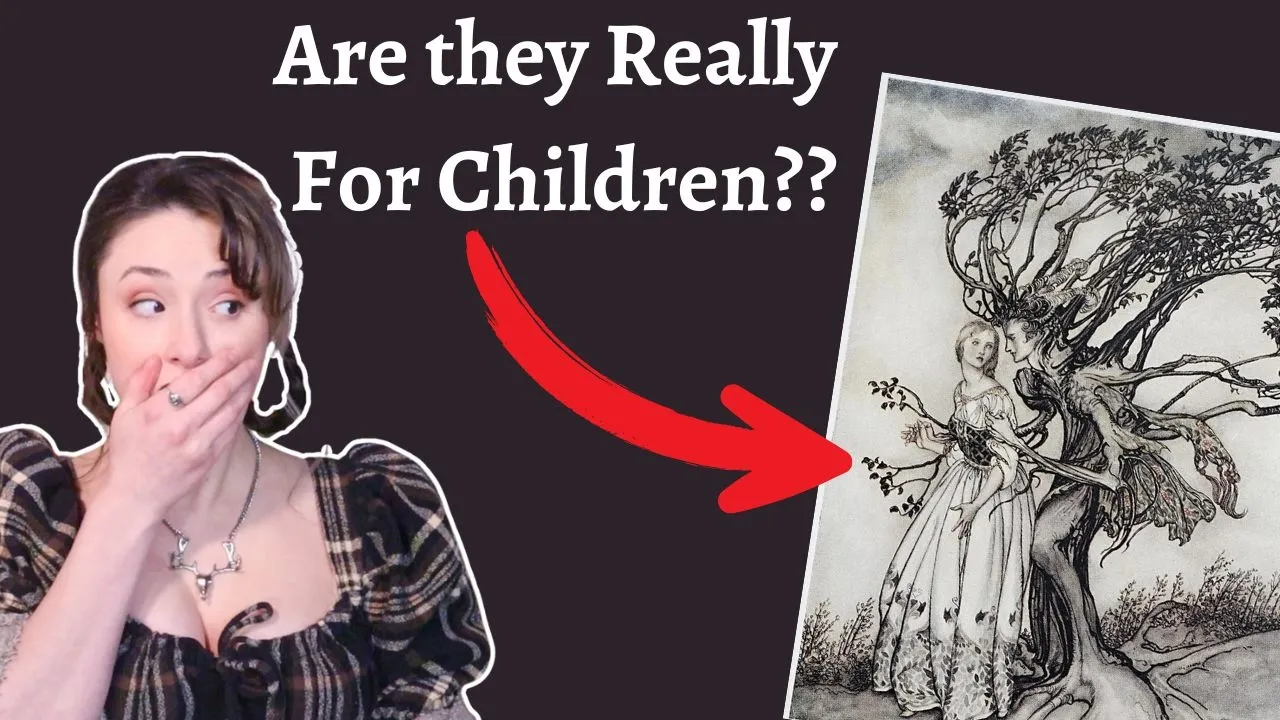
>> Yeah. Yeah. That's where you can go take a nap on the couch and I'll just talk for >> So you have a tree and then you'd look at uh uh ancient Germanic mythology where you have idrasil the tree of the world tree the tree of life and then Christianity which also has a tree at the center right and basically say okay trees mean this thing and they mean this thing no matter where you find them >> yeah Right? So we can see that trees have a certain symbolism in a grims a grims fairy tale, right? That would be recognizable to a Christian, but they would also be recognizable to an ancient pagan. So you have these certain things which mean things and they mean that kind of all across time, right? And so you can look at those elements of stories being like here's a sound and that sound actually might change but ultimately our word for father is still the ancient word for father right that's the that's kind of the idea right and so this gives Wilhelm then kind of a sort of mystical backdoor approach to these stories that helps him get around some of the strictctures of his very rigidly Calvinist upbringing. So, the Brothers Grim, in particular, Vilhelm, they're part of this really uh important uh cultural and spiritual project that's happening in Germany at this point in time. Obviously, that goes some bad directions later on. Uh though it's not the fault of the Grimms, >> right?
>> Um um but they're they're very interested in kind of, you know, basically the the the uh the the German what's called German romanticism.
they're situated squarely kind of within that movement and they saw these ancient stories as a way of preserving after long after both ancient Christianity and uh Germanic paganism are so far removed from the context of 19th uh uh yeah 19th century um Germany that you'll never get you you'll never get back to them. That's what they think. And yet they have these stories that have kind of these mystical meanings embedded within them. And so Wilhham in particular gets very interested in this and he starts kind of as the collections come out and they start publishing them. Obviously the collections are selling very well.
They're selling you know probably much better than the the dictionary which was the main thing that they were working on um and which was the great project the philological dictionary which is the great project of Yakob's life in particular.
um they do it they're doing all of this stuff and as they're doing it Wilhelm is seeing hey there's all these kind of mystical meanings that are encoded within these stories and uh and and then but remember that one of the ideas of romanticism one of the ideas of of Germanic romanticism which is itself basically kind of a response to the German enlightenment is is to say things need to be a little updated they need to be a little revivified. So what does Yaka what does Wilhelm do? Well, in the s successive uh publications of the fairy tales, he starts tweaking them a little bit. Some of them he makes a little more Christian. So other, you know, he makes them like a little less.
He's like, "Oh, well this there's this really barbaric dark element and that was too much, you know, that would that made sense, but that but where it's too much for us now." And so he he makes the stories a little nicer. He makes them a little more Christian and uh kind of tweaks with them. And even at the time, this is like a very controversial kind of a thing. And so nowadays, you can actually buy all kinds of translations of Grims. Uh some of which are are will say like they're way darker and more edgy and actually for adults. And what what that is is a translation of the first couple of editions that they put out >> which will have uh things will be arranged differently. The stories will have different names. very often names that people don't recognize like Little Brier Rose which is the original name for well it's not the original line name for Sleeping Beauty but uh I'll explain that later.
>> That's the one I grew up with actually was was Little Brier Rose.
>> Yeah. Um and then uh so sometimes the stories will have different names and also very maybe the stories are slightly darker although the idea that they're somehow just like oh these are the secret band fairy tales just for adults is uh that's the sort of thing that you'll read in like a New Yorker article and it doesn't again doesn't really hold up. Uh these are relatively small. Yeah, it's it's marketing flannel.
>> Um but it's it's relatively, you know, the the stories are still more or less the same in all the major details. So, uh there's a lot more that could be said about the Grimms. I'm super interested in them. Um >> you know, uh obviously like as a Germanic philologist myself, you know, I have a lot of uh but also I I I manilhelm's kind of whole deal. I just like the idea of like, you know, you're this kid, you grow up in like a hyper strict religious, you know, Protestant religious environment and then you start looking to these older stories as a way of trying to recover a sense of wonder and enchantment and also a connection to uh something more ancient than what you grew up with. Like all those things basically, you know, really resonate with me. So um anyway, even when I have critiques and things like that, I uh it's not out of like a lack of sympathy.
So, all right. We could say a lot more, but I think we should actually tell stories.
>> Let's do some storytelling. So, we've got two stories we're going to do for you today, everybody. The first one popularly known as Sleeping Beauty, uh, but Little Brier Rose a little bit more traditionally. And um and then we also have one called the Juniper Tree, which is is well known to people who study these kinds of stories, but is but if if you've never just sat there and read through, you know, these collections of of the grim stories, you may not know this one. And it's a little weird actually and kind of disturbing in certain ways to the modern mind. Um but we're going to we're going to do something we don't usually do on this show, which we're actually going to tell the story to you. Um, we're we're gonna we're not going to be doing it Martin Shaw style. Uh, which would be kind of great if we could do that. Um, we you probably could. Um, but we're gonna we're gonna read it off of an established version and then we're going to discuss each of them. So, we're going to begin with the one that probably most of you have heard of, uh, Little Brier Rose aka Sleeping Beauty. So, we're going to take turns at this and since this was the tale that you picked, Deacon Saraphim, for us to discuss, why don't you go ahead and tell the story to all the kids at home.
So once upon a time there was a king and a queen who like many kings and queens in these sorts of stories could not have any children.
And each day they would say, "Ah, if only we had a child."
And the queen did all sorts of things.
She went to shrines. She went to on pilgrimages. She went to quack doctors for various remedies.
One day as she was bathing, and in fact in one version of a story, she's actually bathing in a holy well at a saint's shrine, a frog creeps out of the water onto the land and says to her in his very froggy voice, "Your wish shall be fulfilled before a year has gone by.
You shall have a daughter."
And what the frog said came true.
The queen had a little girl who was so beautiful that the king was ecstatic. He was thrilled. He couldn't contain himself.
He's passing out cigars to all all the lads. Uh and he calls for a great feast.
And he invites his relatives. He invites friends and acquaintances. He invites uh people from all over the kingdom and uh from the nearby duchies and earlddoms and so on and so forth. And he also invites what the Grims call the wise women.
Although if you've watched the Disney version, it's the fairies, right? But he invites the wise women in order that they might be kind and well disposed towards the child. Now, as we all know, there are seven wise men women or there are 13 wise women or sorry, there are either eight or there are either or there are 13. In this case, there are 13 of them.
But as he only had 12 golden plates for them to eat from, one of them had to stay at home. So he invites 12 of the 13 or seven of the eight. And the feast is held with all manner of splendor. And when it comes to an end, the wise women bestow their magical gifts upon the child. One of them gives her great virtue. Another gives her great beauty.
A third gives her great wealth. Um, a fourth gives her the ability to wake up looking like that. Even though like most of us when we wake up our hair is all a skew, but when she wakes up she's perfect and looks immaculate. Um, and so on all the all the various gifts.
And when um 11 of them, so remember there's 13 total, 12 invited, 11 of them have now made their gifts. Suddenly the 13th wise woman comes in and she is not happy that they have lost her invitation.
And so without saying so much as a how do you do or even looking at anyone, she cries out with a loud voice, "The king's daughter in her 15th year shall prick herself with a spindle and fall down dead."
And without saying another word, she turns and she leaves the room. Mike dropped.
Now everyone is stunned.
The 12th wise woman, the 12th Norn, whose gift is still ungiven, her wish still unspoken. She comes forward and she says, "I can't undo what has been done, but I can make a weaving of it.
I can soften it.
So it shall not be death but a deep sleep of a hundred years into which the princess shall fall.
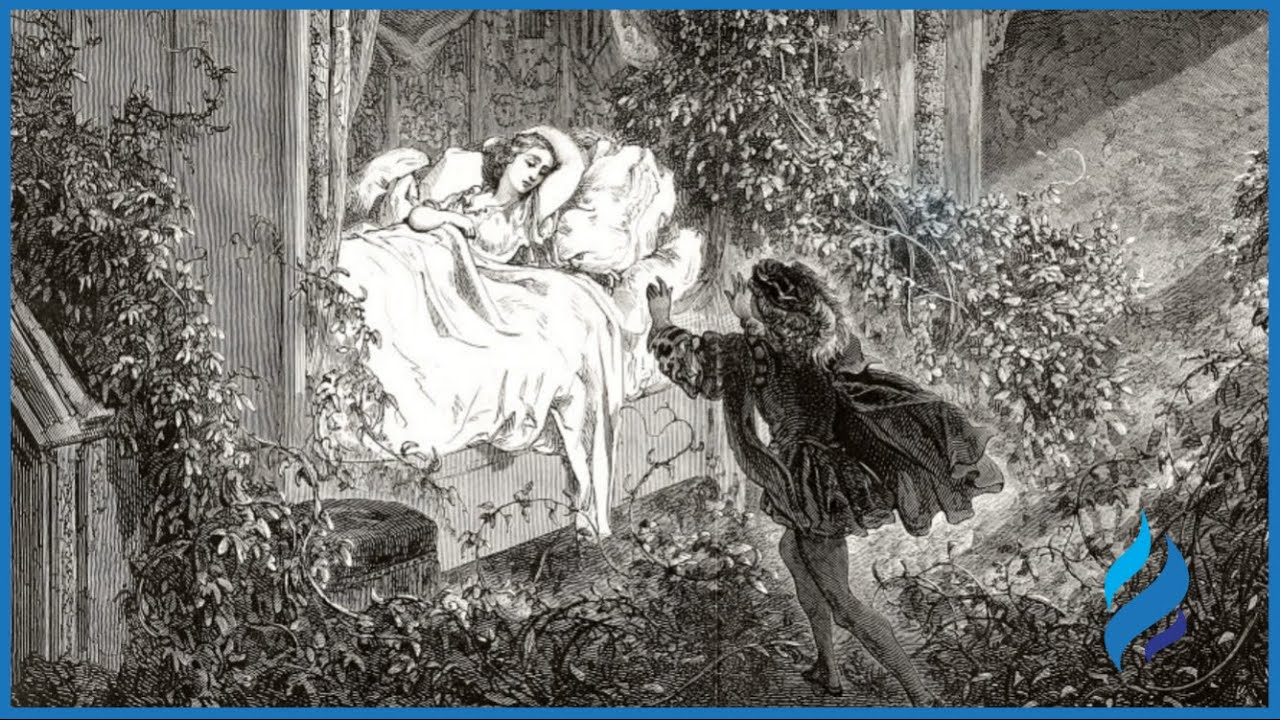
Now the king who wishes to keep his dear child from this misfortune gives orders that every spindle in the whole kingdom should be burnt. Meanwhile the gifts of the other wise women are fulfilled in the young girl. She is beautiful. She is virtuous. She is modest. She is sweet-tempered. She's wise. And she always wakes up looking like that. And everyone who sees her loves her. And one day, on the very day that she turned 15 years old, the king and the queen are not at home. And the maiden is left in the palace more or less on her own. So, she goes around into all sorts of places like you would when you were left alone as a child. uh looks into rooms and bed chambers that uh she wouldn't normally be allowed to go into just as like and at last she comes to an old tower and she climbs up the narrow winding staircase. She reaches a little door.
There's a rusty key in the lock. She turns it. The door springs open and in that room there is an old woman with a spindle busily spinning flax.
A good day, old dame, says the king's daughter. What are you doing here?
I am spinning, says the old woman, nodding her head. What sort of thing is that which rattles around so merrily, keep in mind, all these spindles and all the spinning wheels have all been burned?
She takes the spindle and wants to spin as well, but scarcely had she touched it.
when the magic decree was fulfilled and she pricricked her finger on a piece of flax. And in that very moment when she felt the prick, she looked at her finger as the as a bright red drop of blood appeared and she fell upon the bed that stood there and fell into a deep sleep.
And this sleep extended over the whole palace.
The king and queen who had just come home, they went to sleep. The whole of the court went to sleep with them. The horses, the stable, the dogs, the pigeons on the roof, the flies on the wall, even the fire that was flaming on the hearth became quiet and slept. The roast meat left off roasting. The cook, who was just about to pull the hair of the scullery boy, fell over and went to sleep with his handful of hair. The wind fell and on the trees before the castle not a single leaf moved again. And round about the castle there began to grow a hedge of thorns.
And every year the hedge became higher.
And at last it grew close up around the castle and all over it. So there was nothing of it to be seen, not even the flag on the roof of the highest tower.
But the story of the beautiful sleeping brier rose, for that was the name of the princess, went about the country, so that from time to time the king's sons came and tried to get through the horn thorny hedge into the castle.
This they found to be quite impossible, for the thorns held fast together as if they had hands, and the youths were caught in them, and many of those who got caught in them, I'm sorry to say, could not get loose again and died a miserable, painful death.
After long, long years, once again, another king's son came into that country. Now he heard an old man talking about the thorn hedge and that the castle was said to stand behind it in which a wonderfully beautiful princess named Briar Rose had been asleep for a hundred years and that the king and the queen the whole court were asleep as well. He'd also heard from his grandmother that many king's sons had come and had tried to get through the thorny hedge, but they had remained stuck fast in it. And so it all died a pitiful death. And the prince says to himself, "Well, I'm not afraid. I'll go and see this beautiful brier rose." Now, lots of old people tried to dissuade him. Like many young men, he scoffed at their advice, did not listen to their words.
But fortunately for him, by this time a h 100red years had passed, and the day came when it was time for Brier Rose to awake again.
And when the king's son comes to the thorn hedge, it was nothing but large and beautiful roses which parted from each other on their own and let him pass through unharmed and then closed again behind him like a hedge.
Now in the castle yard he saw the horses, the hounds, the grooms asleep. On the roof sat the pigeons with their heads under their wings. And when he entered the house, the flies were sleeping on the wall. The cook in the kitchen was still holding a clump of the skully boy's hair in his hands. The fire was sleeping on the hearth. The kitchen maid was sitting by by the black uh hen which he was about to pluck. He goes on farther to the great hall, and there's the whole court lying asleep.
um the the the king on his throne, the queen beside him. And he still goes on farther and everything is so quiet that all he can hear is his own breath and the steps of his feet on the stones.
And finally, he comes to a door with an old rusty key and he turns it and he pushes the door open and there's Bria Rose sleeping on the bed. And she of course is so beautiful that he cannot turn his eyes away. And so he stoops and he gives her a kiss. And as soon as he kisses her, Brier Rose opens her eyes.
And of course, as we all know, one of her gifts is that she wakes up looking like that.
So they go down together and the king is awake and the queen is awake and the court is awake. The horses in the courtyard stand up and shake themselves.
The hounds jump up and wag their tails.
The pigeons on the roof pull out their heads from under their wings and look around. The flies on the wall start creeping again. The fire in the kitchen burns up and flickers and starts cooking the meat again. The skully boy screams because the cook is pulling his hair.
The joints on the fire are turning and frizzling.
And the maid plucks the fowl, ready for the spit. Because of course, after a hundred-year nap, everyone wakes up quite hungry.
By the way, that is a detail that is in some of these retellings. Everybody wakes up quite hungry. And then the marriage of the king's son and Brier Rose was celebrated with splendor. And as we all know, they all lived happily ever after.
So, >> huzzah.
>> Yeah, there's there's, you know, it it's been a while since I read this story, actually. Um, I think probably part of what the the disnification does is it kind of makes you get tired of some of this stuff like h you know, but it's it's beautiful to listen to it again.
Um, and to to imagine it again, even though occasionally flashes from the old cartoon came into my head, it's been so long since I saw it that I wasn't just it wasn't just there that way the whole time. You know, one of the things that struck me, which was a detail I I don't think I ever really thought about before is the sleeping king under the mountain imagery that uh comes of this, you know, that here's a kingdom that's kind of lost.
Now, this is not a king who, you know, most of the sleeping king under the mountain stories like, you know, Arthur or whatever else. Um, it's about a king who's going to come back and save his world, you know, save his country. Um, I mean, even the Greeks have this version of the version of the marble king, you know, Constantine the 11th, right?
Sleeping somewhere in the marble of of Constantinople, um, just waiting to come back and, uh, and renew his people. But this is this is interesting to me because it's it's kind of inverted. Um the king is asleep under the mountain, but it's a kingly figure who comes and wakes everybody up and brings the kingdom back to life. You know, although it's it's arguable that I don't know, is he necessary in the story? Is she going to wake up anyways?
A hundred years have passed, right?
That's one of the there's no there's no true love's kiss thing in any of the old versions.
>> Yeah.
Yeah. That that there's this kind of magical necessity.
>> Yeah.
>> Um >> I mean it's certainly the case that he is supposed to be there right at that moment. The the the the prince is an indispensable detail. the mechanics, if you want to call it that, of the the curse or the spell or whatever are that it's basically on a timer. But of course, his showing up at the end of that period is one of the essential parts of of how else would you um let's say how else would you know that it is the fullness of time, you know, unless the prince makes his appearance.
>> Yeah. So this version of the story that uh I've just told you um the uh there's an earlier version that was written down in France >> by a guy named Peralt who I'm probably saying his name wrong but >> yeah uh it's not I mean I'm not it's not yeah I'm not sure about I'm not sure about that one. It's not pero but anyway u he's he's um his version uh there are uh there are eight fairies um so both both eight and 13 are both uh specifically magical numbers and in the French version they are specifically fairies because France uh in Britany which is the Celtic coast of France has a very strong fairy tradition in fact that's where the I the the the the term fairy tale originates from >> and um uh in his version. Uh, first of all, it does not end where this version of the story ends. There's a lot more cannibalism um at the end of the story.
>> Um, >> more cannibalism.
>> Well, there's no cannibalism in this version of the story, but there is there's a whole cannibal sequence at the end of the the older French version.
>> Okay.
>> And um, do you do you want me to just read that real quick? I mean >> I mean, just tell us what what's going on there.
>> Yes. Who is eating whom?
>> Everyone's hungry. the prince's the prince's mother. So So Brier Rose's mother-in-law, by the way, in the in the in the French version, she's not Brier Rose. She's Sleeping Beauty. We'll come back to why the Grims have her name as Brier Rose in a moment, but uh uh her the the prince's mother is a um an ogus.
Um and she >> um uh one day the prince is away and she tells basically tells every the the people at the court uh tells them you know um I I think it's I've decided my grandchildren are looking nice and fat and ripe and I would like to uh I would like to cook them. So why don't you cook the first one and bring it to me in this one with this one particular sauce that you know I like. And uh so they so they uh obviously they don't want to do this so they hide the grandchild and um they substitute uh usually it's some kind of venison. Um they substitute uh some kind of wild animal and they bring it to her and she eats it and it's so good. And the next day she says, "All right, that last grandchild was so wonderful. I'm ready for the next one. Go ahead and cook them up nice and proper and bring it to me with that this particular sauce that you you all know I love so much."
So they cook up another wild animal and this goes on and then finally she says, "All right, it's time for me to eat Sleeping Beauty." And so they cook up a third wild animal with that one particular sauce, that pon pua sauce that um I I always imagine she has a Cajun accent for some reason. But anyway, um um this is a French story, so uh it's uh >> not a Quebec accent.
>> Pqua sauce, you know, and uh she uh >> Justin Wilson in the kitchen.
>> Yeah. Exactly. Exactly. Like it works.
It holds up, you know. I think that I think that basically it's it's fun to imagine like any medieval French thing just like imagine cinjun are doing it.
like it's >> uh but in any case um eventually she finds out what's going on and she's furious and so she orders a huge pot uh with that again that particular sauce that she really likes uh to be put in the courtyard and they begin boiling and they're about to chuck in a sleeping beauty and her two children. And just at this moment the prince rides up and he says, "What the devil is going on here?"
and um she becomes very very angry uh at having been caught and in a peak of of rage throws herself into the pot and is cooked and they all lived happily ever after. That's how the French version of the story actually ends.
>> So in the French version, the prince is a half giant is what you're saying.
>> Uh yeah, I mean his mother is certainly like an ogris or like a kind of a monster of some some kind. Maybe a maybe a bad fairy or related to bad fairies in some way. So the the I I think there are two things. I mean there's a lot about this story that you could talk about from a Christian perspective. Oh, absolutely.
>> Some of it's kind of obvious.
>> Um but there there are maybe two particular things I would want to point out. Um uh before we do that, one would be uh why is she Brier Rose in the groom's version?
>> Yeah. Why is she identified with this hedge frankly?
>> Right. So the hedge is the actually that's the important detail of the story. the most as far as the grims were concerned the hedge is actually the most important part of the story >> as it as >> one you know one one symbolic matrix uh that's not a deliberate pun but there you are that suggests itself is um that a lot of this story is about the coming of age of a young woman right so the hedge becomes her on some level it's her virginity frankly you know her marriage ability uh to you know to put it within the proper terms um and you know what is it with a a spindle right I mean the the daff is so associated with in within the European tradition with women that daff is actually used as a term to refer to women generally and so like there's a certain level on which what's happening is is she's crossing from being a girl to being a woman and >> yeah that's what the that's that's what the bleeding is about to nothing but kind of point on it.
>> Yeah. Yeah. Yeah. Yeah. Yeah. And um you know and then the the the prince comes and completes the picture you know that men and women coming together. I mean I I know like for instance in in the version that uh uh symbolic world press has has published that um you know that Jonathan he made the point in talking about this >> of Snow White. We haven't published >> of Snow White. Excuse me. Yeah. Well, there's a similar movement moment in Snow White, right? Well, where, you know, a kiss from a guy that is not connected. Yeah. I'm sorry. I'm kind of merging the stories together. Yeah. But I mean, there's a similar thing of a sleeping, you know, a sleeping beauty um being woken up by a handsome prince >> and, you know, suggesting like, well, how is that received here in 2025?
Um, you know, with everything that has gone on, the Me Too movement and so forth, you know, what does that look like? And he, you know, in his version of Snow White, he makes it so that they actually meet earlier in the story >> and she indicates like, okay, that, you know, save this for later. Basically, save >> don't awaken before it. Yeah.
>> Exactly. Exactly. But but in this case, you know, and I mean that's the thing is I think it's can be on some level it's hard to read these because something pure and perfect and good like men and women being created for each other which is what you see in Genesis >> Y >> has been so violated now by I don't know the last century or so of and I'm not saying there weren't bad things that were happening before that.
I'm not making I'm not making some kind of argument from nostalgia like, oh, you know, men were men and women were women and everything was great before, you know, all this nonsense started happening in the 1960s or whatever. I I I I'm not saying that. I'm not saying that. Um, Christianity has a long record of women being treated badly and being elevated actually in the midst of that um as holy and God vindicating them, you know. So, it's not like Christians don't know that the stuff that was being complained about in the Me Too movement is is being complained about has not been a long old thing. Um, but part of what's happened, I think, in our modern period is that the attempt to address that stuff has cut way too close to the roots.
you know, rather than saying that, okay, we need to get away from the abuse and men and women need to be both treated like human beings, fully made in the image of God, instead what's happening is the whole shebang is being cut down.
Um, and so it makes it so, you know, people look at a story like this and they see a prince come in and kiss a sleeping princess and it looks like assault, you know, but that's not the story that's being told in the story.
>> Well, not in this version. Yeah, I'm sure there are other versions, right?
>> Well, okay. So, >> are there other traditional versions that it's that there is it is kind of >> just to ruin everybody's ruin everybody's day?
>> Yeah. And again, we're not making any claim that this is an original or that is an original or whatever, >> but in the version that you just read.
>> Yeah.
>> It's not it's simply it's it's sweet and pure. They come together. There's no indication of anything being forced, >> you know, he's not holding her down.
He's he gives her a kiss. So, the earliest version of this story. And we can talk about like what is the story here. Um because this is I mean again the thing the Grims are looking to do is is the sort of like you could say schematic or like almost like a a genetic approach to tracing the lineage of stories and archetypes within stories. So the earliest version of this story seems to be in a medieval romance which is so obscure and so long and so obtuse that there is no way Father Andrew will ever let me tell you guys about it.
>> You can give a little summary. So it's called the romance of Pierce Forest. Not Pale, not the one who pierces the veil, but Pierce the Forest, the one who pierces the forest.
>> Yeah. Yeah.
>> And it is um it is a story about Are you guys ready? Trojans.
>> Who didn't see that one coming?
>> I know. It's a story about the uh the Trojan survivors who come and found the aisle of Britain. And um it traces the lineage of the kings of Britain back to Troy and also to Alexander of Macedon.
And um anyway, it's a very fun, very long 14th century uh medieval romance.
It's so long, no one has ever translated the entire thing into English because everybody who tries eventually gives up.
Um and it's it's rad. Um it's got all kinds of things that you would want to have in a story like this. Um, among other things, one of the characters in the story, uh, by the name of Trous comes across, um, comes across a maiden sleeping in a tower, and while she's sleeping, he gets her pregnant.
>> Yes.
>> And this seems to be And then she she's under an enchantment. Then she wakes up, and everything is is happy and good. But like that's that seems to be the oldest version of this particular motif that we found in at least in recorded medieval literature. But you're absolutely right to say there's nothing like that in this telling of the story here. Now is is uh the French version based on that earlier uh that earlier uh uh middle French romance probably. But there's also a lot of details that that are not there in the romance of pers of pierce pers forest which seems to indicate that there's something else going on here. So in the French version, if we were to read it to you guys, um there would be some >> French of course.
>> Yes, there would be some important differences. For instance, uh the French version is much more explicitly Christian. Um the the the queen, as I mentioned earlier, is actually bathing in like a holy well. Um when uh she's given the prophecy, um there's eight fairies instead of instead of uh uh 13 Norns. And there's um uh there are a few other kind of specific details like it's the the feast that's being held is specifically the the christristening for the child, right? And things like that.
So it's much more explicitly Christian when um when uh this story is collected by I mentioned that most of the grim stories are collected by their grad students. I cannot remember now. Um, her name is Marie something. Um, but the the the the lady who collected this and wrote it down and you can look at uh Grim's notes, Yaka Grim's notes where he basically says, "Oh, this just seems like a reworking of of this one story that's already been collected by this Frenchman. There's nothing that's specifically Germanic here. Maybe we shouldn't include it."
However, Wilhelm when he looks at it, he sees something very important to what what to Vilhelm is the most important secret link to a lost Germanic religion in this fairy tale, which is of course the hedge of thorns.
>> Okay.
So think back, Father Andrew, to your studies in Germanic lore and legend and literature.
What's the great tale of the north?
>> I mean, it's the Volsa saga.
>> Is there any scene, any moment in the Volsa saga which seems similar this >> Oh, yeah. There's there's where um See, I'm going to start to blank on some of the names now, but >> it's okay. this entrance through.
>> Yeah. Yeah. Right. Yeah.
>> To go and and get the Valkyrie.
>> So, Sigur, the great German hero, Sigur rides through the flames around the tower to rescue Brinhild. Brinhild is a Valkiri. She's a chooser of the fallen.
>> Yeah.
>> And uh she one time uh showed a favor to somebody that she wasn't supposed to show favor to. like didn't didn't basically like didn't uh like Valkyries are psychop. So, she like lets somebody live that that's not supposed to live.
And so, Woden punishes her. Do you remember how she's punished?
>> She's punished.
>> She's um she ends up marrying the wrong guy. I'm trying to remember.
>> Well, eventually. So, >> it's probably a lot of these verses are mixed up in my head now, you know. Yeah.
So, Woden punishes her >> Yeah. by pricking her with a magic thorn from the tree of sleep.
And when he does here, we have a tree of sleep here in >> it makes her mortal and it sends her into a deep slumber.
>> Gotcha.
>> And then Woden locks her up in a castle surrounded by a wall of flames.
and he prophesies that she can have no husband save the one who would be so daring as to ride through that wall of flames which of course Sigard eventually does. So, Wilhelm, Wilhelm, as he's going through this, he says, "Wait a minute." Her finger gets pricricked.
She's in a castle. It's surrounded by not in this case, a wall of flames, but a hedge of thorns. And you can sort of think visually how a hedge of thorns kind of looks also like flames or vice versa.
Um, and of course those details in the Banga saga, which are very also very important in the retelling here.
um that uh uh the uh of the the the way the whole sort of castle is under sleep. I mean, this is an important and in this is like one of the best parts of the story in German is is like the the description of like the flies on the wall are go to sleep and the scholar like all this stuff, right? That's a big part of the story.
>> By the way, we're getting a lot of comments in the chat. People really want us to do episode or more perhaps on the Volinga saga.
>> It doesn't end well you guys. Just so you know, this is not a happy ending.
>> Well, a lot of traditional stories. I don't know what to tell you guys. like you just get used to disappointment is all I can say. Um >> it's not even a sad story.
>> It's a horrifyingly bad ending.
>> Yeah. Another another interesting difference here between the German story version of the story and the French story is that I think in the French version of the story, it's a crab, not a frog >> that >> tells the story. And that that change is actually probably suggestive in uh certain ways. So um anyway, all this to say, Wilhelm in his kind of commentary on this fairy tale and his uh his interest in it, he sees a parallel um uh he sees uh parallels to like this sort of ancient lost religion, but also a Christian parallel that is that the um >> the bathing is a baptism or it's a christening like at the be beginning of the story, right? Um, and so the queen is seated both in the ideas like she's seated both in the pre-Christian waters of like time and chaos, but then also in uh it's a also a baptism, right? Um, >> yeah.
>> And um, and Wilhelm has lots of specific linguistic references in all of this. He traces the word that's used in German, you know, through its roots. Again, for the Grimms, especially for Vilhelm, language and story and religion are all kind of go together, right? Whereas nowadays, those those things are kind of separated.
>> Yeah.
>> Another I would say another I mean, again, this might be obvious to say, but I think it's worth saying because here we're talking about this story on this podcast.
um you know reading this like if I were to try to read the story in a way that say many of the church fathers would have read it right I would say that this is a story about the soul becoming um deadened in sin uh and you know who is the prince but but Christ who comes and awakens the soul and you know brings it to life again right yeah >> um I mean yes so this kind of thing I This is this is the kind of reading the fathers give.
>> Well, so it's along those lines. The reason Vilhelm changes it to a frog is because a frog is amphibious. It is some it has it it's a creature that belongs to two worlds, right? So the idea is is both the the pagan world and the Christian world. And uh yeah >> uh it's kind of like the duck and Hansel and Gretle in the sense that it's like this amphibious creature that helps you cross kind of from one world to the next. Um and so in the same sense then you have the the um it's something that helps you cross like the dangerous barrier between two worlds. In the same way the prince is the only one who can cross the dangerous barrier of of the of the >> I mean this is this is kind of the heroing of hell.
>> Yeah. I mean, that's that's that's the the the thing to understand is that fairy tales are um I think earlier in our pre-show, I was I was talking to one of the producers about this. The fairy tales are basically like learning fairy tales have the grammar of the world in them. And so the uh so I for instance Bruno Bellheim famously kind of um uh made famous these these um readings of fairy tales that are where fairy tales are are about like comingings of age and ministration for women and other things for men. But like that's not wrong.
>> Yeah. The thing that you have to understand is that the shape of the world is such that the story of of the death of your childhood and the then the resurrection into adult life and there's like a flood that you pass through, right? that that story and the story of the heroing of Hades and the story of the deliverance of the children of Israel from Egypt and like all those that pattern basic pattern of death and resurrection of passing across these various kinds of thresholds that is just the way that the world works.
>> Yeah. Or as as someone we know would say, it's just how the world lays itself out or you know symbolism happens, >> right? Yeah. So, there's a lot more we could say about the symbolism of sleeping beauty, but I um and there's a lot of fun classical associations as well. Um indeed, >> but I think that we should probably move on to the juniper tree.
>> All right, I have to wet my whistle here. It's a phrase you don't hear much anymore.
Long, long ago, some 2,000 years ago, there lived a rich man with a good and beautiful wife. They loved each other dearly, but sowed much that they had no children.
So greatly did they desire to have one that the wife prayed for it day and night, but still they remained childless.
In front of the house there was a court in which grew a juniper tree. One winter's day, the wife stood under the tree to peel some apples. And as she was peeling them, she cut her finger, and the blood fell on the snow.
"Ah," sighed the woman heavily, if I had but a child as red as blood and as white as snow." And as she spoke the words, her heart grew light within her, and it seemed to her that her wish was granted, and she returned to the house, feeling glad and comforted.
A month passed and the snow had all disappeared. Then another month went by and all the earth was green. So the months followed one another, and first the trees budded in the woods, and soon the green branches grew thickly intertwined, and then the blossoms began to fall. Once again the wife stood under the juniper tree, and it was so full of sweet scent that her heart leaped for joy, and she was so overcome with her happiness that she fell on her knees.
Presently the fruit became round and firm, and she was glad and at peace. But when they were fully ripe, she picked the berries and ate eagerly of them. And then she grew sad and ill.
A little while later, she called her husband and said to him, weeping, "If I die, bury me under the juniper tree."
Then she felt comforted and happy again.
And before another month had passed, she had a little child. And when she saw that it was as white as snow and as red as blood, her heart was so her joy was so great that she died.
Her husband buried her under the juniper tree and wept bitterly for her. By degrees, however, his sorrow grew less, and although at times he still grieved over his loss, he was able to go about as usual, and later on he married again.
He now had a little daughter born to him. The child of his first wife was a boy who is as red as blood and as white as snow. The mother loved her daughter very much, and when she looked at her and then looked at the boy, it pierced her heart to think that he would always stand in the way of her own child, and she was continually thinking of how she could get the whole of the property for her. This evil thought took possession of her more and more, and made her behave very unkindly to the boy. She drove him from place to place with cuffings and buffetings, so the poor child went about in fear and had no peace from the time he left school to the time he went back. One day the little daughter came running to her mother in the store room and said, "Mother, give me an apple." "Yes, my child," said the wife, and she gave her a beautiful apple out of the chest. The chest had a very heavy lid and a large iron lock.
Mother," said the little daughter again.
"May not brother have one, too?" The mother was angry at this, but she answered, "Yes, when he comes out of school."
Just then she looked out at the window and saw him coming, and it seemed as if an evil spirit entered into her, for she snatched the apple out of her little daughter's hand and said, "You shall not have one before your brother." She threw the chapel apple into the chest and shut it, too.
The little boy now came in, and the evil spirit in the wife made her say kindly to him, "My son, will you have an apple, but she gave him a wicked look."
"Mother," said the boy, "how dreadful you look." "Yes, give me an apple." The thought came to her that she would kill him. "Come with me," she said, and she lifted up the lid of the chest. "Take one out for yourself."
And as he bent over to do so, the evil spirit urged her, and crash, down went the lid, and off went the little boy's head.
And she was overwhelmed with fear at the thought of what she had done. "If only I can prevent anyone knowing that I did it," she thought. So she went upstairs to her room and took out a white handkerchief out of her top drawer. Then she set the boy's head again on his shoulders and bound it with a handkerchief so that nothing could be seen and placed him on a chair by the door with an apple in his hand. Soon after this, little Marlene came up to her mother who was stirring a pot of boiling water over the fire and said, "Mother, brother is sitting by the door with an apple in his hand, and he looks so pale. And when I asked him to give me the apple, he did not answer, and that frightened me." Go to him again, said her mother, and if he does not answer, give him a box on the ear. So little Marlene went and said, "Brother, give me that apple." But he did not say a word.
Then she gave him a box on the ear. And his head rolled off. She was so terrified at this that she ran crying and screaming to her mother. "Oh," she said, "I have knocked off brother's head." And then she wept and wept and nothing would stop her. "What have you done?" said her mother. No one must know about it, so you must keep silence. What is done can't be undone. We will make him into puddings. And she took the little boy and cut him up, made him into puddings, and put him in the >> pot. But Marlene stood looking on and wept and wept, and her tears fell into the pot so that there was no need of salt.
Presently the father came home and sat down to his dinner. He asked, "Where is my son?" The mother said nothing, but gave him a large dish of black pudding.
And Marlene still wept without ceasing.
The father again asked, "Where is my son?" "Oh," answered the wife, "He has gone into the country to his mother's great uncle. He's going to stay there sometime." "What has he gone for, and he never even said goodbye to me?" "Well, he likes being there, and he told me that he should be away quite six weeks.
He is well looked after there." "I feel very unhappy about it," said the husband, "and in case it should not be all right. and he ought to have said goodbye to me. With this he went back to his dinner and said, "Little Marleene, why do you weep? Brother will soon be back." And he asked his wife for more pudding. And as he ate, he threw the bones under the table.
Little Marlene went upstairs and took her best silk handkerchief out of her bottom drawer. And in it she wrapped all the bones from under the table and carried them outside. And all the time she did nothing but weep. Then she laid them in the green grass under the juniper tree. and she had no sooner done so than all her sadness seemed to leave her, and she wept no more. And now the juniper tree began to move, and the branches waved backwards and forwards, first away from one another, and then together again, as if it might be someone clapping their hands for joy.
After this, a mist came round the tree, and in the midst of it there was a burning as a fire. And out of the fire there flew a beautiful bird that rose high into the air singing magnificently.
And when it could no more be seen, the juniper tree stood there as before, and the silk handkerchief, and the bones were gone.
Little Marlene now felt as light-hearted and happy as if her brother was still alive. And she went back to the house and sat down cheerfully to the table and ate. The bird flew away and a lighted on the house of a goldsmith and began to sing. My mother killed her little son.
My father grieved when I was gone. My sister loved me best of all. She laid her kirchief over me and took my bones that they might lie under the juniper tree. Kiwit kiwit, what a beautiful bird am I.
The goldsmith was in his workshop making a gold chain when he heard the song of the bird on his roof. He thought it so beautiful that he got up and ran out.
And as he crossed the threshold, he lost one of his slippers. But he ran on into the middle of the street with a slipper on one foot and a sock on the other. He still had on his apron and still held the gold chain and the pinchers in his hand. And so he stood gazing up at the bird while the sun came shining brightly down on the street. Bird, he said, be how beautifully you sing. Sing me that song again.
Nay, said the bird, I do not sing twice for nothing. Give that gold chain and I will sing it to you again. Here's the chain. Take it, said the goldsmith. Only sing me that again. The bird flew down and took the gold chain in his right claw. And then he all lighted again in front of the goldsmith and sang, "My mother killed her little son. My father grieved when I was gone. My sister loved me best of all. She laid her kerchief over me and took my bones that they might lie underneath the juniper tree.
Kiwit kiwit, what a beautiful bird am I.
Then he flew away and settled on the roof of a shoemaker's house and sang, "My mother killed her little son. My father greed when I was gone. My sister loved me best of all. She took her she laid her kirchief over me and took my bones that they might lie underneath the juniper tree. A kiwit kiwit, what a beautiful bird am I?" The shoemaker heard him and he jumped up and ran out in his shirt sleeves and stood looking up at the bird on the roof with his hand over his eyes to keep himself from being blinded by the sun. Bird, he said, how beautifully you sing. Then he called through the door to his wife. Wife, come out. Here is a bird. Come and look at it and hear how beautifully it sings. And he called his daughter and the children.
Then the apprentices, girls and boys, and they all ran up the street to look at the bird, and saw how splendid it was, with its red and green feathers, and its neck like burnished gold, and eyes like two bright stars in its head.
Bird, said the shoemaker, singing me that song again. Nay, answered the bird, I do not sing twice for nothing. You must give me something. Wife, said the man, go into the garrett. On the upper shelf, you will see a pair of red shoes.
Bring them to me. The wife went in and fetched the shoes. There, bird, said the shoemaker. Now sing me that song again.
The bird flew down and took the red shoes in his left claw, and he went back to the roof and sang. My mother killed her little son. My father grieved when I was gone. My sister loved me best of all. She laid her kirchief over me and took my bones that they might lie underneath the juniper tree. Kiwit, Kiwit, what a beautiful bird am I. When he had finished, he flew away. He had the chain in his right claw and the shoes in his left. And he flew right away to a mill. And the mill went click clack click clack click clack. Inside the mill were 20 of the miller's men hewing a stone. As they went hick hack hick hack hick hack. The mill went click clack click clack click clack. The bird settled on a lime tree in front of the mill and sang. My mother killed her little son. Then one of the men left off. My father grieved when I was gone.
Two more men left off and listened. My sister loved me best of all, then four more left. She laid her kirchief over me and took my bones that they might lie.
Now there were only eight at work.
Underneath, and now only five, the juniper tree, and now only one. Kiwit, Kiwit, what a beautiful bird am I. Then he looked up and the last one had left off work. Bird, he said, what a beautiful song that is you sing. Let me hear it too. Sing it again. Nay, answered the bird. I do not sing twice for nothing. Give me that millstone and I will sing it again. If it belonged to me alone, said the man, you should have it. Yes, yes, said the others. If he will sing again, he can have it. The bird came down, and all the 20 millers set two and lifted up the stone with a beam. And then the bird put his head through the hole and took the stone round his neck like a collar, and flew back with it to the tree and sang. My mother killed her little son. My father grieved when I was gone. My sister loved me best of all. She laid her kirchief over me and took my bones that they might lie underneath the juniper tree.
Kiwit kiwit but a beautiful bird am I.
And when he had finished his song, he spread his wings. And when the chain in his right claw, the shoes in his left, and the millstone round his neck, he flew right away to his father's house.
The father, the mother, and little Marlene were having their dinner.
How light-hearted I feel, said the father, so pleased and cheerful. And I, said the mother, I feel so uneasy, as if a heavy thunderstorm were coming.
But little Marlene sat and wept and wept. Then the bird came flying towards the house and settled on the roof. I do feel so happy, said the father. And how beautifully the sun shines. I feel just as if I were going to see an old friend again.
Ah, said the wife. And I am so full of distress and uneasiness that my teeth tatter. And I feel as if there were a fire in my veins. And she tore open her dress. And all the while little Marlene sat in the corner and wept. And the plate on her knees was wet with her tears. The bird now flew to the juniper tree and began singing.
My mother killed her little son. The mother shut her eyes and her ears that she might see and hear nothing, but there was a roaring sound in her ears like that of a violent storm, and in her eyes a burning and flashing like lightning.
My father grieved when I was gone.
"Look, mother," said the man, at the beautiful bird that is singing so magnificently, and how warm and bright the sun is, and what a delicious scent of spice in the air.
My sister loved me best of all. Then little Marlene laid her head down on her knees and sobbed. "I must go outside and see the bird near us," said the man.
"Ah, do not go," cried the wife. "I feel as if the whole house were in flames."
But the man went out and looked at the bird. She laid her kirchief over me and took my bones that they might lie underneath the juniper tree. Kiwit, Kiwit, what a beautiful bird am I?
With that the bird let fall the gold chain and it fell just round the man's neck so that it fitted him exactly.
He went inside and said, "See what a splendid bird that is. He has given me this beautiful gold chain and looks so beautiful himself." But the wife was in such fear and trouble that she fell on the floor and her cap fell from her head. Then the bird began again. My mother killed her little son. "Ah me!"
cried the wife. if if I were but a thousand ft beneath the earth that I might not hear that song. My father grieved when I was gone. Then the woman fell down again as if dead. My sister loved me best of all. Well, said little Marlene, I will go out too and see if the bird will give me anything. So she went out. She laid a kirchief over me and took my bones that they might lie.
And he threw down the shoes to her underneath the juniper tree. Kiwit Kiwit, what a beautiful bird am I. And now she felt quite happy and light-hearted. She put on the shoes and danced and jumped about in them. "I was so miserable," she said when I came out, "but that has all passed away. That is indeed a splendid bird, and he has given me a pair of red shoes." The wife sprang up with her hair standing out from her head like flames of fire. "Then I will go out too," she said, "and I will see if it will lighten my misery, for I feel as if the world were coming to an end."
But as she crossed the threshold, crash, the bird threw the millstone down on her head and she was crushed to death.
The father and little Marlene heard the sound and ran out, but they only saw mist and flame and fire rising from the spot. And when these had passed, there stood the little brother. And he took the father and little Marlene by the hand. Then they all three rejoiced and went inside together and sat down to their dinners and ate.
The end.
Would be real careful of the cooking at that house.
>> That's right. Yeah. What is in that pot?
That's I It's an uncanny story. I mean, it's it's got so many weird weird elements.
Um, but I mean, like at the like the thing at the end particularly, like this is something that's in a lot of these stories where the villain gets what's coming to him or her and everyone is kind of happily ever after. Now, they're not like they're not woohoo. All right. You know, like they're not cheering that she's dead.
She's crushed by the millstone.
Although, I mean, what kind of a bird is this that can carry a millstone around its neck? That's something that occurred to me as I was reading this like wow it's getting kind of working out you know um but yeah I mean that's that that sort of sense of getting your just desserts you know like one of the Cinderella I mean is in one of the Cinderella versions the wicked stepmother she has to dance forever in >> shoes >> snow white snow white yeah shoes with hot iron >> you know um this is a wicked stepmother tale on some level >> um this This story is kind of famous for being one of the darker stories in Grims. Um, it is the one which Tolken brings up as an example of why censorship censorship in children's stories is bad.
>> So, uh, he actually specifically references this story and not fairy stories. Um, which I'd encourage you all to go back and read that bit. Um, and yes, of course, Thomas is right. The bird is a phoenix. So, Yeah. Um, there's a lot that you can a lot of my wife and I actually really like this. This is one of our favorite Grims fairy tales. Um, >> oh, she just commented that in the chat.
>> Oh, yeah. See, >> she loves it.
>> I'm not just making that up.
>> I'm sure I don't perform it as well as your husband, uh, Matuska, but uh, >> so the the thing that, um, there are a lot of different ways and directions you could kind of go with trying to interpret this story. Um the thing to start with I think would be uh trying to figure out what is going on with the gifts and then work backwards.
>> Yeah. Yeah. So you know he gets so the father gets the gold chain around his neck and the daughter gets red shoes.
>> Mhm.
>> Right. Um yeah I don't know. I I I've so I've never looked up any interpretations of this. I just the story is the only thing that I've got you know in this regard. I didn't actually I'm I'm ashamed to say I didn't remember that Tolken mentioned this in on fairy stories. Um but um yeah it seems to me I mean you know a gold chain is symbol of kind of glory and exaltation elevation all this kind of stuff um is how I would read at least that piece. Um red shoes I don't know I mean there certainly are certainly ecclesiastical suggestions there. Is this girl the first female pope?
The shoes of the fisherman.
Just throwing that out there.
>> Of the fisherman. Yeah. I mean, actually, if you read some analysis out there, that is a connection that people make.
>> Really?
>> Yeah. Yeah.
>> How about because >> actually The Shoes of a Fisherman is a great movie from the 60s, I think, with uh I'm trying to remember who's in that.
It's about a Greek Catholic bishop who gets elected pope during the Cold War.
>> No kidding.
>> Yeah. Oh, yeah. Yeah. You should totally watch it. It's It's crazy good and interesting. Yeah. Yeah. Yeah.
>> Anyway, >> um so I mean it's you could say like in some certain like alchemical uh traditions and things like that like red shoes are associated with like uh a mystag or somebody who like leads somebody into you know so so like some of the more occult readings will >> actually uh uh will will point that out.
But so this the story begins with uh um kind of a series of a series of deaths, right? So the first death you have is the death of the mother who >> um >> the the idea seems to be something like um uh so she's she's sitting under a juniper tree. She accidentally cuts her hand on a knife and she sees that red drop of blood on the snow which should immediately make you think of another story.
>> Yeah. Yeah. This is sort of the male Snow White on some level.
>> Yeah. There's actually three or four >> Grimm stories that actually start with this same kind of scene. So it's there's something about that particular >> like the redness of blood on snow. Yeah.
Um, and it's the uh, and it kind of sets a um, like a kind of a tone for the rest of the story, you could say. Right. So, she um, uh, and she has this premonition, right, of her death. And the thing that she says is, "When I die, bury me under the juniper tree." Juniper trees are associated with um although it's quite possible in an earlier version of the story, it was not a juniper tree, it was an almond tree. But in any case, um juniper trees are associated with a certain kind of uh um juniper trees are both poisonous and not poisonous depending on which part of the tree that you eat. So they're associated with like pharmarmacon, they're associated with magic from very early uh uh time. in in the chat, as I say in the chat, Savannah says that juniper trees in Catholic mythology, as she puts it, are associated with the Virgin Mary.
>> Yeah, that's right. Yeah. So, there's something kind of in particular about the juniper tree. You could say it's a magical tree. You should see the juniper tree as Idrasil. You should see it as the tree of life.
>> You should see it as the tree of the cross. Basically going back to the thing I was saying at the be earlier in the episode, all these different things that trees mean kind of overlap.
>> And so she says, "Bury me here, >> right?" So uh then she dies, she's buried there. So there's uh there's the like the first woman, right? She's buried there under the tree. And then of course um uh and then of course the the boy after his mom goes all John Wick on him.
>> Um >> which is all I can >> Yeah. Well, I'm not saying you should see those.
>> Is there a pop culture thing that you've seen that I have not? This it's kind of funny.
>> I've seen every John Wick movie like a million times.
>> I have seen none of them.
>> I'm not a I'm not a good person though.
So anyway, um but yeah, the whole like slamming somebody's head to death in a door is a very John Wick kind of a way to kill somebody. But um the uh illustr I looked up by the way I found illustrations of this story and that's one of the scenes that's frequently illustrated is >> obviously if you're going to illustrate decapitation why would you not do this?
>> So the boy's killed and uh he's killed remember after being offered an apple by the way.
>> Yes. I say notice the apple again. This is the male Snow White on some level.
>> So it's the male Snow White but it's also it's also Adam and Eve right? And so, >> yeah, of course.
>> And so, so what happens? Well, she cooks him into a pudding. And then the father partakes of this this meal of death.
This uh uh it's a very ancient trope.
You could call it accidental cannibalism. Um shows up, you know, it's >> shows up in the Volsa saga as well, >> but also shows up at the very beginning of the whole story of Troy in the cursed house of Rus. Yeah.
>> In any case, >> I mean, I say the other thing you could also read this as um that particular element >> is that this is a kind of um dark eukarist which I mean really really like and like what what is the Eucharist really? But actually >> the it is >> communion in body and blood. Yeah. Yeah.
>> Right. Exactly.
>> Yeah. So so a lot of times this trope is called in in literature around this sort of thing. It's called the dark eucharist or it's called a uh like a false feast or a um uh feast feast of death something like that right that's the idea >> so you have yeah Titus Andronicus Paul that's right so you have this um you have this uh this cannibalistic feast this inverted Eucharist right and then what happens to the boy well the girl takes his bones and she takes them out and buries them under the juniper tree now if you think back to an icon of the crucifixion.
You'll see there's the tree of a cross and then beneath it at the very bottom usually there is a skull.
>> Yeah.
>> And that skull is the skull of Adam. It comes from the the fact that there's this hill outside of Jerusalem which according to ancient Hebrew legend was the burial place of Adam and thus the place of the skull Golgatha.
>> Yep.
>> Right. And so the idea is Adam's bones are there under the cross and it is the it's the uh blood of Christ, you know, that brings Adam back up from the underworld, right? So you have this you have all of this very kind of potent imagery kind of all playing around here.
And it's fairy tales are are never very rarely are is a fairy tale ever going to be one to one. Um and so in that case you could see that the father and the son both have these aspects of adamic imagery about them >> where the son represents the uh the son represents the um the kind of the innocent nature of man whereas the the the father represents Adam in his the role that he's supposed to have as the lord of creation which he which it basically is taken away from him right through this through this this meal, this accidental cannibalism, right? And and you know, sort of loses his lordship. He becomes, you know, sorrowful. He can't be a good father anymore. Like all this different stuff.
And uh in the same way, you could see both the dead mother and then little um she's the only character in the story with a name.
>> That's right. Uh >> Marlene, she doesn't >> Marlene. Yeah.
>> Yeah. And it's interesting to me that she doesn't um it takes a while before we even learn her name. You know, she shows up.
>> Yeah. In some versions of the story, she's also named Marjgery or on Marie sometimes as well.
>> And um anyway, so they they there there's some Adam and Eve imagery that the story plays with, right?
>> And then of course at the middle of the center of all of this is of course the figure of the stepmother. And of course, one of the questions in the chat is what's with all the stepmothers abusing their stepchildren.
>> Yeah.
>> I mean, so it's I mean, in this version of the story, it's explicit that she's >> demonpossessed.
>> Yeah. Or or demon or demon uh animated.
>> And um I mentioned that not just say, "Oh, here's the origin of her evil." Um because it's clear that she has sinful thoughts that she entertains even before the demon is explicitly mentioned. You know, she's certainly she's got this jealousy, right, that the boy is going to be inheriting from the father and she wants only her daughter to inherit from the father. Um you know, and this is the means by which the demon gets in. But I I mention this though because like isn't stepparenthood exactly one of the images in the Bible for the way the demons treat humans.
Right? So like for instance there's a point where Jesus says to the scribes and Pharisees that their father is the devil.
Right? That Abraham is not their father.
Their father is the devil.
>> Right? And and now of course the devil is not literally their father. He is effectively their stepfather. Like he's he's the the wrong father. He's the the off father. The the one that's you know disconnected but brought in as a substitute.
>> Huge miss Darth Vader joke that you could make right here is the Dark Vodder.
>> I am your father.
>> Um well we didn't want to spoil that movie for everybody. Um but now that we have Thank you. Um so I mean I think that's it's not that it's not that you know having an adoptive parent is bad or people who get remarried is bad, right? It's it's that this person is not the natural not the natural parent, right? And um within the Christian context, this is part of what happens is that humanity connects itself to the wrong parent.
we we connect ourselves to a demonic parent rather than to our true parent, our true father who is God, right? And so then we we take after the dark parent, right? And fall into destruction as a result of that. Um so but what's interesting of course as if you read it that way is that the daughter who is a natural child of this woman um she's she's utterly redeemed. I well I shouldn't even say redeemed. She's completely innocent the whole time.
there's nothing there's no sin in her in this story, >> you know.
>> So, so I think that's one way I think of of of reading this whole steparent thing is that there's this kind of, you know, being attached to the wrong the wrong thing and then that's going to destroy you. That'll destroy your soul or whatever. So fairy tales, traditional folk stories, things like this, let's say stories, stories in the genre are almost always pedagogical in uh nature or at least the people who collect them are collecting them together for pedagogical purpose. A good example of this if we go back to Peralt's uh uh retellings this French collection that we mentioned earlier uh he actually had a little poem that he wrote for the end of each fairy tale >> which would tell you >> the moral of the story >> the moral of the story essentially basically telling you what is this story trying to teach you about the world and some of them some of those like when I when I read through his collection some years ago some of them I'm like I don't know that I took away the same thing from that you did but you know on the whole They're, you know, for the most part, so they're pretty obvious. Well, one of the things that fairy tales teach you is what kinds of people to trust and not to trust.
>> And so when you meet a big bad wolf, you could say in particular nowadays in the world that we're living in, how do I put this? There is a kind of wolfish man who invades women's spaces and takes on women's identities >> so that he can devour. Right? That is one of the things that story is about.
You think that's of 20 that's not a we didn't invent that particular thing in the 21st century, right? Like that's been around a long time. Um, another kind of person that you have to be really careful of is what you could call a devouring mother. Um this is one of the ideas that um Lewis talks about C.
Lewis talks about in the four loves uh where he's talking about the different kinds of love and he uses different Greek words. It's not that those Greek words only mean that kind of love when you read the Bible. Lewis himself would probably bonk you on the head if you tried to preach that sermon now. But anyway, the point is that he uses four different words for four different kinds of love. And familial love like the love of parents for their children for instance um uh which he associates with the Greek word stoi is a kind of love which is um every love let's say has a way in which it can go wrong right this is Lewis's idea every love has a way that it can go wrong so love uh the way that uh this fi familial love the love of a parent for you know a mother for a son let's say or a daughter The way that this love can go wrong is it can become devouring. So, we can all kind of think of, you know, like a stereotypical helicopter parent or tiger mom or like whatever, like these different these different uh instantiations of this kind of motherhood in various cultures, right? When fatherhood goes wrong, it looks like something different. And there's plenty of fairy tales about that. But the reason the wicked stepmother comes up so often is that first of all a stepmother is a break in the chain of causality. Uh this is not to say by the way that if you find yourself a stepfather or a stepmother in a loving Christian family that there's something inherently wrong or evil or bad about you. That is not the point.
But it's a break in the normal chain of causality because what it does is it introduces something into the family unit where the idea is that the parents are supposed to be building something like a legacy for the children and then they're going to leave that legacy to their children. So if you bring in now this new woman who kind of represents the strange woman in the sense of like proverbs, right? Uh this this new woman who comes in and she is not actually connected to that system of fertility.
She's bringing in her own fertility from the outside. She's bringing in her own children. She's bringing in her own heirs. She's bringing all these I mean, if you want to go back to Adam and Eve imagery, it's like the Lilith and Eve kind of a thing if you want to go back to some of those legends, right? So, it's the idea that you bring in this this woman who is from outside of this system of fertility and growth and life >> and she wants to uh she's basically becomes a parasite. So she wants that life for herself and for her children instead of for what's there. So this is one way that you could say motherhood goes wrong is when uh a mother um instead of becoming uh and this is could be true of fathers as well, right? that in the case of parenthood, when parents go from wanting to sacrifice and give themselves to the next generation that is to come and instead they want to devour their children. They want their children to basically feed them and give them life and to serve them. And if you think about like the the dad who's a little too into his kid's sports career because he's living vicariously through them or if you think of um you think of the mother who never wants her son to go out into the world does and really doesn't want his son to marry another woman because she wants to be the main woman in that son's life. Right? These are all different images of this devouring mother.
So um that is one of the themes that comes up in a lot of these stories and it's basically because this is a kind of person that when you see them you have to really be very very careful and and really it's a kind of person to steer clear from. Now, >> I'm going to go back to the gifts real quick and then I'll you can you can add something else if you want to.
>> But the the if we think again in the sort of inverted Adam and Eve imagery, right, that's going on in the story. Um what is the chain? Well, the chain is for the father as he's being restored to his role as Lord. That's what if you wear a chain around your neck, this shows that you're you're the king, you're the lord, you're the mayor, you're the whatever. Yeah. Yeah. There you go. You're the arch priest, right? I have no chains about my neck. See, it's totally un free.
>> I'm free. Yeah. Um the shoes. Well, what does she use the shoes for? She uses the shoes to dance.
She uses the shoes uh to dance, to rejoice. This is a like when the world is properly ordered, young women dance. It's what they do.
And we even have this I mean all the way into our apostasal himnography. Dance and be glad and thou theotocos rejoice in the rising of thy son, right? You know this this idea of of when the resurrection comes that's when you dance.
Um, and then the third thing is the millstone.
And it should not be too hard for people who know the Bible to figure this one out.
>> Yeah.
>> Um, uh, but it's the the source of death being destroyed by death. It's it's, uh, um, you know, and then, and then of course the sun is is a phoenix, which >> I mean, also the millstone the millstone is the punishment for those who destroy children.
>> I mean, that's literally very trying to say. That's what I was trying to say.
Like for people who know the Bible, that one shouldn't be too hard.
>> It's very very on the nose. Yeah.
>> Yeah. So the millstone um >> so so the the the sun in bird form in phoenix form. And so in this story the sun is of course among other things sort of Adam but also he's Christ. Um right.
Uh so there's there's obvious imagery here. What's the deal with the phoenix?
Well the phoenix is um is a bird. uh everyone knows lives in Egypt and uh he he rises and he flies to um uh what is you know a a a fragrant tree of myrr and incense and allows and so on uh in um which of course the juniper tree is also a fragrant tree. He flies to this fragrant tree in India and he bursts into flame or maybe comes from India and flies to Egypt. In any case, he bursts into flame and then um out of the ashes there's a little worm and after 3 days the worm grows into a fullfledged bird.
Um full-fledged in the literal sense here uh in you know back into the phoenix, right? So the the idea is you know there's there's a death there's the fragrance there's the uh and it's associated with incorruption right uh this with the myrr and the alos that's why the phoenix can do what it does because it lives in the tree and basically is like absorbing all of this all of the incense and the the sap and so on and uh then it it dies and then 3 days later it's restored right so that's the idea of the phoenix and the and the sun here is and and if you read a medieval bestiary it will tell you that the symbolism of the phoenix has to do with Christ and the and his death and his resurrection. Yeah. And that imagery is being used here as well. And instead of three days, we have three things that he has to go and collect.
>> Um and the the the three things that he's collecting are things which are going to restore the proper order to creation by giving by giving lordship to man, by giving joy to woman, and then by destroying the source of death and evil.
And um and then he's going to also be restored. And how does the story end? We sit down at the table together and there's a proper communion.
>> Yeah. Well, and one of the things that also occurs to me about the gifts is that so they come from a goldsmith, a shoemaker, and then a miller's uh a mill >> and um so on on on one level, right, these are also like you can think of the three kings bringing their gifts. you know, there's this threeness and the things you mention about those particular things, but also like I I want to point out the millstone like what is a millstone for? It's not just for punishing people who who destroy children. It's for grinding grain into flour and flour for bread, for food, right? And so there's a sense in which the millstone is there to restore the banquet. It's there to restore the way that the eating should be going on, right? because we've had this dark banquet, this evil meal, and then that millstone is there now to to restore and and it says that it crushes the mother uh the stepmother and that there's really nothing left afterwards. Now, it does not say that they eat her, but that's the very the very next thing that happens is they all sit down and eat. So, I'm not saying they're eating her, but there is a sense in which she destroyed the boy and then then the father ate him and then she's destroyed and then >> with a grinding tool >> that's that is for grinding food, right?
So, I think that's part of what's going on there as well is there's this meal thing going on throughout. There's a eucharistic um it's a playing I I think that's a I I think that playing is the right word for a lot of what fairy tales fairy tales do with Christian imagery is they're playing with it right >> you know they're putting it you're make making you look at it from angles you that are not presented this way in catechism you know it's it where it should be very straightforward it's very it's very from like the side you know let's talk about millstones crushing stepmothers and that will tell us something about the Eucharist what >> well that's that's part of what I I mean when I say that fairy tales have the sort of the grammar of the world in them.
>> Yeah.
>> Um there are certain images that you need. I mean basically all language uh works on a series of analogies >> and um so even our words for right and wrong have to do with like dairy and laundry originally, right? And so then by by analogy when something wrong happens it's like the milk spoiling, right? when something right happens, it's it's like you get you get everything untwisted, right? That's that's the the kind of idea there. And what fairy tales do is they help to they are ways of encoding those images which sometimes come from scripture, but which very often just come from other things, including pre-Christian cultures. Um, and I think, you know, I'm not a perennialist, but if you wanted to take something like, you know, what Vilhelm Grim is saying and and take it in a in a more orthodox Christian way, you could say that that um this is the spermicos logos. This is the the logos in seed form, you know, scattered throughout the world, left in every culture, preparing the way for Christ. And so these but one of the things that you know that that didn't just happen in a series of like I don't know every culture has a myth that can be interpreted like in a Christian way but you got to understand that that logos and seed form also applies to applies to the very basic meanings of things like millstones and things like golden chains and things like birds and things like that. I mean that's the point of medieval bestiaries is that the the whole creation really and and all the very basic elements of human life all of these things are um are the the language that God is using to speak to the human heart.
>> He he made it all. So yeah it it turns out that the creation is rigged everybody. That's right. It's rigged to tell you about Jesus and his church.
It's the game is totally rigged, >> but not in a lame youth pastor way. Um, >> but in a cool in a cool let's cook a kid into a blood pudding kind of way.
>> Yeah, this is where everybody was reminded that that pudding is used uh in in Europe and then the UK uh in a very different way kind of way. Yeah, it's it's actually kind of uh up for grabs whether this is like a blood soup >> um or if it's uh if it's like a black pudding, which would be a kind of sausage basically is what we'd consider it.
>> Yeah. Yeah.
>> But in any case, >> um >> what we've been we've been interacting a bunch with the chat already, so I don't think we can make a specific point of this, but I did want to point out that Thomas had the idea. He he says red shoes, red apple that she never got to eat.
>> Yeah. Yeah, a little bit. Maybe >> something like that may be going on.
>> You definitely should pay attention to colors in um in uh fairy tales in general.
>> Yeah, for sure. And I'll say, by the way, we did get we uh there are some people that want us to talk about Into the Woods. I think >> I don't know. I think that might be an interesting exception. Something that's not preodern, but it's completely about all of the stuff that we're talking about, you know? I don't know. We'll have to think about that. But definitely a lot of a lot I I'll do we can do into the woods, but then you have to like you have to give me something like in in return, which I think is like we have to go through uh like Vagner's whole ring of the nipple.
>> Oh wow.
>> Just like I think that's >> I mean we could play say we could we could just play Ride of the Valkyries the whole time in the background.
>> Uh I will say by the way I don't know if I've mentioned this on the podcast before. I should definitely mention this when we do Volinga saga but um there is a uh there's um uh there was a movie a documentary called Sing Faster. Have I mentioned this before?
>> You have mentioned it before.
>> Okay. All right. I'll just let everybody go back and whatever. But I will bring it up again when we do posting a saga because it'll be very very on topic. So >> So uh just a couple of things from the chat. Um the hilariously I guess named uh uh user Boomertard.
Um, what those words have never been said on Ancient Faith before. Um, says, "No, Prince Phillip and a dragon witch."
Okay, so I did want to just like to go back to Sleeping Beauty for a second.
>> I did want to mention um I did want to mention as what was going on with uh it's not a witch in that case and it's not even evil fairy, it's it's the 13th Norn. Um although the original number by the way probably is eight. But in any case, we I'll talk about numbers in Germanic culture sometime later. But the the in the Grim's version of the story, they're not fairies. They are the old wise women. That is, they're they're the Norns. These are the women who spin fate. Um and um and so she's not, it's very important to understand that in this version of the story, she's not even evil, >> right?
>> She's not even she's not even evil.
She's just the thing that wasn't accounted for. She's the thing that wasn't in the the the the one that wasn't invited. But but all of the women, the old women, the wise women are basically the Norns. They're the fates.
And and and the idea is of something for which you did not account. And so you can think about how much of the story of Sleeping Beauty is always about trying to let's account for everything. Let's draw a line around everything. But then there's this exception that you cannot plan for.
>> And so it starts with the the father invites 12 of the north but not the 13th. And then she says it shows up she's offended rightly so. And she curses the family or she curses the daughter. She curses the the little brighter rose. Um so she curses her and uh that curse is the thing that was not accounted for. But that curse is also actually the sleep that will awaken life.
And so then what grows around the what grows around the castle when everything falls asleep? Well, the thing that grows around the castle is this hedge of thorns that gets bigger and bigger and bigger. And it's something nothing can can enter through. Nothing can pierce.
Um, which I mean, if you want to get into weird things, there's maybe some connection between the story and things like the name Percal as the one who pierces the veil in the Grail stories.
I'm not saying Persal is connected to this story, but anyway, long story.
Sure. Uh uh but but there's there's this the idea of the thorn the thorns the hedge is again it's like something no exception can enter and then when the exception actually shows up and enters the thorns turn into roses >> that is turns into life >> also you know the thorns and the hedges that Adam has to deal with >> right exactly yeah >> and the transition happens and I mean the thing to understand about that story is that the the castle is actually created creation, right? And it's paradise, right? And it's you got to enter the walled garden, you've got to enter paradise. Um, like all those different things like it's it's drawing on us some really ancient Christian imagery. And also this old pagan imagery of like the sleeping presets in the castle and the wall of thorns, the wall of fire around it. Like all those things kind of overlay each other. And ultimately that's why the story was chosen. uh even though Jakob wasn't sure that it was going to be actually Germanic enough to include um ultimately that's why Vilhelm includes it in the collection. So >> yeah, >> lot lots more to say about that one, but um some of it will just have to be saved for when the symbolic world retelling of Sleeping Beauty comes out, which is currently in the works and it's going to be totally totally great. It's going to blow everybody.
>> I thought you were going to say totally rad. Your attempt to be 80s cool again.
Um, >> there's no attempt.
>> End of the 80s as you were. There's no attempt.
>> I remember the 80s. I was there, my friend. I was there. I'm gonna hold up my card one more time.
>> We're bringing Bringing Rad. And we're bringing Grody back as well, guys.
>> How about gnarly? Tubular. Tubular.
>> I think I think that's a little too far, personally.
>> Totally tubular.
>> Yeah.
>> Complete tub tubosity.
Yeah. Yeah. Well, I think that's it for today.
>> All right. Well, thanks everyone for joining us for fairy tales, if you want to call them that. Um, although there were no fairies were harmed in the making of today's episode. If you were edified by this conversation, please like, subscribe, share, and review. This show's home is on YouTube, but we're also on Spotify and Apple Podcast and other places, too.
Hey, and if you're watching on YouTube, make sure that you click the little bell, ding, when you subscribe so that you can get notified every time we put out a new episode, which is twice a month. For our next episode, our next episode, we are going to be doing a live, and by that I don't just mean live like we're live on YouTube right now.
Yep.
>> A live in-person episode at the Lord of Spirits Conference the first weekend of October.
It will be it'll be filmed live in front of a studio audience as it were. Um if you're not going to be there, of course, it's going to be recorded and it will be made available on the YouTubes and in all the other places. So, >> and uh uh without spoiling too much, I will just say my goal for this episode is to gross Father Andrew out.
>> Oh boy.
>> This is our very special Halloween episode. So, >> you guys are going to love it. It will in fact be rad and also a little gnarly.
So farewell. May you always trace the virtue, the silhouette of virtue in everything that you read. This has been a listener and viewer supported presentation of Ancient Faith Radio.
[Music]
Up Next

Media Interview: Edward Snowden on NSA Surveillance, Whistleblowing & Data Privacy
@StosselTV
45.3K views•2025-03-03

Triumph of Orthodoxy Icon: Byzantine Art & History Explained
@BenCallan
2.1K views•2024-08-06

FastAPI vs Flask vs Django: Choosing the Right Python Web Framework
@TechWithTim
302.5K views•2024-05-26

Game of Thrones Opening Credits: A Cinematic Analysis
@gameofthrones
46.3M views•2011-04-18
Related Study Plans & Knowledge Roadmaps
Structured learning paths in General & Interdisciplinary Studies