Linguistic anthropology is a subfield of anthropology that studies language as a socially embedded phenomenon, focusing on how language shapes and reflects human thought, identity, and social relationships, rather than treating language merely as a neutral vehicle for conveying pre-existing meanings; unlike traditional linguistics which examines structural components like syntax and phonology, linguistic anthropologists investigate the social dimensions of language including semantics and pragmatics, asking questions about what constitutes language (such as sign languages and whistling languages), how language influences self-perception and social categorization, and how children acquire language, ultimately helping us think critically about our own communication practices.
What is Linguistic Anthropology? Introduction to Anthropology
Added:An understanding of the four-field approach in anthropology (cultural, archaeological, biological, and linguistic).

The traditional four-field approach to anthropology (biological, cultural, archaeological, and linguistic) provides a comprehensive framework for understanding human variation and adaptation. This holistic perspective recognizes that human phenomena cannot be adequately understood from any single disciplinary angle but require integration across multiple fields.

The scope of anthropology can be understood through the four-field approach suggested by the French Board: physical anthropology, cultural anthropology, linguistic anthropology, and archaeological anthropology. The relevance of anthropology is understood through the application of theories, practices, and methodologies of these four branches. This approach provides a comprehensive framework for understanding human society and culture from multiple perspectives.

Anthropology employs a four-field approach consisting of biological/physical anthropology (studying human biological variation and evolution), cultural anthropology (examining human customs, beliefs, and social practices), archaeology (analyzing material remains and historical evidence), and linguistic anthropology (investigating language and communication). This comprehensive framework allows anthropologists to study human beings holistically, examining both biological and cultural dimensions across time and space.

American anthropology uses a four-field approach: (1) Cultural anthropology studies contemporary and historical societies, investigating institutions, identity construction, belief systems, and perspectives on the world. (2) Biological anthropology focuses on evolution, genetics, and the interaction between environment and biology. (3) Archaeology studies material remains of past human societies. (4) Linguistic anthropology examines how language reflects and influences culture.

The four-field approach in American anthropology divides the discipline into four crucial and interrelated fields: sociocultural anthropology, biological anthropology, linguistic anthropology, and archaeological anthropology. This holistic framework was established by Franz Boas and continues to characterize American anthropology.
A foundational definition of culture, including how cultural norms, values, and practices are shared and transmitted.

Culture is defined as shared beliefs, values, and practices among a group of people. From these foundations emerge social norms (behaviors that become normalized), traditions (customs passed down through generations), languages (communication systems unique to each culture), and behaviors (actions resulting from learned thinking patterns). Knowledge serves as the fundamental basis of culture, consisting of shared information and understanding that shapes how people perceive reality. Everyone possesses a personal culture representing their beliefs about specific life categories including religion, family, education, media, government, sports, entertainment, and arts.

Culture is defined as the system of shared beliefs, values, customs, behaviors, and artifacts that members of society use to cope with their world and with one another. Culture is transmitted from generation to generation through learning. This definition encompasses the fundamental components that constitute a society's way of life and how members interact with their environment and each other.
Culture is defined as a unique dominant pattern of shared beliefs, values, and norms that shape the socialization, symbols, language, and practices of a group of people. Culture cannot be formed by an individual; it must be created and shared by a group of people. Culture is developed and transmitted by people consciously and unconsciously to subsequent generations.

Culture is a learned behavior that is shared and transmitted among members of a group. It is not innate but acquired through interaction with society. Members of a cultural group teach others who belong to that group how to behave, including language, food habits, clothing styles, and life practices. Culture is accumulated knowledge transmitted through observation, experience, and reasoning across generations. What grandparents observe and experience is passed to their children, who then pass it to their children. Culture is also described as the way of life of a group of people, encompassing their behaviors, beliefs, values, attitudes, and habits.

Culture is defined as the total way of life of a group of people, encompassing all human creations including knowledge, art, money, habits, and practices. It represents a system of learned behaviors acquired after birth and transmitted across generations. Culture serves as a moral and spiritual discipline guiding human advancement according to established norms and values. Humans acquire culture through enculturation, learning specific ways of thinking, acting, and believing according to societal expectations. Culture includes both verbal and non-verbal communication systems, with symbols serving as essential tools for transmitting meaning. This foundational understanding establishes culture as a dynamic, learned phenomenon that shapes human behavior and social organization.
Basic concepts of linguistics, such as the distinction between language as a formal system (grammar, syntax) and language in use.

A key distinction in linguistics is between language as a closed system of rules (grammar, syntax, vocabulary) and language as it is actually used in practice. The formal system represents the abstract structure that linguists analyze, while actual communication involves dynamic, context-dependent ways people interact. This distinction is crucial for understanding how language functions in real communication situations and why formal linguistic analysis alone cannot fully capture the complexity of human communication.

Language can be studied as an abstract system (grammar) or as language in actual use. When studying language as a system, grammatical gender appears to have effects on perception. However, when studying language in actual use, the effects may be different because speakers are influenced by social context, stereotypes, and other factors beyond grammatical structure.

Linguistics is the scientific study of language and languages, which involves understanding key concepts such as language (a system of communication with meaning, arbitrariness, productivity, displacement, and hierarchical structure), grammar (descriptive rules that explain how native speakers actually use language, rather than prescriptive rules that dictate how they should speak), and rules (systematic patterns that describe what is possible in a language, which vary by dialect, formality level, and time). The distinction between languages and dialects is complex and involves not just mutual intelligibility but also political, cultural, and social identity factors, as demonstrated by examples like Swiss German, Dutch, Flemish, and Chinese dialects.

Linguistics is the science studying human verbal language through observations and theories enabling understanding of language evolution. Language is a code formed by words and combinatorial laws enabling communication. Language represents thought through signs enabling communication. Grammar is the study of a language observed as a system. These concepts are often confused: linguistics is the scientific study, language is the code system, and grammar is the systematic study of that language. Understanding these distinctions is essential for teachers to develop students' linguistic awareness.

Linguistics is the scientific and systematic study of language, examining rules, systems, and principles through scientific methods. A linguist studies language to describe and explain topics, producing systematic observations without necessarily forming theories. The field follows three canons of science: exhaustiveness (thorough examination), consistency (no contradictions), and economy (preferring shorter analyses). Linguistics distinguishes speech from writing: speech is spontaneous and rapid, originating from oral culture, while writing is a three-step process (prewriting, writing, rewriting) that is more organized and conscious. Key distinctions include: descriptive vs prescriptive (linguistics describes language facts as they are, not how they ought to be); synchronic vs diachronic (synchronic studies language at a specific point in time, diachronic examines historical development); langue vs parole (langue is the abstract language system shared by a speech community, parole is the concrete act of speaking by individuals); competence vs performance (competence is a person's knowledge of language rules enabling sentence production, performance is the actual realization in specific utterances).
The concept of cultural relativism, which encourages studying human behaviors and systems without imposing ethnocentric biases.

To state the comparative perspective concisely: valid generalization about humans must take into account the full range of cultural diversity. Cultural relativism fundamentally means that no culture taken as a whole is inherently superior or inferior to another. Anthropologists adopt this perspective because concepts such as superiority require judgments about the relative worthiness of behaviors, beliefs, and other characteristics of a culture. However, such judgments are usually rooted in one's own values, and by and large, values depend on the culture in which one was raised. If you think there must be universal standards for judging cultures, you might be right. However, aside from actions such as homicide, people don't agree on what they are to see why a relativistic approach to studying cultures is important. Contrast cultural relativism with ethnocentrism: ethnocentrism is the belief that the moral standards, values, beliefs, and so forth of one's own culture are superior to those of other cultures. Most people are ethnocentric to some degree, and some degree of ethnocentrism is probably essential for individuals to have the sense of belonging needed for personal contentment. It may be necessary for culture itself to persist. Mild ethnocentrism, meaning that people are committed to certain values but do not insist that everyone else hold and live by those values, is an objective, objectionable, and inevitable but extreme ethnocentrism, meaning that people believe their values are the only correct ones and that all people everywhere should be judged by how closely they live up to those values, leads to attitudes of intolerance and misunderstandings that anthropologists find objectionable. In their professional role, anthropological field workers avoid evaluating the behavior of other people according to the standards of their own culture. Ethnocentric attitudes and standards make objectively difficult while doing fieldwork. Like the holistic and comparative perspective, the essential point of cultural relativism may be stated simply: in studying another culture, do not evaluate the behavior of its members by the standards and values of your own culture. Relativism may seem like a simple concept, however, consider what happened recently among a people called Jarawa, numbering around 400, who live in South Andaman Island, now a part of India. India wanted to help the Jarawa retain their ancient ways, free from interference of wealthier and more powerful outsiders. The Indian government set aside a forest reserve of 300 square miles so the Jarawa could continue to gather and hunt the wild products of the forest. Unfortunately, poachers entered the reserve, and one of them impregnated a young woman who gave birth to a boy who was notably lighter skinned than his tribe mates. The poacher later was arrested for rape. Previously, Jarawa had known to kill mixed-blood infants born from liaisons with outside fathers. When a Jarawa man killed the infant, India prosecutors refused to prosecute the Jarawa killer, saying that he was acting to preserve the purity of his race and the cultural integrity of his tribe. In real situations like this one, does the relativistic perspective apply? How far should it be taken? To anthropologists, relativism is a methodology, a principle that refers to an outlook that is essential for maximum objectivity when studying a people whose way of life differs from their own. As a methodological principle, relativism recognizes that behaviors viewed as morally wrong, perhaps even sinful in one society, may not be wrong in another. Polygamy, routinely appearing bare-breasted in public, eating grubs, animal sacrifices, and comparable customs and actions are common among some peoples. Unqualified condemnations of such customs or beliefs have no place in anthropological research or in anthropological writings. However, to many, the term relativism means anything goes with respect to the behavior of people in another culture or ethnic group. More, relativism as a moral principle implies that there are no absolute universal standards by which to evaluate actions in terms such as right and wrong or good and bad. Some people blame moral relativism for a host of social problems. For example, in the contemporary United States, many worry about not only the morality but also the long-term societal effects of gay and lesbian relationships. When gays and lesbians demanded the equal rights they believe only marriage can grant, the legislators of a number of states passed laws defining marriage as a relationship between a man and a woman. Others worry that society's acceptance of extramarital sex or tolerance for non-heterosexual relationships erodes family values and endangers national unity. Many believe that public schools should teach patriotism and traditional morality. Some blame delinquency and crime on public education that has become too secular. Such arguments and policies imply that there are absolute standards and clear rules about right and wrong and moral and immoral behavior. But moral relativism taken to its extreme says that few such standards or rules exist. Newcomers to anthropology often confuse the two meanings of relativism, mistakenly believing that an anthropologist promotes both kinds. Most anthropologists are methodological relativists but few are moral relativists. Anthropologists are as likely to as anyone to consider oppression, slavery, violence, murder, slander, and so forth as morally objectionable. More, anthropologists speak out against the violence that spokespersons for some cultures claim are part of their religion. For example, when a Pakistani teenager was shot in 2012 for promoting the education of girls, anthropologists did not accept the shooting as part of a Pakistani culture. In 2016, when people were killed and injured by attacks in Brussels, Belgium, and in Orlando, Florida, anthropologists were horrified as most other people. One of the main ways the relativist perspective affects anthropological views on such events is what we seek to understand: the historical background and cultural context that contributed to them. Another is that we do not simply assign blame to the culture or religion for the actions of the individuals responsible, because most members of that culture or believers in that religion do not engage in such actions. A third way is that anthropologists tend to examine practices and beliefs in their own homelands rather than assuming that their own way of life is best. The issues are not as simple in practice as the concessional distinction between methodological and moral relativism implies. An example will illustrate. Most people have heard of the custom of female genital mutilation (FGM), sometimes mislabeled female circumcision. The practice is widespread but far from universal in some regions of North Africa and Southwest Asia. It varies in severity, ranging from removing the clitoris to stitching shut the labia until marriage. Cultural beliefs about the reasons for the custom also vary. Most often, the cultural roots center on one controlling female sexuality and increasing a woman's desirability as a marriage partner. In many places, a majority of older women support the custom, so it is not an unambiguously an issue of male control or oppression of women. Sometimes a girl or a young woman herself considers it a symbol of her femi

Human beings are almost everywhere ethnocentric, considering their own behavior not only right but natural. However, the range of human behavior is truly enormous. To accurately reflect humanity, theories of human behavior cannot be based simply on our own cultural assumptions but must also be based on studies of human groups whose goals, values, views of reality, and environmental adaptations are very different from our own. One job of anthropology is to understand what actions and ideas mean within their context and to place these within the broader framework of human society, environment, and history. Anthropologists refer to this practice as cultural relativism. Practicing cultural relativism does not mean believing all cultural traditions are good or of equal worth. Anthropologists do not defend practices like slavery, human sacrifice, or torture on this basis, but they believe we need to understand even those practices that horrify us. Anthropologists bring a holistic approach, combining the study of human biology, history, and learned patterns of human behavior and thought (culture).

Ethnocentricism is the belief that one's own culture is superior and preferable to others, leading to evaluation of other cultures using one's own cultural standards as a yardstick; it exists in three levels (positive, negative, and extreme negative) and breeds intolerance, discrimination, and human rights violations. Cultural relativism, developed by Franz Boas and his students, is the method of analyzing cultures objectively without personal biases, evaluating each culture from its own perspective rather than external standards; it enables objective cultural analysis, increases tolerance, and promotes harmony, though it does not justify harmful practices like slavery or genital mutilation that violate human rights.
Cultural relativism, developed by Franz Boas, involves interpreting cultures without etnocentric judgment, understanding them through their own reference points. This replaces cultural inequality with cultural diversity - cultures are different but not better or worse. The first rule is that no culture is better or worse; each is what it is within its specific time and space. Bronisław Malinowski developed participant observation, complementing Boas's work. Indigenous peoples have freedom to choose their religious beliefs, but missionaries cannot impose religion on them.

Anthropology studies human behavior, habits, customs, and beliefs within specific cultural contexts, recognizing that all cultures are equally valid and legitimate; cultural relativism opposes ethnocentrism by accepting that different cultural practices, even those unfamiliar or uncomfortable, have equal value and legitimacy, forming a cultural mosaic where diversity is natural and beneficial.
Prerequisite Knowledge
- Concept 01An understanding of the four-field approach in anthropology (cultural, archaeological, biological, and linguistic).
- Concept 02A foundational definition of culture, including how cultural norms, values, and practices are shared and transmitted.
- Concept 03Basic concepts of linguistics, such as the distinction between language as a formal system (grammar, syntax) and language in use.
- Concept 04The concept of cultural relativism, which encourages studying human behaviors and systems without imposing ethnocentric biases.
Subsequent Learning
- Step 01The Sapir-Whorf Hypothesis (linguistic relativity) and the debate over how different languages structure human thought and perception.
- Step 02Sociolinguistics, specifically how language usage intersects with social identity variables like gender, socio-economic class, race, and power dynamics.
- Step 03Language socialization, exploring how children and community newcomers acquire both linguistic competence and cultural identity simultaneously.
- Step 04The phenomena of language endangerment, shift, and global revitalization efforts to preserve indigenous and minority languages.
- Step 05The ethnography of communication, focusing on qualitative fieldwork methods used to analyze speech acts within specific cultural communities.
Core Field
0:08- 1
Defines anthropology as the study of humans across four subfields.
- 2
Highlights the main focus: human culture, biology, and language studies.
Generative Linguistics and Cognitive Universalism
While linguistic anthropology views language as a social and cultural practice deeply embedded in community life, Generative Linguistics—pioneered by Noam Chomsky—offers a major counter-perspective. This formalist framework argues that language is primarily an innate, biological cognitive faculty governed by a 'Universal Grammar' common to all humans. From this viewpoint, the fundamental structure of language is hardwired in the brain and largely independent of cultural influence. Critics from this school argue that linguistic anthropology's heavy focus on cultural relativism and qualitative ethnography overlooks the universal, biological, and mathematical foundations of human language.
The Sapir-Whorf Hypothesis (linguistic relativity) and the debate over how different languages structure human thought and perception.
The Sapir-Whorf hypothesis claims that language structures thought so deeply that speakers of different languages have qualitatively different thoughts. While this idea is attractive and widely believed, evidence does not support it. For example, Russian speakers who lack a single word for 'blue' (having separate terms for dark blue and light blue) show only slightly greater sensitivity to blue distinctions in artificial experiments—not fundamentally different cognitive frameworks. Many languages mark every detail of experience (small indigenous languages), while others are more telegraphic (like Mandarin Chinese). All humans think in basically the same way except for tiny shades of difference detectable only in psychology experiments.

The Sapir-Whorf Hypothesis proposes that language structure determines how speakers perceive and categorize experience. English contains pervasive conceptual metaphors—argument as war, time as money, status as height—that shape thinking without conscious awareness. The Irish language conceptualizes emotions as temporary states ('there is sadness on me') rather than permanent identities, contrasting with English's static identity compartmentalization. This demonstrates how linguistic structures fundamentally influence worldview and self-perception.

The Sapir-Whorf Hypothesis proposes that language shapes perception of reality. The strong version (linguistic determinism) claims language completely controls thinking, while the weaker version (linguistic relativity) suggests language influences thought without determining it entirely. Modern research supports the weak version: babies think before speaking, proving language doesn't fully control cognition. However, language quietly influences thinking in measurable ways. For example, English speakers conceptualize time horizontally (future ahead), while Mandarin speakers think vertically (past up, future down). These differences manifest cognitively—English speakers perform faster with left-right buttons on time tasks, while Mandarin speakers excel with vertical arrangements. This demonstrates that language provides different frameworks for understanding abstract concepts.

Linguistic relativity, also known as the Sapir-Whorf Hypothesis, proposes that the language or languages one speaks shapes the way one thinks and perceives the world; this hypothesis exists in two versions—a strong version suggesting language determines thought, and a weak version suggesting language merely influences thought—with research demonstrating that languages differ significantly in how they encode spatial relationships (such as prepositions in English versus verb-framed constructions in Spanish), categorization systems (like classifiers in Navajo and Guugu Yimithirr), lexicalization of concepts (such as snow terms in Inuit), color terminology (with Berlin and Kay's implicational hierarchy), and directional systems (geocentric versus geographic), all of which constrain speakers' attention to and conceptualization of different aspects of reality.

The Sapir-Whorf Hypothesis (linguistic relativity) proposes that language shapes thought and perception. Different languages have different categories and concepts, which influence how speakers of those languages perceive and think about the world. For example, languages with specific color terms may help speakers notice color differences more readily.
Sociolinguistics, specifically how language usage intersects with social identity variables like gender, socio-economic class, race, and power dynamics.
Sociolinguistics is the study of how language interacts with society, examining how factors like age, gender, class, ethnicity, and geography influence language use, and how our speech reflects and shapes social identities and power dynamics; key concepts include speech communities (groups sharing linguistic norms), code-switching (switching between languages/dialects), diglossia (two language varieties serving different purposes), linguistic variation (differences based on social factors), and the relationship between language and power, where standard varieties are often stigmatized while prestige varieties grant social advantages.

Sociolinguistic variables—different ways of saying the same thing—are influenced by multiple interacting social factors including class, gender, age, and social network. Research shows that while traditional sociolinguistics emphasized class as the primary factor, gender and other social categories interact in complex ways; for example, young middle-class men may adopt working-class speech patterns as markers of local identity, and women often lead linguistic changes by favoring incoming prestige forms. Additionally, social categories like class, gender, and ethnicity have local meanings that vary by community and cannot be transferred across cultures without context.

Sociolinguistics is the study of how language functions as a social phenomenon, examining how factors like geography, demographics (age, education, class, race, ethnicity, gender, sexuality), and social networks shape our speech patterns and accents, while also revealing how societal attitudes toward different ways of speaking can lead to discrimination despite all linguistic varieties having equal grammatical sophistication.
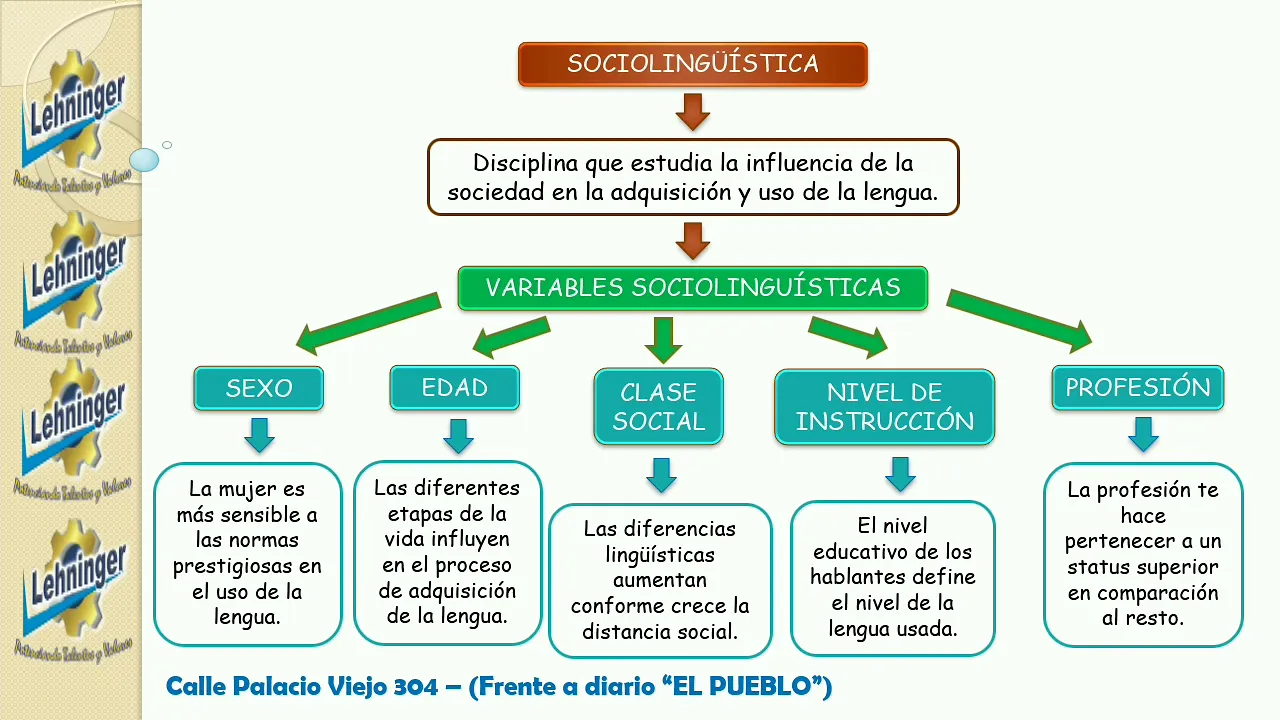
Sociolinguistics is a branch of linguistics that examines how society influences language acquisition and use. Five key sociolinguistic variables shape communication: (1) Sex/Gender - women typically show greater facility for language norms; (2) Age - younger speakers use more relaxed language and slang; (3) Social Class - upper classes use refined language, lower classes use more humble speech; (4) Level of Education - higher education correlates with deeper language knowledge; (5) Profession - different occupations influence communication styles, with professionals like lawyers speaking more carefully than technical workers.

Sociolinguistics studies how language varies systematically across social contexts and how speakers use linguistic variation for social positioning. William Labov's pioneering department store study demonstrated that the pronunciation of postvocalic R correlates with social class, with non-pronunciation associated with lower classes and clear pronunciation with upper classes. Language varieties are subsystems within a language that correlate with social factors, and speakers strategically select variants to position themselves socially. The three waves of sociolinguistics evolved from correlating extralinguistic parameters with language use (First Wave), to examining how varieties construct identity in speech communities (Second Wave), to analyzing how speakers use linguistic variables for social positioning and identity negotiation (Third Wave). Gender is not a fixed property but a performatively constructed identity that speakers continuously produce through linguistic choices, as demonstrated by drag performance where speakers switch between gendered speech styles to construct and critique social identities.
Language socialization, exploring how children and community newcomers acquire both linguistic competence and cultural identity simultaneously.

Language socialization is the process by which language acquisition becomes intertwined with becoming a person in society, where learning a language simultaneously involves learning to become a member of a community through socially recognized practices, power dynamics, identity formation, and culturally specific communication patterns; this process involves children learning speech acts, stance-taking, and narrative structures through observation of adults, and is studied through ethnographic research methods that capture emic (insider) perspectives on how communities transmit language and social membership across generations.

Language socialisation is a gradual, ongoing process by which newcomers to a community or culture acquire communicative competence, membership, and legitimacy through language-mediated interactions; this bidirectional process involves both experts guiding novices and novices influencing experts, occurring throughout the lifespan as individuals learn to adopt appropriate identities, stances, and ideologies of their new community.

Early childhood language acquisition differs from adult learning. The hosts discuss how children who grow up in bilingual environments develop different language proficiencies than those who learn languages as adults. They also explore how language proficiency influences cultural identity, with diaspora communities negotiating belonging through language use and sometimes facing labels like 'Benis' (half-Venezuelan).

Language acquisition is a natural process shaped by environment and exposure. Children learn their first language naturally through home environment, then acquire additional languages through school exposure. Bilingualism provides cognitive advantages and cultural benefits. The speaker discusses how children can learn Spanish at home while learning English at school, demonstrating that bilingualism can be achieved through consistent exposure to both languages. This shows that language acquisition is a natural process that can be facilitated through regular practice and immersion in different languages.

Children learn language through social contact with family members from birth, without needing formal grammar instruction. By approximately 3 years of age, children typically become fluent speakers. Language and culture are interdependent, as each influences the other. Language serves as a social tool and means of cultural identity, reflecting the identity of different groups and communities. It also plays a role in social stratification, as the language one speaks can determine their position within society. Different social groups often have different ways of communicating and different linguistic styles.
The phenomena of language endangerment, shift, and global revitalization efforts to preserve indigenous and minority languages.

Many minority languages in Russia are endangered and declining, with only about 40% of Tatars speaking the Tatar language. This language endangerment results from assimilation policies and the dominance of the Russian language. In contrast, Canada has made efforts to preserve indigenous languages, including the Cree language, with schools teaching in Cree. North America was originally home to hundreds of indigenous tribes speaking different languages, and in Canada, these indigenous peoples were not systematically destroyed as they were in the United States. The relationship between indigenous peoples and colonial powers in Canada was relatively more peaceful.

Language endangerment results primarily from language shift, where populations abandon their ancestral tongue for another. Intergenerational transmission failure occurs when parents don't pass their language to children, common among immigrant families. Political suppression through education policies forces language replacement (e.g., Ckunsa in Chile). Economic pressures drive communities to adopt dominant languages for mobility (e.g., Manx in Isle of Man). Urban migration disrupts small speech communities, forcing adoption of majority languages. Catastrophic events like genocide or disease cause rapid speaker death, accelerating language loss.

Approximately 50-90% of the world's 5,000-7,000 languages are at risk of extinction by the end of the century, primarily due to urbanization, globalization, and historical colonial policies that suppressed minority languages; however, successful preservation requires focusing on quality intergenerational transmission and community-based revitalization efforts rather than just increasing speaker numbers, as demonstrated by successful cases like Hebrew and Hawaiian.
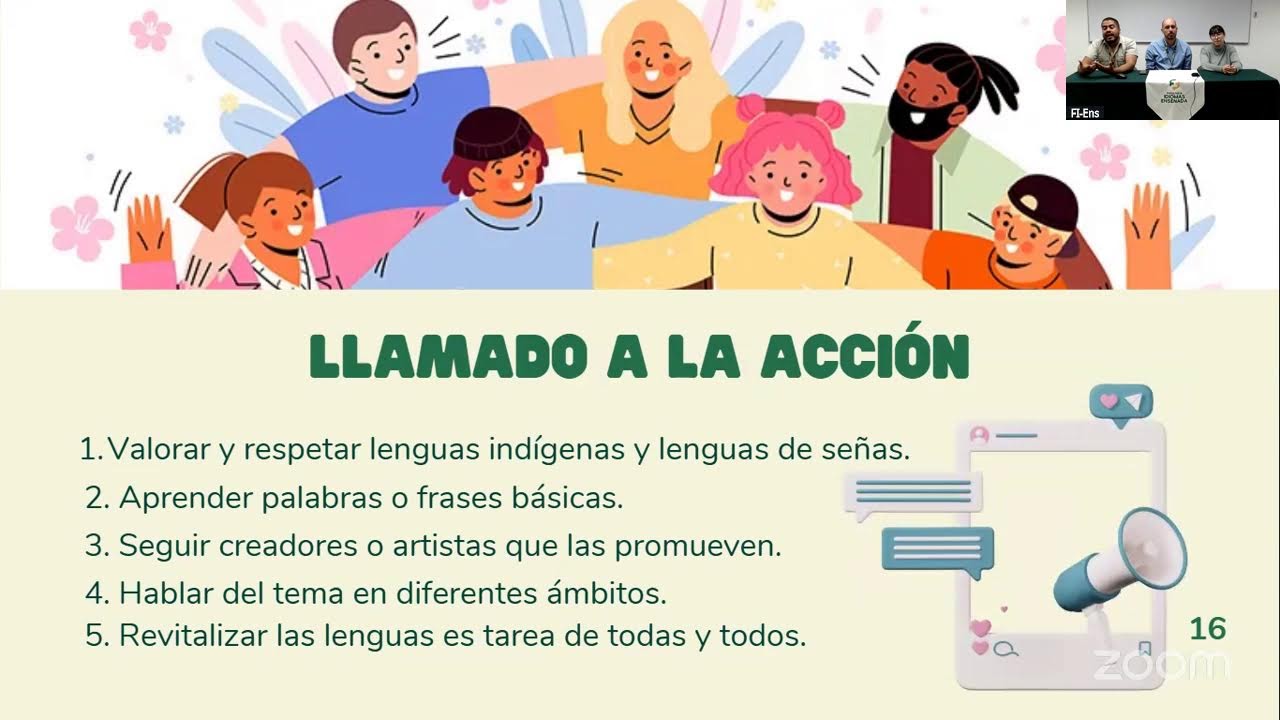
Languages are disappearing at an alarming rate, with approximately one language dying every two weeks worldwide, representing the extinction of entire cultures, histories, and unique worldviews. Mexico has 68 officially recognized indigenous languages, but 30 are in grave danger. Causes include discrimination, lack of educational support, globalization pressure, and negative attitudes toward indigenous languages. Revitalization strategies include bilingual education (e.g., Purépecha in Michoacán), digital dictionaries, documentation projects (e.g., Mayucateca Sign Language), and cultural/artistic initiatives like comics and murals. Communities themselves are essential to preservation, though challenges exist when elders do not teach their languages to descendants.

This segment examines indigenous identity, language endangerment, and cultural revitalization in Latin America. There is growing interest in indigenous identity and cultural revival among indigenous peoples, with many communities establishing schools, cultural centers, and social media groups to preserve and promote their languages and traditions. The segment discusses challenges in learning indigenous languages, including complex phonetic systems and lack of standardized writing systems. The segment also addresses indigenous language endangerment, with approximately one indigenous language lost each day worldwide. In Brazil alone, there are over 300 indigenous languages, but many are endangered with few remaining speakers. The segment examines indigenous intellectual traditions and their relationship with Western philosophical traditions, representing a complex synthesis of indigenous and Western perspectives. The segment also discusses indigenous cultural representation in media, ranging from stereotypical portrayals to more nuanced depictions that attempt to capture indigenous experiences and perspectives. The segment addresses how indigenous cultural symbols, particularly from Aztec and Maya civilizations, have become popular in contemporary popular culture, raising questions about cultural appropriation and recognition.
The ethnography of communication, focusing on qualitative fieldwork methods used to analyze speech acts within specific cultural communities.
![ethnography of communication [ speech event , community situation and act ]](https://i.ytimg.com/vi/3xNGF0MGu3M/maxresdefault.jpg)
The ethnography of communication is an interdisciplinary approach that examines how members of specific communities use language and communication in various social and cultural settings, focusing on the speech events, communities, and situations that shape communicative behavior. This methodology explores the formal, informal, and ritual events within particular groups, examining the varieties of language, speech acts, and genres available to community members, while drawing together anthropological and linguistic perspectives to understand communication as part of different ways of life.

The ethnography of communication seeks to understand human communication by examining speech events ethnographically. A speech event is any defined activity where talk plays a central role, ranging from two-person conversations to political rallies. Anthropologist Dell Hymes established six analytical steps: defining the event, defining the community, defining the setting, describing the speech event, describing speech styles, and describing speaking rules. The setting encompasses both social context (cultural understandings about the setting) and physical environment. Understanding speech events requires analyzing how participants define the event, what they share that makes it possible, and how differences among them affect conduct.

Ethnography of communication, developed by Dell Hymes in 1960, studies language in its total cultural context through fieldwork. It examines how people use language in real situations to develop communicative competence, which includes not just language rules but appropriate usage. A speech community shares common language knowledge. Hymes' SPEAKING model provides a framework: Setting (time/place), Participants (speakers/audience), Ends (purpose/goals), Act Sequence (form/order), Tone (manner), Instrumentalities (channels/styles), Norms (social rules), and Genres (speech types).

Communication ethnography applies general ethnographic methods specifically to communication research. It examines five communication functions: expressive (emotions), directive (commands), referential (truth claims), aesthetic (beauty), and phatic (solidarity). Researchers must define the speech community (masyarakat tutur) before study, as boundaries vary by interpretation. The scope includes means of communication (tools like traditional drums or modern sound systems), communicative competence (knowledge of codes, audience awareness, situational appropriateness, cultural norms), and the relationship between language and worldview (how vocabulary reflects cultural reality). Language varieties include codes, dialects, and registers that vary by region, social context, and speaker status. Linguistic rituals like Japanese bowing or Sundanese greetings serve social functions. High-context cultures derive meaning from context and nonverbal cues, while low-context cultures rely on explicit verbal messages.

The ethnography of speaking, developed by Dell Hymes in 1962 as a reaction to Noam Chomsky's distinction between linguistic competence and performance, is an anthropological approach that analyzes patterns of language use within speech communities by investigating directly the use of language in contexts of situations, taking as context a community and studying its communicative habits as a whole; unlike Chomsky's focus on grammatical accuracy, this approach emphasizes communicative competence—the speaker's ability to produce appropriate utterances in appropriate contexts—by examining four key elements: linguistic resources available to speakers, supra-sentential structuring for different linguistic events, social norms governing interactions, and the ways speakers associate particular modes of speaking with different contexts and cultures.
Core Field
0:08- 1
Defines anthropology as the study of humans across four subfields.
- 2
Highlights the main focus: human culture, biology, and language studies.
Generative Linguistics and Cognitive Universalism
While linguistic anthropology views language as a social and cultural practice deeply embedded in community life, Generative Linguistics—pioneered by Noam Chomsky—offers a major counter-perspective. This formalist framework argues that language is primarily an innate, biological cognitive faculty governed by a 'Universal Grammar' common to all humans. From this viewpoint, the fundamental structure of language is hardwired in the brain and largely independent of cultural influence. Critics from this school argue that linguistic anthropology's heavy focus on cultural relativism and qualitative ethnography overlooks the universal, biological, and mathematical foundations of human language.
hello hello there my name is eve and today i'm going to tell you about linguistic anthropology a lot of people haven't heard about linguistic anthropology i know that i didn't well fairly recently so i think more people should know about it because it's awesome but before i tell you about linguistic anthropology i should first describe what anthropology is for anyone who maybe doesn't know broken down to component parts anthro is a prefix that comes from the greek language which means man or human and ology is subject or branch of knowledge and that's an english suffix i think anthropology is a big word that in simplest terms just means study of humans and humans are complicated so anthropology is currently divided into four subfields archaeology which is probably the most uh well-known in popular culture cultural anthropology which is what i'm studying biological or evolutionary anthropology which is also very very cool and linguistics linguists are the people who study linguistics in anthropology and many other people commonly conceive of language as sort of an empty vehicle that conveys pre-existing meanings about the world or people see language as simply as those that convey information and there's there's debate about this there's debate that we should add a new subfield into anthropology and that subfield should be linguistic anthropology and it's different it's drastically different from traditional linguistics because traditional linguistics linguistics studies the structural components of language like syntax phonology and morphology linguists focus on these structural elements of language whereas they sort of ignore the social aspects of language such as semantics and pragmatics and i don't have time to get into all of that with this video but maybe someday we can talk about those things too these two social components of language are what linguistic anthropologists research and study and write about and talk about linguistic anthropologists ask questions like what counts as language like is sign language does that count as language what about whistling languages do those count how do people's ideas about language influence the way that they think about other people and how they might even think about themselves how do children acquire language in the first place these are just a few questions there are so many questions that linguistic anthropologists are studying and it's very exciting so stay tuned for more to summarize linguistic anthropology is the youngest most emergent and for some the most exciting branch of anthropological studies linguistic anthropology has much to offer not only in the social sciences or other academic disciplines but can offer valuable insights to everyday people like you and me linguistic anthropology helps us think critically about what we say how we say it why we say it and when and to who and perhaps most importantly what our words have the power to do
Up Next

Haitian Vodou: History, Beliefs, and Rituals Explained
@ReligionForBreakfast
565.9K views•2021-08-25

Astrobiology Through an Anthropological Lens: Field Insights
@georgiatechastrobiology
128 views•2021-04-14

Proxemics Explained: The Study of Personal Space
@Vox
536K views•2016-07-05

Psychology of Internet Trolling and Pranks Explained
@AzzyLand
10.7M views•2017-12-20
Related Study Plans & Knowledge Roadmaps
Structured learning paths in Anthropology