In the classical labor market model, when wages are above equilibrium (W1), there is a surplus of labor (unemployment) where supply (Q2) exceeds demand (Q1). This surplus causes wages to fall, leading to a contraction of labor supply and extension of labor demand until equilibrium is reached at point E, where wages settle at W2 and labor demand equals supply.
Classical Labour Market Theory Explained | Animated Economics Diagram
Added:Deep Dive
Basic principles of supply and demand, including how market forces establish equilibrium price and quantity in a standard goods market.

Разбор задания №21: Все ловушки из сборника Котовой и Лисковой! | Обществознание ЕГЭ 2025 | Умскул
17.8K
Market equilibrium occurs at the intersection of demand and supply curves. When demand increases (curve shifts right) while supply remains unchanged, equilibrium price rises due to scarcity. When supply decreases (curve shifts left) while demand remains unchanged, equilibrium price rises due to scarcity. When supply increases (curve shifts right) while demand remains unchanged, equilibrium price falls due to abundance. When demand decreases (curve shifts left) while supply remains unchanged, equilibrium price falls due to reduced desire to purchase. Non-price factors affecting demand include consumer income, tastes, preferences, prices of related goods, number of buyers, and expectations. Non-price factors affecting supply include number of sellers, production costs, technology, prices of related goods in production, and expectations. These principles apply universally across goods and services markets.
Click to watch →

CH-5 Determination of Equilibrium Price and Quantity|PRINCIPLES OF MICROECONOMICS-I| B.COM/B.A(P/H)|
36.6K
This section establishes the foundational principles of market economics. The law of demand demonstrates the inverse relationship between price and quantity demanded—consumers buy more at lower prices and less at higher prices. The law of supply shows the direct relationship between price and quantity supplied—producers offer more at higher prices and less at lower prices. Market equilibrium emerges when these forces balance, with quantity demanded equaling quantity supplied. The video explains how market prices naturally gravitate toward equilibrium, with excess supply creating downward pressure and excess demand creating upward pressure. Understanding these basic relationships provides the analytical framework for examining how markets function and respond to various economic conditions.
Click to watch →

Supply, Demand and Market Equilibrium | Principles of Economics | From A Business Professor
78.5K
Market equilibrium occurs at the point where the supply curve and demand curve intersect. At this equilibrium point, the quantity of a good that consumers want to buy equals the quantity that producers want to sell. The price at this intersection is called the equilibrium price, and the quantity is the equilibrium quantity. When prices deviate from equilibrium, market forces push them back: surpluses (when supply exceeds demand) drive prices down, while shortages (when demand exceeds supply) drive prices up.
Click to watch →

100 Most Expected Question| Price determination in different markets| Economics CA foundation Jan 26
2.6K
This segment explains how equilibrium price and quantity are determined in markets. When Demand and Supply increase equally, equilibrium price remains unchanged while quantity increases. When Demand increases more than Supply, both price and quantity increase. When Demand increases and Supply remains constant, only price increases. When Supply decreases and Demand remains constant, price increases. The key principle is that equilibrium price changes depend on the relative magnitude of demand and supply shifts. The market equilibrium occurs where quantity demanded equals quantity supplied.
Click to watch →
PLUS TWO ECONOMICS| CHAPTER 5| MARKET EQUILIBRIUM |FOCUS AREA BASED CLASS| MICRO AND MACRO ECONOMICS
66.2K
Market equilibrium occurs when quantity demanded equals quantity supplied. There is a positive relationship between price and quantity supplied—higher prices encourage suppliers to produce more. When supply exceeds demand, excess supply (surplus) creates downward pressure on prices. When demand exceeds supply, excess demand (shortage) creates upward pressure. The equilibrium price (P*) and equilibrium quantity (Q*) represent the stable market point where no further adjustments occur. Equilibrium is found by setting supply equal to demand and solving for price. For example, with supply equation Qs = 20 + P and demand equation Qd = 10 - 2P, solving 20 + P = 10 - 2P yields the equilibrium price.
Click to watch →
Deep Dive
The concept of marginal productivity, specifically how firms determine labor demand based on the Marginal Revenue Product of Labour (MRPL).

Marginal Revenue Product of Labour (MRPL) I A Level and IB Economics
66.7K
The Marginal Revenue Product of Labor (MRPL) is the extra revenue generated from employing an additional worker. In competitive labor markets, the demand curve for labor is derived from MRPL estimates. MRPL equals Marginal Product of Labor multiplied by Marginal Revenue. As firms hire more workers, diminishing marginal productivity eventually causes MRPL to decline. This creates a downward-sloping labor demand curve, explaining why firms hire fewer workers at higher wages. The MRPL framework provides the theoretical foundation for understanding how businesses determine optimal employment levels based on the value workers contribute to revenue.
Click to watch →

ECO401 Short Lecture 24_Highlighted Questions_ECO401 Lectures_Final Term_Full Detail In Short Time
11.3K
Marginal Revenue Product of Labor (MRPL) is the additional revenue a firm earns from employing one more worker. It equals the marginal physical product of labor multiplied by the marginal revenue of the product. The labor demand curve is downward-sloping because as more workers are employed, diminishing returns cause the additional revenue from each worker to decrease. Firms hire workers up to the point where wage equals MRPL.
Click to watch →

Classical Theory of Income and Employment - 1 | Economics | NTA UGC NET | Prerna Mishra
52.5K
The marginal revenue product of labor (MRPL) is the additional revenue generated by hiring one more unit of labor, calculated as the marginal physical product of labor multiplied by the output price. Firms demand labor as long as the MRPL equals or exceeds the wage rate. The demand for labor is downward sloping because as more labor is hired, the marginal physical product decreases due to diminishing returns, reducing the MRPL.
Click to watch →
A2 Economics - Labor Market - Past Papers Solved
722
Marginal Revenue Product of Labor (MRPL) is the additional revenue generated by each additional worker. It equals marginal product of labor multiplied by marginal revenue. Firms hire workers up to where wage equals MRPL. For example, the first worker might generate $1,000 in revenue, the second $800, and the third $600. This diminishing return occurs because each additional worker contributes less to output. MRPL determines the demand for labor at each wage level, as firms will not pay more than the revenue a worker generates.
Click to watch →

ಮಾರುಕಟ್ಟೆ ಸಮತೋಲನ| 2 PUC Micro Economics 5th Chapter| Important Questions
7.2K
The marginal revenue product of labor (MRPL) equals MPL multiplied by marginal revenue. Profit-maximizing firms hire labor where MRPL equals the wage rate. This condition ensures workers are paid equal to their marginal contribution to revenue. The labor demand curve derives from this MRPL = W relationship.
Click to watch →
Deep Dive
The distinction between nominal wages (the actual cash amount paid) and real wages (the purchasing power of wages adjusted for inflation).

У кого в РФ самые большие зарплаты?
36.6K
Nominal wage is the actual amount of money earned, as recorded in payroll and tax reports. Real wage represents the purchasing power of that money—the actual goods and services one can buy with their earnings. The key difference is that nominal wages can increase while real wages decrease if inflation outpaces wage growth. For example, if nominal wages rise by 12% but prices rise by 17%, real wages actually decline by approximately 4.4%. This distinction is crucial for understanding true economic well-being.
Click to watch →

Lec -19 Factor Pricing ( Part-A)
6.6K
Nominal wages are the actual monetary amount paid to workers without adjustment for inflation. Real wages are nominal wages adjusted for inflation, representing the purchasing power of wages in terms of goods and services. The standard of living depends on real wages, not nominal wages, because real wages reflect what workers can actually buy with their earnings.
Click to watch →

1-ma'ruza
116
Nominal wage is the wage expressed in current market prices, while real wage represents the purchasing power of that wage. Nominal wage is calculated at current market prices, whereas real wage reflects what goods and services can actually be purchased with the earned income.
Click to watch →

MVD Noticias l Columna de Economía con Germán Deagosto
125
Nominal wages refer to the actual monetary amount paid to workers, while real wages represent the purchasing power of those wages after accounting for inflation. The distance between nominal wage growth and inflation growth indicates changes in purchasing power. When nominal wage growth exceeds inflation, real wages increase; when inflation exceeds nominal wage growth, real wages decrease. This relationship is crucial for understanding workers' actual standard of living.
Click to watch →

El SALARIO es una FARSA (Trabajo y Fuerza de Trabajo) - Introducción al Comunismo #6
7.1K
The nominal wage is the money paid to workers, expressed in currency. The real wage is what workers can actually purchase with that money—the goods and services they can buy to meet their needs. The distinction between nominal and real wages is important because it reveals the actual standard of living of workers. Even if nominal wages rise, real wages may fall if the prices of goods rise faster. The real wage shows whether workers can actually afford the necessities of life and whether the wage system truly corresponds to the value of their labor power.
Click to watch →
Deep Dive
The fundamental assumptions of Classical Economics, such as perfectly competitive markets, rational economic agents, and fully flexible prices and wages.

Classical Model of Income & Employment | Macroeconomics| Deepti Mahajan
2.5K
Classical Economics rests on several fundamental assumptions: (1) Self-regulating economy where market forces automatically correct disequilibrium, (2) Say's Law that supply creates its own demand, (3) Flexible prices and wages that adjust freely, (4) Perfect competition with no monopoly or restrictions, and (5) Full employment assumption where all workers willing to work at prevailing wages find employment. These assumptions form the theoretical foundation for Classical macroeconomic analysis.
Click to watch →

CLASSICAL THEORY OF INCOME DETERMINATION | CLASSICAL THEORY ASSUMPTIONS | ASSUMPTIONS OF CLASSICAL
21.1K
Classical economics is built upon six fundamental assumptions: (1) Perfect competition in markets, (2) Fear of sacrifice (government should minimize intervention), (3) Market clearing (supply equals demand), (4) Money neutrality (money supply doesn't affect real variables), (5) Classical dichotomy (real and nominal variables are separate), and (6) Flexibility in wages and prices. These assumptions form the theoretical foundation for classical economic analysis.
Click to watch →

UGC NET Economics Paper 2 | Classical School of Thought By Shivani Sharma
1.1K
Classical economics is built on several foundational assumptions: (1) Wealth and assets are determined by the quantity of natural and man-made resources available in an economy. (2) International trade is based on absolute and comparative advantage. (3) The three factors of production are land, labor, and capital. (4) Economies naturally operate at full employment because wages and prices are flexible. (5) Free markets with minimal government intervention allow demand and supply to determine ideal prices. (6) Say's Law states that supply creates its own demand, as production generates income that creates demand. (7) Money serves only as a medium of exchange and does not affect real economic variables.
Click to watch →
Classical Theory of Income and Employment - 1 | Economics | NTA UGC NET | Prerna Mishra
52.5K
Classical economics is built on several core assumptions: (1) Full employment is the normal state of the economy, where workers willing to work at prevailing wages will find employment; (2) Perfect competition exists in all markets, ensuring efficient resource allocation; (3) Government intervention is unnecessary as markets self-regulate; (4) The invisible hand guides individual self-interest toward socially beneficial outcomes. These assumptions form the foundation for understanding classical economic theory and its implications for market behavior.
Click to watch →

CUET PG 2026 | Classical and Keynesian Theory | Concepts & Questions | CUET PG 2026 Economics | PW
1.7K
The Classical Approach is based on key assumptions: (1) The economy is a capitalist economy with free play of demand and supply; (2) Wages and prices are flexible and can adjust freely; (3) Competitive markets exist throughout the economy; (4) The market automatically adjusts to equilibrium through the interaction of demand and supply. These assumptions form the foundation of Classical economic theory.
Click to watch →
Prerequisite Knowledge
- Concept 01Basic principles of supply and demand, including how market forces establish equilibrium price and quantity in a standard goods market.
- Concept 02The concept of marginal productivity, specifically how firms determine labor demand based on the Marginal Revenue Product of Labour (MRPL).
- Concept 03The distinction between nominal wages (the actual cash amount paid) and real wages (the purchasing power of wages adjusted for inflation).
- Concept 04The fundamental assumptions of Classical Economics, such as perfectly competitive markets, rational economic agents, and fully flexible prices and wages.
Subsequent Learning
- Step 01Keynesian labor market theory and the concept of wage rigidity (sticky wages), which explains why labor markets may fail to clear, leading to involuntary unemployment.
- Step 02The economic impact of labor market interventions, such as statutory minimum wage laws, collective bargaining by trade unions, and unemployment benefits.
- Step 03The analysis of different types of unemployment, specifically focusing on the causes of structural, frictional, and cyclical unemployment in modern economies.
- Step 04Advanced modern labor market frameworks, such as Efficiency Wage Theory and Search and Matching models (e.g., the Mortensen-Pissarides framework).
Initial Wage
Surplus Drop
Equilibrium
Final Balance
Initial Wage
0:05Playing Section
- 1
Wage at W1 creates labor surplus.
- 2
Supply exceeds demand at this point.
Keynesian Economics and Wage Rigidity
Keynesian economic theory serves as the primary challenge to the Classical labour market model. While classical theory assumes that wages are perfectly flexible and naturally adjust to ensure full employment, John Maynard Keynes argued that wages are 'sticky' or rigid downward. Due to factors such as labor union contracts, minimum wage laws, and employee morale, wages do not quickly drop during economic downturns. Consequently, when demand falls, firms lay off workers rather than lowering wages, resulting in persistent involuntary unemployment. From this perspective, the labor market does not automatically self-correct, and government intervention through fiscal or monetary policy is necessary to stimulate aggregate demand and restore employment.
Deep Dive
Keynesian labor market theory and the concept of wage rigidity (sticky wages), which explains why labor markets may fail to clear, leading to involuntary unemployment.

THE KEYNESIAN SYSTEM (IV). AGGREGATE DEMAND AND SUPPLY. FROYEN 8.1 - 8.3
10.4K
Workers care about real wages (W/P) not nominal wages. Classical economics assumes flexible wages keep real wages constant. Keynesians argue money wages are downward rigid due to: worker resistance to nominal cuts, relative wage concerns, employment contracts, employer reputation costs, and legal minimum wage constraints. With fixed wages and excess labor supply, rising prices reduce real wages, incentivizing employers to hire more workers, generating an upward-sloping aggregate supply curve.
Click to watch →

Keynesian money wage rigidity model | price wage rigidity | upsc Economics optional | net Economics
21.4K
The Keynesian money wage rigidity model explains involuntary unemployment through three main causes: (1) Money illusion, where workers resist nominal wage cuts despite accepting reduced real wages through inflation; (2) Long-term labor contracts that legally bind wages for extended periods; and (3) Minimum wage laws that prevent wages from falling below certain levels. Unlike classical economists who assumed flexible wages would automatically clear labor markets, Keynes argued that downward wage inflexibility prevents the economy from reaching full employment equilibrium, making involuntary unemployment a normal feature of capitalist economies rather than a temporary disequilibrium.
Click to watch →

AP Macro Units 1-3 Review
22.1K
Sticky wages theory explains why economies experience prolonged recessions despite having unused resources. Unlike other markets where prices adjust quickly, wages and prices resist downward adjustment. When aggregate demand falls, workers resist accepting lower wages even when unemployment rises. This stickiness prevents the economy from self-correcting rapidly. Keynesian economists argue that active government intervention is necessary because waiting for natural adjustments causes unnecessary economic suffering, whereas classical economists believe the economy will eventually correct itself through market forces.
Click to watch →

FULL MACROECONOMICS CUET PG ECONOMICS Revision | CUET MA Economics Entrance | CUET PG Economic Class
7K
Keynes argued workers suffer from money illusion, focusing on nominal wages without considering price changes. Labor supply depends on nominal wages while labor demand depends on real wages. Wage rigidity prevents quick adjustment to market conditions due to menu costs and institutional factors. Efficiency wages suggest firms pay above equilibrium to ensure worker efficiency and loyalty. These factors create involuntary unemployment even when labor demand equals supply at equilibrium wage, contrasting with classical flexible wage assumptions.
Click to watch →
![[한림법학원] 2025 황종휴 거시경제학 GS1순환](https://i.ytimg.com/vi/NdfAarVAV-c/maxresdefault.jpg)
[한림법학원] 2025 황종휴 거시경제학 GS1순환
817
In competitive labor markets, equilibrium occurs where labor supply equals labor demand. At equilibrium, the wage rate adjusts to clear the market. If wages are flexible, any disequilibrium (excess supply or demand) will be corrected through wage adjustments. This is the classical view of labor markets. If wages are rigid (do not adjust downward), labor markets may not clear. When there is excess labor supply (unemployment), wages cannot fall to clear the market, resulting in involuntary unemployment. This wage rigidity is a key assumption in Keynesian economics and explains why markets may fail to achieve full employment.
Click to watch →
Deep Dive
The economic impact of labor market interventions, such as statutory minimum wage laws, collective bargaining by trade unions, and unemployment benefits.

O level/IGCSE Economics 2281/0455 Microeconomics Revision Day 13
875
Trade unions affect the economy through: Advantages include reduced poverty, improved standard of living, increased quality of income distribution, worker training improving productivity, and potential GDP growth. Disadvantages include demand-pull inflation from increased worker consumption, cost-push inflation from higher business costs, increased unemployment, and reduced economic output from industrial action. Government minimum wage intervention sets minimum pay above equilibrium, creating a surplus of workers and potential unemployment. Advantages include increased wages for low-income workers, reduced poverty, and incentives for unemployed people to enter the labor market. Disadvantages include increased unemployment, reduced aggregate supply, cost-push inflation, demand-pull inflation, and potential wage gaps between income levels.
Click to watch →

A2 Economics 9708 Specimen 2023 Paper 42 Section B (Micro) |How to answer 20 Markers|
5.3K
Trade unions restrict labor supply through strikes and industrial action, shifting supply curves leftward and increasing wages while creating unemployment—a trade-off between higher pay and job availability. Minimum wage legislation sets legal wage floors above equilibrium, creating labor surplus. The unemployment effect depends on elasticity of labor demand and supply—when both are inelastic, unemployment effects are smaller; when elastic, effects are larger. Trade unions can negotiate wage increases that also increase employment through improved working conditions, shifting demand rightward. Collective bargaining outcomes depend on relative bargaining power between unions and employers. Closed shop agreements occur when unions negotiate wage increases while maintaining current employment levels.
Click to watch →

O Level / IGCSE Economics 2281/0455 | Labour Market ( Practice Questions ) Lecture 4 |
148
A trade union is an organization of workers that negotiates with employers on behalf of employees for better working conditions, higher wage rates, and protection from unfair dismissal. Minimum wage is a wage control imposed by the government for unskilled workers to improve their standard of living and reduce poverty. For minimum wage to be effective, it should be imposed above the equilibrium wage rate to actually increase wages rather than creating unemployment.
Click to watch →

DIEGO GIACOMINI ■ ECONOMÍA AL CUADRADO
607
Immigration restrictions, minimum wage laws, mandatory unionization, and unemployment subsidies are state interventions that harm economic welfare. Immigration restrictions prevent workers who contribute through work, savings, capital accumulation, and entrepreneurship. Historical evidence shows countries built prosperity through immigration, including immigrants who lacked formal education but drove innovation. Minimum wage laws set wage floors above market equilibrium, eliminating jobs for low-skilled workers. Mandatory unionization concentrates these effects in specific sectors, excluding workers who could have obtained employment at lower wages. Unemployment subsidies prevent unemployed workers from competing with unionized workers, protecting union interests at the expense of overall employment. These interventions are funded through taxes on employers and consumers, reducing their ability to invest and create jobs. The result is increased unemployment concentrated among the most vulnerable social strata.
Click to watch →

EP Module 13
210
Collective bargaining (unions negotiating contracts) has the same general effect on unemployment as minimum wage laws. Both create wage floors above the equilibrium wage, leading to a situation where quantity supplied of labor exceeds quantity demanded, resulting in structural unemployment.
Click to watch →
Deep Dive
The analysis of different types of unemployment, specifically focusing on the causes of structural, frictional, and cyclical unemployment in modern economies.
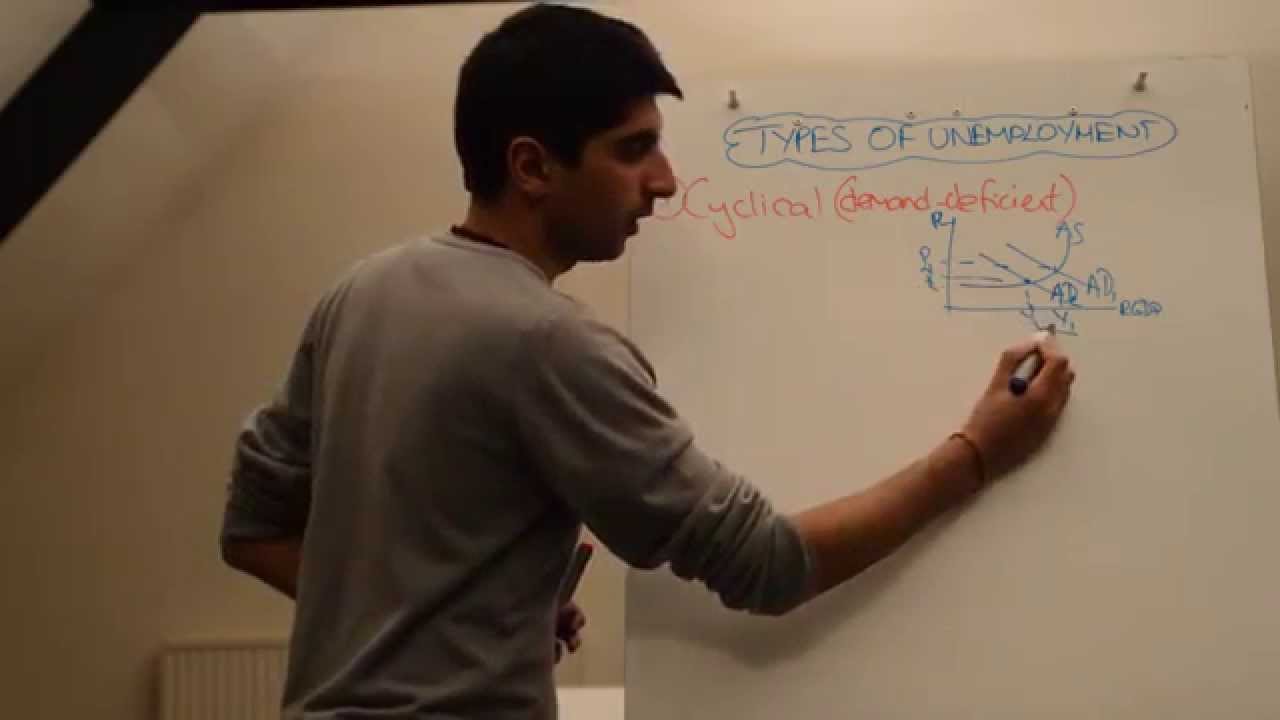
Y1/IB 9) Unemployment Types (Cyclical, Structural, Frictional)
217.2K
Unemployment can be categorized into three main types: cyclical unemployment occurs when there is insufficient aggregate demand in the economy, causing firms to reduce hiring or lay off workers; structural unemployment arises from labor immobility, either occupational (workers lack skills needed for available jobs) or geographical (workers refuse to relocate for work); and frictional unemployment happens when workers are temporarily between jobs while searching for new employment.
Click to watch →

Les 3 types de chômage : frictionnel, structurel et conjoncturel
6.5K
Unemployment exists even in healthy economies due to three distinct types: frictional unemployment (temporary job transitions like job changes or relocation), structural unemployment (long-term skill mismatches from technological changes or industry decline), and cyclical unemployment (crisis-driven job losses from economic downturns). Each type requires different solutions: better job information platforms for frictional unemployment, training and retraining programs for structural unemployment, and fiscal/monetary stimulus for cyclical unemployment. The natural rate of unemployment combines frictional and structural components, explaining why unemployment never reaches zero even during economic booms.
Click to watch →

TYPES OF UNEMPLOYMENT ( HINDI )
97.3K
This segment covers three major types of unemployment. Disguised unemployment occurs when more people are employed than needed, common in agriculture where extra family members work without adding productivity. Structural unemployment results from skill mismatches between workers and available jobs. Cyclical unemployment rises during economic recessions when companies reduce workforce to minimize losses. Frictional unemployment is temporary unemployment during job transitions, also called search or voluntary unemployment. Each type stems from different economic conditions and requires different policy responses.
Click to watch →

Economics : Unemployment | बेरोजगारी | Types of Unemployment | GS by Akshay Sir | CrazyGkTrick
134.3K
Unemployment manifests in multiple forms. Structural unemployment results from market demand changes or technological advancements that make certain skills obsolete, requiring workers to retrain. Cyclical unemployment occurs during economic recessions when companies reduce production and lay off workers. Frictional unemployment is temporary, occurring when individuals transition between jobs. Seasonal unemployment affects industries like agriculture and tourism where work is only available during specific periods. Each type requires different policy responses.
Click to watch →

Macro: Unit 1.4 -- Unemployment
151.2K
Economists classify unemployment into three distinct types based on underlying causes. Frictional unemployment occurs when workers are temporarily between jobs, seeking new employment, or changing careers; these workers are qualified with transferrable skills but currently not working. Seasonal unemployment is a subset of frictional unemployment tied to seasonal demand fluctuations, such as holiday workers losing jobs after peak seasons. Structural unemployment arises when workers' skills become obsolete due to technological or structural changes in the economy, rendering their skills non-transferable until they acquire new ones. Cyclical unemployment occurs during economic downturns when reduced consumer demand causes firms to cut production and lay off workers. Each type reflects different economic dynamics and requires different policy responses.
Click to watch →
Deep Dive
Advanced modern labor market frameworks, such as Efficiency Wage Theory and Search and Matching models (e.g., the Mortensen-Pissarides framework).

LMSF, Lecture #4: The Mortensen‐Pissarides Model, II
258
The Mortensen-Pissarides (MP) model is a macroeconomic framework applying search and matching theory to labor markets. It generates a natural rate of unemployment and provides mechanisms for wage pressure and Phillips curve analysis. The matching function describes how firms and workers are brought together through two-sided search, exhibiting constant returns to scale. Labor market tightness (theta), the ratio of vacancies to unemployed workers, serves as a sufficient statistic for market conditions. Workers benefit from tightness (higher job finding rates), while firms dislike tightness (higher vacancy filling costs). Productivity (s) can vary across workers and changes through random Poisson shocks. When a match occurs, there is a constant probability that a productivity shock will occur. If the shock falls below a reservation level (R), both parties agree to separate. The reservation level R measures job fragility—higher R means jobs are more likely to dissolve. The incidence of unemployment equals Lambda times F(R), where Lambda is the shock arrival rate and F is the cumulative distribution function. The MP model uses valuation equations to determine the value of being employed versus unemployed. Workers and firms have different perspectives on the same match, leading to a joint surplus that must be split through Nash bargaining. The bargaining outcome depends on the worker's bargaining power (beta) and the firm's bargaining power (1-beta). The wage equation depends on the asset value of being unemployed, which includes the unemployment benefit and the probability of finding a new job. The model assumes atomistic agents who cannot influence future values through their negotiation. The MP model is determined by two key equilibrium conditions: the job creation condition and the job destruction condition. The job creation condition equates the capitalized value of posting a vacancy to expected vacancy costs, represented as C/Q where Q is the discount rate. This condition is negatively sloped in the (R, theta) space because tighter labor markets make it less attractive for firms to post vacancies. The job destruction condition represents the point where workers are indifferent between continuing in their job and becoming unemployed, incorporating the option value of waiting for a better productivity draw. This creates an 'optimism' effect—workers don't separate immediately even at the reservation level because productivity could improve.
Click to watch →

Two-sided labor search
330
In a two-sided search model where workers and entrepreneurs (firms) search for each other, matches are formed when productivity y exceeds a reservation level y*, and surplus is shared according to a bargaining parameter β, with equilibrium characterized by the wage equation w(y) = βy + (1-β)[(r+λ)U - λb]/(1-β) and the reservation productivity condition, where θ (labor market tightness) determines matching probabilities and unemployment dynamics follow the same structure as one-sided search models but with productivity thresholds instead of wage thresholds.
Click to watch →
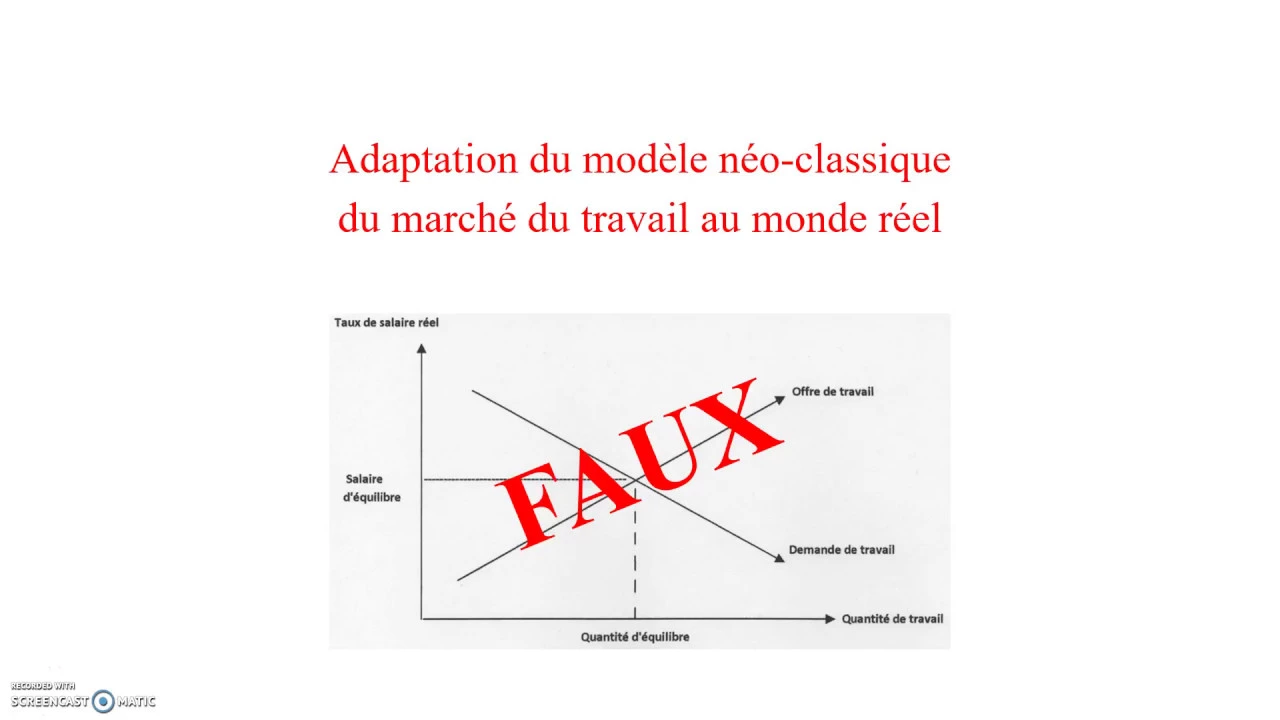
Critique de l'analyse néo-classique du marché du travail
4.7K
The efficiency wage theory (Stiglitz) explains why employers pay above equilibrium wages: (1) Selection effect - higher wages attract more productive workers with higher reservation wages; (2) Retention effect - well-paid workers have more to lose from firing and thus exert greater effort. This addresses information asymmetry and moral hazard problems. The job search theory (Stigler) challenges the assumption of free information by showing that job searching involves time and monetary costs. Workers invest time in searching for better opportunities rather than accepting first offers, creating unemployment as an information-gathering investment. These theories demonstrate that labor markets involve complex information problems and strategic behavior that the neoclassical model fails to capture.
Click to watch →

4th lecture Theory of Labor Markets with Search Frictions
951
The Mortensen-Pissarides model explains unemployment through search frictions rather than wage rigidities, treating job search as a dynamic matching process where workers and firms meet randomly; the model derives equilibrium unemployment from the interaction of job creation (firms posting vacancies) and job destruction (matches dissolving when productivity falls below a reservation threshold), with key parameters including labor market tightness (vacancies/unemployment), productivity shocks, and institutional factors like unemployment benefits and firing costs that affect both the wage-sharing rule and the stability of employment relationships.
Click to watch →

Scaletta tema 2025 del Concorso Diplomatico
577
Downward wage rigidity stems from long-term contracts, trade unions protecting employed workers, and minimum wage laws. Efficiency wage theory (Shapiro-Stigletz) explains rigidity through productivity gains from higher wages. Insider-Outsider models (Lindbeck-Stigletz) show employed workers resist wage cuts. Search and matching theory (Mortensen-Pissarides) explains frictions in job matching. A minimum wage above equilibrium creates involuntary unemployment by preventing wage adjustment. If set below equilibrium, it has no binding effect. The impact depends on whether the minimum wage is above or below the natural equilibrium wage.
Click to watch →
Initial Wage
Surplus Drop
Equilibrium
Final Balance
Initial Wage
0:05- 1
Wage at W1 creates labor surplus.
- 2
Supply exceeds demand at this point.
Keynesian Economics and Wage Rigidity
Keynesian economic theory serves as the primary challenge to the Classical labour market model. While classical theory assumes that wages are perfectly flexible and naturally adjust to ensure full employment, John Maynard Keynes argued that wages are 'sticky' or rigid downward. Due to factors such as labor union contracts, minimum wage laws, and employee morale, wages do not quickly drop during economic downturns. Consequently, when demand falls, firms lay off workers rather than lowering wages, resulting in persistent involuntary unemployment. From this perspective, the labor market does not automatically self-correct, and government intervention through fiscal or monetary policy is necessary to stimulate aggregate demand and restore employment.
Basic principles of supply and demand, including how market forces establish equilibrium price and quantity in a standard goods market.
The concept of marginal productivity, specifically how firms determine labor demand based on the Marginal Revenue Product of Labour (MRPL).
The distinction between nominal wages (the actual cash amount paid) and real wages (the purchasing power of wages adjusted for inflation).
The fundamental assumptions of Classical Economics, such as perfectly competitive markets, rational economic agents, and fully flexible prices and wages.
Keynesian labor market theory and the concept of wage rigidity (sticky wages), which explains why labor markets may fail to clear, leading to involuntary unemployment.
The economic impact of labor market interventions, such as statutory minimum wage laws, collective bargaining by trade unions, and unemployment benefits.
The analysis of different types of unemployment, specifically focusing on the causes of structural, frictional, and cyclical unemployment in modern economies.
Advanced modern labor market frameworks, such as Efficiency Wage Theory and Search and Matching models (e.g., the Mortensen-Pissarides framework).
3.6K views1likes0:36@EdwardBahawOriginal Release: 2010-03-19
In the figure, initially wages are at W 1. At this wage rate, the supply of labour is given by Q 2 and the demand for labour is given by Q 1.
The difference between these two represent a surplus of labour or unemployment. This causes the wage rate to fall. As a result there is a contraction of supply and a extension of demand. Equilibrium is eventually achieved in the market at point E, where the wage rate has fallen to W 2. At this point, labour demand and supply are equal.
Up Next

22:40
AI and the Future of Economic Transformation | Anton Korinek
@futureoflifeinstitute
82.9K views•2026-02-26

5:07
Impact of Yuan in Indo-Russian Trade Amid Sanctions
@WION
261.9K views•2022-07-01
10:33
Behavioral Economics Explained: Rationality, Nudges, and Risk
@crashcourse
1.1M views•2016-03-12

113:18
The Age of Easy Money: Fed & Inflation | Full Documentary
@frontline
21.2M views•2023-03-15
Related Study Plans & Knowledge Roadmaps
Structured learning paths in Economics
economics
Sovereign Debt: Defaults, IMF & Restructuring
01Introduction to Sovereign Debt & Government Bonds
02Debt Sustainability & Credit Ratings
03Anatomy and History of Debt Crises
+ 2 more learning modules
12h5 modules
Explore Roadmap
economics
Market Design: Matching Theory & Gale-Shapley
01Introduction to Market Design and Price-Free Markets
02Two-Sided Matching & The Gale-Shapley Algorithm
03School Choice Systems and Mechanism Design
+ 2 more learning modules
10h5 modules
Explore Roadmap
economics
Impossible Trinity: Forex, Capital & Policy
01Introduction to Monetary Policy and Central Banking
02Exchange Rates and International Capital Flows
03The Mundell-Fleming Model
+ 2 more learning modules
8h5 modules
Explore Roadmap
economics
Healthcare Economics: Market Failures & Systems
01Introduction to Healthcare Markets and Market Failure
02Asymmetric Information and Adverse Selection
03Moral Hazard and Insurance Design
+ 2 more learning modules
12h5 modules
Explore Roadmap