

















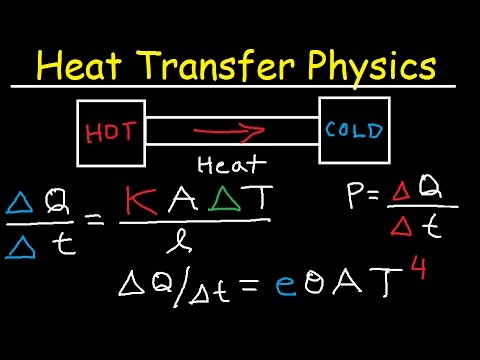




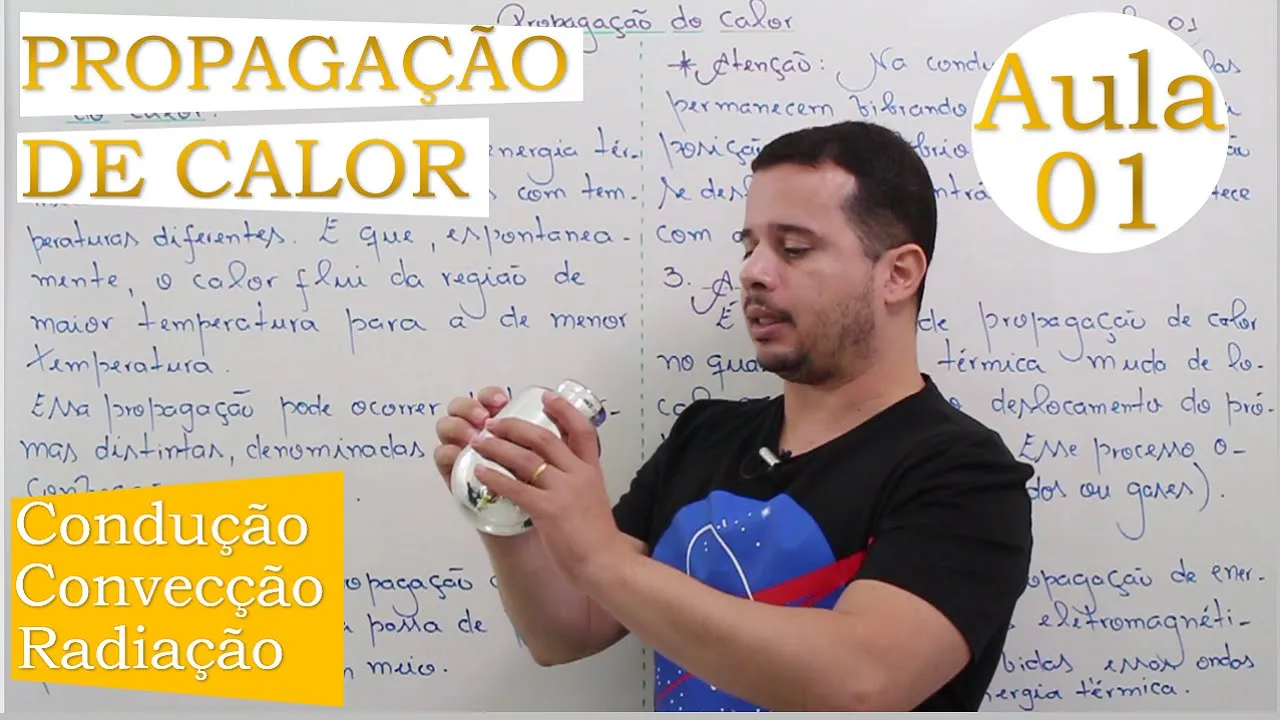
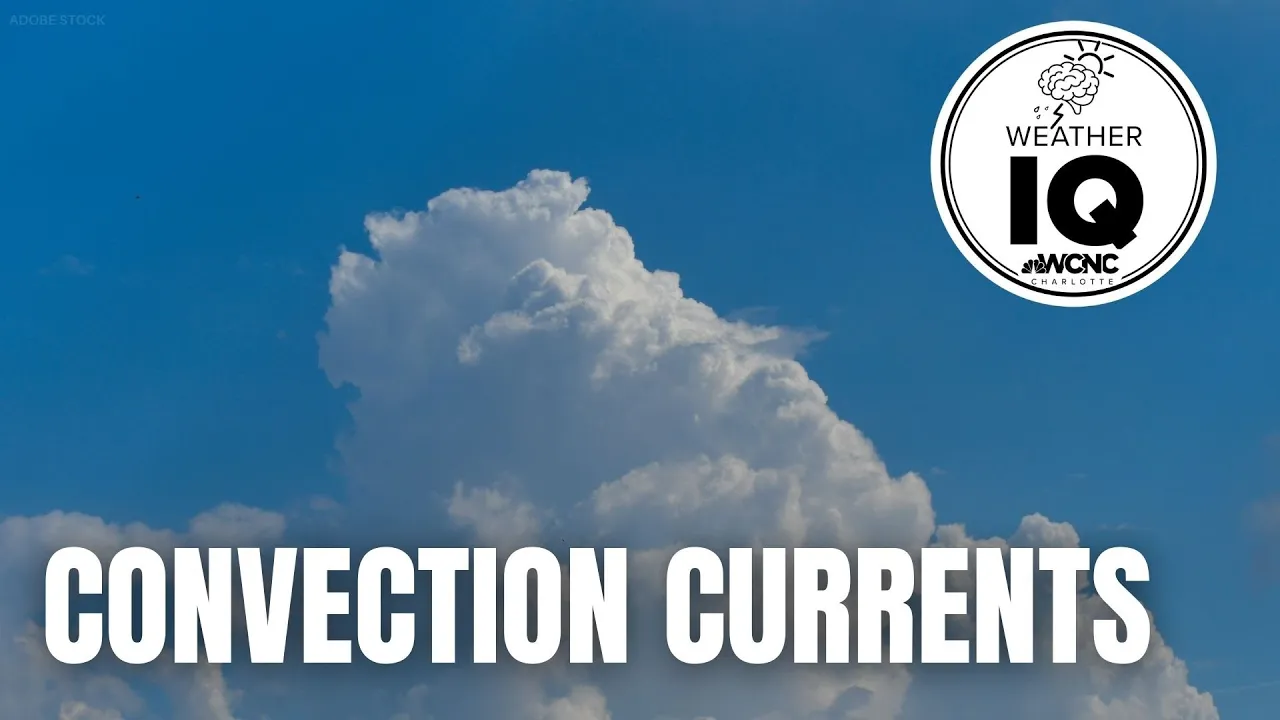


Thermal energy transfer occurs through three primary mechanisms: conduction (energy transfer through molecular collisions where faster-moving molecules transfer kinetic energy to slower ones), convection (heat transfer via fluid movement where hot, less dense air rises and cooler, denser air sinks, creating circulation patterns), and thermal radiation (energy transfer through electromagnetic waves emitted by accelerated charged particles, allowing heat to travel through empty space without a medium).
Thermal Transfer: Conduction, Convection, and Radiation
Added:Understanding the difference between heat (thermal energy in transit) and temperature (the average kinetic energy of particles).
The Kinetic Molecular Theory, specifically how the motion of atoms and molecules relates to thermal energy.
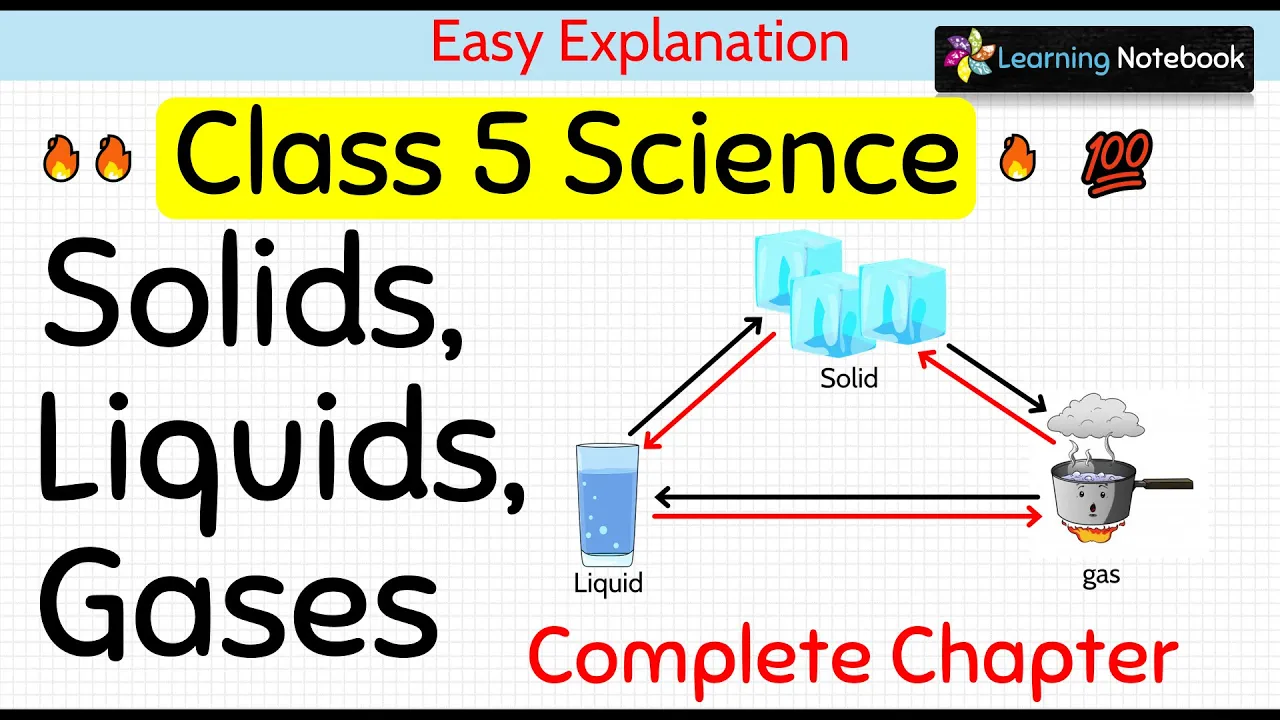
The fundamental states of matter (solids, liquids, and gases) and how their molecular structures differ.
The concept of thermal equilibrium and the thermodynamic principle that heat naturally flows from hotter to cooler regions.
Quantitative heat calculations using specific heat capacity and the calorimetry equation (Q = mcΔT).
Fourier's Law of Thermal Conduction and how material properties affect thermal conductivity and insulation (R-values).
The Stefan-Boltzmann Law of radiation and the concept of blackbody radiation.
Real-world meteorological applications, such as how atmospheric convection currents drive wind patterns and weather systems.
Engineering designs optimized for thermal management, including heat sinks in electronics and active cooling in engines.
576.7K views3.6Klikes9:09Original Release: 2015-07-23
- When we observe what we call fire we have this combustion reaction going on and then we see these flames what we're really observing are the three forms of thermal energy transfer.
We're observing conduction, conduction, convection, convection, convection, and thermal radiation all at the same time.
So I'll do this, thermal, thermal radiation, thermal radiation.
And I could say thermal conduction, thermal convection, and thermal radiation, and the word thermal is just relating to things dealing with temperature.
So what is the conduction going on?
Well what we have going on in the fuel for our fire, so down here the fuel for our fire we have our classic combustion reaction and I encourage you to watch the video on that in our chemistry playlist, or chemistry section if you're interested in it.
But you're taking carbon molecules and their bonds and then in the presence of oxygen and some heat you have a combustion reaction producing carbon dioxide and producing water and even more energy than you put into it, so it's producing a lot of energy.
And that energy is going to excite the molecules that are around it, so you have these molecules, you have these molecules that end up getting a lot of kinetic energy.
And remember, temperature is proportional to average kinetic energy.
And so the ones that just combusted, or the molecules right near the reaction, or maybe the ones that were part of the reaction, they're gonna have this really high, they're gonna have this really high average kinetic energy 'cause all of this energy was released from that combustion reaction.
And then they're going to bump into other molecules that might not have quite as high kinetic energy, but then they're going to transfer that kinetic energy through these collisions.
And we have a whole video on thermal conduction, but that's what's happening.
Things with higher kinetic energy are bumping into things with lower kinetic energy and transferring some of that kinetic energy and they're transferring some of that momentum.
So that is definitely happening when we look at a fire like this, that neighboring molecules are bumping into other molecules and transferring energy.
Now convection, this is around the idea that hot air is less dense.
So if we have a bunch of air particles here, so let's say this is the cool air up here, and it makes sense why cool air is going to be more dense than hot air.
'Cause hot air, these particles have a much higher kinetic energy and so they're gonna bump into each other and they're gonna push each other much further away and get more seperation from each other because of that high average kinetic energy.
But because the hot area is less dense, this area right over here is less dense, less dense, than the white area, these might be all the same molecule, I just made them in different colors to show the less dense area and the more dense area, it is going to rise, it is going to rise.
Or you can even think of it as a more dense area.
The more dense area is gonna fall around it, it's gonna fall around it, or try to go under it, because it is more dense, and then the less dense area is going to rise.
And by doing that, you have the hotter molecules are moving upwards and then the cold molecules can go down to maybe the source of heat, the source of heat, the source of energy right over here to get heated up more.
So this right over here is, so hot air rises, let me write this, the hot, hot air rises.
And when we think about it it makes room for the cool air to come down and then get heated up again.
And that's what's going on in the fire here.
You see the combustion reaction, combustion reaction occurs right over there, let me just hit a different color, combustion reaction is occurring in the fuel, that super hot air, it's going to rise.
And that's why it looks like these flames are kind of, they're moving upwards, they're kind of flickering upwards.
And you'll also see, and actually we're gonna talk about this in thermal radiation, is that they also change color as they move upwards.
But this whole idea of fire moving upwards and the hot air, if you put your hand up here it's gonna be much hotter than if you were to put your hand, say, right here, even though in theory this is closer to the flame than up here and that's because the hot air, the hot air is rising and it's making room for cold air, or cooler air, I guess I could say, to come down here and be part and get heated up again, and then it would rise up again.
And so this convection, this idea of the hot air rising or the cold air falling, this is another form of heat transfer.
Now the last form that we're observing when we're looking at fire is thermal radiation.
And this is all around the idea that if you have charged particles being accelerated they're going to release electromagnetic radiation.
And so you might say, Wait, wait, charged particles, where are those being accelerated here?
Well, we have these molecules that are constantly being accelerated as they bump into each other, the one that's gonna transfer kinetic energy from, let's say this one bumps into that, it's going to accelerate that in different direction and even this one might go in another direction and acceleration is a change in velocity so it could be the magnitudinal velocity or your directional velocity.
So as they're colliding you have all of these accelerational charged particles, so let me write this down, you have acceleration, acceleration of charged particles, charged particles, particles, and then that releases, that releases, electromagnetic radiation, that releases electromagnetic radiation.
I know what you're thinking, Wait wait, hold on a second, Sal.
Okay, I can buy that we have molecules that are being accelerated, but where is this charged, where are you getting this charged particles business?
Well we have to remember these molecules are made up of atoms and atoms are made up of charged particles, are made up of protons and electrons.
And so as you accelerate these and the more that you accelerate these the more radiation you are going to release.
And you might say, Okay, you said I'm observing that in fire, where am I observing radiation?
Well just the very fact that you can see the fire, the light emitted from the fire, that is electromagnetic radiation, that is electromagnetic radiation.
It's just the electromagnetic radiation in the wavelengths that your eye considers to be visible light, or that your eye considers to be light.
Even the particles up here, so even the particles up here that are still quite hot, they are also emitting electromagnetic radiation because they're all bumping into each other and their electrons and their protons are all getting accelerated in different ways, they're also releasing electromagnetic radiation, but it is at a slower wavelength than your eye is capable of perceiving as light.
If you had an infrared camera you would see the flames being much larger.
You would see them go all the way, all the way up here.
And if you were to look at the flame closely you would see down here right where the combustion reaction is happening, the flame looks blue.
And that's because the blue light is higher energy light, and that's because the particles are being accelerated more down here, and then it goes from blue to kind of a white to a yellow, to a red or to an orange, to a red, and then it, to your regular eyes, it disappears.
But everything, everything that has some temperature is releasing electromagnetic radiation.
And you're like, Okay, well that's all fine, I can see it but how is that a form of energy transfer?
Well, if you're ever sat next to a flame you will feel the heat.
In fact, even if the air between you and the flame is cold you would still feel like you're getting warm.
So if this is a flame right over here, so that is fire, and let's say you have cold air, cold air, let's say you're at a campfire right over here, maybe it's 30, this air right over here is 30 degrees, if you are standing right over here you would still feel heat, you would still feel like you're getting warmed up.
And that's because that electromagnetic radiation is being emitted from the air particles that we perceive as fire and then that can actually excite particles on your skin and it will transfer energy to your skin and so you feel like you are actually getting warmed up.
I remember once, this is kind of a strange story, but I was on the highway and there was a car on fire and I was literally, we drove to the far lane because it was on fire, we're three lanes away from it and it kind of exploded.
I don't think anyone was in it, hopefully no one was in it, but I remember right when it exploded it was an intense, immediate heat that we felt through the window of the car, and that was electromagnetic radiation.
That was thermal radiation being released by these accelerated particles in the air around that explosion, which we perceived as a an explosion, or fire, but then it was warming up particles on my skin.
Up Next
18:32
Turbulent vs Laminar Flow: Fluid Dynamics Explained
@veritasium
11.2M views•2020-06-11

12:53
21cm Hyperfine Transition in Neutral Hydrogen: Radio Astronomy Basics
@AaronRobertParsons
12.4K views•2011-10-13
14:45
Simple Pendulum Period: Physics Tutorial
@khanacademyphysics7609
384.2K views•2016-07-29

27:14
Entropy and the Second Law of Thermodynamics Explained
@veritasium
27.5M views•2023-07-01
Related Study Plans & Knowledge Roadmaps
Structured learning paths in Physics
physics
Nuclear Physics (Decay, Fission & Reactors)
01Atomic Structure and the Binding Force
02Radioactive Decay and Half-Life
03Nuclear Fission Mechanics and Chain Reactions
+ 2 more learning modules
12h5 modules
Explore Roadmap
physics
Soft Matter (Polymers, Colloids & Rheology)
01Foundations of Soft Matter & Thermal Forces
02Polymer Physics and Macromolecules
03Colloids, Surfactants, and Self-Assembly
+ 2 more learning modules
38h5 modules
Explore Roadmap
physics
Analytical Mechanics: Lagrangian & Hamiltonian
01Mathematical Foundations: Calculus of Variations
02From Newtonian Mechanics to Constraint Dynamics
03The Principle of Least Action & Lagrangian Mechanics
+ 3 more learning modules
28h6 modules
Explore Roadmap
physics
General Relativity (Spacetime & Cosmology)
01Foundations of Relativity: Special Relativity
02The Geometry of Spacetime: Equivalence Principle & Curvature
03Einstein's Field Equations: The Mathematics of Gravity
+ 2 more learning modules
55h5 modules
Explore Roadmap