The duty to retreat is a legal principle requiring individuals to attempt to escape from an attacker before using deadly force, but this duty does not apply to non-deadly force or within one's home (castle doctrine). Outside the home, retreat is only required if it can be done safely without increasing the risk of injury. In jurisdictions with stand your ground laws, the duty to retreat is further eliminated for deadly force.
Duty to Retreat Explained: Self-Defense Law with Prof. Kim Ferzan
Added:Deep Dive
The foundational elements of self-defense as an affirmative defense in criminal law, including the requirement of an imminent threat of unlawful force.

KARMELO CASE OVER.
328.2K
Self-defense claims require that the response be proportional to an imminent threat of violence; instigating a confrontation or provoking someone to attack invalidates self-defense claims, regardless of the accused's age or background.
Click to watch →

Baby Daddy Set Her Up? The Truth Behind the Romika Meeks Case
85.8K
This segment provides a detailed explanation of self-defense laws and the legal requirements for using deadly force. The narrator states 'YOU ONLY COULD SHOOT ON SOMEBODY WHEN THEY are [__] imminent threat,' indicating that self-defense is only justified when there is an immediate danger to one's life or safety. The segment criticizes those who 'don't know the real mother truth' and 'don't know nothing' about self-defense laws. The narrator explains that self-defense requires that a person faces an imminent threat and cannot safely retreat, stating 'YOU MOTHER DON'T KNOW [__] ALL YOU FAKE ASS FACEBOOK INVESTIGATORS, whatever you want to be.' The segment emphasizes that understanding self-defense laws is crucial for protecting oneself while avoiding legal consequences for excessive force. The narrator also discusses how the perpetrator violated her concealed carry by crossing state lines, stating 'You violated your own restraining order cuz why is you showing up to her son's school?'
Click to watch →

Desaparecieron a su Hermano PERO ELLA ACABO CON EL LIDER DEL CJNG - CRIMENES IMPERFECTOS
46.8K
Self-defense is legally justified when a person faces an imminent, real threat to their life or safety. The video demonstrates how Nicole's actions were contextualized by her history of victimization and ongoing threats from Rosales. The legal system recognizes that individuals facing sustained, credible threats may act in self-defense even when the threat is not immediately visible, provided the threat is real and imminent. This principle allows for contextual understanding of criminal behavior.
Click to watch →

Polícia não trata como legítima defesa caso da mulher que esfaqueia companheiro em briga
156.9K
Legitimate defense (legítima defesa) requires an imminent and ongoing threat to life or personal safety; in this case, the 10-minute video showed the woman was verbally and physically aggressive for 7 minutes before the stabbing, while the victim remained relatively calm, demonstrating that premeditated attacks or prolonged conflicts do not qualify as legitimate defense.
Click to watch →

Homeowner CHARGED For SMOKING Black Teen REPEATEDLY Breaking Into His Garage As Family CRIES MURDER!
263.5K
This segment provides a detailed legal analysis of self-defense standards. Prosecutors argued the homeowner shot a teenager who was fleeing, meaning no imminent threat existed. The homeowner reloaded, went inside, and returned to continue shooting, which may constitute pursuit rather than self-defense. Shooting through a locked, detached garage door further complicates the legal analysis, as the garage is not the homeowner's dwelling. The segment explains that legal justification requires both imminent threat and proportional force, and how these elements interact in real cases.
Click to watch →
Deep Dive
The legal distinction between deadly and non-deadly force, and the core requirement of proportionality in response to a threat.

A Critical View of Self-Defense Law Scholarship
3.8K
Proportionality requires that defensive force be no greater than the force being defended against. For practical purposes, this means: (1) Deadly force can only be used against deadly force threats (imminent death or serious bodily injury); (2) Non-deadly force can only be used against non-deadly force threats. Using deadly force against a non-deadly force threat violates proportionality and destroys the self-defense claim.
Click to watch →
Podcast #265: The Law of Self-Defense | The Art of Manliness
2.7K
Deadly force is any force that can cause death or grave bodily injury. Non-deadly force is anything less. You can only use deadly force in response to a deadly force threat. A sustained beating that could cause grave bodily injury qualifies as a deadly force threat. People commonly get into trouble when they use deadly force against a non-deadly threat, such as using a gun against someone merely threatening to shove them. Statistics show you are five times more likely to be the victim of a non-deadly force attack than a deadly force attack. If your only self-defense tool is a gun, you may be forced to use deadly force against a non-deadly threat, making your use of force disproportionate and unlawful. Martial artists must understand that techniques causing grave bodily harm constitute deadly force, regardless of whether weapons are used.
Click to watch →

ROMECA MEEKS CASE: LOVE TRIANGLE GONE WRONG| OPEN PANEL ISCUSSION
1.9K
There is a critical legal distinction between using non-deadly force and deadly force. Non-deadly force can be used to stop a non-deadly threat who is interfering with a person or their property, provided it is reasonable and not deadly. Deadly force, however, can only be used when a person is reasonably in fear of imminent death or great bodily harm. This distinction is fundamental to understanding when force is legally justified.
Click to watch →

Law of Self Defense News/Q&A Show: Oct. 29, 2020
144
The law categorizes force into two buckets: deadly force and non-deadly force. Within the non-deadly force bucket, there are varying degrees of force intensity. A finger poke to the chest is a lesser degree of force than a punch to the face. Maintaining proportionality is required not only between non-deadly and deadly force buckets but also within the non-deadly force bucket itself. This distinction is crucial because the law does not require proportionality within the deadly force bucket, where all deadly force is considered equal.
Click to watch →

Minneapolis ICE Shooting ERUPTS Into Full Blown Political War! LAWYER REACTS!
22.4K
Proportionality requires matching defensive force to the threat level. Deadly force includes any force reasonably capable of causing death or serious bodily injury (broken bones, loss of bodily function, or death). Non-deadly force cannot readily cause such harm. The law requires proportional responses: non-deadly force against non-deadly threats, deadly force only against deadly threats. Vehicles can constitute deadly weapons when used to inflict death or serious bodily injury. The burden of proof rests on the state to disprove self-defense elements beyond reasonable doubt, not on the defendant to prove self-defense.
Click to watch →
Deep Dive
The standard of 'reasonableness' (subjective belief versus objective rationality) required to justify the use of defensive force.

Protests ERUPT NATIONWIDE Over Renee Good Killing, Violence Feared | The Culture War EP.
105.6K
The legal standard for use of force requires both subjective and objective reasonableness. Subjective reasonableness considers what the officer actually believed at the moment. Objective reasonableness considers whether a reasonable person in the same circumstances would have perceived a threat. Both standards must be satisfied for use of force to be justified.
Click to watch →

A$AP Rocky Not Guilty
33.2K
The reasonableness of defensive force is judged by an objective standard, not a subjective one. This means the jury must determine whether a reasonable person in the defendant's position would have believed that using force (including a firearm) was necessary to prevent imminent harm, not whether the defendant actually felt threatened. Even if the defendant genuinely believed they were in danger, if no reasonable person would have shared that belief, self-defense does not apply.
Click to watch →
A Critical View of Self-Defense Law Scholarship
3.8K
The reasonableness element requires two components: (1) Subjective reasonableness - the defender must genuinely believe defensive force was necessary; (2) Objective reasonableness - this belief must be one that a reasonable person would share under similar circumstances. A defender can make reasonable mistakes (e.g., mistaking an airsoft gun for a real gun) and still have valid self-defense, but irrational perceptions that no reasonable person would hold destroy the self-defense claim.
Click to watch →

Police Use of Force: Legal Analysis of the LAPD Incident
111.7K
The reasonableness of force use requires both subjective and objective analysis. Subjectively, one must consider whether the officer would have acted the same way in their position. Objectively, society must determine whether such violence should be used in that type of defense. Both standards must be satisfied for the use of force to be legally justified.
Click to watch →

Woman Kills Unarmed Man & Claims Stand Your Ground | No Charges Filed
90.3K
The reasonableness standard requires that the belief that force was necessary must be reasonable under the circumstances. This involves both subjective belief (what the person actually believed) and objective reasonableness (what a reasonable person would believe). The question is not just whether the person was scared, but whether a reasonable person in that situation would perceive the threat at that particular level. This standard distinguishes legitimate self-defense from excessive force.
Click to watch →
Deep Dive
The basic structure of state criminal statutes and how criminal liability can vary by jurisdiction.

Decalogo del "Diritto penale di base per i concorsi pubblici" (01/03/2020)
120.2K
Crimes require both objective elements (conduct, event, causal relationship) and subjective elements (intent or negligence) for liability. Special categories include perpetual crimes continuing without interruption, habitual crimes triggering aggravating circumstances, and impossible crimes where objective impossibility prevents liability. Excluding causes of liability—physical coercion, errors from others' deception, and legitimate defense—protect against unjust punishment. Criminal responsibility requires imputability, developing at age 14 (full from 18), while mental illness or temporary intoxication may exclude liability. These structural principles ensure proportionate criminal justice.
Click to watch →

المراجعة النهائية في القانون الجنائي | المنهج في فيديو| حل قضايا 🕵@law-eslamelgingihy
12K
Criminal Law (Law No. 58 of 1937) is divided into General Part (general principles) and Special Part (specific crimes). Crimes are classified by severity: Felonies (death, life imprisonment), Misdemeanors (1 day to 3 years imprisonment or fines over 100 pounds), and Violations (minor offenses). Criminal liability requires: (1) commission of a crime (act or omission), (2) legal provision defining the crime, and (3) criminal intent (knowledge and will). Intentional crimes involve deliberate knowledge and will, while negligent crimes involve harm through carelessness without intent. Age of full criminal responsibility is 18 years; minors under 18 cannot face death or life imprisonment. Duress does not exempt criminal liability unless it genuinely overcomes willpower. Private prosecution crimes require victim complaint. Statute of limitations: 10 years for felonies, 3 for misdemeanors, 1 for violations. Punishments are Primary, Secondary, and Supplementary. Crimes are Continuous, Instantaneous, or Habitual. Retroactive application: New law applies if more favorable and effective before final judgment. Territorial principle applies to all persons within state territory regardless of nationality. Personal principle applies to all citizens regardless of where crime occurred. Maritime jurisdiction: Warships follow flag state law; merchant vessels follow territorial water law. Diplomatic and consular personnel enjoy immunity from host state criminal law, though they may be arrested for serious crimes.
Click to watch →

029 วันศุกร์ที่ ๑ มิ.ย. ๕๕ วิชากฎหมายอาญา มาตรา ๕๙-๑๐๖ (ปกติ) อ.เกียรติขจร วัจนะสวัสดิ์
42.9K
The structure of criminal liability consists of three main components: (1) The act must be voluntary and constitute a crime, (2) The act must not be exempted by law, (3) The act must not be exempted from punishment. This structure provides a systematic approach to determining criminal liability and ensures that offenders are held accountable only when appropriate.
Click to watch →
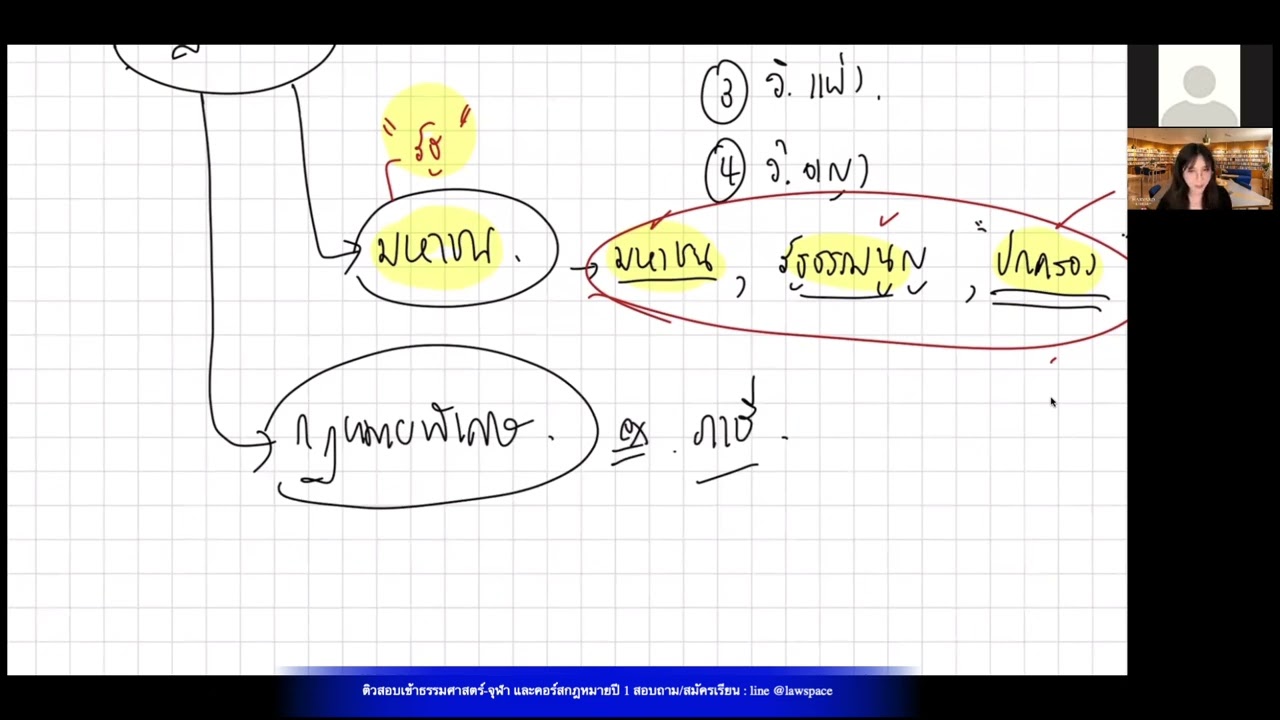
บรรยายพื้นฐานกฎหมายปี1 ‼️📕บุคคลและอาญาภาคทั่วไป ✨ #กฎหมาย #นิติศาสตร์
1.4K
Criminal Law (กฎหมายอาญา) is divided into General Part, Specific Offenses, and Minor Penalties. The General Part establishes foundational principles for understanding specific offenses. Territorial jurisdiction is governed by Section 4: crimes committed in Thailand must be punished under Thai law. Section 4(2) extends jurisdiction to crimes on Thai ships or aircraft regardless of location. Sections 5, 6, and 8 provide additional jurisdictional bases. Criminal liability requires three structural elements: (1) The act must fulfill all elements of the offense, (2) No legal exemption from liability, and (3) No legal exemption from punishment.
Click to watch →
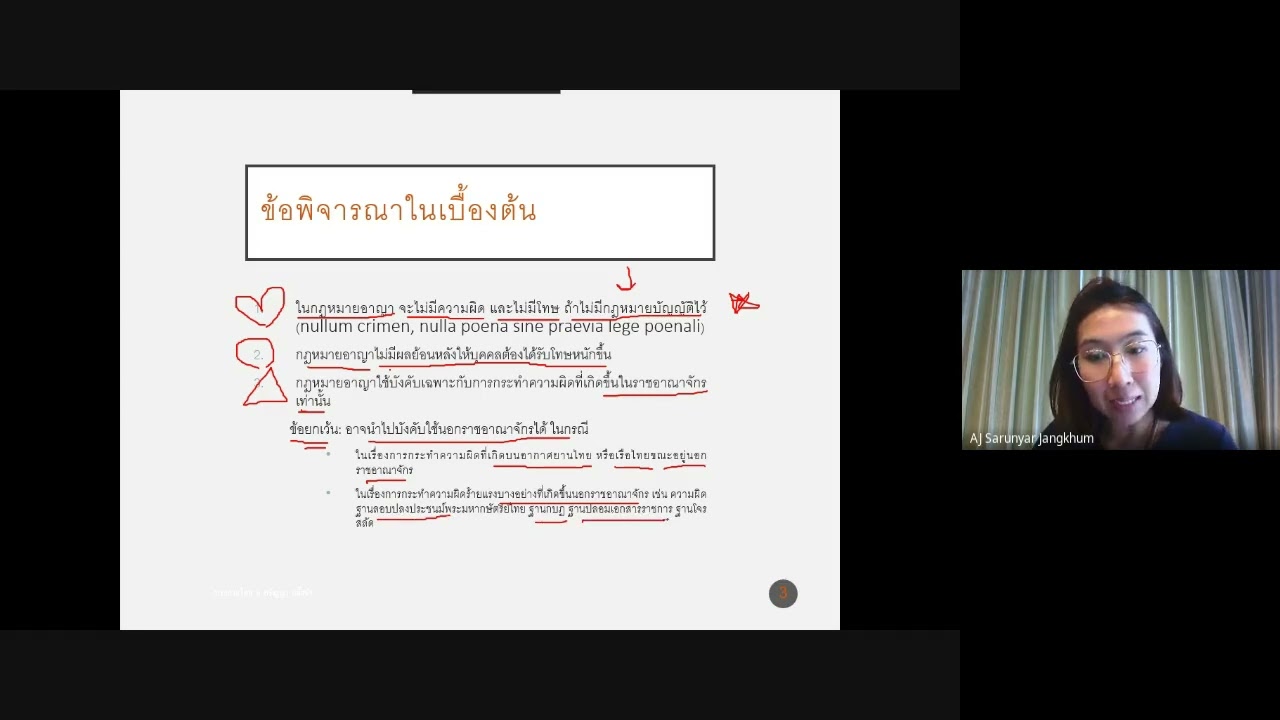
บทที่ 3 กฎหมายอาญา (วิชา กฎหมายเบื้องต้น)
2.7K
Criminal law is public law governing state-private individual relationships, directly affecting freedom and life through punishment. Key principles include: (1) Principle of legality - no crime or punishment without legal provision; (2) Non-retroactivity - laws cannot impose heavier penalties on past conduct, but beneficial laws apply retroactively; (3) Territorial jurisdiction applies only within Thailand, with exceptions for crimes on Thai aircraft/ships and crimes outside Thailand with effects within Thailand; (4) Universal crimes (piracy, crimes against humanity) allow any country to prosecute regardless of location. Criminal liability requires systematic analysis of all elements: external elements (physical acts or omissions) and internal elements (intent). Both must be present for liability. Intent includes direct intent (purposefully intending the result) and indirect intent (foreseeing the result as certain consequence). Attempted crimes occur when all elements are present but the result does not occur, receiving lighter punishment than completed crimes.
Click to watch →
Prerequisite Knowledge
- Concept 01The foundational elements of self-defense as an affirmative defense in criminal law, including the requirement of an imminent threat of unlawful force.
- Concept 02The legal distinction between deadly and non-deadly force, and the core requirement of proportionality in response to a threat.
- Concept 03The standard of 'reasonableness' (subjective belief versus objective rationality) required to justify the use of defensive force.
- Concept 04The basic structure of state criminal statutes and how criminal liability can vary by jurisdiction.
Subsequent Learning
- Step 01The 'initial aggressor' doctrine, which dictates how initiating a conflict affects or forfeits a defendant's right to claim self-defense.
- Step 02Advanced self-defense scenarios, such as the use of force in non-confrontational contexts, including cases involving histories of abuse and 'imperfect' self-defense.
- Step 03Empirical and policy debates surrounding 'Stand Your Ground' laws, analyzing their impact on homicide rates, deterrence, and racial disparities in criminal justice outcomes.
- Step 04The legal framework governing the defense of third parties (defense of others) and the limits of using force in defense of habitation or property.
Duty to Retreat
Duty to Retreat
0:02Playing Section
- 1
No duty to retreat before using non-deadly force.
- 2
Castle doctrine eliminates retreat duty inside home.
- 3
Retreat only required before deadly force outside, if safe.
The 'Stand Your Ground' Philosophy
In contrast to the 'duty to retreat,' the 'Stand Your Ground' philosophy argues that individuals unlawfully attacked have no legal obligation to retreat before using force in self-defense, provided they are in a place they have a right to be. Proponents of this view contend that requiring retreat unfairly places the burden of safety on the victim rather than the aggressor, forcing victims to make complex, split-second risk assessments under extreme duress. This perspective, rooted historically in the 'True Man' doctrine, asserts that fleeing from an unlawful assailant compromises personal dignity and autonomy. Advocates argue that 'Stand Your Ground' laws act as a deterrent to crime and protect victims from being unjustly prosecuted for defending themselves in life-threatening situations.
Deep Dive
The 'initial aggressor' doctrine, which dictates how initiating a conflict affects or forfeits a defendant's right to claim self-defense.

LIVE! Is Aaron Spencer The Prototype For Jury Nullification? Or Was It Self-Defense?
104.4K
The initial aggressor doctrine states that a person cannot claim self-defense if they were the initial aggressor in the confrontation or if they provoked the person against whom deadly force was used. In the Aaron Spencer case, the prosecution might argue that Spencer was the initial aggressor, but the defense would counter that Spencer was responding to an ongoing threat to his daughter.
Click to watch →

Lawyer Reacts to Panama Protest Incident
186.9K
Under the aggressor doctrine, a person who initiates a conflict becomes the aggressor and generally cannot claim self-defense when using deadly force. Louisiana's definition states that a person who brings on a difficulty cannot claim self-defense unless they withdraw from the conflict in good faith and in such a manner that their adversary knows or should know they desire to withdraw.
Click to watch →

SUNDAY SERVICE WITH MR. BEDEROW: MARCH 22 2026
16.9K
Self-defense is a legal justification that allows individuals to use force to protect themselves from imminent harm. However, the initial aggressor doctrine states that anyone who initiates an attack forfeits the right to claim self-defense in subsequent encounters. This means that if someone starts a confrontation, they cannot later claim they were defending themselves. The legal analysis explains that in the Kelsey case, if she was the initial aggressor (by picking up a firearm and pointing it at the officer), she would not be entitled to self-defense justification. The doctrine ensures that individuals cannot use the law to justify violence they initiated.
Click to watch →

Appeal Breakdown: Did Sarah Boone’s Lawyer Have Anything to Work With?
3.6K
The initial aggressor rule states that a person who initiates a confrontation is not privileged to use self-defense. Florida law allows a special jury instruction on this rule when the defendant is committing a forcible felony. The instruction negates the right to self-defense if the defendant was committing a forcible felony at the time of the incident.
Click to watch →
Sarah Boone's Appeal is Finally Here - Was it Worth the Wait?
38.6K
The initial aggressor exception to self-defense states that a defendant cannot claim self-defense if they were the initial aggressor in the confrontation. Under Florida law, this exception applies when the defendant was committing or escaping after the commission of an attempted forcible felony or aggravated battery. The Florida Supreme Court in Martinez v. State held that this instruction should not be given unless an independent forcible felony was charged, because otherwise it would create circular logic that precludes a finding of self-defense and amounts to a directed verdict on the affirmative defense.
Click to watch →
Deep Dive
Advanced self-defense scenarios, such as the use of force in non-confrontational contexts, including cases involving histories of abuse and 'imperfect' self-defense.
Defense Closing Argument
140
Self-defense claims require evaluating the full context of a relationship, including patterns of prior abuse. The defendant testified that Emily had become physically abusive, hitting him with objects including a cell phone, fists, laptop, and wine bottle, giving him a black eye. He stated he never hit her back, explaining he would restrain her until she calmed down. He also mentioned they went to counseling together. The defense argued that domestic violence can be a learned behavior, but he consciously chose to break the cycle. This demonstrates how courts consider the complete history of a relationship when evaluating self-defense claims, including whether the defendant was genuinely pushed to the point of no longer tolerating abuse.
Click to watch →

Menendez Brothers: Why DA Hochman Is Wrong & Newsom's Intervention Changes Everything
10.2K
The imperfect self-defense defense differs from traditional self-defense. Traditional self-defense is about imminent harm, whereas imperfect self-defense is about someone thinking there to be a risk to their life at that time, even if that belief is irrational. In the Menendez case, this defense relates to the accumulation of abuse over years, the hypervigilant nature of victims, and the trauma response. The timeline showed that Eric had told Lyle about ongoing abuse, Lyle confronted Jose and Kitty, Jose made threats, Kitty had two guns and knew about the abuse but did nothing, and Jose had intervened to stop Eric from staying away at school. Eric told Lyle that Jose had told him to go to his bedroom, which was normally the precursor to abuse.
Click to watch →

WI v. Kyle Rittenhouse Trial Day 9 - Arguments Over Lesser Included Charges
182.4K
In self-defense cases, a jury could find that the defendant did not have perfect self-defense but rather imperfect self-defense. This means the defendant reasonably believed they needed to use force but the amount of force used was not reasonable. The defendant's testimony that they did not mean to kill someone can support a finding of imperfect self-defense rather than intentional homicide. The jury considers whether the defendant's belief in the need for force was reasonable under the circumstances.
Click to watch →

Victims or villains? New evidence could free Erik and Lyle Menendez | 60 Minutes Australia
402.4K
The imperfect self-defense doctrine is a legal principle that recognizes that individuals who have been subjected to prolonged psychological or physical abuse may react differently and inappropriately when faced with perceived threats, potentially reducing a murder charge to manslaughter; this doctrine acknowledges that years of battering can fundamentally alter a person's psychological state, making them more likely to respond with excessive force in self-defense situations, and thus the legal system should account for these altered states of mind when determining appropriate sentencing.
Click to watch →

Self-Defense Rights in North Carolina—For the Record on WTOB
10.6K
Imperfect self-defense applies when the defendant had the right to defend themselves but used excessive force. The defendant still has some legal protection but faces reduced charges (potentially from murder to manslaughter). Courts consider past relationship history between parties when determining reasonableness of force. In domestic violence cases, courts may examine prior incidents to assess whether the force used was proportionate to the threat.
Click to watch →
Deep Dive
Empirical and policy debates surrounding 'Stand Your Ground' laws, analyzing their impact on homicide rates, deterrence, and racial disparities in criminal justice outcomes.
The effects of 'stand your ground' laws
32.5K
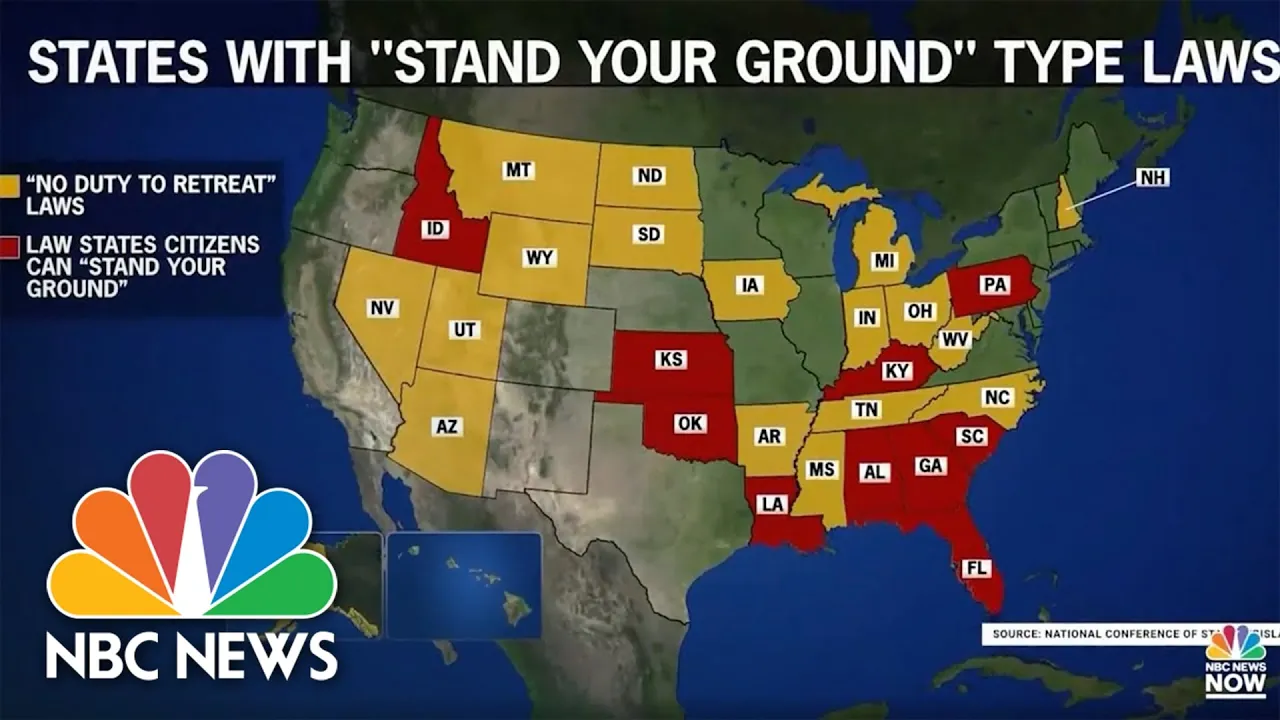
Stand your ground laws, which remove the duty to retreat before using deadly force in self-defense, have been shown through research to increase homicide rates by 8-11% and create significant racial disparities, with cases involving white shooters and Black victims being 10 times more likely to be ruled justified than cases with Black shooters and white victims, according to a 2020 U.S. Commission on Civil Rights report on Florida's laws.
Click to watch →

Carol Anderson: Race and Guns in a Fatally Unequal America
46.4K
Stand Your Ground laws expand the castle doctrine beyond one's home to anywhere one has a right to be, allowing individuals to use deadly force when perceiving a threat. Because Black people are the default threat in American society, this perception puts Black folks in the crosshairs. Statistics show that when whites kill blacks under stand your ground, they are 281% more likely to walk with justifiable homicide than when whites kill whites, revealing systemic racial bias in how threats are perceived and judged.
Click to watch →

The Civil Rights, Public Safety Implications of "Stand Your Ground" Laws
127
Stand your ground laws, which expanded self-defense provisions starting with Florida's 2005 legislation and spread through ALEC's model bills to 25 states, have increased homicides by approximately 600 per year with no deterrent effect on crimes, allowed shooters to walk free in drug-related incidents, emboldened confrontations that killed unarmed children, and significantly increased racial disparities in homicide rulings (17% justified for white shooters/black victims versus 1% for black shooters/white victims), prompting bipartisan calls for reconsideration.
Click to watch →

THE BIG DEBATE: Gun Laws that Work | USA vs. The Rest World
68.5K
Stand your ground laws expand the castle doctrine principle beyond homes to public places, allowing individuals to use deadly force in self-defense anywhere they have a legal right to be. Florida passed the first stand your ground law in 2005, and now 33 U.S. states have some form of this legislation. Comprehensive reviews of 16 independent studies found evidence that stand your ground laws moderately increase total homicide rates and specifically support the notion that such laws increase firearm homicides, contradicting claims that they serve as effective deterrents.
Click to watch →

Stand Your Ground laws, what are they exactly?
704
Stand your ground laws remove the traditional duty to retreat before using deadly force, allowing individuals to use lethal force when they reasonably believe their life is in danger, regardless of their location. These laws are controversial because they introduce subjective 'reasonable fear' standards that can be influenced by bias, and research shows they correlate with increased homicide rates (8-11% rise, over 700 additional gun deaths annually) and racial disparities in enforcement, where white shooters killing black victims are four times more likely to have their actions ruled justified compared to the reverse scenario.
Click to watch →
Deep Dive
The legal framework governing the defense of third parties (defense of others) and the limits of using force in defense of habitation or property.
Podcast #265: The Law of Self-Defense | The Art of Manliness
2.7K
The law treats defense of others much the same as self-defense, with most statutes simply adding 'or another person' to self-defense provisions. However, coming to the defense of others is more complicated because you often don't know what's really happening, especially when defending strangers. You can only use force in defense of others if that person would have been entitled to use force in their own defense. People get into trouble when they intervene because they don't know who the aggressor was. Additionally, rescued victims may change their stories to avoid criminal liability, making you appear to be the aggressor. Two legal paradigms apply: reasonable mistake (if you reasonably perceived a threat, your use of force may be justified) and alter-ego (your right to use force in defense of others is no greater than your right to use force in your own defense). In most states, highly defensible property (typically your home, sometimes your place of business, and sometimes your occupied vehicle) provides extra legal dispensation to use force. Personal property is not highly defensible; you are only allowed to use non-deadly force in defense of personal property.
Click to watch →
![MBE Torts [I,B]: Intentional Torts - Defenses to Claims for Physical Harms](https://i.ytimg.com/vi/ps9uYhBjfxM/sddefault.jpg)
MBE Torts [I,B]: Intentional Torts - Defenses to Claims for Physical Harms
7.8K
Privileges and immunities excuse liability even when tort elements are satisfied. Self-defense allows reasonable force against imminent threats. Force must be proportional to the threat, and the belief must be reasonable. Defense of others follows similar rules. Defense of property allows reasonable force to prevent imminent destruction, but killing to protect property is not justified. Defense of the home is sacred—force is most justified when someone penetrates the home's boundaries.
Click to watch →
Can I Defend Another Person?
62.4K
The law permits individuals to use force to protect others as if protecting themselves. Key principles include: (1) Immediacy - threats must be present and require immediate action without delay; (2) Proportionality - force level matches the threat severity (non-deadly force for non-lethal threats, deadly force for life-threatening situations); (3) Reasonableness - a reasonable person would believe intervention was immediately necessary. States with duty-to-retreat laws may limit intervention options. This framework allows bystanders to act in emergencies while maintaining legal protection when justified.
Click to watch →

BLAW 431 Chapter 7 Part 1
349
Defense of others allows you to use the same level of force to defend another person as you would to defend yourself, such as stepping in front of another person who's about to get hit and stopping the plaintiff from hitting them. Defensive property is somewhat controversial and varies state by state. This defense allows you to use reasonable force to defend your property from an intruder, but deadly force to defend only property is rarely justified. One notable example is Texas, where you can use deadly force to defend property in many situations. The instructor's law professor joked that if you shoot someone on the stoop of your house, you should stick a clock radio in their hand before calling the police.
Click to watch →

Gun Gripes Episode 41: STAND YOUR GROUND!
325.9K
Georgia Code 16-3-21 states a person is justified in using force intended or likely to cause death or great bodily harm only if they reasonably believe such force is necessary to prevent death or great bodily injury to themselves or a third person, or to prevent the commission of a forcible felony. You cannot use deadly force based solely on verbal threats - the attacker must be showing and have the means to commit what they are threatening. Georgia Code 16-3-23(a) states a person is justified in threatening or using force against another when and to the extent they reasonably believe such threat or force is necessary to prevent or terminate another's unlawful entry into or attack upon habitation. If someone is kicking down your door and you fear for your life, you can use any amount of force you deem necessary to stop them. However, pointing a gun at someone who has broken into your house can be more dangerous than shooting them, as some attackers may be faster on the draw.
Click to watch →
Duty to Retreat
Duty to Retreat
0:02- 1
No duty to retreat before using non-deadly force.
- 2
Castle doctrine eliminates retreat duty inside home.
- 3
Retreat only required before deadly force outside, if safe.
The 'Stand Your Ground' Philosophy
In contrast to the 'duty to retreat,' the 'Stand Your Ground' philosophy argues that individuals unlawfully attacked have no legal obligation to retreat before using force in self-defense, provided they are in a place they have a right to be. Proponents of this view contend that requiring retreat unfairly places the burden of safety on the victim rather than the aggressor, forcing victims to make complex, split-second risk assessments under extreme duress. This perspective, rooted historically in the 'True Man' doctrine, asserts that fleeing from an unlawful assailant compromises personal dignity and autonomy. Advocates argue that 'Stand Your Ground' laws act as a deterrent to crime and protect victims from being unjustly prosecuted for defending themselves in life-threatening situations.
The foundational elements of self-defense as an affirmative defense in criminal law, including the requirement of an imminent threat of unlawful force.
The legal distinction between deadly and non-deadly force, and the core requirement of proportionality in response to a threat.
The standard of 'reasonableness' (subjective belief versus objective rationality) required to justify the use of defensive force.
The basic structure of state criminal statutes and how criminal liability can vary by jurisdiction.
The 'initial aggressor' doctrine, which dictates how initiating a conflict affects or forfeits a defendant's right to claim self-defense.
Advanced self-defense scenarios, such as the use of force in non-confrontational contexts, including cases involving histories of abuse and 'imperfect' self-defense.
Empirical and policy debates surrounding 'Stand Your Ground' laws, analyzing their impact on homicide rates, deterrence, and racial disparities in criminal justice outcomes.
The legal framework governing the defense of third parties (defense of others) and the limits of using force in defense of habitation or property.
2.9K views33likes2:34@TalksonlawOriginal Release: 2022-02-10
professor kimberly ferzan of the university of pennsylvania school of law kim welcome to talks on law thanks so much for having me joel professor i'd love to talk quickly about duty to retreat what is the duty to retreat and perhaps we could give a couple of different examples of states responses to it the first thing to recognize is that there is not a duty to retreat before using non-deadly force no jurisdiction says if somebody's threatening to punch you that you need to run away instead of stopping them by using force against them now that traces back to what's been called the true man doctrine uh which theorists are often critical of because it sounds like this very testosterone-laden manly men stand up for themselves uh kind of you but other scholars say this actually traces to the view from sir matthew hale that it's about innocent men so the idea of a true man is an innocent man and the idea that right should not give way to wrong so if in fact you're lawfully where you're entitled to be you shouldn't have to leave that place rather than use at least non-deadly force so there's no duty to retreat for non-deadly force and there's also no duty to retreat within your home so within your castle the castle doctrine if somebody attacks you you do not have to run out of your house you get to stay and defend yourself and so that just leaves the question whether or not you need to retreat before using deadly force outside of your home there still you only have this duty if you can do so with complete safety so if turning and running away is going to actually make you more vulnerable to attack you are not required to retreat but you may not use deadly force if in fact you can retreat with complete safety so there's no duty to retreat for non-deadly force there's no duty to retreat in your home the only place where you have to retreat is before you escalate to deadly force outside the home right that's correct assuming that your jurisdiction does not have a stand your ground law because what the effect of stand your ground is to say you also don't have a duty to retreat uh before using deadly force [Music]
Up Next

15:27
Legal Use of Force to Protect Property: Attorney Analysis
@ActiveSelfProtection
308.4K views•2020-08-02

4:27
US Secondary Sanctions Impact on EU Businesses and Blocking Legislation
@Bureauvandijk
1.6K views•2019-03-20
54:54
Self-Defense Law: Justification, Use of Force, and Key Cases
@Talksonlaw
1.5K views•2022-03-08

24:42
Police Interrogation Tactics: False Confessions & Legal Reform
@LastWeekTonight
7M views•2022-04-18
Related Study Plans & Knowledge Roadmaps
Structured learning paths in Law
law
Self-Defense Law: Imminence & Castle Doctrine
01Foundations of Self-Defense Law
02Imminent Threat & Reasonable Belief
03The Principle of Proportionality
+ 3 more learning modules
12h6 modules
Explore Roadmap
law
Defamation Law: First Amendment & Actual Malice
01Introduction to civil torts and the First Amendment
02Elements of Defamation: Libel and Slander
03Public Figures vs. Private Individuals
+ 2 more learning modules
8h5 modules
Explore Roadmap
law
Hearsay Rule: Trial Evidence & Exceptions
01Introduction to Trial Evidence & Courtroom Basics
02Demystifying Hearsay: The Core Definition
03Non-Hearsay: Exclusions Under FRE 801(d)
+ 3 more learning modules
14h6 modules
Explore Roadmap
law
Medical Malpractice: Law, Liability & Care
01Foundations of Tort Law and Civil Liability
02The Four Elements of Medical Malpractice
03Defining and Proving the Standard of Care
+ 2 more learning modules
12h5 modules
Explore Roadmap