










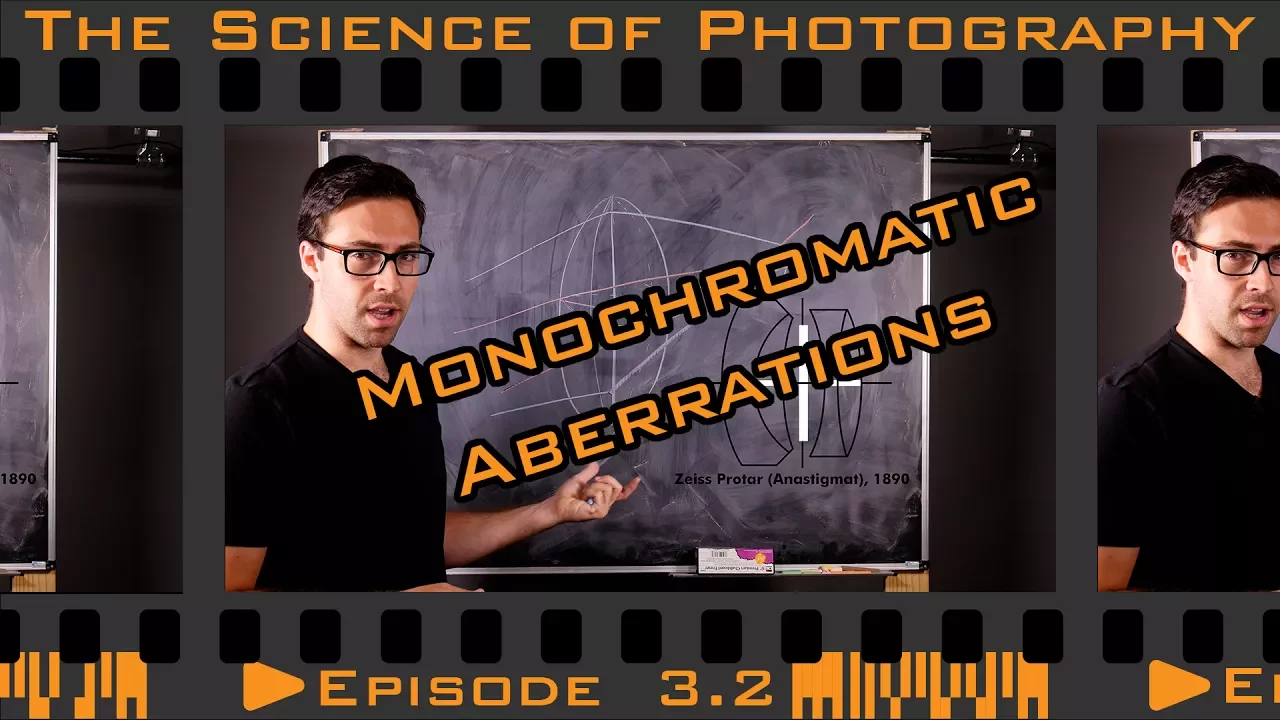






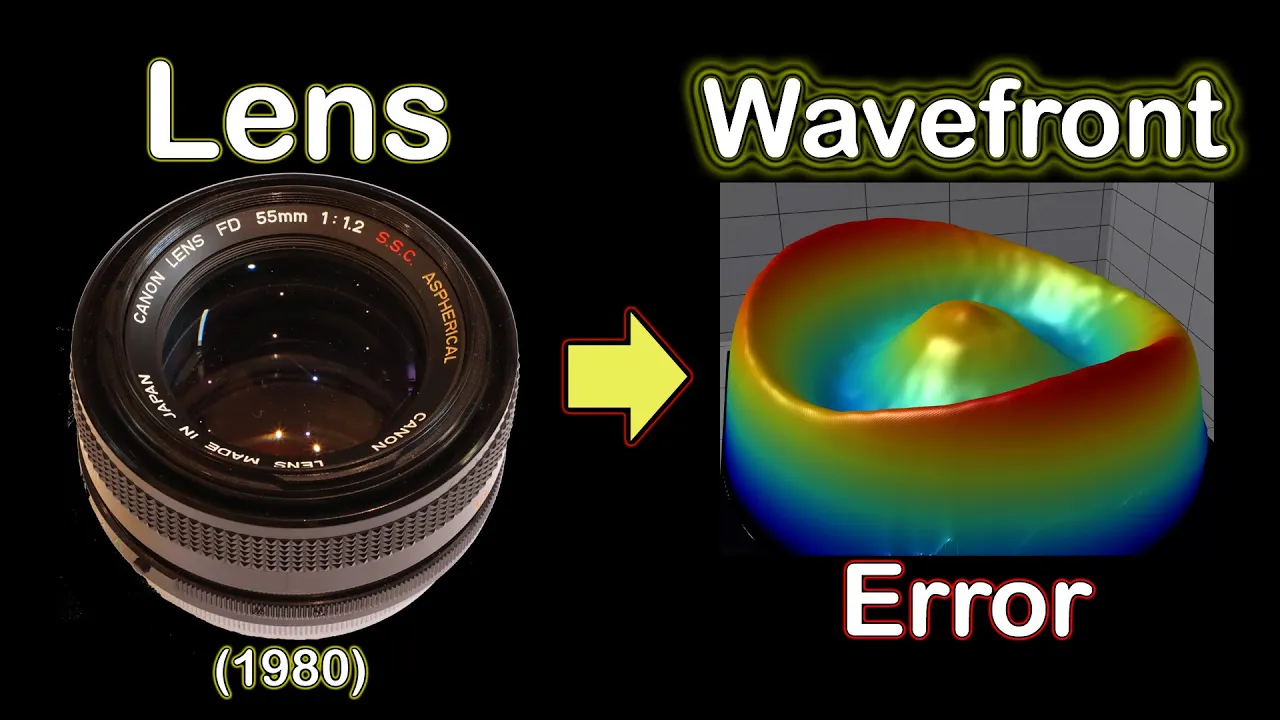

Optical aberrations are defects in lenses and mirrors that cause image distortion, primarily spherical aberration (where rays striking different parts of a spherical surface don't converge to a single focal point) and chromatic aberration (where different wavelengths of light refract at different angles due to varying refractive indices, causing color separation). These can be corrected using parabolic mirrors or specialized lens combinations.
Optics Part 4: Spherical and Chromatic Aberrations Explained
Added:The law of refraction (Snell's Law) and how light bends when transitioning between different media.
The concept of optical dispersion, specifically how refractive index varies with the wavelength (color) of light.
Basic geometric optics, including lens terminology (focal length, principal axis, focal point) and ray-tracing techniques.
The paraxial approximation (small-angle approximation) and why ideal lens equations assume all rays meet at a single focus.
The design and mechanics of corrective optics, such as achromatic doublets, apochromats, and aspheric lens surfaces.
Other primary monochromatic aberrations (Seidel aberrations) including coma, astigmatism, field curvature, and distortion.
Practical applications of aberration correction in high-precision optical systems like camera lenses, microscopes, and astronomical telescopes.
The transition from geometric optics to wave optics, including how aberrations affect the diffraction limit and wave fronts (Strehl ratio).
73.2K views928likes9:21Original Release: 2016-10-25
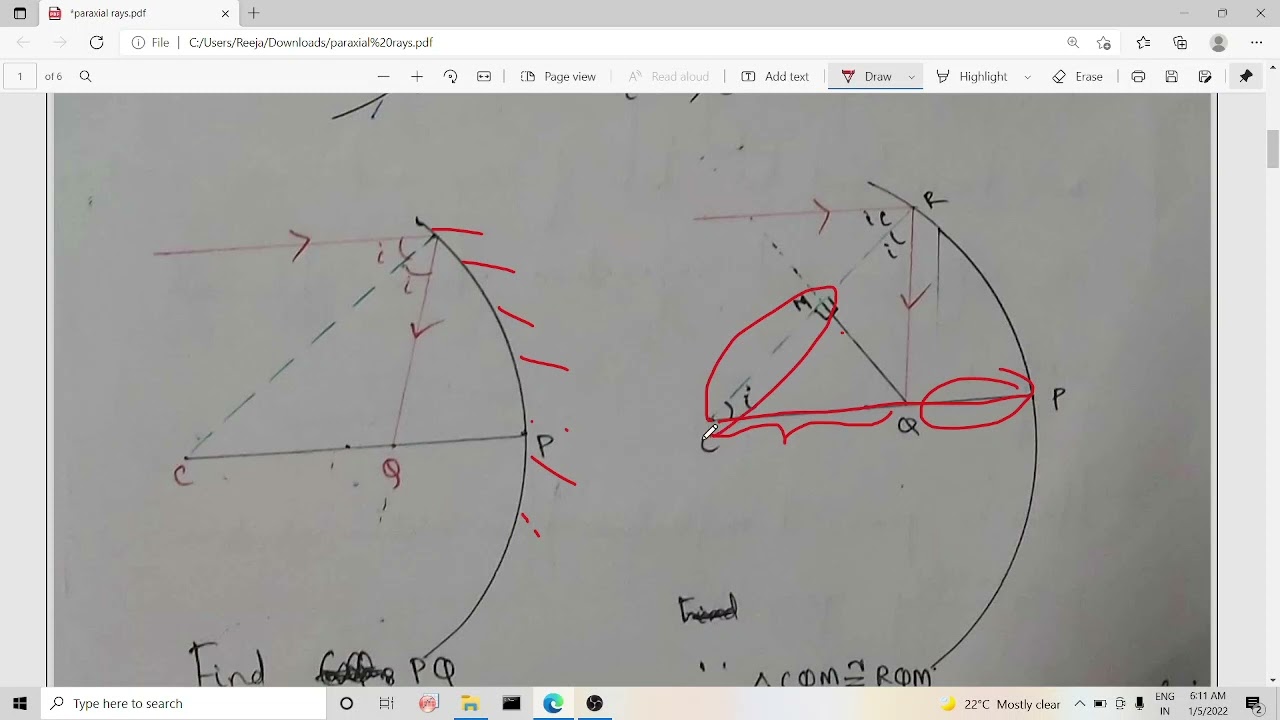
[Music] so in this video we're going to talk about aberrations and these are essentially Optical defects which result in an optical instrument producing a nonideal image it usually results in the blurring or Distortion of an image now the first of these is what we call SP iCal aberration so when we were talking about mirrors we talked about spherical mirrors and okay this is a curved mirror it's not spherical but we assumed that we had a constant radius of curvature and that gave rise to a single focal point however that is actually not the case and we could see that when we were making our approximations when we were deriving the images for mirrors um we were assuming that the radius of the mirror was a lot less than the radius of curvature of the mirror and that allowed us to make some approximations about certain distances being very very small and negligible and also that the you know signs of angles were approximately equal to the angles themselves the small angle approximations however when you actually calculate how a ray of light will be reflected by a mirror if you look at a semi circular mirror it's quite horrific that you only see the Rays in the center are actually focused to something approximating a common focal point and the Rays on the outside are actually scattered all the way around and in fact some of the Rays if you projected them further as showing in this diagram here would actually reflect off the Surface Two or even more times so clearly this is going to lead to a distortion and that Distortion is called spherical aberration however it's not just limited to mirrors when we derived the lens equation for lenses which had spherical surfaces we also made these small angle approximations and the result there is is that the light that is striking different points on the lens of surface do not all have a single common focal point but like a um spherical mirror for rays that are going in close to the center of the lens that is a very good approximation but this is something we can actually demonstrate and so let's actually have a look at a demonstration of spherical aberration for a lens such as this one so what we're going to demonstrate here are the effects we've just been talking about which are spherical and also in fact chromatic aberration so the what we've got here is we've got a semicircular lens so obviously this lens has a very high degree of curvature and the radius of the lens is in fact equal to the r radius of curvature here now you can tell that you know this approximation of a spherical surface that we've been using up until now really isn't going to work because if we look at the two outer Rays you can see they don't even go through the lens and that's because they totally internally reflect inside the plastic here so clearly uh those ones are not going to contribute to an image at all because of total internal reflection but if we look at the three rays in the center we can see that actually in this region here where you know we've used only a small fraction of the full radius of the lens about half um we do get a single focal point where all three rays are incident together but to show the effect of spherical aberration what I'm going to do is I'm going to move this down now and so we have four Rays incident on the lens and there you can see now that the two rays that are going through the center of the lens here come to a focal point here but if we turn the lights down you can probably see it a little bit better if we look at the two outer Rays these come to a focal point here so we have two different focal points for the Rays on the outside of the lens versus the Rays on the inside of the lens and that is a result of spherical aberration but if you look closely at the two rays that are coming on the outside of the lens you can also see another type of optical defect the Rays in the center are quite narrow and remain narrow when they come out but the Rays on the edge you can see are spreading out into a fan and if you look very very closely you might just be able to make out that there is a split of colors over these rays and the focal point here is not a nice sharply defined uh point it's actually a range of uh positions here it's a sort of uh uh oval shaped here and that is a result of chromatic abberation what is happening is the different wavelengths in the white light are diffracting are um refracting differently because they have different refractive indices in the plastic and that gives a range of different focal lengths for the different wavelengths and that effect is known as chromatic aberation so what we're demonstrating here is the physics that lies behind chromatic aberration and what we've got is a very bright white light source that is now shining not on a lens but on a glass prism and you can see that the uh light is split into its component colors and what that tells us is that for this prism the material the glass that it's made of has a different refractive index for each different wavelength of light and that is what gives rise to Chromatic aberration because the lens has a different refractive index for each wavelength and that leads to a different focal length for each wavelength of light and we call this effect dispersion and we'll discuss it in more detail later on in the course so we've now talked about two types of defect that give rise to these things called aberations which distort images on the one hand we have the spherical aberration that came about because we have a nonideal shape for our lenses and mirrors and on the other we have chromatic aberration that comes about because of essentially less than ideal materials that we make lenses from now both of these can be corrected for in a variety of different ways for example a spherical mirror can be corrected either by not making a spherical mirror if you make a parabolic mirror you end up with a perfect Focus for parallel lay rays of light and this is commonly used when you're focusing radio waves and you're building a radio antenna these will be these are made from metal which is easily shaped into a parabolic form and so if you happen to have a satellite TV DISH at home that will actually probably have a parabolic shape the other way you can correct for this in amateur astronomy telescopes is something called a Schmid correction plate which is a carefully machined uh piece of glass that has very slight variations in thickness generally you can't see these Variations by ey they it looks like just an ordinary plate of glass and that can make Corrections uh essentially by using refraction to correct incoming parallel light so that the spherical lens at the other end of the tube does actually Focus all of that light to a single Focus point for chromatic aberration you can fix this by using two different lenses together so if you want to have a net converging lens you would have a weak diverging lens made of a material that's got a very large difference in refractive index over the range of visible light and you couple that with a strongly converging lens that has made from a material that has a very small difference um in refractive index over the range of visible light and that way you can create a lens which has roughly the same Focus focal length for all wavelengths of light it's never perfect but it's close now those are the only two defects we're going to talk about here but there are of course others there's things like coma which affects when you have parallel light that's coming from off axis so not down the optical axis but at a slight angle to it that uh gives you an effect called coma and there are going to be other effects that we will actually talk about a little bit later in the course when we deal with defraction because the finite size of the lens or the mirror will result in defc of effects but we'll discuss those later so for now that's all we're going to say about Optical [Music] defects
Up Next

8:25
Adaptive Optics Explained: Wavefront Correction & Microscopy
@NemonicNeuroNex
4.4K views•2019-11-25

12:53
21cm Hyperfine Transition in Neutral Hydrogen: Radio Astronomy Basics
@AaronRobertParsons
12.4K views•2011-10-13

32:32
NMR Spin Physics I: Zeeman Effect, Resonance Condition & Larmor Frequency
@nptel-indianinstituteofsci8064
2.3K views•2024-01-17

27:14
Entropy and the Second Law of Thermodynamics Explained
@veritasium
27.5M views•2023-07-01
Related Study Plans & Knowledge Roadmaps
Structured learning paths in Physics
physics
Nuclear Physics (Decay, Fission & Reactors)
01Atomic Structure and the Binding Force
02Radioactive Decay and Half-Life
03Nuclear Fission Mechanics and Chain Reactions
+ 2 more learning modules
12h5 modules
Explore Roadmap
physics
Soft Matter (Polymers, Colloids & Rheology)
01Foundations of Soft Matter & Thermal Forces
02Polymer Physics and Macromolecules
03Colloids, Surfactants, and Self-Assembly
+ 2 more learning modules
38h5 modules
Explore Roadmap
physics
Analytical Mechanics: Lagrangian & Hamiltonian
01Mathematical Foundations: Calculus of Variations
02From Newtonian Mechanics to Constraint Dynamics
03The Principle of Least Action & Lagrangian Mechanics
+ 3 more learning modules
28h6 modules
Explore Roadmap
physics
General Relativity (Spacetime & Cosmology)
01Foundations of Relativity: Special Relativity
02The Geometry of Spacetime: Equivalence Principle & Curvature
03Einstein's Field Equations: The Mathematics of Gravity
+ 2 more learning modules
55h5 modules
Explore Roadmap