








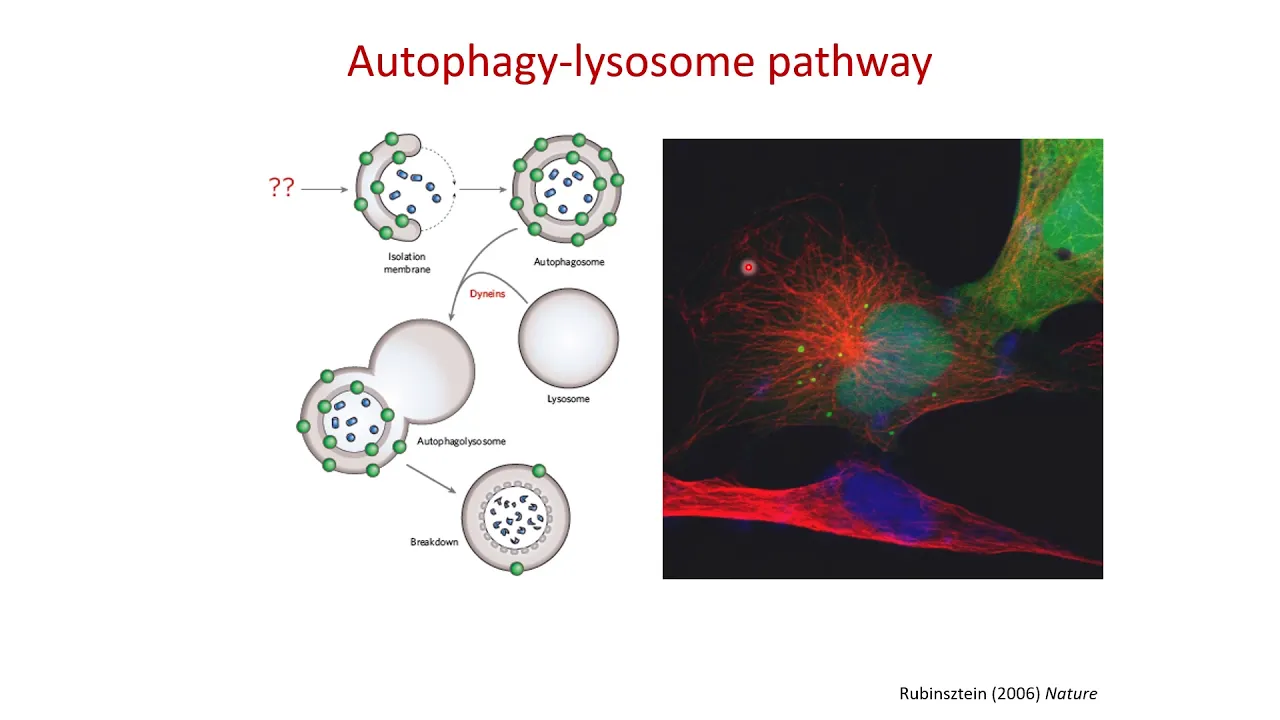







Autophagy is an evolutionary conserved cellular recycling system where cells degrade and recycle their own components through a multi-step process involving the formation of double-membrane vesicles called autophagosomes, which sequester cytoplasmic material and fuse with lysosomes for degradation; Yoshinori Ohsumi elucidated this mechanism by studying baker's yeast and identifying 18 essential ATG genes that form a hierarchical complex system, including two conjugation systems (ATG12-ATG5-ATG16 and ATG8/LC3) and regulatory components, revealing that autophagy serves both bulk recycling during starvation and selective degradation of damaged organelles and protein aggregates for maintaining cellular homeostasis.
Autophagy: Intracellular Recycling System | Nobel Lecture 2016
Added:Basic cell biology, specifically the structure and function of eukaryotic organelles like lysosomes and vacuoles.
The concept of cellular homeostasis and how cells respond to metabolic stress, such as nutrient starvation.
Fundamentals of protein degradation pathways, particularly the distinction between the ubiquitin-proteasome system and lysosomal degradation.
Basic genetics and the utility of model organisms, specifically baker's yeast (Saccharomyces cerevisiae), in genetic screening.
The molecular mechanisms of autophagy, including the roles of specific autophagy-related (ATG) genes and autophagosome formation.
The role of dysfunctional autophagy in neurodegenerative diseases, such as Parkinson's and Alzheimer's, due to the accumulation of misfolded proteins.
The complex, dual role of autophagy in cancer development, progression, and resistance to chemotherapy.
Therapeutic interventions targeting autophagy, including the development of autophagy inhibitors and enhancers for clinical applications.
150.9K views2.6Klikes1:01:48Original Release: 2016-12-11
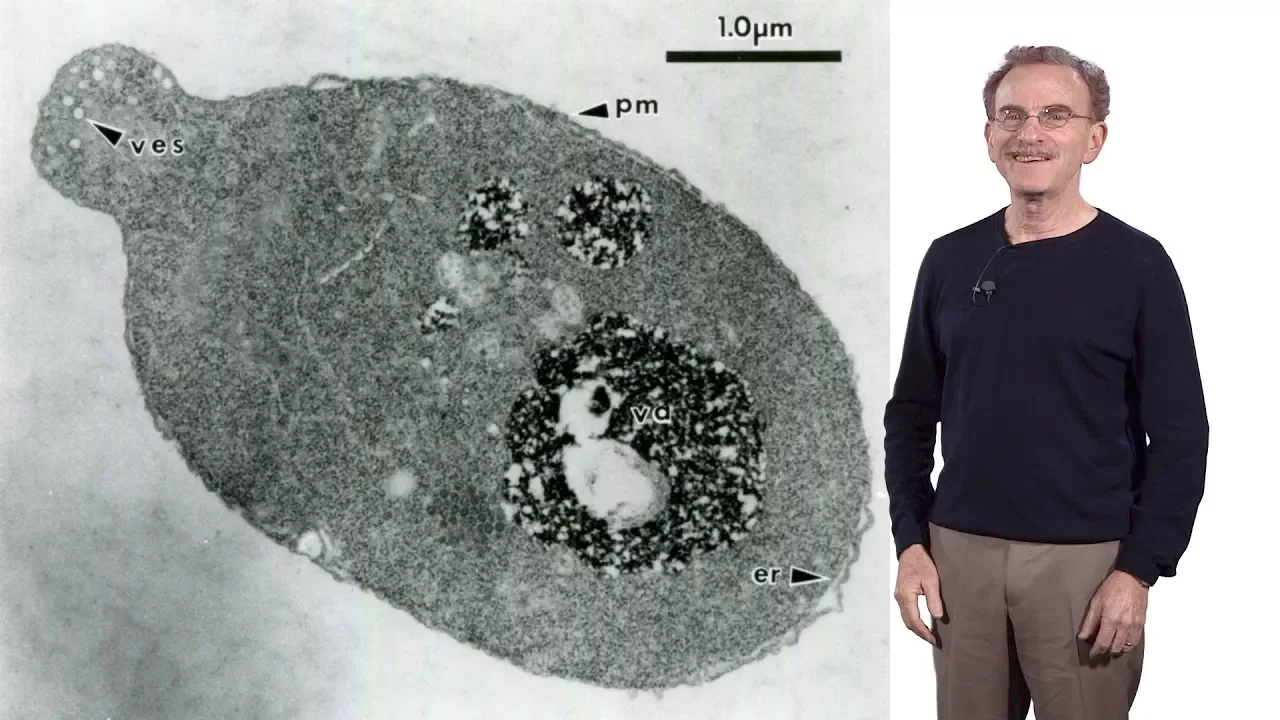
[Applause] Nob priz La excellencies ladies and gentlemen a very good afternoon to you all it's a great pleasure and privilege for me to welcome you all to kinska Institute at AAA for the 2016 Noel lecture in phys theology or medicine my name is Ken Dalman Wright and I serve as acting Vice Chancellor of kinska instituted during the noble week and particularly during the noble lectures we celebrate science and the unique contributions of some exceptional individuals research is a way of exploring our Serv for knowledge testing our own limits and having an outlet for our creativity and and competitive Spirit within physiology or medicine the ultimate goal is to achieve scientific breakthroughs that change our view of human health disease and normal vital processes to the benefit of individuals as well as Society at large today it's an honor for me to extend my warmest welcome on behalf of the kinska instituted to Yori usum the 2016 Noel laate in physiology or medicine who is receiving the Nobel Prize for elucidating mechanism underly underlying autophagy a fundamental process for degrading and recycling cellular components I now call upon marama sui professor of biology and a member of the noble committee for physiology or medicine who will introduce the [Applause] lit dear Nobel laet acting Vice Chancellor colleagues ladies and gentlemen it's a great privilege and an honor for me to introduce this year's Nobel lecture by by Noel La yorio sui the Nobel assembly at kolin ska Institute has awarded the 2016 Noel prize in physiology or medicine to Dr osumi for his discoveries on the mechanism of autophagy autophagy which means literally self-eating is an evolutionary coner Pro physiological process by which eukariotic cells digest part of their own content to release energy or to recycle the building blocks that are required for the production of proteins sugars and fats autophagy was first observed more than 50 years ago shortly after the discovery by um Christian the do of the lysosome the lysosome is the recycling compartment on the cells where cell component are actually destroyed and Christian the received for his Discovery the Nobel Prize in physiology or medicine in 1974 while studying the lome uh scientists discovered another uh part vesicle in the cells uh which is sequestered into a double strand me double layer membrane parts of the cyon plasm and large components such as protein aggregates and an organel uh using a different type of visualization meth on the fractionation procedures they could also observe that vesicles appear in the cytoplasm of cells which are Expos to different type of stress and that this vesicle grou to engulf parts of the cytoplasm and finally fuse to with the lysosome where their content is destroyed for for almost 30 years very few scientists studied autophagy and in fact the molecular mechanism of this phenomenon is significance remain largely unknown the discoveries of yorumi changed dramatically this uh field of research he for his studied focused on unicellular organism the baker yeast and discovered first of all that autophagy is conserved in this organism and can be easily visualized in a simple organism like the this cellular organism he then went on to develop a very clever screening method that allowed uh to identifi a large number of genes that are Essentials for the development of autophagy and subsequently he and his colleagues went on to eluate the function of the product product of these genes which at the end both in yeast and in Maman cells which at the end led to a very comprehensive view of the mechanism of autophagy and which allowed further understanding of the importance of this phenomenon for both physiology and disease we are now very much looking forward to hear from Professor osumi himself the history of how scientific curiosity hard work and then have led to our current understanding of autophagy as a fundamental phological process with the huge implication for both health and disease but before giving the word to Professor osumi I would like to say a few word on the novel L himself yoshor Yumi was born in Fukuoka Japan in 1945 and he receives his doctorate degree from the University of of Tokyo in 1974 after a post-doctoral training at the Rockefeller University in New York he returned to Tokyo University where he started slowly to climb the um academic career ladder being first an assistant Prof and um an ass a scientist a lecturer and an assistant professor in 1996 he was appointed professor at the National Institute of basic research in okazaki city and from 94 2004 to 2009 he was also professor at the gradate University of advanced studied in hayama he officially retired in 1914 but he still working full-time and I understand also during holiday during weekends and he when is currently serving as a professor at Tokyo University Institute of Technology where heads Sal biology Research Unit uh the outstanding work of Professor Lumi has been recognized by many different prizes and just to mention a few we received the Tokyo prize for basic science in 2012 The Gardener Foundation Award in 2015 and only few days ago he received the Breakthrough prize in life sciences we really look forward to Dr Rumi uh Nobel lecture with the title autophagy and intercellular recycling uh system and please joining me in welcoming Professor Lumi on stage okay it's great honor to for me to be here as a recipient of Nobel Prize in physiology or medicine first I would like to express my sincere appreciation to kiny Institute and Nobel f foundation for this wonderful opportunity and I would like to say something to all the audience here today let's begin I believe s science is a uh system of knowledge that is gradually accumulated by Society but it's also inherent human activity I believe that every scientist is a product of the era they which in De so today I would like to start my talk from a brief introduction of my life then give us historical overview of our work and I was born oh sorry I was born in fuker sou J Japan in 194 5 half years before the end of World War II that this was a very challenging time in Japan and everyone had difficulty getting basic uh basic daily Necessities including Foods I myself suffered severe malnutrition and was was a very Sicky child around this time my mother got tuberculosis and had a was a very uh spent a long time period but bed bound sorry but she was miraculously able to recover thank to the gifts of just developed antibiotics from their family friend in Hawaii I remember that word strapped Ming and O Ming without knowing what that mean my childhood was home was surrounded by Nature with life parties streams Hills and sea all nearby I spent a lot of time outside catching a fish and peeking plants in elementary school I was engrossed in colle in insects and watching night skies I would say this intimacy for nature had a strong influence on me at that time I vaguely longed to be a scientist in high school I joined to the chemistry club club where I experienced The Wonder of chemical reactions I entered the University of Tokyo where I initially hoped to be a chemist soon but soon I had difficulty to find a field to work in sree this was a time just when central dogma was just being established molecular biology immediately fascinated me so I decided to join the love of Kaz Tomo M holy as a graduate student there I began my research career here studying ribosome which is a Machinery of protein synthesis this period made me keenly aware of the continuous nature of protein synthesis within cell I gradually become interested in Uncharted function bi a membrane so I worked on the mechanism of action of Colin E3 which is a cytotoxic protein that in inhibit the protein censes by binding a receptor on the me membrane of other cell after finishing my doctorate studies I enroled in the lab of Gerald edman at roeller University in New York there uh during my final year in Dr edman La I worked with Mike Jasinski on the initiation mechanism of DNL ation in East which was my first encounter with East as a experimental organism at the end of 1977 I returned to Japan as a assistant professor in yilo andak lab at the to University of Tokyo Dr andak entire lab was task on on with studying Transporters and uh uh respirat chain in the col but fortunately he allowed me to start his work after a period uh reflection I decided to work on the East bar I'm not a competitive person but rather prefer to work on a subject that is not functionable this year picture show uh is bako uh you don't see any structure inside the baru at that time B was so just sorry uh it's nor more than the garbage damp in the cell but I thought it must play yet unknown role in cell phology and I was able to show active transport of amino acid and calcium ion through the Bako membrane providing evidence that Bako is important for homeostasis of metabolites and ions we also described their uh no plon pump on the bakio membrane B type ATP which generate plon gladient across the membrane vular membrane in 1988 I was able to start my own lab consisting just myself at the College of Arts and Science at University of Tokyo I decided to devote myself to litic function of this vacuum since it is a uh acidic compartment and contains various hydr liic enzymes so I thought it might be homologous to like isone however I had no concrete idea how it to approach this problem before going to experimental details I will briefly touch on protein mechan metabolism in cell proteins which are the polymer of amino acid are the key player in all biological processes uh Central doger stated that the protein is synthesized according the genetic information encoded in DNA through RNA since then many researcher have studied how to understand gen expression and protein synthesis recent progress in cell biology has revealed how each protein localized to its specific destination in the cell we know now each protein is ingeniously organized through the process of intracellular trafficking however one aspect that is missing from this picture was the degradation of protein within cell when I held a biology class for first year undergraduate student I used to start my lecture with this uh question how many blood cells are made within just one second in our body C calculation is simple and given an answer about 3 million cell per second how about hemoglobin within red blood cell further calculation show that about 1 * 10 to the 15 1 million billion hemoglobin molecular synthesiz per second if it follows that exactly the same amount of cells and protein are degraded the key message is that living cells are so dynamically maintained Japanese climate is characterized by four distinct Seasons that influence our culture and student at school learn that everything are continuously changing Frant Reeves offer an excellent example in Spring uh Reeves develop and then actively synthesized starch by sunlight but in autumn leaves turn yellow and fall off what we see as a beautiful a Autumn color is act actually caused by the degradation of leaves photosynthetic Machinery green for Chlor Blaster completely uh degraded and resulting amino acid transport to the trunk similarly Li leave turn yellow at Harvest Time all protein in the leaves are delated and transported to make Pro proteins in life grain for Next Generation this example demonstrate that degradation is not adverse process but rather it's essential for new construction or regeneration let's think about the human body our body make about 2 to 300 gram of protein every day but we only intake about 70 to 80 gam of protein for from the diet the amino acid required for protein synthesis mostly come from the degradation of our body's own proteins life is maintain tightly controll balance between censes and degradation and recycling the sensal for for Life Al Pioneer in the field of pro metabolism was do do Shan heimr who in 1930s proposed the concept of protein T however unfortunately his idea was not widely accepted the Monumental black through come from uh come in the 950s with the discovery of Rome by Christian D soon after researches at rocker University analyzed the process of the delivery of our own s component to Rome by electron microscopy a process which Christian D Coin autophagy in 19462 from the Greek for self eating Glen mimer and parin afterward produced informative works by uh tackling both physiological meaning and regulation of all on in mamals despite this our standing understanding of the molecular mechanism of autophagy remain in its infancy for many years in mean in the meantime another intracellular protein degradation system Yin protome system was discovered as it become clear that this system plays important roles on in the regulation of variative cell process protein degradation suddenly attracted future amount of in uh attention in biological research this was ultimately recognized by the Nobel priz in chemistry in 2004 was was awarded which was awarded to uh these three scientist sh here but the field of Rome degradation and auty still remained quiet now let's return to my work assuming that the V function is already compartment the question I had were when what and how such spasmic constituent go across the vular membrane and become accessible to vular enzymes first I searched what condition we M where massive protein degradation May might occur in each C life cycle spor formation is a myotic process that generate for spores and is induced by the depr of nitrogen the essential element for amino acid I reason that this uh dramatic cell modeling should requires a degradation of preexisting protein to make necessary proteins I have to admit that I have always loved to absorb is by light microscopy the Vu is relatively large and it's only clear clearly visible organella in the cell and inside of the vaco is just a solute solution so I knew that it is easy to see structure if they were inside the vacuum I probably spent more time sitting at the microscope than anyone else at that time I carefully observed the early stage of sporulation but I couldn't see any significant change in the cell I conceived to use a vular plenis deficient mutant to prevent further degradation fortunately Elizabeth Jones had there donated many proteinous mutant in to each genetic stock Center so I I obtained this strain and shifted to the nitrogen depleted medium okay looking down uh the microscope I saw many spherical structure bigly moving around the vacu this structure appeared within uh 30 minutes and almost completely filled the vacuum after 3 to 4 hours for me this observation marked the exact starting point for more than 27 years of AI research the reason I could discover this phenomena with only a common low magnification like microscopy or to the move uh vigorous movement of this structure by B Motion in otherwise static is cells this dramatic change was enough to convince me that I encountered the unknown and fascinating phenomena soon Kazo takes showed this phenomenon is not not restricted to spoliation but it's a general cellular response to a range of uh station nutrient station condition then I called excellent electron microscopist Mrs Baba and masako osumi to capture the mology of this phenomena within cell by electron microscopy their effort produced beautiful and con conclusive image of that entire autophagic process as shown in the SE following several slide thissection image of nitrogen St cell at for 3 hours you can see spal structure within B and this High magnification image hold these structure are bounded by a single membrane and their contents are exactly the same as a portion of c plasm c cytoplasmic structure such as e are here suggesting that non selective uh sequestration of cyto uh component we also observe the me membrane sack uh just uh end up in a portion of the S so next to the baru after completion of expansion and seiling we could see the double membrane structure of East oosome and this phase fracture image showed a fusion event between autosome with vular membrane there uh outter membrane of aosome is continuous with the vular membrane here also you you can see inner membrane structure which we named autophagic bodies autophagic body is uh body occasionally contain mitochondria sh s here and here and here so that means aoic uh autophagic can degrade not only cic protein but also super molecular structure like ribosome and even entire organ which is a character characteristic feature of autophagy this slide shows the scheme of autophagic process in East when cells are faced with starvation condition small membrane sck appear next to the Vu and expand to end up prop portion of cytoplasm then double membrane structure of fome Target the vacu and fused with vacular membrane releasing in inner membrane structure into the vacle in Wild type cell this structure immediately disrupted by vacular enzyme the proteinous deficient mutant allowed us to follow the progression of autophagy as a accumulation of oasic bodies the membrane dynamics of this process was essentially the same as non memarian oophagy though vacu is much larger than lome as you know East is a very good organ to dissection or for dissection of complicated biological effect phenomena through genetic analysis I was inspired by beautiful work by Lee Hardwell which unlocked the the cell cycle from uh through CDC muton and also by uncovering of a secretary passway using SE mutant by Landy sheekman I we therefore set out to obtain autoag defective mutant to find the gene involved in autophagy however at that time I had no idea how autoag defect mutant would behave so we decided to perform a simple uh mical screening for mutant that do not accumulate autopathic body under station condition Miki sc one of the my first uh graduate student made a great contribution during this screening process by assessing thousand of mutagenized cell by by one one by one for mutant racking aoic body see she identified the first autoag defect mutant which we name APG 1-1 later the name to atg1 this mutant sorry this mutant uh cannot uh proceed protein degradation but they grew normary in Rich medium and otherwise had no obvious phenotype however soon we found that atg1 mutant di sooner than wild type cell during long period of starvation shown here assuming that this phenotype is caused by the defec in autophagy Micky uh ran another screen assessing the viability of muten cell first and successfully obtained about 100 100 AAG defect mutant genetics analysis of this mutant revealed 14 atg m Newton we know now 18 atg genes are essential for establishing IND dist autophagy in the East so I can say this initial screen was very effective soon our work by electron microscopy suggested that all these HG gen are defective in the formation of autosome the most crucial event in autophagy sorry the first The Next Step was to determine uh protein encoded by these atg Gene the first Gene atg1 turned out to to encode a protein kindness but most of the at gen clown by our group and and the others were completely Noble and I me sequence of uh did not tell us anything about their function that was a difficult time for us uh my love in College of Arts and Science was quite small and had no fensive equipment and funding was limited and then I had only a few colleagues but it it without doubt that eight years in that club were the foundation of my work in autopi in 19 96 I became a professor at the National Institute the basic biology inasaki which provide us with a very conducive research environment I asked thas yoshimori to join our as a ass associate professor to start work on AAG mamar mammarian cell and also tesi no and Yoshi kamada to join us as a assistant professor the following year Noel Mishima came to my lab as a post do year by year talented post do there are researchers and graduate student gathered to my lab the croning of atg genes proceed much faster than I expected thank to the collaboration of Maro LA and also completion of East gen fall Genome Project the first breakthrough was done by Noel M Shima when he examined the products of atg2 he found two bands one of which lands much uh High molecular weight he also LED in wow sorry he also found uh in atg5 7 and 10 uh this High molecular weight bond is missing I won't go further detail we found that atg12 is a noel tin like molecule and it's activated by E1 enzyme atg7 then transfer to E2 enzyme atg10 and finally form bond with atg5 to to and finally this atg12 5 conjugate is if is uh Bound by atg 7 50 16 diers this discovery of this uh the discovery of this enzyme system uncover the function of five atg genes at all at once another molecule we are interested in was atg8 because imuno electron microscopy showed that atg8 is localized to the autoag related membrane as shown here suggesting that a good marker for membrane biogenesis two talented graduate student takayoshi kisak and yosim and another unique conjugation system atg8 is synthed as a precursor that is processed by atg atg4 protones and it's activated by the same E1 enzy atg7 and then transfer to atg3 but rather forming with a conjugate with protein atg8 forms a bond with one of the major membrane phospholipid phospholine thus to our supplies we found about half of atg genes are involved in to these conjugation systems in 1998 eight tesi found that laam induced the auty even s are grown in a rich Medium as lapam the inhibitor of toes we therefore proposed to and to kindness is the most Upstream regulator of vagi meantime Yoshi kamada and tomoshi studied the early step ofy and showed 13 and 17 played an important role in autoag induction and are necessary for atg1 kindness activation kihala AK kihala also found the autoag requires speciic P3 kindness complex one which is distinct from the predominant uh complex complex 2 within a decade of our researching in NMB we found two more atg protein that interact each other as well at at 17 that regulate H1 kindness activity we concluded that total 18 atg protein are essential for aagy and those protein can be classified into six functional groups shown here atg1 kind complex uh and regulator atg pi3 kindness complex and two conjugation system and atg9 soul membrane protein among atg in and atg2 atg uh 18 complex also during my our time at nibb no MIM Yoshimi Tam yosimi began to start study M Maran autophagy and successfully showed that 812 system uh well conserved in M Marian cell and tamot definit Def def definitively proved that LCC uh atg8 homologue can be used as a very effective marker of autophagy progression in Maran cell at around this time two of my colleague two colleagues uh hii hanoka and koshimoto succeeded to identify atg genes in plant cell although the homology of atg genes are R but atg system is well consumed from east to M and plan indicating that the core Machinery of aaji uh acquired at an early stage of evolution the identification of atg genes essential for autophagy changed the entire landscape of autophagy research one ascept aspect of this evolution is that we can uh now visualize the process of autophagy by forance microscopy using HG protein as Mar Noel mimat got advantage of this when he constructed a transgenic Mouse expressing gfpl lc3 this to was allowed to us to access assess how much autophagy occurs in every organ in mouse body this mouse has been distributed all over the world nooru also developed the first atg1 knockout Mouse and which allowed to show autoag plays crucial roles for Survivor at bur and comat masaki KATU shower uh by use making a conditional at7 knockout Ms we show that auto is uh essential for defective mutant accumulate all uated protein and F uh altimetry tumor in the liever from this point manipulation of H genes in various organis different cell type variety of tissue and organs and individual started uh in many RS around the world and reild a burst Alle of physiological function of autoag the relevance of autophagy in various disease are getting clear uh this rapid expansion of autophagy would not have been possible without a consulted effort of aut research all over the world but this huge area fall outside the scope of my talk today I mentioned earlier the nutrient recycling is the most primary primary function of Auto which is uh evolutional adaptation to a persistent challenge of f of nutrient limitation starvation recent work has shown that another important function of autophagy in addition to the Bulk Recycling of portion of cyprin autophagy is also able to pick and choose excess or Hood material from the cyop plasm in a selective manner Target of this degradation includes speciic protein super molecular structure protein aggregate organ and even virus and invasive bacterior now it is well accepted that autoag plays an essential role to maintenance of the cellular homeostasis defec in this quality control may cause various abnormality health problem and disease this kind of autophagy is generally not random and but selective also using East D crony has studied CBT pathway the first identified model system of selective autophagy in is several receptor for Selective autoag has been found as shown here in now var's select mode of autoag has become one of the most exciting field in autoag research we are now beginning to arrive at the clear understanding to for some of these selective types of autophagy such as mitochondrial autophagy but uh this is an area in which we need more research to obtain the precise molecular details even in the simple East system many fundamental questions uh remain to be answered for this reason my group is still working on East autophagy also we have identified the quir component of autosome formation the question of where and how these protein function in the cell remained uh k Suzuki made a major contribution on this area first he found that autophagy is induced most atg protein localized at least partly adult structure next to the vacu he also showed that the autosome is generated from these dot structures we call PR autosome structure the past we systematically analyze the mutual relationship between HG protein to uncover the uh how the pass is organized and uh found the caal relationship among six functional groups as shown in this slide atg7 atg13 complex is the and then atg9 comes something like that okay and recent uh Improvement of the Flores microscopy what wow sorry I sorry sorry I made a mistake yeah recent microscope showed this is a atg 17 uh that means that di form of atg 17 291 complex as you see here atg 17 is just moving around in the S so and under growing condition sorry wow wow what's happened sh sorry w what should I do Sor that won't work someone help me sorry could could you help me okay okay so sorry under station condition 80 oh I was so sorry under starvation condition uh a small portion of 8 s 17 complex come to the pass as shown here that means only a portion of uh protein doing uh Auto formation under starvation conditions but now we know that the hierarchical relationship between atg protein reflector temporal SE of event that occur during a formation shown here uh closed and long-term collaboration with no no nor and the late Dr fiko inagaki successfully provide us with structural information of many HG protein and their complex which was really crucial for our understanding of their function now I'd like to talk briefly about the recent work on ear step F formation which were mostly done by haash Moto and no atg13 is a key player that has a which has a quite unique structure that is made in the Tam Global domain and the rest is just a uh long the nature uh naturally disorder region in this region we can found many phosphorated residue by toes and starvation uh these uh AG13 residue are quickly this de phosphorated which allow to bound to atg1 and atg7 be specific site in disorder region resulting the formation of D13 17 29 31 complex as you see here uh we found the specific binding site of uh atg13 to atg1 and also we uh could identify the binding sight of ag7 to the atg13 and in the region of disordered region so atg13 this for for atg13 can bound at71 and 187 2931 complex but uh then kon's group showed the real actual number of HG protein at the past is about 30 to 40 so next question we had is how this High uh higher ordered structure is formed recently we found um another binding site of 1817 in their disorder region and I will show the our image of the ear step of AAL home for formation as I said atg13 has a wrong disorder region and after the phosphation of these residue uh allowed to bound to atg1 kindness at termin and this region is binding s of ad7 it formed this kind of complex and we found another uh uh binding site of 187 it's bound to the another atg this complex so that allowed to the forming a uh higher order of this structure that means we can have more uh mtic uh form of this uh atg1 complex uh this is important for Activation of atg one kind is uh this adjacent H1 by this uh Auto phosphation and also we found recently show Suzuki showed the at uh and terminal domain uh bound to the atg9 atg9 to recruit atg9 basical so uh this is our image of the ear step of a Auto or F on formation so this result show the at uh pass is not a static or stable complex and uh pass is a flexible super molecular assembly made of many atg complex and also membran structured and pass assembly is also highly regulated by by modification and transient interaction of atg protein at each stage of membrane formation okay now at present my group is focused on the physiological meaning of autophagy in East in a way I feel we have come full circle by going back to the original question when and how and what is degraded by autophagy uh by using a latest analytical Tools H Hanan and tomoko Kata uh showed that massive alna is degraded via autophagy and the resulting base uh uh transport out from the cell it's not a recycling system so I believe we need uh more knowledge about the degradation process and also assess the degradation product of the aagy and how they are uh transported out from the bar to the side plasm and how they affect the me cellular metabolism so those are question we are trying to so my a research was always been driven by nothing more than uh intellectual curiosity and start to get better understanding of life through protein uh protein Dynamics in the cell when I started my work I never thought uh autophagy become so uh relevant to disease as diverse as neurogeneration infect infectious disease cancer and others in such a short time but now autophagy research has become a major field in biology and this figure pre present that the number of paper related to autophagy is so rapidly increasing it goes without saying that this is this is thanks to the large part to the tremendous work uh effort of many researchers all over the world so I'd like to express my sincere thanks to share this honor with all of them however this figure also tells us it takes a while to establish one field TR uh original Discovery in science are often triggered by un predictable and unforeseen small findings now day distance between basic Discovery and practical application is getting closer while it is exciting but scientists are now increasingly required to provide evidence of immediate and Tang ible application of their work it is TR truly my hope uh that Society is able to nurture not only purpose oriented science but also science as a core of culture activity if my small idea and decay of work had made a contribution to fundamental science through autophagy and Nobel Foundation recognize the basic nature of uh this work with this prize it is honesty my great pleasure and satisfaction as a basic scientist finally I would I must acknowledge all all good fortune I had I have had throughout my career the excellent colleagues who have joined me on the this journey great effort of many collaborators good friends and contined support of many grants and my caring family especially my wife Mari Co thank you for [Applause] attention [Applause]
Up Next
3:30
Mitophagy Explained: Mechanisms, Parkin, and USP30 | Vincere Biosciences
@vincerebio
55.3K views•2020-07-15
50:12
Bacterial Communication: Quorum Sensing and Biofilm Formation Explained
@JHUAAP
12.6K views•2011-06-28

5:35
Enteric Nervous System Explained: The Gut's Brain | Neurobiology Lecture
@alumniu6029
438 views•2018-09-12
7:08
Bacteriophages: Earth's Deadliest Killers and Future Antibiotics
@kurzgesagt
34.6M views•2018-05-13
Related Study Plans & Knowledge Roadmaps
Structured learning paths in Biology
biology
RNAi: Biogenesis, RISC & Gene Silencing
01Molecular Biology Foundations: DNA to Protein
02Introduction to RNA Interference (RNAi)
03Molecular Biogenesis of miRNA and siRNA
+ 2 more learning modules
10h5 modules
Explore Roadmap
biology
Mycorrhizae: Signaling, Biophysics & Ecology
01Foundations of Mycorrhizal Symbiosis
02Molecular Signaling and Root Colonization
03Biophysics and Bioenergetics of Nutrient Exchange
+ 1 more learning modules
11h4 modules
Explore Roadmap
biology
Circadian Clocks: TTFL, SCN & Periphery
01Foundations of Molecular Biology & Gene Expression
02Introduction to Chronobiology and Actograms
03The Core TTFL: Molecular Architecture of the Clock
+ 3 more learning modules
14h6 modules
Explore Roadmap
biology
Population Genetics: Math, Drift & Selection
01Genetic & Probability Foundations
02The Hardy-Weinberg Principle and Baseline Models
03Mathematical Modeling of Natural Selection
+ 3 more learning modules
18h6 modules
Explore Roadmap