






















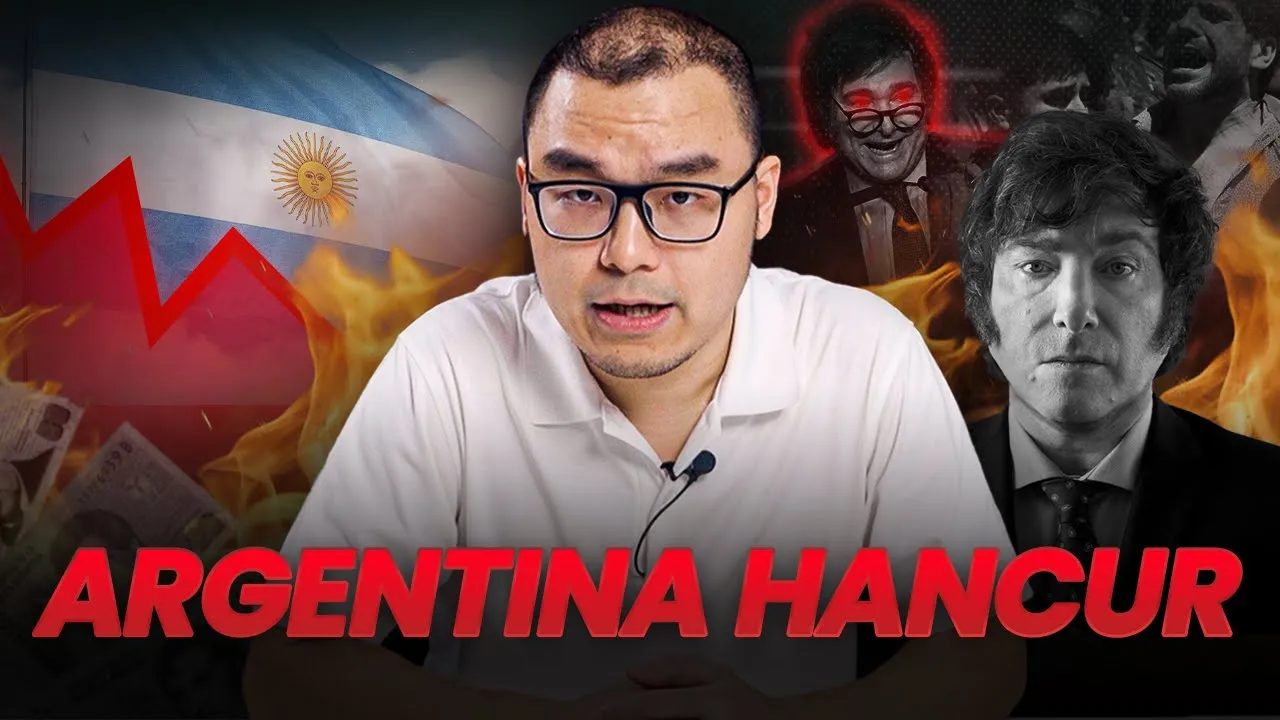

Argentina's dramatic economic decline from one of the world's wealthiest nations in 1913 to a developing country today illustrates how persistent government intervention, cronyism, and lack of institutional accountability can destroy even the most prosperous economies over a century, demonstrating that sustainable prosperity requires sound economic policies, political stability, and respect for individual rights rather than populist redistribution and state control.
Argentina's Economic Collapse: A Century of Decline Explained
Added:Fundamental macroeconomic concepts, particularly the relationship between fiscal deficits, monetary expansion (money printing), and hyperinflation.
The concept of Populism in political economy, including how short-term redistribution policies can impact long-term fiscal sustainability.
The basics of sovereign debt, international borrowing, and the role of global financial institutions like the International Monetary Fund (IMF).
The economic theory of Import Substitution Industrialization (ISI) versus export-led growth models in developing nations.
The study of Institutional Economics, examining how political institutions and property rights influence long-term economic trajectories (e.g., 'Why Nations Fail' framework).
A comparative analysis of Argentina's economic path with similar resource-rich nations like Australia or Canada to understand divergent development.
The mechanics of sovereign debt restructuring, default dynamics, and the legal battles between sovereign nations and international creditors.
An evaluation of contemporary Argentine economic proposals, such as dollarization, central bank reforms, and aggressive fiscal austerity.
1.6M views26.6Klikes1:03:44Original Release: 2024-02-29
On November 19th, 2023, Argentina’s presidential election sent shockwaves around the world.
Javier Milei, a self proclaimed anarcho-capitalist, known for cloning dogs and naming them after famous economists, achieved a historic victory, securing his position as the nation's first Libertarian president.
His rapid surge in popularity wasn't due to his superhero alter ego, General AnCap, his eccentric campaign antics like demolishing replicas of the national bank, or even his controversial remarks about the Pope, whom he labeled a “filthy leftist”.
Instead, it was his unyielding rejection of the country's ruling politicians that resonated with the population, a population who felt robbed of the Argentina that once was and the Argentina that could have been.
Only one hundred years ago, Argentina was one of the wealthiest places on the entire planet.
For five continuous decades, it had the fastest growing economy in the world, transforming the country from an obscure backwater on the periphery of a dying empire, to a rising economic colossus.
Its GDP per capita was nearly double that of its former colonial master, Spain, and surpassed those of rich nations like France, Germany, and Italy.
Indeed, Argentina’s meteoric rise was so striking that many foresaw it becoming a sort of United States of South America.
By the eve of the First World War, State-of-the-art locomotives traveled across 22,000 miles of newly constructed tracks, transporting tens of millions of tons of cargo from the heart of the country to its vibrant capital, Buenos Aires.
Here, sprawling, tree-lined boulevards, opulent opera houses, cutting-edge port facilities, and grand train stations, earned the city its nickname, the “Paris of South America ''. For the millions of European immigrants flooding the New World, choosing between New York or Buenos Aires, the Great Plains or the Pampas, was not an easy decision.
By the 21st century, there was no longer any competition.
The United States emerged as one of the most successful economies in history, while Argentina faced the largest sovereign bankruptcy ever.
Life savings vanished, tens of thousands of companies folded, unemployment hit 25%, while poverty engulfed over half its population.
In a nation that once exported enough wheat to feed its population twice over, there were now reports of widespread hunger and malnutrition.
With the Argentine peso having lost 90% of its value in just the last 4 years, the election of a political outsider, one who vows to reverse all his predecessor's policies, appears less a choice of desperation and more a logical response to a century of underachievement.
But what exactly went wrong?
How did Argentina become so incredibly rich, only to find itself on such a relentless path of decline?
As the first Spanish explorers sailed into the mouth of a vast estuary off the Eastern coast of South America, they became so convinced that the land before them held the treasures they desired, they named the estuary “Río de La Plata”, the river of silver.
Such was the strength of their conviction, that maps soon began to mark the region as 'Terra Argentina', the Land of Silver.
There was just one problem.
There was no silver, or at least not any close by.
Eventually, a mountain called Cerro Rico was discovered that contained so much silver, it became the source of 80% of the global supply for nearly two entire centuries.
Cerro Rico, though, was over 1,000 miles away from the newly established settlement of Buenos Aires.
Its residents however, encountered a far more immediate problem.
Spain’s typical conquest strategy of enslaving sedentary farming societies was ineffective in the region, as the local nomadic peoples were sparsely populated and resistant to subjugation.
Consequently, Buenos Aires was abandoned after just five years.
But, despite the lack of local riches and exploitable labor, the Rio de La Plata basin soon found its colonial purpose.
Situated 13,500 feet above sea level in the harsh Andean terrain, the city of Potosí, which formed at the base of Cerro Rico, had quickly grown enormous.
The sheer abundance of silver had propelled the city to become the largest in the hemisphere.
But in being built in such a wasteland, the city was Incapable of sustaining itself, everything had to be shipped in.
This demand spurred the emergence of settlements across the Southern Cone, each dedicated to supplying the silver mines with basic necessities.
Soon, yerba leaves and tobacco from Paraguay, mules and cattle from Cordoba, wine and wheat from Mendoza, as well as imported slaves and mercury from the reestablished Buenos Aires, became indispensable, underpinning the commercial fabric of the entire region.
The immense wealth generated by this trade however, was accumulating in the hands of only a tiny segment of society.
Control of production, and its distribution, were privileges reserved for Spanish elites and conquistadors.
Land grants were issued in enormous parcels to these individuals, with some estates, later known as 'estancias', spanning nearly 1,000 square miles.
This system of selective control over economic activities and land, not only fostered but was designed to uphold a strict and unyielding social hierarchy.
Spanish born elites were at the top, followed by Argentine-born Europeans, known as Creoles, who formed a class of secondary elite.
At the bottom were slaves, native peoples, and those of mixed descent, forming the labor force that toiled on farms, drove the ox carts, and carried supplies over mountain passes.
But while this system of exploitation was legally sanctioned by Spain, the trade that sustained it was oddly, not.
For Spain, the silver from Potosí was the foremost contributor to its economic and political might.
As such, it attempted to do everything to protect and control the trade of it.
Buenos Aires, the most logical location for the import of supplies and export of silver, was deemed too vulnerable to Portuguese, Dutch and British Maritime power.
As a result, Spain mandated that all trade in Spanish South America must be conducted through the safer port of Lima.
This trade system, persisting for 200 years, was hugely expensive, inefficient, and mostly ignored.
Smuggling became, not so much a symptom of poor economic policy but a defining characteristic of the Rio de La Plata.
Spanish officials, ranging from low paid customs officers to the colonial representative himself, were not only complicit in turning a blind eye to these activities but also actively participated in them, using their political status to skirt laws and generate massive profits.
The scale of corruption and smuggling became so immense, that despite trade through it being illegal, Buenos Aires by 1776 had become South America’s busiest port.
As the Creole elite amassed great wealth, and developed a preference for autonomy, Spain initiated comprehensive reforms aimed at reasserting its control over the region.
The Río De la plata, including the Potosi silver mines became its own viceroyalty, Spain's administrative unit for its new world territories.
Buenos Aires was named the capital, gaining the right to trade directly with Spain and other New World ports.
But, other reforms inadvertently sabotaged the very issues they were designed to address.
A new centralized and strengthened colonial government led to an influx of Spanish officials, who ousted the Creole elite from key bureaucratic and military roles, accompanied by higher taxes and stricter enforcement.
Meanwhile, Spanish born merchants monopolized the now booming legal trade.
So while Spain regained control over trade, they inadvertently antagonized the local elite and did nothing to address the rampant corruption and growing inequality.
As tensions rose, all that was needed was a simple spark to ignite a full scale rebellion.
In 1806, Sir Popham, a British Naval commander, embarked on a military expedition that took his own government by surprise.
On June 25th, his fleet of four ships and 1,600 men invaded and swiftly captured Buenos Aires as an extension of the Napoleonic wars.
As all high ranking Spanish officials fled the city, leaving it to defend for itself, creole officers rallied the militia to thrust the British from the city, not once, but twice.
This not only exposed the colonial government's incompetence and decay but also sparked a sense of nationalistic unity against Spanish rule.Upon receiving news of Napoleon's army overthrowing the Spanish King, the Creole elite seized control, eventually proclaiming independence and establishing the United Provinces of the Rio de la Plata.
However, the initial euphoria of independence was short-lived, as the struggle for freedom soon devolved into a series of brutal civil wars.
The vacuum left by the absence of a strong central authority allowed numerous warlords, known as caudillos, to seize control of the interior provinces.
Commanding large private armies, they ruled their territories as dictators, thwarted Buenos Aires' efforts to unify the nation, and frequently waged war with one another.
This period, marked by horrific violence and lawlessness, spanned decades and ultimately resulted in the territorial loss of Uruguay, Paraguay, and Bolivia.
The once-thriving colonial economy laid in ruins, as trade ground to a halt, and the Potosi silver mines not only ceased to be worked, but fell out of the United Provinces' control.
but, as the era of silver waned, a new industry began to boom, poised to forever reshape the land of silver.
Stretching for over 300,000 square miles encircling Buenos Aires, is a region known as the Pampas.
Blessed with a temperate climate, consistent rainfall and rich fertile soils, this expanse of grasslands stands as one of, if not the most exceptional livestock grazing regions on earth.
With the onset of independence, the introduction of unrestricted trade, was met with a rapidly expanding global demand for animal products.
By 1825, 70,000 cattle were being slaughtered and processed for export by new meat salting plants every year.
By mid century, that number was close to a third of a million.
Tallow, bones and horse hides were sent to Great Britain, raw wool and salted hides were sent to the US, France and Germany, while salted meat was shipped to Cuba and Brazil to feed growing slave populations.
The livestock industry grew to such a scale that Charles Darwin noted in his journal Quote “The whole sight is horrible and revolting: the ground is almost made of bones; and the horses and riders are drenched with gore.” As profits from the Estancias quickly outpaced those from shipping and trade as the main wealth generators, the old colonial elite and the emerging political class leveraged their fortunes and connections to acquire all remaining prime lands.
However, it wasn't long before the livestock industry's critical limitation became apparent.
As the slave trade was abolished following independence, and as a huge number of young men had been conscripted to fight in the various provincial wars, the Pampas became defined by a desperate shortage of workers.
By the 1860s, this scarcity drove real wages up by 60%, reaching levels twice those in Southern Europe.
The labor crisis escalated to the point where ranch workers frequently took unscheduled days off, openly insulted their employers, and often declined to perform certain tasks, confident in their irreplaceable status.
But one man had a solution.
Exiled in France during the oppressive reign of Juan Manuel de Rosas, the de facto dictator of the United Provinces, Juan Bautista Alberdi, devised a comprehensive plan to address the labor shortage and ignite the region's economic potential.
Influenced by the transformative effects he witnessed in Europe, Alberdi recommended a trio of key strategies: encouraging mass European immigration, promoting unrestricted foreign investment, and making significant investments in an extensive railroad network.
The latter was envisioned not just as a means to reduce shipping costs but also as a way to facilitate the settlement of the 'desert'—a term used for areas still under indigenous control As de Rosas was overthrown by a provincial caudillo in the early 1850s, Alberdi seized his opportunity.
As architect of the 1853 constitution, he was able to embed his economic agendas, alongside the establishment of a strong centralized authority crucial for unifying the nation.
With its signing, the Republic of Argentina was officially born.
But despite the constitution's ratification, it took three more decades of conflict between the provinces and Buenos Aires, warfare with external enemies, and territorial expansion before achieving political stability and unification.
But, once this stability was established, Argentina embarked on one of the most remarkable economic expansions in history.
In 1879, five military columns departed from Buenos Aires, Cordoba, San Luis and Mendoza, forming a 500 mile wide pincer movement, designed for extermination.
The newly formed Federal Army, equipped with the latest repeating rifles, conquered 86,400,000 acres of land within just two months, decimating all indigenous populations in their path.
The success of this campaign propelled its mastermind, General Julio A. Roca, into the national spotlight, paving the way for his election as President the following year.
As the Buenos Aires militia incited a rebellion, opposed to the idea of another president from the provinces, Roca, with his firm control over the army, quickly crushed the uprising.
Utilizing the window of opportunity, he then disbanded all militias, and placed Buenos Aires under the central government's direct control.
In doing so, he brought an end to seven decades of violent political centralization.
Meanwhile, Roca had garnered widespread support across key societal groups, with provincial oligarchs, landowners, and merchants uniting behind his National Autonomist Party.
This coalition of elite classes known as the generation of 80’, would govern unchallenged for the next 40 years.
Reflecting the interests of its elite supporters, the government, inspired by Juan Alberdi's economic blueprint, aimed to transform Argentina into an agricultural producer's paradise.
To boost exports, already minimal trade restrictions were relaxed further, making Argentina one of the world's most open economies just as international trade began to blossom.
At the same time, demographic booms, urbanization, and rising incomes in Europe and North America, created an insatiable appetite for Argentina’s agricultural goods, which was boosted further with the advent of steam-powered shipping, and the introduction of refrigeration technology, making it possible for fresh meat from the Pampas to reach dinner tables around the world.
The convergence of this rising demand, underutilized potential, political stability and economic freedom, positioned Argentina as one of the world's most attractive destinations for investment.
Within ten years, it was receiving nearly half of all British investments made outside of the United Kingdom.
In total, foreign direct investment reached close to a third of a billion dollars annually, spanning across banking, utilities, meatpacking, construction and especially the railroads.
In vigorous pursuit of constructing a national railway system, foreign companies were offered guaranteed annual returns, tax exemptions, and land alongside the tracks.
By 1885, the completion of the first 2,700 miles of railway had begun reshaping the countryside, making it profitable to transport and grow bulky, low-cost-per-unit commodities such as grain, and expanding agricultural activities further into the frontier.
And just as Juan Alberdi had envisioned, all of this expansion was fueled by an extraordinary influx of European migrants.
Attracted by high wages, and almost non existent immigration barriers, approximately seven million people, mainly from Italy and Spain, settled permanently in Argentina.
Their arrival provided not just the essential labor needed for the estancias, but also brought the expertise that began the country's first wave of industrialization.
The result was truly breathtaking economic expansion.
From 1880 to 1915, Argentina transformed from a wheat importer to the world's third-largest exporter, while it topped the list for chilled beef, corn, linseed, and oats.
The total value of exports grew by an average of 15.2% annually, while economic output expanded at an average rate of 6% a year, the fastest growth recorded anywhere on the planet.
Argentina had risen to be among the world's richest countries per capita, featuring the largest railway network and middle class in the southern hemisphere.
Meanwhile, Buenos Aires ranked as one of the most populous and modern cities in the world.
At night, the city glowed with gas lanterns, electric trams transported over 400 million passengers annually, and its port, equipped with hydraulic machinery and grain elevators, ranked among the world's most advanced.
Such prosperity combined with its visual opulence gave rise to the French saying, 'As rich as an Argentine', But what was less evident was the tremendous cost of this growth, a cost that would undermine all of its progress, not necessarily due to the changes that occurred, but because of the crucial aspects that remained the same.
On February 4th, 1905, Argentina was swept by a coordinated uprising aimed at overthrowing the government.
Despite the widespread nature of this revolt, and the support from numerous sympathetic military units, it was quickly crushed.
Yet, in its brief spark, it laid bare the shaky grounds on which Argentine society stood.
Central to this uprising was the Radical Civic Union, a political faction determined to break the ruling elite's iron grip on power.
Their influence was on the rise, fueled by widespread dissatisfaction among the population.
This discontent didn't stem from the government's inability to generate wealth, Instead, it was a response to an all-too-familiar pattern: reminiscent of the colonial era.
Most of the country's newfound riches were being concentrated in the hands of only a select few.
Mass immigration had given birth to a vast urban working class who resided in overcrowded, neglected slums, while they suffered horrific working conditions.
The middle class who more obviously benefited from the country's development resented the elites for their monopolization of political power and economic opportunities.
Meanwhile, military officers, originating from the less affluent provinces, harbored grievances against the European immigrants who were often given preferential treatment in the job market.
The problem was despite its modern appearance, and wealth, Argentina was still fundamentally a backwards nation.
While richer than both Germany and France, Argentina’s primary school attendance was less than half of theirs, while further education was predominantly reserved for the children of the elite.
The government's focus had always been on supplying a labor force for the landowners, not on educating the masses.
The economy itself remained largely underdeveloped as it focused on exporting raw materials.
Key industries, like value-added meatpacking and the technologically sophisticated transportation sector, remained controlled by foreign interests.
By 1910, foreigners owned over half of Argentina's productive assets, leaving the country vulnerable to global economic fluctuations.
This fueled resentment, especially as low wages and poor labor conditions in these industries were enforced by the government's harsh repression of union activities.
As inequality widened, and the lower and middle classes grew evermore frustrated, the government faced a stark realization – their tight hold over Argentina was unsustainable.
In a bid to outmaneuver the radicals, electoral reforms were enacted in 1912, extending voting rights to all native-born adult males and introducing secret ballots.
The Generation of '80 believed that by allowing broader political participation, they could appease the demand for change without actually ceding their power.
But then, crisis struck.
As the nations crucial to Argentina's trade and investment became embroiled in the First World War, the vital economic links that Argentina depended upon were severed.
The economy shrunk by 10% almost instantly, while mass layoffs spread across industry and agriculture alike.
Those that stayed employed faced falling wages and rising prices.
Amid this backdrop, the 1916 election resulted in a landslide victory for the Radicals.
Upon assuming power, the Radicals implemented a minimum wage, established the right to strike, introduced the 8-hour work day and founded YPF, Latin America's first state-owned oil enterprise.
These actions aimed to diminish Argentina's reliance on imported energy, gradually reduce inequality, and increase the living standards of the working class.
However, by and large, the new government policies did not significantly deviate from those of the previous regime, as it needed to placate the demands of the landowning elite, who maintained their stranglehold over the economy and by extension the politics.
This precarious balance, managing the needs of vastly unequal social factions would prove unsustainable as the country faced its largest crisis yet.
In 1929, the global economy came to a standstill.
The great depression, the most severe economic downturn in modern history, led to the disintegration of the established economic order, as a global surge of protectionism spread in its wake.
Argentina, one of the world's most open economies, was simply steamrolled.
As Britain, its most important trading partner turned inward, opting to import food only from its colonies, the value of Argentina's exports evaporated by 70%, taking 20% of the entire economy with it.
The working class faced mass layoffs, the middle class found it impossible to pay basic bills, and the elites watched as their financial empires crumbled.
Utilizing the crisis, the old ruling elite, allied with the military, set their sights on overthrowing the government, which everyone had blamed for the crisis.
As a contingent of 1,500 troops marched toward the presidential palace, an enthusiastic crowd cheered as Argentina’s experiment with democracy was put on an indefinite pause.
Armed with power again, the elites scrambled to protect their economic interests.
To maintain access to the British market, they rushed into a devastating trade treaty.
In exchange for Britain's ongoing purchase of beef and crops, Argentina committed to exclusive coal purchases from Britain.
Additionally, British companies operating in Argentina received special exemptions from local laws and taxes.
Moreover, Argentina agreed that 85% of the beef sold to Britain must be processed by British meatpacking companies.
In effect, the elite had sacrificed the nation's economic independence, to protect their own financial interests.
But despite these egregious initial actions, the elites had learned their lesson.
In order to appease the lower and middle classes, the ones who thrust them from power last time, the government began to implement a policy of import substitution.
By placing tariffs on the importation of goods, thus making them more expensive, and by giving tax exemptions to local industries, thus giving them an advantage over foreign firms, Argentine manufacturers could scale up and replace the products being imported.
In theory, doing so would generate jobs, lift wages, and boost growth, while promoting national self sufficiency.
Combined with a natural fall in imports following the great depression, Argentina began to rapidly industrialize.
From 1935 to 1946, the industrial workforce increased from 430,000 to over a million.
For the first time in Argentina's history, Industrial production now created more value than agriculture, yet workers' conditions did not improve.
Labor laws were ignored or repealed, and the shift towards replacing imports with domestically produced goods led to inefficiencies, and higher prices for everyday goods.
The outbreak of the Second World War exacerbated these issues, triggering another sharp recession, followed by inequality reaching an almost unheard of level.
By 1943, the wealthiest 0.1% of Argentinians were earning 11% of the nation's total income, a disparity nearly three times greater than that observed in the United States, and even higher than Apartheid South Africa.
As a new set of phony elections drew near, a profound sense of pessimism enveloped the country.
In the early morning hours of June 4th 1943, troops once again marched onto the presidential palace.
Only this time there were no cheering crowds to greet them.
Orchestrating this coup was the United Officers Group, a secretive faction of military officers who, despite lacking a clear plan on how they would govern, were united by their anti communist and fascist-leaning ideals.
Following the takeover, the military government cycled through several short-lived presidents before settling on General Farrell as their preferred leader.
But, the most important development, unforeseen at the time, was the appointment of a Colonel named Juan Perón as the Head of the Department of Labor.
Perón, known for work as military attache in fascist Italy, quickly realized the vast potential of his new found position.
He immersed himself in the lives of the working class, conducting tours of their neighborhoods, holding numerous meetings with union leaders, and frequently visiting factories.
Leveraging his official capacity, Perón began mediating numerous labor disputes on an industry-wide scale, siding exclusively with the workers' interests.
Labor laws were reintroduced and enforced, while negotiated collective agreements improved wages and working conditions.
Perón's actions made him the most prominent figure of the new regime, earning him substantial popularity among the lower classes which propelled him to the vice presidency.
By 1945 however, enormous demonstrations involving hundreds of thousands of middle class citizens began protesting the government, demanding the return to constitutional rule, and for the government to come out in support of the allied powers in the World War.
Notoriously, the military government held pro German sentiments.
As the demonstrations gained momentum and increasingly contained anti working class sentiments, rival military officers seized the opportunity to have Perón arrested and imprisoned.
Fearing that this would mean a roll back of reforms, the working class launched nationwide strikes calling for Perón's release.
As 300,000 marched in Buenos Aires, the military government conceded to demands, releasing Perón, and drafting plans to hold the first free and fair elections in decades.
Upon his release, Perón emerged onto the balcony of the presidential palace, greeted by an immense, roaring crowd of workers chanting his name.
On February 24th, 1946, Perón was elected president, as he forged an unstoppable populist coalition.
He garnered working-class support with promises of extensive welfare expansions, higher wages, and improved worker protections.
He wooed the military with the prospect of playing a larger role in Argentina's industrialization, while middle-class youth were lured with the promise of lucrative, comfortable positions in an expanding state-led economy.
Meanwhile his commitment to reducing foreign dependency by nationalizing key industries earned him widespread support across all classes.
In a series of three two-hour long press conferences, Perón unveiled his comprehensive five-year plan aimed at transforming every facet of national life.
He starkly warned that opposition to this plan would be deemed not just dissent, but treason.
He implemented universal social security, a minimum wage, paid vacation, maternity benefits, free healthcare, and protection against unfair dismissals.
He significantly expanded welfare programs, subsidized essential goods, and granted all workers an annual bonus equal to one month's salary, which he famously dubbed a "Christmas present.
In parallel,he spearheaded ambitious infrastructure projects, including building 5,000 miles of roads, creating 45 hydroelectric power plants, laying the world’s then longest gas pipeline, constructing a major international airport, and developing hundreds of thousands of affordable homes, and thousands of schools and hospitals.
Along with the establishment of many new state controlled industries from shipbuilding, steel production, and armaments, Perón was radically transforming Argentina in one fell swoop.
But the centerpiece of Perón state led economic agenda was the nationalization of foreign assets.
The government executed a series of expensive acquisitions, most notably, 16,000 miles of British-owned railways for a staggering $600 million.
The sum total cost of all of these efforts was immense, but Perón had a plan.
Technically signed into law by the previous administration, but done at the behest of Perón, was the creation of the Argentine Trade Promotion institute, which monopolized all trade.
Going forward, farmers and ranchers were required to sell their products directly to the government, receiving payments significantly lower than global market prices.
The government would then supply Argentina’s cities with artificially cheap food to boost the purchasing power of the working class.
Any excess was then sold internationally at significantly higher prices, funding the expansive welfare and construction efforts.
The same would happen in reverse for imports, with the agricultural sector paying artificially high prices for inputs, to subsidize imports for the industrial sector.
The government defended this approach as a fair redistribution of the nation’s income.
In reality, it was little more than the redirection of unearned profits toward certain influential social groups, in exchange for their political backing.
This industrial favoritism resulted in a total isolation of Arginine industries and workers from foreign competition.
When combined with a period of high international prices for Argentine exports, Perón’s policies initially seemed to work like magic.
In just a few years, Argentina cleared all of its debts, saw a 25% increase in industrial production, enjoyed a 59% growth in real wages, and experienced a significant decrease in inequality.
None of it however, was sustainable.
State-run companies were overstuffed with thousands of useless and redundant jobs meant to reward political supporters, causing severe and persistent mismanagement.
The private sector grew dependent on protectionism, subsidies, and low-cost loans to survive, as the government mandated repeated wage increases and made it nearly impossible to fire non productive workers.
Consequently, wages throughout the economy began to reflect political favoritism rather than a fair compensation for time and labor.
As productivity declined, the government encountered rising expenses, which were further aggravated by widespread corruption.
The situation deteriorated further when Perón dismissed Supreme Court justices opposing his policies.
This effectively transformed the judicial system into an extension of his presidential will, facilitating an environment where corruption could flourish unchecked.
The program to build desperately needed affordable housing was compromised by party leaders and insiders who acquired vast numbers of units at minimal costs.
Meanwhile, in a throwback to colonial-era practices, bureaucrats facilitated the tax-free smuggling of cars and other goods into the country.
These items were then sold at exorbitant markups, a practice that Perón personally profited from.
As Argentina’s post war boom began to fade with normalizing prices for its exports, the deep cracks within its economy started to appear.
Because the government had forced farmers and ranchers to sell their products at minimal rates, total production plummeted, with land under cultivation decreasing from 22 million hectares in 1938 to under 17 million by 1955.
This resulted in widespread shortages, so severe that the government had to implement days when selling meat was illegal.
As both the volume and value of exports fell, so did government revenues, as a massive budget deficit began to emerge.
As a financial crisis approached, it highlighted the fundamental flaw of Perón’s governance.
His populist strategy of redistributing profits and buying political support necessitated government expenditures that far exceeded its revenue.
But, with the country cut off from international financing due to its self-imposed isolation, the government was left with only one option to bridge the budget gap: printing money.
And thus the true killer of Peron’s populism emerged, inflation.
In just five years, inflation skyrocketed from 4% to 60%, surpassing the government's capacity to raise wages.
By 1952, real wages were 21% lower than their 1949 levels, and were continuing to fall rapidly.
Mass protests, violence, and strikes followed.
With Perón’s popularity on the decline, the military seized the opportunity to once again topple a democratically elected leader.
Perón fled into exile, and military rule returned.
As the new military government assumed control in late 1955, their primary goal was straightforward: eradicate Peronism completely.
They embarked on a widespread purge, removing Perón's supporters from influential roles across the government, unions, and military.
This campaign of de-Peronization was so thorough that even the body of Perón's immensely popular late wife, Eva—who had effectively been the nation's co-leader—was dug up and hidden.
But, persecuting Perón's supporters and banning his political party turned out to be far simpler than departing from his style of governance.
Successive military and civilian presidents found themselves clinging to Perón's methods of income redistribution and political favoritism as mechanisms to solidify their weak grip on power.
These governments hesitated from scaling back the bloated state-run enterprises, reducing support and subsidies for the private sector, opening the economy, or cutting back on welfare benefits.
They feared that such measures would trigger economic distress and social upheaval, ultimately threatening their rule.
This reluctance to overhaul the economy only served to deepen existing inefficiencies, leading to increased costs, isolation during a time of global economic growth, and persistent underinvestment.
As a result, the government became ensnared in a relentless cycle of using money printing to cover deficits, which only worsened the economic situation.
As inflation diminished the real value of wages, the government maintained an artificially high exchange rate to keep goods affordable for urban consumers.
However, this strategy led to an overvalued peso, rendering Argentine exports like beef and wheat less competitive against their American and Australian alternatives.
The decline in export revenues eventually reached a point where Argentina could no longer afford the necessary inputs for its industries.
This predicament often forced the government to devalue the peso, triggering spikes in consumer prices and sparking political unrest, oftentimes resulting in presidential resignations or military coups.
From 1930 to 1983, aside from Perón, only two heads of state finished their terms in office, with presidencies averaging only two years—a duration matching the frequency of currency devaluations.
This persistent cycle led to an era of dynamic stagnation, characterized By short bursts of economic expansion that were quickly undone by severe downturns.
This stagnation, combined with ongoing political repression equaled an increasing percentage of the population becoming radicalized.
By the late 1960s, the result was the emergence of several guerrilla movements, most notably the Montoneros, a far-left peronist faction, who made a dramatic entrance onto the political scene by kidnapping and executing the ex-president implicated in the disappearance of Eva Perón's body.
Employing a range of disruptive tactics, from bombing showrooms of car companies and taking over provincial towns to assassinating labor leaders and kidnapping executives for ransom, guerrilla activities soon rendered Argentina nearly ungovernable.
Soon attacks were occurring at an average rate of one every twelve hours.
By 1973, the government had no choice but to call for elections and allow the participation of Peronist candidates.
The result was a blowout victory for the Peronists, ushering Hector Campora into the presidency.
In office, Campora appointed leaders of the Montoneros to governmental positions and released 371 political prisoners, including individuals considered to be hard core terrorists.
This was fiercely opposed by many right-leaning Peronists which would ultimately complicate the long awaited return of Perón himself.
On June 20th, two million people, undeterred by paralyzing traffic jams, converged on Ezeiza International Airport to welcome him back to the country.
However, a violent confrontation ensued between the Montoneros and right-wing gunmen at the very stage where Perón was to greet the crowd, forcing an angered Perón to divert his plane.
Shortly after he forced Campora to resign and call for a new special election.
Perón won 61% of the vote with his new wife, Isabel, a former nightclub dancer, as vice president.
Upon regaining power, Perón dismissed montaneros from positions of power, imposed price controls, and intensified the deficit spending that defined his last term in office.
But, widely regarded as the only leader capable of unifying the country, the economic climate began to show signs of improvement as confidence was restored.
This however was brief, as Perón died of heart failure the following year, leaving his widow, Isabel, as the first female president in the world.
Inheriting a nation mired in instability and reeling from the loss of what many perceived as its sole beacon of hope, Isabel faced challenges that far exceeded her abilities.
Immediately, the Montoneros declared war on the government with 723 attacks in 1975 alone.
José López Rega, the minister of social welfare, who famously consulted astrological advice, convinced Isabel to divert funds to the Argentine Anticommunist Alliance, a right wing terrorist organization who were tasked with suppressing leftist guerrillas.
As horrific violence spilled out onto the streets, an outbreak of foot-and-mouth disease decimated cattle exports, while the Arab oil embargo sent prices skyrocketing.
By 1976, inflation had increased to a catastrophic 600%.
The situation became so dire that newspapers, opposition leaders, and even the workers began to beg the military to intervene once again.
On March 24, 1976, the military swiftly terminated Isabel’s presidency, ushering in a new era of military dictatorship.
The new regime focused on two main goals: curbing inflation and eradicating the guerilla fighters—objectives that received widespread approval.
But, the extreme measures taken to meet these ends would traumatize Argentina forever.
The dictatorship moved to solidify its hold by dissolving Congress, banning political parties, censoring the media, and prohibiting trade unions, eroding what little checks on power remained.
It then sought to implement radical economic reforms.
Breaking with decades of import substitution and isolation policies, the regime began to open up the economy and significantly deregulated it.
Import tariffs were drastically cut from almost 100% to roughly 30%, export taxes on agricultural goods fell from nearly 30% to virtually zero, and plans were made to reduce government spending.
At the same time, the liberalization of capital flows allowed both companies and the government to take on international debt.
The key reform however, was the introduction of a crawling peg system for the currency, involving very gradual, pre-announced devaluations of the Peso, intended to reduce inflation by building confidence in the currency’s stability.
To underscore its commitment, the government provided insurance against unforeseen devaluations.
In theory, these reforms would reduce the deficit, kickstart growth and tame inflation.
But, the success of this plan relied heavily on the military dictatorship, to manage these changes responsibly, especially its newfound capacity to incur debt.
Debt which had been growing very cheap.
While the Arab oil embargo had hammered Argentina, it also led to international banks being flooded with deposits from oil-producing nations, making them overly eager to find new investment opportunities.
Argentina with its immense untapped potential, began to be inundated with an enormous volume of irresistibly cheap loans.
Faced with this reality, the government scrapped its plans to reduce spending as quickly as it made it, opting instead to go on a spending spree.
As a deluge of public spending, cheap financing, and deregulation washed over the country, a temporary economic sugar rush began.
While inflation initially slowed to under 100%, it persisted at that level.
But since this rate of inflation outpaced the currency's planned devaluation, the Peso became extremely overvalued, which made imports remarkably cheap.
Middle-class families suddenly found themselves able to afford trips abroad, while they imported cars, appliances, and electronics, leading to a period nostalgically remembered for its so-called "Sweet Money".
In only five years, imports surged by sixfold, as the government effectively took out huge loans to finance consumer imports and embark on grand infrastructure projects.
But as more and more debt began to accumulate, an alarming proportion of the money seemed to vanish into thin air.
A billion dollar loan was secured to construct a network of super highways in Buenos Aires.
But the project was put on pause after only two of the planned sections were finished before funding ran dry.
Another $200 million dollar loan was taken out to construct a gigantic amusement park, but construction ceased after only a few attractions had been completed.
Subsequent audits revealed that most of the project's funds had been siphoned into Swiss banks.
The result was a ballooning in Argentinas external debts from 8 billion to over 40 in just seven years.
But while Argentina’s future was being spent on short term government approval, this temporary era of “sweet money” allowed just enough time for the government to tackle its second objective.
The military in coordination with state sponsored death squads began to systematically hunt down the guerrilla fighters, and political dissidents, in what became known as the “Dirty War”.
Soon arrests, executions and torture sessions encompassed, civil rights laywers, judges, and journalists who reported on the alarming number of civilian disappearances.
In order to eliminate roughly 2,000 guerrilla fighters, up to 30,000 people were murdered, and half a million were forced into exile.
For a few years, the combination of fear, secrecy and sweet money, muted the public's reactions to these atrocities.
But by the early 1980s, the economy began to unravel and with it everything else.
A potent combination of plummeting commodity prices caused export revenues to dry up just as international interest rates began to skyrocket.
As massive interest payments on previous debts loomed, and as deficits soared higher, citizens and investors alike began transporting as much money as possible out of the country.
Between 1979 and 1981, the total value of money that left Argentina amounted to 20% of its entire economy.
As demand fell for the Peso, in order to maintain the crawling peg, the government had to use up ever larger amounts of its foreign currency reserves, and take out more debt.
As they did this, confidence in the government's ability to maintain the peg fell even further, thus causing a downward spiral.
By 1981, the peg finally broke, leading to the Peso losing 80% of its value in the span of months.
The sudden devaluation triggered the government to pay out the devaluation insurance, and led to a massive banking crisis, for which all deposits were also insured.
As a full scale economic meltdown seemed imminent the government decided to nationalize all of the banking sector's debts.
Shortly thereafter, Argentina was unable to meet its debt obligations, leading to a default in 1982.
Once again, the government resorted to money printing to finance the deficit.
As inflation shot up to almost 1000%, ruptures within the military began to emerge, threatening to destroy the entire regime.
As General Leopoldo Galtieri assumed the presidency, he seized upon a truly insane last ditch attempt to restore the military government's legitimacy.
In April the following year, Argentine armed forces invaded the Falkland Islands, starting a war with its owner, The United Kingdom.
Argentina had long claimed sovereignty over the islands, which had been under British control since the 19th century.
Galtieri believed that reclaiming the territory would ignite patriotic fervor and solidify popular support along nationalist lines.
But, after a 74 day occupation of the territory, British forces decisively defeated the Argentine conscripts, who were ill-prepared to face a global power.
Following Argentina’s surrender, Galtieri resigned.
A wave of anger swept over the population as they realized that the military, which had been so successful in stealing the public's money, murdering its own citizens and leaving the nation in a state of economic ruin, had failed to fulfill its fundamental obligation to defend the nation.
In 1983, new elections were called, restoring democracy that was finally here to stay.
The military returned to the barracks, and in a stunning turn of events, the Peronist party lost its very first election, as the Radical candidate Raul Alfonsin became president.
Alfonsin inherited a catastrophe.
In just a decade, GDP per capita plummeted by 15%, the deficit had ballooned to 15% of GDP, and it now took almost 100,000 pesos to equal a single US dollar.
After nearly two years of ineffective short-term fixes, the government finally launched a comprehensive stabilization strategy, the so-called Southern Plan.
A new currency, the Austral, replaced the Peso.
In coordination with unions and business leaders, freezes on wages and consumer prices were implemented, alongside spending cuts, a halt on money printing, and a pledge to enhance tax collection.
The plan quickly showed potential, halving government deficits and reducing inflation to 24%.
However, political and social resistance, along with the absence of deeper structural reforms, undermined these efforts.
By the late 1980s, government employment once again swelled to 600,000, nearly 20% of the total workforce.
Off-budget spending increased the deficit again, and tax enforcement measures failed to materialize.
By 1989, in a nation of 30 million people, only 30,000 individuals paid any income tax.
Without significant spending cuts or revenue increases, the government resumed printing money.
The public, fearing another crisis, hurried to convert their Australs into more stable assets.
By July, inflation rates soared to 12,000%.
Supermarkets started announcing prices via intercom to avoid having to update price tags on an hourly basis.
Real wages collapsed, general strikes paralyzed the economy, while widespread looting led to stores across the country being ransacked.
There was however, one sign of progress.
Elections would see the first peaceful transfer of power to the opposition since 1916.
Carlos Menem, a Peronist, won on the hopes that he would raise wages, increase spending and expand the state controlled economy.
That's why it took everyone by surprise when he announced plans to do the exact opposite.
A form of economic shock therapy, endorsed by the IMF, saw regulations, tariffs and export taxes almost completely eliminated.
But, the most shocking development was the mass selling off of state owned industries.
Within only four years, 115 previously state-run companies transitioned to private ownership, shedding tens of millions of dollars in governmental costs.
Yet it would be Menems' next reform that would prove the antidote to inflation.
The Austral was replaced by a new Peso, but this time its value was legally tied to the value of the US dollar.
Enforced by a currency board, the central bank was only able to increase the supply of money if it had the equivalent US dollar in reserve.
Essentially this meant the government was no longer able to freely print valueless money.
Within three years, the deficit was eliminated and Inflation stood at only 7%, the lowest it had been since the 1950s.
The combination of all of these reforms infused Argentina with newfound confidence and stability.
Productivity rose, as factories and ports were modernized with the help of a flood of foreign investment.
The agricultural sector, which had been dormant for decades began to roar back to life, propelling the economy to its strongest and most consistent growth rates since before Peron took office.
But this growth had come at a cost.
For five decades, Argentina’s leaders had sought to achieve full employment by stuffing state owned industries with unneeded positions, and making it hard to fire workers.
With those industries now in private hands, mass layoffs logically followed as they became profit rather than employment driven.
Simultaneously, the lifting of protective tariffs subjected Argentina’s inefficient manufacturers to international competition they had never seen before.
As cheap products flooded in, many of them went bankrupt.
Manufacturing as a percentage of total output declined from 31% in 1989 to 17% 6 years later.
By 1995, unemployment hit 20%, the highest sustained rate in the country's history.
And while Menem differed from his Peronist predecessors on trade policy, he didnt on corruption.
He filled high government posts with relatives and accepted luxury cars from businessmen.
Foreign investors voiced frustrations over the necessity to bribe officials for basic permits, and audits began to uncover discrepancies in the sale of state assets.
Notably, the sale of the state-run airline included dubious charges labeled as “costs associated with the sale,” amounting to $80 million, which were funneled into the pockets of public officials.
Echoing Peron's tactics, Menem was able to expand and stuff the supreme court, remove term limits and have corruption cases dismissed.
Government officials, in democracy just as before, operated with impunity.
Despite this, low inflation rates and high growth won Menem another election in 1995.
But what the voters didn't see was that the economy was once again being built on a house of cards.
Debt negotiations allowed Argentina to restructure its debts, backloading payments, and allowing a resumption of borrowing.
Immediately, expenditures rose, the deficit reappeared, and external debts doubled within the decade.
Then in the late 1990s, the US dollar, which the peso was pegged too, began quickly rising in value.
As imports once again became cheap and exports uncompetitive, a sharp recession began.
As back Loaded payments came due in the early 2000s, holders of Argentine Pesos began to question the currency board's ability to maintain the Peso’s link to the Dollar.
As people began to doubt the soundness of the Financial system, a run on bank deposits began in 2001.
By November, 27% of all deposits had left the banking system, before the government decided to freeze all accounts.
Shortly after, the government found itself once again unable to pay its debts resulting in a 132 billion dollars default, the largest in history at the time.
The currency board was abandoned, the peso lost 75% of its value, and the government forcibly exchanged all dollar deposits at the old exchange rate.
Consequently, Argentinians lost three-quarters of their life savings within a matter of weeks.
This financial upheaval plunged Argentina into a deep depression, with the economy shrinking by one-third.
Unemployment soared to 25%, over half the population descended into poverty, and severe malnutrition reports emerged as widespread looting resumed.
The days of Argentina considering itself a wealthy and developed country were well and truly over.
Its GDP per capita, which had once been comparable to that of other rich nations, was now only a third of their level.
In fact, Argentina became the only country regarded as wealthy at the beginning of the 20th century that failed to retain its relative prosperity into the 21st century.
As the great-grandchildren of European immigrants formed lines at embassies, eager to return to their ancestors' homelands, the stark reality emerged: Argentina was no longer a prospective superpower, but a cautionary example to learn from.
In the two decades since the crisis, Argentina’s situation has remained depressingly similar to its historical trend.
For a brief moment, it was in the midst of yet another economic boom as China's insatiable demand for commodities ballooned the price of soybeans by four fold.
As Argentina’s farmers began planting soybean en masse, the economy was once again flooded by export revenues.
But the free market policies and l export led development that made Argentina rich 100 years prior was not on the cards this time.
After all, the Peronists were back in power.
With the election of Néstor kirchner in 2003, policy became a mere continuation of traditional populist peronism, namely income redistribution, trade protections, and the renationalization of various industries.
One notorious example was the government's re-takeover of the national airline in 2008.
Since then it has required 8 billion dollars in subsidies to survive as it has not posted a single profitable year since.
In 2012, the government seized control of YPF, the previously state-owned oil company, from its Spanish owners, accusing them of underinvestment.
In reality, the government wanted to tap into the newly discovered Vaca Muerta formation, the second largest shale deposit ever discovered.
Mismanagement, combined with an inability to attract foreign investment has caused plans to develop the site to largely fail as the country has become a net importer of energy for the first time since the late 1980s.
In 2022 the government spent 12 billion dollars on energy subsidies while capping prices.
In theory this was to help the country's poor cope with the increasing cost of living.
In practice, it de incentivized energy investment, making blackouts a not uncommon occurrence.
Indeed it is this perverse ideology of shortsided economic policies that have once again trapped the nation in stagnation and governmental bloat.
With the Peronists holding power for 16 of the past 20 years, Argentina's fleeting 4% budget surplus in 2004 has deteriorated into an almost 4% deficit today.
During this period the government has doubled in size to where it now employs a third of the entire workforce.
As a result, Argentina's debts have surged, now accounting for one-third of the IMF's entire outstanding liabilities.
With the country having defaulted on its debts another two times, once in 2014 and another during the pandemic, It has once again turned to money printing, and outright lying about inflation statistics.
Today, no one trusts the currency, no one trusts the government, no one wants to invest and few dare to start a business.
As Daron Acemoglu and James A Robinson so eloquently describe in their book the Narrow Corridor, “ Argentines are not citizens with rights, they are patients of the state who may or may not be tended to… The state is arbitrary, creating uncertainty and frustration, manipulating and disempowering the people who are reduced to waiting and begging”.
Eight decades of impunity, economic seclusion, wealth redistribution, deficit spending, and shortsighted economic strategies have sickened the nation's economic incentives, relegating its citizens to the role of patients in need of treatment.
They are prescribed unneeded jobs, welfare, and protections against competition as the government drains any available revenue and accrues debt to procure these medications for which it cannot afford.
Amidst this, politicians, masquerading as doctors, promise to increase the dosage, while they redirect the nations scarce resources for their own enrichment.
But the genuine remedy—accepting short-term economic discomfort for long-term sustainability and establishing checks and balances to ensure leader accountability—remains largely unpopular.
This cure demands the dismantling of safety nets upon which many Argentinians depend and requires those in authority to forfeit their privileged grip on power, making it a bitter pill that few are willing to swallow.
But as inflation has soared back to triple digits, the economy has once again faltered, and default appears likely again, it seems Argentinians have finally voted for real change.
On November 19th, Javier Milei, who has run on a promise of reversing almost a century of inept policy, and who has not shied away from describing the economic pain that will have to be endured was elected president.
He has vowed to dismantle the central bank and adopt the US dollar, relinquishing the government's power to print money and spend without restraint.
His plan includes reducing government operations to the essentials, cutting regulations, and privatizing all state-owned assets that could be managed by the private sector.
Currently, he has eliminated half of the government ministries, halved the peso's value to stimulate exports, and paved the way for the privatization of 33 state-owned companies.
Moreover, he has lifted export restrictions and initiated a strategy to cut public spending by 3% of GDP.
Yet, executing further plans will require maneuvering through a congress where his party only controls 10% of the seats.
As it stands, the practicality of Milei implementing his full agenda is uncertain.
More crucially, it's doubtful whether he can halt nearly a century of stagnation, allow Argentinians to unleash the country's latent potential for the common good, and steer the nation back towards prosperity, especially given the monumental challenge of overcoming five centuries of historical inertia.
Up Next

13:22
What Happens When a Country Defaults on Its Debt? A Deep Dive
@ThePlainBagel
528.7K views•2022-09-16
5:07
Impact of Yuan in Indo-Russian Trade Amid Sanctions
@WION
261.9K views•2022-07-01
10:33
Behavioral Economics Explained: Rationality, Nudges, and Risk
@crashcourse
1.1M views•2016-03-12

113:18
The Age of Easy Money: Fed & Inflation | Full Documentary
@frontline
21.2M views•2023-03-15
Related Study Plans & Knowledge Roadmaps
Structured learning paths in Economics
economics
Sovereign Debt: Defaults, IMF & Restructuring
01Introduction to Sovereign Debt & Government Bonds
02Debt Sustainability & Credit Ratings
03Anatomy and History of Debt Crises
+ 2 more learning modules
12h5 modules
Explore Roadmap
economics
Market Design: Matching Theory & Gale-Shapley
01Introduction to Market Design and Price-Free Markets
02Two-Sided Matching & The Gale-Shapley Algorithm
03School Choice Systems and Mechanism Design
+ 2 more learning modules
10h5 modules
Explore Roadmap
economics
Impossible Trinity: Forex, Capital & Policy
01Introduction to Monetary Policy and Central Banking
02Exchange Rates and International Capital Flows
03The Mundell-Fleming Model
+ 2 more learning modules
8h5 modules
Explore Roadmap
economics
Healthcare Economics: Market Failures & Systems
01Introduction to Healthcare Markets and Market Failure
02Asymmetric Information and Adverse Selection
03Moral Hazard and Insurance Design
+ 2 more learning modules
12h5 modules
Explore Roadmap