




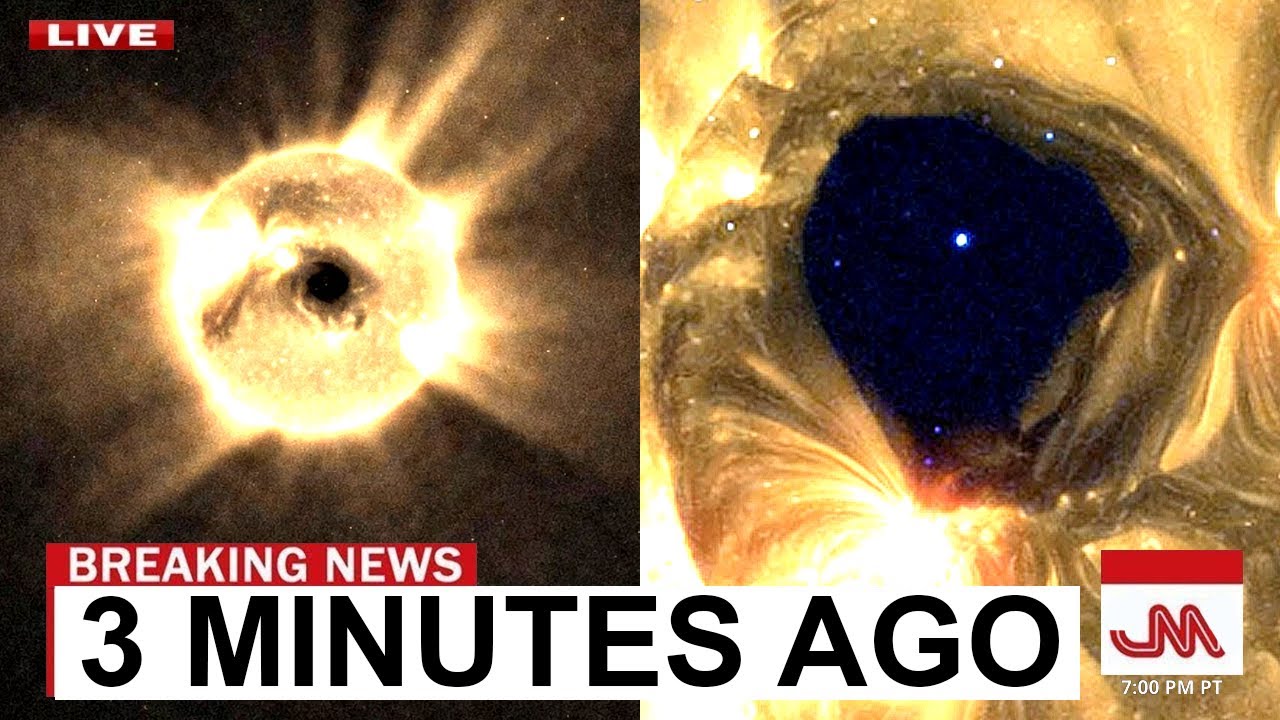

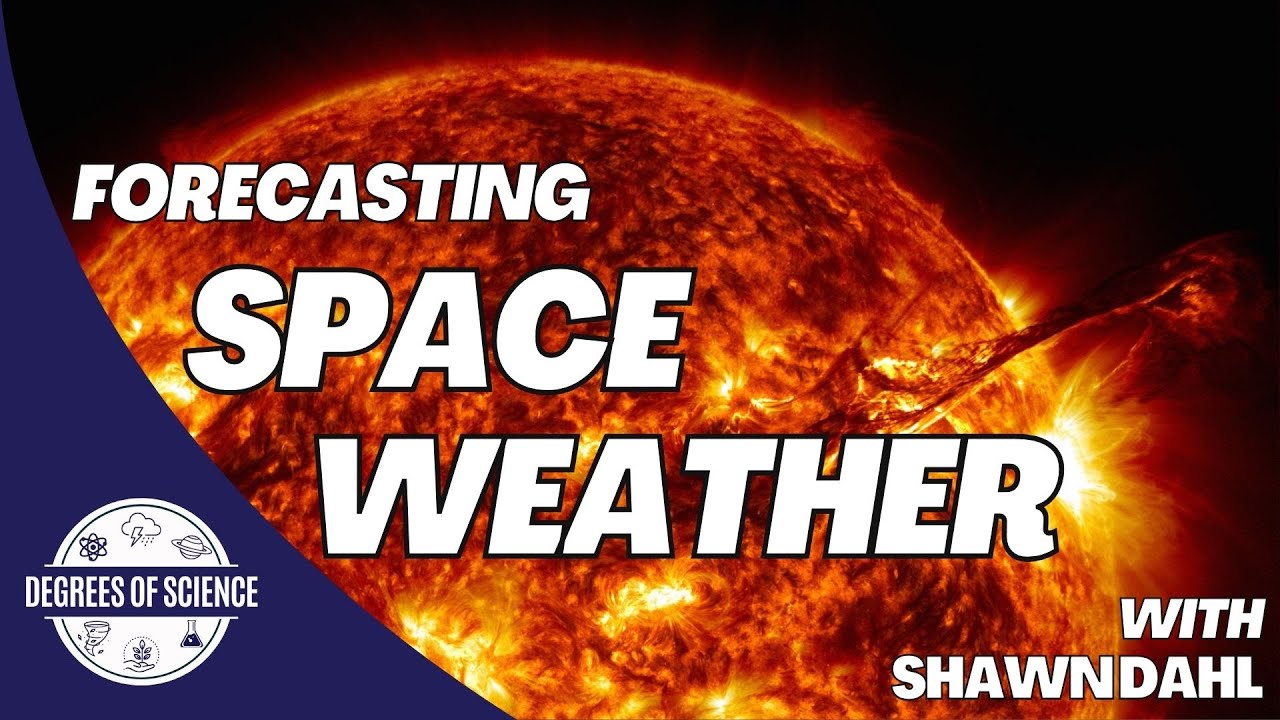


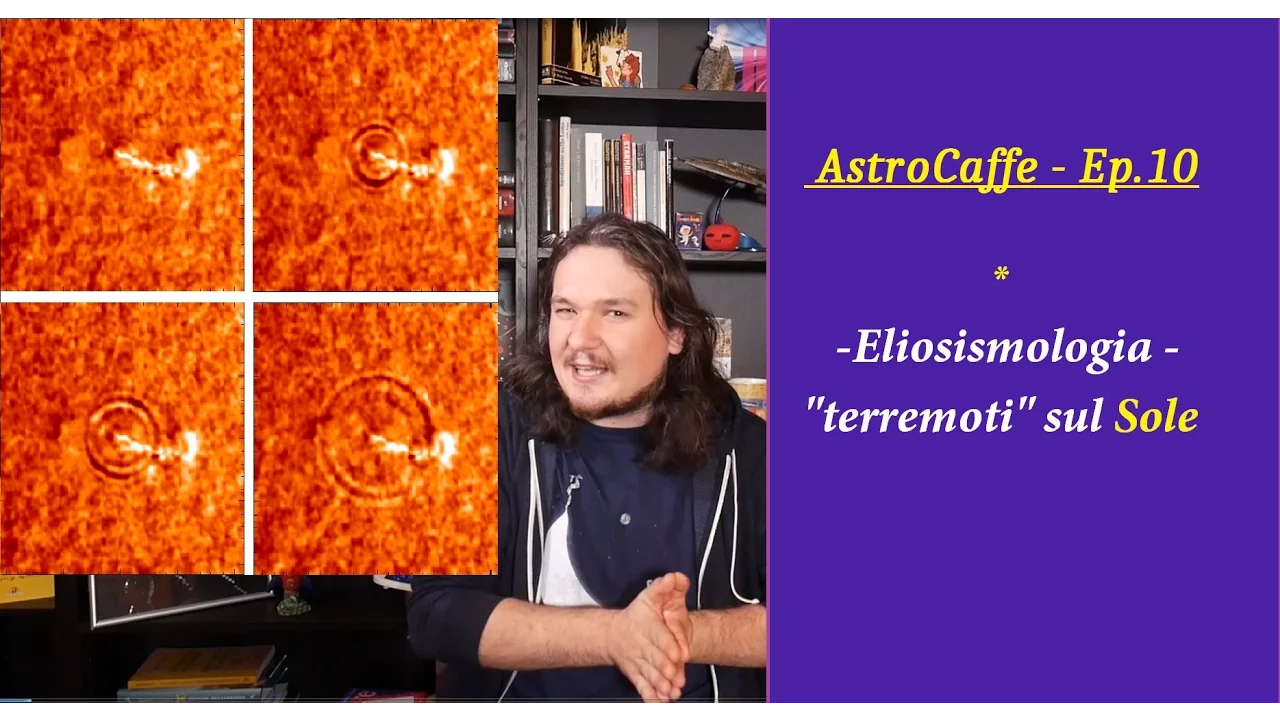







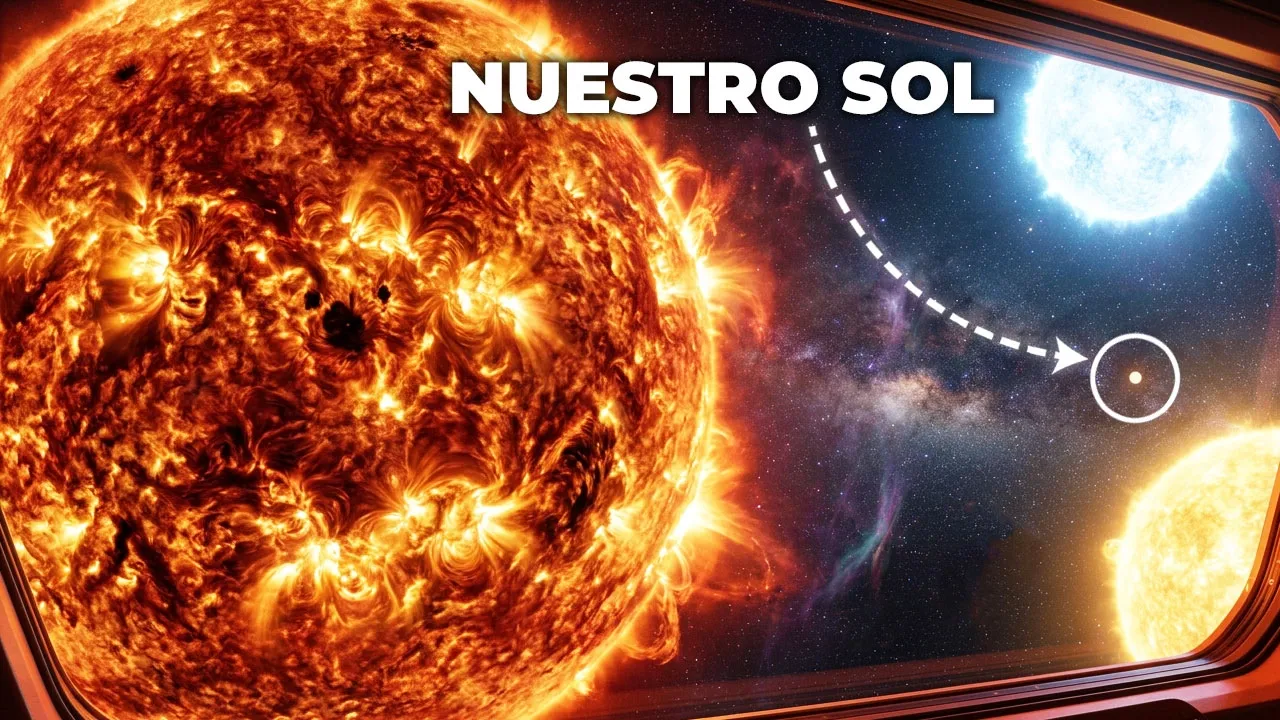
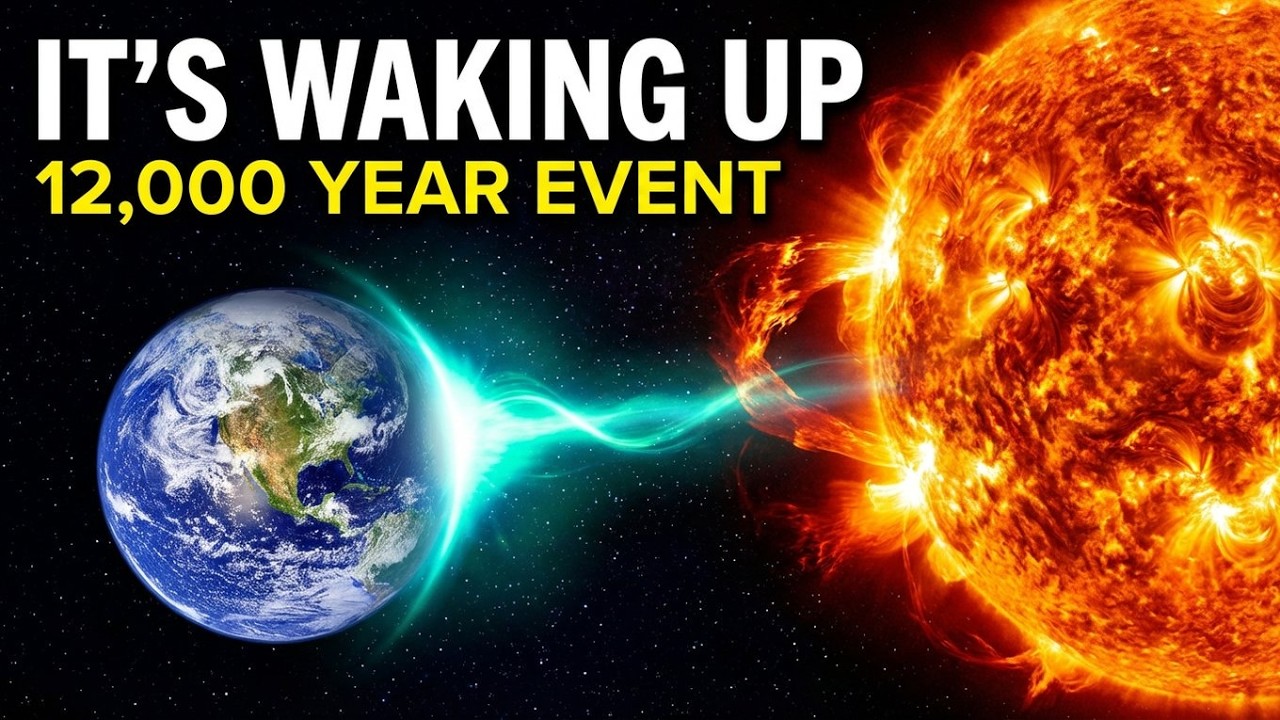

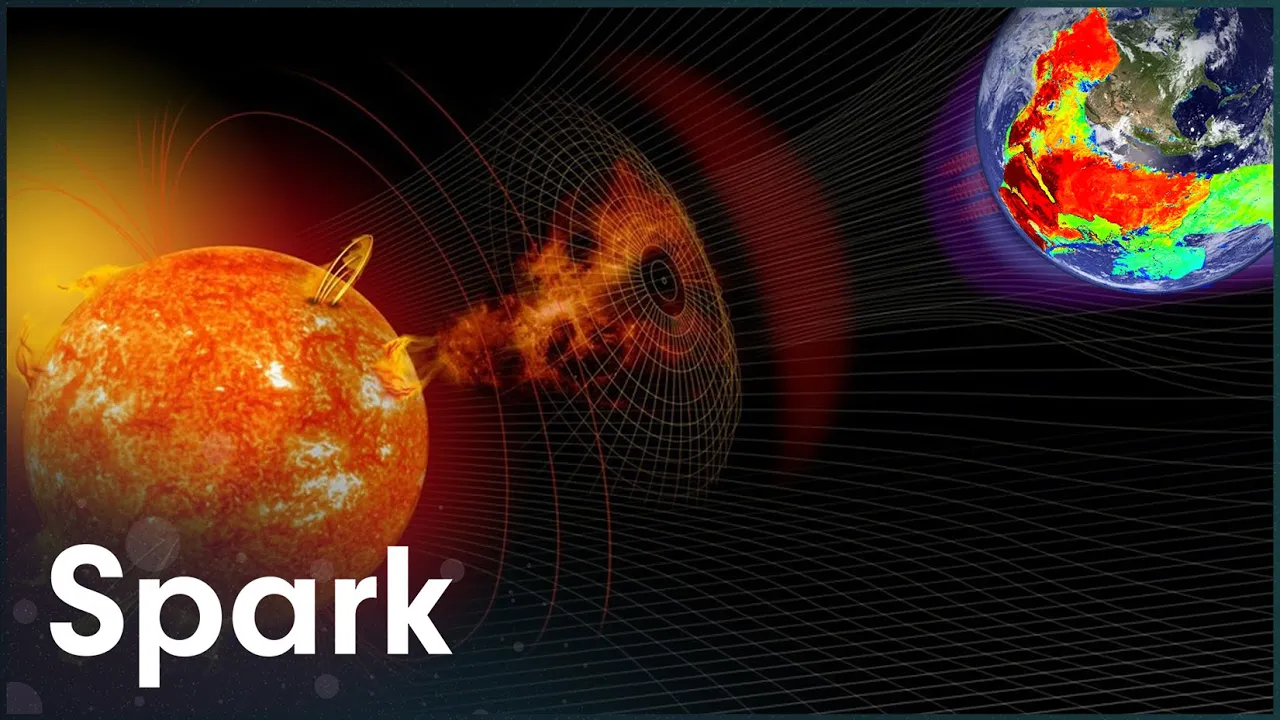


The Sun is a dynamic star where nuclear fusion in its core converts hydrogen to helium, releasing energy that travels through the radiative zone (taking 100,000+ years) and convection zone (about a month) before emerging as sunlight. This energy drives solar storms including solar flares (X-ray bursts) and coronal mass ejections (CMEs, waves of billions of tons of charged particles at over 1 million mph). These phenomena follow an 11-year solar cycle, with solar maximum bringing increased storm activity. While the Sun provides essential light and heat for life on Earth, its violent eruptions can disrupt satellite communications, cause power grid failures (as seen in the 1989 Quebec blackout), and pose radiation risks to astronauts. Understanding the Sun's complex magnetic field dynamics and developing better prediction capabilities remains crucial for protecting our technology-dependent society.
The Sun: A Documentary on Solar Science and Its Impact on Earth (2024) — Mastering the Art of Discovery
Added:It's an alien landscape where magnetic tornadoes twist upward tens of thousands of miles. Mysterious dark spots, large enough to engulf the Earth. EB and Flow, and violent eruptions shoot tons of charged particles into space at speeds of over 2 million miles per hour. This is not some strange world on the other side of the galaxy; this is our Sun. And now, new technologies are allowing us to see it like never before. Satellites are giving investigators new insights into centuries-old mysteries. Did you see that? Boom! There goes a flare.
That is really a quantum leap in solar physics, a continuous eye on the Sun. How does our Sun work? Where does its power come from? And how can its inner workings impact us some 93 million miles away? Finding answers has a new urgency because the experts estimate that in about 60 years, and the bigger the hit, the bigger impact our Sun has. A dark side: it's violent storms capable of taking down the electrical grids that power our daily lives. Repair could take weeks, months, and even in the worst-case scenario, up to 10 years for a full recovery. If you can imagine a world without electricity, you're really going back in time. Now, join scientists on a quest to understand the secrets of the Sun, dive deep into its core, and ride out its spectacular storms.
Dawn, February 15th, 2011, Boulder, Colorado. The team at the National Space Weather Prediction Center begins its day as it usually does: carefully watching the surface of the Sun. Okay, a 10 cm came in today. Although 93 million miles away, forces here can impact Earth in surprising and destructive ways. For the smaller...the M6. For the M6, you see, this is the very first one. The M6 today. After years of relative calm, a satellite detects something: a dramatic explosion on the Sun's surface, a violent solar storm that would dwarf Earth is erupting, releasing a massive shock wave hurtling towards us at over a million miles an hour. Right now, no one is sure what to expect.
But I think that the M6 is going to get here. We have to determine when that thing is going to impact Earth's magnetic field. It's going to be sometime tomorrow, perhaps later in the morning, later at night. That's what exactly what we're trying to determine. In fact, I have to join the discussions right now, so I'll get back with you. The team models the approaching storm, so 15z for the arrival of the CME right there. Their simulation shows it racing out from the Sun on the left towards the small dot on the right. So, we're looking at about Earth.
The solar storm carries a one-two punch. First is a solar flare, releasing an outburst of X-rays that can reach Earth within minutes. The second, more ominous threat arrives a few days later: a phenomenon called a coronal mass ejection or CME. It's a wave of billions of tons of electrically charged particles, seen here in this repeating image as it ripples away from the eye of the storm. Together, they could hit like a cosmic tsunami, delivering a surge of radiation and an electrical spike of trillions of Watts, potentially crashing the power grid. Sound far-fetched? In March 1989 in Quebec, Canada, that's exactly what happens. One by one, power stations crash, disabled by the overwhelming power surge caused by a CME. In less than 2 minutes, 6 million people are left without power.
Recently, NASA's Jim Green finds evidence that an even bigger solar storm hit Earth in 1859. And what we found was the granddaddy of geomagnetic storms, and that was just 150 years ago. If we had a geomagnetic storm of that intensity today, the National Academy suggested that the impact on critical infrastructure could be catastrophic. And the big concern is the electric power grid. The massive electrical surge from a CME wave could overload power lines and melt transformers, blacking out entire cities. Repair could take weeks, months, and even in the worst-case scenario, the National Academy suggests it could take up to 10 years for a full recovery. If that occurred, if you can imagine a world without electricity, you're really going back in time.
It's not just the power grid that's at risk. More and more, we rely on technology that could be affected by the Sun: global positioning satellites, long-distance communications, airplane tracking, astronauts in space. Roger, how does it look? So there's an urgency in understanding what the Sun is doing, what's it going to do next, and how can we prepare for that and respond to it? Worried or not worried? Well, I would be just a little bit worried. Yeah, concerned right now. We'll be watching it, monitoring it very closely here in the coming days.
We've gazed at the Sun since antiquity. We've worshiped it and built entire cultures around its power. We marvel when it's eclipsed during the day and when its power lights up the night sky with dancing curtains of light—the aurora. Its power and size are awesome. It is so huge a million Earths could fit inside it. Temperatures at its core soar to 27 million degrees Fahrenheit.
It's been shining for over 4 billion years and will do so for at least 4 billion more.
Yet, for something that has such an overwhelming influence on our lives, the Sun is mysterious.
How does the energy generated in its core reach us as sunlight? What processes are at work inside the Sun?
Out of these powerful inner workings generate explosive solar storms. These are some of the mysteries scientists must understand to protect us from the sun's darker side. The sun can really surprise us. The sun is elusive, crazy complicated, incredibly dynamic, and crazy with explosive potential. The key to that explosive behavior lies deep beneath the sun's blinding surface.
Until recently, seeing inside the Sun was impossible, understanding its internal processes a pipe dream. But an accidental discovery changes everything. Until the 1960s, much of solar physics relied on things that were like solar dermatology; it was things that were right at the surface or just skin deep. But as physicists studied the sun in more detail, they made a surprising discovery: the surface seems to be vibrating like ripples on a pond.
Initially, they thought the vibrations were the result of defective instruments. They couldn't get rid of them. They built better instruments, but the ripples were still there.
They looked at it for 10 years, they had conferences, they all talked about it and harped on it.
But what it turned out to be was just sound waves. It is an astonishing revelation. No one expects that the sun can generate sound waves. It leads scientists to see the sun in a completely new way.
Our sun vibrates like a giant pipe organ. But instead of air producing the notes, churning gases deep inside send sound waves rippling through its interior. Because a sound wave changes as it moves through different material, we can look at the different frequencies and determine what's happening inside the Sun. Geologists are familiar with this by studying sound waves passing through the Earth's crust; they can see the layers below our feet, a technique called seismology. Similarly, sound waves moving through the sun's interior reveal how it's made up.
I can use this organ to illustrate how sound waves work inside the Sun. For example, if I hit this low note, it comes from one of these big pipes, big deep sound, and on the Sun, that corresponds to a wave that goes very deep into the Sun and brings back the information from deep down in the Sun. If I turn to a high note, it comes from a much shorter pipe, and on the Sun, that's telling us information about very close to the surface of the Sun, not very deep at all into the Sun. There are 10 million different frequencies resonating in the Sun. Deciphering them leads to a seismic shift in understanding its structure, creating a new science: helioseismology.
Once helioseismology came along, we could not only see what the surface was but we can actually tell what the physical processes were underneath. So, by looking inside, we can actually see what the Sun is doing.
Studying the sun's sound waves reveals a complex, multi-layered machine. Directly beneath its blazing surface is a zone of perpetual churning. Next is a layer where light takes thousands of years to cross. At the center is the sun's core; it's the smallest region but over 25 times the diameter of Earth. This is the powerhouse of our star. Everything we experience on Earth, sunlight, heat, and the effects of solar storms, starts here.
So what's it like here? What's the core made of? The Sun's a crazy place, right? It's far too hot to be a solid; we know that. Heat up, it's far too hot to be a liquid. So, you think, well, it's a gas, right? Well, not really. It is this gaseous soup of charged particles that we call plasma. You're more familiar with this soup than you might think.
There are plenty of examples: fluorescent light bulbs, flames, neon lights, perhaps fancy TVs that I can't afford. But these are all plasma. Plasma is sort of all around you.
But plasma is radically hotter at the Sun's core.
The closest thing on Earth is lightning during thunderstorms. Electric charges build up, creating lightning bolts that reach tens of thousands of degrees. That's pretty hot, but it's nowhere near as hot as in the core of the Sun. So if you were to travel into the core of the Sun, the plasma would be 15 million degrees.
As the Sun formed, hydrogen gas at its heart was crushed under the weight of the material above. Eventually, temperature and pressure rose so high that the hydrogen atoms broke apart into electrons and protons, creating plasma. And it's under these extreme conditions that something really, really cool happens: nuclear fusion. It's the same atomic process inside the hydrogen bomb. Under tremendous pressure, protons in the plasma fuse together, releasing photons, minuscule packets of heat and light. An unimaginable number of photons are made every second, generating the Sun's incredible power, some of which reaches us as sunlight.
This atomic alchemy converts over 4 million tons of mass into energy every second, in an endless loop. That much mass into energy is the equivalent of 10 billion hydrogen bombs being created every second. The Sun does this day in, day out. It's been doing it for 4 billion years, and it's going to continue to do so long after I'm gone.
The energy of billions of bombs is released in the core every second. This begs a simple question you could ask: well, why doesn't the Sun blow itself apart? It's because there's this beautiful balancing act that occurs in the core of the Sun. You've got this pressure from all of this fusion pushing outwards, and the Sun is huge, so you have all this gravitational pressure pushing downwards. And so, you have gravity pushing down, and the Sun trying to blow itself apart from the inside. And it is this beautiful balancing act between the two that keeps the Sun in one piece.
This light, born at the core, reaches us after a remarkable journey. Away from the core, pressure and temperatures drop, and nuclear fusion stops. Now, each photon begins a tedious journey through the Sun's thickest layer of plasma, a region called the radiative zone.
Although squeezed less than at the Sun's center, the plasma is still very dense, and photons struggle to move through it. Each packet of energy is continuously absorbed, then spit out by the plasma particles in that particular part.
There's no energy being generated, but the energy is transmitted by the radiation. So, that's why we call it the radiative Zone. Not too surprisingly, the photon slowly bounces through the plasma here, ricocheting in a zigzag path called the random walk.
So, imagine that you're in a crowded room, and you're trying to make your way through, and you greet other people. Each person you greet, you have to say hello to, and then you move off in another direction. So, it takes you a long time to get from one place in the room to another because you're just kind of meandering your way around the room.
So, the same way the photons in the inside of the sun, they don't have a preferred direction.
All they want to do is they want to be moving, and they want to be greeting other particles.
Though moving at the speed of light, 186,000 m a second, it takes photons over 100,000 years to cross the Zone.
Eventually, the photons reach a boundary where pressures drop again, the plasma thins, and moving through it gets easier. The photons still pack a lot of energy. Now they leak out into the convection Zone, heating it from below. The thinner plasma in this Zone makes the photons move in a different way. So, instead of bouncing, all of a sudden, there's an ordered motion.
So, it's as if all of a sudden, someone said lunch, and all the particles decided, "Oh, we all have to go in this direction." You still have to wait in line to get out. So, it takes a month to get from the bottom of the convection Zone to the surface, but it's a relatively short period.
During this short period, heat from the photons sends plasma here into perpetual motion, a maelstrom of churning 125,000 m thick. Think of it like a massive lava lamp.
There's heat that enters at the bottom from the light bulb. It heats the material, and the blob rises to the surface. When it gets to the top, it cools off, and when it cools, it gets more dense and falls back down.
This is a good analogy for what's happening inside the sun. We have the core of the Sun heating the material at the bottom of the convection Zone. Material expands and it carries the energy upward until it gets to the surface. These incredible images reveal convection at the sun's surface, rising and sinking plasma that creates a mesmerizing structure called granulation.
The granulation cells are about the size of the State of Texas. They only last for about 12 minutes, so there's an incredible amount of energy. It's a very dynamic, very chaotic place, and all of the activity is going on the surface of the Sun, where we can see it.
Photons produced at the core finally reach the surface. They emerge as a weakened form of solar energy. This weakened energy reaches Earth in 8 minutes. We know it as sunlight.
So, 100,000 years, about a month, and then 8 minutes. Once you get to the surface of the Sun, it just takes 8 minutes to get to where you can see it unimpeded. The trip from the core to the surface would take the photons a matter of seconds. In reality, the sunlight that shines on us today may have been created during the last ice age.
Energy reaching the sun's surface doesn't just result in sunlight. It can also trigger solar storms. Understanding the sun's destructive power requires 24-hour precision surveillance, something that until recently was impossible to achieve.
5, 4, go for main engine start, 3, 2, 1, zero, and ignition and liftoff of the Atlas 5 with the Solar Dynamics Observatory. In February 2010, NASA launches its most sophisticated solar satellite yet, the Solar Dynamics Observatory, or SDO for short.
SDO is the first satellite to deliver almost continuous super high-resolution coverage of our nearest star, giving researchers unprecedented access to the Sun and its secrets. The first day was very exciting. We knew we were going to open our doors that actually let the sunlight into the instrument for the first time. We started looking at the first pictures, and it was almost in focus.
As soon as we focused it, it was just beautiful. The new images reveal the sun like never before, an alien landscape where strange structures ebb and flow, giant tornadoes hundreds of thousands of miles high that could easily engulf the Earth, and superheated bubbles of plasma the size of Alaska.
When I look at the pictures, I think they're really beautiful. I'm struck by the dynamics of it. Things are changing all the time, no matter where you look, and I'm also pretty daunted by the complexity of it all. That's not surprising. Previous satellites only revealed a portion of the Sun in high resolution. Now they see it in mind-boggling detail.
Now, in order to look at the Solar Dynamics Observatory images that we're bringing in every day, we've built this very special wall, which is 9 high-definition television screens together that can display these images. So, the instrument and the display system together are an entirely new way of looking at the sun.
We can see all the details of what is going on, and that is really a quantum leap in solar physics, being able to see all of that all the time, a continuous eye on the sun. One of the most important aspects of SDO is its ability to see sunlight across a range of wavelengths, the equivalent of looking at things glowing at different temperatures.
That wasn't our eyes are most sensitive to sunlight glowing at around 10,000 degrees Fahrenheit. At this temperature, the sun's surface looks almost featureless. But at hotter wavelengths, normally invisible, a far more dynamic picture emerges. The February 15th, 2011 storm is a perfect example.
In this repeating image at around 90,000 degrees Fahrenheit, SDO captures just a ghostly trace of the CME wave. But at just over a million degrees, the super hot plasma rippling away from the eye of the storm is much clearer. This allows researchers to see coronal mass ejection waves evolving across the entire Sun.
This is an absolutely amazing time for solar physics because of these beautiful high-resolution images that allow us to understand better the physics behind what's going on when solar storms erupt. It was that one last look at this back at the National Space Weather Prediction Center. That's the M1 Bill Mtto tracks the storm's CME wave. It carries a billion tons of plasma right now and is now only about 20 hours from Earth.
We're bringing it in mid to late on the 17th. Into what they see is alarming. Well, there's actually three CMEs that we're looking at. So, we bumped up some numbers for late tomorrow.
Yeah, it's not a single CME wave but one, two, three of them. We won't call it the perfect storm yet or anything, but conditions are lining up for some significant space weather.
Their models show trajectory and speed, but the big unknown for MYTO is how powerful the waves will be when they hit. The answer lies in a force that governs the sun: magnetism.
We're all familiar with magnets; they produce an invisible force that pushes and pulls on charged particles. In fact, Earth has a magnetic field that protects us against threats from the Sun.
But we are less familiar with the Sun's magnetic power, which researchers believe plays a major role in driving solar storms. We've essentially learned that it takes two things to make a star magnetic.
It needs to have these convective motions right underneath the surface. The bub of the gas needs to spin, and the faster it spins, the more active it becomes. Wherever those two things—the bubbling and the spinning—can interact, that's where we see the strongest magnetic activity in stars. Astronomers know that the surface of the Sun spins in a strange way. If you travel from the poles of the sun towards its equator, you'd notice it turns faster. Analyzing S-waves inside the Sun reveals that the plasma layers beneath the surface also spin at different speeds. That's because they act like fluid, which gets denser towards the core. The interior of the sun is a place of spectacular turmoil, turmoil that's the key to the sun's magnetism.
The motions there, the differential rotation, the motion from equator to pole, are driving a new force. They're driving a magnetic field. There's a Dynamo at work here, a Dynamo that's generating a force that we actually experience here on the earth. It works like a giant wind turbine, churning plasma in the convection Zone, stirring up powerful electrical currents which generate a huge magnetic field. We have upflows here and downflows coming down this way. Those are the holy grail for scientists, understanding exactly how this Dynamo generates solar storms.
The clue lies deep within the convection Zone. Magnetic field lines normally run from pole to pole, but with all the turmoil in the convection Zone, that pattern can't last. Rotating layers stretch them horizontally; convection twists and braids them. Under immense strain, they begin to kink upwards towards the surface. Imagine this spring is a magnetic field line.
The magnetic field inside the Sun is amplified in strength, led by the rotating motions, and the shearing motions, and the churning motions inside the Sun. It wants to expand upwards, and it does until it pokes out through the surface of the Sun.
Tracking invisible field lines is normally impossible, but plasma plays a critical role.
Even though the magnetic field lines themselves are invisible, the plasma, which is heated and hot, can light up along these paths. In maybe the same way you could think of a highway, and at night you wouldn't see the highway at all, but with the cars with their headlights on, you'd see the path of the highway. Watching field lines is critical to understanding solar storms. As field lines emerge, they form loops, one end has a positive pole, and the other a negative pole. Turning plasma beneath the surface twists these loops, pumping them with energy. If twisted enough, positive and negative parts of the loops cross. When they do, they short circuit with a tremendous explosion. The energy released heats the plasma to millions of degrees, resulting in a spectacular solar flare. It's the final dramatic stage of a very long journey.
Photons formed in the core make their way to the surface. Some pass directly into space as sunlight, but in the process, that surging energy disturbs the convections of Zone, generating a magnetic field. The field lines wind up to the point that it explodes in a solar flare.
Now SDO provides a complete and unprecedented picture as these events evolve. This is beautiful because the hot gas outlines the magnetic field lines that we would otherwise not be able to see, and here you can see even a twisting structure as some of the mass drains back down to the surface, and a lot of it escapes in the eruption. This is the essence of space weather or solar storms. This explains how flares form, but it's not the end of the story.
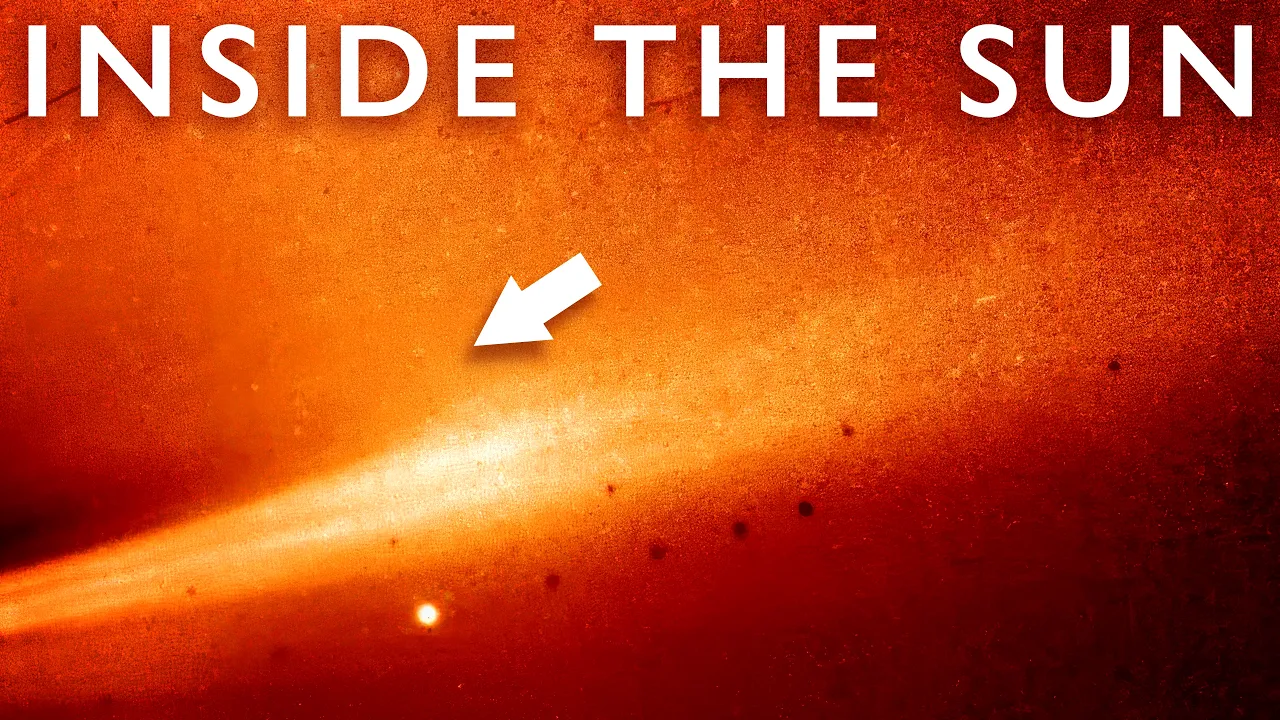
Crossing magnetic field lines can cause nets of plasma to be flung into space. This is a coronal mass ejection, a CME wave, the portrait of how solar flares and CME waves form is coming into focus, but a key question remains. CME waves can travel 93 million miles to Earth in a matter of hours. So, what gives them such explosive energy? Part of the answer is hidden here in the sun's atmosphere, the corona. It's made of super hot plasma that blisters at over 3 million degrees Fahrenheit, 300 times hotter than the sun's surface. Some scientists suspect that this heat powers massive gusts of energy that blast CME waves toward Earth at incredible speeds. But why the corona is so hot is an enduring mystery.
Understanding it is crucial if we want to get to the bottom of how the Sun drives space weather and the impact of the sun on the earth. The fact that the corona is so much hotter than the surface flies in the face of physics. The sun's Corona is a very odd place. Take this fire, for example, as I put my hands close, sure it's warm. But as I pull them away, it gets cold. That's not the case on the Sun at all. As you go in close, it's definitely warm, but as I pull away, it actually gets warmer still. Recently, Japanese investigators observed high-velocity jets of plasma shooting up from the near-surface. Macintosh suspects these jets deliver heat to the corona, but he doesn't have a way to confirm it visually until he turns to SDO for help. Lo and behold, we actually managed to join the dots and see that these objects that we could see moving out of the lower atmosphere at high speeds, kind of like these licks of flame, really were reaching a couple of million degrees.
It was really a joyous moment. We kind of looked at each other and said, 'Wow, what have we just done?'
They've shown that the plasma jets accelerating upwards from near the sun's surface generate tremendous heat. As a result, temperatures in the corona soar to 32 million degrees.
If confirmed, it represents a huge leap forward in understanding CME behavior. The immense heat of the corona acts like a wind in a raging gale. It's constantly pushing on the plasma draped on the field lines, billowing them out like sails, pulling on a mast like solar flares. When magnetic lines cross, there can be an immense explosion. In this case, the lines are cut, and the sail whips off into space, loaded with a billion tons of highly charged plasma. The CME wave can wreak havoc on electricity-dependent Earth.
At the National Center for Atmospheric Research, this violent event is captured by satellites.
Now, to see the CME, we need to create a little artificial eclipse. To do that, we block out the light from the disc of the Sun, and that's this little circle here. But what that allows us to do is to see this extremely faint, high-speed thing shooting away from the Sun. This one moves about 1,000 km/second. By enhancing the picture and slowing it down, it's possible to see the shock wave moving at over 2 million mph. Though we have a better understanding of what causes solar storms and how they reach us, there is still a final pressing problem: trying to predict when solar storms are going to occur.
On the sun, really requires a lot of detective work. Basically, we're looking for clues and observations to tell us when potential storms might occur. The best clue comes from these sunspots, dark patches which can linger on the sun's surface for weeks at a time. A sunspot is a massive region several times the size of the Earth, which appears on the Sun as a dark spot. It's dark because it's relatively cool compared to its surroundings, and it's cool because the magnetic fields are so strong that they're suppressing the flow of heat from below. The strong magnetic fields which create sunspots are the breeding ground for solar storms. The challenge is trying to decipher a pattern for when and how many will appear.
As we watch sunspots over a period of many years, we see something very interesting: the number of sunspots at any given time will wax and wane over a period of about 11 years.
And since we now know that sunspots are associated with strong magnetic fields, this tells us that the sun's magnetic fields are likewise going through a cycle. The constant churning and twisting inside the Sun create a powerful Dynamo, the biggest electrical generator in the solar system. The magnetic field lines it produces get so wound up that, roughly every 11 years, the magnetic poles of the sun reverse. After that, calmer magnetic activity prevails, and fewer sunspots form, a period called solar minimum. But because of the sun's turbulent nature, the field gradually winds up again, and as it does, magnetic outbursts are far more common, a period called solar maximum. The solar cycle actually determines the personality of the Sun. During solar maximum, it can get very angry and throw off solar storms that are sometimes directed at Earth. And during solar minimum, it becomes much more subdued. There aren't as many sunspots, and there aren't as many solar storms occurring.
The activity cycle basically determines how the Sun is going to act.
Prior to the solar storm of February 15th, 2011, things were pretty quiet on the Sun.
But that outburst marks an ominous turning point. The sun's magnetic activity is winding up again as it heads towards solar maximum. Just a few days ago, Bill Minto and the team at the space weather prediction center witnessed the turn.
Minto: The X2 and the M6, if it comes in with any geoeffectiveness between 12 and 1800, so that's what we're seeing. It's now time to let the world know what it might expect.
Nothing higher than R1 in the next couple of minutes here. We're going to have to make a decision and make the prediction that this coronal mass ejection is going to arrive at whatever time tomorrow, and the geomagnetic storm will ensue. Of course, once it arrives, with the event we had, Merton knows that the severity of the storm depends mainly on two things: how strong the CME's magnetic field is and at what angle it hits Earth's own magnetic field. CME waves approach Earth like a slowly rotating shield. One end is positively charged, the other negative, with magnetism. Opposites attract and like poles repel. If the wave's positive pole lines up with Earth's positive pole, most of the power of the storm will be repulsed. But if opposite poles line up, the plasma the waves are carrying will hit with full force.
Did you say it came in at 115? Merto makes his final assessment only hours before impact.
Minto: It could be larger, more complicated typically than just your single... I think we nailed the forecast. Nailed it, I'd like to think so.
So, according to the observations, the CME wave will be repelled; we don't expect it to be too strong. We'll see moderate storming levels, which is good enough to produce some Aurora Borealis down in the United States, down along the Canadian border, Northern Tier States, and it will cause some minor problems to the power grid and whatnot.
Space weather for the next 24 hours is expected to be minor. Radio blackouts reaching the R1 level are expected. This time we dodged a bullet.
But disturbing evidence suggests that Earth will not always be so lucky. It's a cautionary tale. NASA's Jim Green discovered it while researching a book on the American Civil War at the Library of Congress. Green found news accounts from 1859, which caught his eye.
Green: I would run across articles about Aurora, fabulous Aurora, and this really piqued my interest because it's in my field. It seemed as though the armies of Heaven were engaged in terrific, though noiseless, conflict. This terrific aspect soon subsided into a more beautiful and brilliant appearance, a few of which I can only refer to.
The reports tell of auroras so bright miners in Colorado woke up and went to work thinking it is dawn. Other accounts tell of a more harmful impact on the lone electrical system of the day: the telegraph.
One, for instance, because of the induced current on their system, overheated the battery and started a fire. It nearly burnt down the telegraph office. Another operator was burnt so badly he ended up in the hospital.
Green uncovers numerous reports of auroras seen not only across the United States but around the world. The evidence is clear: Earth was struck by a super storm in 1859, the result of two massive CME waves. Those two storms were not only enormous, but they happened one right after the other. No one alive has seen anything like it. On the day before the waves hit, a British astronomer observes a giant sunspot group light up with two massive flares. The second CME wave hit 18 hours later, allowing Green to calculate its speed: 5 million mph, plowing into Earth at almost four times the speed of the February 15th, 2011, CME waves.
Using the various reports, Green is able to reconstruct the 1859 storm. The accounts suggest that the poles of the CME waves were aligned, and instead of being repulsed, the waves hit with full power. The charged particles funnel down into the atmosphere, electrifying it like a giant neon sign, producing dazzling Aurora displays. The storm is so intense Earth's magnetic field all but collapses, millions of tons of plasma spill towards the equator, and a powerful electric surge pulses over the globe.
For the largely pre-electrified world, the moment passes with minimal damage. That might not be the case today.
It has the potential of knocking out power grids, and if it burns out transformers that are hard to replace, we may be without electricity in many areas for a very long period of time.
There are only a few places that make these 125 KT transformers. It takes several months to make them, and if you burn out half of them, we're going to be shooting squirrels and chopping wood out in the backyard for a long period of time just to survive it.
Everything grows, but the 3D is really today's solar scientists believe it's not if but when the next big one will strike.
With the next solar maximum due in 2013, it begs an all-important question: Can we predict when the next solar storm will hit? Maybe. Maybe. Maybe. And the reason why is we've learned so much about the sun; we're getting better at it, but we have a long way to go.
And the more we look at some of these historic events, the more we get a deeper appreciation for what we need to know. Today, we see the sun better than ever before. We're beginning to understand it from the inside out. But its unpredictable personality means there will always be uncertainty when living with a star, the sun, our nearest star.
In the fall of 2003, it unleashed an eruption of energy equal to 200 billion hydrogen bombs, blasting a tidal wave of superheated charged particles at speeds of up to 6 million mph.
It was one of the largest solar storms ever recorded, and it was aimed at Earth. They were some of the fastest, hottest, and strongest storms ever measured, assaulting the Earth.
The sun's energy forced space station astronauts to take cover in their most sheltered compartments.
Lights went out, communication streams were cut, airliners scrambled for safety. This really was a hurricane of space storms.
Though no major damage was done, these storms were a stark reminder that we live at the constant mercy of the sun. It controls all aspects of our lives: our climate, our food, our bodies.
We actually live inside the sun's atmosphere. We, along with all the other planets, are greatly influenced by it. But its influence is changing. It's actually growing more powerful.
Might we lose its protection from deadly cosmic rays? At its boundary where it's protecting us from the intergalactic winds, that boundary is actually shrinking a bit. Will our technology-dependent society be able to handle another solar superstorm? Sometimes these effects can be so severe that they're catastrophic. And when will the next superstorm strike?
3, 2, 1, go for drop. Pegasus is away.
In the IX Mission, Fall 2008, NASA launches IBEX (the Interstellar Boundary Explorer).
Part of its mission is to study the effects the Sun has on the furthest reaches of our solar system. IBEX joins the long list of human attempts to explain our star's impact on our solar system, our planet, and our lives.
The Sun provides all of our light and heat. If it weren't for the Sun, we wouldn't be alive. We, people, are very interested in what goes around us. We like to understand our neighborhood. The Sun, in the universe, is our street, our neighborhood. The Sun, we are actually affected by its moods. In fact, it's like the parent, and all the planets are the children that are affected by its moods. We need to know how it's going to evolve and how the changes that are always happening in the Sun affect us here on Earth.
The Sun, if we want to understand the universe and the stars that make up the universe, then it's important to study the one that's closest to us. We've learned more about the Sun in the past 40 or 50 years than in all of recorded history. This Golden Age of Exploration was kicked off by a unique mission that gave us close-up images of our Sun from above our atmosphere.
SkyLab, we're reading you loud and clear over the Vanguard.
For 8 minutes in 1973, SkyLab became the first man-made space station. It sent back images of the Sun clearer than anything taken from Earth. The SkyLab mission was one of the very first laboratories that was dedicated just for the research and study of the Sun. In some ways, it's kind of the grandfather of the current missions.
Today, right now, a fleet of about 20 space probes scan and study the Sun in ways we never imagined even 30 years ago. By studying the Sun from the vantage of space, we can see it in a whole new light. Using different light wavelengths, including X-ray and extreme ultraviolet, we can peel back its layers and begin to understand how and why the Sun acts the way it does.
The different wavelengths mean different temperatures and different structures are more visible in different wavelengths than in others.
Our robotic space probes never stop watching the Sun. With their help, scientists are working out the big questions about our star. And we already know a lot. The Sun is one of over 200 billion stars in our Milky Way galaxy, but it is our closest, at 93 million miles away from Earth, almost the same distance as 4,000 trips around the globe. And despite that distance, its light only takes 8 minutes to reach Earth. It is only 4.6 billion years into its nearly 10 to 11 billion-year lifespan, and though technically a medium-sized star called a dwarf, it is enormous, 109 times the Earth's diameter. If hollowed out, 1.3 million Earth-sized planets could fit inside the Sun. It accounts for 99.8% of the mass in the solar system and weighs 300,000 times more than the Earth. It is made up almost entirely of a superheated form of electrified and magnetized gas called plasma.
The Sun packs enough gravitational pull to keep the planets from spinning off into space, and as Copernicus first suggested, it rules the center of our solar system with a gravitational iron fist.
Copernicus's model in which he placed the Sun in the middle of the solar system, with all the planets going around it, instead of everything going around the Earth, was a giant paradigm shift. It meant that the Sun is the most important thing in the solar system.
It meant that we really should understand the Sun.
Our Sun, like all other stars in the universe, is made from the dust of stars that lived and died over billions of years, going all the way back to the Big Bang. So our Sun and our solar system is really the debris from many generations of stars. The Sun we see every day is the solar system's source of power. Deep in the center of our star, its core is superheated to 27 million degrees Fahrenheit and is the engine that drives it all. Inside the Sun's core, the process of fusion is occurring, and that fusion process is giving off light and particles. Every second, the Sun shines. It releases the same amount of energy as 1 million hydrogen bombs.
The Sun's light is made of particles called photons, born in the core, then propelled by convection currents through the radiative and convective zones of the Sun. Eventually, they reach the volatile outer layers of our nearest star.
The Sun's outer parts consist of three regions. There's the Photosphere, or surface of the Sun. It's not really a hard surface like that of the Earth; the Sun is gaseous throughout.
The temperature of the Photosphere is around 10,000 degrees Fahrenheit. Above the thin layer of the Photosphere is another thin layer called the Chromosphere. The Chromosphere is slightly hotter than the Photosphere, which is counterintuitive because you would think that as you go away from the source of all the energy and heat, the core, the temperature would drop. But in fact, the temperature rises from the Photosphere to the Chromosphere, and it gets even hotter as you rise to the third layer of the atmosphere called the Corona.
Beyond the Chromosphere is a large, tenuous extended region, the Corona, which is millions of degrees. The Sun produces a continuous outward flow of energy called the solar wind, constantly blowing it, carrying energy out into the solar system, extending our Sun's reach 9.3 trillion miles well beyond Pluto.
The space in between the planets and the space in the entire solar system is not an empty void, but it's full of these particles and it's full of these rays of light. While the solar wind blows away from the Sun, its gravity holds and pulls everything in. Take comets; all comets orbit the Sun and can get pulled directly into the line of fire. Recently, scientists witnessed one of the Sun's most dramatic outbursts: a coronal mass ejection ripping the tail off a comet.
When it hit the comet, the tail was cut off like it took a knife, and the tail drifted away. And then it took a little more time for the comet to generate more gas and plasma and dust and create a tail. It tells us about how the solar wind moves in the solar system and how it can affect things. The Sun affects everything it touches, even us.
To learn just how much, scientists sometimes rely on a remarkable cosmic coincidence: the lethal output of the Sun has made studying it almost as difficult as understanding it.
But scientists can get a good look at our nearest star thanks to a cosmic coincidence: a total eclipse of the Sun.
A total solar eclipse occurs when, from our perspective, the Moon is exactly aligned with the Sun and blocks its photosphere. It's a glorious sight. The solar eclipse is the most wonderful thing to see. It grows really dark by factors of thousands within seconds. And as it does become so dark, you can look up in the sky, and you see the dark shadow coming from one direction, sweeping at you. It's really coming at thousands of miles an hour, so it's very impressive to see. Humankind has marveled at the mysteries of the eclipse for millennia. Scientists have used it as an opportunity to see the Sun's outer atmosphere, the enigmatic Corona, one of the hottest regions of the Sun.
Energy from the Corona radiates out to the edge of the solar system.
The entire solar system actually sits in this outer Corona of the Sun, so this atmosphere of the Sun is bathing all the planets.
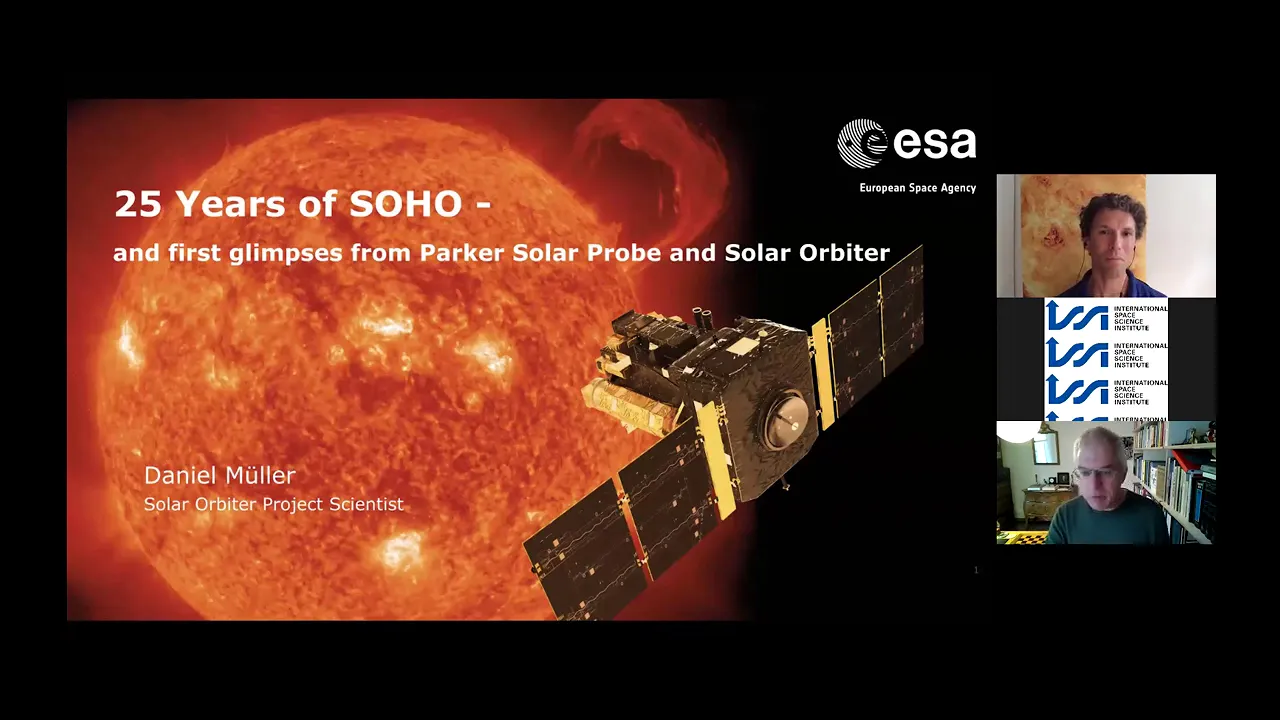
The engineers who built the Solar and Heliospheric Observatory, or SOHO, installed an artificial eclipse into the space probe called a coronagraph. It does the same thing as a natural eclipse, blocking out the blinding rays of the Sun so scientists can try and answer an old question: How does the solar corona get so hot? After all, the everyday surface of the Sun, the photosphere, is only around 10,000 or a little more Fahrenheit, and the corona, on the other hand, is millions of degrees hot. If you go away from a stove, you know it gets cooler, but if you go away from the everyday surface of the Sun, it gets hotter. How is that?
It all starts at the Sun's core, where every second, nearly 700 million tons of the universe's most common element, hydrogen, are converted into helium through nuclear fusion, giving off the energy that becomes photons, otherwise known as light. The Sun's core is really hot, several tens of millions of degrees, and there, the temperatures are so high that protons (hydrogen nuclei) can come together, grab each other, fuse eventually into helium, and in this way, release energy.
What happens with these photons? They go through this process we call a random walk, where they have to go through the layer of the Sun, they get absorbed, and then reabsorbed into lots of different photons at lower energy levels. So this process of being absorbed and reabsorbed millions of times can take 150,000 years.
Once out of the Sun's interior, photons are only 8 minutes away from Earth, but they're leaving behind a world in constant motion. The solar surface boils, energy rises constantly from below, coils of plasma and energy called coronal loops spring across the Sun, while dark regions known as sunspots stretch thousands of miles. And at only 7,000 degrees Fahrenheit, these sunspots are the coolest part of the Sun, emitting less light than the surrounding area. If you were to pluck a sunspot away from the Sun and place it in the sky, it would actually be as bright as the full moon.
Sunspots appear on the surface and are easy to see. Their genesis, however, is tied to the Sun's deep interior and complex rotation. The Sun doesn't rotate like a solid body; instead, it rotates more quickly near the equator than near the poles, which leads to sunspots. The equator completes one rotation in 25 days, mid-latitudes complete one rotation in about 30 days, and near the poles, one rotation is completed in about 35 days. This called differential rotation. This process makes the Sun's interior churn at different speeds, creating intense magnetism in the form of millions of magnetic field lines, which get mixed up as the Sun's interior twists up like a rubber band. This builds up pressure, which makes them buoyant, so they float to the surface, and where they pop through the surface, they create sunspots.
Once on the surface, the now twisted and balled-up magnetic field lines block the convection of super hot plasma from rising, making sunspots appear dark. And when those sunspots start to twist around, you can imagine that you have one sunspot here and one sunspot here, and there's a magnetic field that connects the two, and that magnetic field gets twisted, and eventually the same sort of thing that happens with a rubber band, it pops. When the magnetic field pops, it releases energy, and in the case of the Sun and solar flares, it releases huge amounts of energy.
The magnetic field lines created by the twisting and churning of sunspots, though invisible, can be seen in the dramatic formations on the surface of the Sun in the form of flares and prominences. It is here that the Sun's influence starts, as the breaking of these magnetic field lines drives massive amounts of energy from our nearest star out into the solar system. And it is these magnetic field lines that are behind most theories on why the corona is so much hotter than the surface.
It's pretty clear that it has something to do with the magnetic field that heats the corona. But presumably, there are waves along the magnetic field that bring energy from underneath the surface of the Sun into the corona.
The Solar Probe Plus, which means 'sunrise' in Japanese, was launched in 2006. Its mission: to study the interaction between magnetic field lines and the corona. Recently, it captured images of one of the waves thought responsible for heating this enigmatic region: Alfven waves.
Alfven waves are waves that occur in a plasma, in a bunch of ionized gas threaded by a magnetic field. And indeed, it's thought that these Alfven waves might be bringing turbulent energy from inside the Sun out to the corona, where that energy heats the corona.
Energetic Alfven waves form inside the Sun and travel up through the surface, making the looping magnetic field lines sway and vibrate. And so, through this vibration or this oscillation, they're having friction with the magnetized plasma serenia in the corona. And through this friction, the heating occurs.
It's this heat delivered to the corona that radiates out into space, filling our solar system with the Sun's energy. But this energy is not constant; our Sun is an ephemeral body, never the same from one day or one year to the next. Like Earth changes with seasons, so does the Sun. And when the solar seasons change, anything can happen.
Day in and day out, the Sun we see appears the same. But, like Earth, the Sun has seasons: solar minimum and solar maximum, two distinct personalities that can affect our technology and possibly even our weather. The transition between solar minimums is called the solar cycle, an average 11-year period in which the Sun's activity maxes out, then eases again.
The primary measure of the solar activity cycle is the number of sunspots visible on the Sun. During solar minimum, the period with the fewest sunspots, solar activity is limited. When sunspots break through the surface during solar maximum, the Sun's power reaches out. When there are lots of sunspots, there are lots of flares and coronal mass ejections.
Increases in solar activity enhance the connection between Sun and Earth. Energy expelled from the Sun can create disturbances in the near-Earth environment.
The Earth is embedded in the Solar atmosphere, and so what happens on the Sun affects the Earth, and that's what we call space weather. Accurate space weather forecasting is the ultimate goal, but this can be challenging. The Sun is turbulent, especially during solar maximum, which is the peak of solar storm activity. During solar maximum, the magnetic field of the corona becomes very complicated, and you have magnetic fields everywhere, even near the poles. You can have coronal mass ejections, flares, and solar storms occurring sometimes several times a day. Solar flares, violent eruptions of energy, usually occur near sunspots and burst into space like a bolt of lightning, quickly and powerfully.
They can happen over a matter of minutes and can give off the same amount of energy as a billion megatons of dynamite. Solar flares are gigantic outbursts of energy from the Sun, coming from a very small, localized region of the Sun's surface, so they're very concentrated ejections of energy that heat the surrounding gas to 10 million degrees.
A solar flare is sort of like a snapping of the whip; it releases a lot of energy very quickly, accelerating particles almost up to the speed of light. The particles from the most energetic solar flares can reach us in something like 15 minutes. But the solar hurricane of space weather comes from coronal mass ejections. These massive blasts carry billions of tons of superheated gas and plasma into interstellar space. So, a coronal mass ejection is where a huge amount of mass and energy is expelled away from the solar surface.
If you can imagine this huge amount of mass and energy traveling away from the Sun at these high speeds, sometimes at over a million miles an hour, they create these like big bubbles of hot gas and magnetic field. They can move off the Sun so quickly that they actually create a shockwave. These are the biggest storms, and they're the most important ones for understanding space weather. Solar probes like SOHO have captured the Sun expelling massive amounts of energy into space.
But scientists are most concerned when they see something called the "halo effect," when the cloud of energy appears to surround the coronagraph. That means the Sun has aimed its latest blast at us, like in the massive solar storms of 2003. The fastest coronal mass ejection ever studied in modern times came from these storms. Shortly after the initial blast from the Sun, SOHO was bombarded by charged solar particles, protons, and electrons, overwhelming the camera and causing the image to drop out. What happens is you see a sort of "snow" on the camera, all sorts of sparkles going by, and that's the particles accelerated by the coronal mass ejection hitting the actual camera on SOHO. If caught off guard, solar storms can harm astronauts, exposing them to the same amount of radiation in seconds that we receive on Earth in a year. So, if we're going to send astronauts back to the Moon and to Mars, it becomes very important to be able to determine when these coronal mass injections and storms are going to occur. The charged particles embedded in these coronal mass injections are dangerous; it's a lot of radiation that would hit an astronaut.
Astronauts and satellites aren't the only potential victims of solar storms; the particles blasted towards Earth can interact with our magnetic field, occasionally wreaking havoc.
When this material comes smashing into the Earth's magnetic field, it causes it to "ring," almost like a bell. When you have a magnetic field, and that magnetic field moves, physics tells us it's going to create currents. So, electrical currents will be created in the outer atmosphere of the Earth, and these electrical currents can cause all sorts of disturbances.
The currents create problems for satellites orbiting the Earth; they disrupt Global Positioning Systems and can interfere with communications equipment, causing radio blackouts and knocking out mobile phone systems. These mass ejections can send so many charged particles toward the Earth that some of them make it through the Earth's magnetic field and even reach power stations here on Earth, causing surges of electrons, power outages, and short circuits.
In extreme situations, solar storms cause excessive radio interference and increased levels of radiation, requiring planes flying near the poles to be rerouted. But as powerful as the storms were in 2003, they're no match for what astronomer Richard Carrington saw in 1859: a super flare. The super flare of 1859 was incredible because prior to this event, we didn't even know that flares existed. Carrington saw this huge, bright flash on the Sun with an unaided eye, and in order for him to see that, it had to have been a super huge flare. There were reports of telegraph lines running without being powered. We probably won't see another one that intense in our lifetime, although it's hard to say for sure.
The Sun has thrown us some surprises. If a similar storm were to strike today, one recent estimate projects 130 million people would lose power, possibly for months. Most of the electrical infrastructure, the power grids around the world, would be knocked out, and many transformers would be overloaded. Having a large portion of the population with no power for many months can cost huge amounts of money; people have estimated that it would be upwards of $2 trillion. We won't know unless it actually happens, and the more warning we get, the more we can do to reduce the economic impact, which is one of the reasons why we're studying the Sun.
Scientists are a step closer to being able to predict these storms since the launch of the Solar Terrestrial Relations Observatory, also known as STEREO. This pair of probes now gives scientists the ability to see the Sun in 3D. So now, when one of these coronal mass ejections travels towards us, we're actually looking at the side view, and we can see how fast they're traveling and how they're evolving in structure. In 2011, the STEREO probes will reach their ideal vantage point on opposite sides of the Sun, giving NASA a 360° view and allowing them to see what is coming from the far side of the Sun before it impacts Earth. So, for the first time, we're going to have a complete view of the Sun all the way around, and this will lead us to a better ability to predict these types of storms.
But as dangerous as solar maximum can be for its increase in space weather, the Sun's solar cycle counterpart, and calmer period, solar minimum, may come with its own dangers. When there are a low number of sunspots on the Sun, the climate here on Earth can actually cool a little bit. In 2008, we saw the fewest number of sunspots in nearly a century, with a total of 266 sunspot-free days. In 2008, we were at sunspot minimum, but by now, we expected to be climbing out of that sunspot minimum, and we're not. So, this could mean that this particular sunspot minimum is more protracted. Scientists believe that past protracted minimums have had a chilling impact here on Earth. Every once in a while, the sunspot activity cycle seems to just go away or become much diminished. There was such a period around 1650 to the early 1700s, where only about 50 sunspots were recorded when normally there are tens of thousands in the same time frame. It was called the "Maunder Minimum," and it was associated with lower-than-normal temperatures here on Earth. Europe experienced sort of a mini ice age during those few decades.
Whether or not this current minimum will be protracted enough to have such a large impact on Earth won't be known for years. But another measure of solar activity, the solar wind, appears to be waning, and that could impact Earth. Tomorrow, bathed in the Sun's atmosphere, Earth is shielded from deadly cosmic rays. And while the Sun's power protects us, it can also harm us. Life on Earth survives this close to its star thanks in part to its ozone layer. But what would happen if the ozone layer were gone? If Earth lost much of its ozone layer, ultraviolet radiation from the Sun would penetrate through the atmosphere and reach the Earth's surface. The Sun's massive amounts of ultraviolet rays would quickly eliminate most basic elements of the food chain, wiping out plants and then animals.
If we are bathed in huge amounts of ultraviolet light, eventually, life on Earth would die.
But what could cause such a catastrophic collapse of the ozone layer, something the Sun is supposed to protect us from? A gamma-ray burst.
Gamma-ray bursts are intense, brief flashes of the most energetic kind of radiation known.
Gamma-ray bursts are the most powerful events in the universe. In seconds, they give off the same amount of energy that the Sun will emit in its entire life. They occur when certain large mass stars die or even collide. They can be generated from very extreme processes, such as large mass stars collapsing into black holes. They occur somewhere in the sky roughly once per day, and they come from very, very far away. Most of them are billions of light-years away, but just 8,000 light-years away, deep within the Sagittarius constellation, buried in a pinwheel-like formation, looms a potentially ticking time bomb: WR104. Two stars locked in a cosmic dance, spinning a full rotation once every 8 months. But one of these stars is on the verge of going supernova and emitting a gamma-ray burst. Now, one of these two stars is a very massive star that might someday form a gamma-ray burst, and its beam might hit the Earth. If the high-energy beam from a gamma-ray burst were pointing directly at the Earth, it could spell real danger. The radiation from the gamma-ray burst would be so intense, very short, on the order of 10-20 seconds, but this would set up a chain of events which eventually would deplete the Earth of maybe 50% or more of the ozone layer.
Scientists have speculated that a nearby gamma-ray burst caused an ancient extinction on Earth millions of years ago. At the time, there was only sea life that existed, and even though the sea life deep beneath the sea wouldn't be directly affected by the UV radiation, the plankton and the life on the surface would die off, and therefore the food chain would be affected. The threat is heightened even further by something scientists have witnessed over the past few decades: a 20% decrease in the power of the Sun's solar winds. The solar wind is the steady emission of particles from the Sun. They carry the magnetic field that is in the Solar Corona out into space. It exists even when there are no coronal mass ejections or solar flares. The solar wind continues way out beyond the orbit of Pluto, and it's actually blown a bubble in interstellar space. Now, that's a bit of a protective bubble because the magnetic fields protect us from charged particles coming from outside. Normally, solar winds stream off the Sun in all directions at speeds of 1 million mph, pulling the Sun's invisible magnetic field along with it. They form the Solar System's defense against intergalactic intrusion—the heliosphere. The heliosphere is the very boundary where the solar wind hits intergalactic space. So, it's the shell that surrounds the Sun and the solar system, where it protects us from intergalactic winds. Here on Earth, recently, scientists have learned that the heliosphere is shrinking and getting weaker. The solar wind pressure has been measured to be decreasing over the last 25 years. In fact, the heliosphere, where the solar wind pressure is, has actually shrunk a bit. A weaker heliosphere increases the possibility that Earth will be exposed to harm from intergalactic cosmic materials.
So, if there's less solar wind, then the heliosphere itself is going to shrink. That makes it easier for more cosmic rays to enter into the solar system. Already, the amount of high-energy electrons, a small but telling aspect of cosmic rays around Earth, has jumped in number by 20%. It looks like the cosmic ray electrons have increased, and you would suspect that if the solar wind has decreased by 20-30% over the last 15 years, the bubble will have gotten smaller, and you expect an increase in galactic cosmic rays. The good thing for us is that we live on a planet with a thick atmosphere and a magnetic field, so we have two types of shields that protect us. But that could change when WR104 emits its gamma-ray burst, possibly upsetting the balance of Sun and Earth—a balance that may already be in jeopardy because of something the Sun did billions of years ago.
Over billions of years, the Sun and the Earth have developed the perfect balance for life to thrive, sitting in the Goldilocks position of the solar system— not too hot and not too cold. The Sun gives us just enough light, just enough heat, and just enough energy to fuel our planet and our lives. The Sun drives everything on Earth. The Sun is the energy source of the Earth, so all of the energy that's given off by the Sun heats up the Earth.
This drives weather, on a larger time scale, this drives climate, and so basically, the Sun is the energy source. It's the battery that drives the whole Earth environment. Plants harness the Sun's energy through photosynthesis, creating carbohydrates. People and animals consume these carbohydrates, converting them into energy we can use. Even the fossil fuels that power our lives were created by the Sun. But our increased use of fossil fuels seems to be upsetting the balance between the Sun and the Earth.
Since all living material gets its energy initially from the Sun, the Sun is the source of the fossil fuels, whether it's trees or other things that have been trapped in the rock layer and then squeezed and slowly, over millions of years, made into the hydrocarbons that we know them as. We then harvest and use those from underground. The fossil fuels that we burn today unleash the Sun's energy from millions of years ago, overwhelming the balance struck between our planet and its nearest star. If we burn all this, we will change the atmosphere unrecognizably long before we get to a point when we're actually running out of the resource itself. Already, we have seen the effects of too much solar energy in the rise of global temperatures. The release of millions of tons of ancient solar energy stored in fossil fuels has amplified the necessary and natural process called the greenhouse effect.
Many people think that the greenhouse effect is a bad thing. Well, in fact, it's not. It keeps the Earth warm. Without the greenhouse effect, Earth's oceans would be frozen solid.
What is bad is too much of a greenhouse effect. If there's too much carbon dioxide, water vapor, and methane in the Earth's atmosphere, then those gases trap too much of the Sun's radiation, elevating Earth's average temperature, leading to global warming. Now, that can cause a melting of the polar caps and a rise in the ocean levels, leading to just a calamity on Earth if it happens too quickly. Not only will our atmosphere continue to trap more heat, it could start to decay.
Continued use of fossilized solar energy will allow undesirable amounts of radiation from our Sun. Right now, our ozone layer prevents the majority of the Sun's ultraviolet radiation from reaching Earth while allowing just enough sunlight to give us what we need to survive.
Sunlight interacting with our skin produces vitamin D, which is a very useful vitamin.
Vitamin D can protect us from a number of diseases, including the bone disorder osteoporosis and heart disease. But here, too, a balance has been struck. Too much sun can alter our DNA, causing skin cancer.
Maintaining the equilibrium between Sun and Earth that allows life to thrive will require using less of the Sun's ancient energy and more of the energy it delivers on a daily basis. After all, the Sun's energy output is estimated to be 386 billion billion megawatts, meaning in 15 minutes, our star radiates as much energy as all life on Earth consumes in one year. Tapping this power source has been the goal of scientists for decades. For sheer size, a solar satellite would be unprecedented—a structure 35 to 40 square miles covered with solar cells, able to capture the Sun's energy 24 hours a day and beam it to Earth. NASA has yet to achieve a goal on that scale, but their work with solar technologies in space has advanced technology here on Earth. The history of solar cells is essentially a technology that came back down to Earth from space. When we first started to work on the H and Mercury and Gemini programs, we needed power plants in space. Solar cells were a natural way to do that.
Currently, we have two ways of directly harnessing the sun's energy: solar thermal, which converts the sun's energy into heat by concentrating it enough to drive turbines, and solar panels, which use silicon-based technology to directly convert the energy from above into electricity.
We can indirectly tap into the sun's power through wind turbines, capturing the energy produced by the weather the sun helps create. These technologies are constantly being improved, but some of the most interesting new science is coming from a very old process: photosynthesis.
There are some really exciting opportunities as we move from the world of semiconductor solar cells to organic ones, attempting to mimic Mother Nature. Scientists have been able to create electricity from something found at the farmers market: spinach. There are organic molecules in spinach, as in all green plants, but spinach happens to have a very convenient one where you can harvest that peptide, that molecule. Researchers were then able to put that peptide into a kind of solar sandwich, placing it between two electrically conductive materials. When it's exposed to sunlight, it will circulate electrons, which is current, which is electricity. So, these organic molecules can actually become little solar cells.
In order to maintain the balance between Earth and our nearest star, it's become clear we must focus on finding ways to fuel our lives with the energy the sun supplies today. After all, the promise of solar energy is that for as long as the sun shines, its power can be ours. But what will happen when its power becomes too plentiful?
The elements that make up the Sun, the Earth, and even humankind all come from one place: stardust, the remains of stars that lived billions of years ago. And just as those stars died, so too will our sun in about 5 billion years. The sun will pretty rapidly become much more powerful, much brighter, and much bigger. The Sun will reach a stage where it has burned through all of its hydrogen, and once that happens, it will start to burn through all of its helium. The sun will start to expand as it reaches a stage called a red giant.
As it expands, it will start to expand into a much larger size and fill the inner solar system. The orbits of the planets themselves will actually expand outward as well because it's not as massive during that stage. Some instabilities, which I call cosmic burps, will cause the sun's outer atmosphere to be gently ejected. The outer layers of the red giant will just keep drifting off at some slow rate. The hot inner layers of the sun will ionize that cloud of gas surrounding it and cause it to glow. So, our sun will be surrounded by these glowing clouds of gas. They will form what's called a planetary nebula.
They're beautiful shapes. Some are just purely round, but some have been distorted into other shapes. They've come off nonsymmetrically from the star underneath. What'll remain is the contracting core of our sun, and it won't produce any new energy through nuclear reactions because all the nuclear reactions will have stopped. So, it'll continue contracting and slowly fading with time until finally, it just fades from view.
The death of the sun will have catastrophic effects on the solar system. If the massive expansion doesn't swallow the nearby planets, it will likely change their orbits and superheat them, including Earth. Earth's surface will be fried to a crisp. The Earth is probably going to get baked one way or the other. I mean, imagine the sun being one or 200 times brighter than it is right now. Imagine how much the Earth would be heated. It would not be a pleasant place to be. It actually may get baked before the sun completely dies because the sun will get hotter even before it becomes a red giant and gets as large as the orbit of the earth. It'll get warmer, and at some point, the Earth will get hot enough so the water will boil. So, the oceans will evaporate away, and all of life as we know it will cease to exist. If there's anything left of the Earth, the Sun will shrink down to a white dwarf, and the Earth will, instead of heating, freeze. This will not be a pleasant place to live, but that's billions and billions of years from now. We've only had rockets in space satellites for 50 years or so. We're talking, and now we're talking billions. So clearly, we'll be able to travel around the solar system at the very least to go to places that will be at the temperature that the Earth is now, and we'll be able by that time to go to more distant solar systems. So, I don't spend a lot of time worrying about what's going to happen to the sun in 5 billion years. The sun gave us our life, and it will eventually take it away, and though the Earth will die, it and everything on it will in some part live on the stardust that gave Earth and all of its inhabitants life. Will one day become the stardust that gives rise to a new generation of planets, stars, and life. So indeed, we are stardust. The carbon in your cells, the oxygen that you breathe, the calcium in your bones, the iron in your red blood cells, all those elements were created deep inside stars through new nuclear reactions. And because some of those stars explode, we eventually are able to exist. The realization that we came from the stars is one of the greatest discoveries ever in all of science.
Up Next

Understanding the Solar Cycle and Sunspot Activity
@NASAgovVideo
101.5K views•2013-05-15
First Billion Years of the Universe with the Square Kilometre Array
@iaaudc
121 views•2022-05-26

Kepler's Laws of Planetary Motion Explained (Educational Astronomy Video)
@Peekaboo_Kidz
404.9K views•2023-02-17
Gamma-Ray Bursts: Cosmic Snipers Explained | Astronomy
@kurzgesagt
15M views•2016-07-31
Related Study Plans & Knowledge Roadmaps
Structured learning paths in Astronomy