Reionization: Pop III Stars, IGM & 21cm Line
Learning Goal: Investigating the Epoch of Reionization (EoR), including the properties of Population III stars, the physical mechanisms driving the ionization of the intergalactic medium (IGM), and the detection strategies using the cosmic 21-centimeter line and high-redshift Lyman-alpha emitters.
- Prerequisites: Basic understanding of introductory physics (thermodynamics, atomic structure, radiative processes) and introductory astronomy.
- Estimated Total Study Time: 17 Hours
Module 1: Foundations of Cosmology & the Early Universe
Understand the timeline of the early universe, from the Big Bang to the Dark Ages, including the nature of the Cosmic Microwave Background (CMB) and the transition to a neutral universe.
Recommended Videos
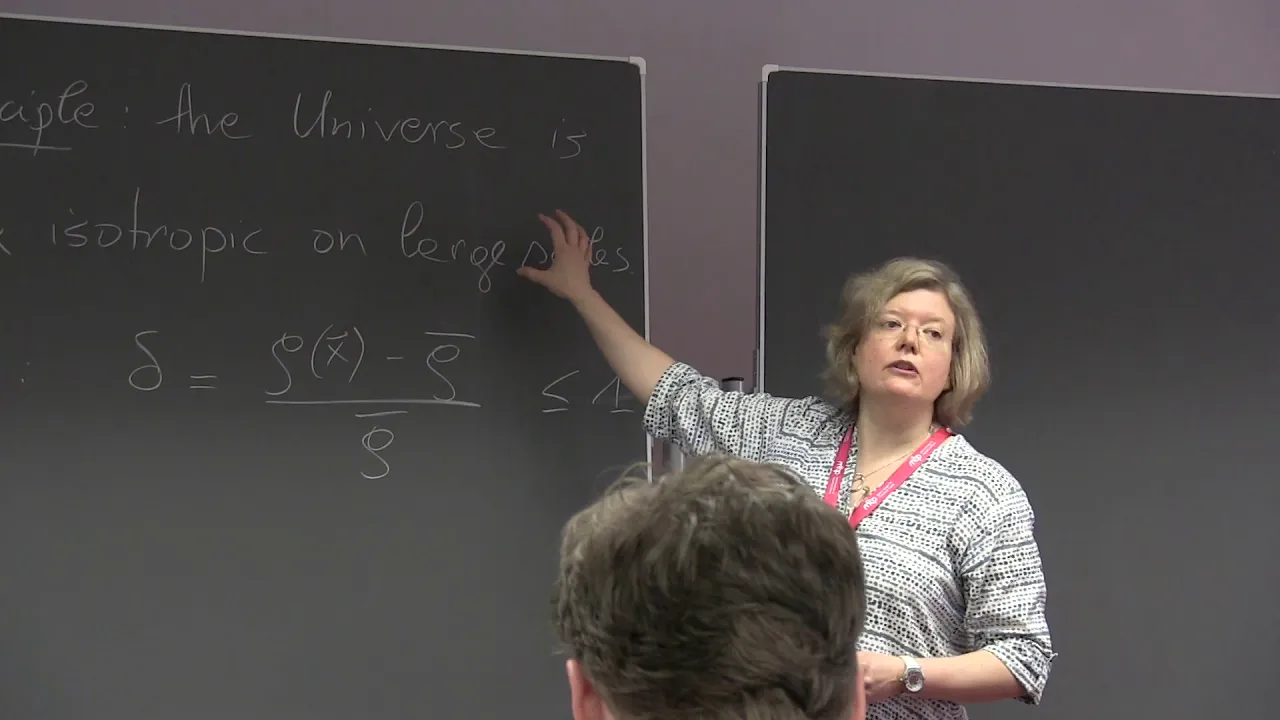
Why this video: This academic lecture establishes the mathematical foundations of modern cosmology. It introduces the Friedmann-Robertson-Walker (FRW) metric, showing how the scale factor and spatial curvature govern the expansion of the universe. This provides the essential relativistic framework required to understand redshift () as a dynamic coordinate of time and scale.
Knowledge Checkpoint
- Understand the mathematical definition of the cosmological scale factor and how it relates to redshift ().
- Derive the Hubble parameter in terms of the scale factor.
- Define the cosmological principle of homogeneity and isotropy.

Why this video: This video provides a visual and conceptual overview of recombination—the era when the hot, ionized plasma of the early universe cooled sufficiently for protons and electrons to combine into neutral hydrogen, releasing the Cosmic Microwave Background (CMB) photons. It details the transition from an opaque electron-scattered medium to a transparent universe.
Knowledge Checkpoint
- Describe the physical state of the universe before recombination and explain why photons could not travel freely.
- Explain the temperature drop (down to ~3000 K) that allowed the formation of stable neutral hydrogen.
- Explain how cosmic expansion stretched these 3000 K photons into the microwave spectrum observed today.
Why this video: This video bridges the gap between the release of the CMB and the ignition of the first stars. It outlines the "Dark Ages"—a period lasting hundreds of millions of years where the universe was filled with cold, neutral hydrogen gas and lacked any localized light sources, setting the stage for the Cosmic Dawn.
Knowledge Checkpoint
- Identify the duration of the Cosmic Dark Ages (approximately from to ).
- Explain why standard optical instruments cannot directly view structures within the Dark Ages.
- Discuss the role of dark matter gravitational wells in pulling in neutral hydrogen to form the earliest protostellar structures.
Module 2: Population III Stars & Cosmic Dawn
Explore the formation, composition, and physical properties of the universe's first generation of stars (Population III) and how they brought about the Cosmic Dawn.
Recommended Videos

Why this video: This academic lecture provides a rigorous thermodynamic and chemical analysis of how the first stars formed without heavy metals. Because carbon and oxygen were not present to cool gas clouds via fine-structure line emission, these stars relied entirely on molecular hydrogen () chemistry. This limits cooling to ~200 K, which explains the high Jeans mass and massive nature of Population III stars.
Knowledge Checkpoint
- Explain why the absence of metals (elements heavier than Helium) prevents efficient gas cooling below 200 Kelvin.
- Describe the role of (molecular hydrogen) chemistry in the thermodynamics of primordial gas collapse.
- Detail why the Jeans mass of a collapsing cloud is significantly larger in a metal-free environment compared to modern star-forming regions.
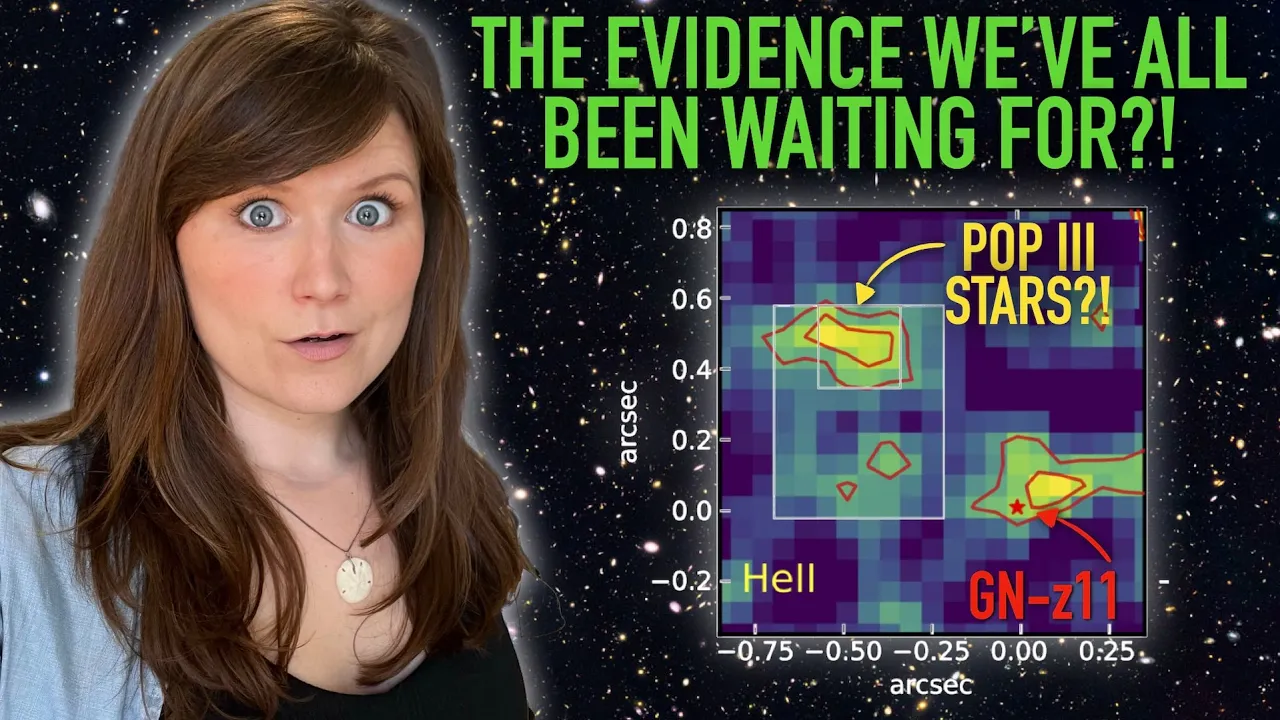
Why this video: This video covers the observational side of the hunt for Population III stars, focusing on the James Webb Space Telescope (JWST). It explains the observational signatures of these stars, such as the strong Helium II emission line without accompanying metal lines, and analyzes recent high-redshift galaxy candidates.
Knowledge Checkpoint
- Identify the primary spectroscopic marker (e.g., strong He II emission with no metal lines) used to detect Pop III stellar populations.
- Explain how gravitational lensing assists telescopes like JWST in observing these highly redshifted, ancient systems.
- Contrast Pop III stars with Pop II and Pop I stars in terms of metallicity and typical mass scales.
Module 3: Physical Mechanisms of Reionization
Examine how ionizing ultraviolet radiation from early stars, galaxies, and quasars interacted with the neutral hydrogen in the Intergalactic Medium (IGM) to ionize the universe.
Recommended Videos

Why this video: This deep-dive pod-lecture provides an excellent conceptual framework for the Epoch of Reionization (EoR). It details the phase transition of the Intergalactic Medium (IGM) from a completely neutral state to a highly ionized state, driven by the emergence of the first stars and galaxies clearing the "cosmic fog."
Knowledge Checkpoint
- Explain the distinction between recombination (Module 1) and reionization (Module 3) as phase transitions.
- Describe the process of "bubble growth," where individual galaxies create localized spheres of ionized hydrogen ( regions) that eventually overlap.
- Understand the timescale over which reionization occurred (roughly from down to ).
Why this video: Understanding reionization requires understanding the medium being ionized: the Intergalactic Medium (IGM). This video explores where the ordinary baryonic matter in our universe lives, demonstrating that over half of it is distributed outside of galaxies in a highly diffuse, ionized plasma state within the IGM (specifically the Warm-Hot Intergalactic Medium, or WHIM).
Knowledge Checkpoint
- Define the Intergalactic Medium (IGM) and explain why most of the universe's baryonic matter resides outside of galaxies.
- Describe the WHIM (Warm-Hot Intergalactic Medium) and the techniques used to detect diffuse intergalactic gas.
- Connect the low density of the IGM to the long recombination timescales of hydrogen atoms once ionized.

Why this video: This video evaluates the role of active galactic nuclei (AGN) and supermassive black holes in driving cosmic reionization. While massive stars in early galaxies supplied the bulk of UV photons, high-energy X-ray and UV radiation from accretion disks around early supermassive black holes (quasars) significantly altered the thermal and ionization state of the surrounding IGM.
Knowledge Checkpoint
- Compare the ionizing contributions of early stellar populations (soft UV photons) with active galactic nuclei/quasars (hard UV and X-ray photons).
- Understand how X-rays can penetrate deeper into neutral gas clouds due to their lower cross-section compared to extreme UV photons.
- Explain how feedback from early supermassive black holes can suppress star formation in dwarf galaxies.
Module 4: Mapping the EoR with the Cosmic 21-Centimeter Line
Learn the quantum mechanics behind the 21-cm spin-flip transition of neutral hydrogen and how astronomers use it as a highly sensitive probe to map the Epoch of Reionization.
Recommended Videos

Why this video: This video directly addresses the basic physics gap identified in the review feedback. It provides a derivation of the 21cm hyperfine transition. It explains the quantum mechanical interaction between the magnetic dipoles of the proton and electron, showing how a transition from parallel to anti-parallel alignment releases a radio photon (, ).
Parallel Spins (Higher Energy) Anti-Parallel Spins (Lower Energy) [Proton] [Electron] [Proton] [Electron] (↑) (↑) (↑) (↓) _/ _/ | | +------------------> releases 21cm <----+ photon (1420 MHz)
Knowledge Checkpoint
- Explain the quantum mechanics behind the hyperfine spin-flip transition of neutral hydrogen.
- Calculate the energy difference () associated with this transition.
- Explain why this transition is highly forbidden (low transition probability ) yet remains easily detectable on cosmic scales.
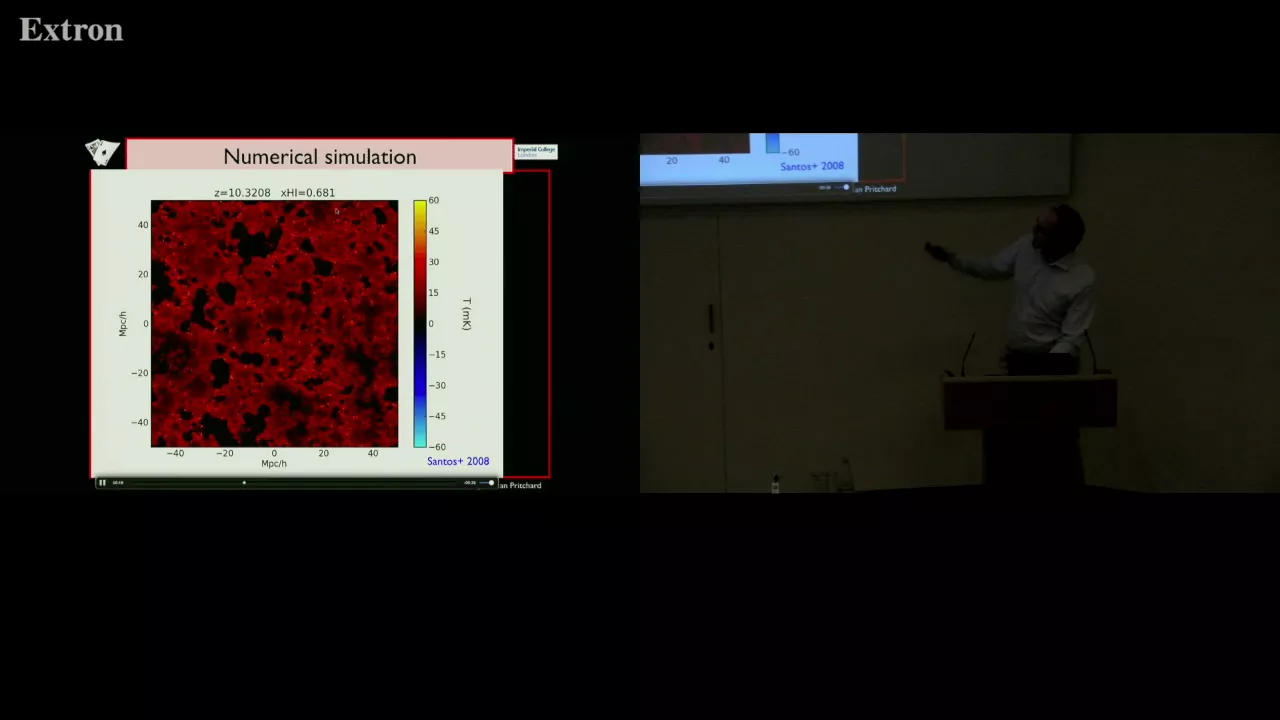
Why this video: This lecture details the mathematical formulation of 21cm cosmology. It introduces the spin temperature , the CMB background temperature , and how their relative values dictate whether the 21cm signal is seen in absorption or emission. It links these variations to the Wouthuysen-Field effect and early heating.
Knowledge Checkpoint
- Define "spin temperature" () and explain how it determines whether the 21cm line is observed in emission () or absorption ().
- Describe the Wouthuysen-Field effect and explain how Lyman-alpha photons couple the spin temperature to the kinetic temperature of the gas.
- Identify how the 21-cm brightness temperature contrast () evolves through the Dark Ages, Cosmic Dawn, and the Epoch of Reionization.
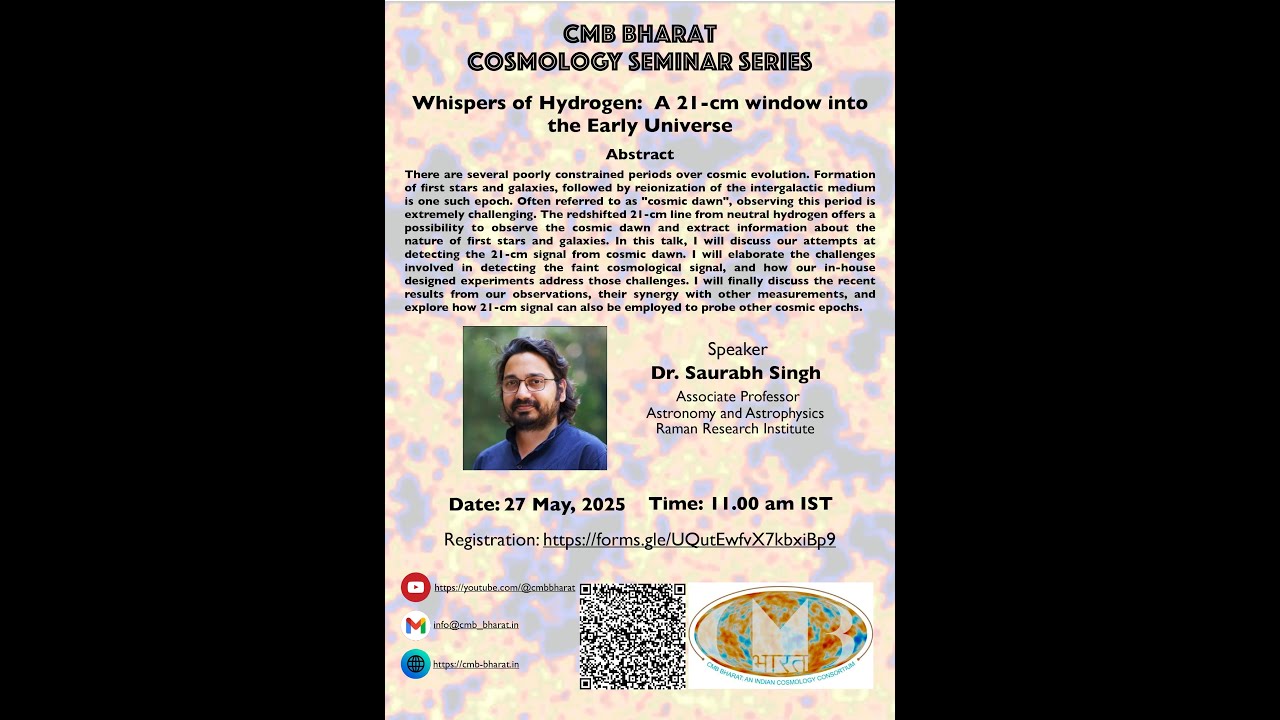
Why this video: This talk focuses on how cosmic expansion stretches the 21-cm signal to lower frequencies. By observing at different radio frequencies (e.g., 50–200 MHz), astronomers can trace the line-of-sight evolution of neutral hydrogen. This technique acts like a tomographic slice through cosmic time, mapping the three-dimensional structures of reionization.
Knowledge Checkpoint
- Map observed radio frequencies to cosmic redshifts using the formula .
- Explain how 3D tomography of the early universe is achieved by scanning across a range of radio frequencies.
- Describe the observational challenge of isolating the weak cosmic 21cm signal from bright galactic and extragalactic foregrounds.
Module 5: Lyman-Alpha Emitters & Next-Gen Observatories
Investigate how high-redshift Lyman-alpha emitting galaxies are used to trace the progression of reionization, and explore current/future telescopes like JWST and the SKA.
Recommended Videos

Why this video: This video addresses the Lyman-alpha forest gap identified in the review feedback. It provides an introductory, non-technical to semi-technical explanation of how neutral hydrogen clouds along the line of sight absorb Lyman-alpha photons from distant background quasars. This absorption creates a dense "forest" of redshifted lines, mapping out the distribution of neutral gas.
   [ Distant Quasar ]
           |   Lyman-Alpha photon emitted at 121.6 nm
           v
 ( Cloud 1: z=5.5 ) ----> Absorbs at local Ly-alpha wavelength
           v
 ( Cloud 2: z=4.0 ) ----> Absorbs at a different redshifted wavelength
           v
   [ Earth Telescope ] ---> Records "Forest" of absorption lines in spectrum
Knowledge Checkpoint
- Explain how a single emission line (Lyman-alpha, ) turns into a "forest" of absorption lines as light passes through gas clouds at varying redshifts.
- Explain the Gunn-Peterson trough and why a fully neutral early IGM completely absorbs light shortward of the Lyman-alpha limit.
- Use the absorption density in quasar spectra to track the transition from a highly neutral IGM to a fully reionized IGM at .
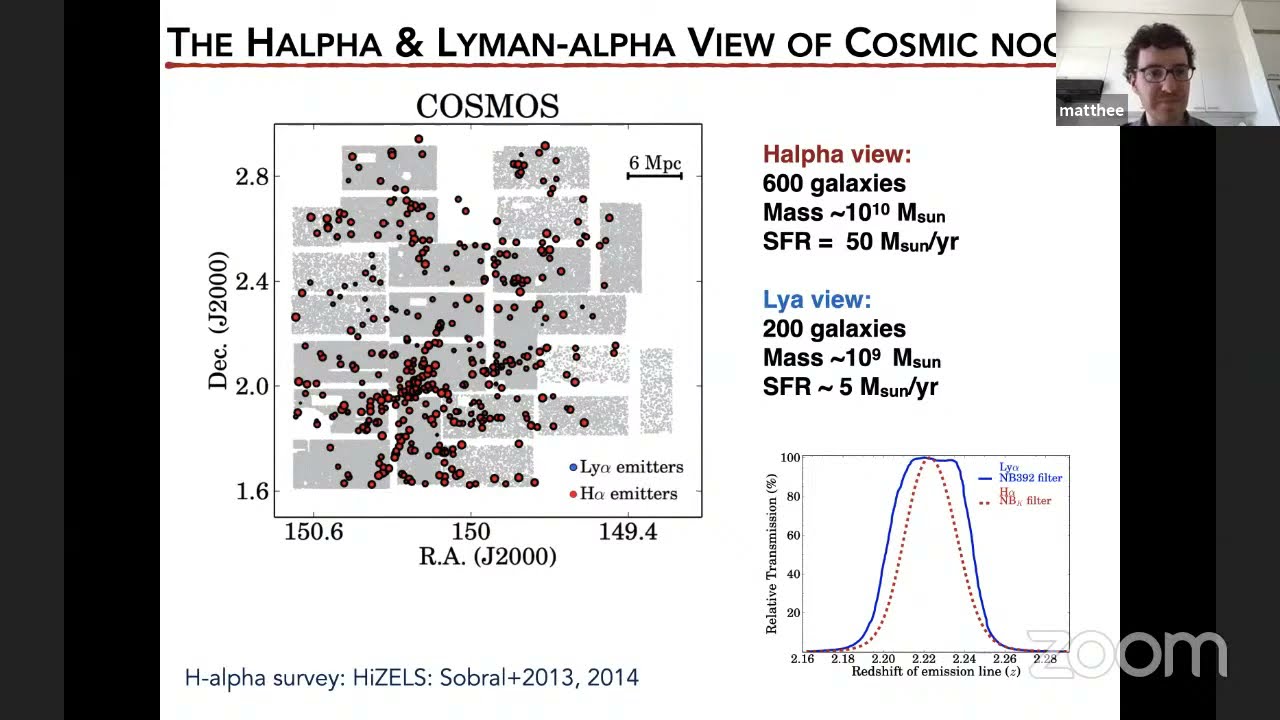
Why this video: This academic summary explains how Lyman-alpha emitting (LAE) galaxies are selected and categorized using narrow-band imaging. During reionization, Lyman-alpha photons are heavily scattered by surrounding neutral hydrogen. This means detecting these galaxies can help map the boundaries and sizes of the ionized bubbles that formed around early star clusters.
Knowledge Checkpoint
- Explain how Lyman-alpha resonant scattering in neutral hydrogen prevents Lyman-alpha photons from escaping early galaxies.
- Describe how the visibility of Lyman-alpha Emitting (LAE) galaxies drops as redshift increases into the neutral epoch.
- Detail how the spatial clustering of detected LAEs highlights the geometry of the first ionized bubbles.
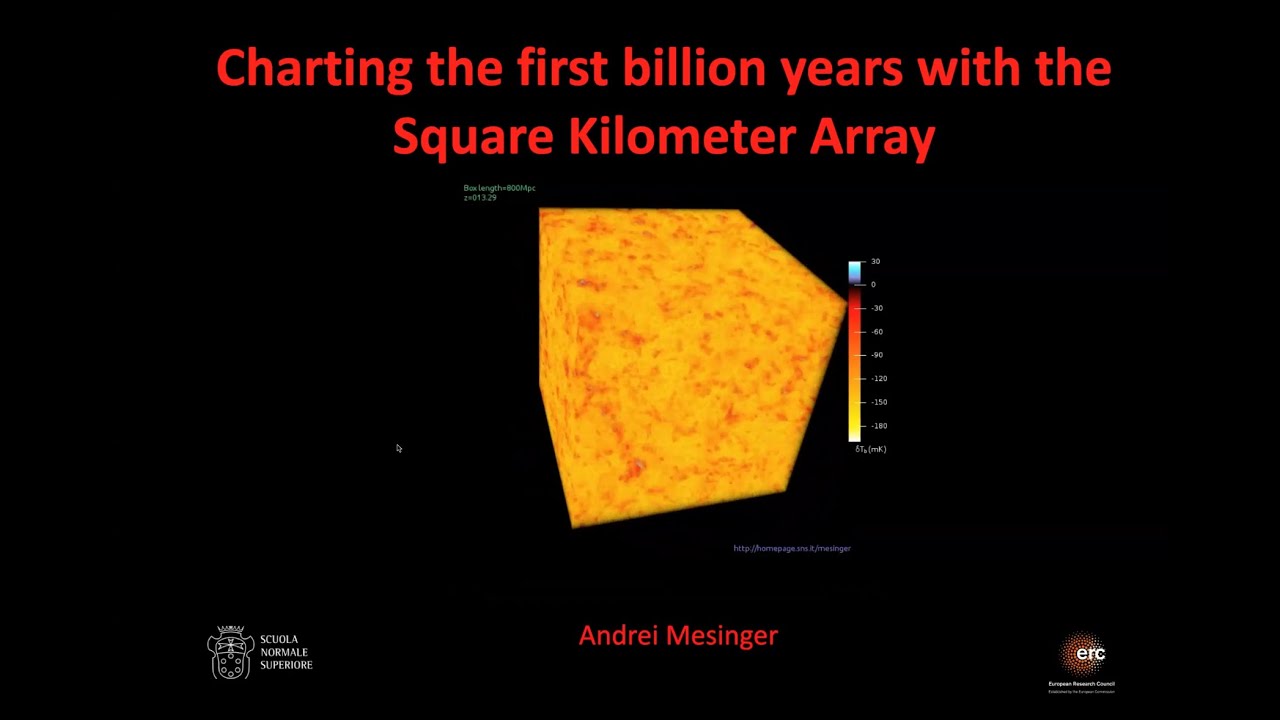
Why this video: This lecture discusses the instrumental frontier of cosmic reionization. It explores how the Square Kilometre Array (SKA)—a giant next-generation radio interferometer—will achieve the sensitivity, angular resolution, and frequency coverage needed to map the redshifted 21-cm signal. This will allow researchers to test different models of reionization and early stellar feedback.
Knowledge Checkpoint
- Describe the design and configuration of the Square Kilometre Array (SKA-Low) for low-frequency radio astronomy.
- Understand why radio interferometry is required to resolve spatial structures in the 21cm background.
- Explain how SKA data will help distinguish between stellar-driven and black-hole-driven reionization models.

Why this video: This video presents recent JWST discoveries, showing how high-redshift spectroscopy has detected some of the earliest ionized bubbles. By identifying Lyman-alpha emission from galaxies at , JWST is mapping out the sizes of these bubbles. This has forced astronomers to revise their models of how quickly reionization progressed.
Knowledge Checkpoint
- Explain how JWST can detect Lyman-alpha emission from galaxies that existed when the surrounding universe was mostly neutral.
- Define a "reionization bubble" and describe how early galaxies cleared out transparent, ionized paths for light to escape.
- Contrast these recent JWST observations with older models that predicted reionization started much later.
Course Map
Key People Index
- Dr. Laura Covi (Göttingen University): An expert in theoretical cosmology. Her work focuses on the early universe, dark matter candidates, and the mathematical framework of the expanding cosmos.
- Dr. Paul Clark (Cardiff University / UCHiPACC): A researcher in stellar astrophysics who specializes in the thermodynamics, chemical pathways, and hydrodynamics of the universe's first generation of stars.
- Dr. Jonathan Pritchard (Imperial College London): A key figure in 21cm cosmology. His theoretical work outlines how spin-flip transitions can map cosmic structures during the Dark Ages and Reionization.
- Dr. Aaron Parsons (UC Berkeley): A radio astronomer and instrumentalist who designs radio interferometers to isolate and measure the 21cm signal from early cosmic history.
- Dr. Jorryt Matthee (ETH Zürich): An astrophysicist who uses narrow-band imaging and spectroscopy to characterize early galaxies and trace Lyman-alpha emission during the Epoch of Reionization.
- Dr. Andrei Messinger (Scuola Normale Superiore): A leading theoretical cosmologist who develops numerical simulations (like 21cmFAST) to model the intergalactic medium and coordinate science goals for the Square Kilometre Array (SKA).
Final Self-Assessment
- Explain how the universe transitioned from an ionized plasma state to a neutral state during recombination ().
- Describe the chemical and thermodynamic processes that allowed Population III stars to form without heavy elements.
- Explain why the lack of metal cooling caused Population III stars to be significantly more massive than modern stars.
- Outline the process of reionization, including how UV radiation from stars and early quasars cleared the neutral hydrogen in the IGM.
- Describe the quantum mechanical basis of the 21cm hyperfine spin-flip transition.
- Define the spin temperature () and explain how it determines whether we observe the 21cm signal in emission or absorption relative to the CMB ().
- Explain how observing different radio frequencies allows us to reconstruct a 3D tomographic map of the early universe.
- Describe how the Lyman-alpha forest in quasar spectra can be used to measure the ionization state of the IGM at different redshifts.
- Explain why Lyman-alpha photons are heavily scattered by neutral hydrogen, and how this scattering affects our ability to detect early galaxies.
- Discuss how next-generation observatories like JWST and the SKA are helping to resolve outstanding questions about the timing and physical drivers of cosmic reionization.