

![Где половина Вселенной? Вот она! [Veritasium]](https://i.ytimg.com/vi/qFnNi7RyXio/maxresdefault.jpg)














Astronomers discovered that half of the ordinary baryonic matter in the universe is located in the warm-hot intergalactic medium (WHIM), a diffuse plasma between galaxies that was previously undetectable because it doesn't absorb visible light; this discovery was made possible by analyzing the dispersion of fast radio bursts, which revealed the electron density along their paths through the WHIM.
How Fast Radio Bursts Solved the Missing Baryon Problem
Added:The definition of baryonic matter and how it differs from dark matter and dark energy in the cosmic energy budget.
The 'Missing Baryon Problem,' specifically the discrepancy between the amount of ordinary matter predicted by Big Bang nucleosynthesis and what was historically observed in the local universe.
The fundamental properties of electromagnetic radiation, particularly how radio waves propagate through ionized plasma and experience dispersion.
A basic understanding of Fast Radio Bursts (FRBs) as highly energetic, millisecond-duration radio transients originating from distant galaxies.
The Macquart Relation, which mathematically links the dispersion measure of Fast Radio Bursts to their cosmological redshift.
The physical properties of the Warm-Hot Intergalactic Medium (WHIM), where the missing baryons were ultimately located.
How FRBs are used as cosmological probes to measure the Hubble constant and study the distribution of magnetic fields in the intergalactic medium.
The role of next-generation radio telescopes, such as the Square Kilometre Array (SKA) and the Deep Synoptic Array (DSA), in detecting and localizing thousands of new FRBs.
5.2M views183.4Klikes14:09Original Release: 2020-07-31
This episode was sponsored by KiwiCo More about them at the end of the show Until recently, half the universe was missing or hidden or just... undetected And no, I'm not talking about dark matter or dark energy, which make up 27 and 68 percent of our universe, respectively.
No, I'm talking about normal ordinary matter Which makes up you and me and the planets and stars and nebulae, and basically everything you can see.
And since most of this stuff is made of protons and neutrons, which are forms of baryons, this has been known as the missing baryon problem.
We expect the universe to be made up of 5 percent baryonic matter.
But when we go looking, we only find 2.5 percent.
Now, the first question you're probably asking is "Why should we expect the universe to be 5 percent ordinary baryonic matter in the first place?"
The answer is because, with that density, we can explain the relative abundances of different elements that we observe in the universe.
Specifically, the ratio of deuterium to hydrogen to helium.
In the beginning, like right after the Big Bang, there were all of these neutrons and protons whizzing around.
It was incredibly hot, and there was tons of radiation.
The universe was radiation dominated.
But, as the universe expanded, it cooled to the point where protons and neutrons could start fusing together.
A particularly stable nucleus to form would be helium-4, made of two neutrons and two protons.
The problem was, to form helium-4, you first have to form deuterium, one proton and one neutron.
And, this is a less stable nucleus. And as quickly as it formed, it would get smashed apart.
But, by about 10 seconds after the big bang, the universe had cooled sufficiently that deuterium could form.
And as soon as it did, it would rapidly fuse into helium.
The rate at which this happened depended on the density of matter in the early universe.
The higher the density - the faster this fusion could occur.
Then, by 20 minutes after the Big Bang, the temperature had dropped low enough that fusion could no longer occur.
So, at this point, the elemental abundances were locked in.
Like a snapshot of this moment.
There were 75% hydrogen and 25% helium, by mass.
Which is basically still what we observe in the universe today.
Of the hydrogen nuclei, 26 out of every million were deuterium.
What's amazing about deuterium is that it's stable - it doesn't decay.
And there are no known processes that can produce it in significant quantities since the Big Bang.
And that means, virtually all the deuterium in the universe today, including the one out of every 6000 hydrogen atoms in tap water was created not in stars but in the first 20 minutes after the Big Bang.
When we look deep into space, the oldest light we can see is the Cosmic Microwave Background Radiation.
The afterglow of the big bang which has been traveling through the universe unimpeded since about 400,000 years after the Big Bang.
And so we can literally count up those photons and work out the density of radiation right after the Big Bang.
And using the value of 26 deuterium nuclei per million hydrogen nuclei, well, we can work out the ratio of baryonic matter to photons, and that is how we work out that there should be about five percent baryonic matter in the universe.
So in the late 1990s scientists went looking for all this baryonic matter.
It was a census of sorts.
They added up all of the planets and stars and black holes, galaxies, dust clouds, gas, basically everything you can see or infer exists using a telescope.
And what they found is that everything that I normally think of as the actual stuff in our universe, it only makes up barely 20 percent of all the baryonic matter.
So where is the rest?
Well, not all ordinary matter is glowing brightly or is illuminated by nearby stars It's not dark matter but it is ordinary matter that is just in darkness.
And so if you want to find those baryons, well, one way is to use a backlight -- a bright source of light very far away, and that also means in the very early universe.
And quasars are the perfect backlight.
Their luminosity can be thousands of times that of whole galaxies.
The light comes from the accretion disk of a supermassive black hole at the center of an early galaxy as it engulfs all this matter.
And since it is so distant the light we receive from quasars is heavily redshifted.
For example, the light emitted when a hydrogen atom goes from its first excited state to its ground state, the Lyman-alpha transition, it produces ultraviolet light of around 121.6 nanometers in a lab.
But from a quasar it can be observed as a peak in their spectrum at over 560 nanometers -- that is yellow light.
What's fascinating is if you look to the left of this peak you see many little dips.
These are absorption lines created by neutral hydrogen atoms that lie along our line of sight with the quasar.
When light from the quasar reaches neutral hydrogen the photons that can excite the electrons from the ground state to the first excited state are absorbed.
This is the same Lyman-alpha transition, but since these patches of hydrogen gas are closer to us they are less redshifted so the notches they make in the spectrum are at shorter and shorter wavelengths the closer the gas is to us.
This has been described as the Lyman-alpha forest.
It's like a one-dimensional map that shows us where and how much neutral hydrogen gas lies along the line connecting us to the quasar.
Adding all of that neutral hydrogen gas into our baryon budget brings us almost to 50 percent.
So where is the other half of the baryons?
Well, computer simulations of the entire universe suggested they are out there just in between the galaxies in these sheets or filaments and they're very spread out -- just one to ten particles per cubic meter.
Plus, these particles are ionized so they don't absorb the light like the neutral hydrogen gas.
And they're in a temperature range between about 100,000 and 10 million Kelvin, a range astronomers like to refer to as warm-hot, so this is known as the warm-hot intergalactic medium or WHIM for short.
But finding the WHIM has been a real challenge because they're ionized, because of their temperature, they only emit or absorb in the high energy UV or low energy X-rays.
Now, some people have used very sophisticated techniques to try to find the WHIM but then recently a naturally occurring physical phenomenon allowed us to find all of the missing baryons.
Let's find out how.
First we need to talk lightning and I promise this is related.
Okay so did you know that it's possible to detect lightning from the other side of the earth?
This is because lightning produces a flash of electromagnetic radiation in all parts of the spectrum.
I mean we see the white light but there's also broad spectrum radio waves which are released and if you were nearby you could detect those as a pulse.
But the very low frequency radio waves can actually travel up and out of the atmosphere and they get guided along the Earth's magnetic field lines out several radii from the Earth and then back down where they can be detected in the other hemisphere.
Except if they're detected there they don't come in as a single pulse, instead they are spread out as a whistler.
Now if you play these radio waves through a speaker we can actually hear them, so listen to this.
You hear that descending tone that sounds like a sci-fi laser gun?
Yeah, that is lightning on the other side of the earth.
So what's happening here?
Well, as the radio waves travel through the earth's magnetosphere they encounter free electrons, which slows them down and more for the lower frequency waves: this is dispersion.
Just as a prism separates white light into its component colors the plasma in the magnetosphere separates the radio waves into its component frequencies: low frequencies are slowed down more than high frequencies, so what started as a pulse ends up as a whistler.
And the amount of dispersion tells you how many free electrons that radio wave had to pass through to reach the detector.
Now just imagine we could do something very similar to find all the ionized baryons in the universe.
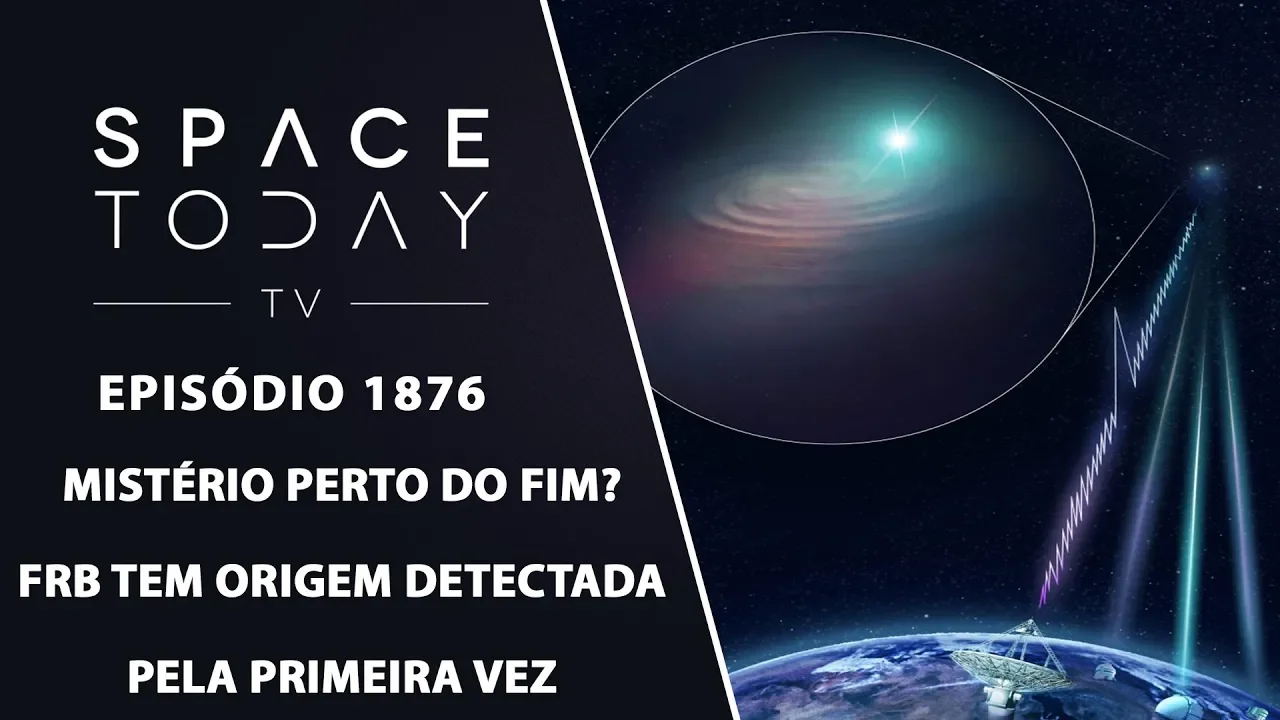
All we would need is a bright flash of radio waves somewhere in the distant universe and as if on cue in 2007 astronomers found the first fast radio burst, which is just what it sounds like: a very short-duration pulse of intense radio waves.
And it came from the deep universe, from other galaxies.
Now, these pulses can be incredibly powerful, I'm talking billions or trillions of times as powerful as the sun, but they last for on order of a millisecond.
We don't really know what creates them, though some people suspect that it's magnetars or neutron stars or some sort of collision between these very powerful massive objects like black holes and neutron stars.
But for our purposes all we need to know is that those flashes exist and that we can use them to look at their dispersion and figure out how many ionized baryons are between us and the source.
And this is exactly what one recent paper did in Nature: they plotted out the dispersion measure of several of these fast radio bursts versus the redshift of their host galaxy.
And what they found was, sure enough, the further out these fast radio bursts were the more dispersed their signal when it reached the earth.
And in fact using their measurements they were able to estimate the total baryonic matter that is out there, and that includes all the ionized particles in the WHIM, and they found that it was five percent.
They found the missing baryons. Roughly 50 percent of them are in that warm-hot intergalactic medium and so this validates what we had been thinking the whole time.
You know, what surprised me in making this video was realizing just how little of the ordinary matter from the big bang ended up in things like stars and galaxies, what I normally consider as the stuff of the universe.
No, that's only like 10 or 20 percent of all the baryonic matter.
So it turns out the formation of these interesting structures is a really inefficient process.
But this finding is yet another triumph for science.
Those computer simulations run decades ago turned out largely to be correct and so everyone involved should be congratulated.
But this also highlights for me the difference between scientists and non-scientists.
I feel like non-scientists like being right, they like when things turn out the way they were expecting, but scientists on the other hand, they want things to work out not the way they expected because that's the way we get clues into what new physics is still out there to be discovered.
I guess for now we'll have to be content with being right.
Hey, this video was sponsored by kiwiko which i'm really excited about because i've been using their monthly crates since the beginning of the year with my four-year-old, he got it as a christmas present and I've got to say they have been a great resource for learning at home.
Each crate has super cool hands-on projects that are fun to make and They expose kids to STEAM concepts: that's science technology engineering art and math now each box includes all the supplies needed meaning no extra trips to the store and kiwico offers eight subscription lines for different age groups and topics they sent me some of the older age group crates to try out and I had a lot of fun uh making this…… this is a planetarium and something you might not know is kiwico is not only a subscription service you can browse their store and purchase individual projects or value packs for different ages no subscription required so let's talk about why kiwico is so useful right now I mean anyone who has been at home with kids over the past few months knows just how important it is to get them engaged in something other than a screen the summer brain drain happens every year but it is especially challenging right now with disruptions to school and online learning just not being as good as you know in in-person hands-on learning now what I know from my own experience is my son loves making kiwico projects with me he has a lot of fun and doesn't even realize he's learning what do you see It's a star!
You know one day we will talk about the missing baryons but for right now these projects are a great way for us to connect and learn together so if you want to try it out you can get 20% off everything in the kiwico store using code: veritasium or go to kiwico.com/veritasium I'll put that link in the description so I really want to thank kiwiko for supporting me and I want to thank you for watching
Up Next

61:05
How Supermassive Black Holes Heat the Intergalactic Medium
@cfacolloquium3139
1K views•2023-04-05
61:17
First Billion Years of the Universe with the Square Kilometre Array
@iaaudc
121 views•2022-05-26
13:41
How Gravitational Lensing Predicted Supernova Refsdal
@veritasium
5.3M views•2020-10-20
6:10
Gamma-Ray Bursts: Cosmic Snipers Explained | Astronomy
@kurzgesagt
15M views•2016-07-31
Related Study Plans & Knowledge Roadmaps
Structured learning paths in Astronomy
astronomy
Reionization: Pop III Stars, IGM & 21cm Line
01Foundations of Cosmology & the Early Universe
02Population III Stars & Cosmic Dawn
03Physical Mechanisms of Reionization
+ 2 more learning modules
17h5 modules
Explore Roadmap
astronomy
Planetary Rings: Dynamics, Roche & Resonances
01Foundations of Gravity and Orbital Mechanics
02Tidal Forces and the Roche Limit
03Structure, Composition, and Collisions
+ 2 more learning modules
10h5 modules
Explore Roadmap
astronomy
Asteroseismology: Stellar Waves, Ages & Cores
01Foundations of Stellar Astrophysics & Wave Mechanics
02Stellar Oscillation Modes: P-modes and G-modes
03Mathematical Framework of Asteroseismology
+ 2 more learning modules
35h5 modules
Explore Roadmap
astronomy
Adaptive Optics: Physics, Engineering & Control
01Foundations of Wave Optics and Wavefronts
02Atmospheric Turbulence & Optical Distortion
03Wavefront Sensing Technologies
+ 3 more learning modules
35h6 modules
Explore Roadmap