






















The Square Kilometre Array (SKA) will revolutionize our understanding of the first billion years of the Universe by mapping the redshifted 21-cm line of neutral hydrogen, which encodes information about the cosmic dawn and epoch of reionization; this Bayesian, data-driven framework allows astronomers to infer properties of the first galaxies—including stellar-halo mass relations, ionizing escape fractions, X-ray luminosity to star formation rates, and contributions from Population III and II stellar populations—by forward-modeling lightcones of the early Universe and comparing them to observations, with the unprecedented size of SKA datasets enabling percent-level precision in constraining these fundamental astrophysical and cosmological parameters.
First Billion Years of the Universe with the Square Kilometre Array
Added:good morning everybody welcome again for this new colloquium at the institute of astrophysical andalucia in granada in spain and today we will have the talk by dr andrei messinger he is from escuela normally superior in pizza italy and he will talk about charting the first billion years with the square kilometer array and they will be properly introduced by dr reiner schwedel please right here thank you um so uh good morning everyone or good afternoon almost uh so many greetings from our director from anton and from isabel from the scientific director of the silver ochoa pro when both of them unfortunately cannot attend and then send their excuses and then best wishes to andre so isabel has asked me to present andrei today andrei messinger is currently an associate professor of cosmology at the scuola normale superiore in pisa he received his phd at columbia university in 2006 and subsequently held several post-doctoral fellowships for example had two postdoctoral fellowships at yale and at princeton university then he moved to the scuola normale his research was awarded a hubble prize fellowship in 2008 and an erc starting grant award in 2015.
he has written over 140 publications with an age index of 51 and edited two books his research interests are first light reorganization cosmic 21 centimeter high redshift galaxies modeling techniques machine learning and bayesian interference he's deeply involved in current efforts to detect the cosmic 21 centimeter signal and is the current co-chair of the epoch of reionization and cosmic dawn science working group for the square kilometer array as well as being an executive board member of the hydrogen epoch of reionization array collaboration and today will talk to us about charting the first billion years of our universe with the square kilometer array andre it's a pleasure to have you as a weblokian speaker and here's all to you now thank you thank you very much for that wonderful introduction it's a pleasure to to be here virtually be here uh and uh it's a shame i couldn't be there in person but but hopefully we i will we will rectify that uh soon and i look forward to to visiting and chatting with you uh in person in the near future so today um uh i i will indeed be talking about uh this this new potential the the the gold mine the physics gold mine that will be uh the square kilometer array and i'll get to why uh that will be and what we can can learn uh in a minute and the goal of my talk is mostly to get people excited get people interested in in what will really be a game-changing uh revolution uh in this field so before oops before uh um i get to that i'll just do a brief introduction about what do i mean the first billion years what does that accomplish so um i'm sure you're all familiar with the cmb the cmb is currently the gold standard for for one of the gold standards for cosmology uh providing us with a measurement of the acoustic that the baryonic fluctuations uh at ratchets of 1100 or so uh which which allows us to do precision cosmology one of the tools that allows us to do purchasing cosmology following uh the the last scattering surface following recombination though these baryons were allowed to to uh collapse under under gravity they uh feel the potential wells that are that have been established by uh dark matter and so they condense into uh ever increasing uh uh structure of increasing densities and eventually and this is the period called the dark ages the the the seeds of structure that have formed uh as these variants are now allowed to uh feel the influence of gravity um eventually the end result of this process is the formation of the first stars the first galaxy the first stellar black holes and we call this pier the cosmic dawn when the first star is lit up their light spread out throughout the universe in various wavelengths as i'll touch uh later on um and and eventually they they established cosmic radiation field they this light in influence not only uh the intergalactic medium where most of the the matter resides but also um through to feedback processes influenced subsequent star formation inside uh inside halos in galaxies and this period of cosmic dawn culminated in the last major phase change of our universe which is the epicopyanization where virtually every uh baryon in the universe was was ionized and that we think ends at a righteous of about uh five to six um and finally after that we have the more the the buildup of more and more complex structures more and more massive structures uh clusters of galaxies and and the zoo of galaxies that we see today and so the first billion years is this is this epoch here that encompasses the dark ages uh cause mcdonald immunization it's mostly the cosmic dawn and realization i thought i'll show in a minute so you can say well okay what do we know uh what's the current status about uh our knowledge for the first billion years what do we know about the igem and the galaxies that formed during this time well we know we know we have some indications of this and this is really driven by observational progress in the past decade or so and we're now kind of getting a handle on the timing of the process of realization and we are this is a plot of the the mean neutral fraction as a function of redshift from one of the latest compendium of constraints and you can see the kind of the midpoint of randomization we estimate to be roughly seven seven point five depending on what probes we use and this is this is still um this is a very uh recent as i said uh development although we still don't really understand the uh the very beginning stages and we're starting to get a handle on the the end stages but we have a we have a an overall picture you can ask the analogous thing about what we know about the heating history right gas has an ionization state but it'll you have a temperature and this is a similar plot showing the mean temperature that while temperature and mean density as a function of redshift so after um recombination the the baryons were thermally coupled to the cmb through it will come from scattering but then as the universe expanded the baryons are allowed to cool adiabatically become colder than cmd and then when the first stars form actually the first x-ray binary stars form their x-rays have long been prepared and they're able to permeate the ign and i'll get to that also in a minute uh and these x-rays can relatively efficiently heat the the diffuse igm bringing the temperatures up to maybe uh a hundred thousand kelvin we don't know um before the bulk of of reunionization happens don't take these red chips too seriously this is just an old preliminary estimate and and realization then uh heats the gas to something like 10 to the four kelvin um keeping it there in photoionization equilibrium uh eventually quasars uh heat uh doubly ionized helium which deposits another another uh a boost in energy um but the important thing to note is that that we have only observations at relatively low redshifts uh the red these the observations that come primarily from the lyman alpha force are really only telling us about the late universe the the post-wretched five universe um the the early earlier evolution will be uh pro by 21 centimeter and i'll get to that in a minute so we have these kind of rough ideas uh of of mean evolutions of of the properties of the gas in the universe but we really have scratched the surface of this really that this is this uh these periods the first design years are actually the the bulk of our light home the bulk of our zero universe and this is a figure adopted for from uh professor chang um and and it's actually drawn to scale so that so that the surface areas that you see in these rings correspond to the relative volumes that are probed in these redshift annulments and so you can see that the period in the first 10 years above red five or so is the bulk of our universe and we and can we really are those two lines that i showed really the most that we can get uh from the most of our universe um you know we are we're well it's like we're living in this house and we've seen you know the the wallpaper on the walls we see our immediate surroundings but then we don't see the majority of the house it's in darkness like are we comfortable with that i i would say no i think that we this is an untapped uh frontier and it's inevitable because again it's the bulk of our universe so it contains many very uh fundamental questions that we have about the birth of the first galaxies um how do they impact each other their surroundings the dominant feedback mechanisms that i said uh also dark matter properties dark matter provides essentially the scaffolding for the galaxies to grow and so and so you know we can we can learn about the properties of dark matter uh from how galaxies evolve uh and also in certain models as they'll show in a minute uh that you know dark matter can also deposit heat directly into the eye gem through through annihilation um we can look at other cosmological probes how does the hubble parameter for example evolve during these epochs we can study the properties of the first stars the first flag holds many many many more questions and so as i said we're starting to scratch the surface um and then the first the simplest thing you can do if you look at the these first galaxies that fit in this in this first billion years is to do a census and so you use the hubble code to to study the fields and then you do you count galaxies essentially at different redshifts and so after you do that you get these uv luminosity functions which are basically just a histogram of how many galaxies per volume you find in a given uh magnitude bin so in in towards the the the right uh our painter galaxy so the deeper you go the more you integrate the fainter light the more galaxies you find and if you do just a simple estimate about where do you think this trend will stop you realize that we're really seeing just the proverbial tip of the iceberg here right so we expect the galaxies to sit at least uh down to the atomic hydrogen cooling threshold uh which should be somewhere around here even before that molecular cooling can cool gas and we'll have a lot of reform stars and even fainter objects uh down here and so we're missing the vast majority of galaxies and and we will also you know jwc is a powerful instrument but but it won't help us get through the bulk of the population of galaxies it will just improve our current limits by something like one to two or four uh magnitudes um and so it's really you know the analogous thing you can think of is if you were if you were an alien and you were trying to learn about humans and the only thing you could see are the wealthiest uh humans in existence and so you could you could make some inferences you could you could you know postulate that okay humans have a head on average they have you know two arms two legs uh but you would obviously miss a lot of the a lot of the uh interesting nuances you might uh incorrectly presume that that most humans are are rich white uh uh males you you would miss races you miss genders you would miss professions businessmen uh you would miss you would miss uh a lot of a lot of the details about the bulk of the population from this biased sample that you're getting and so really you know studying these faint galaxies um we need another way to do it so the route towards progress well we can continue learning about the the physics of the brightest galaxies of jupiter's galaxy that we see using jwst using armor of the telescopes we can continue working on probes of ionization kind of narrowing down our uncertainties systematic to get the mean realization history you know this curve of the neutral fraction versus friendship but really the transformation the transformative revolution will come from mapping this volume mapping this first billion years using the 21 centimeter signal and from these maps we can indirectly infer uh uh the bulk properties of the of the whole galaxy population um okay so what is this 21 centimeter line briefly uh the 21 centimeter line is the spin flip transition of neutral hydrogen uh the in the ground space the aligned triplet spin is is uh has a higher energy than the anti-line spin and and this energy difference corresponds to a photon of wavelength 21 centimeters and so it was discovered uh theoretically in 1944 and has been used subsequently to map beautiful kinematics of neutral gas in our galaxy in nearby galaxies as you see here but before realization our entire universe was filled with neutral hydrogen and so how to apply this cosmologically you you basically use the cmd as as a backlight and you you measure the difference in intensities of the cmd and the h1 and this is in the rest frame 21 centimeter so it's in the rayleigh gene tail so so you typically write this in terms of a brightness temperature because the brightness temperature is proportional to the intensity and so the cmb protons travel through the universe and they interact with the neutral gas and as a result we see this we have this this we hope to see something like this then this will be the unveiling of of uh essentially the the our our hubble volume um and if you look closely take a you know take a a slice through this uh sphere uh and you zoom in this is what it looks like so on on the vertical axis you can think of that as a as an angular scale on the on the sky and for reference this is the moon so this is something like um eight and a half degrees on the sky and on the horizontal axis i'm showing right just going from right to 5.5 to 24.
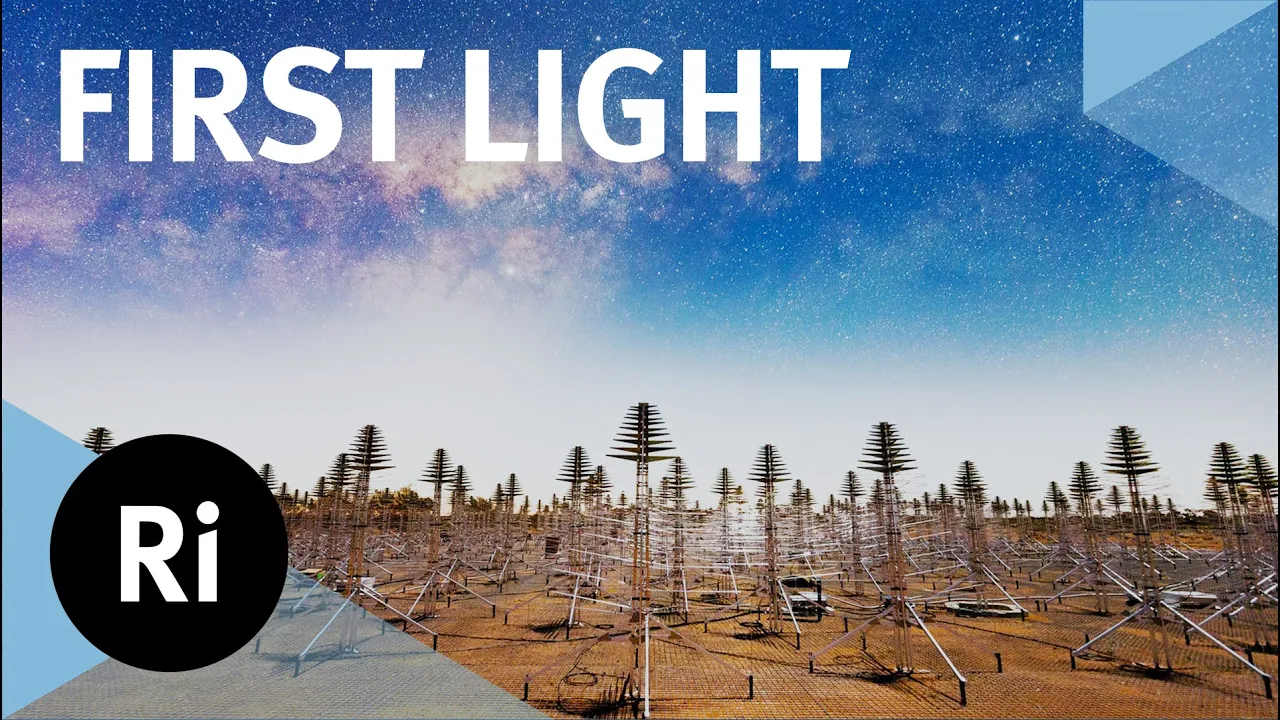
and so you can you can the thing that's striking is the beautiful dynamic range of this image um and the wealth of structures that are encoded in this so as we go from earlier times we have these dark ages that i mentioned but then as the first stars form you can see how the patterns are where that where these galaxies are located drive these patterns in in the 21 centimeter field even at very early times and as i mentioned before here the gas is adiabatically cool and so this like it's seen in absorption against the cmb um and then when the x-rays heat the gas as i mentioned before the the signal changes from absorption to emission during this uh transition here um which is commonly called the epoch of x-ray heating or the epoch of heating and then finally the epoch organization removes the signal as the universe becomes binary and so this this this wealth this dynamic range is really uh if you expand out the signal you can see it's driven by the fact that the signal depends on various turns it depends on the neutral fraction it depends on the matter density it depends on the temperature of the gas so it has both astrophysical and cosmological terms making it a very physics physics-rich probe so how do we use this information to learn about these unseen galaxies well taking the neutral fraction for example this allows us to learn about the ionizing properties the uv ionizing properties of the galaxy and if you look for uh at a very simple example of two extremes where you have a model um these are from early realization uh numerical simulations we have a model that has an abundant population of paint galaxies and here the ionized regions are white and the neutral regions are are black versus just rare bright galaxies basically the galaxies that we see you can see the ionization morphology is very different here there are many many more high-energy sources and so you have a lot more smaller regions as the h2 regions grow around these uh more abundant uh more uniformly distributed galaxy population so even at the same stage in realization the the the morphology is different um but there's also a temperature term so you can do the same thing using the temperature term and so you can look at different heating mechanisms and probe the x-ray properties that are responsible for heating the gas and so if you do very simple estimates you you realize that x-ray binaries are likely the dominant heating source at high rates of low red chips we we know that agn dominates the x-ray background but as you go to higher and higher edges something around at just five or six depending on your estimate agn become increasingly rare and the dominant population that sets the extra background are x-ray binary stars these are stars that that grow up in binaries and and one of them is a compact object and it then accretes uh a gas from a massive companion and emits an x-rays and so if you take two scds that you can imagine we don't really know the lcds very well of these objects and if the std is hard so that it has more um harder higher energy photons these photons have a longer magnifique path and so you can see that they would heat the igm more uniformly this is a temperature distribution if you assume a hard std versus a soft suv you can see that the patterns here in the hard case are more washed out these differences are detectable which means that we should be able to also learn about the the shape of the std of these first galaxies indirectly because we're not going to be able to see them um so there's a lot of wealth that that is encoded in this about the first galaxies the the patterns and the timing of this this map tells us about these properties but it's also a hugely data rich probe and that's something that really us in the field we haven't gotten comfortable with yet we're not used to thinking about that we're we're used to being data starved in c1 one quasar and you get really really excited but this is going to be a 3d signal with many orders of magnitude more independent modes than than for example in the cmb which is currently the gold standard in cosmology um so so it's going to really uh drive a big data revolution in the field um and so how do you take advantage of this later big data revolution well the obvious thing if you can do it is to is the forward model uh uh forward model the the signal and then compare your models to the observation and so this is something that i've spent the last 10 years working towards and the the goal is to have something like this this is a mock observation again it's a it's just a 2d slice through this kind of cosmic light cone with red shift increasing along this direction um it's it's it's a mock observation so it's not we don't have a real observation yet but eventually we'll have a map and then you need to characterize this observation using some summary statistic and that's a whole other genre of my research because there's no obvious choice of summary statistic because it's a non-gaussian path so if it were gaussian like the cmv you can do a power spectrum analysis and not lose information this is this is somewhat non-gaussian so there might be better summary statistics but still the power spectrum is still an obvious choice and then you can take the cycle cut it into chunks you compute in each chunk a power spectrum and that's what's shown here these are increasing redshifts the power spectrum computed from the mach observation and then we put estimate some noise this is a thousand hours noise from in this case it was from the hera telescope um and then we excise modes also at large scales that we expect are dominated by by foregrounds from our galaxy so from this mock observation you can also combine it with other observations because this is not the only piece of the puzzle we also have the uv luminosity functions that i mentioned at the beginning this is actual data that we have in hand we also have estimates of the optical depth uh to the cmb or um and so that that tells us about the integral constraint of ionization you combine these pieces to do inference and so by and forward model and so what that means is you sample the parameters uh that govern the astrophysics of your galaxies that cover physical cosmology as well as any residual systematic and you create realizations of the data and for each realization you compare with the observation and so i have a movie here that shows this that starts from some some initial sampling this uses the emt uh sampler and you can see just a random sample from from the the current uh change shown here with the corresponding power spectrum here um and the and the uh life uh luminosity functions shown here and so you can see as as this mcmc evolves you can see uh the the posterior is starting to converge uh it's bringing up the samples to converge on the observation you can see visually in this case the seed was chosen so visually you can compare against the mock but in practice we use different cosmological seeds when we do this and you can see that at the end we recover um our galaxy parameters here um to very high precision percent level precision so this is this is what we need to what we need to actually do this that i mentioned this is the goal well there are several pieces for this obviously you need sufficient simulations uh by efficient you mean you need to call it uh hundreds of thousands of times however many you need for for for your estimate to converge to converge uh and there needs to be parameterized in some way so that you have a parametric uh model for the cosmology uh galaxy physics and systematics obviously you need observations because you need to compare your theories to the observations and you need a quantitative weighing way of comparing that and there's really only one uh quantitative way which is the basic one let's say rigorous way of doing that which is the basis so let me go through these these kind of steps uh so first we need to simulate the universe the problem with simulating the first billion years is that there's a huge range of scales involved so ultimately we want to learn about the first stars the first black holes from cosmic radiation fields and these are in homogeneous on scales of 100 megaparsec 10 cents 100 megaparsecs but ultimately they're driven by by small-scale structure clumps and and stars and galaxies so we need a sub-grid approach uh and and we do this by uh cutting off the scales such that on linear and quasi-linear scales we can simulate things more or less directly the density field and velocity fields are simulated with a higher order perturbation theory and then we have uh prescriptions for quick radiation field simulation and then the galaxy uh the galaxies and the clumps are simulated using a subgrid a so this the parametrize that we use is is called 20 centimeter fast um it's it's something that i started developing uh when i was a postdoc um but the using these kind of approximate prescriptions were able to address dramatically cut the computational cost of large-scale simulations um at the at the expense of a modest loss in accuracy so here on the left you see uh the amok 21 centimeter image from a high dynamic plus radio transfer simulation and here you see the same using the same initial conditions from 21 centimeters fast and you can see on large scales and we quantify this in the paper uh something like above one megaparsec the the the two are are converged the power spectra for example are converged to within a 20 or so but the dramatic thing is that here you have uh uh something like eight orders of magnitude drop in computational cost in these two things which means that you can use this for one of these you can you can run ten to the eight of these and actually map out the parameter space of uncertainties it's been widely used uh around the world it's being used to interpret data from all 21 centimeter experiments it's a public code so if you're interested you can go on github and find it the reason why simulating 21 centimeter signal itself is especially challenging compared to other probes is precisely because it is a physics-rich probe it encodes a lot of physics and so you start with the density and the the matter field which contains uh galaxies and here i show these lycone slices but they're inverted so that the redshift increases along this direction you can see structures forming the cosmic rays forming as time increases and these galaxies that sit in this matter field they drive radiation backgrounds and one needs to follow various radiation backgrounds ionizing to organization x-rays for heating lima warner lyman alpha and these radiation backgrounds then impact the subsequent formation of galaxies through feedback mechanisms um and in in ionizing protons for example to keep the gas making it more difficult for gas to cool and collapse onto onto dark matter halos but also the photons in the line of warner band the soft ub band disassociate molecular hydrogen which which removes the cooling mechanism for the very first galaxy that makes it more difficult for the various the first galaxies to form stars um and so you can see then at the end the the these radiation backgrounds really leads to uh the 21 centimeter signal that looks like what i've showed before but but you can see from this that that at different times of uh a different epoch cosmic epochs the structures here are driven by different fields here which which is really the the power of this approach you can see the fluctuations right around by the ionization fields here here you can see they're driven by by the the first the very first galaxies uh the densities and so you can see the the reason why this is such as a physics rich probably so the dynamic range is so large um just to illustrate this uh even further this is a movie from this evolution of 2010 structure progress which is an ultra large scale public realization a 1.5 gigaparsec uh in size and and just to put that in context uh this roughly corresponds to the size of the uh state-of-the-art uh hydrodynamic plus rt simulation um so we can we're able to reach much much larger scale and here i show the movie uh evolving uh from redshift 35 you can see the global 21 centimeter signal here you can see that the power spectrum in the above panel as structures form as they heat the ibm and as they then ionize the ign removing the signal and so then you can ask well okay you talk about these galaxies in a kind of abstract way uh what galaxy parametrization are using well i think there's two things to keep in mind uh uh there is no singular galaxy parametrization that that that is the right one um however uh you're you're aided by a couple of things one is that this is a bayesian framework so you can you can change your galaxy parameterization you want look at like something like the basic evidence to see which is which is uh favored by the data but then the other thing is that the observable signal is actually sourced on relatively large scales so if i look at one of these like cones with red shifts increasing in this direction and i look at the slice through this this is is now simulating the resolution of a single frequency slice so this is uh on sky size using noise as well as as foreground excursions so this is kind of a pessimistic uh model but you can still see that the fluctuations that remain there are fluctuations they constrain a lot of our physics but there you lose the small scale structure you lose structure on on scales below 10 megapixels or so and what this means is that that each of these fluctuations is sourced by uh tens maybe even hundreds of galaxies which means that you can use scaling relations if you don't have to model individual galaxies you can use ensemble averages whenever you ensemble average something that has a characteristic mean you you have to get using a central limit there you have to get log normal distributions and so that's shown here this is this is a a very flexible parametrization very simple parameterization of uh astrophysics where we take a power law for the stellar to halo mass relations and in fact that is what observations see that that there is a power law uh that has a free parameter which is the the amplitude and the scaling we also take a characteristic star formation time scale which scales with the dynamical time of the galaxies we allow the ionizing escape fraction to again be a power law with a halo mass and then on small scales we account for the fact that galaxies have difficulty in cooling uh and forming stars below certain halo mass with a characteristic turnover and you can see that these uh parameters some of them are already constrained by current observations like venocity functions you you can't have expelled halo mass relations that are too steep but then others like the state fraction uh are only poorly constrained well at least using this data and and the small the faint and turnover is not constrained at all um and these kind of scaling relations are just a natural product as i said of of population averaging and they you can these kind of models can characterize very different simulations they all are reasonably characterized by this this is from a hydrodynamical simulation using very different parameters for star formation also semi-analytic models they result in these these power law relations some observations using abundance matching they seem to follow these trends we also need to characterize the x-ray properties uh and this is we do this using the the actual luminosity the star formation rate relation and this is the expected fcd from a theoretical model and so we have parameters that characterize the luminosity and the shape of this std and uh and the self-absorption by the galaxy um and so you can see as again some of these parameters are already constrained uh others not so much especially for example x-ray parameters as you as whoops the current observations don't constrain the x-ray parameters at all i don't know why this is not moving yeah whatever but the 21 centimeter signal shown above will that's the impact stronger so these are the simulations um what are the observations i showed a a uh an example using a mock observation um but actually we we do have some observations currently in hand unfortunately we only have upper limits this is the compendium of the currently available upper limits uh from from first generation telescopes like mwa lopar and hera and you can see that the limits this is the expected signal this is the power spectrum as a function of redshift you can see the upper limits are still several orders of magnitude away from where we think the signal lies but we are now starting to get as time progresses these become lower and lower as we understand the systematics better um and in particular i'm going to talk about these two lowest limits that we got recently in pink and they were obtained by this sk precursor instrument called the hydrogen apocalyptic array uh it is it is built in south africa this is an actual satellite image it's not a not a mock it's fully built it's rolled out since it's it's doing observations using a sub sample of antennas as as more and more uh antennas are able to be better characterized and understood uh so it's progressing well and so last year the the collaboration uh we published a a a first uh results using about ten percent of the antennas and using just uh 18 night of observations using four fields shown here the drift scan telescope so the sky falls above you and you measure and these are the observations in red uh from the different bands then one is ratchet corresponds to red shift of ten then two corresponds to register eight and again the power spectrum here is relatively large but these observations are consistent uh uh with the thermal noise estimate which is shown here in black except for the very large scales where it's still dominated by foregrounds and systematics and so these these we definitely uh these are not consistent with thermal nodes so again there's still two orders of magnitude above this respective signal but can you still can you can you say something with this so that's the question so you need you need you can you can in fact rule out you potentially can't rule out very extreme models that that are uh that have very large power and so what kind of models are the first things that you can allow well you can look at this equation that i wrote here for the brightness temperature that's the signal um and you can go through the terms this is the ionization fraction so this can vary from zero to one uh so it doesn't help us with its pre-factor of 30 very much um this is the density field uh again on large scales you manage the density uh maybe the tens of percent two to something like two uh you don't get much much range here you don't get much of a help here but then if you look at this temperature term so here we have the cmb temperature uh in the numerator and denominator we have the gas temperature the spin temperature of the gas which is coupled to the gas temperature and so when the gas is hotter than the cmb you can see that this term saturates to one but when the gas is colder than the c and b during this adiabatic expansion for example at redshift 10 that cmb would be roughly 30 and the adiabatic limit would be something like 2 kelvin so you can get a factor of 15 or so boost from this term if the gas is cold and so these kind of models now you're talking because you have a factor of 15 to help you with this uh with the amplitude of this signal so the first models to be ruled out are have to be cold this is what these are the models that can get up to those large upper limits so you require that the gas is much much cooler than the cmb and you also need to have because you're not measuring the global signal you're measuring spatial fluctuation you also need to have facial fluctuations driven by something so you could have spatial fluctuations in any other term like ionization fraction as we saw ionization is apache process so you you of course have fluctuations in that you can have fluctuations just purely by the matter power spectrum and you could potentially have fluctuation in temperature itself but this this is unrealistic because the x-rays generally have long energy faster so so you can't get sharp uh temperature fluctuations you need a very unrealistically soft suv and this is an example of what these things look like for example this is a slicer simulation where the gas is cold but you have these black patches around galaxies that have been ionized versus where the gas is still cold and there's no realization and so the in this case instead of these black patches you have over densities in the matter field and so basically this is just a probe of the matter power spectrum with this additional boost in the in the in the mean from the from the uh the coldness of the ign so in both of these cases the the upper limits are exceeded in the power spectrum but as i started off this uh talk we do know already something about the eor so so this is this is one of those things like if the eor is ongoing then and then we can constrain the temperature of the igm but we don't have to have that if because we actually have other additional constraints in the eor we know at retrospect where the object operations are the eors are going so there are some some some fluctuations there so that means that we can actually you know not constrain a conditional statement but actually constrain the temperature of the igm using incarceration so before everybody gets too excited it's important to realize that these are these are still upper limits as i said a two red shift and and a couple orders of magnitude above where we expect the signal to lie so instead of what i showed before it's it's just kind of these upper limits roughly here so we're not going to get uh very strong constraints um but we do get some constraints and this is this is the posterior from this uh from our hera analysis paper and then purple is what we currently know using uh current observations of human oscar functions in ur history and in purple is if we add in now these hera upper limbs and you can see that it doesn't help much except for this one parameter and this indeed is the x-ray luminosity per unit star formation right this this is the extra luminosity that is doing the heating and if we don't include hera we have a flat prior because we don't have any observations that constrain the temperature of the igm but now when we include these preliminary observations we have this posterior which is actually disfavoring current observations of of local x-ray binary luminosity would sit here at something like one and a half sigma and the reason is that we know that local x-ray binaries actually uh have a strong dependence on the metallicity of their environment low metallicity extra binaries have trouble uh driving winds and so they have increased mass accretion and so they're brighter per unit star formation rate and this is a couple of models for how this should involve in this in this low metallicity environment where we expect the first galaxies to lie so this is consistent actually with what theoretical predictions are that the first galaxies are more x-ray luminous um than than than local uh galaxy i think i'm running a little bit low on time so maybe i'll i'll speed up um so you can ask for what can you learn using full data using like a proper detection 1000 hours while you get all sorts of beautiful constraints uh all parameters are roughly constrained to percent level uh a precision we we detect a faint population indirectly that we don't detect using current luminosity function observations and the er history is is almost a giveaway like this if we constrain it to better than one percent precision or roughly of one percent decision so we get a lot of stuff um and the other thing is like this you know i've demonstrated this with this flexible galaxy model but but it's important to note that because this is fully bayesian you can change the galaxy model and we demonstrated this in its paper uh using a more complex galaxy model and use the data to to use the array the evidence ratios to uh see if the data prefers a more sophisticated model and there's so much data upcoming in this that you can have a strong preference even though by eye you can you know find very strong degeneracies but data will allow us to actually infer the galaxy model so briefly uh it's been a few minutes the final minute talking about um physical cosmology i've so far been talking about galaxies but it's also rich probably physical cosmology so the simplest thing you can think of well there's this matter term equation so maybe we can find a cosmic epoch or a piece of of the sky where we can probe the matter power spectrum directly that might be challenging to do a clean signal so the next thing that you can do which you should do is just co-vary the cosmological parameters in the inference um and and you get something like this uh triangle plot where you can covariate both and if you marginalize out the astrophysics in this paper we showed that that you could improve constraints on something like sigma 8 from the current planck prior the current planck results which are used here the prior you can get more exotic heating mechanisms this is this is the paper uh computing how much we expect uh dark matter annihilations to heat the intergalactic medium and this is a different form of heating than the galaxies because the dark matter is distributed uh almost uniformly compared to the galaxy the bias of one and so the heating is deposited in a very uniform way so it's so it's not uh degenerate with the in the fluctuations is not degenerate with galaxy heating um and that's something we're continuing also with collaborators uh laura and others um with by coupling 21 centimeter fast with dark history and looking at different um looking at how how different heating histories can evolve depending on the different animation products uh another thing which which i think is really exciting is to use uh you can use potentially these these punctuations as a standard ruler so if i run this movie that i showed before and i stopped it at this point and you look at the power spectrum you start you you you see some wiggles here right and you can say well okay maybe those are our cosmic variants but the actual the cosmic variant sets in over here these are hugely large these are one point five gigapixel simulations and these are a hundred megapixels so what is that well those are actually acoustic oscillations that we see in the signal so we see uh acoustic oscillations just come from from [Music] over densities in the quantum fluctuations uh that then in the the photon baryon fluid uh as as it as it expands uh it then ends up uh stopping uh at recombination and that freezes in a certain scale the sound horizon scale at recombination and this scale this characteristic scale is imprinted in the galaxy formation because it results in a velocity difference between the variants which have been dragged along in this fluid and the dark matter which has been collapsing the whole while and you can this has been noted by uh in a paper a decade ago but simulations have studied this in more detail and if you look at regions in the universe that have a low velocity offset between the baryons and dark matter compared to ones that have a high velocity offset galaxies form much more difficultly in regions that have a high velocity offset because the gas just kind of streams past and doesn't decrease in the dark matter halo and so we incorporate this in our simulations and you can see this characteristics on horizon scale appearing in the uh in the maps this is a map without velocity and it's a little well so you can see these scales and that's actually what these fluctuations are this is these are these are uh so-called acoustic oscillations in the velocity of field that are easily measurable which would allow us to set a cosmic ruler in this regime that's so far untapped uh during the the cosmic dawn and and kind of tie in estimates of how each week should evolve over cosmic time which right now as you know there's attention from estimates from the cmb and from local estimates all right so i will conclude here i apologize for running a little bit over time um so the to conclude the you know we we have this uh daisy and fully bayesian for modeling framework which allows us to on the fly uh forward model 3d light homes of various fields and and and we can use this toolkit to learn about the first galaxies using upcoming 21 centimeter observations which will provide us with these fluctuations these 3d maps that we can compare to our models and if we look at what we expect from from ska which is starting to be built i should i should mention that sk has started its construction and so you know we expect to get first data within a few years we will be able to constrain galaxy properties from the the patterns in these maps from the timing to percent level precision but even preliminary data that these two orders of magnitude above the expected signal uh allows us to to increase what we currently know uh it allows us to constrain the heating history during the cosmic dawn and it actually tells us that as we expect but now we have actual data the the first galaxies are more extra luminous than local ones and this is expected from the fact that they they live in low metallicity environment um it also was a probable physical cosmology it's a bayesian framework again so you can pull various cosmological physical parameters you could you know vary parameters to change the matter transfer function you know people have have done this uh there's a lot of a lot of studies in this area that can be done you can also include exotic heating processes from uh dark matter annulations and decay but you can also find the standard ruler uh in in these these measurements from acoustic oscillations that imprint a velocity difference in the in the dark matter and the barium um and again analysis is fully based in so you can you can change your model you can change your model for for galaxies you can change your model for dark matter uh do the inference and compare the evidences and you can actually then use the data to learn about the physics which is going to be a powerful way of of thinking about the first billion years and that's it so thank you very much thank you very much andre for this very nice talk and now the talk is open for questions questions uh will be managed by teresa so there is a now you are called amphitrone co-host here you should see the right set hand on your screen yes or actually let me see here i i'm just going to make sure i can see all the participants i think so okay i i thank you so much andre this was uh quite an interesting talk and i'm going to take the opportunity because i'm talking to to ask you two questions myself if you don't mind so i i just a comment there is a lot of h1 expertise here but mainly perhaps on the nearby universe i find it personally super interesting and exciting to see how versatile each one observations are and how we can use it to constrain the parameters of the cosmic dawn and uh also very very exciting to hear about here which is an sk precursor that isn't always so much in the limelight as for instance uh meerkat and so on so one of the things i thought was really cool is when you're mentioning oh you just need to simulate the universe and it sounds like quite a task and i remember in my phd studies i was modeling the h1 contents of of the galaxies and i felt super cool when i was doing this so my my first question was just really what kind of data power do you need to to simulate the universe to model the cosmic dawn h1 content uh and you mentioned briefly it was 21 centimeter fast and i saw a slide on network of stations but but i missed that a little bit so yeah so i mean the the the idea is that is that we have these kind of approximate approximations that we make and so for example the matter field you can do quickly using 12 pt because again these are skills you that your observer skills on relatively large scales you're not observed directly galaxies you observe fluctuations on 10 megapixel skills or you know maybe a few to 10 megapixel skills and above um so so 12 pt is perfectly fine uh but then it's the radiation fields that end up being uh more challenging and you can't afford to do radiator transfer instead what you can do is you can do uh again averaging over over spherical shells in kind of the light cone and you can say for each gas element uh you can count the you know the emissivity in certain shells surrounding that cache element and you can actually store that because these are just sfts they're quick to evaluate you can store that in memory there's a lot of like you know efficiency hacks uh that allow us to compute this in a reasonably quick way and so you know at the end you can do one of these realizations roughly in one hour if you do like a good resolution simulation on on like a single core which is which is not bad but it does mean that to do like them to the you know the the the inferences that i've shown we're done with something like a hundred thousand or ten thousand well twenty thousand live points uh hundred thousand samples something like this you do need a cluster and you need a couple weeks on a cluster to do it but you know still you have you know uh a hundred thousand then samples from from a posterior of our universe which which then is great you can post-process that to do machine learning we're doing that actively and various other things okay that's awesome that's that's impressive could i ask you to maybe unshare your screen it will be easier to see everyone ah sorry here we go and see raised hands so uh i do have another question but i actually always ask every co-chair of the ska working group and it's the as gay is kind of famous for the ability of commensal use of the data and maybe i should have praying you warned you about this because people are usually more into your own use of the data but do you know anything about how uh the upcoming data that we would use for this research might be used in other areas as well um well yeah i mean the the the raw data is is well not the raw data but but some version of the process data is going to be shared so the stuff that i was showing comes from uh will come from sk low sk is already used by other other groups like pulsars cradles life and others and so there are some commonalities in how the data is processed so some of the data products will be will be publicly available and and other research groups uh can use it um from our end we we tend to make everything public so so the codes are public the you know the the posteriors are public um you know people are welcome to check you know the research that we did with using their own tools uh so there is there is kind of a philosophy of making things public as much as possible okay thank you do we have any other questions here i'm not sure if i'm actually seeing everyone no other questions i think you're gonna have to to yell them out if you have one because i my screen seems weird and if not i'll there is reiner right oh yes hi i have a question which is kind of really on a side topic here since i'm not into 21 centimeters etc but but i missed again the ex could you would you kindly repeat the explanation why metal poor x-ray binaries are more luminous than metal rich x-ray binaries and they yeah so that's that's that's an empirical observed observation i can show the slide that shows this um it's empirically observed in local star-forming galaxies let me find the slide to show the data um but it's theoretically also expected if you from people that do uh modeling of of the first i cannot find this they do the theoretical model is models of x-ray binaries and the reason is because you you have inefficient wings when you go to low metallicity environments you have uh uh a less mass loss because i can't find it okay but you get you get the less mass loss because the metals help couple the radiation the radiation pressure right you refer to muscle it's not from the companion it's it's from the companion so the companion object ends up with low metallicity it ends up preserving its outer envelope because it doesn't have the metals to to drive winds because the metals are required for efficient coupling of the radiation pressure that pushes out uh the winds so the companion ends up being more massive it has more of its atmosphere that then gets dumped onto the binary that is true for massive x-ray binaries also for low mass yeah massive experiments for massive extra binaries the low massive ones take a long time for their companions to evolve and they they dig in later i have a another plot of that but now i get it thanks a lot yeah okay anyone else if not i'd like to say a big big big thank you again for for uh giving this presentation and um found it very illuminating and i'll hand the word over to renee again thank you thank you teresa thank you everybody thank you angry and thank you everybody see you tomorrow we have another talk by jose luis gomez and he will talk about the new image of the black thank hole thank you very much and take care bye thank you
Up Next

Decoding the Lyman Alpha Forest: Quasar Light & Cosmic Structure
@AlasLewisAndBarnes
2.9K views•2021-04-07
Lyman-Alpha Emitting Galaxies From Reionization to Cosmic Noon | Jorryt Matthee (ETH)
@icsuzh1977
275 views•2021-04-30

Kepler's Laws of Planetary Motion Explained (Educational Astronomy Video)
@Peekaboo_Kidz
404.9K views•2023-02-17

Gamma-Ray Bursts: Cosmic Snipers Explained | Astronomy
@kurzgesagt
15M views•2016-07-31
Related Study Plans & Knowledge Roadmaps
Structured learning paths in Astronomy