Asteroseismology: Stellar Waves, Ages & Cores
Learning Goal: Master the principles of asteroseismology to probe the internal structures of stars, including the physics of acoustic and gravity oscillation modes, mathematical formulations of non-radial pulsations, practical data analysis pipelines using space-based photometer data, and the derivation of precise stellar parameters such as age, mass, radius, and core rotation profiles.
- Prerequisites: Base-level undergraduate physics (thermodynamics, fluid mechanics, differential equations) and introductory Python programming.
- Estimated Study Time: 35 Hours
Module 1: Foundations of Stellar Astrophysics & Wave Mechanics
This module establishes the physical baseline necessary to understand stars as resonant acoustic cavities. You will study the fundamental differential equations governing stellar structure, the core concept of hydrostatic equilibrium (the balance between gravitation and internal pressure), and the initiation of fluid perturbations that evolve into standing stellar waves.
Recommended Videos

Why this video is valuable
This lecture concisely summarizes the mathematical foundations of stellar interiors. It explicitly reviews the four fundamental differential equations of stellar structure: mass conservation, hydrostatic equilibrium, the equation of state (ideal gas vs. radiation pressure), and radiative/convective energy transport. This provides the mathematical equilibrium state upon which all subsequent perturbation theories are built.

Why this video is valuable
This presentation bridges the gap between static stellar structures and fluid waves. It visually breaks down hydrostatic balance—the basic structural state of a star—and explains how minor thermodynamic or dynamical perturbations propagate through the interior as acoustic and gravity waves, initiating global resonances.

Why this video is valuable
A highly technical lecture introducing the mathematical stability criteria of stars. It demonstrates how perturbed stellar configurations are evaluated using linearized equations of motion, setting up the exact conceptual framework needed to understand how physical restoring forces return a perturbed parcel of stellar gas to equilibrium, causing oscillations.
Gap Note: Rigorous thermodynamic derivations of equations of state and non-convective fluid mechanics should be supplemented by standard texts such as Stellar Structure and Evolution (Kippenhahn, Weigert, & Weiss).
Knowledge Checkpoint
- Write down and explain the physical meaning of the hydrostatic equilibrium equation ().
- Define the role of the Equation of State (EOS) in coupling pressure, temperature, and density inside a stellar core.
- Explain how a localized pressure perturbation in a fluid element leads to the propagation of a acoustic wave.
Module 2: Stellar Oscillation Modes: P-modes and G-modes
In this module, you will explore how stars behave as three-dimensional resonant cavities. You will contrast pressure modes (p-modes) against gravity modes (g-modes), understand their restoring forces, and study the thermodynamics of the Kappa () mechanism which drives self-excited stellar pulsations.
Recommended Videos
Why this video is valuable
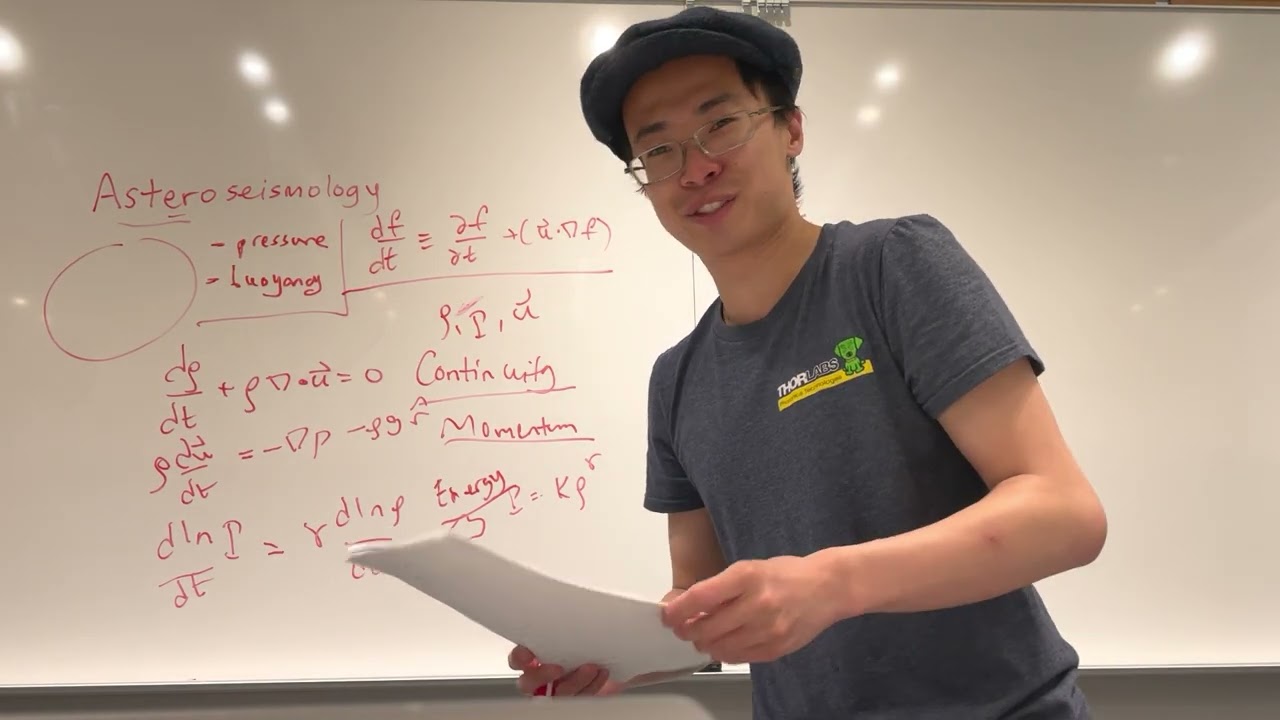
This university-level seminar acts as a masterclass on the physical classification of stellar oscillations. Nicholas Rui details the fundamental mechanics of p-modes (acoustic waves governed by pressure as the restoring force) and g-modes (buoyancy waves governed by gravity as the restoring force), explaining where they propagate and how they differ observationally.
Why this video is valuable
Dr. Jim Fuller presents an in-depth dive into the propagation of waves through stellar interiors. He discusses how p-modes probe outer envelope conditions, whereas g-modes sink deep into the degenerate cores of evolved stars, acting as direct messengers of core physical properties.

Why this video is valuable
This lecture explains the five key restoring forces that govern stellar oscillations: acoustic (pressure), gravity (buoyancy), Coriolis (rotation), Alfvén (magnetic fields), and tidal forces. It details how these forces interact in complex ways inside rapidly rotating stars to create specific wave behaviors.

Why this video is valuable
Conny Aerts provides a clear, high-level conceptual model of stellar vibration. She highlights how different modes penetrate to varying depths inside stars, providing a natural tomography of a star's thermal and chemical structure.
Gap Note: If you are seeking deep mathematical visualizations of the thermodynamic Kappa () opacity mechanism, consult Chapter 2 of Fundamentals of Stellar Astrophysics by Cox, or look up papers on "heat-engine driving of stellar pulsations."
Knowledge Checkpoint
- Contrast the physical restoring forces of p-modes and g-modes.
- Identify which region of a star is primarily probed by p-modes versus g-modes.
- Explain how the Kappa mechanism acts as a heat engine to drive coherent stellar pulsations.
- List the five restoring forces that can act inside a vibrating star.
Module 3: Mathematical Framework of Asteroseismology
This module introduces the mathematical formulation of non-radial pulsations. You will learn how stars are modeled using spherical harmonics, derive wave propagation characteristics using position-dependent acoustic cutoff frequencies, and explore the mathematical eigenvalues of stellar oscillation equations.
Recommended Videos

Why this video is valuable
Professor Nils Andersson provides a rigorous derivation of the mathematical basis of stellar perturbations using vector spherical harmonics. He breaks down how fluid displacements are separated into radial (), polar (), and toroidal () components. This is mathematically identical to the framework used to model non-radial pulsations in normal stars.
Why this video is valuable
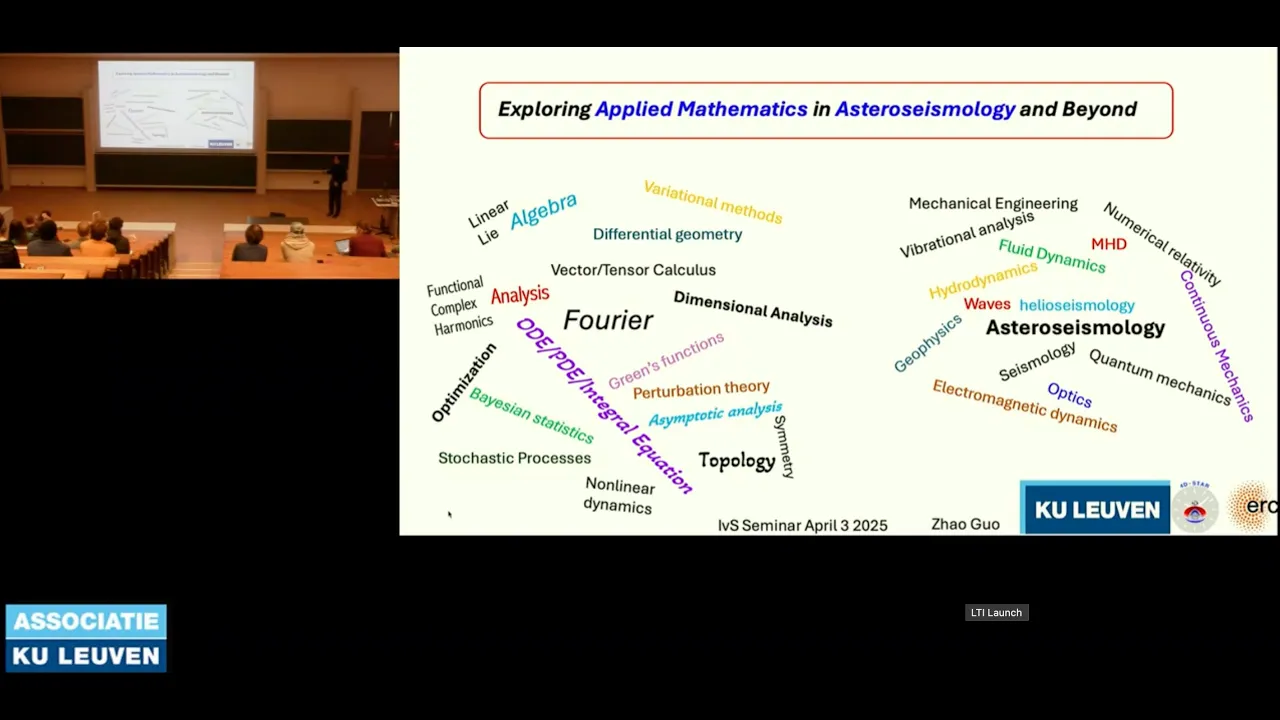
This advanced seminar frames stellar oscillations mathematically as an eigenvalue problem. It presents the linearized operator equation , detailing how structural perturbations (e.g., rotation, convection boundaries, magnetic fields) shift the eigenvalues (frequencies) away from spherical symmetry.
Why this video is valuable
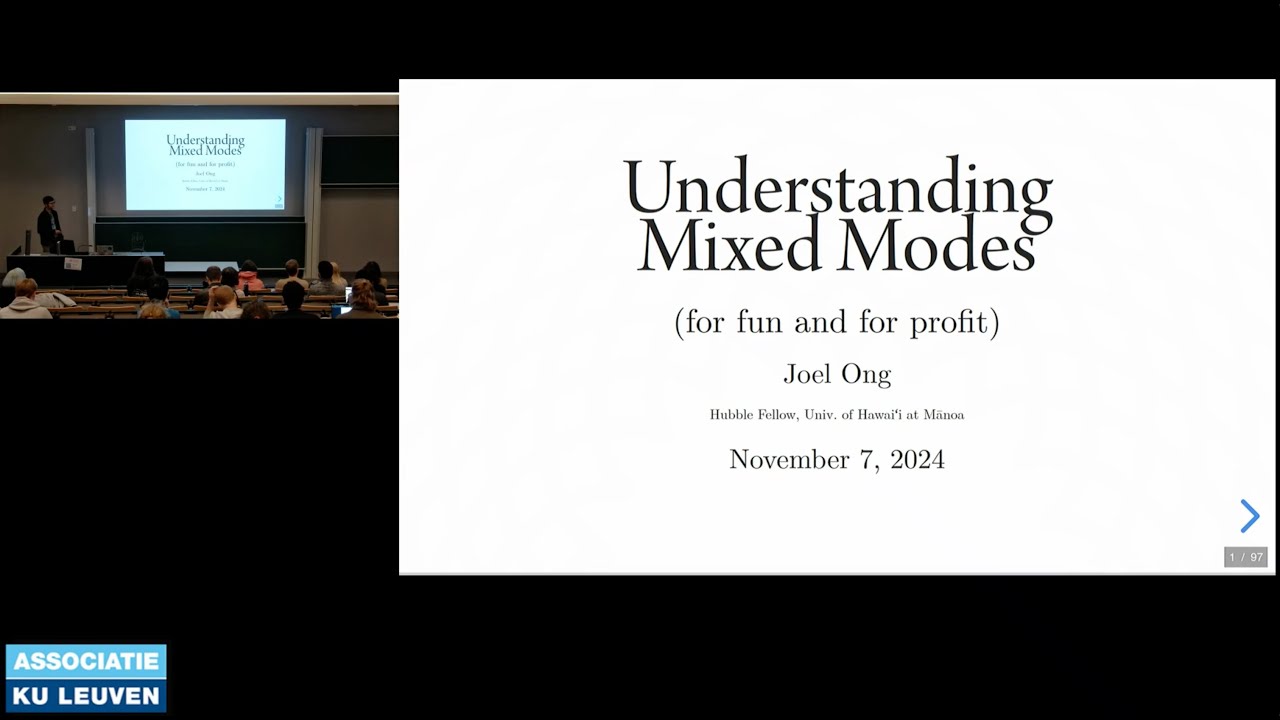
This presentation dives into the wave equations of stellar oscillations under the influence of position-dependent acoustic cut-off frequencies. It explains how red giant stars form dual cavities, where p-modes and g-modes couple across a thin evanescent zone, creating mixed modes.

Why this video is valuable
This lecture mathematically constructs the inner product spaces for fluid perturbations in stars. Dr. Andersson proves that stellar oscillation modes are orthogonal under a specific energy-related inner product metric, establishing the mathematical validity of analyzing separate, decoupled frequency channels in power spectra.
Gap Note: For the specific derivation of the asymptotic relations (Tassoul's equations for large frequency separation and small separation ), refer to Unno's Nonradial Oscillations of Stars or lecture notes from the Kepler Science Office.
Knowledge Checkpoint
- Define the three indices () of a stellar oscillation mode and explain their physical and spatial meaning on a sphere.
- State the linearized eigenvalue problem and define what represents the eigenvalues and eigenfunctions.
- Explain how an evanescent barrier acts to split or couple p-modes and g-modes in evolved stars (like red giants).
- Mathematically state what it means for two stellar perturbation eigenfunctions to be orthogonal.
Module 4: Practical Time-Series Analysis & Python Pipelines
This module transitions from theory to practical data science. You will learn to use astronomical libraries (such as Lightkurve and Astropy) in Python to download stellar light curves from space missions like Kepler and TESS, clean time-series data, and compute Lomb-Scargle periodograms to extract raw oscillation frequencies from unevenly-spaced data.
Recommended Videos
Why this video is valuable
This video is a comprehensive hands-on workshop covering the standard software workflow for Kepler and TESS time-series data. It demonstrates how to fetch target pixel files (TPFs) and light curve files from the MAST archive, perform basic detrending, and convert raw flux records into normalized light curves.
Why this video is valuable
Stellar light curves from space are plagued by gaps, telemetry downlinks, and orbital cycles. This mathematical and practical tutorial covers the Lomb-Scargle Periodogram—the gold-standard algorithm for detecting periodic signals in unevenly sampled astronomical time series, showing how it differs from a standard Fast Fourier Transform (FFT).
![AAVSO How to [Python! Finding Frequency Solutions for Variable Star Light Curves]](https://i.ytimg.com/vi/ZhtHBkbTuWY/maxresdefault.jpg)
Why this video is valuable
A clean step-by-step programming tutorial demonstrating how to use Python, Jupyter Notebooks, and astronomical packages to ingest a variable light curve, execute frequency-solving algorithms, and plot the computed amplitude/power spectra to resolve the star's underlying physical frequency components.
Why this video is valuable
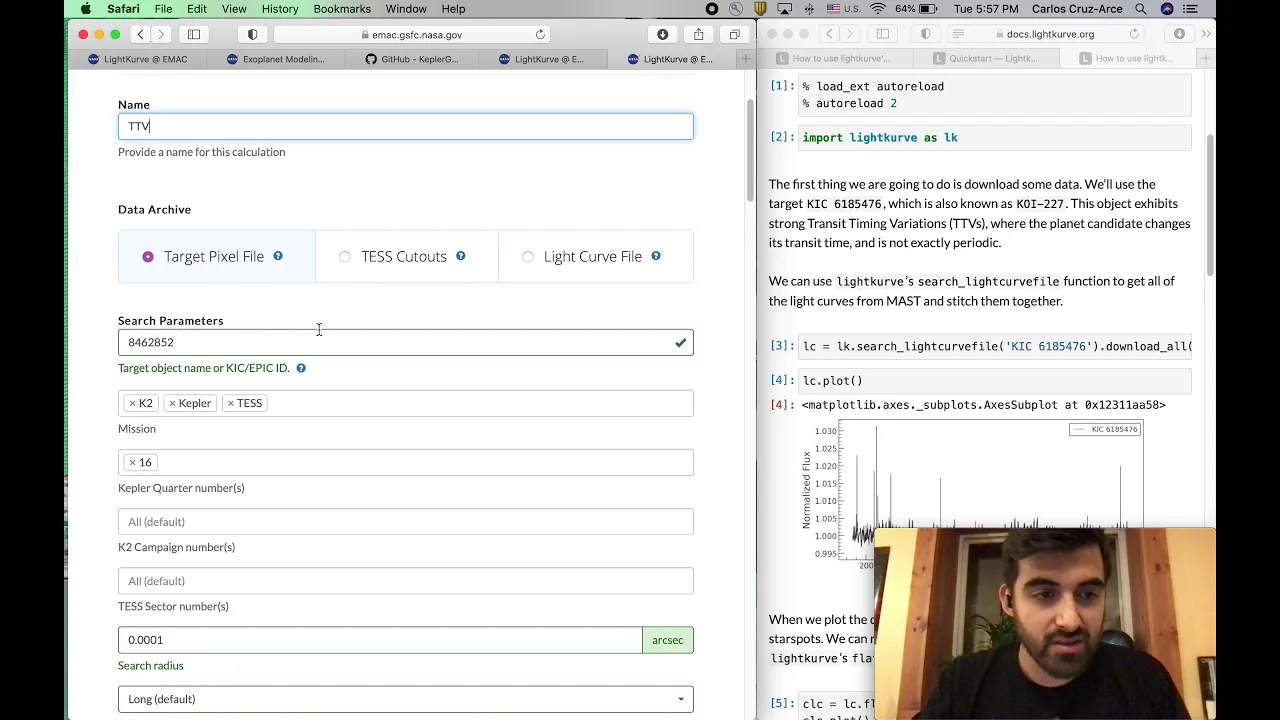
This video showcases the web and GUI tools wrapping the Lightkurve package. It provides an intuitive mental map of light curve manipulation tasks (such as flattening, outlier removal, stitching sectors, and interactive aperture selection) before you write the code programmatically.
Why this video is valuable
An excellent primer on visualizing astronomical time-series data. It walks you through manipulating plot objects generated by Lightkurve in Python, removing noise, and identifying instrumental artifacts in the time-domain so that they do not corrupt the power spectral density (PSD) calculation.
Knowledge Checkpoint
- Write Python code using
lightkurveto download a Kepler light curve (e.g., KIC 8330050) and plot it. - Explain why a standard Fast Fourier Transform (FFT) fails on light curves with gaps, and how a Lomb-Scargle periodogram resolves this mathematically.
- Explain the difference between
SAP_flux(Simple Aperture Photometry) andPDCSAP_flux(Pre-search Data Conditioning SAP) in Kepler/TESS data. - Write a script using
astropy.timeseries.LombScargleto compute and plot the power spectrum of a light curve.
Module 5: Probing Interiors: Mass, Age, and Core Rotation
In this final module, you will translate raw oscillation frequencies into fundamental physical parameters of stars. You will utilize asteroseismic scaling relations to derive precise masses and radii, study how core hydrogen depletion shifts oscillation signatures to yield accurate stellar ages, and analyze the rotational splitting of modes to reconstruct the internal core-to-envelope rotation profiles of stars.
Recommended Videos

Why this video is valuable
Fraser Cain hosts an in-depth discussion on how asteroseismology determines the ages of stars with unprecedented precision (down to <10%). The video explains how core hydrogen consumption changes the internal mean molecular weight and density structure, directly shifting the frequencies of deep-penetrating acoustic and gravity waves.

Why this video is valuable
This presentation covers asteroseismic scaling relations. It details how the large frequency separation () relates directly to a star’s average density, and how the frequency of maximum power () scales with surface gravity () and effective temperature (). This allows model-independent calculations of mass and radius.
Why this video is valuable
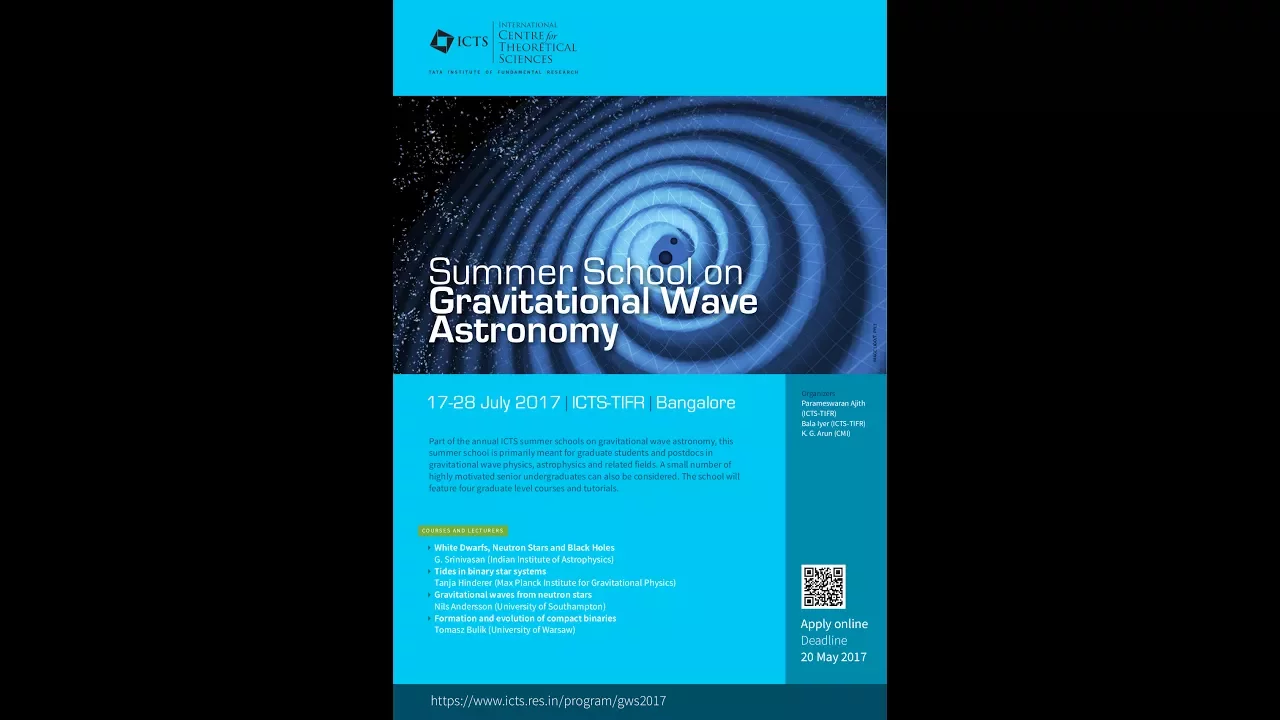
This physics lecture reviews rotational splitting. When a star rotates, the spherical degeneracy of the azimuthal quantum number is broken. This video derives how rotation splits a single mode frequency into branches (), allowing us to directly measure the interior rotation profile ().
Why this video is valuable
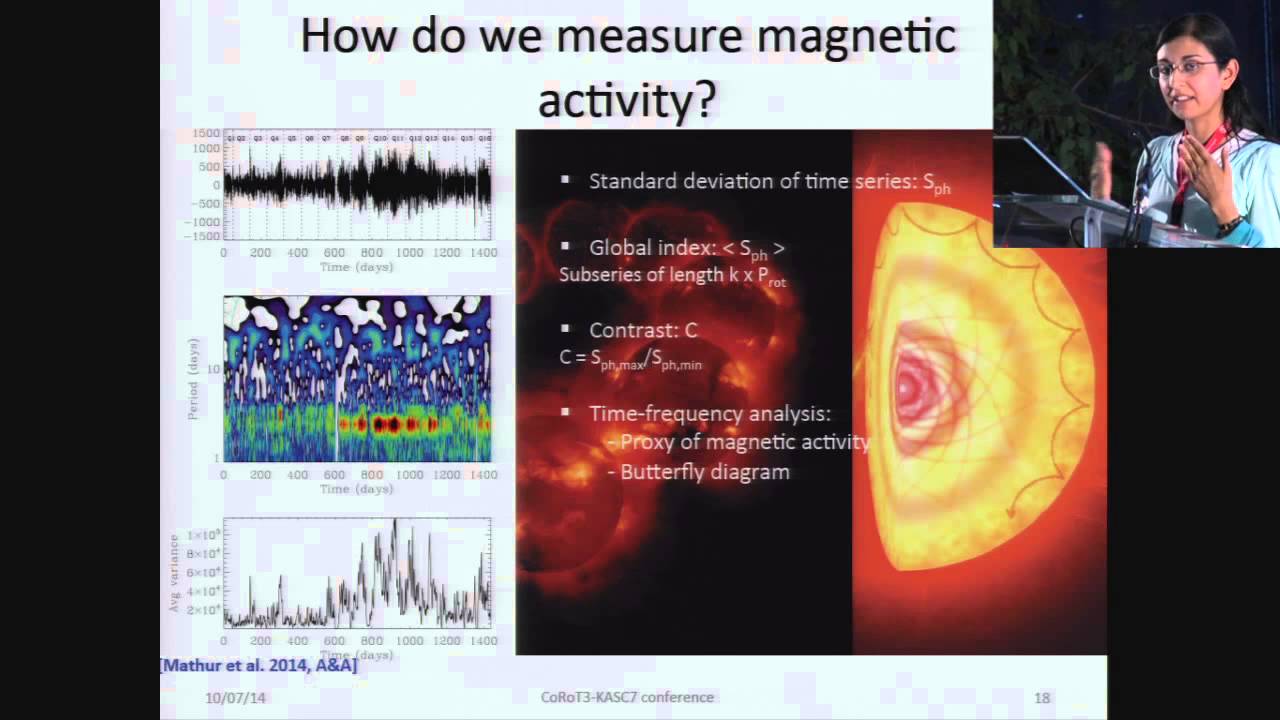
An advanced seminar addressing the co-evolution of stellar age, rotation, and magnetic fields. Dr. Savita Mathur outlines how magnetic braking slows down a star's surface envelope while leaving its core rotation profile distinct, explaining how asteroseismology reveals this internal shear.
Knowledge Checkpoint
- State the two primary asteroseismic scaling relations for and as functions of solar reference values, mass, radius, and temperature.
- Solve the scaling relation equations to calculate mass () and radius () given measured values of , , and .
- Explain how core rotation rates are determined by measuring the frequency separation between and split dipole modes.
- Describe how the accumulation of helium in a star's core over time affects the speed of sound, and why this changes the small frequency separation (), revealing the star's age.
Course Map
Key People Index
- Dr. Conny Aerts (KU Leuven): Kavli Laureate, pioneer in high-mass stellar asteroseismology and rotational profile modeling.
- Dr. Jim Fuller (Caltech): Theoretical astrophysicist specializing in stellar wave propagation, wave transport, and compact object binary dynamics.
- Dr. Nils Andersson (University of Southampton): Expert in stellar perturbation theory, fluid dynamics of relativistic stars, and gravitational wave modeling.
- Dr. Savita Mathur (IAC): Leading researcher in solar-like oscillations, stellar rotation pipelines, and magnetic activity mapping.
- Dr. Douglas Gough (University of Cambridge): Foundational pioneer of helioseismology and asteroseismic mathematical scaling models.
Final Self-Assessment
Review this list of physical, mathematical, and practical milestones. If you can confidently complete these tasks, you have successfully mastered the fundamentals of Asteroseismology:
- I can derive the equation of hydrostatic equilibrium from first principles of momentum conservation in a fluid element.
- I can explain the physical restoring forces that distinguish pressure modes (p-modes) from gravity modes (g-modes).
- I can write the spatial displacement of a non-radial oscillation mode mathematically using spherical harmonics .
- I can explain the physical mechanism behind the acoustic cut-off frequency and how it determines where wave reflection occurs inside a star.
- I can download, clean, detrend, and normalize a Kepler or TESS light curve using Python and the
Lightkurvepackage. - I can compute a Lomb-Scargle periodogram from an unevenly spaced stellar time series and accurately identify key oscillation peaks.
- I can use asteroseismic scaling relations to compute a star's mass () and radius () from , , and .
- I can explain how rotational splitting breaks the spherical symmetry of stellar modes and write down the split frequency equation: .
- I can explain how the small frequency separation () acts as a direct probe of core hydrogen abundance, serving as a cosmic clock to determine a star's age.