















![La vida privada de las estrellas [8/10] Supernovas de tipo II](https://i.ytimg.com/vi/RThoKZlidLU/maxresdefault.jpg)











![SACANI RESPONDE [TEMAS VARIADOS #01] - Ciência Sem Fim #311](https://i.ytimg.com/vi/JntgF5qy9wA/maxresdefault.jpg)



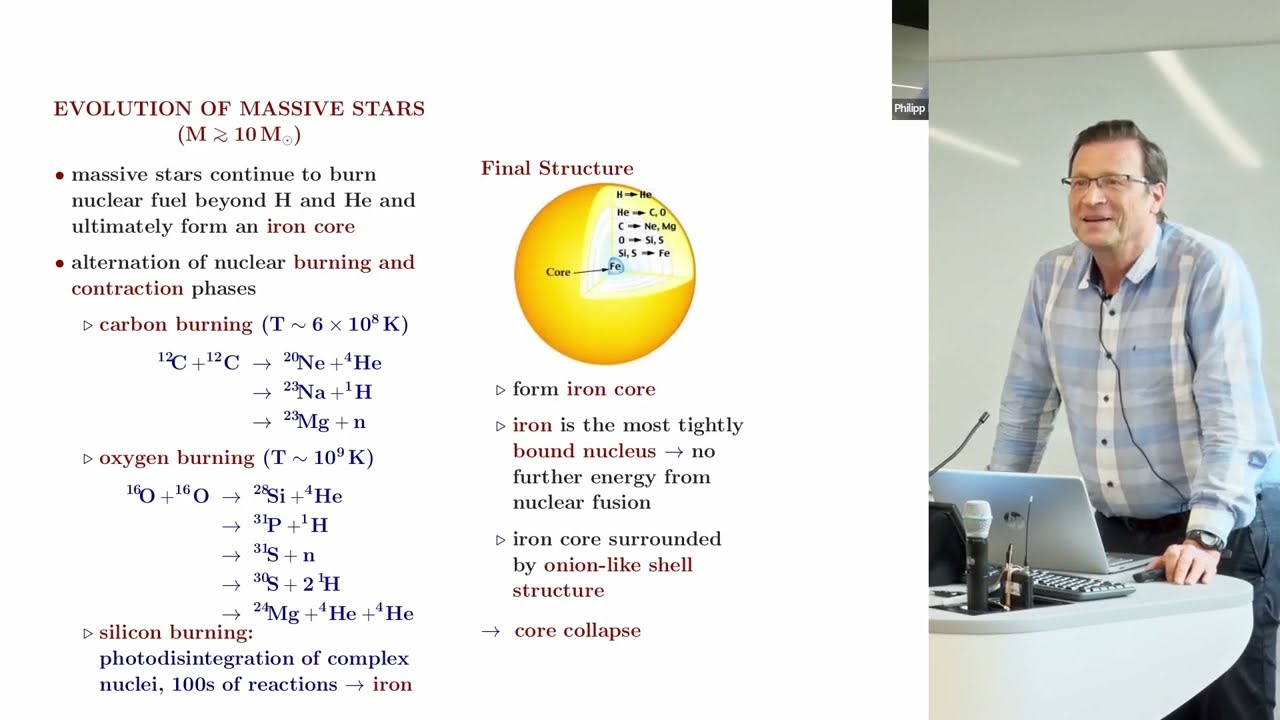
Massive stars are governed by four fundamental structure equations: mass conservation (dM/dr = 4πr²ρ), hydrostatic equilibrium (dP/dr = -GM(r)ρ/r²), energy conservation (dL/dr = ε - dE_grav/dt - L_neutrino - L_mass_loss), and energy transport equations (radiative flux F_rad = - (1/3)cτρκ(dE/dz) and convective transport via the Schwarzschild criterion ∇_rad > ∇_ad). These equations, combined with the equation of state, nuclear reaction rates, and opacity tables, allow numerical modeling of stellar evolution. Key scaling relations include the mass-luminosity relation L ∝ M³.5 for massive stars and the mass-radius relation showing strong dependence on mean molecular weight. Massive stars have convective cores and radiative envelopes, unlike low-mass stars, and their shorter lifetimes (τ ∝ M⁻².⁵) result from rapid nuclear burning.
Stellar Structure Equations & Massive Star Evolution | Lecture 2
Added:before we start um I'm goingon to start again welcome everyone to this lecture two U lecture uh series on massive stories uh first of all I would like to remind you that the next lecture is going to take place in two weeks time so not next week but in two weeks and also please mind that Europe is changing time to winter time zone while other part of uh the world might not so please check that you are on time and not 1 hour before or later um yeah so that's it so uh for today we have theas duta working at EA with ilva gber who is gonna talk about massive star structure so uh the best he did his Bachelor studies at tesur University in India and then he did his master stud studies at Indian Institute of Technology palakat I hope I pronounce well um during his master te is is studed per instability supern and the black hole Mass Gap and it tried to see the various factors which can affect the maximum mass of black holes below the mass Gap so nowadays is his first year PhD student at EA as I said before and the exact topic of his thesis is not yet fixed which is kind of usual but he is working on connecting binary models with tar atmosphere models and at present he is trying to study how the spect of the Star Strip in binary evolves after the mass transfer it does have a publication so if you are interested please look at uh the paper which is uh published at um in Ana uh which is evolutionary nature of P PP strip star binaries and their occurrence in Stellar populations so I'm going to give you the floor the B if you are ready and please let us know a bit more about massive star structure and afterward we will open up for a discussion and we really encourage everyone to participate to this um discussion afterwards so the best way if you are ready then the floor is yours uh yeah am I audible yes hi yeah uh so yeah thanks for the introduction uh hi I'm debashish uh I'm a PhD student at The Institute of Science and Technology Austria so today uh uh I'll be speaking about the massive star structure uh in this second uh lecture of the lecture series and mostly I'll be uh talking about the structure equations um although uh primarily I'll be focusing on massive stars but then of course this uh equations are General and works in other Mass regimes also okay so uh here's a brief outline of my talk uh I begin with uh the introduction of what stars and how can we study Stars through the surface properties and what are massive stars then i' go into the formulation of the structure equations uh which have mass conservation the equation of motion energy conservation energy transport by radiation and convection together with it I'll also be speaking about uh the equation of State the equation for composition changes and a bit on opacity uh after this I would uh talk about some important time scale which are uh relevant when discussing Stellar structure and evolution and also be uh talking about some simple scaling relations which um can be used uh which is helpful to study some uh some relations between some basic properties and then I'll end with a summary of how the structure of a masip star can look like okay uh so I'd like to begin with what are stars so as we know stars are objects which radiates energy from an internal source and they Bound by their own gravity and this radiation from internal energy and then energ generated in the interior to nuclear reactions and while studying Stars we make some assumptions like uh we assume that the star is spherically symmetric uh and um also when I to mention that when we discussing spherical symmetry we assume that there's no rotation if there is rotation then we no longer have spherical Symmetry and uh the and rotation will be discuss in N of the upcoming talks in this series uh next we also assume that the star is isolated that means it doesn't have interact with any of the nearby companions but Stars can be in binaries or triples soers and um also we can have star plan interaction so we will have uh talks on this maybe in the next block of the lectures and last we assume that SS are form with a homogeneous composition now uh here I have the HR diagram which have Luminosity on the y- axis and uh effective temperature on the x-axis just uh made ACC exis here so for the labels and and to show that that effective temperature as we know effective temperature decreas increases as we go towards the left in this HR diagram uh this horizontal strip uh we can see a diagonal strip in this HR diagram which is known as the uh main sequence so these are the stars which are converting hydrogen into helium and these are by far the most abundant stars and therefore we can see many main SE can star in the HR diagram so we also know the stepen balsman law uh and from this we can see that the radius of the star depends uh on the luminosity and temperature uh so we can uh so uh for high Luminosity uh and uh low temperatures we have large values of the radius and as as we can see as if we go for high luminosities and low effective temperatures we can have uh the Giants and the super Giants which are name because they are larger in size than the main sequence stars now this super Giants they can be red super giant or blue super giant or yellow super giant uh depending on the temperatures uh for example in the oriona we have uh uh the two of the brightest stars the ble juice and the ryel the ble juice here is a red super giant and Rael is a blue super giant and then uh we also have the white dwars which are smaller in size the main sequence uh and these are the compact remnants of uh Lowa star Evolution now uh so now I like to speak about what are massive stars now uh the definition of massive stars would be different for different people but uh what our massive stars depends on what is the final fate of the stars and very Loosely we can say that stars which undergo core collapse can be called a massive star so this happens when the initial mass of the star is greater than e solar mass or higher uh although this is not a very sacred quantity and this can change depending on various properties uh here I have a plot between the initial mass of the stars and the evolutionary phase now what we see for the lower M Stars the lower M Stars evolve and end up as white dwarfs it can be a carbon oxygen white dwarf or for little bit more massive stars we can have a oxygen neon white dwarf and as we go to more massive stars we can see that it goes through many buring cycles it have it it under go a core collapse and form neutron stars or black holes these are the massive stars uh this is what the massive stars are we'll mostly be talking about the Stars which undergo cor collapse so uh what is not mentioned in this diagram is uh what happens to stars when they are very high so for very massive stars we uh we there's a uh condition called the PA instability Supernova where uh the oxygen go collapse and and there is a explosion so uh with so high energy that there's no compact Remnant the whole star blows up okay so now uh we I have a here some evolutionary tracks in HR diagram so competed with the Geneva Evolution code and this numbers here represents the initial mass of the star and as we go uh higher we can see we have evolutionary tracks of increasing initial mass and in the upper region here is where the evolutionary tracks of the massive stars have uh and here are the here are where massive star side if we see uh in the HR diagram and to mention that this evolutionary TRS are computed at solar metallicity and with no rotation yeah so here we have some another HR diagram with some evolutionary tracks now although the HR diagram is a good beautiful tool however uh we have Luminosity on the y- axis and if we are to work with observations uh what we get from the observation is a flux and um the and the flux depends on Luminosity we have a dependence on distance and sometimes we can we may not have um proper estimates of the distance so at that time what comes into handy is the peel diagram which is a plot between the effective temperature and the surf log of the surface gra gravity um but however as we can see in the scale diagram um as we go to more higher masses the spacing between the tracks decreases and we might not be able to say which track it belongs to therefore both of these have some advantages and disadvantages of its own okay from now i' would like to go to the formulation of the structure equations of stars like to begin with the mass mass conservation so assume a mass shell here we assume spherical Symmetry and with the mass DM and we know the density is defined as the mass par in the volume where we can write the DM in this way and uh we can have matter inflowing and on flowing out of this Mass shell so we can write the DM as a function of uh the position and the time where this represents the mass that is contained contain and here this represents the mass that's flowing in and out of the shell replace Dr with vdt okay now when this when we have no uh no Mass flux and a mass flux is zero then TM is just this and if we rearrange the term here this is what is the first equation of Stell structure and with this I come to the second uh formulation of the second equation which is the equation of motion so I look at the gas parcel in the spherical shell and I see what forces acting on this gas parel so we have uh this um the forces is due to gravity and the force due to the pressure the force Z pressure can be from gas pressure or the rad and the radiation pressure so we can write the equation of motion here where we have M into the acceleration here we have um uh the force due to gravity and the force due to pressure and then uh which translates to this now uh in most of its lifetime a star remains in um stable it doesn't change much so we can assume that the acceleration term is uh zero and when the acceleration term is zero we end up a situation like this DP by DM is equal to minus GM by 4i R to^ 4 and this here is a second equation of Stellar structure which says that the star remains in in a hydrostatic equilibrium for most of its lifetime and which means that the force which is the force due to gravity which is pulling the star inwards is being balanced by the uh force of the pressure which is pushing the star outwards now I to introduce a concept here when the star is in hydrostatic equilibrium which is the pressure scale height so I start with the second equation that is the hydrostatic equilibrium and using the first equation I replace the DM in terms of Dr and so I get DP by Dr minus G time row so we assume ideal gas pressure and put this value of row I'm inut here and just solve this equation and what we get is p is p eus r by HP HP here is the pressure scale height which is uh defined by the modulus of Dr by D of Ln P which is uh the distance the pressure scale height is the distance of the pressure decreases by factor of is very helpful when we discussing the structure of the star and it's useful when we'll I'll be discussing convection okay so till now we have two equation the mass conservation the hydrostatic equilibrium so here we can see that these are um these have mass as a function of radius the uh the so the position the pressure and the density so we need one more equation if we if we want to solve this here comes the equation of state which is the relation between pressure and density so the pressure depends on the density the temperature and the chemical composition and the pressure could be uh in the form of a IDE classical ideal gas or when we go to uh and here uh which is row by mu mu mu so mu here is called a mean molecular weight which is average number of particles per unit atomic mass unit so this uh actually this whole this this this both of these quantities uh together represents the average mass this mu as we can see the it depends on the uh mass number so for higher heavier element we have heavier mean molecular WID okay so we can have this ideal gas pressure or we can also have uh the degenerate pressure when we talking about ideal white dwars although not so much important for massive stars but uh so this form equations is called polyrope and uh in addition to the gas pressure we have the radiation pressure which is due to the photons which is given by 1x3 80 power 4 and the total pressure is a combination of the gas pressure and the radiation pressure where the where these two terms make up for the gas pressure this is for the classical ideal gas and these are for degenerate quantities okay now I move on to the energy generation in the stars as I mentioned in the first slide that uh energy generated inside the Stars uh through nuclear reactions and um uh this and we know that for into nuclear reaction to occur we need the two particle uh crossing the potential barrier and which requires energy which is dependent on the DS City and temperatures so these nuclear reactions are temperature dependent and the start starts I mean this starts by burning hydrogen to helium and goes on to carbon oxygen and in many uh burning Cycles so the first reaction that we have is the Hydro is hydrogen fusing into helium which occurs when temperature at at a temperature of 10^ 7 Kelvin and for the lower Stars this Fusion happens to the proton proton the pp chain where we have two uh hydrogen nuclear coming together and forming this helium nucleus this is the by far this is the most dominant Channel also this can have other branches um where pp2 pp3 and uh this uh numbers in red represents the branching ratios so uh for more massive stars uh the dominant mode of uh hydrogen burning is not the uh PP chain but uh as the carbon nitrogen oxygen cycle where the CN cycle where the carbon nitrogen oxygen excess catalyst so we to start with a um carbon nuclei we have a proton so it's hydrogen so carbon acting with proton makes 1 oxygen sorry 13 nitrogen and then we have a cycle and at last um we make uh nitrogen with the proton capture reaction makes this uh uh alpha particle or the helium nucleus so we uh so in this cycle we have three protons uh coming together making up the um uh helium uh and this uh cnoc cycle is actually a bicycle uh where um after this one after this cycle uh we Branch out from this 15 nitrogen to one more cycle which is known as the O N Cycle so this first this is the CN cycle and the second one is the O N Cycle so uh in this o cycle uh we have oxygen uh we have the fusion oxygen therefore which requires a higher kulum barrier therefore this occurs at a higher temperature so uh so usually uh I mean uh the CN cycle sets in first and after some time this o cycle sets in and this is because uh the the branching ratio for the O cycle is low yeah as I mentioned because of the higher Kum barrier uh now uh in this uh in this cycle the the SL slowest reaction is the reaction where 14 nitrogen going to 15 oxygen and since this reaction is very slow it acts as a bottleneck and it conest the flow of nuclei so it preserves uh it so so so nitrogen 14 accumulates in the burning region and therefore massive stars are predicted to have a large amount of nitrogen in their cores compared to the L Stars so as I said the two um uh the the two reaction mechanisms the PP chain CN cycle PP chain occurs in lower Mass and for more massive stars we have the CN cycle now the switch from pp2 C happens uh because of the temperature dependence in its energy generation rate so this is a nuclear energy generation rate of the pp and C for PP it goes to Diva 4 and for CN it goes as to Diva 16 and uh so so we have some proportionality terms here which are dependent on densities and uh Mass fractions so the proportionality terms uh is generally higher for the pp chain so therefore in the when when when we have lower temperatures we have PP chain which is the most dominant form but as we go to higher temperature this temperature uh term takes over and we have C cycle so this is a plot of the energy generation rate and uh temperature as you see at some point uh the I mean we have PP chain in the beginning at some point it switches to CN um so higher uh temperature means higher more massive stars so uh more massive stars uh that's why I have CN cycle as a dominant mode of hydrogen Fusion now L was mentioning that um C cycle happens for massive stars but actually a switch the transition from PP too happens quite early around 1.3 solar which is yeah not so massive uh for more higher temperatures we can have helium burning happening through the triple Alpha reaction and so where three alpha particles so helium nuclear combine to give carbon and this happens at high temperatures above 10 8 Kelvin and when sufficiently sufficient amount of carbon 12 has been created we again have a reaction which forms oxygen so in the helium burning we form carbon we we form both carbon and oxygen now we can after this we have the heavy elements burning that is the we have the carbon burning and I have mentioned the temperatures in the right hand side the neon burning Oxygen last we a silicon burning which form ion core now uh this is how the structure of massive star looks this is very simplified version but this is how it looks like at the end stages we have a iron core and at a center and we know the binding energy of iron is the highest so for the fusion is not possible and once an iron core is formed the core collapses as a result of no energy gener generation so yeah so as we have seen we have many reactions that are going inside the Stars so uh if we want to write the equation for how this for the composition changes we can look uh uh let's say we have an element I which is getting created uh in some nuclear reactions involving element K and L and it's at the same time it's getting destroyed by with by reaction with some other element J so if you want to see how much of this uh element I is present we look at the number density of this element where ni is given by the mass fraction uh dens time density divide by total mass and um if we see how the mass fraction is changing with time uh we can differentiate both and we can combine I mean we can just uh do this and we have dxi by DT some constant terms Times dni by DT where dni by DT is um is how the rate of this this reaction TN I DT can be given by the rate of the reaction so we have dni by DT how the number of this this particular element I is changing which is given by this RK which is the uh rate of this first reaction the reaction in which energy is of this I is created uh this is the term for creation uh and uh sub and minus uh the rates of this destruction term now this reaction rates um these are generally computed or measur in the lab and what goes in the modern St Evolution codes are um are some tabulated forms of this reaction rates okay so we have created energy so obviously the energy is conserved somehow so we consider a Mell again with uh Epsilon as the energy generation rate and L is a local Luminosity of this specific cell and we can write the DL the Epsilon is DL DL by DM now uh this DL by DM uh uh where we have Epsilon this Epsilon can have various uh this Epsilon uh can have various sources for example we can have the Epsilon due to nuclear reaction the energy generation due to nuclear Reactions where energy is getting created we can also lose energy through neutros now neutros um have a long uh mean-free paths and they escape the star without reacting with any other particles and therefore neutros SC energy as it escape the star and neutros are important in the later part of the evolution and then we can also have the Epsilon the energy uh change due to the gravitational expansion of contraction I mentioned some time ago that uh the star remains in hydrostatic equilibrium for most of its lifetime but at some point we can uh the star can contract or expand and this is where this uh Epsilon graph comes then also uh then uh then here we have uh the energy uh due to the energy changes due to the mass loss now this is important uh this is not important for most of it uh for all the stars maybe but the mass loss can be due to winds which are important for uh massive stars and this Mass loss can also be uh when we are transferring Mass from a star to when the stars are in a binary configuration and is a mass transfer so this equation here is the third equation of Stellar structure till now we have three equations the mass conservation the equation of hydrostatic equilibrium and the conservation of energy next we have energy uh since we have generated the energy we need need to transport the energy so energy transport can OCC through various ways can have diffusion energy is being transported by the motion of the particles and in diffusion we can have radiation where the energy is being carried by photons or conduction where gas particles the ions and electrons carry energy we can also have convection where the thermal energy is transported by U the movement of the matter itself and as I said uh neutros take your energy with it because they have uh long meanf free paths uh therefore we have neutral losses so I would like to go uh over them so first we have the radiation now when we talk of radiation we work in the diffusion approximation where the mean free path of the photons is much less when you compar to the total length over which the transport is to be done so if we want to go for a formulation for diffusion we start with the diffusion equation so let's assume we have some particles flowing and this is given by the fixed law where J is the particle flux gr of n is the density in the gradient of particles sorry gradient in the density of particles and D here is the diffusion coefficient so similar to the uh particle diffusion we can write the equation uh we can analogous we can write a equation analogous for energy so where here we have the energy density uh and here we have the gradient in energy density and this D is the diffusion coefficient which is given by 1/3 of uh the average velocity into the mean free path and this average velocity four photons will be the speed of light L here is the mean free path which is given by one over the density and Kappa Kaa here is the uh is known as opacity so basically we Define uh the mean free part as 1 / row into Capa and this uh Kappa determines the resistance of the Stellar gas as it of to the passes of energy by radiation and this uh opacity can be dependent on the temperature the density and the chemical composition and the opacity can have various sources like the electron scattering the free free absorption the Bound free absorption the bound bound absorption and inside a star where most of the uh particles ionized the major uh source is the electron scattering um and uh similar to the chemical compositions this uh uh this opacities are for for the Stell Evolution codes we use some form of tabulated opacities okay so we were here we have written the diffusion equation for energy so now combining all this term into uh in here we have the radiative flux is where uh D is 1/3 of uh the one thir of the Velocity which is C and the mean free path and energy density now we know energy density is given by a t to the^ 4 where uh so if we um if we put those values here we have um this flux in terms of the temperature gradient and if n uh this flux we can write as the Luminosity by 4 pi r² and if we rearrange what we get is a temperature gradient okay so long story short we start with with a diffusion equation and then analogously we write it for energy and we arrive at a um temper temperature gradient Now using the first equation of Stellar structure we can write this Dr in terms of d m so what we have is DT by DM um have a gradient in terms of the mass coordinate so if if we want radiation inside the star this condition must be fulfill so basically this is temperature gradient required to transport energy by radiation and these are only valid for large Optical left and as we approach the surface of the star it becomes invalid because as we approach the surface we have large mean-free paths uh therefore this diffusion approximation no longer holds okay so the next process is convection so as I said convection is when the energy is transported by the motion of the matter itself now for example let's imagine uh a pot of water boiling and we put in some noodles there and after sometime it starts boiling and as you can see the random motion of particles the particles moving here and there and with that it um uh carries energy along with it so how does convection transport energy uh for this we need to go to 3D hydronic simulation and some of it is being which is uh done in here and although U but we do have a simple 1D Theory which is not as a mixing Len Theory and which goes like this so let's say we have a gas parcel and um we have the proper condition for convection so set in and after sometimes the gas parcel Rises and after traveling a certain distance it mixed with the surroundings and this distance over which it mixes it's known as The Mixing length which is written in terms of the pressure scale height which I mentioned uh some time ago so this conviction could be a very important uh good mixing mechanism and there will be more details uh in the next talk about convection which is dedicated to convection uh but uh in my in my talk what I will mention is some basic formulation of convection so we uh so we see uh we want to see when convection can take place for for that let's imagine we have a bubble of gas here uh with uh and we have a stable situation that means the temperature is determined by radiation now so the the density and pressure is similar to the surroundings the environment so we part up this particle and this bubble and make it rise in a length Delta R and when it rises in order to um in order to maintain the same pressure uh it under goes expansion and the time scale for this uh uh displacement upward displacement is very less when compared to the time scale for heat exchange therefore this uh uh the bubble expands adiabatically and when it reaches a certain uh distance let's say Delta R we'll have new condition for the environment we'll have new condition for the bubble so uh the final uh density of the bubble can be written as the initial density Row one uh plus uh the density gradient in adiabatic conditions as I've said times the uh length over which it is transported the density of the environment is given by the initial density which is Row one uh plus the density gradient of the environment times the uh distance now we can have two conditions here if the density of the bubble is greater than the density of the surrounding then the bubble will fall back we have a stable situation here let's say we we pup the bubble we make it go up but then again it comes to the same position we don't have any kind of convection here but if the density of the bubble is less then the bubble would go up uh and this is a unstable condition and this is where we have convection so this here uh when the density of the bubble is less than density of the surroundings this is the condition for convection this is instabil this instability Criterion if we uh put in these values and we arrange it this is what we'll get the density gradient of in ad diabetic condition the bubble is less than the density gradi of the environment as I said the environment is determined by radiation so we write the density gradient of the environment as density gradient in radiation okay so we have this instability Criterion now if we take the ideal gas and put in the values and do a little bit of calculation what we will get is this form where this term here is the uh radiative temperature gradient and this term is the adiabetic temperature gradient so the condition convection to occur is when the radiative temperature gradient is greater than the adiabetic temperature gradient in this condition is known as the criteria okay so now we have the full equation for energy transport energy transport depends on the temperature gradient which is equal to minus GMT by 4 Pi r^ 4 P times this grad and this could be and this take the form of a adiabetic temperature gradient or the sorry the the the radiative temperature gradient or the adiabetic temperature gradient depending on we have radiation or convection according to SW shell criteria and um here I have uh two plots uh the first plot shows um is for a one solar mass star on the xaxis we have the radius so here is the center of the star and as we go uh right we go towards the surface and on the y- axis what we have is this uh temperature gradients so what you can see for one solar the interior of a in the interior of a star the the adiabetic temperature gradient is larger so we have radiation according to this condition in the exterior we have the radiative temperature gradient Which is higher so in the exterior we have convection now uh if we see for a four solar mustar which is larger which is more massive the the condition for convection radiation is completely different in the interior we have this condition fulfilling so we have convection and in exteriors we have radiation so LMA stars have radiative course and convective envelopes and massive stars have convective course and radiative envelopes and this is uh and this is I'm saying about U main sequence this is valid the main sequence as we as a star further evolves this changes of course so we finally have all the structure equations in one place we have the mass conservation the hydrostatic equilibrium the energy conservation and the energy transport equations so this structure equations can be solved um in a consistent Manner and for this we need three more quantities which are the equation of State the opacity and the chemical composition equations the changes due to chemical composition and these are as I said these are these in the Stell Evolution C we take this from uh some tabulated uh equation States capacity or the the rates now uh uh now if we see here in all this equations the only equation that is depending on time time is this changes due to chemical composition so this is the star this is the condition that is uh responsible for the evolution of the Stars so the star evolves since the composition changes when composition changes the temperature changes the density changes the location of convection zones and therefore we have uh therefore this is the term which is responsible for the evolution of the star so this uh as I said this can be solved numerically and today we have many cell Evolution codes uh like the Mesa the Stars code from Cambridge keplar the Geneva Evolution code and so on and more about the evolution codes and numerical calculations will be dealt in the uh fifth talk of this series okay so uh so with this uh so with this I go to the next section which is the time scales so here I talk about the relevant time scales which are important in uh Stellar Evolution so the first is a dynamical time scale so this is a time scale that the star uh take time the star take to grow or Shrink if we disrup the condition for hydrostatic equilibrium so we have this uh uh we have this equation of motion now if however we remove this pressure term let's say there is no gas nothing we just uh so so there's no pressure inside the star so this term no longer exist so if we solve this what we get the dynamical time scale uh approximately something like this and the example of this dynamical time scale would be core collapse when at the end let's say where uh we have iron core which is not producing energy so uh the core just collapse in in dynamical time scale and this is very fast for for for our sun it's around 1600 seconds which is uh half an hour so if somehow we to we to remove the pressure pressure I mean like energy happening inside the star then um the star just collapse so it's a it is cat this is a catastrophic event next we have the thermal time scale and this is the time that the star requires to radiate the reserver of its thermal energy if some of the nuclear reactions were cut off this also know as a Kelvin ham Hol time scale which is given by internal energy by time by the uh luminosity and uh which can be written as the potential energy by two this comes from the vdal theorem which not mentioned but this is what it this is what it means the potential energy and internal energy so the potential energy is given by GM squ by R and uh so so an example of this thermal time scale would be the heartspring Gap that is when uh let's say uh the star uh after the main sequence uh the hydrogen is depleted and the star now contracts and when the star cont um star starts to contract and when the star starts to contract uh the star needs to find the star needs some time to react to the changes that is happening and this happens in the thermal time scale This Heart sprung Gap is seen in this Evolution tracks this is uh the heart spring Gap and then this thermal time scale is uh for our sun for our sun is around uh 1.5 * 10 7 years which is much larger than the dynamical time scale next we have the nuclear time scale this is basically a time scale on which uh the star burns the nuclear foil so this is just the energy energy due to nuclear reactions by uh the Luminosity so Example The Burning on the main sequence now uh our sun which is burning hydrogen to helium on the main sequence this is burning the nuclear time scale so the nuclear time scale for sun is 11 years so as we have seen the dynamical time scale is uh is very small followed by the Calin ham hols and the nuclear time slave now this is generally valid only in the beginning stages towards the end the nuclear time scale actually becomes very short and um towards the end of the evolution uh and it's shorter than a termal time scale that means the nuclear the changes that nuclear fusion does uh to the interior no longer affect the surface properties therefore in the evolution track if we see the uh the track doesn't change much at the end of the evolution uh with this I come to the scaling relations now as you know the one of the famous relation is the mass Luminosity relation and this can be derived from simple scal of the structure equations I take the equ uh the uh equations uh two and four of the Stell structure which is the hydrostatic equilibrium and the energy transport uh equation and then we do some simple scaling for this reaction equation and then um uh so this is p by R and here m r Square row row I can write in terms of mass and radius put this here and for ideal guess the pressure depends on the row and T again we use row here and we can write something like this where T now depends on mass by radius from this equation uh we can write some we can just uh do some simple scaling here and arrange the term here and we can put this thing here and we lend up at L uh proportional to mq now uh this is something that we have seen most most probably and uh this is generally valid for I mean I've have calculated this using simple scaling but here also I have assume gas pressure but as we go to more higher masses we have the radiation pressure which is which becomes more and more prominent therefore the actual uh exponent for more massive stars look a bit different so uh there is a plot between the luminosity and the mass so we can see this um this this track here uh it actually platens after some time and for massive stars around 50 solar mass this takes uh the form of M to^ 3.5 and uh for very massive stars where which is dominated by only radiation pressure this can even reach one so l d is directly proportional to M so uh we have the mass Luminosity relation and similarly we can have the mass radius relation Al the relation between the luminosity and mean molecular weight and um again this is these are for massive stars this one so where we can see that the Luminosity has a strong dependence on a mean molecular weight so uh and this is uh and the con and this can have some consequences and which is uh this some evolutionary tracks and if we see uh this is where the star starts uh where the main sequence start and this is where the main sequence ends and as the stars star Burns hydrogen to helium we have higher mean molecular weight and since because of this High dependence we have increasing Luminosity here so we have this Mass Luminosity relation which goes as Luminosity uh goes as M to^ 3.5 with this we can estimate the lifetime of the Stars so the lifetime of the stars is given by the energy by luminosity and which um which is around one by m to^ 2.5 so as we see as we go to more higher masses the lifetime becomes shorter and shorter so for more massive stars the massive stars live fast and they young and I have a plot here which shows the lifetime of the stars with the initial mass and there's a lot of things here but what I wanted to show is the lifetime of this Mass decreases as we go to more higher masses so let's say for two solar mass here the lifetime is around 10 to 3 mega year for let's say 100 solar mass so we have 3 mega year so with this I come to how the structure of a massive star should look like so the structure of a massive star is I said uh we have convection in the interior and radiation in the exterior so we have the convective zones here and the radiative zones here now uh the conve uh the the convective boundaries can uh may not be very well defined so the convection can extend a little bit which is as overshooting this again overshooting will be uh dealt very properly in the next lecture and um here I have a plot of the mass coordinate and the mass fraction so this is a mainly a proxy for radius as we go towards the surface as we go for more higher Mass coordinate we go towards the surface uh in the interior we have convection outside we have radiation and uh we just it is just the beginning of the main sequence so the hydrogen Fusion has uh is about to begin so we have hydrogen helium and as we go further we have seen hydrogen converting into helium and the convective boundary receding and and this is at the end of the main sequence we can also see nitrogen here and as I said uh nitrogen is um we can find is that the massive stars areed to have nitrogen in their course because of the slow reaction in the CN cycle uh in absolute terms it's not much but when compared to the low mass stars we still have some nitrogen and I just want to end with keep and hand diagram uh which is a plot of the time uh and the mass coordinate so as we go up in the y- axis we go towards the surface and as we go uh on the y axis x-axis uh we have time here so this is the beginning we have hydrogen converting to helium these green shaded regions are the convective Jones so the uh we also have mass loss in the Stars so therefore the star is somewhat losing mass here and as the star evolves we have convections in the outer layers also so this is the more evolved stage where we have you know this convection zones here and there and this actually this purple colors here represents the energy loss due to neutros so as I said neutros are very important at the end stages of the evolution so we have lots of uh neutral losses here and uh with this I'd like to summarize what I said I introduced some of the basic concepts regarding massive stars then the formulated the structure equations the mass conservation the hydrostatic equilibrium energy generation and energy transport and also discuss the equation of State nuclear reactions and capacities after I discuss some relevant time skills and some simple Skilling relations and At Last I did um I showed the how summarize how the massive star structure can look like thank you thank you de for this fantastic uh talk it was really interesting and a lot of equation thank you very much um do we have someone willing to ask a question make a comment start the discussion and you can raise your hand and then yes Gloria hey good morning yeah excellent overview thank you very much uh the question I have is are we going to get a talk in in the near future on what happens when you have to include rotation uh yes it's in the it's after uh after one talk so next talk we have on convection and then next talk is on rotation okay do we have another question or a comment yes Sarah please go ahead uh yes thank you it was a very very nice talk um my question is about the opacity which is one of the ingredients of these models um and I know for the uh M atmosphere codes this is super crucial and very hard to have it the atomic data good for this um so how uncertain are these opacities that are needed for the star Evolution um yeah and how how do they affect the models I actually don't have much idea on the opacity tables or the atomic data so um okay if if someone else has an answer to that um here she is more than welcome maybe Ila or J no sorry I uh missed the question can you repeat it Sara yes um so this opacity that goes into the the models um I know for the um seller atmosphere models this is very crucial and uh not always so certain um and I wonder how this plays a role in The Evolution models and uh if there's large uncertainties or that kind of good question for sure there is uncertainty in the opacity and updated aity tables are always useful and can change things um it looks like the models are are not that horrible in terms of opacities at this point but uh perhaps When You Reach really high mass I would guess perhaps it would change more I don't know yo do you want to fill in yeah I can can add to this So currently we hope that we have do you hear me by the way sorry do you hear me yes so uh currently we we have the hope that the capacity tables are quite uh reasonable but maybe one should shall shall go a bit back into history because I'm old I can go back into history so uh the opacity project which was actually uh begun uh or or has started say in the middle of the 1980s was just uh initiated by some problems in Stellar Evolution now particularly by the problem of cied variables that they were not working as they should and so at that time the people also thought maybe there is a problem with the opacities and indeed it was and a large group of atomic physicists have set together and then have developed all the required codes to set up this opacity tables which are nowadays used so this is more or less I would guess okay with respect to the nuclear re actions this is a slightly different story so we had just discussed this with you and with debasish in the preparation of the talk that for instance a couple of these nuclear reactions are not so old so certain certain of these reaction rates are not older than say 20 years or something like this I hope that they are quite consistent but they are still always in check so they can be or there are certain observational checks so this is what I I know maybe the specialists in the audience know more thank you a specialist in the audience wants to comment on that or maybe later um I can see in the chat that we have a question so I'm going to ask it um for the person who wrote it so lovely talk in the structure equation section you had an analytic expression for the radiation gradient but not the convection one how do we calculate that one he so um you mean this right yes uh okay so as I said this comes from this D lnt by DP so uh this is how we uh do this uh maybe I don't have a better answer maybe some so so so it's very simple I think you misunderstand the question I mean the the question is only how to calculate the adiabatic gradient and this is pure thermodynamics and basically depends on the so-called adiabetic exponent and this adiabetic exponent depends on the composition particularly on the number of free electrons compared to others so whether uh certain elements are ionized or not but this is simple thermodynamics and and and knowing and knowing the ionization equilibrium which then uh is a certain uh yeah needs to be calculated okay does that answer the question well it's difficult is the chat we're going to assume it's answering the question um in the meantime yes thank you uh Sergio um please go ahead yeah thank you very much theashes for this very nice uh lecture so if you can go to the basic equations because I have one question for my own curiosity and and I know yeah right yes so I I know we are for the moment concentrated on single stars and um but um I was curious to see and maybe you don't know but there is people in the audience doing also binary modeling so when you have now um Mass added to the structure of your star uh what are the equations that are modified and uh is it's only that you need to add a new term on mass a crated or is also other quantities in all these equation that are changing uh to to continue your evolution of of the star uh if we add the mass um in a b or if we lose the mass so of course all other quantities will be affected by this I guess but I just wanted to show this that um in case we have mass loss then we uh the there will be conservation of energy and this is where it comes so it it will be only it will be only affected this energy conservation not for example the yeah the mass conservation not necessarily or or at the very edge of the St at the boundary you have to take this into account also for the mass conservation I guess no yeah no no I think it will affect all the other equations as well okay so maybe we we ask our specialist is dannie still here oh is no not here yes he is here ah ah he is here so so what what are you doing in practice when you PL some Mass onto the star with these equations one thing to realize is that in a binary the binary Mass transfer happens somewhere for most of the binaries happen after cor hyren burning now after hydrogen burning most of the star is still in spherically symmetric equilibrium and it's only the outer layers that are affected by the very strong muscles so actually Um this can be summarized and that can be um um modeled on a very on a rather independent way for the final structure of your star but I mean so you need the good uh model in order to calculate the mass loss of the mass loser but what about the mass gainer this is another story yeah this I guess this was a question by Serio yeah this is is basically just to put mass and then continue your computation or is that also there's a chain in the structure in some way and then you have to take into account the for the you drop the mass that is lost by the loser you uh drop it on the Gainer like some snowfall model but I mean this is definitely theer not true because you can have the formation of a disc before you have a cre so what is happening there is very very very uncertain okay so what what is happening in when your period is for example a little bit uh smaller so that you have a mastering where the master him hits the Gainer directly without forming a dis what is happening there so you know if you have uh if you have a talk on single stars and this talk lasts for one hour you need at least five hours in order to explain what is happening during a rush up overflow uh and then I guess also also the because since the the the composition is also taking or is is taking into account for the equation also the composition is changing so for the outer part it's also taken into account for the model absolutely um it's it's not only the composition of the mass transfer but you have completely different diffusion in in a crater and and we are all aware that uh since a couple of years now everybody is convinced that a lot of binaries they merge MH this is an exponent of a cre so we are not yet there okay so probably we'll learn more if there's a a block on binary Evolution we will learn more yeah you need a block and in yeah we will have a Block Donnie and I hope you will act as a supervisor this will be exactly in one year okay thank you okay uh yes El like please hi and thank you very much for the great um the great presentation I had a question concerning your slide 58 short question when you um when you show ilas plot of the um the profile of chemical composition and the convective and radiative zones yeah this one so the fact that the convective Zone recedes uh as you uh enrich the material in H depleted in hydrogen is it due to the L Criterion so the fact that your convective and stability is not just the have to take into account the chemistry yes I guess so I have not mentioned the Le Criterion here but yeah it's and so the heavier the higher the mean molecular weights the um less convective and stable you are yes okay cool thanks you're you're muted Sophie thank you um do we have other um question and especially here I would like to invite the um PG student and young P to ask the question because this is your opportunity to ask all the question you want this is made mainly for you to come up with the question you want to ask so please yes Thomas can I ask a question yeah hello um yes um nice talk um I just want to I just wanted to come back on the slide 4045 uh please yeah on the equations um the you you said that the the the gradient the nabla gradient um is equal to nabla ad uh in case of convection but uh if I'm not mistaken that's an approximation and yes yeah yeah because because in in in in some cases um you have um you have very uh very higher differences between between the the real gradient that you that you should use in the in the equation and the altic gradient uh in the envelope of of massive STS yes yes so actually I just mentioned a very simple term here for theile Criterion so there can be other like I have not mentioned the Leo criter which also involves the mean molecular weight and therefore OB this is a very simplification of this process no so just let me comment on this basically you have a couple of limiting cases and the reality as you have just said namely also the envelope will not or or the outer parts the the the ambient medium sorry the ambient medium will not be completely in radiative uh uh will not show a completely radiative gradient the bubble will not be completely adab and so on but at least the radiative and the diabetic one are limiting cases the most important point in this game is something which debasish has not mentioned just because we will talk about this next time namely of course that the bubble per se is not always a diabetic namely when you have when you have additional processes and one important process for instance is radiation which can leave the bubble and cools it and then the bubble will be no longer a diabetic and only when the cooling when this kind of radiation cooling is more or less negligible then we really have more or less an a diabetic case otherwise it's somewhat with a different slope but as I have convinced myself in a couple of all these codes not in all but in a couple of these codes which are mentioned here indeed they are then either using the radiative or the a diabetic one and they don't make really big differences that there are also possibilities in between so but this can be done okay thank you okayy do we have other common uh questions if if you are too shy to ask you can still send me a message and I can ask the question for you no I don't see anything then we are done I guess so um it's your last chance three two one then I suggest we uh wrap up here and we thank again the speaker the bassi and we thank again also the supervisor Ila and Joe and we meet up in two weeks time and please check out the your time zone as I said at the beginning because Europe is changing time so thank you very much for today and see you in two weeks Bish please stay here
Up Next

Asteroseismology: How Sound Waves Reveal Star Properties
@uwspaceplace
193 views•2022-03-24
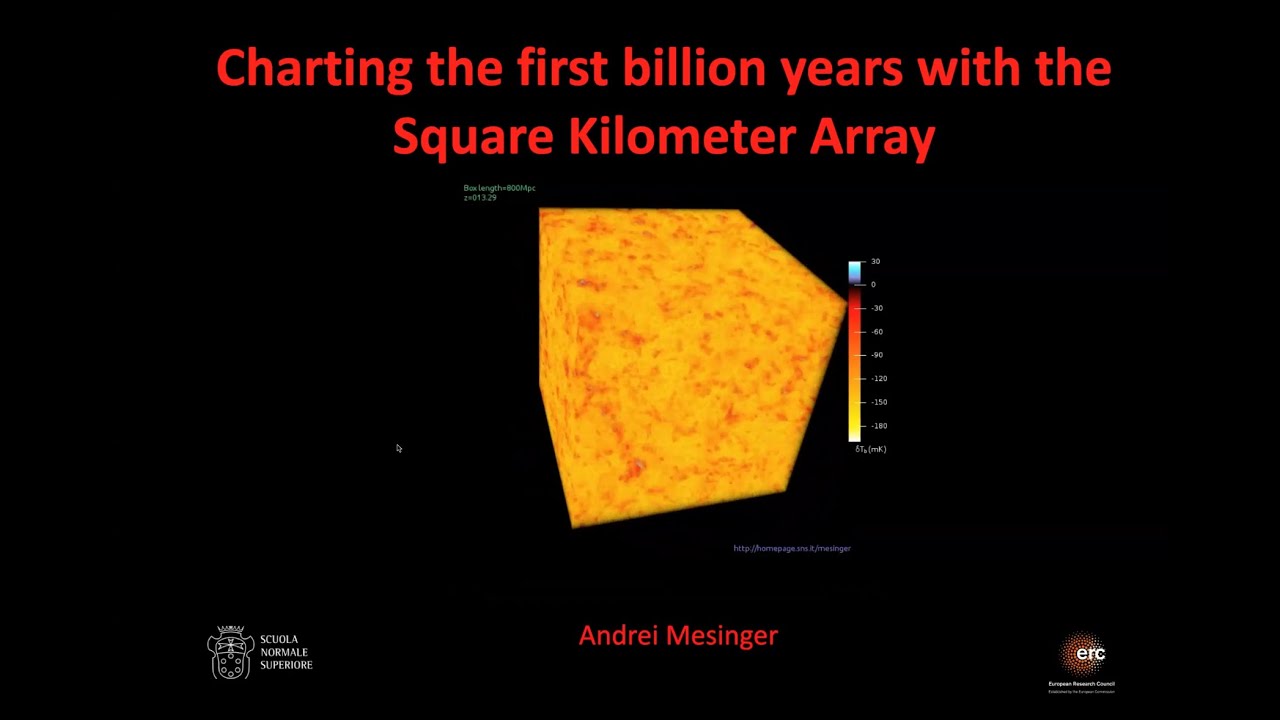
First Billion Years of the Universe with the Square Kilometre Array
@iaaudc
121 views•2022-05-26

Kepler's Laws of Planetary Motion Explained (Educational Astronomy Video)
@Peekaboo_Kidz
404.9K views•2023-02-17

Gamma-Ray Bursts: Cosmic Snipers Explained | Astronomy
@kurzgesagt
15M views•2016-07-31
Related Study Plans & Knowledge Roadmaps
Structured learning paths in Astronomy