




























In astrophysical fluid dynamics, the stability of a star against radial oscillations depends on the adiabatic index γ; a star is stable against radial perturbations if γ > 4/3, meaning the pressure response to density changes is sufficient to counteract gravitational collapse, while γ < 4/3 leads to instability where the star continues expanding after being disturbed. This criterion arises from analyzing the acceleration of fluid elements under spherically symmetric perturbations, where the restoring force depends on the difference between the adiabatic index and 4/3.
Ceptr Oscillations & Stability in Stars: Gamma Condition
Added:Hydrostatic Equilibrium: The balance between gravitational collapse and outward thermal pressure inside a star.
Thermodynamics and the Adiabatic Index (Gamma): The ratio of specific heats and how gas pressure responds to changes in density under adiabatic conditions.
Basic Wave Mechanics: Understanding of oscillation frequencies, standing waves, and the difference between radial and transverse wave propagation.
Stellar Structure Equations: Fundamental equations governing mass distribution, pressure gradients, and temperature profiles in stellar interiors.
The Kappa-Mechanism: Exploring how ionization zones and opacity changes drive stellar pulsations in Cepheids and RR Lyrae variables.
Asteroseismology: Utilizing non-radial stellar oscillations (p-modes and g-modes) to probe the internal structure, rotation, and composition of distant stars.
General Relativistic Instability: Studying how general relativity alters the classical gamma > 4/3 stability limit, leading to core-collapse in massive stars or neutron stars.
Numerical Stellar Modeling: Using computational tools to simulate stellar pulsations and non-linear hydrodynamics in unstable stars.
334 views3likes29:56Original Release: 2021-04-16
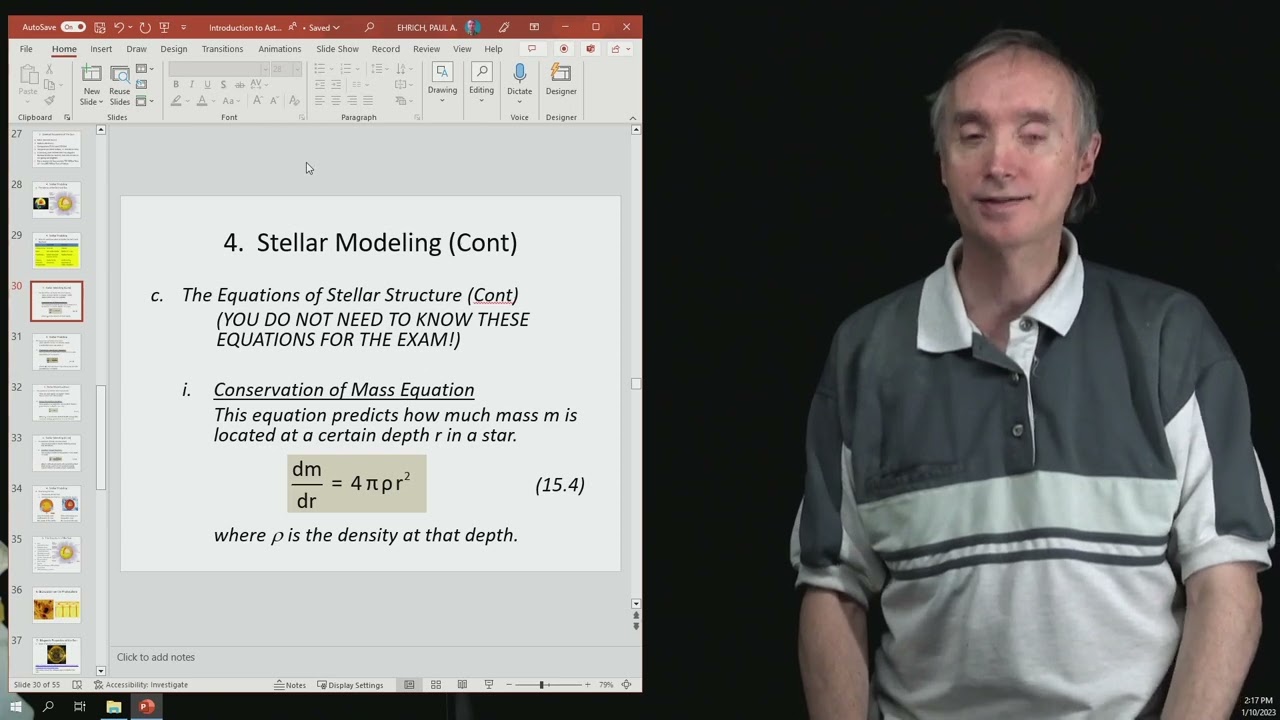
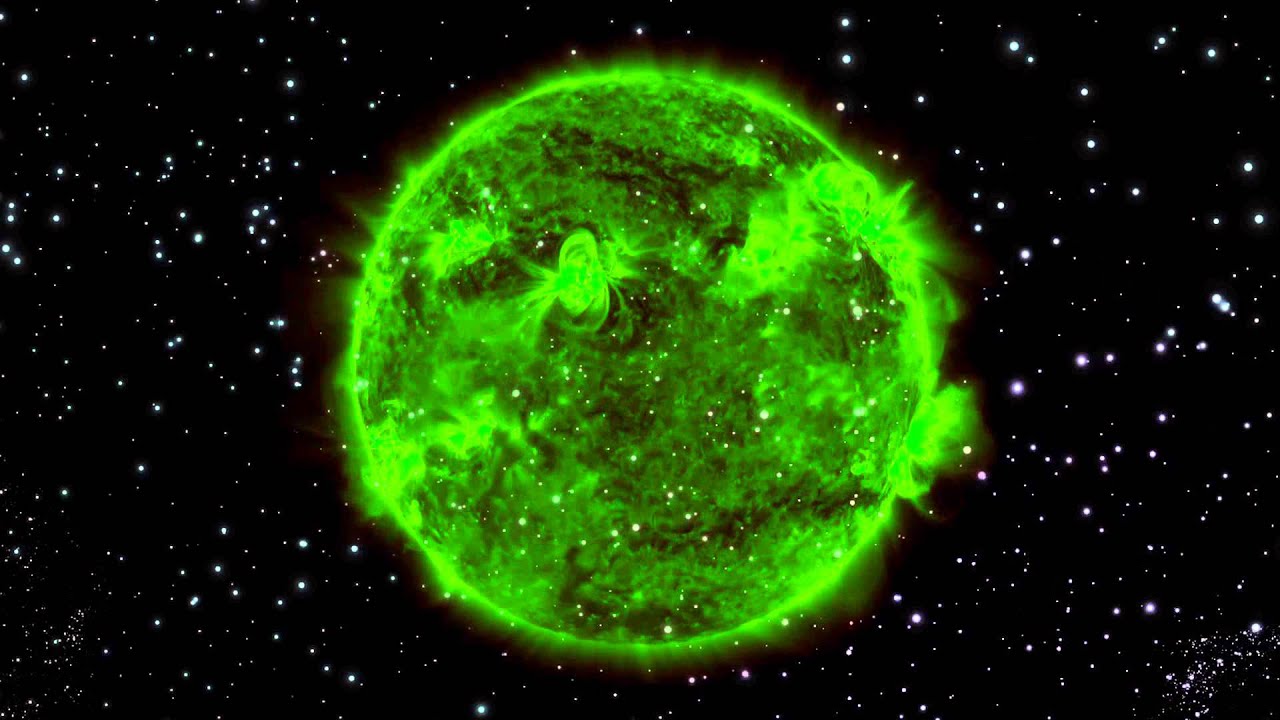
[Music] [Music] hello and welcome to another lecture session of introduction to astrophysical fluids so we here you can finally see some picture okay so this is the picture of a star which is oscillating so let's say this is the initial condition initial state at rest and then after perturbation this pink lines ok this is the perturbed figure ok and you can actually see that more or less if you are at a distance like r from this one from the center so more or less you are having the same nature of the perturbation ok whether you are i mean irrespective of whether you are here or you are here or you are here so this is a rough image of course we know that the pure radial oscillation or pure radial perturbation is an idealization in this case so in general we can just ah think that this type of figures are there so roughly considering this is radially symmetric and then we actually think that we we just like we just consider uh the equations of motion or the newton's equation for a fluid element so which which should i mean can be should be considered as a particle here and we will write the force equation for that so that this particle is situated let us say at a distance r from the center okay so if the particles velocity is v then dv dt so dv dt is nothing but if you remember in terms of the eulerian derivatives that is equivalent to del del t plus v dot nabla v okay so this dv dt is equal to minus 1 by rho dp dr why this is dpd this is in general gradient of p but here once again we are only considering the system uh in the i mean radially symmetric direction so the only component i mean only ddr will survive del del theta del del phi will not survive so del del r basically now has become ddr okay so this is something is ah is given ok so ah and minus g m by r square so this is the pressure gradient force and this is the ah gravitational force due to so this is the gravitational force due to self gravity so this ah so that's what that's what i have written over here that this equation is for a fluid element which is situated at a distance r from the center and the m is the mass of all the star which is inside which is situated from 0 to r the whole mass ok the whole mass for example ok so basically because because the fluid element it it ah how to say it ah experiences the gravity field created by the whole whole mass which is inside the radius r right that's the meaning of m so what happens at the initial state so our initial state is as assumed to be not only a steady state but as a static state so we just say v 0 and dv dt is also 0 so the pressure gradient force will simply be exactly balanced by the cell gravity if you just refer to this equation ok now ah let us assume that due to a spherically symmetric perturbation the star is expanded uniformly in all directions okay and the fluid element which was initially at r 0 will now be situated at some r so we now say that okay that was the generic variables r v so and it was also not i mean so this equation is uh true for initial state for current state any any later state okay so we are now calling all the initial variables at ah as r0 rho 0 and rho 0 and for example if you you will see that p 0 so rho 0 is the initial density r 0 is the initial so rho 0 is the initial density of the star of course and the r 0 is the initial distance coordinates of course you can also think of the position of the fluid particle ok so rho 0 is of course you can think that this is the density of the fluid particle at that which is situated at r ok ah which is situated at r zero so this is the initial density ok and finally ah just a minute yeah and p zero will be the corresponding pressure initial pressure ok so now what we will do we will simply perturb the position of the particle from r 0 to some value r where r 0 r is nothing but r 0 times 1 plus delta and this delta is greater than 0 but what i forgot to write this less than one is a very small perturbation ok and if this is true then the density of the star can be written as rho is equal to rho 0 times 1 plus delta to the power minus 3 that is simply because the volume increases from v 0 to v 0 times 1 plus delta whole cube if the if the radius increases like this then the radius q will be increasing like this and so the volume will be proportion i mean volume increase will be proportional to this factor and if delta is very very small it will be simply 1 plus 3 delta approximately this factor and so for the density it is actually reducing because density is nothing much by volume and the mass is unchanged for the system okay so maybe i was maybe at some point i said something a bit confusing that this rho 0 is the initial density of the whole fluid ok this is not the density of the fluid particle of course but this is the this is the density at the at the point r0 at the point r0 that's for sure through yeah now ah this density is now changed to this density of course i mean this is not a representative density this is the just the variable ok so initial variable was this final variable after perturbation is this but they are actually changing from one point to the other ok so that is something to ah not to forget ok and the volume is increased because we have dilated the star a bit by dilating the radius so the density will reduce by this factor and then it will be becoming almost rho 0 times 1 minus 3 delta ok now we have assumed polytropic closure so p will be if rho is decreased by this factor p will be decreased by this factor to the power gamma and that is exactly what i have written over here times the initial pressure so the final pressure is equal to the i mean the perturbed pressure variable is equal to the initial pressure variables times 1 minus t gamma delta and that is true for every point of the fluid right this is just relating the initial variables initial set of variables and the later state of value i mean later set of variables like current set of variables okay if this is clear then you can easily say that for initial state i can just write the balance equation of the pressure gradient force and the self gravity force using the initial coordinates that's exactly true 1 minus rho 0 times dp 0 dr 0 is equal to gm by r0 square and for current state i write the equations with the current variables dv dt is equal to minus so dv dt is no longer equal to 0 so this will be equal to minus 1 by rho times dp dr minus gm by r square but rho is nothing but rho 0 times 1 minus 3 delta p is nothing but p0 times 1 minus 3 gamma delta rho is again nothing but rho 0 sorry r is nothing but r 0 times 1 plus delta and here r 0 square will be nothing but r z i mean sorry r square will be nothing but x zero square one plus delta square and which is almost equal to one plus two delta one second just keeping the terms up to first order now ah if we do that finally we can say that this is nothing but 1 minus 1 by rho 0 d p 0 d r 0 times the whole factor 1 minus 3 gamma lambda gamma delta by 1 minus 3 delta times 1 plus delta now 1 minus 3 delta 1 plus delta gives you 1 minus 2 delta minus 3 delta square again 3 delta square will be neglected and we we will have simply 1 minus 2 delta at the denominator 1 plus 2 delta in the denominator will become 1 minus 2 delta in the numerator right delta is a first order once again and then finally you can write this 1 minus 2 delta equal to the minus 1 will become 1 plus 2 delta so 1 minus 3 gamma delta times 1 plus 2 delta finally keeps you to the first order 1 plus 2 delta minus three gamma delta and this will be multiplied with the initial pressure gradient force done okay minus the initial self gravitation for self gravity force term times one minus two delta so this is the factor which is now multiplied with the initial term and we know this one is equal to this one due to this relation due to this relation we know this one is equal to this one so finally we take the ah just replace this one by this minus by this minus 1 by rho dp0 dr 0 and finally we can get this whole thing dv dt will be now equal to minus 1 by rho 0 d p 0 d r 0 and within bracket 1 plus 2 delta minus 3 gamma delta minus 1 plus 2 delta ok and what is this this is nothing but 4 delta minus 3 lambda delta sorry 3 gamma delta sorry extremely sorry 3 gamma delta okay so finally what we obtain so finally we obtain that dv dt is equal to minus gm by r0 square times three delta within bracket gamma minus four by three so this is the final equation actually okay this is the final equation one should write for the acceleration of a fluid particle situated at a ah distance r from the center okay now ah the acceleration can be negative can be positive now what is the implications of that we were trying to dilate the same thing by putting some outward perturbation to the radius so we try to increase the radius right now if the acceleration so of course you know like these two forces i mean the gravity and the pressure gradient force the acceleration is also radially directed and if the acceleration is radially directed then this will ah be positive i mean if this is positive that will simply indicate that the system will be dilating and if this is negative then this will indicate that the system will try to get back to its original position so it will counter act the act of dilution and when dvd is greater than 0 simply because g m r 0 squared 3 delta all are positive so the only possibility that this becomes greater than 0 only when gamma is less than 4 by 3 then only this part is negative and this part is negative makes makes the whole thing positive so if gamma is less than four by three then the system if dilated a bit it will continue expanding thereby supporting or enhancing the dilutation and that is why we will have instability however if you have gamma greater than 4 by 3 then the acceleration is actually ok in radial direction but in inward direction because then it will be negative this this thing will be negative the total thing because this is positive then we will have the so the acceleration is in the i mean radially inward direction and so opposes the expansion and then it leads to the stability now here at this point just think of it we understand a very i mean the result is interesting the result is simply obtained so we have enough reason reason to be happy but before being happy just think what is the physical reason because finally we are doing some astrophysics so some physical reasons should be thought why that i mean gamma why it is like that when gamma exceeds ah critical value let us say four by three ok finally gives a rise to the stability otherwise it is unstable of course a very simple and very apparent explanation is there that is whenever you are trying to part of the system let us say by increasing the density for example then what happens then you are just increasing the density at any one point and so the self gravity force will be important at that point but if your density is increasing due to your polytropic closure your pressure will be increasing and that will actually increase the hydrostatic pressure to balance the effect of the self gravity now if your gamma is higher and higher i mean higher than some critical value okay then some increase in density will make the increase in pressure so important that it will be enough or it will be sufficient to counteract or counter balance the gravitational effect self gravitational effect or collapse type of thing efficiently whereas if gamma is less than this four by three value then what happens then the pressure the pressure perturbation is not sufficient to counterbalance the gravitational effect and the same thing can be actually thought if we decrease the density okay so for example here we are just decreasing the density so we are decreasing the density the um the gravitational with the self gravity force basically decreased but with the decrease in density how the decrease in pressure will act because if the if if pressure wins again so here we are trying to curb the gravitational force so if the pressure is ah still very much enhanced then it will actually expand so we can have actually two types of instability one is instability by expansion one is instability by collapse both should be counter balanced by their corresponding enemies okay so here you will see that we we try to dilate the system and then this dilatation is actually counter balanced by the ah reduction in the hydrostatic pressure gradient force ok so and this is this is exactly the same mechanism by which one can actually think of stability and instability in this framework okay now when stability is there then every time every time you are increasing or decreasing the density so you make a change so increasing and decreasing density means increasing or decreasing the gravitational effect okay so your pressure pressure should be efficiently increased or decreased respectively so that you can nullify or counter balance as soon as possible the effect caused by the perturbation so that is the very i mean apparent and ah apparent and straightforward i mean discussion now it is true that we the there is a i mean that is an interesting thing about four by three so four by three actually i mean maybe not really relate directly related so it has a very much i mean very interesting importance in this this number four by three ah in the context of chandrasekhar limit okay so you search and you let me know that whether you got it or not okay this is very much in very interesting 4x3 so you know like for a normal gas for normal classical gas what is the adiabatic index if it is consisting of monatomic gases its 5 by 3 can we have some gas for which the adiabatic index is 4 by 3 check okay so these are very interesting things and also i said that there is a relation with that and chandrasekhar limit okay anyways coming back to our question that here we have not done proper linearization proper dispersion relation we have just taken a fluid element and we have tried to analyze its motion whether it is after under dilatation whether it is trying to accelerate outward or inward very simple of course this type of simple analysis is ah good for symmetric cases and actually if you do the formal calculations you can actually see that um the stability criteria which we get here is exactly the same that is gamma should be greater than four by three okay now ah one can actually do a proper analysis and from that one can also think of ah i mean can find out the stability criteria ok now what happens so here in this case we have done very simplified radial oscillations but what happens if we consider non radial oscillations can we have something better i mean something much more formal then should we should we do something much more formal well then actually this system i mean the solution is no longer as simple as this i mean yeah as simple as this then here you will have also something called y e l m there will be another two two other index which will be the function of theta and phi and you can you know they are known as spherical harmonics if in case you don't know search for it what they are so in case of non ah radial oscillations we have to use the spherical harmonics okay and we have to perform a ah formal analysis process okay finally the question is that if the radial oscillation is so in simple why should we at least at all think about non radial oscillations because let us now have a look at the reality and what is the reality our neighbor and our uh the i mean the central star of our solar system this is sun how can we forget that one and actually likes the fade variables sun is also an oscillating star but sun is full of non-radial oscillations and solar oscillation is a subject of very very interesting and ongoing research okay so many people are working currently on this subject of system i mean solar solar oscillations and this is known as the subject of helioseismology okay in general when we are talking about the subject of the oscillation of stars we talk about the asterosystemology and just for the sun this is known as helioseismology okay so since sun is full of non radial oscillations a careful and thorough analysis of the perturbation and deriving the dispersion relations is the only way we cannot emit that cannot avoid that and here in this picture you can actually see that this is one of the schematic picture and this picture is actually taken from internet so courtesy to nasa okay so this picture gives you a uh a clear idea about the oscillation of at the sun's surface okay so this is the oscillation at the sun's surface so the oscillation of the sun surface was actually ah first established by three people light on i am sorry okay later on uh noise and simon in the year 1962.
so this is much more recent and finally whether they are just i mean then the people actually thought that maybe some some oscillations were there at the surface and then people thought that maybe they are local oscillations and they are not global but for i mean how to understand whether this is just a local oscillation or local perturbation or this is not really something uh like related to the global i mean global mechanics or global dynamics of the star we have to actually then find the corresponding eigen frequencies if the eigen frequencies of those oscillations match with the eigen frequency of the global system ok global star ok including its geometry and the boundary conditions then this is an indication this is the indication that the oscillations which we see at the surface level they are actually the oscillation of the whole body okay due to the whole body so we we discussed much earlier two type of forces body forces and surface forces so it's all so i always love to make analogies in this philosophical part so here this is also like body oscillation and surface oscillation so surface oscillations if this is totally uncoupled from body then this is not of interest not not this doesn't belong to this current analysis but it is ah if this is a part of the bulk oscillation then this is a this is something which we are now studying we are now studying the body oscillation thing ok so for the first time if you see that dubna in the year 1975 he actually showed that this is actually related to the proper oscillation of the sun and this is the um like related to the eigen frequencies of the sun's bulk okay the sun's body okay and then the proper development of his heliosmology was ah caused or was um i mean brought in into the picture and now it is of course a question that why this is useful because helioseismology other than the oscillation mechanism and the luminosity and the variable i mean the luminosity and the temperature variations of the star of the sun periodically there is another very interesting and fundamental useful i mean how to say utility of the helios seismology that is that this helps us know about the differential rotation of the sun and actually the sun is rotating we all know and this sun does not rotate like a solid body so every single i mean the the concentric spherical shells or layers they are rotating with different angular velocity and by using proper analysis of halo seismology one can actually know what is the ah variation of this and what is the i mean what is the dependence of the angular velocities of radial dependence or i mean in any case i mean the dependence of the angular velocities in various parts inside the body of the sun okay so ah that was all for this of course of course if you are further interested you can check uh all the books and the internet there are very good books about this so one book who is which is uh ex i mean very intensively discussing the sun's oscillation or other stars oscillation but mostly non radial part that is the book by unosaki okay so you can see the book's name is known as non radial oscillations in stars maybe okay i am just not sure but this type of name okay so just have a look you have also on internet so many things so this is a very very interesting topic where you can actually find your topic of research as well okay so that was all about the waves oscillations and instability linear instability part for our course so in the next discussion we will start a new topic that is the effect of rotation in astrophysical fluid dynamics ok thank you very much [Music] [Music] [Music] you
Up Next

93:41
Neutron Star Perturbation Theory: Oscillations and Modes
@ICTStalks
284 views•2024-01-04

12:53
21cm Hyperfine Transition in Neutral Hydrogen: Radio Astronomy Basics
@AaronRobertParsons
12.4K views•2011-10-13
28:18
Solar Wind-Magnetosphere Coupling and Geomagnetic Storms | Space Environment 04
@IITKanpurNPTEL
202 views•2025-07-24

27:14
Entropy and the Second Law of Thermodynamics Explained
@veritasium
27.5M views•2023-07-01
Related Study Plans & Knowledge Roadmaps
Structured learning paths in Physics
physics
Nuclear Physics (Decay, Fission & Reactors)
01Atomic Structure and the Binding Force
02Radioactive Decay and Half-Life
03Nuclear Fission Mechanics and Chain Reactions
+ 2 more learning modules
12h5 modules
Explore Roadmap
physics
Soft Matter (Polymers, Colloids & Rheology)
01Foundations of Soft Matter & Thermal Forces
02Polymer Physics and Macromolecules
03Colloids, Surfactants, and Self-Assembly
+ 2 more learning modules
38h5 modules
Explore Roadmap
physics
Analytical Mechanics: Lagrangian & Hamiltonian
01Mathematical Foundations: Calculus of Variations
02From Newtonian Mechanics to Constraint Dynamics
03The Principle of Least Action & Lagrangian Mechanics
+ 3 more learning modules
28h6 modules
Explore Roadmap
physics
General Relativity (Spacetime & Cosmology)
01Foundations of Relativity: Special Relativity
02The Geometry of Spacetime: Equivalence Principle & Curvature
03Einstein's Field Equations: The Mathematics of Gravity
+ 2 more learning modules
55h5 modules
Explore Roadmap