


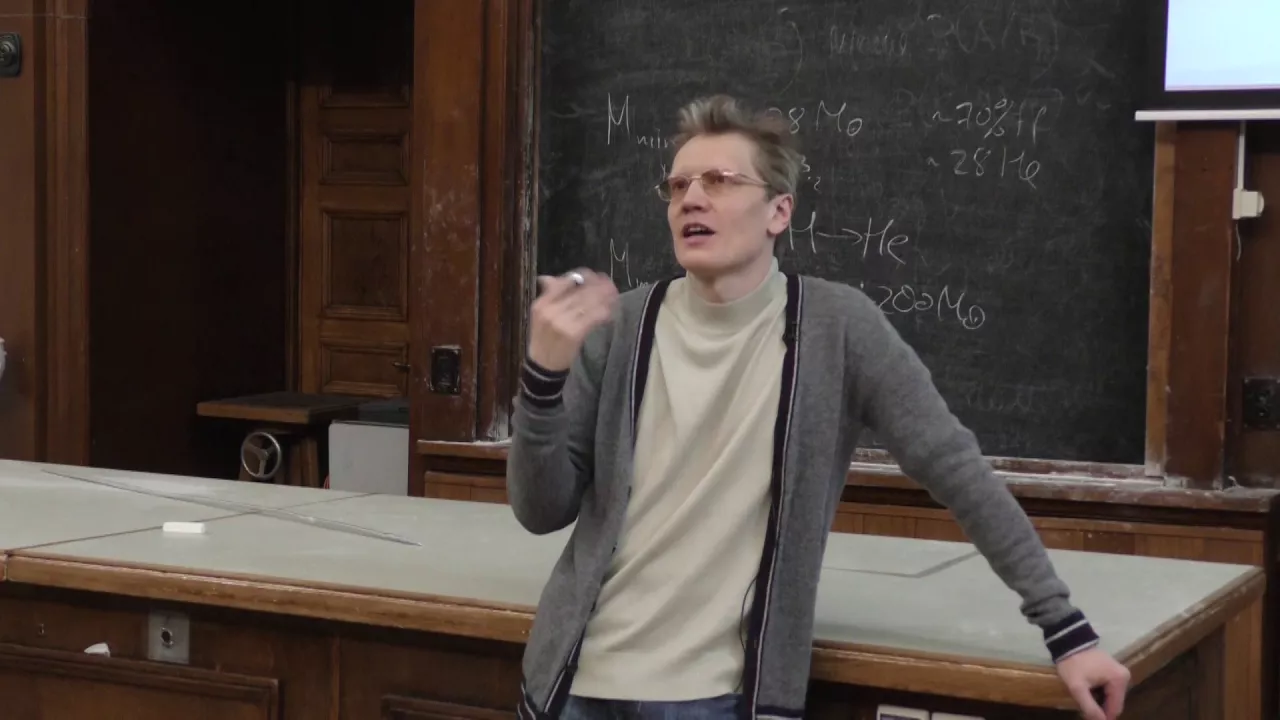










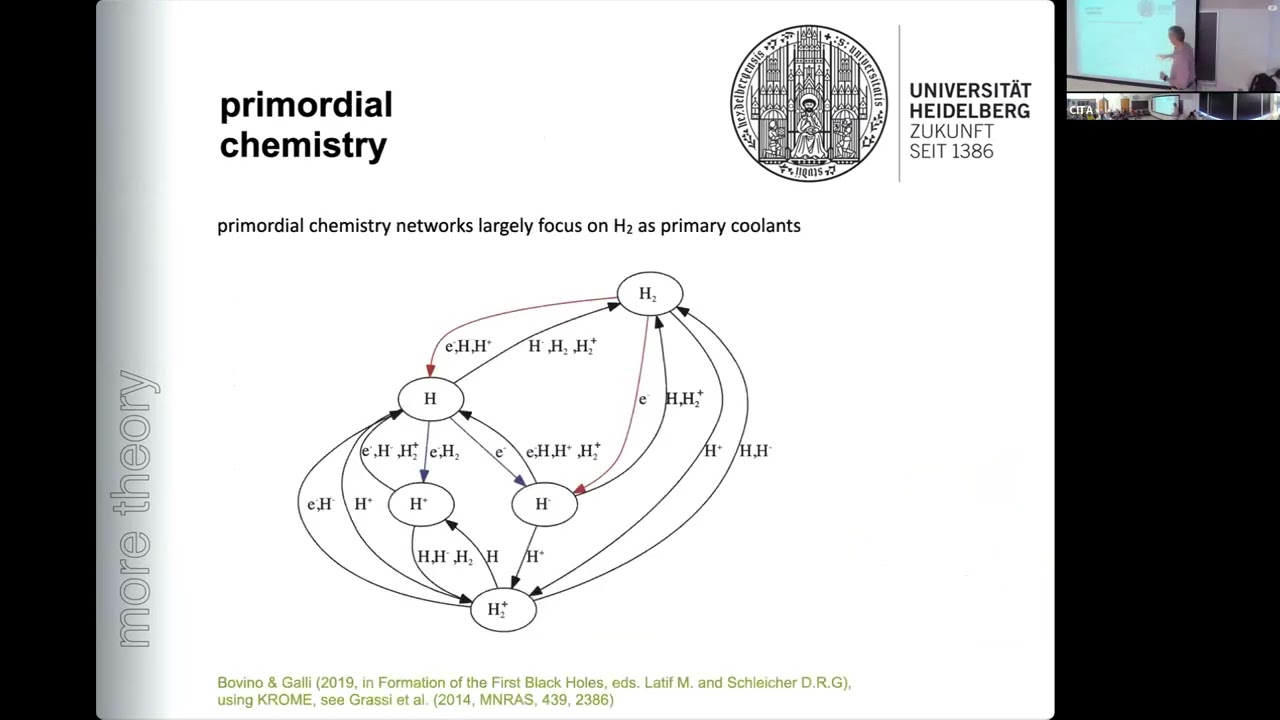






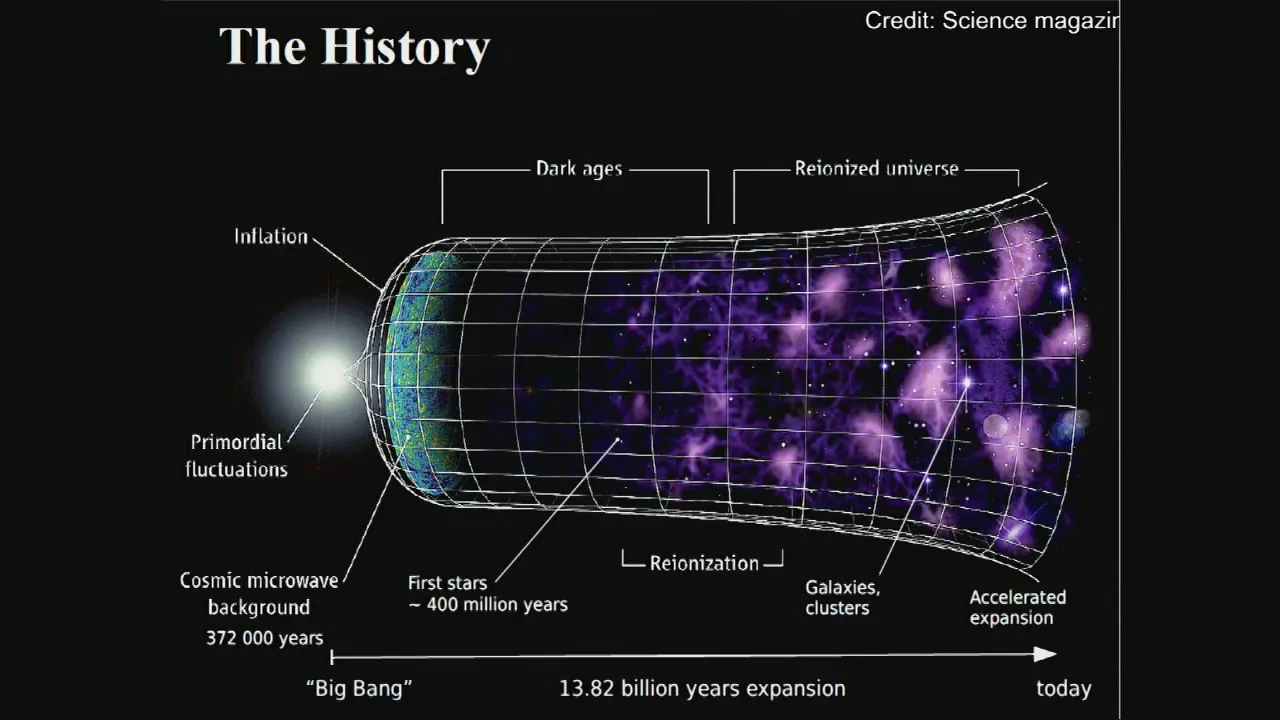

Population III stars form in metal-free mini-halos with masses around 10^5 solar masses at redshifts 16-20, where H2 chemistry is critical for cooling; the gas must first heat to ~1,000 K to form sufficient H2 for cooling, then cool to ~200 K before HD cooling enables further cooling to ~40 K, allowing fragmentation into stars with masses ranging from ~50 to ~500 solar masses depending on the cooling mechanism.
The Chemistry & Thermodynamics of Population III Star Formation | Paul Clark (2013) | AstroComputing Summer School
Added:Understanding of Big Bang Nucleosynthesis (BBN) and the pristine composition of the early Universe (primarily hydrogen and helium, with lack of heavy elements/metals).
Fundamental concepts of stellar structure and star formation, particularly gravitational instability, Jeans mass, and free-fall collapse timescales.
Basic thermodynamics and radiative cooling processes, including how gas loses thermal energy through atomic and molecular transitions.
Introductory chemical kinetics, specifically gas-phase reactions and the distinction between two-body and three-body reaction rates.
Advanced computational astrophysics and hydrodynamical simulation techniques (e.g., SPH, AMR) used to model primordial gas collapse.
The transition from Population III to Population II star formation, including the concept of 'critical metallicity' and the dust-grain cooling pathway.
Observational cosmology techniques aimed at detecting the first stars and galaxies, such as JWST deep-field imaging and 21cm line intensity mapping.
The role of Population III stars in cosmic reionization and the feedback mechanisms (UV radiation, pair-instability supernovae) that shaped the early intergalactic medium.
280 views3likes54:04Original Release: 2013-08-01
today I was going to talk about population three star Mission and um I've been talking the last couple of days about chemistry and Cooling in the ism and really been highlighting the fact that the chemistry in the ism isn't really doing much to the uh to the cooling okay so most of the cooling is is taken over by either C+ um and dust and so the chemistry that you're doing there is more of a for a diagnostic basis right really wanting to see what happens when you observe um that simulation and you try to compare it to observations okay so population the Stations of very different regime um in which the chemistry matters a lot okay now you don't have very many you don't have any Metals basically it's just all all hydrogen and etherium chemistry uh for the most part um and so you would think that the chemistry is actually much simpler because you've got less things to do but the fact is you have to take much better care of the H2 chemistry simply because it is is is much more important for the cooling okay now I should also say that people started doing chemistry in in hydr damic simulations long before they started doing it so they started doing it in in in population three star formation long before they started doing it in present day star formation okay for the ism so people like Tom Abel fuer Brum um naoki ashida Kazi omakai and and various other people whose names are probably forgotten and not mentioned here have been working out the details of the H2 chemistry for some time okay so what I'm really telling you here is is is what's been built up through about a decade of people trying to figure out how H2 works and and the physics of the H2 and and and the hydrogen atom so where do the first stars form just kind a quick overview well they form in mini Halos and dark matter Min halalos which have masses around about 10 to the five solar masses and above and these Min Halos um become fertile at roundabout red shifts of between 16 and 20 okay so 20 was the was perhaps somewhat of an older estimate nowadays people think it's 16 and the reason why that has changed slightly is is if we now include the free streaming motions so um the gas should the barion should stream um um against the uh the dark matter um in the initial conditions of the universe and then that extra streaming then delays the collapse in the mini Halos to R about um V of 16 and so Thomas gri and a of paper back in 2011 was showing that with um using a repo and the temperature in the Min Halos is around about 1,000 Kelvin and that's really the the variable temperature right so that's what happens when you take the kinetic energy of the dark matter in there and try and convert it to a physical temperature and for the most part that is the temperature that the gas the Barons inherit when they fall into that into that Halo okay they're excited up to that temperature and if they can't cool and the gas density in these sterile Hal in these um sorry fertile hals is run about 1 G per cubic cm okay so why are these conditions the conditions for population the star formation and what sets it is what we'll be talking about as we go on the talk yeah what right do you need re on the um I'll come to that it depends it's the reason why it's actually to do with the variable temperature okay so the variable temperature here is is key here and I'll come to that in a couple of slides good yes good question it's a right question to be asking okay so just I want to kind of just say briefly how people are doing this in numerical simulations what the current state of the art is what you tend to do is you have some large scale cosmological um simulation which follows the dart matter and the expansion of the universe and here's one by a student in our group in heidleberg mesaki um she's been doing this one here which is a 2000 Cube Dark Matter particles and she's got dark matter um particle masses around about n solar masses so right so she can resolve the Halos where the stars form fairly well in this one uh in this in this Co moving Mega part um box here okay and um the reason why you want to some large part of the universe is you want to be able to see different fluctuations in the dark matter um Power spectrum and see how these different Halos um evolve into into the pop three stars okay now for doing an actual if you want to zoom in here and actually follow the gas in one of these Halos you probably will have to again resolve the Dark Matter again people do these multi um resolved um um zoom in calculations where they're trying to going to keep some patch of the uh well some representation of the of the global box but a lower resolution then they have gradually increasing resolution as they go into one the many hals by increasing by decreasing the uh the dart matter particle masses okay question gas there was no gas in the simulation it's a pure mbody um so what may was actually doing here is she wanted to you know a very it's a very common practice in in doing uh population th star formations that people run a big box like this and they then say okay that's the Halo that collapses first I'm going to focus on that and then they zoom in and then they work out where the population three stars are right and then if they want to see any Cosmic variance they want another big box again they take the first Halo to collapse and do that again right so what may wanted to do was she wanted to zoom into many Halos within the one box to see if there was you know if um if a if a Halo collapse is you know somewhere else maybe kind slight under density um compared to the first thing that goes off will it have different properties for the star motion process the vure for that sure I think is run about 20 at this point okay so that's it's been evolved to the point where the first Hill is begin to collapse okay yeah yeah so she's now actually should say she's now actually zooming in some of these and putting the gas in as well okay okay so so that's kind of that's kind state of the art R about so if you want to do like the basic grid first you want to figure out where your your Halo are going to be you probably need start off with something round about 2,000 Cube and you're going to be starting with kind of a CO moving Mega par set okay and then you can decide where you're going to zoom in and then populate that simulation volume also with the Barons um and then you can choose whether you put in that streaming velocity or not obviously it's more accurate if you do okay okay so why do so the back the question why is this um so go front there asked the question why do you have this um uh 10 to the five solar masses being setting the uh the point where they become sterile H Sor become fertile and the reason is is to do with the chemistry in the gas okay so the chemistry that taking place here is this ion neutral reactions that I was mentioning the other day and we're saying that in the in the ism in in the present day ISM these are particularly ineffective because these species here this H minus and this h2+ are very fragile and they get broken apart by photons which we have lots of in the present day universe and when these stars are forming in the other Universe there aren't any of these photons to to break these intermediat species so they can last for a long time and then they can go on and actually create the H2 okay as we were saying before it's a catalyzed reaction you have these electrons which are left over and also the protons which are left over as well okay so they get recycled in the reaction and what you can see there is that obviously the uh amount of H2 you're going to form is going to depend quite critically on the ionization fraction that you have in your Halos okay so it's important to be able to follow the chemistry well enough to be able to track the ionization fraction in the the Halo as they form okay so why does it occur in Halos around about 10 to 5 well you need the condition that the cooling time to get any gas to collapse inside the Halo the cooling time has to be less than the Hubble time okay now below 7,000 Kelvin H2 is the only useful coolant you have okay so if you want to be able to get your gas to cool you're going to have to form H2 and you have to form enough H2 that you satisfy this Cooling Criterium here okay so you have to be able to create enough H2 in those Halos and it turns out that when you get to a temperature of about 1,000 Kelvin you start to create H2 fast enough that you start to be able to cool okay so it's only and and, Kelvin occurs when you get a mini halo around about 10 to 5 casses okay a 10 to four um Sol Mass Halo would have a ver temperature of maybe about 500 Kelvin it wouldn't form enough H2 therefore it's cooling time would be longer than Hubble time and it would just sit there sterile okay so that's the reason why you need to have that and so you have this kind of slightly strange kind of counterintuitive concept which will keep popping up as as as we talk here that to get the thing to actually cool you have to make it hot enough first okay slightly counter intuitive you'd imagine that star formation would be better if you had a lower temperature because the G the baronss would be able to cool faster turns out they can't because um sorry lower temperature cuz they have a jeans Mass turns out yes they might have a jeans Mass some point probably actually they don't but they could do if this if they were to gradually accumulate more and more mass but the problem is that the cooling time would simply be longer than Hubble time and they would never collapse okay so that's very very important any questions on that before I go on yes two more you start collapse we start to collapse in the in the general um Intero medium it's run about 10us 5 okay and to get I'm saying okay and to get cooling to occur you need 10 to- 4 10us 3 for the cooling to be effective for this cooling Criterion to work so just to make sure I understand what's going on once the Halo reaches above the critical temperature the ionization fraction high enough the electrons the protons can then form H2 which can then subsequently cool the gas ler you actually have enough electrons and um protons even before that the is that the formation rate of H2 just in general is not long enough it's a very sensitive function of temperature as you increase the temperature these reactions occur much quicker and then you get the H2 so it's not the iation state it's just the actual Motion in order to get them exactly it's to do with it's to do with the collisional cross-sections of the of the rect yes it is dependent on the dens on on the number density of the the anization fraction as well but you already have that that uh at lower temperatures that condition's already been satisfied so this one is just to get the H2 to form finally is there anything else okay so coming back to this idea of what the H2 fraction is how is it set well we've just said that the ionization fraction um is is is important you need these electrons need the protons and if you a very low ionization fraction you obviously couldn't get this reaction to work if you very high ionization fraction it will go very rapidly um the problem is that the ionization fraction is continually decreasing as the density increases in the gas okay so um the electrons and protons start to rec combine as the density increases and so you have this problem that the H2 is trying to form but it's losing the electrons and protons at the same time and so there's a balance there and ends up what happens is the the um the be combination of the electrons and protons eventually winds and that sets an upper limit to the maximum amount of H2 you can form by this process in a collapsing Minal okay it turns out that the amount you can get is a few 10us 3 okay just because at that point you start to run out of electrons and protons and the reaction rate drops to the point where it doesn't really continue anymore you'll see that again in a couple of slides okay so this process although it's very efficient initially it then plate off and you can't get above 10us 3 H2 fraction but that t that is enough H2 to be able to cool the Halo and low star formation to proceed so just mentioned that so what happens next so this is a nice plot from uh Nai does paper in 2006 and some of you may be familiar with it already I just wanted to kind of I showed it the other day and people were asking what the different stages here were in fact someone was asking can't remember who it was was asking um what was going over here I'm actually going to focus on all the stages here and just kind of kind of work you through what's happening in the Halo as as as the gas collapses okay oh so the first thing that happens is the gas falls into the Halo and it can't cool so it's kind of Behaving ad diabatically so it shocks up to the variable temperature of the Halo right which is set by the by the the gravitational energy of the system okay now during that process the gas gets hot and then eventually some of the H2 can form so the H2 starts to rise okay so it goes down from there that's the um people were asking what the H2 fraction in inter inter Halal medium there you can see it's a a few 10 to Theus 5 okay so the H2 starts to form during this um shock in the minillo eventually at some point the the the um the H2 fraction is high enough the gas can start to cool and therefore it doesn't shock anymore also it will just reach the variable temperature of the Halo as well okay so there the kind of two effects there that are capping the top the top temperature and at some point the gas will start to cool again the H the H2 formation is continuing to rise at this point so now what happens is that the H2 formation um so the um the H2 information has got to the point now we have enough H2 to be able to cool the gas very effectively and it turns out that the H2 is not in thermo equilibrium right it's in the non-lte limit which means its cooling goes as the number density squared okay now the heating rate from gravitational collapse goes as the number density to three halves right so the cooling winds and so as you collapse to higher densities the gas is able to cool as it collapses rather than heating up as it collapses okay so you get this nice um cooling regime here now people have tried to kind of kind of say that this is very similar to what happens in the ism where you have C+ Cooling and you get this cooling instability it is not C plus cooling is almost independent of temperature and it's just a very strong function of density goes density to the uh to the power of two in non LTE uh case here the cooling for H2 is actually a very strong function of temperature and it's begin to become less effective as you go down so it's not a true thermal instability like you have in the ism okay so please don't make that mistake um at some point you're also like I was saying the rec combination um occurs with electrons and so your H2 fraction starts to platum you see it's kind of It kind of now for a very large range in density here it kind sits there and does almost nothing okay at some point down here you see the temperature kind of hits hits a minimum and that occurs around about a temperature around 200 Kelvin and so you say well okay what's happening there and what's happening is that the um the H2 cooling is only really excited very well above um 512 Calin that's where the G2 rotational state is and so below this temperature it's dropping off exponentially that's what I saying it's not it's not a it's a very very strong function of temperature okay and when you get to about 200 Kelvin so the H2 cooling becomes fairly ineffective for this amount of H2 if I had more H2 I could cool a little bit below 200 Caron but for a few 10 to minus 3 I can okay so I'd have to have more H2 I don't have that H2 because again the recombinations of set some plateau in in in what you're allowed okay so that is limiting the amount of um it's limiting the bottom of this of this temperature um density curve here now the um temperature and density here at this point are setting the gene mass in the Halo and that's going to be the genes mass of which the fragmentation inside the Halo occurs and it's going to set the characteristic mass of stars okay so um at this temperature and density the Gen mass is about 5 Sol mass or so it's much much higher than it is in present day star formation you also see that the temperatures again are much much higher and so you have a higher accretion rate so people have always assumed that because of this you have a very big gen Mass you very high accretion rate these stars are going to be massive in the universe they're not going to be like the one Sol mass stars or point two Sol mass stars that that Prevail today okay so that was that That's the basis of that argument comes from is just from this inflection point here in the temperature denate diagram okay now as we go to higher densities you see that the gas starts to gradually heat again so what's happening there well what's happened is the H2 has now reached its critical density it's no cooling um it's now an LTE Cooling and so the cooling rate now goes as n rather than n SAR we said that the gravitational compressional heating rate is going as well n to the 3es so the gravitational heating is winning over the cooling okay so the so the the actual the um the cooling time if you like is now longer than the coll than the um the freef fall time and the gas will gradually heat up as it as it continues to collapse okay it has to heat up to be able to balance the heating rate that you have from the gravity and so you get this gradual rise you see a kind of a similar effect when you're looking at dust temperature Cooling in present day universe as well okay it's not quite as strong as that but is is similar okay any questions there before go on yes what happens the isar so what's happening so so in in non-lte every time two atoms uh sorry two molecules or molecule collides let's say you got an H2 um molecule and you have a hydrogen right so every time they Collide the energy level gets excited and it can radiate away okay so your rad your amount of um of radiation you have is just then set by your Einstein a coefficient okay once you've hit the critical density above what's happening is that you yes you excite that um that energy level but that energy level can be be collisionally de exited before it gets the chance to radiate away okay and so you're robbing the gas of its ability to emit those photons and so the cooling rate is then reduced and you find if you work through the mathematics which you can get in any standard um Spitzer textbook for example you'll see that it comes out as it cools then as n rather than n s okay so extra factor of n disappears okay one simp way I'm understanding that is just saying high density the gas goes to L sure the energy levels become right so so the rate ofion is just proportional how many emitters in that level populations are totally uneffected so the cooling rate per unit volume is simply proportional the number of ATS yeah anything else okay so um you'll see here that you have this very dramatic rise in the H2 fraction you're probably wondering what's happening well at some point um the density and temperature become high enough that those three body reactions I was talking about before we have three hydrogen or an H2 and two hydrogen are able then to create H2 very very effectively and they manage to convert almost all the hydrogen into H2 within you know a couple of decades in density it's a very very rapid change and then once you get that um um huge amount of H2 you can then cool again much more effectively which is why you see a platting in the temperature curve there okay so the gas is then able to cool again um uh sorry I had to mix my slides up here in the order so um just want to say a little bit more about the three body H2 information uh regime it's chemically it's very tricky and thermodynamically it's also very tricky right you have this reaction rate which is going as n cubed okay so it's very very strong function of density which is why it rises up so quickly in density space on that plot and um if you take one of the reaction rates um for example the one by Simon Glover here um and you plug in the numbers and then you work out the heating rate as a result of this for every hydrogen um molecule you create you heat the gas by 4.4 EV you can work out a heating time um you can work out a time scale for to create uh to create all the H2 and you can also work out a heating rate in the gas and what you find is that when you get to number densi around about 10 to 9 10 to 10 the heating rate in the gas is much much larger than you get from compressional heating due to gravity okay so that becomes the dominant source of heat in the gas at that point and what you inen to find that the collapse slightly stalls very briefly while all that H2 is being converted however once the H2 is converted then you've got a lot of coolant okay and then the gas can again cool again so you got this very complicated regime where there's two competing forces um which are trying to kind of do very different things to the gas okay so it's a very difficult regime to get right in in in your calculation you have to take care about it when you're trying to uh Solve IT numerically yes 10 10 that's by by 10th to 10 yes but between 10th to 9 10th to 10 you start to get that regime where everything starts to balance okay now before I go on I should also say reason I want to kind of have more time in this Slide the three body reaction rate in this regime at a number density of round about 10 to8 and temperature of of um 1,000 Kelvin is uncertain by two orders of magnitude okay that's quite a lot so um the the rate that we pick here the um Simon one is sitting in the middle okay so what we've done in the past was we tried to to you know if something's uncertain by two of magnitude and you think it's going to make a strong effect on your um your your hydrodynamics your thermodynamics the best thing to do is a numerical um experiment and you just run two simulations where you pick the extremes okay so the extreme rates are um from um Tom abble the Abal one um back 2002 is the is the the quickest rate I no it's the slowest rate I think and is the one by flow and Harris in in 2007 is is the fastest one and if you just do a simulation you compare those two you do see you actually do get differences in the um in the structure that comes out of that phase okay so it is a very important phase and the fact that it's uncertain is a big uncertainty in population three star formation okay so at the moment we normally just take the one in the middle and say okay this is the kind of chronical one but obviously that's not good I mean Simon would actually argue that his is the best obviously so um CU he's doing the uh he's doing the rate a little bit more carefully than some of the others have done but still um it's also extremely difficult to measure this in the lab um Dan um I've forgotten the name sorry um we're um um being or Simon sometimes collaborates with um people who do actually experiments to try and measure these reaction rates um so these are physical chemists and they were interested in the fact that this one is so uncertain and maybe trying to get a handle them what this case should be but it's extremely difficult to do this in the lab because you have to get three hydrogen sitting there doing nothing and then let them go right you to keep doing that in different temperature regimes to actually figure out what's going on so okay it's going to be a long time before that's actually been done properly in the lab and at the moment people are saying they think it's kind of impossible for for the time being okay so you're reduced to having theoretical um um approximations for it okay okay uh do I have the same slide duplicated yeah I did okay that's what happens so um as you get to higher densities you've just created all this H2 the density is getting very very high um your gas is trying to cool via H2 line Cooling and the problem is that then the opacity of the H2 starts to rise right because you just have all that H2 column there and the photons can't escape and because of that you find that the temperature then starts to rise again so it enjoys a little bit of a dip and then gradually starts to rise again so for about a decade in density it can cool very efficiently and then after that it's like oh I I can't cool anymore and people have looked at this little dip here and they try to see that well you know perhaps in that little dip you can it gas can fragment again you've got this little time where you can cool faster than the Free Fall time and anytime you can can do that it's a chance for you to fragment right and so people thought that this chemothermal instability that occurs here would allow you to create more fragmentation turns out some no she actually in I don't know if it was this paper or 2007 one I think it was this one examines that and actually finds that the regime is quite stable okay had it lasted for longer in density space then it wouldn't be stable but due to the fact that it's just only one decade in density or so um it actually is not enough time for the gas to fragment sufficiently during that Thomas gri also has a new paper on this where he is claiming it is more efficient I don't really understand the differences I must confess so but you can go and look that up if you wish okay so what happens at hard denes well the gas obviously doesn't go straight away ad diabatic something else is is happening there you can see it's still the temperature is only gradually Rising with the density so what's going on and what's happening is a thing called collision and Juice emission and that's when you have two H2 molecules come together for a brief time and they create this big super molecule the dipole okay and then you can have all sorts of um transitions for the electrons inside that super molecule okay it allows them to cool very very efficiently and it's um it it creates a Continuum of of points because you have the electrons in this in this kind of random orientation okay you kind have various energy states as the two H2 come together okay so that allows you to cool via Continuum and Continuum cooling is always very good so if you can push your um cooling over a Continuum rather than a channel you're always doing better and it allows you to cool very efficiently for again about a decade or two in density right so you get from round about 10 to 13 to 10 to 15 a number of densities beyond that point uh cie cooling also becomes optically thick eventually the Continuum becomes optically thick um and then eventually you um you reach this point here where the gas is still cooling you see it's not still not rising and the reason why it's not Rising it's now breaking apart H2 okay so as the gas um gets hotter you get collisional dissociation of the H2 molecules and that releases that 4 4 EV that you packed into the gas um over here when you're forming the H2 okay so you can think of it in a kind of a strange way so the the collapse stores energy for later and then breaks it again further over okay so the Collision dissociation cooling really isn't a cooling term it's more like you just put the gas you put something somewhere and again it can be used later okay there's not an external um source of heating and cooling there it's all internal it's just here it was able to cool effectively through H2 line Cooling and didn't need to break the H2 whereas here it does okay so that's the fair stages that kind of make up the population three star picture once it runs out of H2 you've got a star okay that's essentially you hit the hydrostatic core what you notice here is that if you used to present day star formation where you have a regime where you have um for number densities of 10 to the 5 or so you kind of go as a thermal uh sorry I'm in the wrong plot um way down here in the temperature curve you go way down here you have an isothermal regime then you have the optically thick regime from dust then it would go isother again roughly as it breaks H2 and it goes optically thick again you don't have those different stages in population three star information okay it just goes straight to the star okay so there is not not that intermediate stage you have with dust coing okay um check time okay okay so that was one path to population three star information and that's what people have now started to call oh sorry question if you go back to your M that's a good question um it kind of all happens on the Free Fall time at the density here which the number which is round about a number den of one maybe a little bit lower okay so you're looking at 10 to the 7 years or so okay when the point at which it so from here at Point C which is a few 10 to three you're looking at number densities so you're looking at time scales of less than a mega year okay and you know you might have thought well you said that I mean I was saying that the gas briefly halts its collapse over here at these high densities when H2 is forming and you get that feedback from the chemistry the problem is the densities are so high there you can sit there for many many free fall times and compared to the Free Fall time here it's nothing right so in terms of a doesn't really make any difference so in terms of local free fall times the gas can hang around over here but in terms of dival Free Fall time it's just still collapsing okay just R about a mega Year from that point good question anything else okay so different path of population the station you've heard about this um You probably heard this pop 31s and pop 3. tws people are now saying that well you should distinguish between Stars which form truly in isolation and stars which may be formed near other stars okay so I'm going to explain why is that the case why people come up with that idea and population 3.2 star is star information that has been um it has involved HD cooling at some point so that's um an H2 molecule now we've taken one of the hydrogens and replace it with tutum okay so HD forms is formed and destroyed with hydrogen via these reactions here you see H2 and D+ and then eventually you get HD and H+ and then it gets destroyed again it collides with H+ and forms back into H2 and above um about 460 Kelvin or so these keep these keep occurring but they prob this one is exothermic and this one is endothermic and so below this point this one starts to win the top one starts to win right and they start to create more and more HD okay and you have this kind of thing happening occurring called chemical fractionation which is when the ratio of the molecule of HD over H2 is greater than you would expect just from looking at the abundances of the two isotopes okay so so HD has only got AB abundance of 10us 5 or so okay so it's very very low however HD can if all that HD was converted into sorry if all that duum was converted into HD then the HD fraction would also be 10us 5 okay the H2 fraction we said is 10 to- 3 and so this ratio here would be you know would be 10 to- 2 okay 10 to- 2 is much bigger number than this and that's called chemical fractionation okay it's where you get more um you get more of this than you'd expect just from the elemental abundances of what you've got okay it turns out that this is very important because when you get HD cooling you can cool much more effectively okay so around about um 4 60 Kelvin this becomes more important once you've hit around about 200 Kelvin or so you now have 10 times more HD than you'd expect to have just by Straight Elemental abundance and HD is a very efficient coolant um much more efficient than H2 it has a dipole now right okay so you can get dipole L transitions they much more efficient coolant and it can cool the gas all the way down to the CNB temperature and round about red shift of you know we're saying red shift of 20 to 16 that ends up as a temperature around about 40 Kelvin or so okay so the dip in that curve is now no longer 200 kin it's now down at 40 kin and so people have said well the Gene's mass in the original in the original curve was around about 500 solar masses or so and that's what we're setting the mass of Pop Fe stars and they said well okay so these pop three stars that form with HD being important can um can get all the way down to having genes masses around about 50 solar masses which is much you know it's still big compared to a star forming in the present the universe but it's not the Super you know bare moths that we were thinking it was um from the previous calculation and also thetion rates you know C Cub of a g you now Dro by a factor of 100 here in the temperature um roughly sorry not quite but factor of five or six so then you're you're changing thetion rate onto these stars as well and so the idea is that they behave very differently and people thought there was then two that the um the IMF for population three stars was in some way bodal you had the very first stars from which were very very big and then you had this second generation which were forming which could have been much smaller okay as we've seen since then the field has evolved a little bit but now see there's much more chaos and confusion in between these two regimes and that has I know not quite panned out as the way people thought it was and I should say that nobody has done a self-consistent calculation looks my knowledge of a pop 3.2 star all the way down okay so that still hasn't been done so how do you get that H2 cooling to be excited um well we said that we know you can't really get below 200 Kelvin normally with H2 cooling for the normal abundance you need to get below H2 cooling for HD to be important for for actually become an important coolant in the gas so the question is how do you get there and you get there basically by having more electrons and and protons in the gas and so you form slightly more H2 in that initial phase which means you got ability to cool a little bit below 200 Calin okay and um how you get those extra electrons and photons we concur in two different ways one way is that you can have a nearby star it shines it starts to um photo ionize the gas inside the Halo where the stars trying to form you get elevated um abundance of electrons you then form more H2 and you can then cool that's again slightly counterintuitive you think having a star nearby would be bad for Star formation and make the gas hotter again and another kind of strange Paradox in population star formation having a star nearby is actually making the gas colder in this sense okay if it hits that sweet spot where it's able to form just enough um um free electrons and protons um to help the H2 be catalyzed the other way you can do it is actually if you just go to if you just wait if the universe Waits For Sight longer which obviously it is doing you have all these dark mat minals forming and they're getting gradually more and more massive eventually they get to the point where they get massive enough that the the varial shock in the Halo is enough to start to collisionally ionize some of the hydrogen that comes in and then you again you start to free up the electrons create protons and again you can catalyze that H2 information Channel okay so you create electrons more electrons that gives you more H2 more H2 gives you colder gas colder gas gives you HD and HD can cool you down to the CMB temperature right so it's a very kind of complicated chain okay so if you don't get the chemistry of all that right you're going to get the thermodynamics and the Dynamics wrong as well so people have done these calculations beautiful calculations Nida has this really nice one where he keeps zooming in he's you know he's got a Min Halo you've all seen Tom abble simulation I'm sure where he starts with you know the universe and then zooms into a star forming the center it's very impressive right and they've zoomed in through all these different scales and they've been able to follow that chemistry and cooling as I've been talking about there and you know they really pioneered this uh this uh this subject and they kind of zoomed in zoomed in zoomed in eventually get down to you know 25 Sol radi okay they're getting all the way down from the universe down to 25 SL R it's very impressive but the problem is then they stop okay then they said okay that's done done the reason why is because the um you know the Kill by the CR time you have to model a sound wave bouncing around inside 25 SOL at the same time is trying to model the universe okay and as you have this huge difference in time scales and you can't solve it okay now we know that you know I'll talk more about this tomorrow as well but talking about syn particles SN particles have been introduced to solve this problem basically what you do in a syn particle is you say well I don't really care what's going on in this scale and slightly smaller I'm going to put a point mass in there that can just gobble the gas okay so it just eats everything up what that means is I can then while this bit in the middle has been taken care of I can then watch what happens to the gas around here okay now that wasn't done in population the star formation so much people were kind of either didn't have syn particles cuz they they were just getting to this point right so they were you know that that's where the field was at the time or they just cheated them with huge suspicion which you know it's fair enough cuz they do you know they do violate all the the fluid equations inside your code and they're doing something very very kind of cludy but they are necessary evil if you want to be able to evolve the system for any length of time and see what happens so the question is you have this disc here see it has this nice spiral structure has this very strong M2 spiral and we know from present day station that if you see that strong m equals 2 spiral very often the gas fragments and to form a binary system or even higher order multiples okay so the question was is that going to form one big star or will it's fragment into so whole cluster of small things so um what we did in our group in highberg actually was we're taking the kind of computational framework from present day star formation which involves Sy particles a lot and then merging it with the chemistry and cooling the people we doing here and then we're able to follow this system for longer okay and what we found was that yes indeed the gas does then break up okay so here's um simulation we did back in 2010 2011 and is following that system that na was showing in his plot but just a little bit further right I'm only following it here pardon me for extra 100 years not even that long and event what's happened is you get this big M2 spiral eventually it's not symmetric because you know there's there instabilities in the gas the gas coming in also the system itself is just generally chaotic and very unstable and as soon as you break the symmetry of the micals to a spiral you squeeze one um of the spirals up and it can fragment okay and in this case it does fragment if the cooling time is short enough I should should point out in this case it was I'll come to that in a second um and you were able to form a star right and then we found oh another guy starting to form over here again there's some as symmetry in the system now this guy now gets squeezed it forms another one and again again again we found it kept fragmenting as as as a simulation went on okay now I should also say that we also did have some very very simple heating uh prescription from the Central Star here and you think well the central star is inreasing like crazy it should be able to protect you know should be able to keep that disc stable turns out that it it can and one of the reasons why is that the star in the center is only5 Sol masses okay this this is so early in the system the disc fragments so quickly but it's not had time to build up a massive star which then would stabilize the system okay so we have a fragmentation time scale there of a few hundred years okay now people said wow you know you're using SP you know SP is terrible and you know Caitlyn was talking about all the problems with viscosity uh Etc that you have in these discs and discs are inherently very difficult to model as Caitlyn was talking about last week and she's correct we Tred to use as many particles as we could to here so we a few hundred thousand in the disc could be a bit more um but you know you're still going to be there's still going to be viscosity in there what we were saying was well you know because you have this big m equals 2 spiral that is actually the dominant mode of of of anglum transport it does turn out to be correct we actually kind of worked out what Ang amount of Transport was and that is correct but you know you always do worry about the viscosity and Etc and it'd be good to try the same thing with a different fluid method completely different so not using um and see if it works the problem was that you know not very many people were doing this in population the star formation as I said you know most of the groups were just looking at the first collapse going all the way down to the star so Thomas gri was using a repo at the time so we've heard a little bit about this code um over the week and that's a code written by fer springle and um and Jim is talking about it I think Monday I'm talking about Monday um and use this Lan not Lan mesh but use this um um totally adaptive me a moving mesh where the the mesh tries to move is quas lingly with the flow this is doing like uh L flux work over the over the cell boundaries and Thomas had basically the same chemistry and cooling that we had used in the previous uh models and then he was able to then rerun the simulation with the repo to figure out what happens there and again he had sync particles and he was again able to see that that system in the in the the middle broke up he was actually able to follow it for much much longer he's a longer time I was able to follow it in my calculation I see a much more chaotic system okay also I should say that in this SP simulations to get the resolution that you needed in the center we had to split the particles right which means you take the box so in our case we're taking the Box we then say okay the particles in the middle I want to make them smaller I take that particle out I put in smaller particles but I'm kind of spraying them in randomly okay when you do that in Sp you create all this small scale Noise Okay what that does is it creates a little pressure term locally while it tries to damp out the chaos that you've just put in if you do it in small enough skill it shouldn't affect the large scale structure but it and it should wipe out wipe itself out on the sound Crossing time so if you got a very very small scales it should it should it should damp fairly quickly but it does create a small pressure term for that time when you're doing it which can then wash out structure and turbulence in your Cloud um you don't have to do that in a repo and so Thomas's flows coming in were much more chaotic than ours were and he gets a more chaotic disc structure right it wasn't quite as nice m equal 2 spiral as ours were to begin with but but nevertheless he still finds the same thing here this um cluster forms in the center you don't really have one star you're a bunch and and you know if you look at the mass function that comes out of these early stages at least it seems to be flat yes question you do that spitting through y so what we did was we we yeah so some people I think Nai actually has this on the Fly maybe some of the guys from nai's group shingle naoki does his particle splitting as the simulation progresses right he doesn't stop and start is that right now noi in his particle splitting his particle splitting algorithm no maybe don't know okay I think I think what nooki is doing is he's actually as the simulation is going he says every time he gets close to violating the genes length or by his genes Criterium he says okay now I have to create more particles he takes the guys in the center and splits them what we did was actually we kind of said well I want to just be a little bit more careful and we took a much much bigger region so we let it collapse to high densities then went back and said okay these particles went into the center take this big region we collapsed it we split it we ran it again went back and then we kept doing it in in in different stages to try and minimize the amount of noise that we put in the system but we still had noise different starting out with the zoom simulation you know we it is kind of a zoom it's just a zoom you're doing it kind of a kind of a dumb way right you're kind of going all the way in it's not adaptive on its fly know that's right we've using the lonian history of the SP I know that that particle went to the center so I can then go back can say I need to split this one and you try and do it at low enough densities we Tred to do this all at densities which are fairly low before actually even before the three body heating came in because we're worried about quitting horrible effects as you went through that Vision okay so but yeah so it was nice to see that Thomas using a repo which does it on the Fly do adaptively as you're creating you can just insert mesh points as you're going and he was able to um do that much better so that was encouraging so that was good you know the same basic idea um and there's been other studies so ran Smith was looking at the Fe back and how it affects it fragmentation again seeing that the feedback these Early Times doesn't really do very much it seems to be that the gas is inherently unstable so why is it inh stable so here's a picture from from our paper where we just looked at the radio properties of the disc um at some different times so these looking at just a few different times so one is that the point of star formation is light blue and then the point where the disc is actually fragmenting uh yes the point the disc actually about to fragment so so by star mean me the central object is formed at at this point and the point where the disc is about to fragment is now this black line and what you found was several things first of all that um the gas has a high H2 fraction so again remember we're talking about 0. five is fully molecular in these units SO gas is a high H2 fraction out at you know 10 Au and it stays fairly High I mean this is a very small range here fairly High all the way out okay so you this very very high H2 disc which wasn't actually predicted by the um by the model of for example Jonathan tan and Chris mcke they were thinking that the disc was going to be completely dissociated at this point it was going to be cleaned by lime and Alpha the reason why is they didn't realize that the three body reaction is so fast every time you break the hydrogen it just immediately reforms again okay it's already much faster than the Free Fall time at a number density of 10 to the 10 once you up at these densities in the disc that three body reaction is going way faster right so goes as en cubed remember so the disc is always H2 and that means that the disc is able to cool very effective ly and if you look at the uh stud the tur CU parameter of the disc you see it drops below one remember Caitlyn was talking about that last week okay the this becomes just gravitationally unstable and it can't do anything so why does it become gravitationally unstable and the reason why is that it cannot transfer the anglum that's being fed in from the inflowing material from the from the envelope so in this plot we're basically just taking the accretion rate through spherical shells in the case of the envelope that's given here by this um line the top then look at the cretion rate through the dis down here and then what we're doing is we were then saying okay for a given property so for the properties of my disc what would the effective Alpha remember this Alpha viscosity that we're talking about last week in cin spots what Alpha viscosity what would if I had an alpha viscosity of one what would the disc action rate be basically is what we're doing and you can find yeah here it's kind of stable and Alpha One could stabilize disc at a at at far radi it's not enough right and what CIT is showing is that you can't really get above an alpha of one in a disc you can't from gravitational torqus and from rental stresses from the spiral arm you can't get a bigger Alpha right so that basically is the limit to what a dis can do if you feed the disc faster than it can accrete the angular mum it will just break okay and then once it breaks into the binary system then that quite nicely absorbs the angular momentum and you don't have to worry about it going through the disc anymore okay so that's basically what's happening there okay so that was all very nice and you know we had this this lovely picture of a disc it looked really nice and everyone was very happy but then Matt Turk came along and tried to spoil it all yeah mhm he didn't include it right for the most part so he was actually finding fragmentation in smaller scales in fact the simulation he did without the syn particles trying to resolve the star he has no acis Luminosity at all he did put it in I think in his calculations just to check and then ran Smith did a followup paper on that as well but yeah so actually what um the cre Luminosity um is what's causing this high temperature here right it's what's stabilizing the inner dis essentially and then around about 10 10 the cre Luminosity isn't efficient enough and it can't keep the disc hot and the disc can then just uh fragment but yeah it does stabilize the inner disc so we find without the cre Luminosity I get fragmentation inside 10 a year with it on and then suppress the fragmentation up to 10 a year little bit beyond y yeah good question okay so that was a lovely picture and we were well we were all very happy then Matt Turk came along and tried to spoil it and uh then we were all very annoyed so what was he saying he was saying that as you increase the resolution so it's a low resolution simulation here with so many cells P length as he increased the resolution going to higher resolution across here the disc is away ah not good okay so then we're all annoyed right so he's basically saying that we had problems with numerical convergence in some way that our angle mum wasn't been transferred enough and so the angr was whing up in the center and we were getting a disc when perhaps we shouldn't have however Thomas gri noted that in his simulation he had a very similar resolution to What U Matt was presenting in this paper and so he was like that's kind of strange because he does see a disc Early times again I mentioned it's a little bit Messier because you got less viscous code you can resolve the turbulence the subsonic velocities a bit better B you know Mark so Matt's using Enzo and he's you know that's a it's not as viscous as on these skills and he also has this Big M go to his spiral okay and then it goes away suddenly goes away what's happening okay so we were confused cuz Thomas wasn't seeing this effect and he was using very high resolution kind of comparable to at least halfway between these two if not this one in his simulations and so he didn't really know what was going on um a paper came out recently showing that depending on how you do chemistry treat that chemistry in cooling the coupling um can make a huge difference to the thermodynamics of the gas as it's collapsing okay so this paper by bino was taking the Enzo codes and then using different ways of solving the chemistry in cooling within it one of them was a high order um I think a second order bar difference solver that was put in by Matt Turk um and then he finds you get sees with with increasing the resolution he finds you know these um solid lines here are um with the high order scheme and you find that as you increase the resolution it converges to a result the other lines here is using a very crude backwards order um where you're only doing was actually a forwards I think he's actually doing a forwards Oiler um with um no error control so you're just doing one iteration step and without really coupling the uh the chemistry and the cooling and what he's finding is then it's very very sensitive to the um into the resolution in fact it's just Noise Okay it's not converging at all okay that's with Enzo that both these calculations these two sets calculations were done with Enzo it turns out when Matt was doing his paper in the previous one he wasn't doing the second order one that he created himself he kind of fell back for some reason I'm not entirely sure which uh reason he fell back to using the simpler one and then he was getting basically non-con convergence in his thermodynamics as he was moving to higher and higher um resolution and so a lot of the features which he sees here just simply went away it which is chaos and noise so if you don't and that's that's all happening in that three body H2 information regime right so if you don't resolve that regime correctly and carefully you will get results which do not numerically converge okay so you have to be very careful how you solve the chemistry and thermodynamics so clearly H2 line cooling is important as well we mentioning that's the main dominant coolant here and it becomes optically thick at some point and um I think yesterday I was talking about you know you can use um so lengths as a way of treating the optically thick line cooling um the problem with the op thi the problem of the sub approximation is that it only really works as we're saying if you have um kind of Monolithic um uh velocity gradient and you have highly supersonic velocities then it becomes pretty good and the other thing you need to do is because you're you're you're creating a length scale and using a local density and you're extrapolating the properties at that local point over that L scale and that might not be true right and in fact what you find is that um the H2 fraction changes rapidly enough with density in population the station because of that um that you it goes as n cubed right go going very very fast it changes rapidly enough over short over very short length scales that if you work out a subl length um you actually you have this huge column of H2 which just isn't physical right you're overestimating the column immensely and then you underestimate the amount of cooling that you get from the H2 line okay now the other problem is that obviously that the the discs in um in population three Starion uh and the claps in general um the velocities and the velocity gradients you have are around about Sonic okay they're not really that supersonic okay so again subl length breaks down and that's a problem okay so there's two reasons why subl length doesn't really work and will overestimate your your your your Optical depth that you're applying to your um to your scape rep probability to do your Ling and so what we have a we have a student tman harvi um in in heidleberg and he's been looking at improving this and he was what he was doing was using our treeall algorithm because it stores the it can store the H2 columns and it also knows about the velocities in gadget because the tree Gadget stores velocities for drifting the tree nodes when it does the gravity and then you can say well how much H2 column do I have within the linewidth of the thing that's actually trying to emit okay I can ignore the um the H2 in nodes in tre nodes which are moving faster than than line with and they're doler shifted outside okay so he gets a much better estimate of the cooling from that and he finds that again he gets much colder temperatures down here so these are different ways of combining the sub length and the tree column for the most accurate one the one that's trying to do it prop he really does get very cold um disc forming whereas for the standard one it heats up very very rapidly okay so he gets very different results so probably we've underestimated the amount of cooling substantially by ords of magnitude in population three star formation and the chances are then that it can cool much more efficiently and then um potentially fragment more he's been looking at the fragmentation um in some you know just generally rotating solid body rotation um calculations and he does find that the fragmentation is increased when you have a better estimate the cooling um those are very simple and idealized calculations he's now using ones from mesaki that dark matter picture I was showing you at the beginning she's now doing high resolution runs with the repo and he's now using um uh Fu cosmological initial conditions to see if this actually holds in a cosmological environment as well but we think it does so something to watch out for um also remember CL induced emission cooling um is also there and it's also very important we're seeing it becomes Oly thick at some point I just wanted to point some nice work that shingle heran has been doing with um um Noida and he's been looking at different ways of approximating the Collision just emission Cooling and the H2 Cooling and finds yeah you can get very very different Dynamics and and setups um depending on how you treat it and jingle is here so if you want to ask him what he's doing there then please go ahead so that's that's also very nice so we have to be very careful how we're treating those Heating and Cooling processes so I think that's probably me done um any more questions or should we stop difficulty no okay
Up Next

58:49
Cosmic Dark Ages Explained: 21cm Line & Moon Telescope Research
@frasercain
26.7K views•2025-07-07
61:17
First Billion Years of the Universe with the Square Kilometre Array
@iaaudc
121 views•2022-05-26

6:25
Kepler's Laws of Planetary Motion Explained (Educational Astronomy Video)
@Peekaboo_Kidz
404.9K views•2023-02-17

6:10
Gamma-Ray Bursts: Cosmic Snipers Explained | Astronomy
@kurzgesagt
15M views•2016-07-31
Related Study Plans & Knowledge Roadmaps
Structured learning paths in Astronomy
astronomy
Reionization: Pop III Stars, IGM & 21cm Line
01Foundations of Cosmology & the Early Universe
02Population III Stars & Cosmic Dawn
03Physical Mechanisms of Reionization
+ 2 more learning modules
17h5 modules
Explore Roadmap
astronomy
Planetary Rings: Dynamics, Roche & Resonances
01Foundations of Gravity and Orbital Mechanics
02Tidal Forces and the Roche Limit
03Structure, Composition, and Collisions
+ 2 more learning modules
10h5 modules
Explore Roadmap
astronomy
Asteroseismology: Stellar Waves, Ages & Cores
01Foundations of Stellar Astrophysics & Wave Mechanics
02Stellar Oscillation Modes: P-modes and G-modes
03Mathematical Framework of Asteroseismology
+ 2 more learning modules
35h5 modules
Explore Roadmap
astronomy
Adaptive Optics: Physics, Engineering & Control
01Foundations of Wave Optics and Wavefronts
02Atmospheric Turbulence & Optical Distortion
03Wavefront Sensing Technologies
+ 3 more learning modules
35h6 modules
Explore Roadmap