





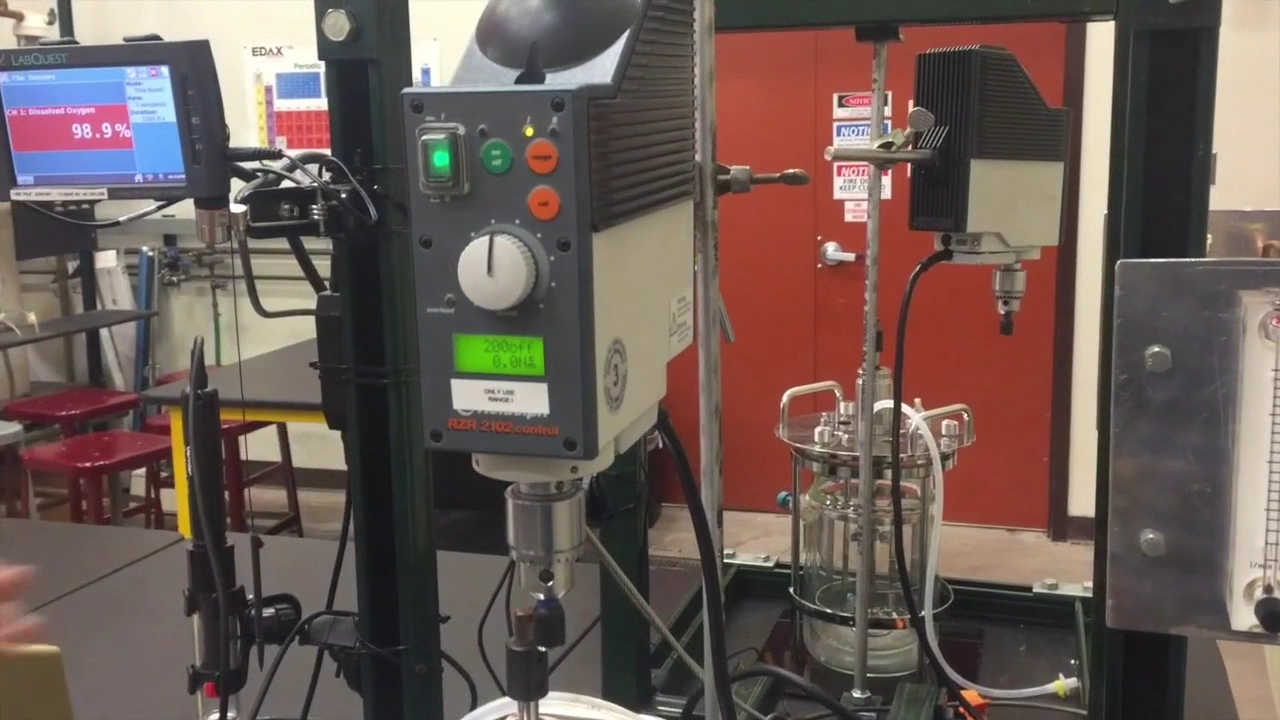












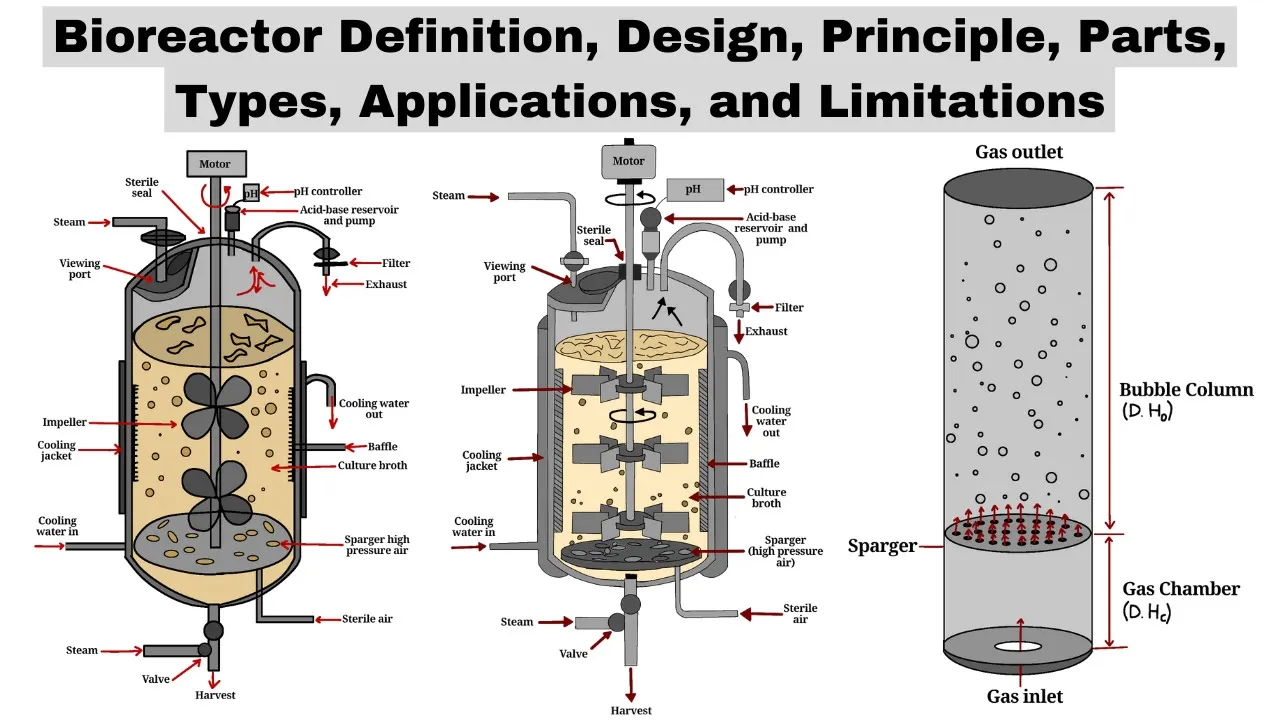









A conventional bioreactor (fermenter) is a stainless steel vessel with a domed shape (height-to-diameter ratio of 2:1) designed to prevent product accumulation and facilitate cleaning. Key components include a jacket for temperature control, agitator with impeller for mixing, sparger for aeration (types: porous, orifice, nozzle, combined), baffles to prevent vortex formation, and ports for nutrient addition, sampling, and product harvest. The aeration system introduces sterile air through spargers to provide oxygen for aerobic fermentation, with oxygen transfer efficiency depending on bubble size, gas distribution, and agitation. Control systems maintain pH (5.5-8.5), temperature, dissolved oxygen, mixing, nutrient concentration, and foam formation. Operations include sterilization (batch at 121°C or continuous at 140°C), inoculation (1-10% of media volume), sampling, aeration, and cleaning. Different bioreactor types include stirred tank, air lift, fluidized bed, packed bed, photobioreactor, and membrane bioreactors, each suited for specific fermentation processes.
Bioreactor/Fermenter Design: Conventional Types & Operations | Pharmaceutical Biotechnology
Added:So today in this session we are going to discuss about the bioreactor or fermenttor and its conventional design and different types of uh fermenters.
So this is an important topic from unit five of pharmaceutical biotechnology of six semester be farm. So here it is specified as a general requirement and study of equipment. So the equipment which is used for the fermentation is known as ferment. So these are the some of the questions from this area. This is an very very important topic for your examination and see you can see uh as an essay write in detail about the structure and parts of fanda its control uh with the neat lab diagram. So diagram is very very important here. And second as an five mark question explain in brief about the structure parts of ferment with the help of diagram and uh discuss the design features merits and demerits of continuous fermenters and answer briefly as different type of spares sparger and type control of fermentation parameters. So these are the some of the questions. So based on that this is the learning objective of the session. After the end by the end of the session students will able to understand is if I can write about general requirements for the fermentation design of an conventional bioreactor or fermenttor and type of bioreactors as well as parameters.
So before starting about the equipments used for the fermentation let's discuss about the general requirement for the fermentation. So as we mentioned fermentation is a process of culturing the microorganism in an culture media by using an equipments. So these are the three requirements for an fermentation process. Also we need an microorganism which is usually isolated from the soil, lake, ocean, river or plant, animal or air non-living objects from any uh kind of microorganism which have an ability to convert some of the natural components to an related structurally related compounds. Usually we can use wild strains or improved strains as an microorganism. But by using imbroved strains by protolast fusion or mutation or re combined DNA technology we can increase the yield of the product. So that is the advantage of improving the strains of the microorganism.
And second requirement is culture media.
Uh so in order to develop the inoculum and in order to get the desired products we need to give some kind of nutrients which containing carbon, nitrogen, sulfur, growth factor and antiiforming agent containing substances. So usually this will be in natural origin because we want to reduce the cost of the production of pharmaceutical products.
So we will go for cheaply available products of natural uh products like uh sometime we will use starch for production of alcohol sometime we will use molasses for the production of alcohol. So these are the some of the uh natural products we can use and then finally we required an equipment which is known as fermenttor or bioreactor. So which will provide for the development of seed culture fermentation design of small or large scale production. So these are the general requirement of the fermentation.
Anyhow we will discuss in detail about the three general requirement in detail in further topics. So today's session we will discuss about the equipments which is used for the fermentation process.
So as we mentioned uh the fermenttor or bioreactor is the equipment which is used to perform fermentation or bio uh bio transformation into biorocessing.
So we can study only the conventional bioreactor design because it will vary depending on the product which we have to be uh prepared. So based on that we will vary the design but we will discuss uh the conventional design of an bioreactor or fermenttor. So I want to know inform you one thing. So you can add this kind of conventional design to any question which is related to the fermentation. So if there is any question regarding the ferment you must draw this diagram. That is the mandatory thing. If you didn't write anything also you must draw the diagram of an conventional bioreactor that is mandatory thing without drawing this diagram you cannot score the mark okay so I repeat whether it is for two mark or five marks or 10 marks you must draw the simple diagram of the fermenttor you don't have to go for this complicated one you have to draw the simple diagram of the ferment okay so uh we can discuss the design of an convent conventional bioreactor.
So uh before starting to the parts I want to introduce the ferment fermenttor. So this is an basic structure of the ferment. Uh this is an uh vessel which is made up of uh corrosive resistant metals like stainless steel with an shape of doomed shape which means it is curved in the up and down. Okay. So that is the basic structure which containing an uh stainless steel vessel of domed shape which means the top and bottom portion is in curved portion because why we are keeping this dome shape because it will avoid the accumulation of the uh any kind of uh products. It will be very easy to clean the ferment that's why we are making this shape into curve and all this uh ferment is jacketed with some kind of jacket through which we can provide some kind of heat or some kind of cold water to control the temperature of the entire process. So that is the cooling jacket or heating jacket. From through this jacket we can provide either steam for heating any uh kind of conditions or you can add cold water to reduce the temperature also and there is an agitator in order to mix the entire product which is there in the fermenttor and there is an part which is known as sparger which is the facility to provide aation to the fermentation product or ferment. So by giving the uh air through this parture and by rotating this agitator the entire product will be mixed uniformly to get an uniform mixture of the microorganism as well as culture media as well as the product. So it will avoid the accumulation of the desired product. It will uh avoid the accumulation of the toxic products.
So I was discussing about the fermenttor.
So we have already mentioned the role of jacket, role of sparger and role of agitator. Now there are some uh uh connection for acid and alkali uh deforming agents which will we will add based on the pH of the ender product which is there in the ferment. And there is an air exhaust system to uh remove the air which is uh there in the fermenttor. And there is an uh medium feed nosil through which we can add the nutrient media or culture media. And there will be an glass uh slide sight glass through through which we can monitor the uh process which is happening there in the ferment uh fermentation or fermenttor. And uh there is an uh harvest nosil through which we can uh take out or we can remove the final desired product which is there in the fermenttor. So these are the basic structure uh of an uh bioreactor or fermenttor. So this is a threedimensional structure of the same thing. Uh so this par the agitator will be like this not uh and parall thing which will be uh some kind of impellar which will uh rotate in this uh f product or in this mixture of the microorganism nutrient media as well as the desired product and this is the sparger uh so that we can give the aeration from the upside to uh sorry down to up so that the aeration will very very effective. So this is the basic structure of the bioreactor or fermenttor. So irrespective of the mark of the question, you must draw this simple diagram of the fermenttor wherever it is required. Even it is if the question is like uh structure and parts of the ferment or sometime there will be an question production of uh pencils by fermentation process. So that you have to so you so you have to uh use this uh diagram wherever it is required. Now let's discuss in detail about the different parts of the ferment. So first one is vessel body. So this is the vessel body of the ferment. So uh it usually composed of cylindrical vessel with domed top and bottom. So I have already mentioned why it is doomed top and bottom because in order to avoid the accumulation of the products and usually it is surrounded by the jacket or oil for heating as well as cooling purpose of the entire ferment and usually the height to diameter ratio is 2 is to1 because uh there will be an uh double the size of diameter of height will be double the size of diameter. So while seeing this you can see this is the diameter. So usually the height will be more when compared with the diameter. Uh this is to ensure the efficient mixing and aeration of the fermentation process. That's why it is uh made in that way 2 is to1 ratio and usually it should be made with the stainless steel because for sterility as well as corrosion corrosion resistance and also it must be non-toxic and it must withstand repeated sterilization with higher pressure steam and it must withstand higher temperature of 150°C to 180°C and higher pressure of 377 to 412 kilo pascal. So that that much should resistance as well as that much uh strength should be there for the material which is used for the manufacturing of the vessel vessel body.
Now coming to the second part that is the agitation system. So this is the agitation system. We have agitators like impeller or agitators which is usually uh of rust carbine or marine impeller or flat plate which is mounted on the central shaft. Uh this is the central shaft which is connected to a motor so that it will be effectively uh steered in the desert. Okay. So it will ensure by uh agitation system we can ensure the uniform mixing of the culture media and also dispersion of the oxygen and also it will prevent the settling of the cell and it will maintain is the homogenity of the entire product which is there inside the uh ferment. Now coming to the third part that is buffers. So buffers are nothing but there are some ver vertical uh blades which is uh which is placed inside the uh vessels. Okay, vertical strips which is fixed in the inner wall of the vessel and which is usually used to prevent the vertex formation and to improve the mixing efficiency. Hope you have already aware about what is mean by vertex. So if you are using any kind of stirup due to its centrifugal force there will be an formation of hole okay or vertx formated.
So the vertex formation will affect the mixing ability it will reduce the mixing efficiency. So by preventing the vortex formation by uh by installing kinds of baffles we can increase the mixing efficiency of the bioreactors.
Now coming to the next one that is aeration system. So sometimes the fermentation process has to be carried out in the aerobic conditions by giving air action like oxygen. So it is usually it will provide sparture at the bottom through uh through which the air such as carbon dioxide, ammonia or sometime oxygen can be introduced. So we can use different kinds of spares to increase the oxygen transfer rate. Okay, oxygen transfer rate that is the importance of the aeration system. We have to mix oxygen with the entire products. So there are different kinds of spares. So this is an frequently asked mark question. What is mean by sparger and what are the different types of sparger?
So sparger is an device uh which is fitted at the base of the ferment to introduce the sterile air or oxygen into the culture media in the form of small bubbles. So this is the sparger facility which is usually fitted uh down the or bottom portion of the fermenttor to to provide sterile layer. Okay. So uh the efficiency of the oxygen transfer usually depend three factors. One is bubble size. As the bubble size decreases as we all know as the size decreases there will be an increasing surface area. So that there will be an higher oxygen transfer and gas distribution inside the vessel also will increases the efficiency. As the gas distribution inside the vessel increases the mixing efficiency also will increases and uh interaction with the agitation system. So if you have an properly uh installed impeller inside the ferment it can increases the efficiency of oxygen transfer. So these are the three factor which will defense oxygen transfer. So this is the sparger which is an device fitted at the base of the per to introduce sterile layer. Now let's see what are the different types of spar spares. So we have porous sparger or spares nosal spares and combined sparger which means sparger with an agitator system. So let's see one by one. First one is porous sparger.
So this is usually made up of glass, ceramics or metal which have an uh very small pores in this area. So by giving air through this pipe to this sparger uh it will form fine bubbles. So this is an example of a sparger there will be an fine bubble formation through the spore sparger. So it will provide high surface area for gas exchange but there is an uh limitation. It may there is a chance for cloaking and also it is very difficult to sterilize at large scale and it can be used only for lab scale fermenters of 20 lit 20 lit volume of fermenters or spares because there is a chance for clogging and also there is a difficulty in sterilization process. So this is the sparger which is made up of cindered glass or p or sparger which is made up of cindered glass ceramics or metal. So the air passes through the small pores forming bubbles. Now coming to the or orphice spar which means uh this is an simple tube. So there will be several holes or orphice on the symbol tube.
Sometime it will be in straight line sometime it will be like in circle form.
So this is an example of or sparger.
Sometime this is an example of or sparger. So there will be many orice or holes in the sparger. So while providing uh air through this pipe the air is released through the hole at the bottom of the ferment. Usually this will be arranged in the bottom of the ferment like this. Okay. So uh that is the orace forger. So it will generate large bubbles. That's why that's also they are less efficient in the oxygen transfer and this is mainly used in the large industrial ferment where mechanical agitation will help to break the large bubbles. So even though we are using orificees orifice spes we have to use some kind of mechanical agitators impellers to mix it properly to reduce the size of the bub bubble formed through the or orifice spares. Okay. Now coming to the nosal sparger. It is very same as that of the uh spares or nosles we are we used to use in the gardens.
use same type of spark a single open or closed pipe with a downward posing nosle. So the sterile layer or oxygen is released under the pressure and it is usually designed to reduce the clogging of the first one that is so that was the porous parture. So there was there wasn't disadvantages of porous sparger it there is a chance for clogging because of its minute holes but by modifying this into nosil which have an bigger size of holes we can use this as an uh large scale production and also along with this nosle we have to use uh some kind of uh imbalance to reduce the size of the bubble form. Okay. Now coming to the last one that is combined system which means sparger with the agitator. So this is an example for sparure with agitator. There is an facility to provide aeration in this impeller itself. Okay. In this impeller itself there is an facility to provide which is usually provided through this central shaft of the impellar. Okay. So by providing this air along with the uh agitator it it will uh reduces the size of the bubble bubble formed through during this process. So this impeller will break the large bubbles into the small one so that it will improve the oxygen transfer efficiency. So this is all about the aeration system that is par which is used in the conventional ferment. Now coming to the next part of the conventional ferment that is the control system. So we have three type of control system temperature control system, pH control system and form control system in the ferment. So usually temperature control is achieved by the cooling jacket or internal uh coils. So by using cooling jacket by providing the cold water to the jacket we can reduce the temperature of the terminal. By using internal coil by heating using heating coils we can increase the temperature. So in order to monitor this one we can use some kind of sensors as well as props to maintain the optimum growth condition to ener control. So there will be an pH probe which is which will continuously monitor the culture condition. So based on the variation in the pH we have an facility to add acid or base which will be added automatically to the to maintain the uh desired pH. Now form control since some most of the time we are going to use aerobic fermentation process. So during the use of aerobic fermentation it is quite natural to have an form uh in the products. So in order to reduce the forming in order to break the forms sometime we may have to use mechanical form breakers or we may have to add some time of anti-forming agents uh through sensors which is uh facilitated with this control system. So these are the different control system which are which have which are there in uh ferment. Now coming to ports, there are some ports to add and withdraw some kind of samples.
So we have nutrient and inoculum addition port through which we can add the sterile ports for addition of the field inoculum supplement without any kind of contamination.
We don't have to open the large area of the fermenttor. We just open the uh this kind of ports nutrition, nutrient, inoculum and addition port and we will add the respective thing and we have some sampling port through which we will periodically withdraw the culture sample and we will check for it stability and other conditions in this area. So this is the course. Now coming to uh last one that is exhaust system. So in order to remove the excess gas which is there in the fermenttor we will use exos system but we will use some kind of hepailter to prevent the release of microorganism which is added to the fermentation. So these are the different parts of the conventional bioreactors.
So there are some uh other properties must follow for an conventional reactor.
So while designing an fermenttor we have to design in such a way that it should be free from kind of services and stagnant area. So that's why I mention it should be in doom shape in order to prevent accumulation. Okay.
And it should be very easy to clean and uh especially the welded area uh melted and we have to use the transparent material wherever it is possible because we cannot use the transparent material to build the body but we can use the top of the portion of the perand by using transparent material in order to monitor the process which is there inside the ferment and there should be an uh liquid level of reaction vessel which haven't facility before connection for acid, alkal and chemicals etc. So this is all about the conventional.
So you must draw this diagram for irrespective of the mark of the question and depending on the mark and depending on the question you have to elaborate the different parts of the members in detail. Okay. So this is all about the design of unconventional permanent. This is an frequently asked question also. So be very thorough with this topic.
Now coming to the type of bioreactors uh or fermenters which is used. So this is the learning objective. After the after the session you will able to understand, describe and write about the different types of fermenters like stank fermenters, air lift fermenters, fluid weather bioreactor, packed weather reactor, photobiioactors and membrane bioreactors. So let's see one by one.
First one is stirred tank fander. As the name indicate there will be a stirring in an tank of ferment. That's all. This is the conventional ferment. There is no change in the conventional ferment. We have an vessel. We have an uh impeller.
This is the baffel. This is the baffel which is installed inner side of the uh vessel in order to avoid the wax formation. So this is the simple conventional fermenttor. Here we we will use this stangle fermenttor mainly for microbial as well as animal cell culture and it have an function of homogenization suspension of solid uh dispersion of gas liquid dispersion and it is mainly used for the production of large uh amount of antibiotic enzyme and vaccines and also it is mainly used in breving industrial yeast fermentation. So this is all about the ST pan ferment. This is nothing but a simple conventional ferment. Now coming to the second one that is the air lift ferment. So there is a difference here. Here we are not going to use any kind of mechanical stirring arrangement for mixing. We are not using any kind of mechanical stirring arrangement. So what we will use? We will use an turbulence by providing air inlet air from the bottom of the ferment which is passes through the uh draft tube of the central section of the bioreactor. So this is the draft tube. So we will provide the glass flow into this central uh se section of the bioreactor so that it will flow through this and it will circulate through the entire reactor in upward direction. So that is the difference between the conventional or stir tank uh ferment with airlift uh ferment. So it is mainly used for both free as well as immobilized cell fermentation process. There are some advantages for this airlift fermenters because since we are not using any kind of mechanical st we can eliminate the attrition effect. So what is mean by attrition? It is the normal energy production. There will be an uh conversion of mechanical energy into heat energy. There will be an increase in temperature. So uh we can since we are not using any kind of mechanical steering it we can eliminate the attrition effects which is encountered in the mechanical steering and it is most suited for aerobic culture also and used in mainly to avoid the excess heat produced during the mechanical vegetation. So that is advantage of air lift ferment. Now coming to the next type of ferment that is fluid bed bioreactor or ferment. So you have already heard about the food but mixer.
Okay. So this is an uh another type of ferment which is mainly suited to reaction involving fluid suspended particulate catalyst such as immobilized enzyme as well as cell particulate.
comparable to bubble column by reactor except the top position is expanded to reduce velocity of the fluid and it is designed such that the solid are retained in the reactor and the liquid flow out.
So fluid uh liquid flow will be go out and it is mainly uh used for carry outing reaction involving fluid suspended bio catalyst such as immobilized and immobilized cells microbial flules. So this is the fluidized bed uh ferment. Now coming to the packed bed reactor or uh car which consist of bed of solid particle with the bio catalyst or within the matrix of solid packed in the column. So this is the uh immobilized cell which is uh packed as an solid particles and solid is used maybe porous or non-porous gel which may be compressible or rigid in the nature and usually the liquid the product uh usually obtained are released into the fluid are removed through the uh bottom portion. So okay so that is the uh packed reactor nutrient growth is continuously flow over the immobilized catalyst. So this is the immobilized catalyst which is used as an uh culture media. So the nutrient growth which is in which will be in the liquid nature will continuously flow over the mobile catalyst and the product usually obtained are released into the fluid and removed. So movement can be upward or downward. Either we can give the inlet here or we can give inlet here. So by giving inlet here it will require some time to reach the outlet. So that there will be much time for reaction by fermentation reaction time. So concentration of the nutrient product can be increased by increasing flow rate of nutrient uh by controlling the flow rate of the nutrients. So this is mainly preferred for biorocessing technology uh involving product inhibited reactions.
So that is the packed libert reactors and finally we have photobioreactor.
So for f foration which can be carried out either by exposing sunlight or artificial illumination can be done in the photobioreactor.
example for the production of parotin as well as produce.
Usually these are made up of glass or more transparent plastics.
We have array of tubes like this series of tube.
So we have array of tube or flat panel constituted light receiving system like the solar system. Okay.
And culture can be circulated through the solar receiver by the method such as using the centrifugal pump or air pump.
And it is essential that the cells are continuous circulation without forming any kind of sediment through this kind of uh tubes.
Okay. So that is the uh bioreactor. So this is mainly performed by exposing the product into the sunlight or artificial illumination. So that is the bioreactor.
So photobiioactor and finally we have the membrane bioreactor which consist of semi-permeable membrane which is made up of cellulose acetate and other polymer material and the primary purpose of this membrane to retain the cell within the bioreactor. So this is an example of uh membrane bioreactor. So we will have organic phase as well as enzyme activated membrane here and we will give the aquas buffer and organic phase reagent so that we will get the organic phase product as well as acquis product separately from uh different ends of the bioreactor. So that is the membrane bioreactor. Okay. So that's all about the different types of fermenters.
Now coming to the operations of an conventional ferment. So it is very important for its structural arrangement and also how it operate.
So what are the different operation which has to be carried out. So this is also an frequently asked question like control its control you can see the detail structure and parts of ferment and it control and also there are some question like control of fermentation parameter. So let's see what are the different control parameters. Yes. So this is the learning objective. After the session you will able to understand describe about the different operations of conventional fingers like sterilization inoculation and sampling aeration and control systems and cleaning. So these are the different uh uh operations of an conventional ferment. So let's see one by one. First one is sterilization. So in order to produce any kind of things in foreign pharmaceutical purposes it is very mandatory to keep it sterile. So it has to be performed in aseptic condition. So this is the basic requirement for an successful fermentation and usually uh sterilization is very essential to ensure the stability of the culture media. ensure the stability of incoming and outgoing in ensure to uh sterility of bioreactor and also for the prevention of contamination during the fermentation process. So first let's see how we can sterilize the culture media. We have already studied the cultural media are usually sterilized by the autoclave method and sometimes culture media containing some uh vegetative cells or sorry uh some kind of uh what we thermal level substances we may have to go for some kind of other methods. So usually we used to sterilize culture media by applying heat to lesser extent by using like some kind of physical method, chemical method or radiation method and most economical and most cheap method is always it will be heat. Now what are the different physical method for sterilization of the culture media? You can go for filtration, centrifugation or absorption and it is mainly used for heat label constituent such as item in blood component antibiotic otherwise we will go for the autoclave only if the culture media containing any kind of heat label constituent such as vitamin blood components and antibiotic we will go for the filtration centrifugation or absorption but there are some limitation for the filtration you cannot give high pressure of filtration because sometime we may have to uh increase the speed of the process. So in order to increase the uh speed we may have to give the pressure. So it is not possible in case of filtration process and some of the media component may be lost during the media during filtration. So that also not an good thing for an uh sterilization of the culture media and chemical method usually by using some kind of chemicals such as disinfectant but these are not preferred in case of fermentation process and we will use sometime of some type of radiation procedure like by using UV rays or gamma rays. X-rays are not commonly used for the media sterilization but this will be costly when compared with the conventional heating method. So we go for the heat sterilization method. This is the most widely used method and important factor which will affect the sterilization are quality and quantity of the contamination, composition of the media, pH and size of the suspended particle. So usually by giving an temperature of 60° for 5 to 10 minutes we can kill vegetative cells. But the score if there is a score in the micro the score in the fermenttor we may have to eat to 80°C and above for 15 to 20 minutes. So in order to ensure the uh success of the sterility testing or sorry sterilization process you can use basilus thermopilus which is an sheets resistant strains of the microorganism. So which is mainly used as an biological indicator for assessing the efficiency of the sterilization process. Okay. Now uh it can be done by batch or continuous method. So by batch sterilization process what we will do the culture media are subjected to sterilization at 121°C in batch volume and usually this can be done by injecting steam into the medium by direct method or injecting steam into the interior coil by indirect method. So that we can perform the batch sterilization method either by direct method by injecting the steam directly into the culture media or by indirectly injecting the steam into the interior coil interior jacket of the uh fermenttor. So these are the bad sterilization process but there are some disadvantages may damage culture media and uh uh high energy consumption is required. So these are the disadvantages of batch sterilization.
Now coming to the uh continuous sterilization process here it is carried out at 140°C for a short period of 20 to 120 seconds based on the principle that time required to for killing microorganism much shorter and higher temperature and this can this also can be done by injecting steam into bioreactor or by means of heat exchanger. So there are three type of heat exchanger are used for this kind of continuous sterilization process. So first heat exchanger will raises temperature to 90 to 120°C in 20 to 30 seconds. In second exchanger it will further increase this temperature to 140°C and maintain for 30 to 120 seconds and third exchanger will bring down the temperature by cooling to uh in next 20 to 30 seconds. So, so this is the method of continuous sterilization by using heat exchangers.
So, that's all about the sterilization of the culture media. Now, we have to ensure the the sterility of the air which is used for the ster uh fermentation process. So, it can be done by filtration, heat, UV radiation or gas prepping. So usually air stilization by heat is done by passing through the electrically heated element.
But since this is much expensive because so we usually for sterilization of air we commonly used filtration sterilization for air. So by using depth filters or membrane cage filters. So in case of depth filter air is passed through the glass pool containing the depth filters. So there will be an uh physical efforts such as inertia blocking gravity electrostatic attraction and diffusion. So these are the different uh uh process of uh depth filters and membrane cy filters. usually by uh using an membrane filter made up of cellulose nylon or polyulone. So this is the method for sterilization of the air. Now now sterilization of the bioreactor. So we have already sterilized the culture media. We have sterilized the air. Now we have to sterilize the equipment which is used for the fermentation process.
And this can be done by INC2 sterilization or by continuous heat sterilization which is just as that we have mentioned for the culture media. We have to inject the pressurized steam into uh the ferment by injecting the steam at 120°C for 20 minutes and or by increasing the temperature of 150°C for 120 seconds. That is the two method of sterilization of bioreactors.
So that is the first step sterilization.
Before starting the fermentation, we have to sterilize a ferment. We have to sterilize the culture media. We have to sterilize the air. Now coming to the second step of the uh fermentation process, the inoculation and sampling.
So basically uh we will take the culture media which is sterilized and then we will inoculate the culture media with the microorganism which have an ability to convert the culture media used to structurally similar desirable productim.
Okay. Now, so we have to take almost 1 to 10 percentage of the total volume of the media. So suppose you are going to take 1,000 ml of the culture media. We will take 100 mm of the inoculum. That is the 1 to 10 percentage means. If you are taking 1,000 ml, you will take 100 ml of the culture media. If you are going to take one lakh uh liter of the culture media, we will take almost one lakh one lakh. Okay. So that one lakh volume. So that is the 10%age of the volume of the media. So a high yielding product strain of a microorganism is usually taken. So sometimes there will be same microorganism with a different strains and many strains will give different types of yield percentage yield. So we have to take an uh and strain which have an high yielding production high yielding ability. Okay. Then after inoculating we will give the sufficient environment for the growth of the microorganism and during this period at a regular intervals we will draw some sample in order to check the contamination and also to measure the product form. So suppose we have to carry on fermentation for 10 days 4 and 10 days. So each day we have to take the sample from the fermenta and we have to check for whether there is an contamination by any kind of other microorganism and how much of the product is formed in the culture media.
These are this we have to measure by sampling at regular intervals. So that is the second operation which will happen in the uh fermentation process that is inoculation and sampling.
Now coming to the aeration. So this is another important uh factors which is required for the fermentation. So we have to give aeration by giving by supplying oxygen and we have to remove the carbon dioxide which is formed during the bio reaction. So by using sparger we will provide the oxygen and by using the exos facility we will remove the unwanted gases. So usually if you are taking an uh ferment 20%age of the total ferment volume will be remain vacant.
Usually that is known as head space. And this living of this space is for the accumulation or for keeping the unwanted gases.
Okay. So please uh note that one we will not fill the culture media source we will not fill the ferment with the culture media the entire volume will not be filled we will keep it 20% of volume as vacant space okay for aation now there are different type of aeration procedure we can give airlift system of aeration which means we have to give aeration at the bottom so by giving this airlift formation uh aeration capacity will be increased and also it is there are some factor air flow rate as well as internal pressure are the two factor which is directly proportional to the aeration. As the uh aeration flow rate increases as well as as the internal pressure increases aation capacity will increases. And second type of aation is stirred system of aeration which means we have to give air in the bottom. And we have to use some kind of stirer or imar for mixing this we or stir this oxygen which is provided to the bottom of the media. So there are some kind of uh porous spares as well as orphice parture which can be used for aation.
Now coming to the fourth operation that is the control system. So while performing the fermentation process we have to control many factors to get the desirable product for at an higher yield. So usually these are the some of the factor we have to control pH temperature dissolved oxygen adequate mixing nutrient concentration and form formation. So basically the pH we have to keep between 5.5 to 8.5 which means we cannot perform fermentation in extremely acidic condition or extremely basic condition. So we have to keep the pH in between the extreme acidic as well as extreme basic condition. And what is the reason for changing the pH? Because as the process occur from the lag phase to log phase to stationary phase to decline phase there will be some metabolic release of metabolic rate or release of metabolic product which will changes the uh pH inside the fermenta.
So we have to monitor the change in pH and we have to maintain the optimum level by adding the respective thing. If it is too acidic, we have to add basic uh alkaline and if it is too alkaline, we have to add acid to neutralize to this range 5.5 to 8.5.
Now coming to the second factor that is the temperature. So again temperature control is absolute essential for good fermentation process. Since the lower temperature will process the reduced product formation and higher temperature will causes the adverse effect on the growth of microorgans. So as the temperature increases microorganism got killed. Okay. So what will happen? There will not be any further fermentation process. But what will happen if there is a lower temperature it will reduces the product formation. Okay. So we have to keep the temperature in between these two level. It should not be too low and it should not be too high. So by giving by using cooling jackets or by using heating coil we have to adjust the temperature and we will monitor the temperature by using sensors in the Now coming to the next factor that is the dissolved oxygen. So continuous oxygen supply is very essential for the working of the oxy working of the entire process and it can be done by using different uh aeration system like spares. Now adequate mixing another important factor which has to be considered. So by using stirers homogenizers or anything we have to keep stirring in order to avoid the accumulation of the toxic product. in order to avoid accumulation of the desired product in order to avoid accumulation of the fresh nutrient added to the fervent. So everything should be mixed properly to get uniform solution of the microorganism, culture media and product. Okay. So all these things should be adequately mixed in order to get an proper uniform structure. Now nutrient concentration again as the fermentation progress sometime the microorganism will uses the nutrient and it will start producing the metabolic end products. So metabolic end products uh will cause adverse effect into the organism and it will further decreases the production of the product desired products. So by adding limiting concentration uh or by uh adding the required nutrients at specific time we can control the product formation. So in uh usually by higher concentrate by adding higher concentration of the nutrient media it has an inhibitory effect. We do not think by giving more morphine into the fermenttor we can get uh more yield of the desired product. It's not like that. Higher concentration is usually associated with the inhibit reaction. So we have to give the nutrient in limited concentration in order to get on optimum product formation. So we have to maintain the optimum nutrient concentration. So we have we will monitor the nutrient concentration and product formed through the regular interval by sampling and finally the form formation. Since we are using proteinious materials or media and also we are performing the fermentation in the air aerobic condition. Sometime there will be an formation of forms. So we can reduce the form formation by using antiiforming agents like mineral oil based silicone or vegetable oils or by using mechanical form vehicles in order to reduce the form formation. And finally the last step is cleaning. So once the fermentation process is over for specific period of 5 to 10 days uh all the content are removed. So this removal of content from the fermentation is known as harvestc.
So the removal of the entire content is known as harvesting. Now after removing the product from the ferment we have to make ready the ferment for the next batch of fermentation process. So that is known as turncess and the time required for turn around is known as downcess down. So we have to plan and fermentation process with a minimum down time. It should be very easy to remove.
It should be very easy to clean and it should be very very easy to make ready for the next batch of fermentation. So in order to clean this kind of uh ferment we may have to use some kind of high pressure water jet from noil fitted inside the reaction vessel because we cannot enter into the uh bioreactor. So it should be very automatically clean by using high pressure water jet from the nozzle which is fitted inside the reaction vessel itself. So that is the cleaning method. So that's all about the ferment types of fermenters and different operations of fermenters. So this is a very important topic. So there are many questions from this area. Hope you have already aware. So I have already shown you different questions from this area like uh detailed structure and parts of the fermenttor and its control within each level. the diagram and explain in brief about the structure and parts of perment with the help of diagram. Discuss the design structure merits and emer continuous fermenters and different types of spares sger and types and control of fermentation parameters. So this is all about the uh conventional design of an bioreactor.
Then different types of an bioreactors and operations of an biore reactors.
So hope it is clear.
Thank you for your patient listening.
Up Next
Synthetic Psilocybin Production in Yeast via Metabolic Engineering
@DIYBiotech
237.5K views•2024-10-06
Quantitative Real-Time PCR (qPCR): Principle, Method & Data Analysis
@animatedbiologywitharpan
129.2K views•2023-09-06
Microbial Degradation of Plastics: Biodegradation Pathways & Sustainability
@majeedhammad
2.9K views•2021-04-11

CRISPR and Genetic Engineering: How Gene Editing Works and Why It Matters
@kurzgesagt
30.5M views•2016-08-10
Related Study Plans & Knowledge Roadmaps
Structured learning paths in Biotechnology