




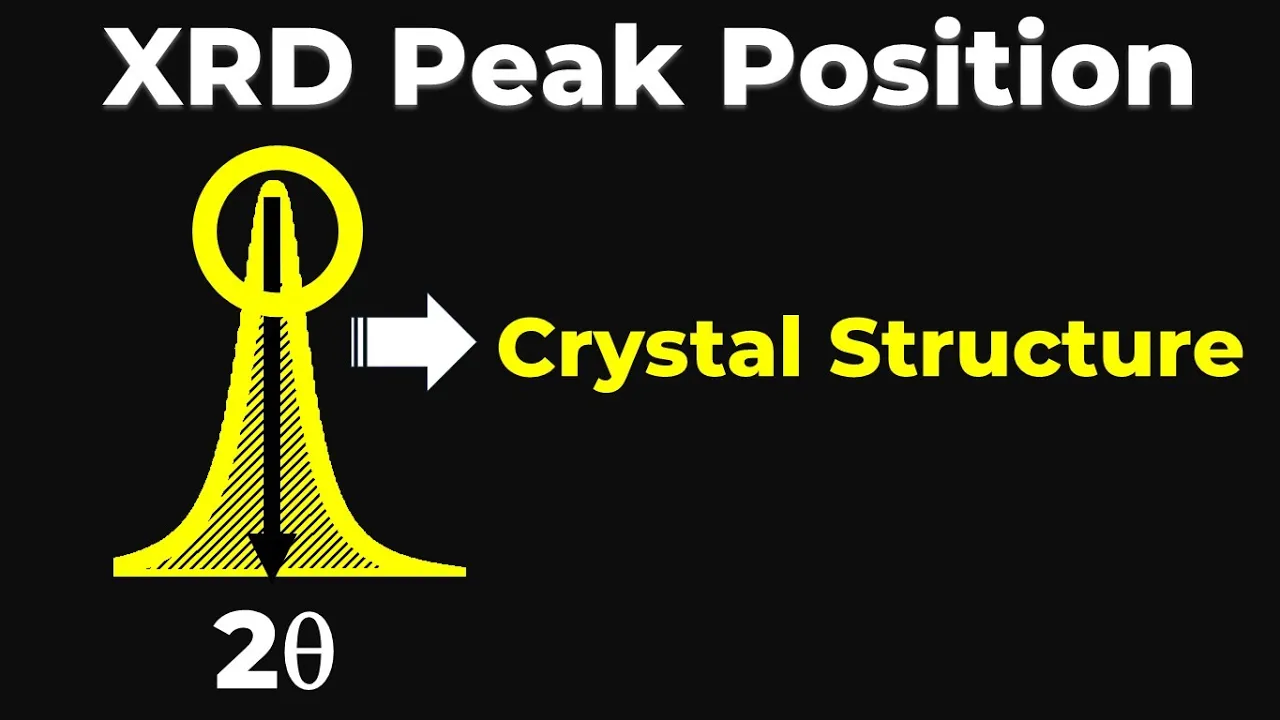














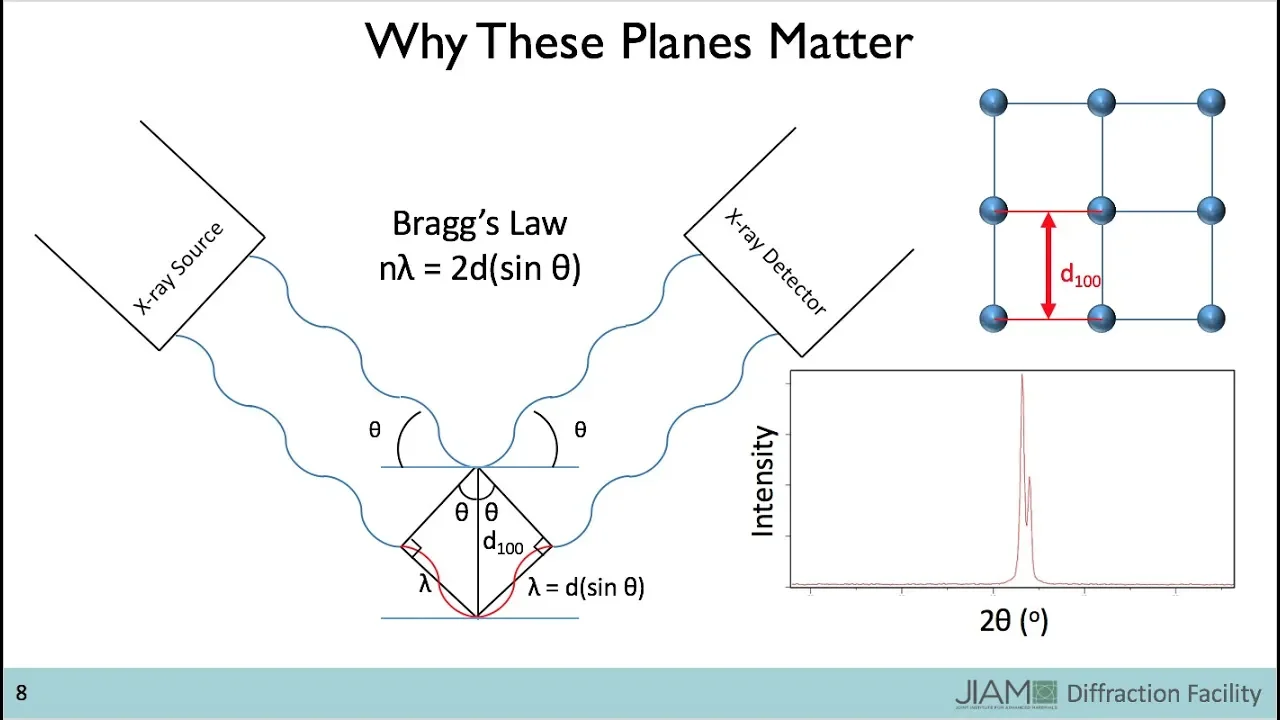


This video demonstrates how to manually index powder diffraction patterns using the sin²θ method, which combines Bragg's Law (nλ = 2d sinθ) with the cubic system equation (1/d² = h² + k² + l²/a²) to correlate peak positions with Miller indices. The process involves converting 2θ angles to radians, calculating sin²θ values, taking ratios relative to the first peak, and identifying permitted M values (h² + k² + l²) that must be integers and follow crystallographic rules. For body-centered cubic systems, all M values must be even. After indexing, lattice parameters can be calculated using a² = d²(h² + k² + l²). This manual approach is particularly useful for simple cubic systems when software is unavailable, though non-cubic systems require more complex calculations.
Manual Indexing and Lattice Parameter Calculation of Diffraction Data
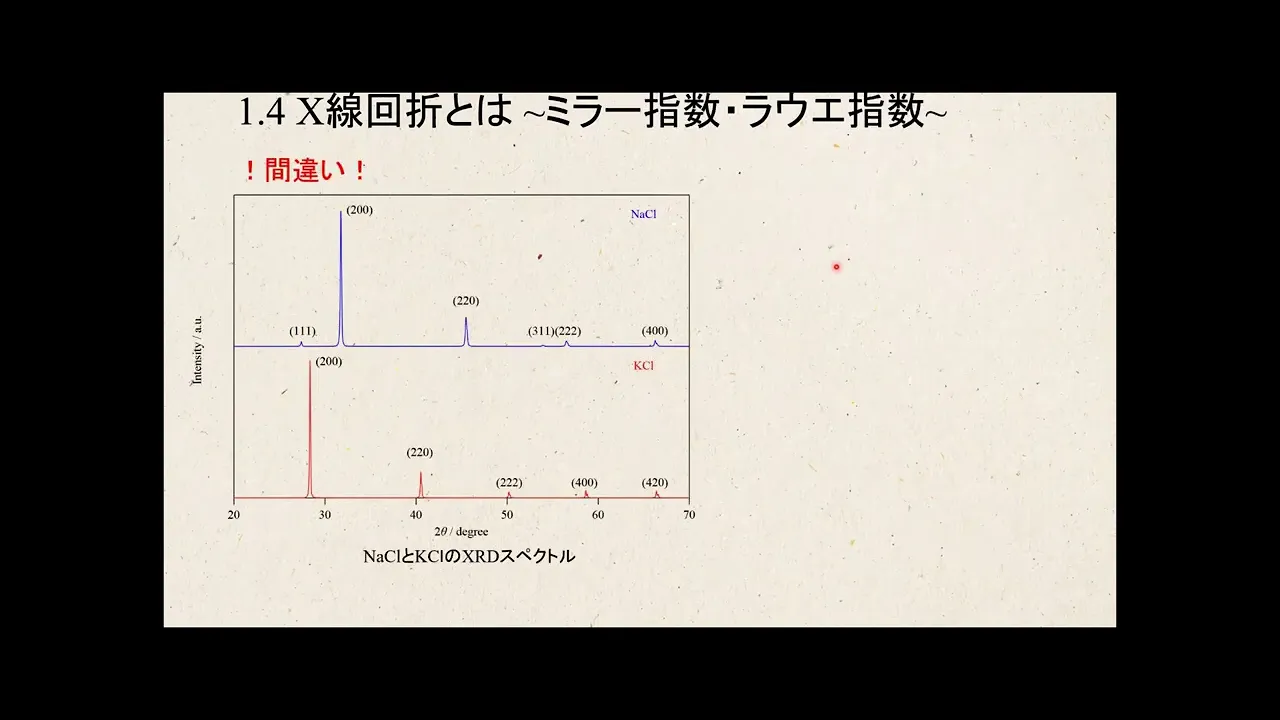
Added:in this video I'm going to show you how we can index a powder pattern by hand and then calculate the ltis parameters we're going to do this for an unknown material let's imagine you've been given a small chunk of uh shiny metal and your supervisor doesn't quite remember what it is they think it's probably either to tantalum or tungsten tantum and tungsten both have very similar space group IM bar 3M both Body Center cubic and the ltis parameters are quite similar as well uh 3.3 angstroms per tantum and around 3.15 angstroms per tungston so how are you going to tell what this metal is well the one thing you can do obviously is do some xrd on it so you get an x-ray defraction pattern and it looks like this a very nice pattern looks almost like someone simulated it in Crystal defract but that doesn't actually solve your problem now you have a shiny piece of metal and defraction pattern let's imagine that you are not able to use the databases or any specific defraction software to solve this problem you're going to have to solve this issue the oldfashioned way from the defraction pattern we could see that the Peaks are spaced fairly evenly this indicates that the uh sample probably does have cubic symmetry after all so we can create a peak list um quite easily you can see here in the table that we've got our Seven Peaks from the defraction profile and we've uh listed the peak position into Thea and the relative intensity what's important is that as we go through this exercise you'll notice I don't refer to the relative intensity at all everything we're going to do is purely from the peak position so what we're going to do is we're going to use a method called the sin squ Theta method this will will help us to work out likely indexing or Miller indices for the Peaks that we've observed the advantage of this method is that we don't need to know the ltis parameter and we don't need to use any software just a calculator I use Microsoft Excel though makes it a bit easier so we need to combine two equations first of all let's consider brags law n Lambda equal 2D sin Theta we can rearrange this to give us sin Theta = n Lambda / 2D and then Square all of that to give us sin Theta = n^ lamb 4^2 we can also consider the equation that correlates uh the desp spacings um between planes in a lce and the unit cell uh size for a cubic system for example 1 / d^2 = H2 + K2 + L2 all over a 2 combining these two equations gives us sin^2 Theta = n^2 Lambda 4 a 2tip h^2 + k^2 + L 2 this um n Lambda section effectively becomes a constant and so we can ignore that for the time being so what you can see is there's a direct correlation between the position of the peaks in sin s Theta with the Miller indices H KL some other useful things that we can Define um let's have a make a new parameter m and M is just going to be the sum of h^2 + k^2 + L2 you'll notice that it's not possible to find values for certain combinations of hkl that will give uh particular values 7 15 23 28 so if you have a one Z 0 m would be one a two 0 m would be four it's not possible um to get a combination of hkl that will give you Nal 7 for example and this will be particularly important in a short while the other thing to mention is that if you're going to do this in Excel you need to convert your angular positions into radians and you can do that by the equation on the screen here so the first thing we're going to do the sin squ Theta method this is the table that we need to fill in to do this the ultimate objective is to fill in the M column on the right hand side and from that we can calculate the hkl values so I've filled in here two columns already we've got the peak positions in 2 Theta I've then filled in the Theta position in radians to get from 2 Theta to the Theta in radians we have to first divide the two Theta values by two to give Theta and then convert them to radians using the equation we saw a minute ago so for example the Peak at 38.46% the next step is then just simply take the sign of that Theta in radians so s Theta for our Peak 3.46 becomes 0.
3294 and so on we can then also uh Square those values so just multiply 3294 by itself and that will give us a s^ squ Theta value of 01085 so that's our sin s Theta value for Peak 1 and so on we then take the ratio of all the sin squ Thea values compared against the first Peak actually you can pick any Peak but I tend to always work from peak one that means that in the first Peak we're going to take the ratio 01085 0 divid 01085 and we'll multiply that that by an integer number a whole number so we'll start in ratio one by multiplying all the values by one so185 / 0185 * 1 gives us 1 2171 for the second beak divided by 01085 ultip 1 gives us two and so on so we can fill in the whole column what you will notice however is that we have a value here of s now these ratios are possible values for M and we know that we cannot have an M value of seven and so that means that this is not a possible solution for M if we go to ratio two what we're doing here is instead of multiplying by one we're multiplying by two and so on and we could carry on we could multiply by three by four by five whatever was necessary until we find an appropriate answer what you can see here is that these values um are all pretty close to integer numbers which is good um we don't want say 1 and a half three and A2 numbers that don't look like integers um so we can round all these up quite easily and they're all permitted values 2 4 6 8 10 12 14 are all fine um so these are possible n values so we can fill in that M column so we have m = 2 for the first Peak four for the second Peak and so on what you can notice from this is that H + K plus L which is effectively our M value they're all even numbers so if they're all even values for M that means that what we're looking at is a body centered lattice there are other rules for different types of lates but in this case is a body centered lce which fits with what we were expecting so we can convert these M values to hkl values now once you get to larger m values there can be multip possibilities but for small values there tends to only be one solution so for example 11 1 0 reflection 1 s + 1 2 + 0 2 = 2 so m = 2 is 11 1 0 reflection for M = 4 that must be a 2 0 type reflection 2^ 2 + 0 2 + 0 2 = 4 and so on so we get um possible Miller indices for all of our Seven Peaks as I said once you get up to the higher end values there may be other possible solutions but these are these are reasonable values in this case so what we've done here is we've indexed our defraction pattern all we've done is use Excel and a little bit of logic and math um and it's been pretty straightforward and so you can see here our pattern from our metal sample overlay with the hkl values for the individual reflections just to step aside from this particular mysterious sample for a second we can also do this routine for non-cubic samples but it is a lot harder and it gets harder very quickly um there are ways to do it you can see some for example in clug and Alexander in chapter 6 but this is where really if you're looking at a non-cubic system you really are going to probably be better off using software like index and refine and when XO but bear in mind if you're using these kind of automated indexing programs they don't have any intelligence um they they're just uh kind of f find numbers that that work not necessarily the best answer you must always check the output does it make sense does it follow the rules does it um answer the problem that you're looking at so we've got now our Peak positions and we've got our Miller indices for this mysterious metal we looked at this equation earlier on briefly 1/ D ^2 = h^2 + K2 + L2 A2 we can use this equation to manually calculate the ltis parameters a for our unknown powder pattern first of all we need to rearrange the equation for a so it becomes a^2 = D ^2 * H2 + K2 + L2 we also need to then convert our um Peak positions from 2 Theta into d space spacing this is done by a simple rearrangement of brags law again in the spreadsheet that I'll attach with this you can see how I've done that in Excel so our Peak at 38.46% and our Miller indices for the Peaks and this is all the information that we need to calculate the latice parameters we can pick out any Peak and use the equation that we derived a second ago to work out the lce parameters so for example for a 110 Reflection we found this D spacing at 2339 angstroms and that was our 110 so we can plug those values into the equation there and that gives us a lce parameter a of 3308 angstroms if you remember the possible values we were given earlier we can now confirm that our mysterious metal sample is in fact tantalum the equation for a tetragonal system is a little bit more uh complicated one over D ^2 = H2 + K2 + L A 2 + l^2 c^2 so we have a separation here of the h k and then the L uh Miller indices so if we want to work out the lce parameters from this we're going to need an hk0 type reflection to give a and a0 0 L reflection to give C so for example you might look for a 001 to find out what C is and then a 110 to find your a lce parameter the equations are shown here for orthorombic and hexagonal systems working out the lce parameters manually for these is still very simple once you've indexed the pattern it's very easy to do once you get to lower symmetry systems it gets a lot more complicated very quickly and so in these instances yes you probably still want to use software but hopefully this video has given you a good idea of how you can manually um work out the ltis parameters and index poed defraction patterns for simple systems
Up Next

Physics of Free Will: Determinism and Quantum Mechanics
@SabineHossenfelder
1.3M views•2023-06-03

21cm Hyperfine Transition in Neutral Hydrogen: Radio Astronomy Basics
@AaronRobertParsons
12.4K views•2011-10-13

NMR Spin Physics I: Zeeman Effect, Resonance Condition & Larmor Frequency
@nptel-indianinstituteofsci8064
2.3K views•2024-01-17

Entropy and the Second Law of Thermodynamics Explained
@veritasium
27.5M views•2023-07-01
Related Study Plans & Knowledge Roadmaps
Structured learning paths in Physics