















![[Wikipedia] RuBisCO](https://i.ytimg.com/vi/6FEjeZbvEa0/maxresdefault.jpg)



Photorespiration is a metabolic pathway in plants where oxygen competes with carbon dioxide for binding to the Rubisco enzyme, leading to the formation of 2-phosphoglycolate instead of 3-phosphoglycerate; this process occurs across chloroplasts, peroxisomes, and mitochondria, consuming ATP and releasing carbon dioxide without contributing to carbon fixation, though it serves protective functions like scavenging toxic intermediates and preventing photo-inhibition.
Photorespiration: Rubisco's Dual Role & Glycolate Pathway
Added:The fundamental stages of photosynthesis, specifically the distinction between light-dependent reactions and the Calvin-Benson cycle.
The primary role of the enzyme Rubisco (Ribulose-1,5-bisphosphate carboxylase-oxygenase) in fixing carbon dioxide.
Basic plant leaf anatomy and physiology, including how stomata regulate the gas exchange of carbon dioxide and oxygen.
The typical C3 photosynthetic pathway and how carbon dioxide is initially fixed into a three-carbon compound.
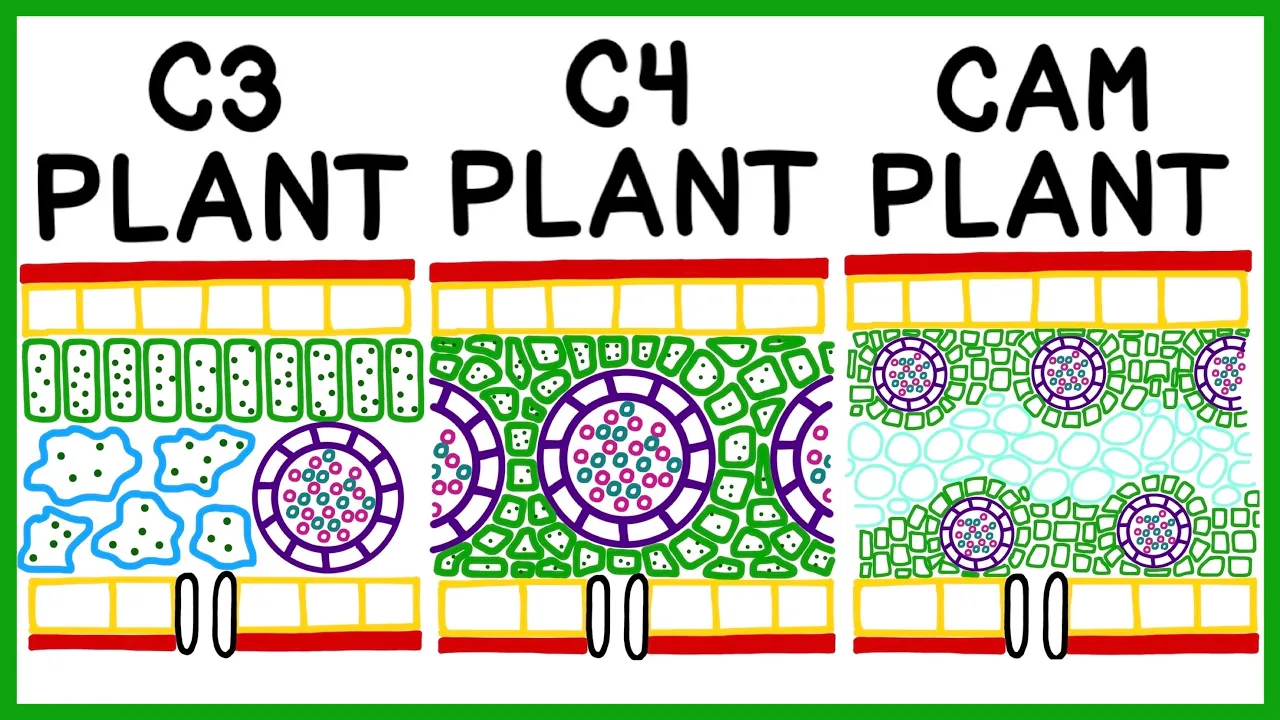
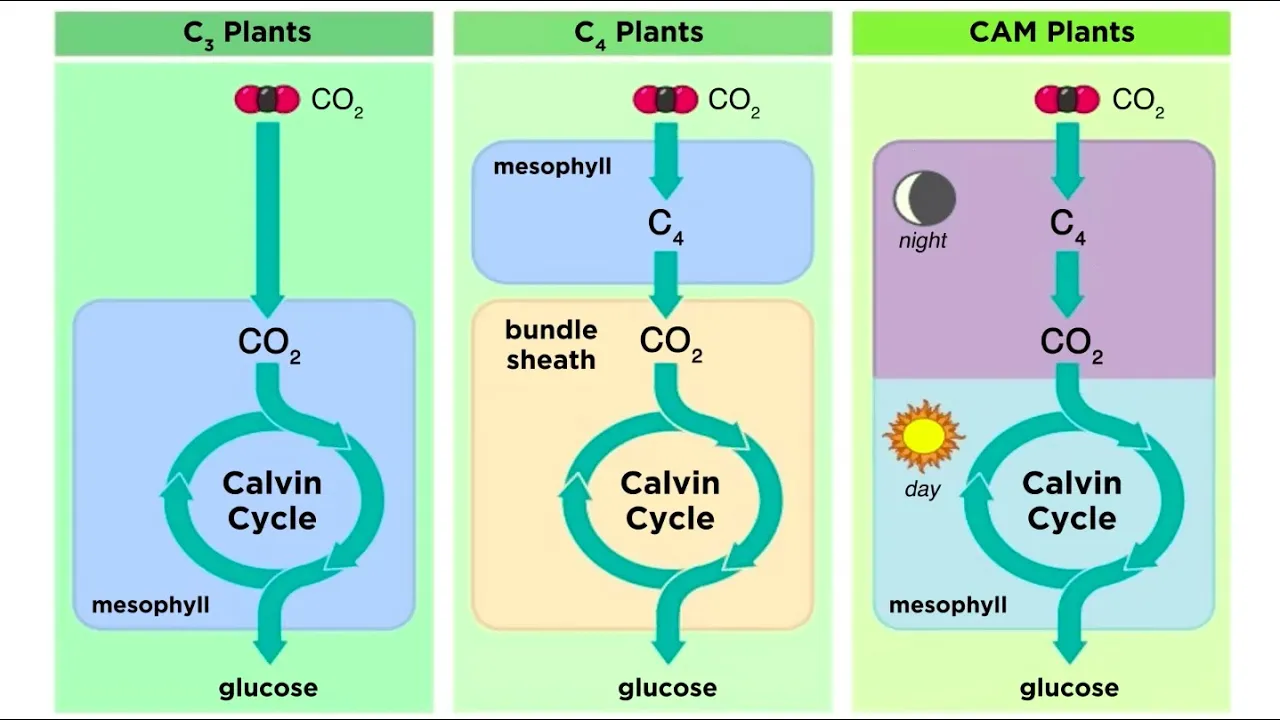
Alternative carbon fixation pathways, specifically C4 and CAM adaptations, which evolved to minimize photorespiration in hot, dry environments.
The bioenergetics and yield costs of photorespiration on agricultural productivity, specifically in major C3 crops like rice and wheat.
Biotechnological and genetic engineering efforts aimed at optimizing Rubisco or introducing synthetic bypasses to reduce photorespiratory energy loss.
The ecological impact of climate change, rising atmospheric carbon dioxide levels, and temperature increases on the balance between photosynthesis and photorespiration.
132 views0likes29:49Original Release: 2025-03-19
[Music] hello everyone I am Kazi Farin again extend a very warm welcome to all of you for the plant physiology and Metabolism course in this lecture we are going to study the important aspect of photosynthesis that is uh the difference between light and dark reaction how rubisco behaves in dual role now we will discuss what is photorespiration and then pathway of photorespiration or glycolate pathway now what is the signific of glycol metabolism then difference between photorespiration and dark expiration so all these aspects today we are going to learn now in my previous lectures we have studied in detail the light reaction and Kelvin cycle so we we might have gone through a certain differentiating points between light reaction and Kelvin cycle you see that U the location of these two reaction that is light reaction and dark Kelvin cycle differ from each other one occurs in thides of chloroplast whereas Kelvin cycle occurs in esta region of the chloroplast uh as you see that uh light reaction can occur only in the presence of light whereas Kelvin cycle occurs both in the presence or absence of light so you see that in light reaction uh light is light energy is absorbed by photosystem 2 and first to start the reaction but what happens in chal cycle that carbon dioxide is absorbed by the stroma to start the reaction and at in light reaction generally ATP as you might be ATP and nadph are the end products whereas in kelvin cycle you see that glucose is the end product and ATP and NPH are basically utilized synthesize in the light reaction and from the type of reaction light reaction is basically photochemical phase whereas Kelvin cycle is biochemical phase so you see that uh how this uh light reaction and Kelvin cycle differ from each other and once we know the Striking feature of these two types of reaction that is light reaction and Kelvin cycle we should keep in mind these differentiating points in mind and now the next aspect is rubisco just I mentioned that how rubisco plays dual activity so just uh what do you mean by dual activity so this Risco can perform dual function both in the form of carox reaction that is addition of carbon dioxide to five carbon compounds namely Rios bis phosphate leading to the formation of a six carbon compound that subsequently break down into two molecules of th froso glyc acid and another is oxy oxygenation reaction that is addition of an oxygen molecule resulting in the formation of one phosphoglyceric acid molecule and two carbon compound namely glycolic acid acid glycolic acid phosphate molecule hence this uh this Risco enzyme is commonly referred to as rubp carox or oxygenase or could be abbreviated as Risco ribulose Bas phosphate carox or oxygenase so you see in the slide that uh uh this uh dual role of uh rubisco was very interesting and in the year 1920 Oto warberg a German biochemist discovered in chlorella chor is a green algae that photosynthesis was inhibited by oxygen this was the observation of warber so despite the photosynthetic origin of oxygen it has been observed that a rise in oxygen concentration can decrease the rate of photosynthesis so this inhibition of photosynthesis by oxygen is known as warar effect and it was later recognized as light dependent release of carbon dioxide due to oxygenase activity of robis scope basically carbon diox oxide acceptor known as rub rubp which occupies the active side of the rubisco enzyme subsequently either carbon dioxide or oxygen can attach to the enzyme leading to either carboxy or oxygenation process as a result you see there is a competition between oxygen and carbon dioxide for active center of the enzyme however it should be noted that uh rubisco basically exhibits a much stronger affinity for binding carbon dioxide compared to oxygen therefore in the presence of natural atmospheric concentration of these gases where oxygen and carbon dioxide both are present in a different ratio Like Oxygen is present in 20 21% whereas carbon dioxide in 0.3% so what happens uh that uh the carbon dioxide the at atmospheric concentration of uh carbon oxygen and carbon dioxide has uh very uh important and uh you see that in this context carbon dioxide has has significant advantages so the proportion of oxygenation uh in leaf photosynthetic gas exchange under these atmospheric condition is only 25 to 30% however when the carbon dioxide concentration decreases and the concentration of oxygen increases then competitiveness of oxygen increases and rubis scope performs oxygenase activity which will be discussed um that the rubisco when rubis scope performs oxygenize activity will be discussed in photorespiration or glycolate pathway now we see that question arise what is photorespiration so you see that uh photorespiration is also known as C2 cycle or glycolate pathway is a sort of metabolic pathway in plants that occurs in the chloroplast peroxisome and mitochondria of the plant cell and this process is basically initiated when oxygen competes with carbon dioxide for binding to robis scope leading to oxygenation of rubp instead of carox this leads to the formation of one molecule of three phosphor glycerate and one molecule of two phosphoglycolate however what happens two phosphoglycolate cannot be utilized in kelvin cycle Instead This two phosphoglycolate enters the glycolate pathway also known as the C2 cycle which as I mentioned which involves the clo blast proxy and mitochondria and the interesting feature of this pathway is the release of carbon dioxide from two phosphoglycolate ultimately allowing plants to recover some of the carbon last during photorespiration now we'll discuss in detail how this pathway proceeds so it's very important to note that the enzyme rubisco can use either CO2 or O2 as a substrate rubisco basically adds whichever molecule it binds to a five carbon compound called ribose5 bis phosphate the reaction that uses carbon dioxide is the first step of the Kelvin cycle and leads to production of sugar the reaction that uses oxygen is the first first step of photorespiration pathway which wastes energy and undo the work of the Kelvin cycle it is very interesting so what determines how frequently each substrate gets chosen basically two key factors are the relative concentrations of oxygen and carbon dioxide and temperature these are the two key factors when a plant has its stomat or leaf for open to open carbon dioxide generally diffuses in and oxygen and oxygen and water vapor diffuses out and photorespiration is minimized however when a plant closes its stomata for just reducing loss of Water by evaporation oxygen uh from photosynthesis generally builds up inside the leaf under these condition photorespiration increases due to high ratio of oxygen to carbon dioxide in addition to this uh rubisco has also higher affinity for oxygen when temperature increases at mild temperature rubisco tenden generally the tendency of rubisco is to bind carbon dioxide about 80 times higher than its affinity for oxygen now how the process of photorespiration proceeds it begins in the chloroplast when rubisco attaches oxygen to rubp in its oxygenase reaction then the first two molecules are produced a three carbon compound three phosphoglyceric acid and a two carbon compound phosphoglycolate followed to this uh uh this three phosphorus glyceric acid is a normal intermediate of Kelvin cycle you might be aware but phosphoglycolate cannot enter the Kelvin cycle so phosphoglycolate which is a two carbon compound is Def phosphorilated by phosphates and converted to glycolate inside the chloroplast glycolate then travels to the peroxisome the next seral cell arganil where it is oxidized to glyoxalate which is also a two carbon compound by enzyme glycolic acid oxidase in basically proxy om hydrogen peroxide is produced which is removed by activity of enzyme catalis now glyoxalate is converted into glycine which is a two carbon compound with the help of enzyme glutamate glutamate glyoxalate trans aminase so this this is basically a trans amination reaction then you see that glycine travels from proxy to mitochondria so in mitochondria two glycine molecules from two reactions of the pathway react to form one Serene molecule which is a three carbon compound and remaining one carbon is released as carbon dioxide molecule here also ammonia is released enzymes involved during this reaction is Serene hydroxy methy transferase now what is the fate of serene Serene returns back to the proxy where it is converted to hydroxy pyate which is a three carbon compound this is basically a trans amination reaction and catalyzed by the enzyme Serene glyoxalate amot transfer is so in proxy hydroxy pyate is now reduced to form glyceric acid and the enzyme involved is hydroxy pyate rectas now this glyceric acid or glycerate enters the chloroplast and is phosphorilated by glycerate kyese to form three phosphoglyceric acid which is also three carbon comp compound as I mentioned earlier this three phosphoglyceric acid as we know that it's a very important intermediate of Kelvin cycle thus enters the C C3 cycle so photorespiration is basically a metabolic pathway occurring in Plants releasing carbon dioxide decreasing photosynthetic output and limiting biomass production in contrast photosynthesis which fixes carbon dioxide photorespiration releases fixed carbon dioxide as carbon fixed carbon as carbon dioxide utilizing ATP but not contributing to carbon fixation or generation of ATP production as a result this process is considered a wasteful process the final product of photorespiration includes carbon dioxide ammonia and a reduced carbon compound in addition to this this pathway as you know that consumes energy without contributing to essential processes now what are the factors that affect photorespiration of course environmental factors such as temperature and oxygen concentration influence photorespiration which tends to increase under high temperature and low carbon di side so the bottom line is that hot and dry conditions tend to cause more photorespiration unless plants have special features such as in C4 and C plants to minimize the problem which we will discuss in our coming lectures in addition to this some Inhibitors of glycolic acid o oxidase like Alpha hydroxy sulphonates hinders or you can say inhibits the process of photorespiration now question arise arises that what is the significance of glycolate metabolism so let us discuss in what ways photorespiration is a wasteful Pro process we have to justify it so you see that one in 10 carbon atoms from the carbon acceptor molecule that is rubp is last during the process of photorespiration in addition to this energy in the form of nadph and ATP is also consumed during the assimilation of ammonia adding to the energy cost of carbon dioxide is imulation photorespiration also increases the energy cost of carbon dioxide assimilation requiring more photons generally number of required Photon increases from 8 to 14 for the process the efficiency of carbon dioxide fixation is generally measured as Quantum efficiency which decreases due to to photorespiration high temperature generally further decreases the quantum efficiency because photo despiration increases more than photosynthesis because the relative rates of carboxilate and oxygen activity basically depends upon the Affinity of rubisco for carbon dioxide and oxygen the ratio of carbon dioxide and oxygen present in the cell solution therefore with an increase in the temperature the solubility of carbon dioxide decreases more compared compared to oxygen and the enzyme affinity for carbon dioxide decreases compared to oxygen as a result glycolate is produced more as compared to three phosph glyc acid especially in C3 plants so this indicates that photorespiration is clearly a wasteful process how glycolate how however the glycolate um produced in this cycle have has some significance like one is Scavenging role a Scavenging role of photorespiration you see in the slide so what of the significant role of photorespiration is believed to be its Scavenging function because glycolate production cannot be avoided due to inherent oxygenase activity of rubisco during the photorespiratory cycle and evolve to remove glycolate with minimum carbon loss about you see that 75% of the carbon loss from the Kelvin cycle as two phosphoglycolate which is recovered in the uh oxidative photosynthetic carbon cycle out of the 10 carbons of rubp only one carbon is lost as carbon dioxide while nine are recycled as three phosphoglyceric acid then the next function is involvement of three arals for glycolate removal as you know that three arals are involved in the removal of glycolate due to its toxicity to rubisco and Kelvin cycle enzymes glycolated glycolate is transported out of the chloroplast and further oxidized to produce glyoxalate in proxy Not In chloroplast so that to avoid inhibition of photosynthesis proxy efficiently removes hydrogen peroxide and convert glyoxalate to gly glycine moreover substrate channel channelizing in a multi-enzyme complex prevents the release of glyoxalate hydrogen peroxide and Hy oxy pyats the intermediates of glycolate metabolism even if the proxyl uh even if the proxyl membrane is damaged the enzyme complex remains intact indicating the protective function enzymes in the present in the cytosol because the are they are present in the cyto enzymes in the cytosol are present to convert glyoxalate to glycolate in case of any sort of leakage then third is uh role in protection from photo inhibition is also very crucial what happens uh during highlight intensity and temperature stomata Clos to prevent water loss which leads to uh decrease in carbon dioxide concent as compared to oxygen so what happens the decrease in carbon dioxide availability causes the accumulation of reduced intermediates of light reaction without carbon dioxide ATP is not consume so the proton gradient across thid is generally reduced hence preventing the dissipation of photosynthetic electron transport this leads to production of reactive oxygen species and damaged to the photosynthetic apparatus a phenomena generally termed as photo inhibition now if these ATP and N adph are consumed in some way this damage to the photosynthetic apparatus will be prevented so basically uh plant plants employ photorespiration as a mechanism to consume NAD pH and ATP hence protect the photosynthetic apparatus from light induced damage now how photorespiration plays a role in nitrogen economy photorespiration basically plays a significant role in maintaining nitrogen economy by conserving nitrogen you see that when glycine is converted to Serene in a mitochondri in mitochondria one nitrogen atom as ammonia is reassimilated In chloroplast through GS goat reaction uh thereby conserving the nitrogen during ammonia assimilation reducing equalent are used as reduced ferrodoxin and nadph now role in amino acid synthesis role of photorespiration in amino acid synthesis the photorespiratory cycle is essential for the synthesis of two amino acids namely Glycine and Serene alternate Pathways for amino acid synthesis function when photo despiration is suppressed now we will basically discuss the difference between photorespiration and dark respiration or usual respiration ation but the detail mechanism of usual respiration will be discussed in my upcoming lectures so how this photorespiration differs from usual respiration you see that photorespiration is light dependent whereas usual respiration is light independent and in addition to this uh this exclusively takes place photorespiration exclusively takes place in Green tissues of C3 plants and minimum in C4 plants whereas the usual respiration takes place in living tissues of all aerobic organisms photorespiration basically linked to an entirely rely rely on the Kelvin cycle whereas usual respiration is not inherit inherently linked to C3 cycle uh but uh you see that usual respiration and C C3 cycle are especially and temporarily distinct process they do not rely on each other you see that uh photorespiration generally takes place uh in various cellular compartments including cytoplasm chloroplast proxy and mitochondria involving glycolate pathway whereas usual respiration occurs exclusively in the cytoplasm and mitochondria involving glycolysis TCA and terminal oxidation you see that photorespiration basically consumes oxygen and uh at three stages of release carbon dioxide and at three stages sorry photorespiration consumes oxygen at three stages and releases carbon dioxide only at one stages so but you see as usual respiration OT is oxygen is solely utilized during terminal oxidation whereas carbon dioxide is liberated at multiple points so you see that uh in other aspects photorespiration and rock respiration also differ from each other generally for every molecule of carbon dioxide released one molecule of ammonia is liberated during photorespiration but uh in usual respiration ammonia is not generated so you see that uh these two process that is photorespiration and usual respiration significantly differ from each other so in this lecture We have basically learned the difference between light and dark reactions uh the Dual role of Risco as carox and oxygenase activity the consequences of oxygenize activity of Risco in photorespiration leading to the wasteful consumption of ATP and release of carbon dioxide further the significance of glycolate metabolism in conserving about 75% % of the carbon lost in kelvin cycle has also been well explained so this is all about for today's session thank you very much [Music]
Up Next
10:41
Photosynthesis in Higher Plants: C4 Pathway (Hatch-Slack Cycle) Explained
@NeelaBakoreTutorials
372.3K views•2016-07-22
50:12
Bacterial Communication: Quorum Sensing and Biofilm Formation Explained
@JHUAAP
12.6K views•2011-06-28

5:35
Enteric Nervous System Explained: The Gut's Brain | Neurobiology Lecture
@alumniu6029
438 views•2018-09-12

7:08
Bacteriophages: Earth's Deadliest Killers and Future Antibiotics
@kurzgesagt
34.6M views•2018-05-13
Related Study Plans & Knowledge Roadmaps
Structured learning paths in Biology
biology
RNAi: Biogenesis, RISC & Gene Silencing
01Molecular Biology Foundations: DNA to Protein
02Introduction to RNA Interference (RNAi)
03Molecular Biogenesis of miRNA and siRNA
+ 2 more learning modules
10h5 modules
Explore Roadmap
biology
Mycorrhizae: Signaling, Biophysics & Ecology
01Foundations of Mycorrhizal Symbiosis
02Molecular Signaling and Root Colonization
03Biophysics and Bioenergetics of Nutrient Exchange
+ 1 more learning modules
11h4 modules
Explore Roadmap
biology
Circadian Clocks: TTFL, SCN & Periphery
01Foundations of Molecular Biology & Gene Expression
02Introduction to Chronobiology and Actograms
03The Core TTFL: Molecular Architecture of the Clock
+ 3 more learning modules
14h6 modules
Explore Roadmap
biology
Population Genetics: Math, Drift & Selection
01Genetic & Probability Foundations
02The Hardy-Weinberg Principle and Baseline Models
03Mathematical Modeling of Natural Selection
+ 3 more learning modules
18h6 modules
Explore Roadmap