








![[29] Serway Physics CH13 뉴턴의 만유인력 법칙, 자유낙하 가속도와 중력, 분석모델: 장 속의 입자(중력)](https://i.ytimg.com/vi/NkD6x3gX8ro/maxresdefault.jpg)









Newton's Law of Universal Gravitation states that every mass attracts every other mass with a force proportional to the product of their masses and inversely proportional to the square of the distance between them, expressed as F = G(m₁m₂)/r², where G = 6.67 × 10⁻¹¹ N·m²/kg²; this law explains phenomena such as calculating Earth's mass from surface gravity (approximately 5.96 × 10²⁴ kg) and determining orbital velocities for satellites.
Newton's Law of Universal Gravitation | AP Physics Lesson
Added:Newton's Laws of Motion, particularly the concepts of net force, acceleration (F=ma), and action-reaction pairs.
The fundamentals of uniform circular motion, including centripetal force and centripetal acceleration equations.
Basic algebra and proportional reasoning, specifically how to manipulate inverse-square relationships.
Determining gravitational field strength (g) as a vector field at various distances from a central mass.
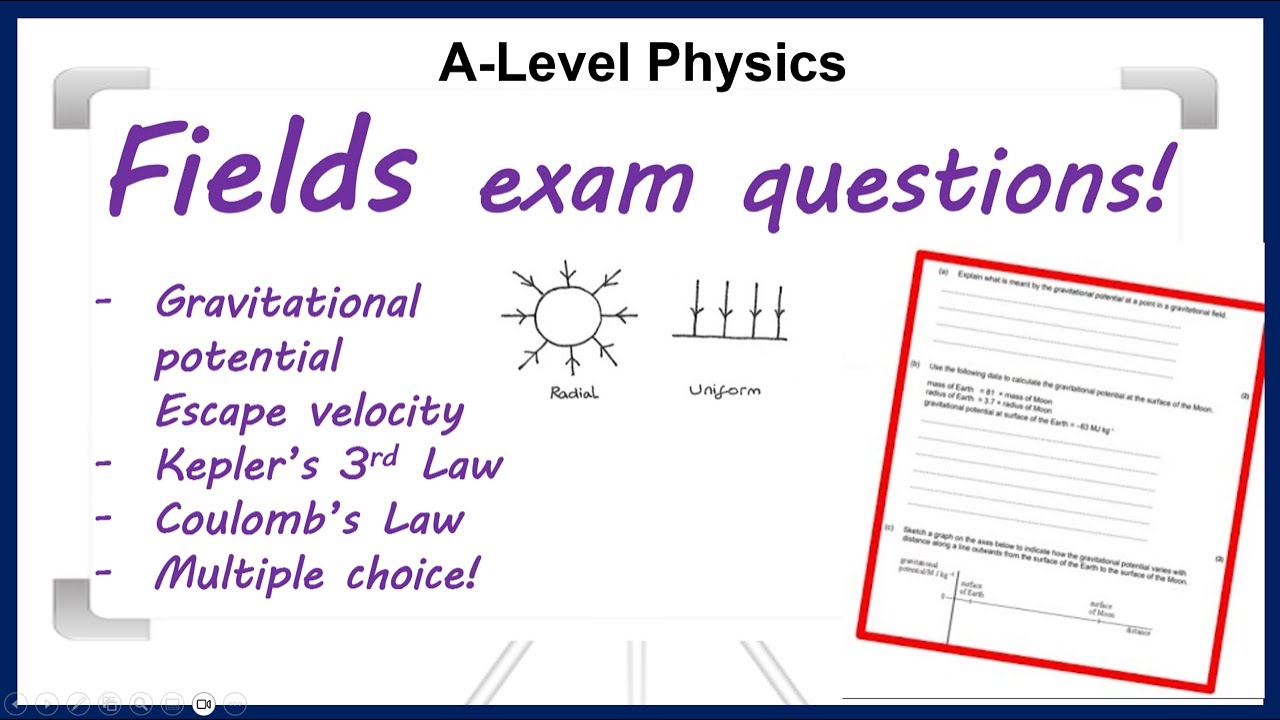
Deriving and applying formulas for orbital speed, period, and Kepler's Third Law of Planetary Motion.
Calculating gravitational potential energy in non-constant fields and determining escape velocity.
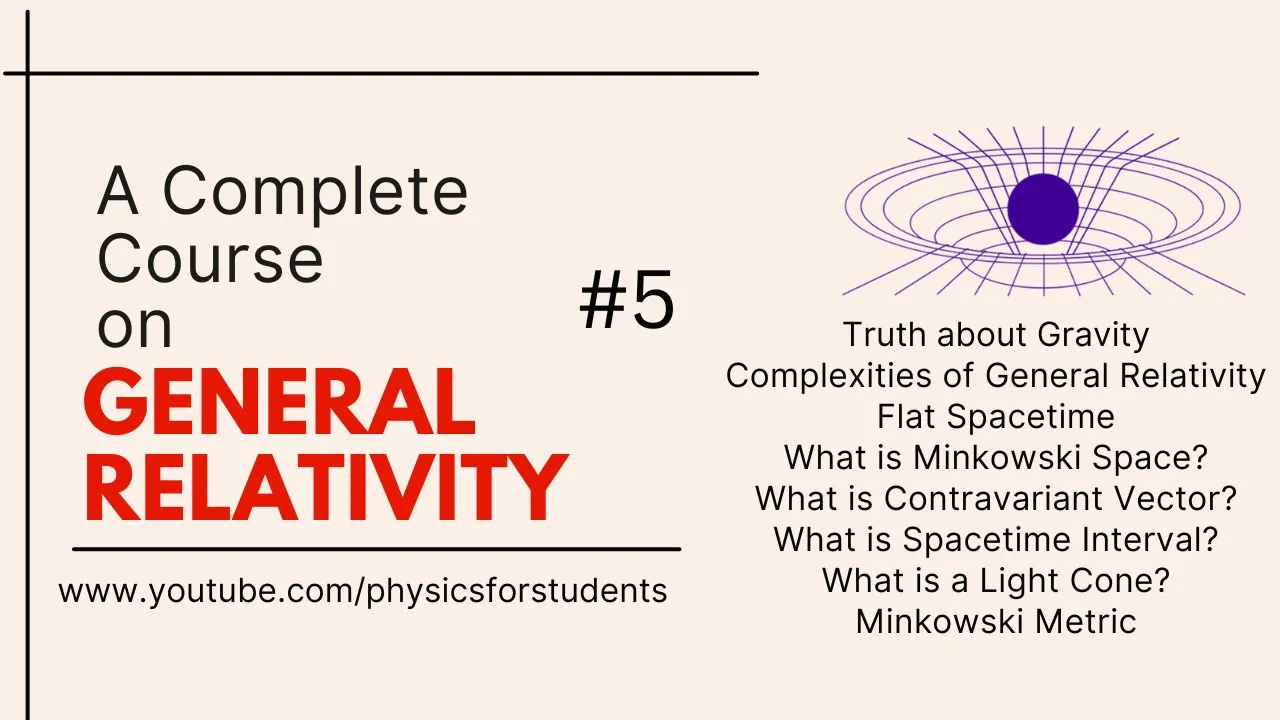
Transitioning from classical Newtonian gravity to Einstein's Theory of General Relativity (gravity as spacetime curvature).
168.8K views549likes11:41Original Release: 2012-10-06
Newton's universal law of gravitation.
So, let's get to it. Um, when we talk about the Newton's universal law of gravitation, we're really talking about the attraction, the forces uh between one large mass and another large mass.
And guys, even you with someone else, you do have a force of attraction. Um, that is a universal law of gravitation.
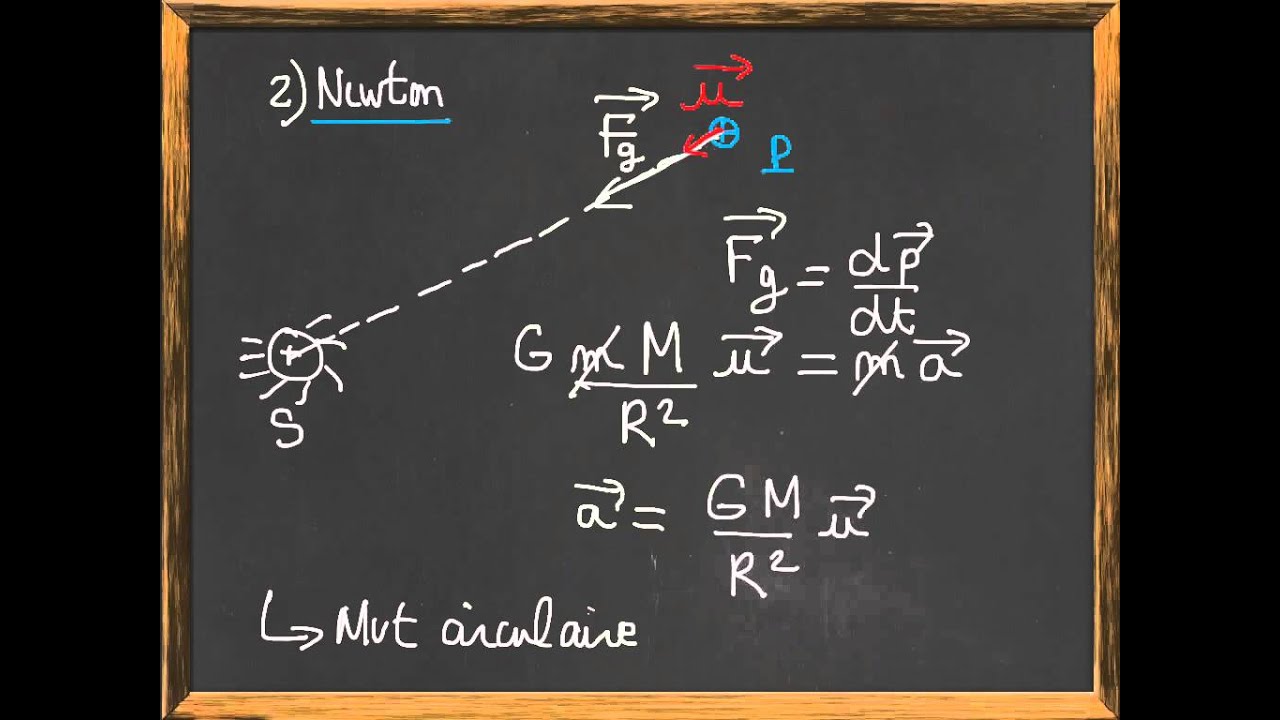
Anything that has mass and has and has a radius apart has a universal law of gravitation and it obeys one equation and that is FG is equal to big G mass 1 mass 2 over their distance squared.
Okay, that big G is just a constant.
That big G it comes out to be 6.67 * 101th.
Remember on your calculator for times 10 you're going to use that E button or that exponent button, okay? that capital E button and it has units of newtons meters squared over kilogram squared.
Please don't get crazy with these units.
All the units do is cancel stuff out.
You can see on the bottom of those units we have kilogram squared. That cancels out the two masses, the product of our masses which is is on the numerator.
Okay. And the meter squared cancels out of course the distance squared which is on the denominator of the equation. And so this is the main equation is that fg equals g m1 m2 over r^2. Let me show you a little simulation here. Here we have a two objects and they have two masses.
One has a mass of 40 kgs, one has a mass of 50 kgs. And what do you know? It has a force of attraction, a force of gravity on each other. And that force is 500 newtons. And take a look. Each one is feeling an equal but opposite force.
Now if I double the mass of the one of them. Okay, take a look at the the newtons. It's 500 newtons right now.
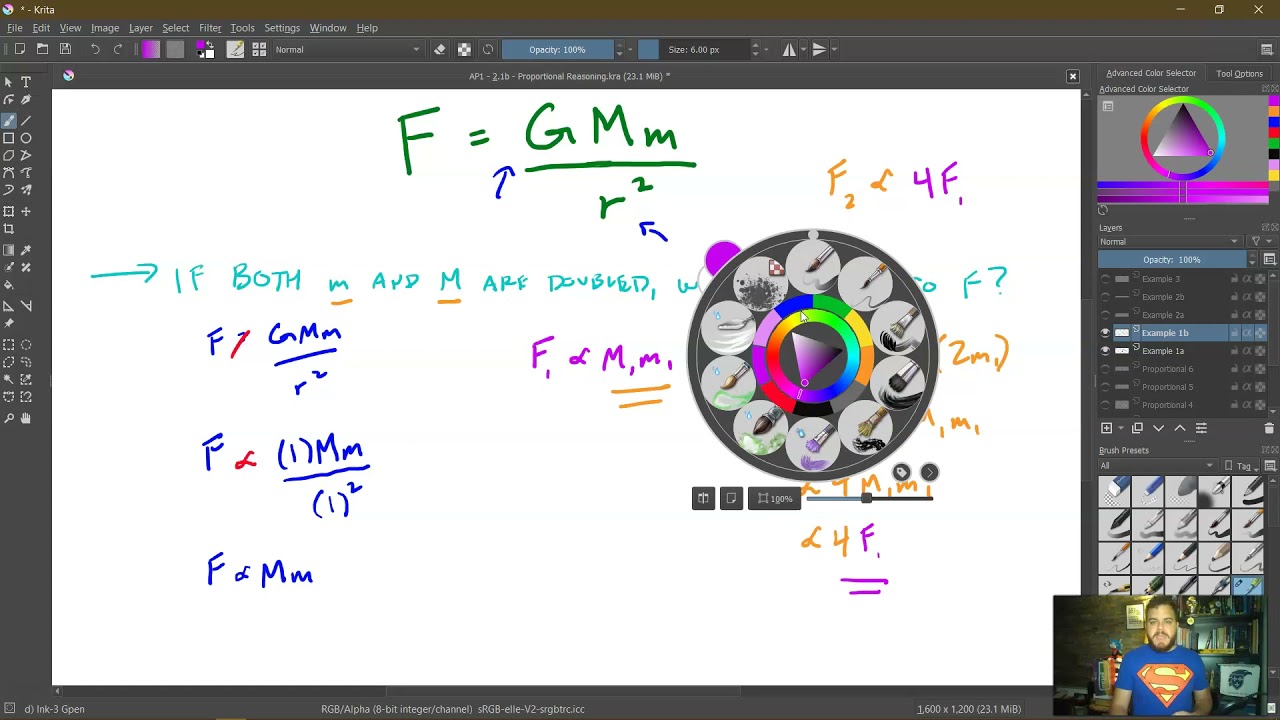
Take a look what happens now. It's 1,000 newtons. So if the mass gets doubled, the force gets doubled. And yet the distance between the smaller it gets look at the force vectors they become greater and greater and greater. Whereas if I put more distance between it gets less and less and less and that is the main equation that we have is FG= GMM over R2 and we have all kinds of relationship problems. I don't know about you I don't have any relationship problems but um our relationship problems deal with if we take and we double our mass. Okay, let's let's say we we double our mass. If you double one of the masses, you can see you're gonna put a two up top, which means what happens to the force of gravitational pull? It doubles as well. So if you can take a look, that force of gravitational pull is doubled.
Okay? And so if you triple the mass, what happens to the force of gravitational pull? It triples if you quadruple the mass. And so the mass is proportional, isn't it? The mass is proportional. Okay. Whereas the the radius down here the radius is being squared. So if you double the radius if you double the radius that number that two is getting squared. So in your denominator you are getting 14th of the force of gravity 1/4. So if you triple the mass if you triple sorry if you triple the radius it is being squared. So you would have 1 ninth of the force of gravity. If you half the mass, half the radius on the bottom, you have 1/2 being squared. That is again on your denominator. And so that ends up being 14th. And that four comes up top, which means if you decrease the radius, it will go up a multiplier of four times.
Let's see a a practical problem on this.
Um, this says the dwarf planet of Pluto has 1/500th the mass and 115th the radius of Earth. It says what's the value of gravity on the surface of Pluto? So, what do we have to do on that numerator right there? We're going to plug in our masses. Okay. And so, my mass is 1500th. That is on my numerator.
Okay. Whereas the 115th is on my denominator because that's the radius and we're putting in 115th. And what are we going to do to that value? We're going to square it because the radius is going to be squared. We still have 1500 from the top because that's proportional.
But 115th ends up being 1 over 225.
And what happens when we have a denominator on the denominator? It comes up to the numerator. So 225 is on the top, 500 is on the bottom. And that is how many times gravity there is. Now if you think about it, our gravity is 10 about 10 meters/s squared. So if we multiply that by 10, you get 225 over 50. And that would be Pluto's meters/ second squared. Okay? And so there are relationship problems.
Hopefully this helps out. All you have to do is plug in the numbers proportionally for the mass and for the radius they are being squared. Okay, here's another problem. Uh this is more of a quantitative problem. Uh this is maybe you standing on Earth. Okay. Um looking kind of skinny today, but um you standing on Earth. Given the radius of the Earth, we're going to calculate the mass of the Earth. So what's crazy is you can actually calculate the mass of the Earth. Now that being said, if you feel a force of gravitational pull, that is the big gravitational pull and that is equal to the force of what we feel of of gravity. Okay? And so F big G is big G, the mass of the Earth, the mass of U, I'm going to call it mass of the person, MP, over the distance squared. Okay? And that is equal to the mass times gravity.
The mass of the person times gravity because that is the force of gravity that person feels. Let me go back to our free body diagram. Our free body diagram is this guy feels a force of gravity.
Okay. And that force of gravity is the exact same force of gravity that the earth feels as the force of big gravitational pull between two masses there. Okay. This was this is what makes Newton's law of gravitational pull so important. Now, if you see I have an M mass of the person on this side, mass of the person on this side. That what does that do? That cancels these guys out.
They basically are divided in. Okay. And what do I know? I know some values. I know G is 6.67* 10 to the11. And you see I'll use that little that e right there. We that's multiplied by the mass of the earth. And that's all over the radius of the earth.
The distance from u which is on the earth surface to the radius. That's the radius of the earth. So we put in 6.37 * 10 to the 6 and we are going to square that bad boy. Okay, square that bad boy.
And that is all equal to 9.8 m/s squared. Now you guys can try this on your calculator. Do the algebra on your own and you will end up finding the mass of Earth is about 5.96* 10 or E* 10 the 24th kilogram. Okay.
Okay? And that is the mass of the Earth.
And what's crazy is you don't even have to put it on the scale. And you can actually know the mass of the Earth, which means you can know the mass of the sun, you can know the mass of the moon, the mass of Pluto, you can even know the mass of Uranus. Um, and you don't even have to put it on a scale, which is nice. Um, that was a little joke. But the uh we This also works with satellites. Satellites. Let me give you a nice little um picture of the Earth and a satellite. Now, this is what it looks like in scale. The Earth and a satellite. satellites really, really small. But you can see the force vectors are equal and opposite. Whether the satellite is far away, the force vector gets smaller. Satellites closer. Whoa, I just blew it up. Um, I'm going to reset it. And it is going to be as we get closer that force arrow gets greater.
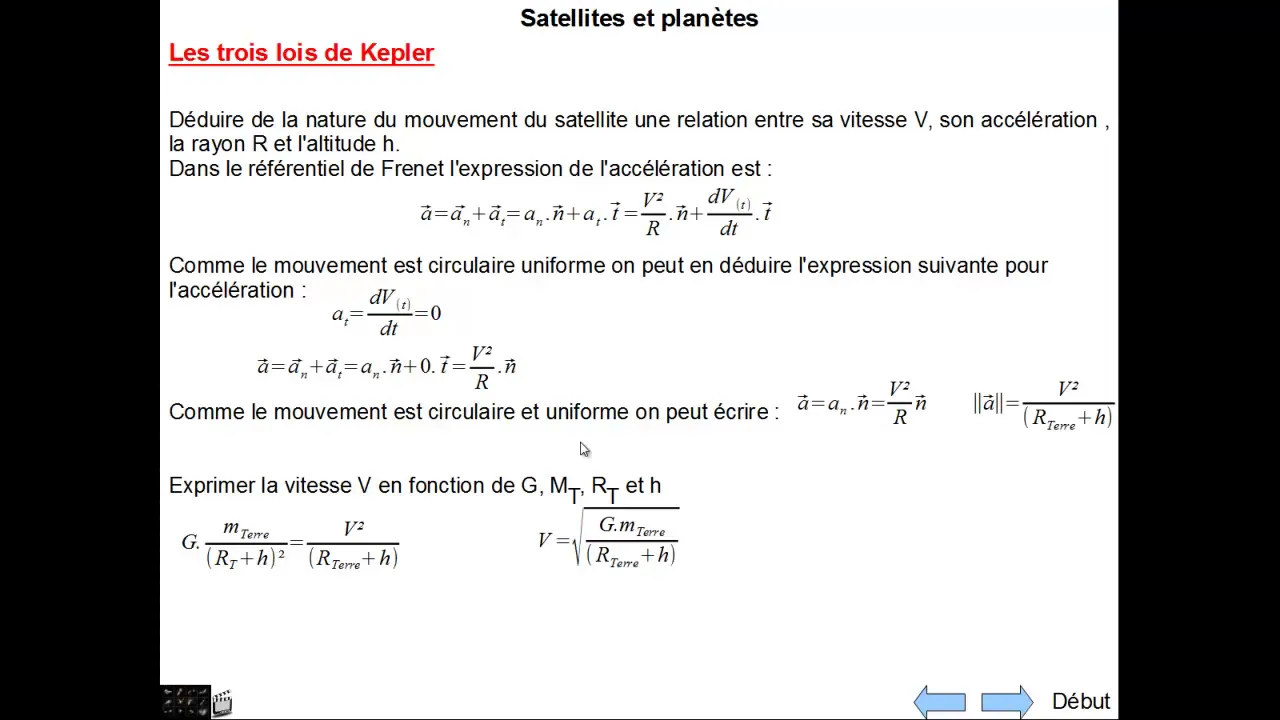
And the satellite moves around the Earth in a circular fashion. And you can see, look at the velocity. the velocity is going to be tangent to the curve tangent to the curve of uh in this centrial orbit. So whenever we have a a satellite problem what you want to do is you want to go to an equality which is force of big gravitational pull is equal and opposite to the force of centripal motion what we just studied. And so we have g time m1 that's the mass of the earth m2 that's the mass of the satellite over r squar and what is moving centrially and you can see this satellite has a a force that is towards the center which we f call the force of gravitational pull that is the force towards the center and our velocity is always going to be tangent to the curve there and so the acceleration is towards the center and that is going to be equal and opposite to mass of the satellite mv^2 squar over r. Now this we need to solve for the velocity. So we're going to move everything over to the other side. And you can see what happens is the mass of the satellites cancel out.
It doesn't matter how what the mass of the satellite is. And [snorts] this r is going to go up top. So if we move this r up top, it cancels out one of these rs, doesn't it? And so what am I left with is I have this big g, the mass of the earth over the radius. And that is equal to the velocity squared. And so in order to get that square out of there, all I have to do is square.
Not no. Yes.
Yeah. I'm almost set.
Awesome.
Yeah.
That's cool.
Yeah.
But for like if I record something or something like that maybe. Yeah.
Oh, that's cool.
Cool.
So, in order to get this square out of here, all you have to do is square root, don't you? You just square root the other side. Now, if you see, let's check to see if this is exactly what we can use for our um variable problem right here. And we can use big G. We can use uh variables like that, little constants like that I should say. We can use the mass of the earth except for we got to call it um a big capital M there. And on the bottom the radius the radius you could take a look the the distance between here and here is what we call D.
And the distance between here and the center is what we call the radius of the Earth. So on the bottom, all I'm going to do is combine these two together is we're going to call it d plus radius of the earth because that is the distance away square rooted. There's your velocity and that's the velocity of my satellite. So we can be thankful to Cam Newton for finding Newton's universal law of gravitational pool. I am really um ecstatic that he did this even while he was playing in the NFL. Um so important for us here in physics. Guys, have a good time. Have a good weekend and I will catch you on the flip side.
Up Next

72:10
Physics 200: Understanding Kepler's Laws and Gravity
@YaleCourses
198K views•2008-09-22

12:53
21cm Hyperfine Transition in Neutral Hydrogen: Radio Astronomy Basics
@AaronRobertParsons
12.4K views•2011-10-13

32:32
NMR Spin Physics I: Zeeman Effect, Resonance Condition & Larmor Frequency
@nptel-indianinstituteofsci8064
2.3K views•2024-01-17

27:14
Entropy and the Second Law of Thermodynamics Explained
@veritasium
27.5M views•2023-07-01
Related Study Plans & Knowledge Roadmaps
Structured learning paths in Physics
physics
Nuclear Physics (Decay, Fission & Reactors)
01Atomic Structure and the Binding Force
02Radioactive Decay and Half-Life
03Nuclear Fission Mechanics and Chain Reactions
+ 2 more learning modules
12h5 modules
Explore Roadmap
physics
Soft Matter (Polymers, Colloids & Rheology)
01Foundations of Soft Matter & Thermal Forces
02Polymer Physics and Macromolecules
03Colloids, Surfactants, and Self-Assembly
+ 2 more learning modules
38h5 modules
Explore Roadmap
physics
Analytical Mechanics: Lagrangian & Hamiltonian
01Mathematical Foundations: Calculus of Variations
02From Newtonian Mechanics to Constraint Dynamics
03The Principle of Least Action & Lagrangian Mechanics
+ 3 more learning modules
28h6 modules
Explore Roadmap
physics
General Relativity (Spacetime & Cosmology)
01Foundations of Relativity: Special Relativity
02The Geometry of Spacetime: Equivalence Principle & Curvature
03Einstein's Field Equations: The Mathematics of Gravity
+ 2 more learning modules
55h5 modules
Explore Roadmap