


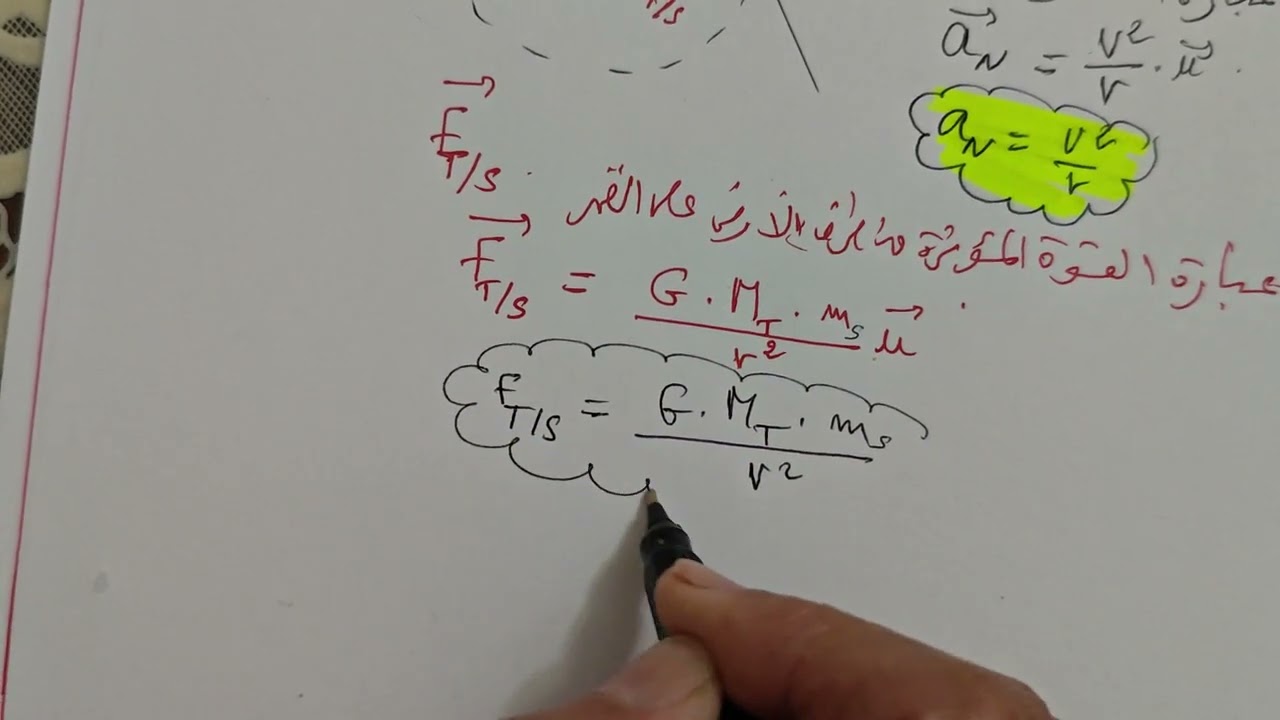
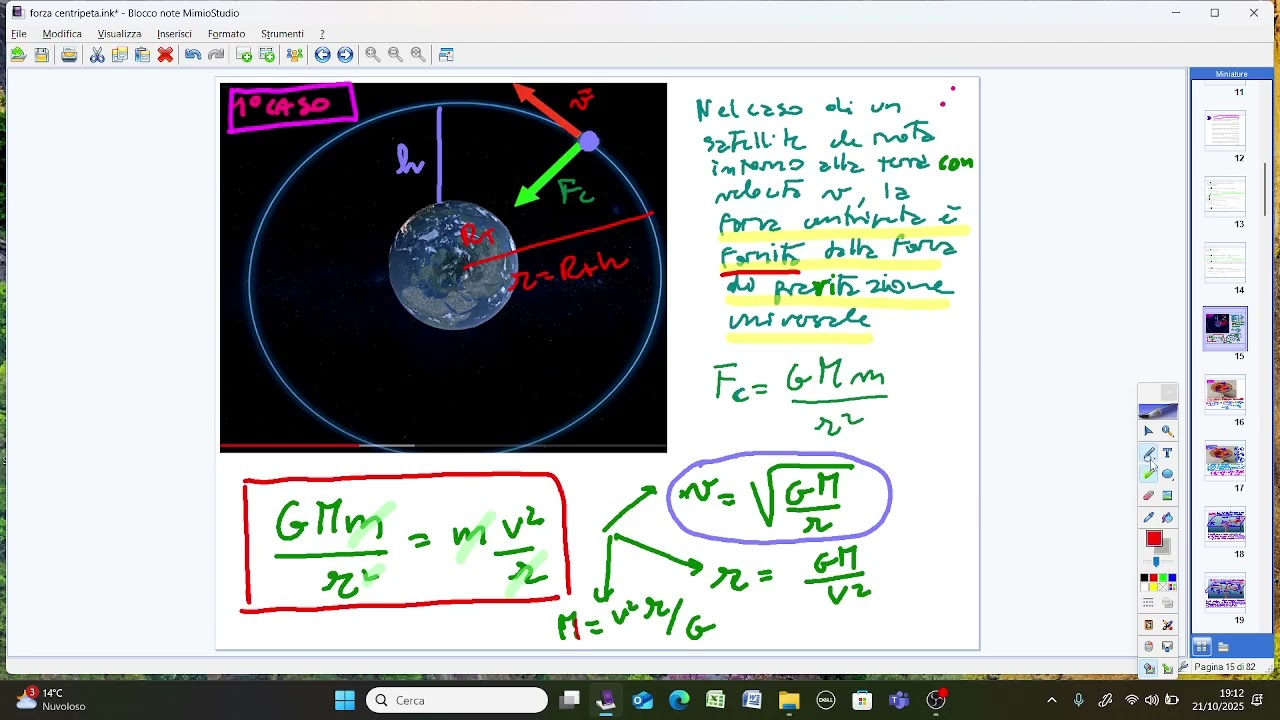







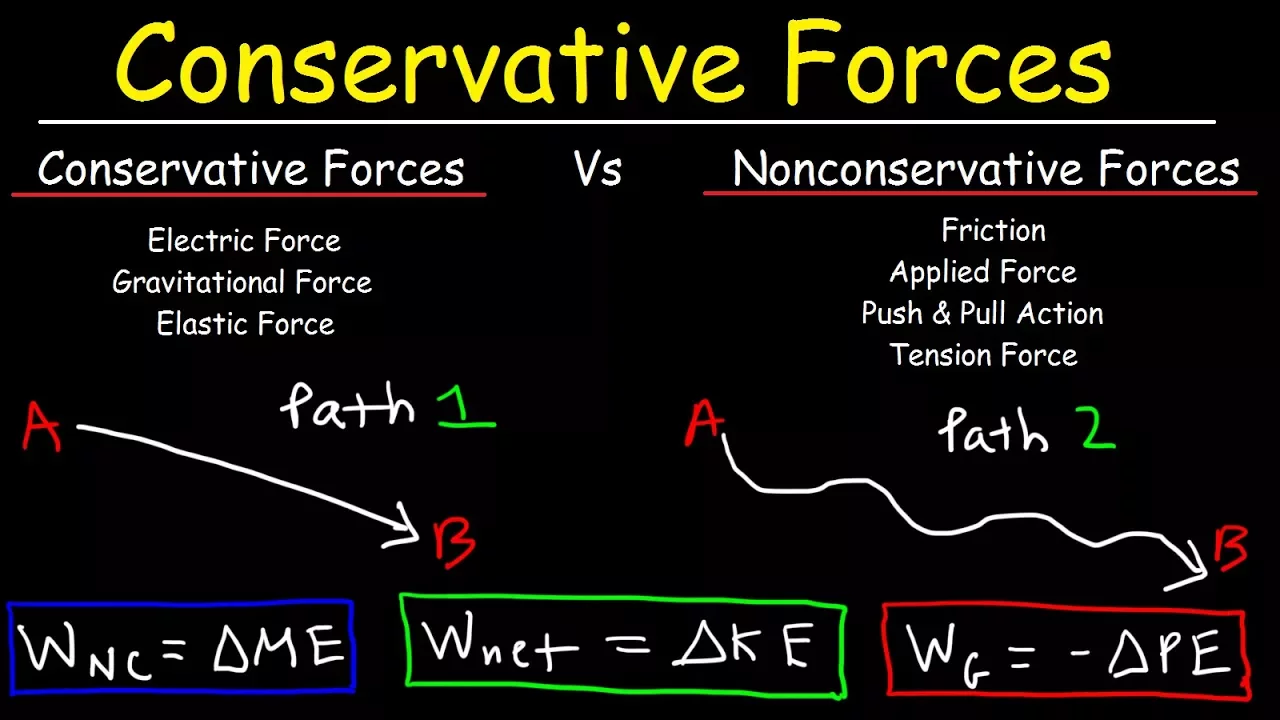


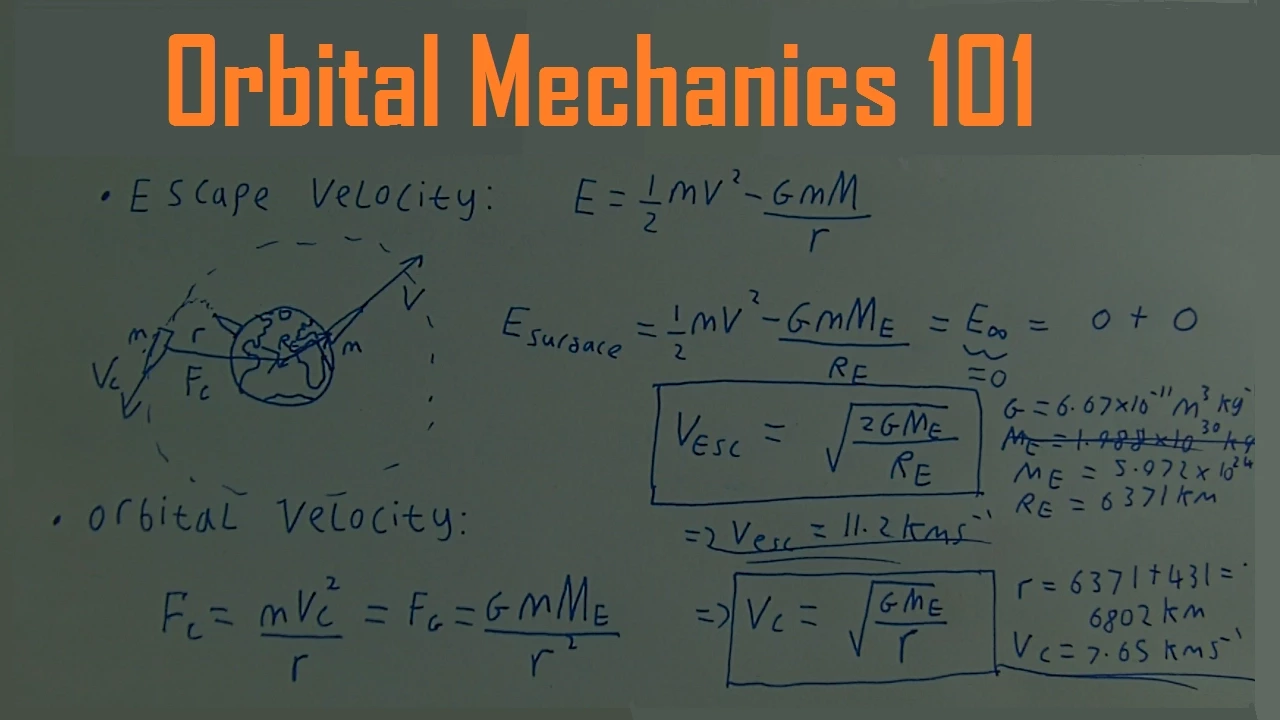








Newton derived Kepler's three laws of planetary motion from his Universal Law of Gravitation (F = Gm₁m₂/r²), showing that gravitational force causes centripetal acceleration for circular orbits (v² = GM/r), leading to Kepler's Third Law (T² ∝ r³), while the conservation of angular momentum explains equal areas swept in equal times, and the negative total mechanical energy (E = -GMm/2r) indicates bound orbits where escape velocity equals √(GM/R).
Physics 200: Understanding Kepler's Laws and Gravity
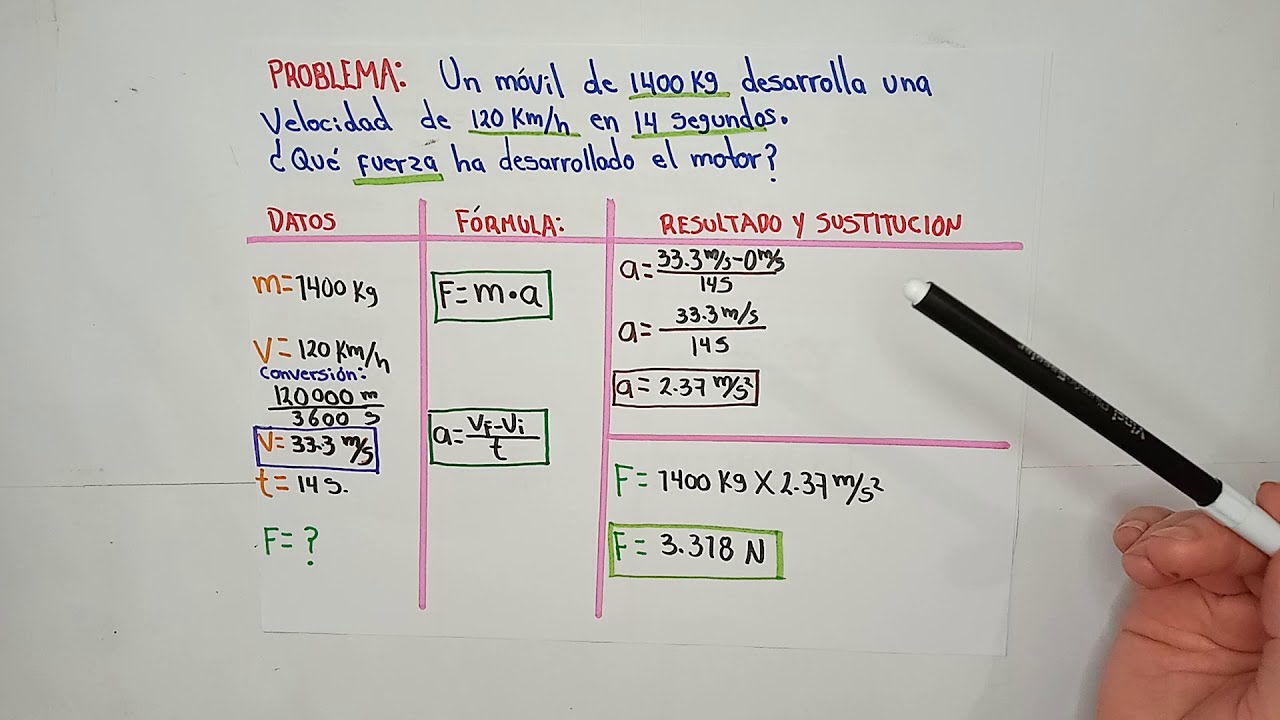
Added:Newton's Laws of Motion, particularly the concepts of force, mass, and acceleration (F = ma).
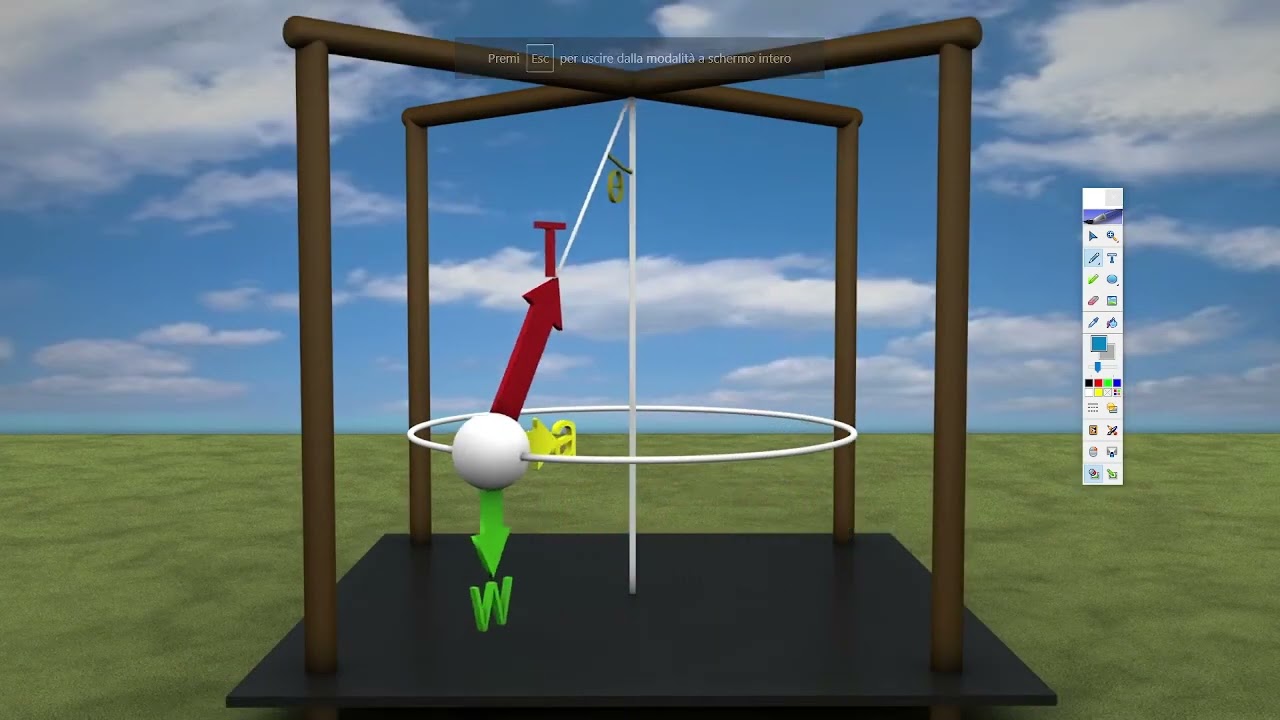
The fundamentals of uniform circular motion, including centripetal acceleration and centripetal force formulas.
Basic geometry of conic sections, specifically the properties of an ellipse such as foci, semi-major axis, and eccentricity.
The concepts of work, kinetic energy, and conservation of mechanical energy.
Advanced orbital mechanics, including calculating escape velocity, orbital energy, and orbital transfer maneuvers like the Hohmann transfer.
The classical two-body problem, including the derivation of Kepler's laws using calculus and vector mechanics.
The concept of gravitational potential energy in a non-uniform field, and the definition of gravitational potential.
An introduction to General Relativity, exploring how Einstein's theory of curved spacetime builds upon and refines Newtonian gravity.
198K views0likes1:12:10Original Release: 2008-09-22
Professor Ramamurti Shankar: I thought before going into today's topic, I will give you a five-minute summary of what happened last time.
So, you guys are saying, "Look, it looks like you got carried away with this thing; we just want to know what we need to become good doctors, so just tell us."
So, if you're a doctor or a lawyer or -- I've had really strong students in my class who had nothing to do with any of the sciences, physics or chemistry, which of course is a great pleasure for me to know.
So, if you go forward into your life's mission, what should you know from the last lecture?
Here's the main point. The Law of Conservation of Energy is a powerful concept that I told you, survives even the quantum revolution.
So, it looks like we may ascribe to a system something called the total energy, which is the kinetic energy, which is always ½ mv^(2), and potential energy which depends on the location of the object, and it varies from problem to problem, depending on whether they're connected to a spring or gravity and so on. In one dimension, we could always get to the potential energy for any force that depended only on location. The trick was to go back to the Work Energy Theorem, which just applies Newton's laws and says the change in kinetic energy of the body is the work done by the body, and that work we defined to be this; then, the sum of all this, on the left-hand side, would be the change in kinetic energy. On the right-hand side, this would become an integral of F, from x_1 to x_2.
And if F really is a function of x and not of also velocity, the laws of calculus tell you, you may write this integral as the difference of two numbers.
Then, you rearrange the expression to get K_1 + U_1; U_1 is shorthand for U of x_1; is K_2 + U_2. And that means the energy E_1, to begin with the energy at the end. If there is a frictional force, then in this integral you break it up into two parts: the part, say, due to a spring and the part due to friction. The part due to a spring will integrate to give you this. Then, you'll still have the part due to friction left over. In that case the result will look like (K_2 + U_2) - (K_1 + U_1). Instead of being zero, it will be the work done by friction.
We write it symbolically this way but the frictional force is not a function of x alone, but if knew which path you're taking and which way you're moving, you can do that integral.
You want to do this in higher dimensions.
In higher dimensions, what I found out was that if you wanted the change of kinetic energy to be the work done, then what you had to do was to write this expression, which was a shorthand for F_x, dx + F_y dy. So, you take a point and you go to a neighboring point, that's the work done; and this work done was cooked up so that it was a change in kinetic energy. Then you say, okay, let me take a finite path, starting with some point r_1 and going to some point r_2. Then, I add up all the changes.
The left-hand side is K_2 - K_1, and the right-hand side is this integral.
This is always true. This will never be wrong.
It's just a restatement of Newton's law.
The problem will be, can we write this integral here as a difference of two numbers, one depending on the starting point and one depending on the ending point?
Is this possible? That's a question mark.
If it's possible, you are done, because you're back to writing K_1 + U_1 = K_2 + U_2.
But I tried to convince you that it's not always going to happen. So, let's understand why it's not always going to happen. It is not enough in this integral to say, start at r_1 and go to r_2. In fact, if I just said, find the integral of the work done by the force between r_1 and r_2, you will have to tell me--you'll have to ask me something. You agree?
What will you ask in addition, besides just saying start at r_1 and end at r_2?
Student: What happens in between.
Professor Ramamurti Shankar: You will ask, "What path did you take?" And unless you specify the path you cannot do the integral, because you don't know what contour you want to draw. Therefore, the answer in general depends on the path, but this right-hand side does not. So, if you pick the same two endpoints and you vary that path into this one, the right-hand side doesn't change, but it's not hard to imagine the left-hand side would be different.
Therefore, in general this will not be true.
So, even though there's a relation between work done and increase in kinetic energy, you will not get a law of conservation of energy, unless this is true.
Then I said, there is still hope because we can, in fact, manufacture forces for which this is true. To manufacture the force, you pick any function U, of x and y that you like, then define a new force whose x component is minus the derivative of U with respect to x, and whose y component is the minus the derivative of U with respect to y. Then, you got to go back and look at your notes and see that if you take F.dr now, you're just adding the change in U, and when you go from start to finish the total change will in fact be the change in U, from start to finish, and won't depend on how you got there.
So basically, what you're doing is, in the xy plane you are defining a function U of xy, which is like a height.
You defined the force in a clever way so that F.dr is the change in the height, as you march.
So, you can start at any point on the mountain, go to any other point on the mountain; if you're only keeping track of the change in height you're going to get the same answer, no matter how you got from here to there. So, you start with a potential and work out a force, and that force will then obviously give an answer that's path independent, and the potential associated with the force is the function you began with. In other words, in this problem then, K_1 + U_1 will be K_2 + U_2, where U is the same guy you began with. So, you can get a law of conservation of energy in that case.
Then, I told you without proof that this is the only way it can happen. In other words, we all agree that if you got a force from a potential by taking derivatives, it does the job. But I'm saying, every force whose integral is independent of path will always have as its ancestor a function U, and the x component of the force will be the x derivative of the function and the y will be the y derivative. That's not obvious, but in other words it's clear it's sufficient but it's also necessary. So, every conservative force is the derivative of some potential, in this fashion.
Finally, I said if someone comes and gives you a force and says, "Is it conservative or not?"
either you can think in your head and try to guess that function U, of which this F is the derivative, in this fashion. If you succeed, you know it's conservative; if you fail, maybe it's not conservative or maybe you are not clever enough in finding that function. So, here is a recipe that works for all of this. The recipe is: take the force, take the d by dy of F_x, and compare it to d by dx of F_y, and if they're equal, it's a conservative force.
That's the summary of last lecture.
How much of a detail you want to know is entirely up to you.
Okay, so now--so I'm going to--This is residual from last time. So, I'm going to basically hide that. If you want, you can take a few moments writing it down.
But you understand the point now.
The point is, there are--In fact, if you think about it, it's fairly miraculous that there are forces in nature so that the work done by them doesn't depend on how you got from A to B.
Even more interesting is that all the fundamental forces that we know -- gravity, electrostatics, even the strong force, weak force, every force that we know to the extent it can be described by a force -- happens to be conservative. So, it's not that we are hung up on some rather exceptional case; nature is kind enough that all the forces are conservative.
Now, friction is a little tricky.
You might say, "Well, friction is not conservative." But friction is not a microscopic force; friction is a gross, average way to describe things, at some real fundamental level every force is in fact conservative.
Anyway, gravity is conservative and then the electrostatic force is conservative also. So, when we study conservative systems, we are studying something fairly general.
So, today I go to one of the famous conservative problems which is the gravitational interaction.
So, the situation was as follows at Newton's time.
You know that Copernicus proposed that the way to think about our Solar System is to put the Sun at the center.
Now, so here is Copernicus' picture.
Here's the Sun, here are the various planets.
You have to agree that's very remarkable.
Okay? First of all, it's remarkable because that was the period when you--It was not "publish or perish" but "publish and perish."
It was not a good thing to come out and say what you thought, and he still did that. Even independent of the social risk, how did anybody figure this out, because even today, even when I know this is true, I look around, it doesn't look like this at all to my eyes.
So, on a good day, I flatter myself into thinking I could have maybe discovered this or discovered that.
There is no way I would have done this.
This is really amazing. Go out and look.
Because what you are saying is, if you look at our Solar System from far away it's going to look like this.
That's fine. But what is our vantage point?
We are sitting on third rock and we're going around and we somehow think we are at rest and everything is spinning around the opposite way. And to deduce from that chaos this simple picture is quite remarkable.
You got a lot of points just for saying this is what's happened. That was a big--It was properly called the Copernican Revolution.
After the Copernican Revolution, people just said, take the data we get with this as the center and transcribe it with that as the center and plot it.
So the person, Tycho Brahe who was a rich guy who had his own lab and he studied the Solar System and Kepler was an assistant who carried on the work for 40 years.
For 40 years he studied this problem and he published his answers. I got to tell you, all of you who are going into science, I would urge you not to publish every 40 years, okay?
You're not going to get a job, you're not going to get a Ph.D., you're not going to get a post-doc; you'll be a 70-year-old post-doc, if you do this.
So, the climate's very different now.
Even though we have a lot more money for science, I don't think we have science, we have money for science of such long vision. The only example that comes to my mind is a work by Ray Davis who looked for solar neutrinos for about 30 years, and fortunately his reputation was so strong that funding agencies kept him going.
He looked at neutrinos from the Sun for 30 years to be really sure that there was a problem, and he confronted the theorists with the problem and the problem subsequently got resolved.
But by and large people published not a paper in 30 years but rather the goal is 30 papers a year is more what you want to do. But you got to realize that we're not much smarter than our ancestors.
In fact, the possibility that we have 30 excellent ideas a year is very unlikely. So, I have to admire somebody like Kepler who after 40 years gave us something that's really solid gold, because that's what triggered, that's what set Newton on the right path.
So, there are three laws of Kepler, okay?
So, three laws in 40 years. Still better than Congress.
Here is what he had. The first law is, "All planets go around the Sun on an elliptical orbit with the Sun as the focus." So, I'm not going to write all the words, it'll take me forever to write it; I'll just say "elliptical orbit," and you guys can get the precise text from any source you like.
But I have to remind you what elliptical orbit means, right? So everyone has to know what an ellipse is. So, you draw a circle, you take a thumbtack, you stick it into your table, you take a string, form a loop like that, put a pencil here, and keep the pencil tight and walk around, keeping the distance, you get a circle. For an ellipse, you take two thumbtacks and you take a string like this, keeping that length plus that length constant, and you move, keeping the string tight, and the shape you produce is the ellipse.
And these are the two focal points, F_1 and F_2. An ellipse is an egg-shaped circle and if you want to get the circle back from the ellipse, you just move the two focal points to a single point, and you'll get the circle.
Whereas a circle has only a single number R, the radius characterizing it, the ellipse has what's called a major axis and a minor axis; and major axis, 2a, and a is called a semi-major axis, which is that distance. So, do you know how you can get an ellipse? Why the Greeks were studying ellipses? Where they come from?
Yes? Student: If you take two points and you have one x as a reflection of another one and you use the plane as a section to cut through the [inaudible] Professor Ramamurti Shankar: Right, these are called-- Student: [inaudible] cones at different angles, the outline of these cones, if you cut a section, will be elliptical, circular [inaudible] Professor Ramamurti Shankar: Right.
They'll be ellipse, circles; they'll be various famous geometric figures. I think for our purpose, even if you took a single cone and you cut it at some angle, that would be an ellipse. That's why the Greeks were studying this. But you need a second cone for other things. But for now, if you slice a cone parallel to the base, you'll get a circle; at an angle, you'll get the ellipse.
So, that's the first statement. Second statement is the following: If you pick one planet and it's there today, you wait a week, it's there, and you wait another week it's there. You join these two lines and you call that the area swept out by the planet in the first week; then, in the second week, the area swept out is that.
So, it's the area intercepted by the two radial vectors and the arc along which you move. And Kepler said the rate at which the area is swept out -- let dA/dt be a shorthand for how much area is covered in a certain time -- so you take area swept out, divide by Δt, and he said that's a constant.
And the third result is that, let me see, the square of the time it takes a planet to go around the Sun, divided by the cube of the orbit size, is the same for all planets.
These are the three laws of Kepler.
Yes? Student: So why did you write [inaudible] Professor Ramamurti Shankar: Well, you don't need calculus to do what I just said. Calculus says take the limit Δt goes to 0. If Δt is one day or one month, it really doesn't matter. Take a planet like Pluto -- I'm going to keep calling it a planet because I'm attached to Pluto more than to some of the newer guys -- you wait one month, you see how much area is covered, then wait another month, you'll still find it's true. In fact, it happens to be true even if it's not infinitesimally; you can wait even finite periods, but this is the limit.
Yes? Student: Are there in fact slight deviations from Kepler's third law?
Professor Ramamurti Shankar: There are lots of deviations. Student: [inaudible] Professor Ramamurti Shankar: No.
Oh, okay. There are lots of corrections to Kepler's laws. First of all, Kepler's law, if we really observe it very carefully, none of these things will actually work.
First of all, planets are not moving just around the Sun, they have the pull of other planets. Secondly, the Newtonian law of gravitation, which we'll study today, has got modifications from Einstein's theory, which also modify the orbits.
In fact, the truth is the planets don't follow close orbits at all but that the ellipse, instead of starting out this way and staying this way forever, slowly rotates, and that's called the procession of the orbit. And one of the biggest mysteries was Mercury had a procession.
In other words, the orbit was not closing but like a Rosetta stone it is doing this -- not at this rate but very, very slowly. The majority of that procession was fully understood by the effects that I mentioned to you, namely the fact there are other forces on it.
Jupiter, particularly, is a very massive planet; you cannot ignore this effect. But still there was a tiny part that was missing, which is 43 degrees of an arc per century -- very, very small deviation, left unexplained, and the general theory of relativity filled in that gap. So, the answer is, every law I told you long back will receive corrections, but they're usually very small. Anyway, this was the data that was given to Newton. So Newton, as you know, was sent home from college because there was a plague and he went and lived in his old village, and he was contemplating this issue, because he had already by this time invented the laws of motion, and I think he'd also invented the basic ideas of calculus.
There was some debate about who got there first but there was no debate about what happened next. So Newton said, "Okay, I am going to understand planetary motion."
And so are you. So, you guys have been terribly disappointed that after all the work you've put in, you're still doing inclined planes and pulleys and whatnot.
So, today we're going to make a big leap, because today you're going to understand how planets move around the Sun.
That's a mega problem, right? The little ms you put in the equation are not mass of a pulley or a plane, but mass of Jupiter or mass of the Sun.
So, you're doing something of cosmological proportions.
And you don't need to know too much more to do that.
You're almost there. So, I'm going to just tell you the one missing thing. So, what Newton had done is to realize that in order to understand motion of bodies, you have to associate a force with acceleration and not with mass. That was his contribution.
If you think it's forces that cause velocity, you look at a planet going around the Sun, where the velocity is pointing in different directions at different times and you have to ask what can possibly be propelling the planet in this loop, you don't get any definitive answer.
On the other hand, if you calculate the acceleration of the planet, take the simple case where the planet's going on a circle. The acceleration at every instant points towards the Sun. Okay?
That's how--That's why it's important to understand what forces are doing. Forces are causing acceleration.
So, Newton had already shown us. And we have done many problems.
When a body accelerates there's a reason for it.
Well, all bodies are accelerating towards the Sun.
It's fairly clear what the reason is.
The reason is the Sun. And you then postulate a force that's exerted by the Sun on the planet that bends it into a circle. And your job is to find out that force. What's the nature of the force?
So, it is again here that Newton decided that the force that bends the planets around the Sun is the same as the force that bends the Moon around the Earth.
It was known by then the Moon's also going around the Earth.
So, let's look at that problem. So, here's the Earth, and here is the Moon, and it's going around the Earth. Now, the Moon is accelerating towards the Earth and that's something we have learned in this course. Then, here is the famous apple, also accelerating towards the Earth.
And Newton decided that the cause behind both the forces is a new force, the force of gravity.
The same thing that pulls the apple is what pulls the Moon.
So, we have to now ask, "What is the nature of that force?" We're going to write a formula for the force. First, let me look at the magnitude. The direction is very clear, it is directed towards the center of the Earth.
So, I won't write that down. Later on I will write you a formula with vector symbols in it; so the vector will point towards the center of the Earth.
But let's look at the magnitude. If you take an apple here, of mass m, and you call M the mass of the Earth, near the Earth we all know the acceleration of a body is constant.
Therefore, it can happen only if the force depends on the mass of the apple. This force is going to depend on various things. I'm going to write the formula, but one thing it depends on, it's got to be proportional to the mass of the apple. That's because then if you divide by m, to get a, the mass drops out and you understand the fact that everything near the Earth falls at the same rate.
The only way that can happen is if the force depends on the mass of the apple. We agreed that that m belongs there, okay?
If it doesn't belong there, if you have something that depends on m squared, for example, or it doesn't depend on m at all, you have a problem. If the force doesn't depend on the mass at all -- suppose the force on every body near the Earth was a constant force -- and then you divide by mass, you'll find that heavier objects will have a smaller acceleration; but that's not what you find.
So, there's a perfect and precise cancellation on the mass of the object, all things fall at the same rate; so I know I need this m here. What else do I need?
You notice that from the Third Law of Newton, if there's a force on the apple, the apple must exert a similar force on the Earth. So, if you take an example in which here's the Earth and here's the apple -- there's an m sitting there -- but imagine the apple's getting bigger and bigger; the formula's not going to change. Make it bigger and bigger and bigger, and bigger, till it looks like the apple is that big and the Earth is that big.
Then, you will have to agree that from that point of view you should also have the mass of the Earth here, playing a symmetric role. So, these two masses have to be there. But then what else should I have there, what are the other variables in the problem?
Yes? Student: The distance from [inaudible] Professor Ramamurti Shankar: The distance between them.
And I don't know what the distance dependence is.
I'm going to say that it's some function of the distance between them. So, we don't know what the distance is. All right?
So, let's find the acceleration of the apple.
That happens to be the mass of the Earth, this function, with r calculated to be the radius of the Earth.
Then, you go to the Moon and you ask, "What's the acceleration of the Moon?" It's the mass of the Earth times the same function, at the radius of the lunar orbit.
Does anybody know how far the Moon is?
Any guess? Do you know how far it is?
Make a wild guess. Student: A million miles.
Professor Ramamurti Shankar: A million miles.
Not bad, but not quite there. Any other guess?
Yes? Student: 250,000.
Professor Ramamurti Shankar: Pretty close, 238,000 miles. So, that's a quarter of a million miles. So, a million's not bad.
Okay? If you make an estimate that's off by a factor of π, in physics, it's fine, but if you say ten miles or something then we should have a talk; we should have a very long talk after class. Okay, so that's correct.
So, this guy is 240,000 miles, just to be simple.
The radius of the Earth, how about that?
Yes? Student: [inaudible] Professor Ramamurti Shankar: How about in good old-fashioned miles? Student: 3 times 10 to the 6^(th) miles. Professor Ramamurti Shankar: 10 to the 6^(th) would be a million miles.
Student: Oh. Okay.
Professor Ramamurti Shankar: Anybody have a quick answer to how many miles? What's the circumference of the Earth? Students: [inaudible] Professor Ramamurti Shankar: Okay, then you can do the math and find out the radius.
2π is like 6; so the radius is 4,000 miles.
So, this is 4,000 miles and this is 240,000 miles.
Look, I know that we should work with meters and kilometers but like the rest of you guys, once I get on the freeway I'm watching how many miles per hour I'm driving, not meters per second, because I have no idea what 55 miles per hour is. So, we do use a lot of British units. If you go buy insulation at Home Depot, it's in BTUs per slug, per pound, or for something, right?
So, we still do that. So, in some sense you wonder why you had the War of Independence if you're still using those units, because that's about the worst part of the whole system. But we still use it.
So, my brain is split. When I do physics, I use the metric system. When I go to Home Depot I use the Home Depot units. All right, so here are the two accelerations. Let's take the ratio of those two numbers. Now, the apple's acceleration, all of you guys know, right?
It's the one thing we know from day one: 9.8 meters per second squared. Acceleration of the Moon, how am I going to find that? So, I need an idea on how to find the acceleration of the Moon.
Anybody from this corner of the room, on the top.
How do I find the acceleration of the Moon towards the Earth?
What will I have to know? Yes?
Student: v^(2)/R. Professor Ramamurti Shankar: Very good. That's all I wanted from you.
We'll fill in the blanks but it's v^(2)/R, and R is this quarter of a million miles, and v is the orbital velocity.
You may not know the orbital velocity of the Moon but you know it goes around every 28 days or something, right? So, velocity is 2πR/28 days. Put it into seconds, you get some acceleration. Yes?
Student: Are you assuming that the orbit is a circle? Professor Ramamurti Shankar: Yes. Student: Is that why it's that way, v^(2)/R?
Professor Ramamurti Shankar: Right, exactly. In fact, if it's not a circle it's much more complicated. So, in this calculation we'll assume everything is a circle; it turns out to be not so bad, even for planets. So, if you do the v^(2)/R, you put the numbers in and you find the acceleration of the apple is 3600 times more than the acceleration of the Moon. On the other hand, you find the apple and the Moon radii are a factor of 60 apart.
In other words, the Moon is 60 times as far from the center of the Earth as the apple.
And you look at 60, you look at 3600, right? You don't have to be a Newton to figure out what's going on; then you therefore write down this great formula.
Do you understand now that the r^(2)--how you get the r^(2)? Again, it's pretty remarkable because this is going to be an r to the power of 2.001, and you would certainly not know you're wrong because these numbers are not known that well. Newton just said, look, let me take the nearest integer power, this looks like close enough to 1/r^(2).
It happens to be 1/r^(2) is a fantastically good approximation to the Law of Gravity.
So, we were also quite fortunate there; the laws of gravity didn't have to be that simple.
Okay, so now are we done, or should I do something else to this? Student: [inaudible] Professor Ramamurti Shankar: Pardon me?
Student: [inaudible] Professor Ramamurti Shankar: This is the force. I need what else now?
Student: [inaudible] Professor Ramamurti Shankar: One of you has to put your hand up and take a stand. Yes, you have to say something?
Student: A constant. Professor Ramamurti Shankar: A constant, right.
Why do you need the constant? Student: Because if you just multiply what you had on the board, you probably wouldn't get exactly the answer. Professor Ramamurti Shankar: Very good. Yes?
Student: If you look at the units, they don't match very good. Professor Ramamurti Shankar: The units don't match, right?
So, if some kid called, Isaac comes to you and says, "I got this new law of gravitation", I would say "Go back and fix your units."
The units don't match. But not only that, I think some of you had another objection, that if you took the mass of the Earth and mass of the Moon and the apple and divided by the radius, you'll get a number that won't agree with the force of gravity near the Earth as we know it.
So the point is, when a function is proportional to all these things, there is always a proportionality constant. And the constants--One of the purposes of a constant is to make the dimensions come out right; the other is to make the values come out right. Because I got to make sure that when I apply it to an apple near the Earth, I put the mass of the apple, and let's say I divide by the apple.
This whole thing, what should it be equal to?
Student: 9.8. Professor Ramamurti Shankar: It's got to be 9.8, you understand that?
The acceleration of the apple, near the Earth, has to be 9.8. If I put the radius of the Earth here, this better be 9.8. So you pick a number g, which is some number, 6 times 10 to the minus11 and the units for g are some number times Newton, m^(2) or kg^(2). That'll make the units come out right. So that's called a G, that's the law of--It's the universal gravitational constant. I'm almost ready to write down now the great Newtonian law. The great Newtonian law says F = GmM/r^(2), where these are two objects of mass; m and M are at a distance r from each other.
But it's not yet a vector; this is just a number.
So, I want to say that if this is one mass and here's the other mass. I want to say this one feels a force towards the center. So, let me take the Earth to be the center here. I want the force on the Moon.
I want a vector pointing towards the center.
So, I know one vector that's pointing away from the second vector, which is the position vector r.
But if I divide that by the length of the position vector r, I think all of you know enough vectors to understand, this vector has a length 1, and points away from the center.
But I want it to be pointing towards the center and that is then the force of gravity on the Moon or on the apple or any object. If I'm thinking of one fixed object, like the Earth, this is the force on the apple.
If you're thinking of two objects of comparable size, you'll have to say the force on one is due to the other.
When you write the formula, then you've got to make sure that the force on one is pointing to the other one, and the force on that guy is pointing towards this guy.
So, there is no universal symbol for all those things.
I will write it in the simple case where we imagine at the center some massive object, like the Sun, and something tiny going around it, and the center of coordinates is chosen to be at the center of the massive object. This is the force on the little guy. This is the Law of Gravity.
It's called the Law of Universal Gravitation because it really is universal. You got to realize that.
It's a tremendous leap of faith to believe that the laws that are operative near the surface of the Earth also apply to the Moon and also apply to the planets.
This was the year 1600-and-something; there was witchcraft and people had all kinds of superstitions.
People were not even thinking in scientific ways.
There were a lot of illusions about what the heavens are made of. To believe they're made up of similar stuff and controlled by the same laws, that's very obvious now but it was very far from obvious in those days. It's a tremendous leap of faith.
And luckily for us that leap of faith is justified because the laws of gravitation--In fact, the laws of physics that we deduce near the Earth seemed to work all over the entire universe. If you've seen pictures and nova of where we are in the scheme of things, we are in a very tiny part of the universe, sampling a tiny volume, over a tiny period of time.
But we apply those equations to the far end of the galaxy, the far end of the universe, and going all the way back to the Big Bang. And we predict the future fate of the universe. So, we assume that the laws that we discover here, now, are valid everywhere and at all times. So far that seems to be true, and that's a big break for us, but for that you really couldn't do anything. If the laws you discovered today are not valid tomorrow, you cannot make any predictions. So, it's another unwritten benefit we got -- unspoken -- it's a great benefit that the laws you find are universal. Somebody had to stick his neck out and say, this is one of the first occasions.
So now, you are going to apply this law to understand what Kepler did. Okay, so what do you have to do to do what Kepler did? So, we are going to consider the motion of a planet around the Sun.
So, let's put the Sun here; let's put the planet here.
The planet's at the location r.
You go back, as usual, to the only equation in town: F = ma. Now F, I told you, has to be deduced every time with painstaking, experimental data. Without that, F = ma is useless. If you don't know what's on the left-hand side, independently--Let me repeat again, you don't say the force on the body is ma.
The force on the body is due to a spring, due to gravity, due to charges -- whatever. You have to do some work to find this; then, you put it into that equation. But let's put it in here.
The right-hand side of Newton's law can be written once and for all: d^(2)r. Now, I'm writing d^(2)r/dt^(2) because I'm living in two dimensions.
Now, on the left-hand side, I have this new result, GMm/r^(2) times--I'm going to use a symbol, r-hat, which is very common; r- anything with a hat on it is a vector of unit length, pointing in the direction of the regular vector r.
So if you want, if r is the position vector of an object, whose length is r, r-hat is a little guy whose length is 1, and which points in the radial direction.
So, this is your equation. It's then a problem in calculus, to solve the equation, and everything Kepler said should come out of that. You should find that planets like to move in elliptical orbits.
You should find the areas swept out as a constant.
You should find the square of a time period is proportional to the cube of the orbit size. Now, if I give this to you as a homework problem in the class, I dare say it'll be very difficult for most of you. I don't know what kind of background you have. You have done some calculus, but it's not easy. But remarkably, Newton also solved this problem.
Even now when I teach in Physics 400-and-something, for advanced mechanics, it takes awhile to know how to solve this equation. It's one thing to write it down, another thing to actually solve it and get the ellipse out of it. So Newton did that too.
So, it's really amazing. That's why he's such a giant.
And you have to step back to that period in time and ask, what did one person accomplish over a period of what, five years? So, that was how physics is always done. Somebody looks at the data, sometimes summarizes the data in the form of certain phenomenological facts, like the laws of Kepler, and somebody else has to -- like a theoretical person -- has to figure out what are the underlying rules of this game, write it in mathematical form, and solve the mathematics and verify it. Just imagine that you wrote this equation but you couldn't solve it.
What you would be saying would actually be correct.
You, in fact, have found the correct law of gravity but you can never be sure it's right because you cannot find the consequence of your equation.
That is not unheard of. That's happening in physics today. For example, there's the Theory of Quarks. The quarks are attracted to each other by a certain mechanism we know.
We know the underlying force law and from that we're supposed to find the--understand the existence of all particles, like protons and neutrons and so on.
We do not yet have a way to show without any doubt that the underlying equations imply the phenomenon that we see when we apply it to the problem of quarks.
By putting it on a big computer we are fairly certain that's correct. That will be like solving Newton's laws on a computer; but what Newton did was didn't solve it on a computer but solved it analytically.
So quite often, in the past, whenever a theory is accepted, it's because the consequences can be worked out and compared to the experiment.
But you could be in a position where you have the right theory and the right equations, but you cannot solve them.
Anyway, this one happens to be solvable.
If I change the force law to 1/r to the 2.1, then it's a different story. Anyway, so we want to solve it but we cannot do the ellipse; it's too hard.
So, we are going to do the circle.
We're going to take the orbit to be circular, and we're going to apply this force law to that and see what we can get. So, let's do that.
We can ask ourselves, "Can a planet have a circular orbit of radius r?" We go back to F = ma.
Now, you guys are experts on the right-hand side now.
We're assuming the planet moves around the circle at constant velocity, at constant speed. We want to ask, "Can such an orbit exist?" You're always allowed in an equation to make an assumption and plug it in and see if it works. If the left-hand side and the right-hand side match, you win.
Nobody will ask you any more questions.
So, we're asking for a modest goal.
Can I find an orbit of a planet going around at a constant speed around the Sun, on a circle?
Let the constant speed be v, then ma, everyone seems to know is mv^(2)/r.
And it's pointing towards the center.
That's should be equal to the force pointing towards the center, and Newton has told us what the force is: GMm/r^(2).
Everybody understand now? The left-hand side is the effect, the right-hand side is the cause.
If you're spinning a rock, spinning it in a circle, that also has an acceleration toward the center but the string is providing the force and you can work out the force of a string, of the string.
Here, it's the unseen force of gravity from the Sun reaching out to a planet and pulling it in.
And Newton tells you the formula, deduced from terrestrial and lunar observations, now applied to planets. Okay, so this is something that should make you very happy because this is a very simple application of F = ma, but you're describing planetary motion now. So, these are all masses of big guys, the Earth and the Sun. So let's cancel the r, and I get--cancel the mass. That's very interesting.
So, that says v^(2)r = GM.
It says, yes, you can have a circular orbit of any radius you like, provided you move at the speed satisfying this equation.
And as long as you satisfy the equation, I don't care if the thing you're spinning is a satellite or a potato, because the mass of the object drops out.
So, the condition for orbit is independent of the object orbiting, again, due to this cancellation of the mass on both sides. All right, so this is all we can get out of Newton's laws. So, let's go back to Kepler.
Is the orbit possible? Well, if you say an ellipse--a circle is a special case of the ellipse, you have shown circular orbits are possible. How about equal areas in equal time? It's obviously true in this problem because it's going at a constant speed.
If it goes that far in one week, it'll go that far in one week and everyone can tell the area swept out is constant.
So, the only thing left to knock off is a third assumption, the third observation of Kepler involving the time period [T].
So, I do the simplest thing. I say, the velocity of this planet is 2πr divided by the time period.
I put that in here and I get 4π^(2)r^(3)/t^(2) is GM, or I find r^(3)/T^(2) is equal to--well, let me write T^(2)/r^(3), because that's how Kepler wrote it. This is T^(2) divided by r^(3) is equal to 4π^(2)/GM.
So, that's another result you got right away and that's the third result, that the time period and the orbital radius--Here is--What did Newton do that went further than Kepler? Can you tell me what he did that's a little beyond? Have you guys verified Kepler's laws or have you gone a little beyond that?
Yes? Student: Well, Kepler says that T^(2)/a^(3) is always the same but he didn't define what [inaudible] Professor Ramamurti Shankar: Exactly right.
Let me repeat what he said. Kepler said T^(2)/a^(3) is the same thing, but he didn't tell you what the same thing is. What is the constant?
Well, now we know that constant to be 4, known to all of us, π, known to all of us, M, mass of the Sun and G is the universal constant of gravitation.
So, you calculate the value. A similar thing happened in atomic physics. A high school teacher called Balmer was studying the spectral lines coming out of an atom, and they were coming out at different frequencies, and he said all the frequencies you'd ever see coming out of an atom look like some number times 1/1 integer squared, times 1 over a different integer squared.
He didn't know what the number was, but it's some constant.
I mean, he knew the number but he didn't know.
He knew the number but he didn't know where it came from.
Then, Bohr had his final theory of the atom.
It had exactly this form but this was just not simply a constant you put in; it involved π and the electric charge and Planck's constant and everything.
So, Balmer did for Bohr what Kepler did for Newton, which is to condense a complicated data into some simple form so that theorists can have a go at it.
Then once you got the right answer it's really beautiful how everything fits. We know this is right.
Okay, this is called a theory. By the time physicists will call something a theory, they've put it to a lot of tests, okay? It's not to be casually used.
And if you have the right theory, you can make a lot of predictions. You can have a theory that planets go around the Sun, because some angels are flapping their wings. And I say, "Where are the angels?" And you say, "Well, part of the theory is you don't see them."
It's very good. What's your next prediction?
Tell me when the next eclipse is.
Tell me the meteor headed for Earth is going to hit or miss.
Is this comet going to reappear or is it a one-shot thing?
If you cannot answer any of that, you don't have a theory.
You have an interpretation of past data that coincides with past data. That's worth nothing.
Okay? So, here's an example of how to do it right. Okay, so this thing has got enormous power. It tells you, if you find another planet, you find a new planet tomorrow, if you know how far it is, I'll tell you what a year is in that planet. I'll tell you how long the planet takes to go around the Sun, because T^(2)/r^(3) is known to me. So, if that planet is at a certain distance, I can tell you the time period, or if I see it going around the Sun and I know it's going to complete the revolution in 240 years, I can tell you how far it is; that's another power of the theory. Okay, so now you can do a variety of problems using this formula.
They're all plug-ins, but I'll just mention one.
And most problems are like that. Everything's going to be plugging into this formula. But one interesting example is the following. So, here is the Earth.
I'm here and I want to watch a tennis game being played there.
I have radio waves, but you know radio waves cannot go through the Earth; they can only travel in straight lines. And the answer to that, I think all of you know, is to have a bunch of satellites, three of them in particular, forming a nice triangle, and if you can talk to this satellite from where you are, that satellite, with the help of the other two, can always see any other point you want, just by bouncing off.
Okay, you bounce off this, you can go there and you can hit this guy. So, if you have three satellites, they can help you connect any point on the Earth to any other point by reflecting off the satellites.
But the important thing is, the satellites better be where you think they are. If they're constantly moving around, it doesn't work. So, what you really want is what's called geosynchronous satellites.
They are satellites--Remember, if I look at the Earth from the top, it is spinning. This is the North Pole and they're spinning. Therefore, these satellites should be rotating around the Earth once every 24 hours.
Then, if they're on top of your head today, they'll be on top of your head all the time. Right?
So, the time period of the satellite is 24 hours, and the only question is at what altitude should I launch them, to go to this formula? Put in 24 hours, write it in seconds, you will get the radius.
Then, once you got the radius, this equation will tell you at what velocity they should be put into orbit.
That's it, that's how you put the geosynchronous satellite.
That's a simple example of applying the formula.
I won't give other examples. But they are always going to be finding T from r or finding r from T. Sometimes you'll know r; sometimes you will know T.
Any question about this? Okay.
Now, I'm going to come to the question of energy.
Whenever you have a new force you can talk about the Law of Conservation of Energy. So, I want to ask myself, what's the potential energy I can associate with a gravitational force? I can ask myself, is it even a conservative force?
So, let's take the problem in two stages.
First of all, if you're near the Earth, everything falls down near the Earth.
If that height is y, then the force of gravity is -mg times J, but J is a unit vector in that direction; the potential energy is then mgy and everybody can check.
If you take the -y derivative of this, you get the force. That's the potential energy.
And therefore, when a body is falling near the surface of the Earth, we may assert that ½ mv^(2) + mg, let me call it height instead of y, let me call this coordinate h instead of y; I don't think it matters too much. That is the total energy and that is a constant. We applied it the other day to roller coasters, going up and down, speeding up and slowing down. It's just that this number will not change. As the roller coaster changes the height, the speed must change, keeping this number constant. But you know this formula is an approximation near the Earth. You want to apply it globally.
Before going to the global problem, let me remember one more thing, that g = GM/R_E^(2) because when you apply Newton's law to the surface of the Earth, you better get this number g, when you apply it to something near the Earth. By the way, Newton took a long time to publish this Law of Gravitation.
Does anybody know why he was holding back for a long time?
Have you heard of anything? Yes?
Student: Newton was in the controversy over the discovery of the [inaudible] and then I think Edmond Haley convinced him later on. Professor Ramamurti Shankar: Ah, Edmond Haley may have convinced him to publish but it was something else that was bothering Newton. Yes?
Student: He was afraid of criticism.
Professor Ramamurti Shankar: He's afraid of criticism. Maybe but that was not why he held back. Yes?
Student: Didn't he also doubt it very much?
Professor Ramamurti Shankar: Pardon me?
Student: Didn't he also doubt that it was possible.
Professor Ramamurti Shankar: No, but look, when he applied it--By the way, he applied it to everything, celestial motion, to the behavior of tides, everything seemed to work.
There is one further assumption that you make.
When I wrote 1/R^(2)_E, I said the distance of the apple from the Earth is that.
But maybe it should be just the two meters from which I release it. Somehow he knew you have to measure the distance from the center of the Earth.
So, it is not clear for the purposes of gravitation.
In other words, originally Newton had a law of gravitation between two point objects, namely point-like.
The distance between them is unambiguously the distance between the points, and he got this law.
But in the end, he wants to apply it to the Earth and the apple; they are close enough for you.
You cannot pretend the Earth looks like a point from where I am. It looks like a big, fat thing.
You cannot say it's point-like. So, what you really should do is divide the Earth into tiny pieces, each one of which is point-like, find the force on each from each chunk of the Earth, using this law, and add it up. And if you're lucky, it will look as if all the pull is coming from one point at the center, carrying the entire mass of the Earth.
So, what branch of mathematics do you have to use to get that result? Yes?
Student: [inaudible] Professor Ramamurti Shankar: What branch of mathematics?
What kind of calculus? Students: [inaudible] Professor Ramamurti Shankar: Had it been invented? No.
So, he had to then invent integral calculus also.
So, if he felt that no one around him was doing any work, it was probably justified because they just dumped the whole thing on this kid and said, why don't you do Integral--? That's why it took him a long time to verify, using integrals, that the sphere behaves like a point particle at the center.
He knew it works because all these numbers couldn't be all the coincidences or not coincidences.
He believed it worked but he had not found a way to show it, and that's what held back a publication.
Okay, that's another rare behavior.
Okay, anyway, I come to this problem and I say I want to apply it not near the Earth but arbitrarily far.
Near the Earth the force is -mg, but far from the Earth, many, many miles away, the force is really what we wrote here, is -GMm/r^(2) times r, unit vector in the radial direction.
The first thing you can check is that this is actually a conservative force. I'm going to give this to you.
I don't have time to do that. In other words, write this r-hat if you like, with an r divided by one more r on the bottom, we don't care.
And that can be returned as -GMm times I times x/r^(3) + J times y/r^(3).
Right? I just wrote the vector r in terms of x and y.
So the x component of this force is x/r^(3); the y is y/r^(3). r is just square root of x^(2) + y^(2). So maybe you can tell me, what should I do to check that this is a conservative force?
Student: Use that formula and [inaudible] Professor Ramamurti Shankar: Yes.
I will repeat what he said; that's the correct answer.
I must take the x component of this, take the y partial derivative, the y component of this, take an x partial derivatives. You guys should do that.
When you take the derivative of something like 1/r^(3), you should first take the r derivative of r^(3), and then take the x derivative of r or the y derivative.
Using the Chain Rule of calculus, you'll find the two agree. So, we know it's conservative.
That's the power of the result. So, all you have to do is guess what potential could have led to this force.
So I say, okay, let's put the Sun here.
Let me move along the x axis.
The force, along the x axis, looks like -GMm/x^(2) because x is just r, if you're moving in this direction.
In the other direction that's r, but let me just move along the x direction. I ask myself, what function has a property that minus a derivative of that, with respect to x, looks like this?
That's a Mickey-Mouse calculus problem.
It's just -1/x. Okay?
Minus the derivative of -1/x is -1/x^(2).
Therefore, x is r, in general.
The U that you want for gravitation looks like this.
So, gravitational potential energy for problems arbitrarily far from the center of this mass, not near just the surface of the Earth but wherever you go, in any gravitational problem, this is U.
You can check but if you took this U, here's what I'm telling you guys to do.
If you're really--. Did I miss something?
Student: Shouldn't that be positive?
Professor Ramamurti Shankar: No.
Let's see. If you took the r derivative of this, 1/r is r to the -1; the derivative of that will make it +1/r^(2). But you're really supposed to take minus the derivative of U; and that'll be the right thing. So, this is the potential energy, which will be negative. So, what am I claiming?
I'm claiming that if you got the Sun and you got some other planet moving around it, the following quantity will not change, which is ½ mv^(2) - GmM/r is a constant.
Now, take an object moving near the Earth.
I gave you a different rule. I said near the Earth.
What did I say the rule was? The constant is ½ mv^(2) + mgh. Kinetic energy looks right; potential energy looks really wrong.
There seem to be two definitions of potential energy.
They don't even agree in sign.
So, what's going on? What's the way out of this problem I'm in? Do you have any idea?
Student: You have to have g by some vector.
Professor Ramamurti Shankar: G, you mean, or g? Student: [inaudible] Professor Ramamurti Shankar: Oh, that's not a bad idea. Suppose I do that.
That's a very good idea. So, let me write that as GMm over R^(2)_E times h. That's a good plan.
But you notice this cannot possibly equal that because that's negative, right?
This is positive.
Any way to reconcile these? Yes?
Student: Well, differences because the first one is for different values of force, while the second one is assuming a constant. Professor Ramamurti Shankar: I agree. But no, the constant is certainly--It's true that near the Earth we treat it as a constant. But if I took the formula value for every distance and I specialized it to the problem near the Earth, it's got to agree with the problem near the Earth, right?
The bigger formula should embrace or enclose a smaller formula. Student: Maybe we should say the radii equal to the first one.
Professor Ramamurti Shankar: Yes, I will do that. In other words, I grant you I'm willing to put R_E here, right? But there is no way this expression and this can match because they're not even of the right sign. You don't even have to think more than that. They cannot be right as they are. Yes?
Student: Maybe try to explain h in terms of radii. Like the difference in [inaudible] Professor Ramamurti Shankar: No, h is the number of meters above the ground. You put the number in.
Look, most of your escape routes don't work because you're trying to get a positive number to equal a negative number.
Yes? Student: [inaudible] Professor Ramamurti Shankar: Thank you.
I didn't know I was going home for lunch, because I was not going to proceed until I got the right answer.
The right answer is, when you define a potential, there is a freedom to add a constant to the definition of the potential. If you look at every theorem, everything I derived, including the stuff I've hidden under the board, U_1 - U_2 is what enters everywhere; the change in kinetic energy is U_1 - U_2. Therefore, one has a freedom in defining the potential to add a constant, and what has happened is that the person working with this potential and the person working with this potential have not taken the same reference point. This person working near the Earth said, let me choose for convenience the potential at height equal to 0 to be 0, because that's a natural point for me. What about this person here?
Yes? Student: Potential is 0.
Professor Ramamurti Shankar: He's saying potential is 0 at infinity because when you're doing celestial mechanics, here's one object, other objects of various distances, infinity is rather an interesting point. You go infinitely far from it, no potential energy. So, the two of them differ by a constant. That's the reason why.
And the constant can easily overturn a quantity that's negative, and bring it up to positive values.
So, except for that constant, once I add a certain constant, everything should work out. So, I will show you that it does. Okay?
Then, everything will be fine. Maybe there are two ways to do it; I'm on two minds on how to show the two ways. I'll try one method.
Let's take the answer that's valid for all distances, right? That's the celestial formula.
Forget all the constants. It looks like -1/r, do you agree? Some blah-blah-blah constant, divided by r. So, it's a graph that looks like this. It blows up to minus infinity when r goes to 0, and it goes to 0 when r goes to infinity. This is the formula for U, for a person who says U = 0 at infinity.
Now, let's look at the formula, in the neighborhood of the surface of the Earth.
Here is where we are most of the time.
So, if I shift my 0 to here, then by design, I've made U to be 0 on the surface of the Earth.
Then, let me also measure the new coordinate this way, called h, which is the radial distance away from the R_E.
This is R_E, this is R_E + h. Then, I blow up this box.
What do you find? I blow up the box with my newly shifted origin. Here is h, and here is the potential energy, looking like a straight line. And if you're lucky, the slope of the straight line should be what?
What should be the slope, so we can reconcile everything?
If a function is a straight line, it has a certain slope.
What's the y coordinate, slope times the x coordinate. Yes?
Student: g Professor Ramamurti Shankar: Not g. Yes?
Student: mg Professor Ramamurti Shankar: mg. If it's mg, if that's a slope, mg times h would be the function you are drawing. Right?
So, that's all I have to show you.
And I will show that that's what happens, and then we are set. So, let's take the master formula for the potential energy; write it as GMm. Let's apply it to a distance; near the Earth it's r + h.
That's what we're trying to do, right?
Now, so, you must solve that expression as -GMm over r times (1 + h/r). That is just a rewriting of this. And you can write that--I'm sorry, I apologize. Do you know what's wrong with what I wrote? This is not r + h.
What should I be really putting here?
[Replaces all small "r"s in the paragraph above with R_E] Students: [inaudible] Professor Ramamurti Shankar: Radius of the Earth. So, I don't know how you're going to correct it in your notes, but this really should be radius of the Earth. Everywhere, here, I want to be at a height h, above the radius of the Earth. So, I put that here.
Then, I write this as -GMm/R_E)(1 + h/R_E )^(-1). I just bring the downstairs to the upstairs. Then, remember the wonderful formula I told you? You guys have to know this: (1 + x)^(n); it is approximately 1 + nx, if x is very small; x is here, the height over the radius of the Earth, which is obviously tiny, so I can approximate that and I get U = -GMm/R_E times 1 + GMm/R^(2)_E times h.
This is the potential energy at the surface of the Earth for a guy who thinks of zero infinity. This is the change in potential energy, when you move a distance h.
Therefore, if you calculate U of h, -U of 0, you will cancel that term; then, you will get the same answer as the person using this formula. So, that's very important to understand how these two are saying the same thing.
It is best understood in terms of the graph that I've drawn for you. You shift your origin to one place and you also shift the zero potential to one place.
Now, for a circular orbit, what's the energy?
It's ½ mv^(2) - GMm/r. But we know that ½ mv^(2) is v^(2) is mv^(2) is a centrifugal force, I mean the centripetal force.
So therefore, you can write that as GMm/r - GMm/r; you find the answer is then minus the potential energy over 2.
Oh, I'm sorry--potential energy over 2, or minus the kinetic energy. In other words, if you combine these two terms, you get -GMm/2r.
So, for a particle in a circular orbit, the kinetic energy is exactly half the magnitude of the potential energy and the total energy is negative.
Okay, so I want to close with one very important result.
So, whenever you see a celestial body -- here's the Sun -- you see some celestial thing moving around, you can compute the total energy.
If the total energy is negative, that object is bound to go on orbiting the Sun. It can never escape the infinity. If the total energy is positive, it can go to infinity. And zero is the borderline case.
So, why is it that if the total energy is negative, the body can never run off to infinity?
Can anyone think of a contradiction you would have, if a body of negative energy found itself at infinity?
Yes? Student: It doesn't have to be gaining energy to go to infinity, [inaudible] Professor Ramamurti Shankar: No, at infinity the potential energy is zero.
What about kinetic energy? Some positive number, right?
But its initial energy was negative, and you cannot change it. So if you got total negative energy, you cannot be found wandering around infinity, because at infinity if you're moving around, you got positive kinetic energy, no potential energy, and the energy that was originally negative, you have no business being there. So, objects with negative energy will never escape. So, if you saw a comet, you want to know if it'll come back again, find the kinetic plus potential. If it's positive, it won't come back; if it's negative it's trapped.
That's the dividing line. So, if you're near the Earth and you want to shoot something, you can pick it in any direction you want. Suppose you start shooting them up. They go to different heights, and one day you don't want it to come back.
You can ask yourself, "How fast should I fire a gun so the bullet never comes back?" Well, you should fire it so that it can go to infinity. When it goes to infinity, you want to just manage to get there; it's going to go to infinity, stagger, and fall down.
Well, it's got no kinetic energy in infinity, it's got no potential energy in infinity.
Therefore, its total energy should be 0.
Therefore, what you should do--At the surface of the Earth your ½ mv^(2) - GMm/R_E should be 0, or these two numbers should be equal; or canceling the mass you will find some formula, which is v^(2) = GM/ R_E. So, depending on the mass of the Earth and gravitational constant radius of the Earth, you'll get a velocity. That's called "the escape velocity." When something is fired with escape velocity, it will just about make it to infinity. You want to be really sure it doesn't come back, give it a little extra speed.
A little less, it'll orbit the Earth, it just won't go away. All right, so I want you to think about what you've learned because you can now go ahead and read articles. For example, you heard about dark matter? I'll just tell you one sentence about dark--Anybody heard about dark matter?
Okay, most of the universe seems to be made out of stuff we cannot see. Okay, you, me, we don't add up to anything, a very small percentage.
How do people know there is dark matter?
You cannot see it but you know it's there.
How do you know it's there? You know it's there because our galaxy or any galaxy has got matter you see and matter you don't see. If you draw an orbit around the galaxy, going all the way around the galaxy, you can treat the entire mass as sitting at the center.
Then you can use your gravitational formula, v^(2)r as the enclosed mass.
If you go further out, you should find you're not enclosing any more mass because the mass is all what you see.
But what we find is, as the orbit gets bigger in the galaxy, v^(2)r keeps on increasing; so the mass enclosed is increasing, but you don't see it. That's how you know there is mass which is not visible to visible observation.
But every galaxy seems to have this halo of dark matter.
And that's how we estimate the mass and it beats all the known mass. But you can do that using just this calculation.
Up Next

56:04
Richard Feynman: The Character of Physical Law, Part 1 - Gravitation
@SevenSevenSevenaka
1.4M views•2011-01-27

12:53
21cm Hyperfine Transition in Neutral Hydrogen: Radio Astronomy Basics
@AaronRobertParsons
12.4K views•2011-10-13

73:20
Ray or Geometrical Optics I | Yale Physics 201 Lecture 16
@YaleCourses
181.3K views•2011-03-24

27:14
Entropy and the Second Law of Thermodynamics Explained
@veritasium
27.5M views•2023-07-01
Related Study Plans & Knowledge Roadmaps
Structured learning paths in Physics
physics
Nuclear Physics (Decay, Fission & Reactors)
01Atomic Structure and the Binding Force
02Radioactive Decay and Half-Life
03Nuclear Fission Mechanics and Chain Reactions
+ 2 more learning modules
12h5 modules
Explore Roadmap
physics
Soft Matter (Polymers, Colloids & Rheology)
01Foundations of Soft Matter & Thermal Forces
02Polymer Physics and Macromolecules
03Colloids, Surfactants, and Self-Assembly
+ 2 more learning modules
38h5 modules
Explore Roadmap
physics
Analytical Mechanics: Lagrangian & Hamiltonian
01Mathematical Foundations: Calculus of Variations
02From Newtonian Mechanics to Constraint Dynamics
03The Principle of Least Action & Lagrangian Mechanics
+ 3 more learning modules
28h6 modules
Explore Roadmap
physics
General Relativity (Spacetime & Cosmology)
01Foundations of Relativity: Special Relativity
02The Geometry of Spacetime: Equivalence Principle & Curvature
03Einstein's Field Equations: The Mathematics of Gravity
+ 2 more learning modules
55h5 modules
Explore Roadmap