Richard Arkwright's Water Frame, invented in the 1780s, was a revolutionary water-powered machine that mechanized the spinning of cotton into yarn by drawing cotton from top spools, twisting it tightly, and gathering the yarn onto bottom spools, effectively replacing 96 hand spinning wheels and making hand spinning obsolete while enabling the rise of factory-based textile production.
Richard Arkwright's Water Frame: Industrial Revolution Spinning Innovation
Added:Deep Dive
The domestic system (putting-out system) of production that preceded the factory system in Europe.

KVS/NVS/EMRS Exam SST | BPSC TRE4.0 World History | STET/ DSSSB TGT/EMRS World History By Sunny Sir
30.1K
The putting-out system (also called the domestic system or cottage industry) was a pre-industrial manufacturing method where merchants provided raw materials to workers in their homes, who then produced finished goods. This system was prevalent before the Industrial Revolution and represented an important stage in the evolution of manufacturing from cottage industry to factory production.
Click to watch →

Putting-Out System
23K
The putting-out system, also called the domestic system, was a pre-industrial production method where businesses sent materials to workers' homes, who manufactured products and returned them for payment; this system allowed flexible work hours, family care, and better child education compared to factories, but was replaced by factory work during the Industrial Revolution because businesses needed faster, more controlled production to meet growing demand.
Click to watch →

The Cottage Industry & Putting-Out system
1.5K
The cottage industry and putting-out system emerged in 18th-century Europe as a response to population growth following improved sanitation and reduced plague outbreaks; merchants supplied raw materials to rural workers who produced goods at home, creating a decentralized form of capitalism that foreshadowed factory industrialization while establishing fundamental labor-capital relationships.
Click to watch →

The Industrial Revolution and the Rise of Imperialism Class 8 ICSE History | Selina Chapter 1
15.5K
The putting-out system was a transitional production method between the domestic system and factory system. Merchants would provide raw materials to workers who would produce goods in their homes or nearby workshops. This system allowed for increased production by enabling more workers to participate and by allowing merchants to control the production process. It served as a bridge to the factory system that would follow.
Click to watch →

La Revolución Industrial
75.9K
The putting-out system was a proto-industrial method where merchants provided raw materials to rural families who produced goods in their homes. This system bypassed the restrictions of the guild system by working with dispersed rural producers rather than urban artisans. The system was particularly important in the textile industry and allowed for the gradual accumulation of capital and skills that would later be used in factory production. The transition from the putting-out system to factory production occurred when merchants realized it was more efficient to concentrate workers in factories rather than visiting individual homes. This concentration allowed for specialization of labor, where different workers could specialize in different tasks (spinning, weaving, finishing).
Click to watch →
Deep Dive
The basic manual mechanics of textile production, specifically how raw cotton fibers are spun into thread or yarn.

textile spinning process overview || How is cotton made in to Yarn| #textile #textiles #cottonyarn
4.6K
The textile spinning process converts raw cotton fibers into usable yarn through a series of mechanical operations including blow room processing, carding, combing, drawing, simplex, ring spinning, winding, conditioning, and final packing, transforming loose fibers into continuous yarn suitable for weaving or knitting.
Click to watch →

Spinning Process | End to end Operation of Spinning Mill work | Check insider Cotton Spinning Mills
240.1K
The textile spinning process transforms raw cotton into yarn through a systematic multi-stage operation beginning with storing raw cotton in cotton godowns, followed by the blowroom process which cleans and prepares the cotton for further processing, marking the first critical step in converting natural fibers into usable textile yarn.
Click to watch →

Cotton Yarn Manufacturing Process | How it's Made
180.9K
Cotton yarn manufacturing is a multi-stage process that transforms raw cotton bales into usable yarn through sequential operations: blow room (opening, cleaning, blending), carding (disentangling fibers into a web), drawing frame (blending and leveling), roving frame (converting sliver to roving), and ring spinning (twisting fibers into yarn and winding onto bobbins). Two primary methods exist—carded yarn (produced through all five stages) and combed yarn (produced through fewer stages, resulting in finer, thinner yarn).
Click to watch →

Spinning Mills Complete Process | Cotton to Yarn Production Full Detail
160
The complete cotton to yarn production process in spinning mills involves multiple sequential stages: raw cotton opening, blow room processing, carding, draw frame operation, comber machine processing, simplex/speed frame spinning, ring spinning, open end spinning technology, yarn winding, and final yarn packing. Each stage progressively transforms raw cotton fibers into finished yarn through mechanical processing, with the blow room preparing cotton for carding, carding aligning fibers, draw frame improving uniformity, comber removing impurities, and spinning machines twisting fibers into yarn.
Click to watch →

Noman Group || Cotton to Yarn Process || Yarn Manufacturing Process || How Make Yarn from Cotton
2.6K
The video describes the spinning process as the crucial first stage in converting raw cotton into yarn for textile production. Raw cotton fibers undergo multiple preparatory steps including blending, opening, cleaning, and drawing to remove impurities and align fibers before spinning. The actual spinning involves twisting drawn-out strands of cotton fibers into yarn, a process carried out in facilities like Talha Spinning Mills Ltd., a subsidiary of Noman Group. The yarn is formed by passing fibers through rotating rollers that increase in speed sequentially, then winding onto rings of a spinning frame. Two main flow charts are presented: the Card Process and the Comb Process. The Card Process includes Blow Room → Carding → Breaker Drawing → Finisher Drawing → Roving Frame → Ring → Winding → Heat Setting → Packing. The Comb Process adds additional steps: Pre Comb Drawing → Unilap → Comber after Carding, before Finisher Drawing. Spinning methods mentioned include Ring, Rotor, Air Jet, and Friction spinning. The resulting yarn is used for sewing, knitting, weaving, and embroidery. The video emphasizes that spinning is the foundational step in textile manufacturing, transforming raw cotton into usable thread.
Click to watch →
Deep Dive
The general historical context of the early Industrial Revolution in 18th-century Britain.

산업혁명의 역사(백년전쟁부터 ~ 빅토리아여왕 시대까지)
19.2K
The Industrial Revolution in 18th century Britain did not begin suddenly but was the result of historical developments starting from the 14th century. The seeds of industrialization were planted during the Hundred Years' War when Britain gained advantages that would later enable industrial development. This demonstrates that major historical transformations are often the culmination of long-term processes rather than sudden events.
Click to watch →

Das Revoluções Inglesas à Revolução Industrial - Parte I
1.3K
The Industrial Revolution occurred in 18th century England because people had not previously discovered the practical advantages of steam energy. While theoretical knowledge of steam existed since ancient Greece and Rome, the practical application of steam to generate mechanical motion was unknown until this period. The revolution required the simultaneous presence of multiple factors: political conditions (bourgeoisie rise to power), economic conditions (primitive accumulation of capital), social conditions (emergence of proletariat), logistical conditions (powerful navy), and geographic conditions (abundant coal and iron ore). England was the first nation to possess all these factors simultaneously.
Click to watch →

産業革命①【世界史111】(収録授業)
7.6K
The Industrial Revolution began in 18th century Britain due to a unique combination of factors: accumulated capital from Atlantic trade (including triangular trade), domestic resources of iron and coal, favorable political conditions after the Glorious Revolution that allowed private enterprise, agricultural improvements (Norfolk four-course system) that increased food production and population, and access to colonial markets. The revolution started in Manchester rather than London because of its proximity to Liverpool's port, which accumulated wealth from trade, and its location near coal and iron deposits. Key inventions like the flying shuttle, Spinning Jenny, and steam engine mechanized production, transforming Britain from an agricultural society to an industrial power.
Click to watch →
18th Century Britain (7/11)
47.1K
The Industrial Revolution began in Britain in the late 17th century due to abundant coal supplies, which enabled the development of steam engines that mechanized industry and transformed society; this technological revolution brought both unprecedented economic growth and significant social challenges, including harsh working conditions, child labor, and urban overcrowding, while also driving scientific advancement, cultural flourishing, and the emergence of modern capitalism.
Click to watch →

Europa: historia de la clase obrera 2/4 - A las barricadas
871
During the 18th century, Britain experienced an unprecedented economic, industrial, and social revolution. New production methods and machinery were invented, creating a new class of workers who served the machines and their owners. These workers were poorly paid, denied the right to associate, strike, or vote, and possessed only the strength of their arms and the will to be recognized as full human beings.
Click to watch →
Deep Dive
James Hargreaves' Spinning Jenny and the initial attempts to mechanize and accelerate textile spinning.
KVS/NVS/EMRS Exam SST | BPSC TRE4.0 World History | STET/ DSSSB TGT/EMRS World History By Sunny Sir
30.1K
James Hargreaves invented the Spinning Jenny in 1767. This machine allowed multiple threads to be spun simultaneously, dramatically increasing textile production efficiency. The Spinning Jenny was a key invention that helped transition the textile industry from manual production to mechanized manufacturing during the Industrial Revolution.
Click to watch →
History of Industrial Revolution Documentary
299.1K
In 1765, carpenter James Hargreaves from Lancashire invented a spinning machine capable of spinning eight threads simultaneously, naming it the 'Jenny' after his wife. He patented this invention in 1770. The machine's capacity expanded to produce 100 threads, though reception was initially slow. Like Kay, Hargreaves faced worker violence when his house was attacked and his machines burned, illustrating the social resistance to technological change.
Click to watch →
![The INDUSTRIAL REVOLUTION Begins [AP World History] Unit 5 Topic 3](https://i.ytimg.com/vi_webp/l656rjVW86k/maxresdefault.webp)
The INDUSTRIAL REVOLUTION Begins [AP World History] Unit 5 Topic 3
622.8K
James Hargraves invented the spinning jenny in 1760, which made it possible for weavers to produce cloth at a much faster rate. When combined with the water frame, these machines enabled textile production faster than any human being could accomplish manually.
Click to watch →

ПРОМЫШЛЕННАЯ РЕВОЛЮЦИЯ | Как Сломать Тысячелетний Уклад за 100 лет | ИСТОРИЯ ДЛЯ СНА
250
In 1764, James Hargreaves, a poor weaver and carpenter from Lancashire, invented the Spinning Jenny. According to legend, his daughter accidentally knocked over a spinning wheel, causing it to fall and spin vertically. Hargreaves realized that placing multiple vertical spindles next to each other would allow one person to drive them simultaneously with a single wheel. His machine could spin eight threads at once, later improved to 16, 32, and over 80 threads. One worker on the Jenny replaced an entire village of spinners. However, the thread produced was too weak for warp threads (the lengthwise threads), suitable only for weft threads (the crosswise threads).
Click to watch →

Industrial Revolution | Why did industrial revolution happen in England only?
139.6K
James Hargreaves invented the spinning jenny in 1764, a machine operated by turning a wheel that could spin multiple threads simultaneously. One person operating this machine could accomplish work previously requiring 8-10 workers. This invention solved the problem of excess thread production by dramatically increasing spinning capacity, enabling mass textile production.
Click to watch →
Prerequisite Knowledge
- Concept 01The domestic system (putting-out system) of production that preceded the factory system in Europe.
- Concept 02The basic manual mechanics of textile production, specifically how raw cotton fibers are spun into thread or yarn.
- Concept 03The general historical context of the early Industrial Revolution in 18th-century Britain.
- Concept 04James Hargreaves' Spinning Jenny and the initial attempts to mechanize and accelerate textile spinning.
Subsequent Learning
- Step 01Samuel Crompton's Spinning Mule, which combined the design principles of the Spinning Jenny and the Water Frame.
- Step 02The transition from water power to steam power (James Watt's steam engine) and its effect on factory location and scalability.
- Step 03The social and economic impacts of the rise of the factory system, including urbanization, changes in labor conditions, and child labor.
- Step 04The global supply chain of cotton, including the invention of Eli Whitney's cotton gin and its impact on the expansion of slavery in the American South.
- Step 05The Luddite movement and the historical resistance of skilled workers to mechanized labor.
Water power origins
Revolutionizing cloth
Labor-saving carding
Water frame unveiled
Arkwright's invention
Simplicity explained
Spinning mechanism
Machine vs hand
Mills expansion
Water power origins
0:02Playing Section
- 1
Water wheels mechanized tough manual jobs.
- 2
Powered saw blades and grain grinding stones.
The Labor Exploitation and Patent Theft Counter-Narrative
While traditional narratives celebrate Richard Arkwright’s water frame as a triumph of technological progress, critical historians offer two major counterpoints. First, they challenge the 'Great Man' theory of invention, noting that Arkwright’s patents were voided in 1785 because he had stolen key designs from working-class inventors like Thomas Highs and John Kay. Second, labor historians emphasize that the factory system birthed by the water frame was built on severe exploitation. The machine allowed mill owners to replace skilled adult artisans with cheaper, easily controlled child and female labor. Under Arkwright's system, workers faced grueling, highly disciplined 14-hour shifts in hazardous conditions. From this perspective, the water frame was not merely an innovation of efficiency, but a tool for de-skilling labor, dismantling the independent cottage industry, and entrenching industrial capitalism at a devastating human cost.
Deep Dive
Samuel Crompton's Spinning Mule, which combined the design principles of the Spinning Jenny and the Water Frame.
KVS/NVS/EMRS Exam SST | BPSC TRE4.0 World History | STET/ DSSSB TGT/EMRS World History By Sunny Sir
30.1K
The Spinning Mule was invented by Samuel Crompton in 1779. This machine combined the principles of the Spinning Jenny and the Water Frame to create a more efficient spinning machine. The Spinning Mule produced stronger and finer threads than either predecessor, revolutionizing textile manufacturing.
Click to watch →

🔥 Bihar D.El.Ed 2026 GK GS Day 7 😱 | Concept + Trick से होगा Selection पक्का 🚀 | By Amit Sir #deled
12.4K
The Spinning Mule was invented by Samuel Crompton in 1779. This machine combined the principles of the Spinning Jenny and the Water Frame to produce thread of both high quality and high quantity. The Spinning Mule represented a significant advancement in textile manufacturing technology.
Click to watch →

SNGOU/Third Semester /History of Britain/Technological Development /Summary.
2.5K
Richard Crompton designed the Spinning Mule by combining features of the Spinning Jenny and Water Frame. His machine could produce both fine and coarse yarn and enabled a single operator to work more than a thousand spindles simultaneously. Despite its significance, Crompton was cheated out of his invention by manufacturers who paid him less than promised.
Click to watch →

विश्व का इतिहास (औधोगिक क्रांति ) (भाग -3) | Class 10 SST RBSE Hindi By Sheetal Ma'am
841
Samuel Crompton invented the spinning mule in 1779. This machine combined the principles of the spinning jenny and the water frame to produce very strong and high-quality threads. The spinning mule represented a significant advancement in textile manufacturing technology, producing superior quality yarns that were stronger and more durable than those produced by previous machines.
Click to watch →

【世界史】産業革命②
322
Samuel Crompton invented the Spinning Mule (ミュール紡績機) in 1779, which combined the advantages of the Spinning Jenny and Water Frame. The name 'Mule' came from the hybrid nature of the machine, which used both hand power and water power. This invention represented a significant advancement in thread production efficiency and quality.
Click to watch →
Deep Dive
The transition from water power to steam power (James Watt's steam engine) and its effect on factory location and scalability.

Промышленный переворот в Англии.
46.1K
In 1784, James Watt developed the first reliable steam engine that could power industrial machinery. This breakthrough eliminated the geographic limitation of water-powered factories, allowing textile mills to be established anywhere in England regardless of river access. The steam engine also drove development of transportation infrastructure, including roads, canals, and later railways, creating a nationwide industrial network.
Click to watch →

Monkman & Seagull’s Genius Adventures Series 1 Episode 1 BBC Documentary 2020
1.6K
Britain was becoming increasingly reliant on coal as its energy source, but deep mines faced flooding problems. Early steam engines were highly inefficient and expensive to run. James Watt, a Scottish engineer, resolved the steam engine's most fundamental problem by inventing the separate condenser in 1769. Early steam engines heated and cooled steam in the same cylinder, wasting energy. Watt's innovation condensed steam in a separate chamber kept permanently cold, allowing the working cylinder to stay hot longer. Engines with Watt's condenser burned two-thirds less coal, making them more affordable and efficient. His partnership with Birmingham-based entrepreneur Matthew Bolton monopolized the mining industry. In 1782, Watt modified his engine by introducing rotary motion, extending applications beyond pumping water out of mines to powering factory machinery. By 1800, there were more than 500 steam engines in Britain's mines, canals, and factories. James Watt is considered one of the fathers of the Industrial Revolution because his separate condenser was the greatest single improvement ever made to the steam engine.
Click to watch →

NCERT History Class-11 | विश्व इतिहास के कुछ विषय | Chapter-9 (Part-1) | औद्योगिक क्रांति |
16.4K
Steam power provided a reliable, year-round energy source for factories, overcoming the limitations of water power which was seasonal and location-dependent. Steam engines could operate continuously and were more versatile for powering various types of machinery. Thomas Newcomen invented the first practical steam engine in 1712, primarily for pumping water from mines. James Watt improved the steam engine in 1777, developing a more efficient design that could serve as a prime mover for various machines. Watt also defined horsepower as the power equivalent to one horse lifting 33,000 pounds one foot in one minute, standardizing mechanical power measurement.
Click to watch →

How did the British Empire Get to Rule the World?
194.6K
In 1769, Scottish inventor James Watt filed a patent for a functional steam engine that used coal fire to produce pressurized steam to power an engine with seemingly limitless applications. Watt's engine opened a new wave of innovation including driving factory machinery, powering ships, inventing the steam train, improving water pumps for mining and agriculture. This marked the arrival of the Industrial Revolution in Britain.
Click to watch →

A&E Biography of the Millennium Part 14, 25-24
18.5K
Scottish inventor James Watt revolutionized human civilization by developing the first practical steam engine, which converted water and heat into usable power; his invention freed manufacturing from dependence on waterways, enabling factories to be built anywhere and triggering the Industrial Revolution—a century and a half of rapid growth that transformed society from rural agrarian life to industrial urban existence, creating modern conveniences like cars, planes, phones, and urban infrastructure while introducing new challenges such as long working hours in crowded workplaces.
Click to watch →
Deep Dive
The social and economic impacts of the rise of the factory system, including urbanization, changes in labor conditions, and child labor.
AP Human Geography - Industrial Revolution & Urbanization
323
Industrialization created severe housing crises as workers needed affordable places to live near factories. Tenement housing emerged as low-income solutions, squeezing multiple families into tiny apartments—sometimes up to 20 people in less than 1,000 square feet. Overcrowding facilitated disease transmission, as seen during the 1918 influenza pandemic and recent coronavirus outbreaks. Child labor was extensive because children were cheap labor (paid significantly less than adults) and their small nimble fingers and bodies allowed them to fit into tight spaces to retrieve dropped parts or manipulate small gears. Economic stimuli analysis involves examining graphs like GDP per capita trends showing dramatic increases after 1800 in Western Europe and the USA, attributed to factories, urbanization, and industrial jobs. Henry Ford revolutionized manufacturing in Detroit by introducing assembly line production for automobiles, assigning each worker a single repetitive task to dramatically increase production speed and efficiency. Brownfields are abandoned industrial sites in the Rust Belt (Detroit to Pittsburgh) that have deteriorated as industries moved overseas for cheaper labor and more efficient production methods.
Click to watch →

Impacts of the Industrial Revolution Urbanization
10.9K
The Industrial Revolution caused rapid urbanization in Britain, with cities growing from 1 major city over 1 million people in 1800 to 2.6 million in London and 18+ cities by 1850, resulting in severe overcrowding, poor sanitation, disease outbreaks like cholera, and inadequate housing conditions for the working class, which eventually prompted public health reforms including Edwin Chadwick's investigations and the Public Health Act of 1848.
Click to watch →

Industrial Revolution and impact of urbanization
431
The Industrial Revolution caused unprecedented urbanization as people migrated from rural areas to cities in search of employment opportunities in rapidly expanding factories.
Click to watch →

2.2. Impact of urbanization and economic change on child development
878
Urbanization and economic change significantly impact child development through both positive and negative pathways: positive effects include improved educational opportunities, economic growth, and social development, while negative effects encompass social inequality, cultural disruption, and increased stress on families. The video emphasizes that understanding these dual impacts is crucial for developing effective policies that support healthy child development in rapidly changing urban environments.
Click to watch →

Всемирная история / Онлайн-урок №7 / ЕНТ - Разбор тестовых заданий
9.8K
The factory system replaced the domestic system of production, concentrating workers in factories where they operated machines. This led to rapid urbanization as people moved from rural areas to cities to work in factories. The factory system created new social problems, including poor working conditions, child labor, and the growth of a distinct working class. These changes fundamentally transformed social relations and economic organization.
Click to watch →
Deep Dive
The global supply chain of cotton, including the invention of Eli Whitney's cotton gin and its impact on the expansion of slavery in the American South.

The History of Cotton — The Fiber That Enslaved the World
141
In 1792, Eli Whitney, a 27-year-old Yale graduate, traveled to Georgia seeking a tutoring job. He heard planters talk about a problem: cotton grew well in Georgia, but processing it was difficult. One person working all day could clean approximately one pound of cotton. Whitney built a hand-cranked device with wire hooks that pulled cotton fibers through a mesh, separating seeds. Two people could process 50 pounds in the time it had previously taken one person to process one pound. He called it the cotton gin. Whitney believed his invention would reduce the need for slave labor, but he was catastrophically wrong. The gin solved the processing bottleneck, so planters expanded cotton fields. More cotton could be processed, therefore more cotton could be grown, therefore more cotton needed to be planted, tended, and picked. In 1790, there were approximately 700,000 enslaved people in the United States. By 1850, there were more than 3 million. Cotton exports went from less than £500,000 in 1793 to £93 million by 1810. By the Civil War, the American South produced approximately 75% of the world's cotton supply.
Click to watch →

🩸 La HISTORIA del ALGODÓN: La Sangrienta Verdad de TU ROPA BARATA
36.4K
Eli Whitney's 1793 cotton gin revolutionized cotton processing by using wire brushes to separate fiber from seeds, multiplying productivity by 50 overnight. This made short-staple cotton the most profitable crop globally, causing Southern planters to expand cultivation to the horizon and dramatically increasing demand for enslaved workers. The price of slaves doubled and tripled. Between 1800 and 1860, the American South transformed into a global economic power rivaling European empires. According to the 1860 census, nearly four million enslaved people worked in cotton fields, with their market value exceeding total U.S. manufacturing, railroad, and bank capital combined.
Click to watch →

APUSH Periods 3-7 Mega Review!!
173.7K
Eli Whitney invented the cotton gin in 1793, which efficiently separated seed from cotton fiber. This invention changed the direction of slavery from decline to growth because cotton became highly profitable. By 1800 there were about 1 million slaves; by 1860 there were 4 million. The deep South had ideal climate and soil for cotton, and the cotton gin required many hands to pick the cotton, leading to the expansion of slavery into new territories.
Click to watch →

History of Slavery In The United States in 15 minutes
361.5K
In 1793, Virginia resident Eli Whitney invented the cotton gin machine, which allowed people to process cotton several times faster. This invention dramatically increased the profitability of the business of planters in southern states, increasing investment in their cotton slave business and making them more active in protecting the institution of slavery.
Click to watch →

Invention & Their Inventor | Science Gk MCQs | Inventions Science Gk | Static GK MCQs #science
123.2K
Eli Whitney invented the cotton gin in 1793, which revolutionized cotton processing by automating the separation of cotton fibers from seeds. Before this invention, removing seeds from raw cotton was labor-intensive and time-consuming. The cotton gin dramatically increased cotton production efficiency, contributing to the expansion of slavery in the American South and significantly impacting the global textile industry.
Click to watch →
Deep Dive
The Luddite movement and the historical resistance of skilled workers to mechanized labor.

Програмісти це лудити!
14.9K
The Luddites were not uneducated people who feared progress. They were highly skilled craftsmen with decades of experience who understood exactly what machines would do to their profession. In 1811, skilled weavers deliberately destroyed machines because they correctly predicted that machines would make their specialized skills obsolete. Before machines, skilled weavers worked as freelancers, taking raw materials from buyers, working at home on their own schedule, and delivering finished products. Machines destroyed this specific work model, forcing workers either to work on factory floors with fixed hours and pay or to exit the market entirely. The Luddites destroyed machines not from fear but from understanding that this economic model would disappear.
Click to watch →

Roasting Shadiversity with @ThatCreepyReading
33.4K
This segment examines the Luddite movement as a historical example of worker resistance to technological change. The Luddites were textile workers who destroyed weaving machines during the Industrial Revolution because they feared losing their jobs. The discussion notes that this resistance was eventually overcome as the technology created new industries and jobs, though the initial workers suffered. The segment also discusses how productivity should be measured differently across job types, comparing a security guard who works 8 hours but produces nothing tangible versus a worker who produces significant output in 4 hours.
Click to watch →
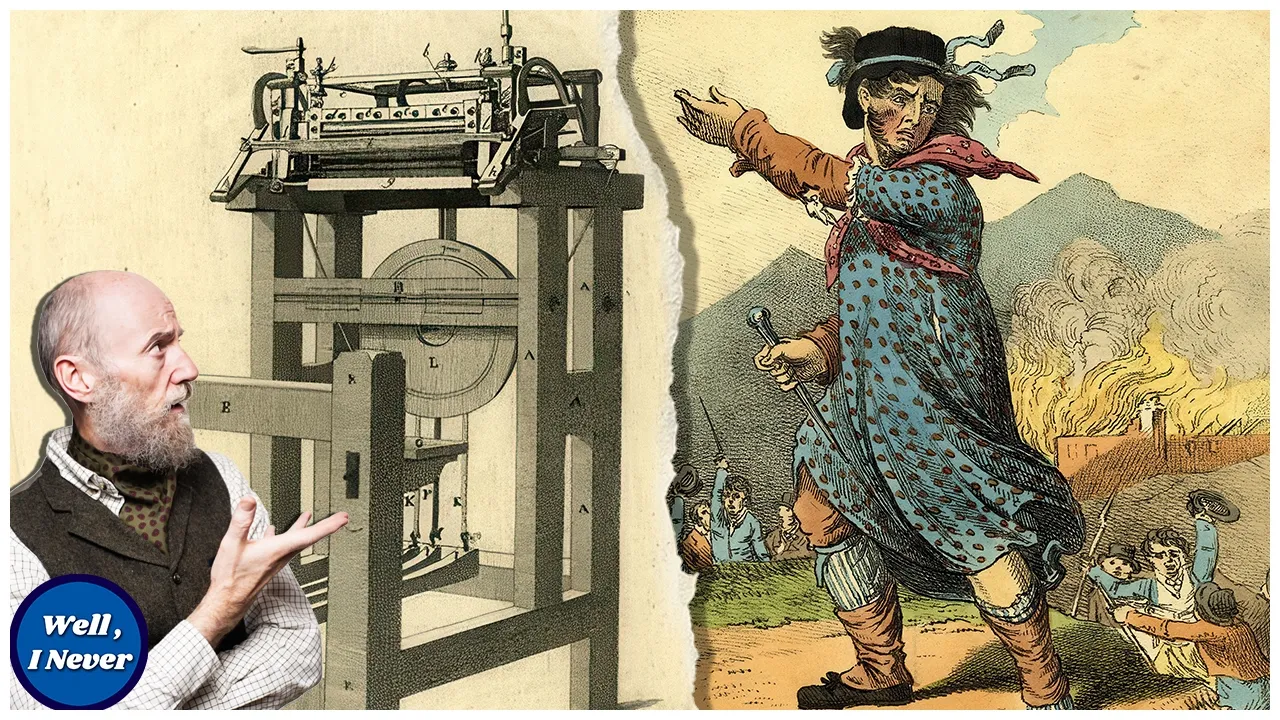
Who Were The Luddites? And Why Did They Hate Technology?
104K
The Luddite movement (1811-1816) was a worker-led uprising in England protesting industrialization's impact on jobs and wages, where skilled textile workers destroyed machinery like stocking frames and spinning jennies to resist unemployment caused by mechanization; contrary to modern misconceptions, the original Luddites sought fair wages and labor rights rather than opposing technology itself, and their movement was suppressed by government crackdowns including military intervention and harsh penalties, leaving behind the term 'Luddite' to describe resistance to technological change.
Click to watch →

Wreck of the Old '97 : a folk history
5.6K
The Luddite movement emerged as a response to the Industrial Revolution's mechanization. The Albion Mills, the largest flour mills in Britain and the first steam-powered flour mills in the world, dominated the London flour market with 20 pairs of millstones grinding 6,000 bushels of flour per week. When a mysterious fire destroyed the six-story building in 1791, millers celebrated while workers faced unemployment. The poet William Blake later referenced 'dark satanic mills' in his 1804 poem, adapted into 'Jerusalem.' English Weavers and Nottingham Shearers found a new leader in Captain Ludd, General Ludd, or King Ludd, supposedly a native of Sherwood Forest. Beginning in spring 1811, Luddites smashed looms and knitting frames throughout Nottinghamshire, with direct action spreading throughout Britain. Hundreds of machines were destroyed, and the movement became famous for using sledgehammers to smash machines.
Click to watch →

BAIXOFOBIA, DEPILAÇÃO, OBJETOS NO C* E OUTRAS COISAS | NÃO IMPORTA #24
280.7K
The Luddite movement emerged during the Industrial Revolution in England, where workers believed machines were destroying their livelihoods. They organized raids against machines, believing technology was coming to 'destroy' people. This historical example illustrates how technological change can create social resistance when people feel threatened by new innovations. The movement represents an early form of anti-technology sentiment that continues to influence modern debates about automation and artificial intelligence.
Click to watch →
Water power origins
Revolutionizing cloth
Labor-saving carding
Water frame unveiled
Arkwright's invention
Simplicity explained
Spinning mechanism
Machine vs hand
Mills expansion
Water power origins
0:02- 1
Water wheels mechanized tough manual jobs.
- 2
Powered saw blades and grain grinding stones.
The Labor Exploitation and Patent Theft Counter-Narrative
While traditional narratives celebrate Richard Arkwright’s water frame as a triumph of technological progress, critical historians offer two major counterpoints. First, they challenge the 'Great Man' theory of invention, noting that Arkwright’s patents were voided in 1785 because he had stolen key designs from working-class inventors like Thomas Highs and John Kay. Second, labor historians emphasize that the factory system birthed by the water frame was built on severe exploitation. The machine allowed mill owners to replace skilled adult artisans with cheaper, easily controlled child and female labor. Under Arkwright's system, workers faced grueling, highly disciplined 14-hour shifts in hazardous conditions. From this perspective, the water frame was not merely an innovation of efficiency, but a tool for de-skilling labor, dismantling the independent cottage industry, and entrenching industrial capitalism at a devastating human cost.
The domestic system (putting-out system) of production that preceded the factory system in Europe.
The basic manual mechanics of textile production, specifically how raw cotton fibers are spun into thread or yarn.
The general historical context of the early Industrial Revolution in 18th-century Britain.
James Hargreaves' Spinning Jenny and the initial attempts to mechanize and accelerate textile spinning.
Samuel Crompton's Spinning Mule, which combined the design principles of the Spinning Jenny and the Water Frame.
The transition from water power to steam power (James Watt's steam engine) and its effect on factory location and scalability.
The social and economic impacts of the rise of the factory system, including urbanization, changes in labor conditions, and child labor.
The global supply chain of cotton, including the invention of Eli Whitney's cotton gin and its impact on the expansion of slavery in the American South.
The Luddite movement and the historical resistance of skilled workers to mechanized labor.
138K views538likes2:13@patrickreed1967Original Release: 2016-09-14
It began with water powered machines. for centuries people had used the turning force of the water wheels to help the tough jobs like driving blades for sawing wood and rotating stones for grinding grain into flour, but eventually waterwheels began to power more complicated devices that would revolutionize cloth making, like this carding machine.
What an improvement over the pet brushes, and by rolling out wispy slivers all day long, it was a great labor saving device. But this was even better: I'm standing next to a machine called a water frame. It was created by the famous English inventor Richard Arkwright - this model is from the 1780s - to spin cotton into yarn.
It looks fairly complex, but it really isn't.
It runs on water power just like the carding machine and saw blades we saw earlier. The cotton in the top spools is drawn out by the action of the machine, which twists it nice and tight and then gathers the yarn onto these bottom spools. It works just like a hand spinning wheel, 96 of them actually, so it's little wonder that spinning by machine would eventually make spinning by hand obsolete. In no time, spinning mills began springing up all over England.
Up Next

16:28
Spinning Jenny: Key to Britain's Industrial Revolution
@Mythos-AI-DK
1.1K views•2024-11-04

33:02
The Great Schism of 1054: Causes and Consequences
@SacredCathedrals
113.5K views•2026-02-19

91:57
The Geopolitics of the Ukraine War and the Rise of Global Autocracy
@JordanHarbingerShow
468K views•2025-04-19

17:05
Understanding the Cold War: Superpower Conflicts and the Road to Détente
@OverSimplified
46.1M views•2019-01-24
Related Study Plans & Knowledge Roadmaps
Structured learning paths in History
history
Byzantine Iconoclasm: Theology, Art & Politics
01Foundations of Byzantium and Early Christian Images
02The First Iconoclasm: Leo III and the Crisis of Images
03Empress Irene, Nicaea II, and the Second Iconoclasm
+ 2 more learning modules
9h5 modules
Explore Roadmap
history
Iranian Revolution (Causes, Events & Legacy)
01The Pahlavi Dynasty and the Roots of Discontent
02The Spark of Rebellion and the Rise of Khomeini
031979: The Fall of the Shah and the Climax of the Revolution
+ 2 more learning modules
8h5 modules
Explore Roadmap
history
Mali Empire: Mansa Musa, Trade & Timbuktu
01Foundations of the Mali Empire
02The Trans-Saharan Gold and Salt Trade
03The Reign and Pilgrimage of Mansa Musa
+ 1 more learning modules
6h4 modules
Explore Roadmap
history
1947 Partition: Politics, Borders & Legacies
01Foundations of British India and the Divide
02The Political Negotiations and the Mountbatten Plan
03Drawing the Boundary: The Radcliffe Line
+ 2 more learning modules
8h5 modules
Explore Roadmap