


















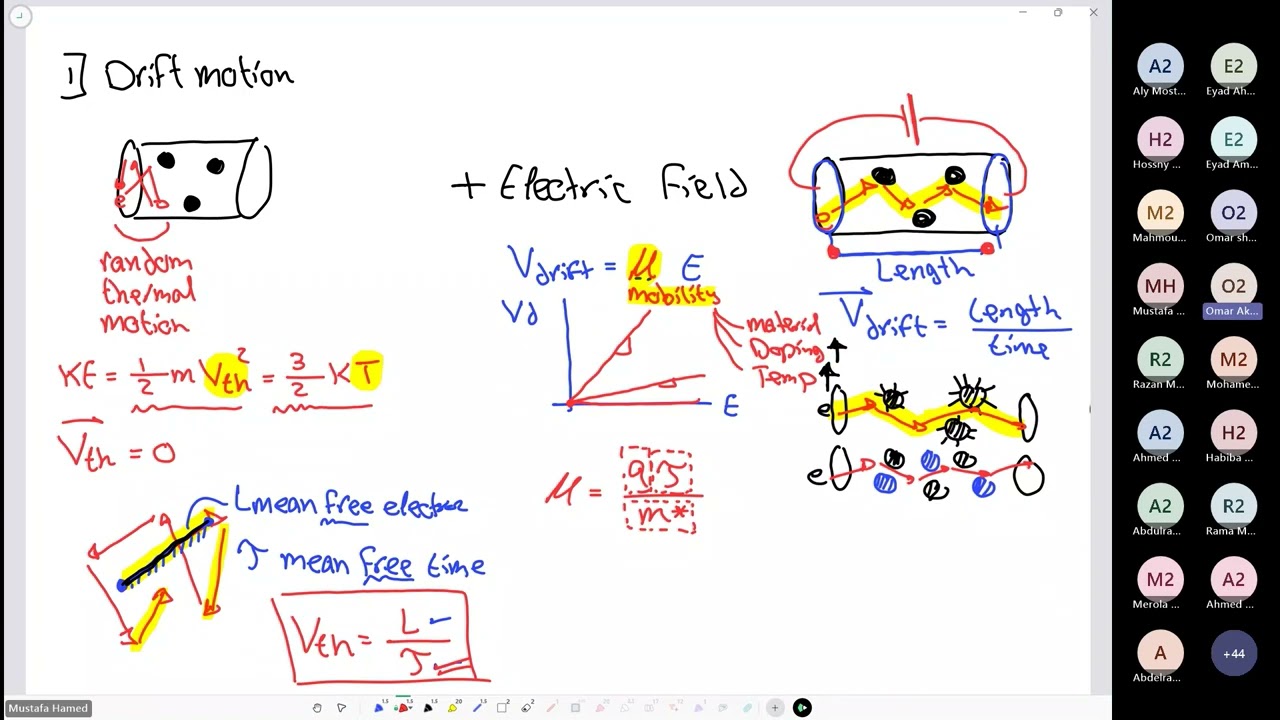








In semiconductors, drift current is caused by the motion of charge carriers (electrons and holes) under an applied electric field, while diffusion current results from the movement of carriers from regions of higher concentration to lower concentration; the total current density for electrons is given by Jn = e(nμnE + Dn(dn/dx)) and for holes by Jp = e(pμpE - Dp(dp/dx)), where e is the electron charge, n and p are carrier concentrations, μn and μp are mobilities, Dn and Dp are diffusion constants, and E is the electric field.
Drift and Diffusion Currents in Semiconductors Explained
Added:The concept of charge carriers in semiconductors, specifically the physical nature of free electrons and holes.
The process of semiconductor doping, distinguishing between n-type and p-type materials and their majority/minority carriers.
Basic electrostatics, particularly how an applied electric field exerts force on positive and negative charges.
Fundamental definitions of electric current, current density, and material conductivity.
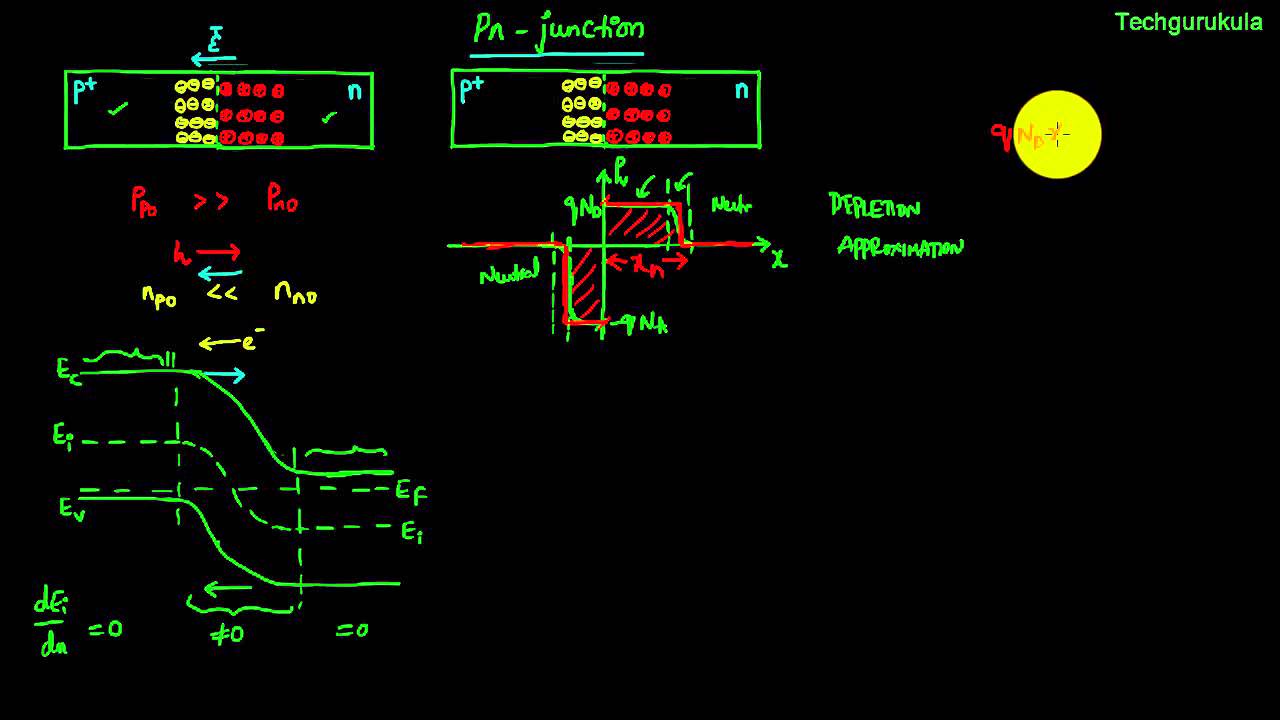
The physics of the PN Junction, exploring how drift and diffusion currents balance out to form the depletion region and built-in potential.
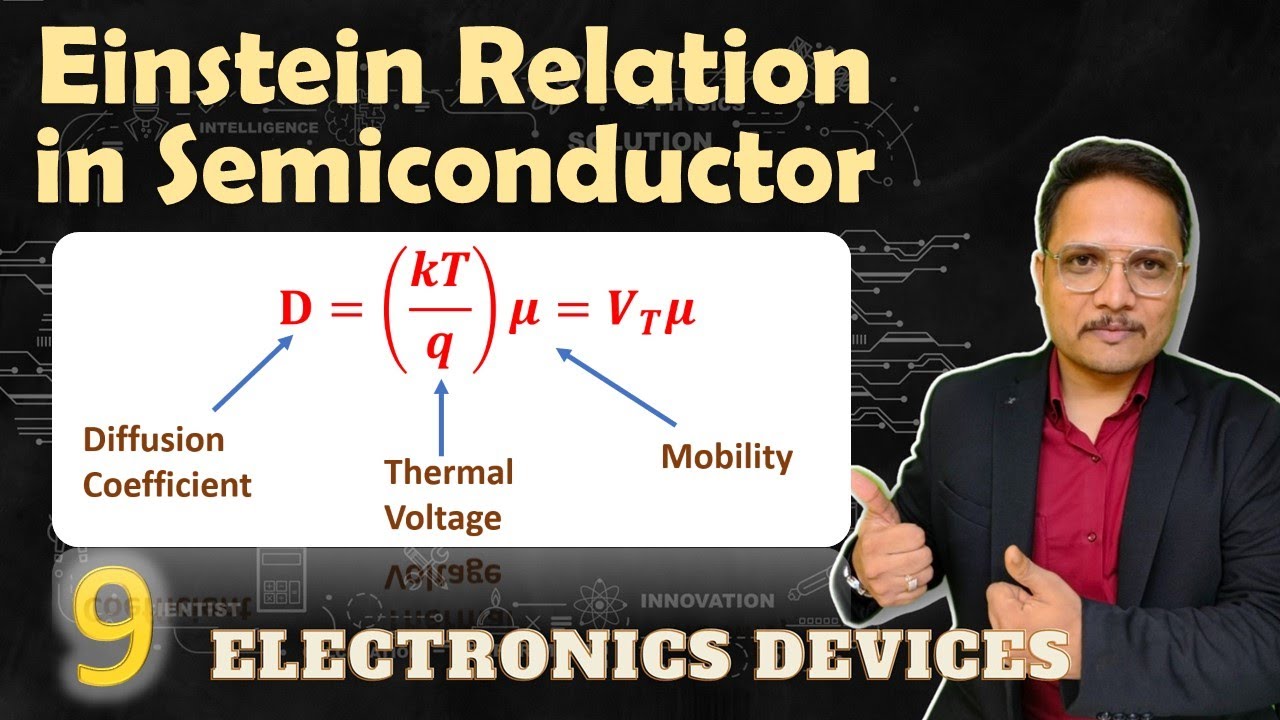
The Einstein Relation, which mathematically links carrier mobility (associated with drift) and the diffusion coefficient.
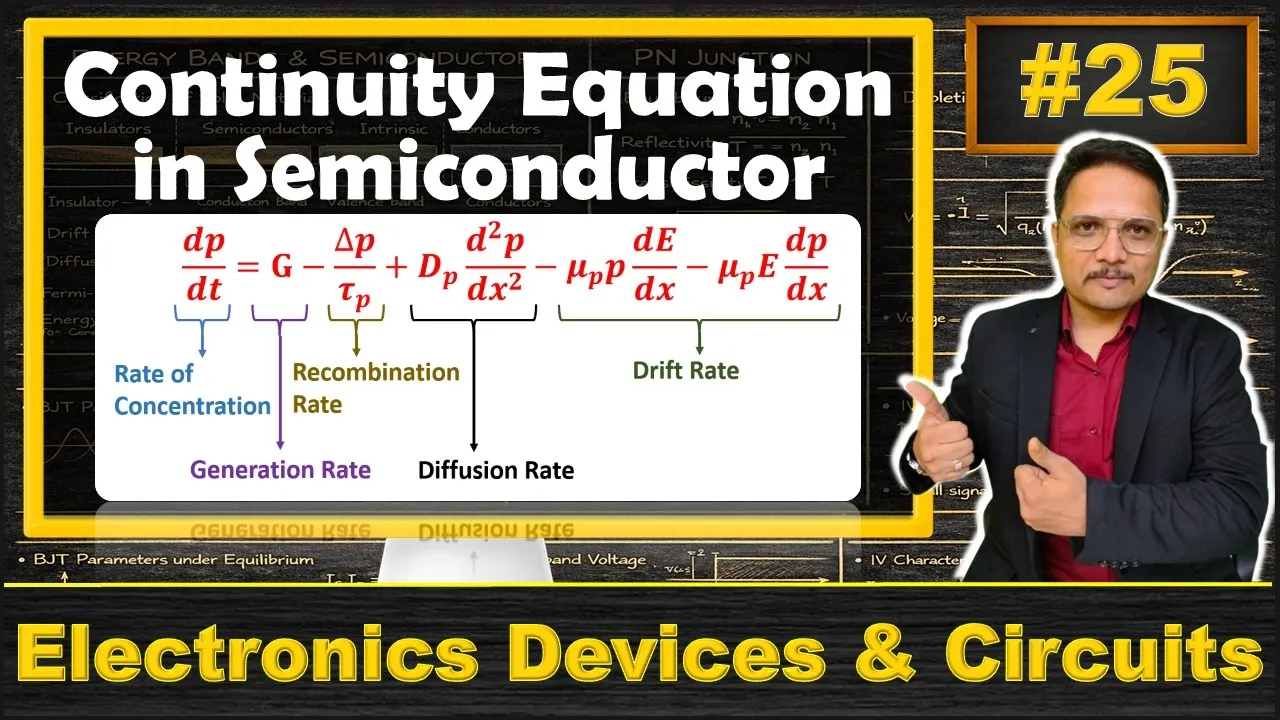
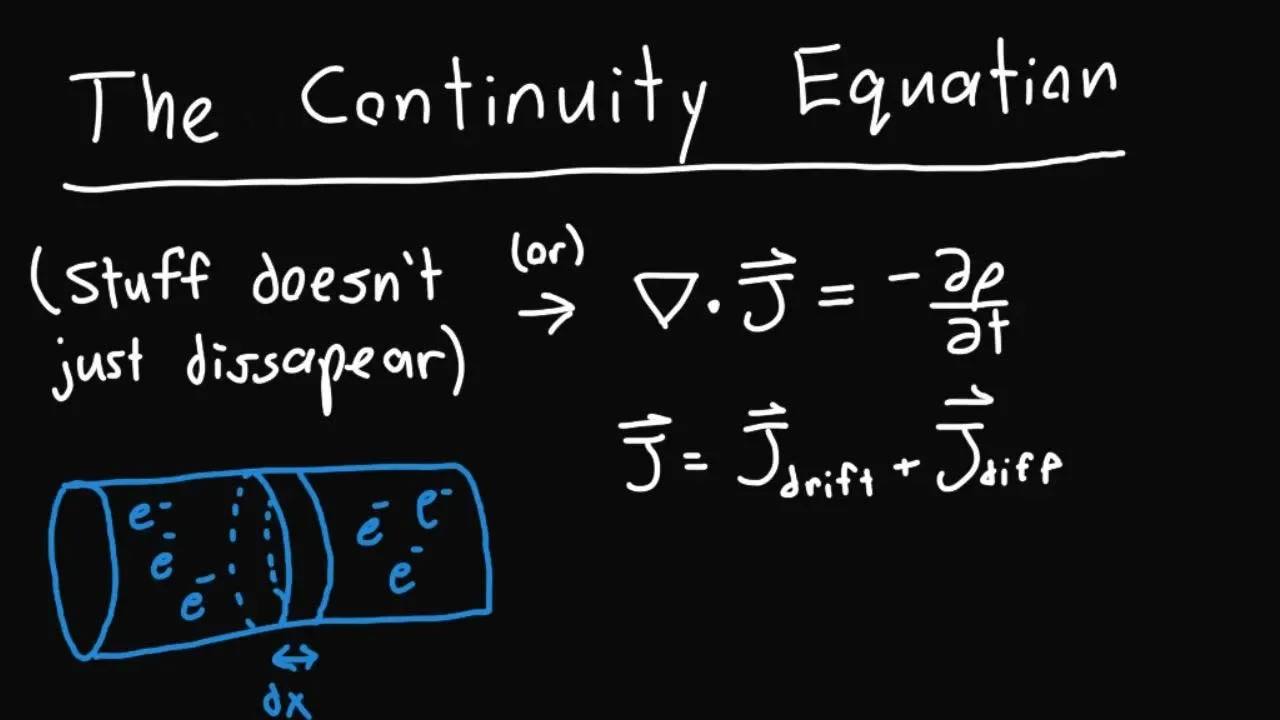
The Continuity Equation for semiconductors, describing how carrier concentration varies over time and space due to generation, recombination, drift, and diffusion.
The operation and I-V characteristics of basic semiconductor devices like Diodes, Bipolar Junction Transistors (BJTs), and MOSFETs.
112 views4likes4:18Original Release: 2022-12-26
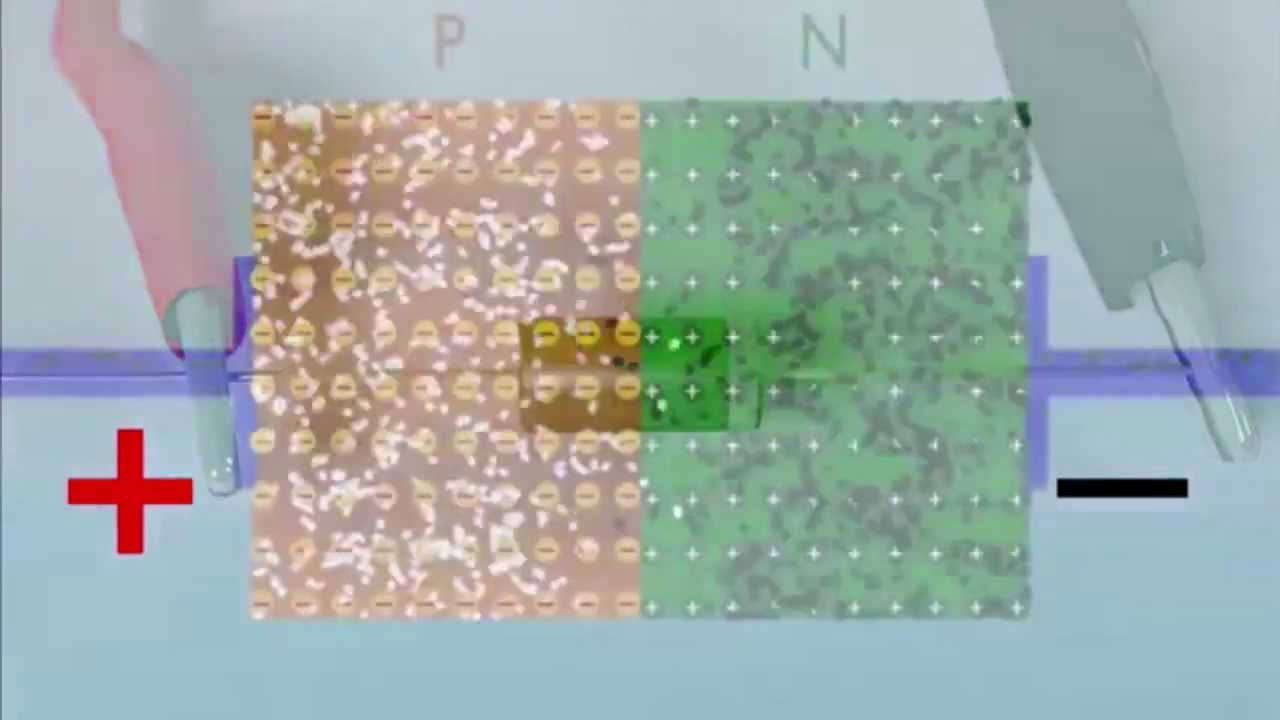
now we are going to discuss about uh diffusion and drift currents so here diffusion current is the current which is due to the transport of charges occurring because of the non-uniform concentration of charged particles in a semiconductor now in this diagram we can see there is a larger concentration of electrons on this side and there is a list concentration of electrons on this side so because of that concentration difference between these two sides there is a flow of electrons from the higher concentration region to the low concentration region so this process of movement of this electrons will be called as a diffusion of electrons and since the flow of electrons we call it as the current this flow of electrons moving from high concentration to low concentration region will be giving rise to what is called as a diffusion current now this diffusion will be continuing until an even distribution of charges will be taking place so in this case we can see the net diffusion current is zero diffusion current which is because of the carrier concentration gradient next drift current drift current is due to the motion of chance carriers due to the force exerted by on them by an electric field now we can see we have connected this semiconductor material to a battery here so when we are connecting this semiconductor material like this the electrons and holes will be moving in the opposite directions so there is a flow of electrons towards a positive terminal that is you can see this Arrow indicating the direction of flow of electrons this is the direction of flow of electrons these are the electrons moving towards the positive terminal and the holes will be moving in the opposite direction to that of the electrons so there is a flow of electrons and holes because of the applied voltage here so because of this external field a force is exerted on this charged part articles and they will be moving in the opposite directions constituting the whole current and the electron current so these currents are called as the drift currents now we'll see the diffusion current density so diffusion current density is given by J N and that is proportional to the gradient of carrier concentration so here DN by DX is giving us the gradient of carrier concentration with respect to the x axis so Jane is equal to Q into DN where capital d n is giving us the diffusion constant of electrons so J N equal to Q into DN into d n by DX similarly the current density due to holes is given by Q minus Q into DP into DP by DX where this DP is called as a diffusion constant for holes and this is the carrier concentration gradient next drift current density shift current density due to the electrons we know this drift current density is proportional to the applied electric field J N equal to e into n into mu e which is the mobility of electrons into the electric field similarly the drift current density due to holes is given by JP equal to e into P into mu P into e where mu B is the mobility of the holes and E is the electric field where small e is the charge of the electron and P is the whole concentration here so the overall current density with respect to electrons can be given as JN equal to drift current plus diffusion current so the drift current because of electrons and diffusion current because of the electrons so J N is given by e n into mu n into e plus e into d n into d n by DX similarly the overall current density with respect to holes can be given by JP equal to drift current due to holes plus diffusion current due to holes so JP equal to EB into mu P into e minus E D B into DP by DX and the overall current density is given by J N plus J
Up Next
14:41
Barrier Potential & Built-in Potential in PN Junction Diode
@nesoacademy
487.3K views•2016-03-23

12:53
21cm Hyperfine Transition in Neutral Hydrogen: Radio Astronomy Basics
@AaronRobertParsons
12.4K views•2011-10-13

32:32
NMR Spin Physics I: Zeeman Effect, Resonance Condition & Larmor Frequency
@nptel-indianinstituteofsci8064
2.3K views•2024-01-17

27:14
Entropy and the Second Law of Thermodynamics Explained
@veritasium
27.5M views•2023-07-01
Related Study Plans & Knowledge Roadmaps
Structured learning paths in Physics
physics
Nuclear Physics (Decay, Fission & Reactors)
01Atomic Structure and the Binding Force
02Radioactive Decay and Half-Life
03Nuclear Fission Mechanics and Chain Reactions
+ 2 more learning modules
12h5 modules
Explore Roadmap
physics
Soft Matter (Polymers, Colloids & Rheology)
01Foundations of Soft Matter & Thermal Forces
02Polymer Physics and Macromolecules
03Colloids, Surfactants, and Self-Assembly
+ 2 more learning modules
38h5 modules
Explore Roadmap
physics
Analytical Mechanics: Lagrangian & Hamiltonian
01Mathematical Foundations: Calculus of Variations
02From Newtonian Mechanics to Constraint Dynamics
03The Principle of Least Action & Lagrangian Mechanics
+ 3 more learning modules
28h6 modules
Explore Roadmap
physics
General Relativity (Spacetime & Cosmology)
01Foundations of Relativity: Special Relativity
02The Geometry of Spacetime: Equivalence Principle & Curvature
03Einstein's Field Equations: The Mathematics of Gravity
+ 2 more learning modules
55h5 modules
Explore Roadmap