









![SACANI RESPONDE [TUDO SOBRE GALÁXIAS COM FELIPE HIME] - Ciência Sem Fim #271](https://i.ytimg.com/vi/aYQ8s_eznrg/maxresdefault.jpg)


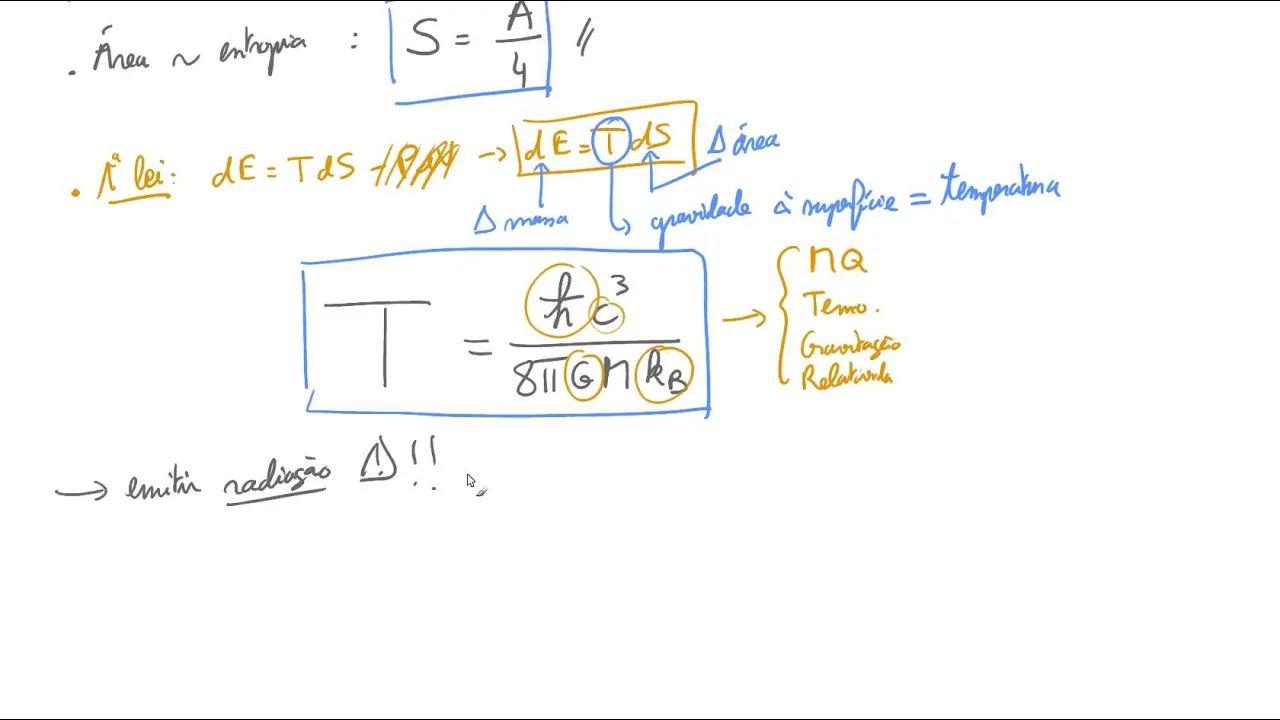



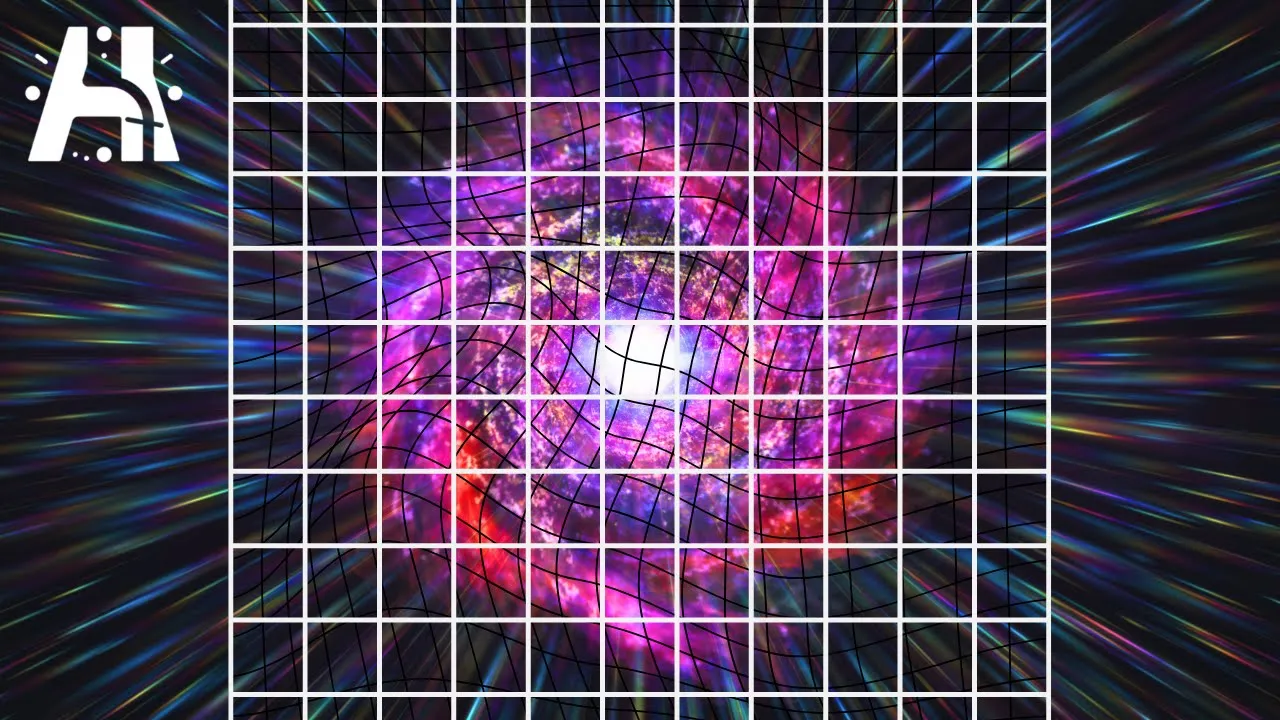

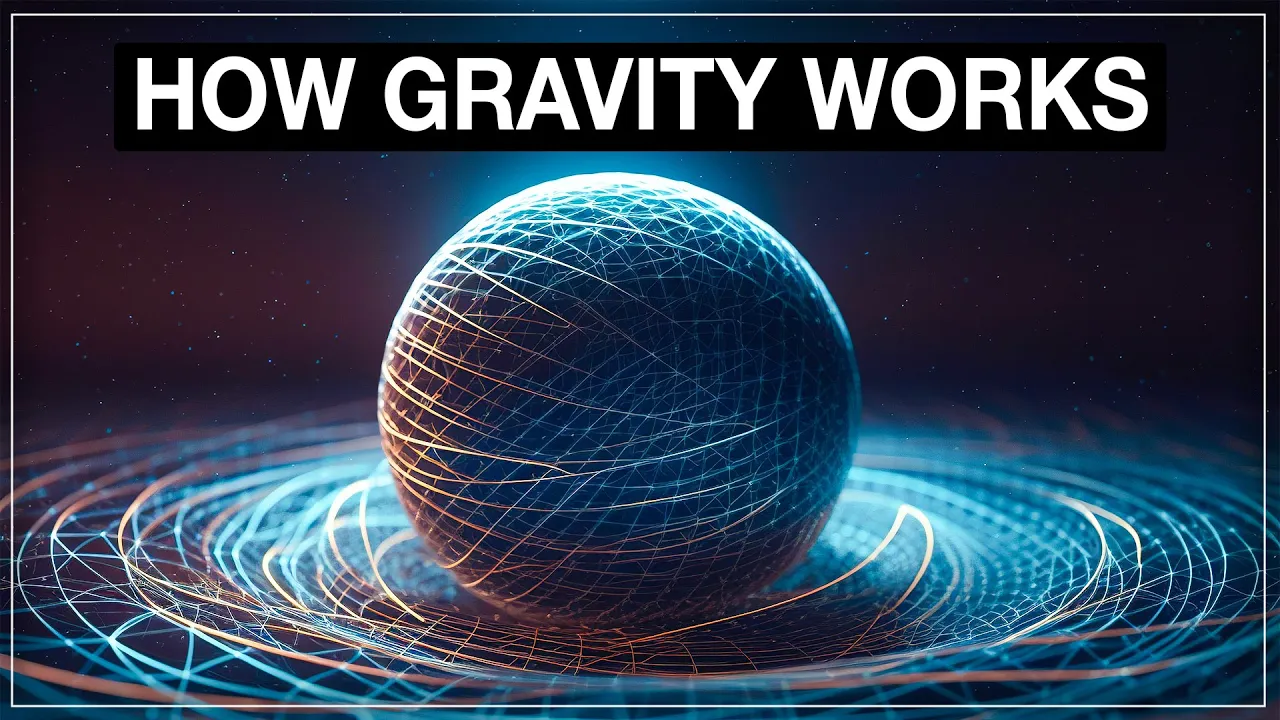
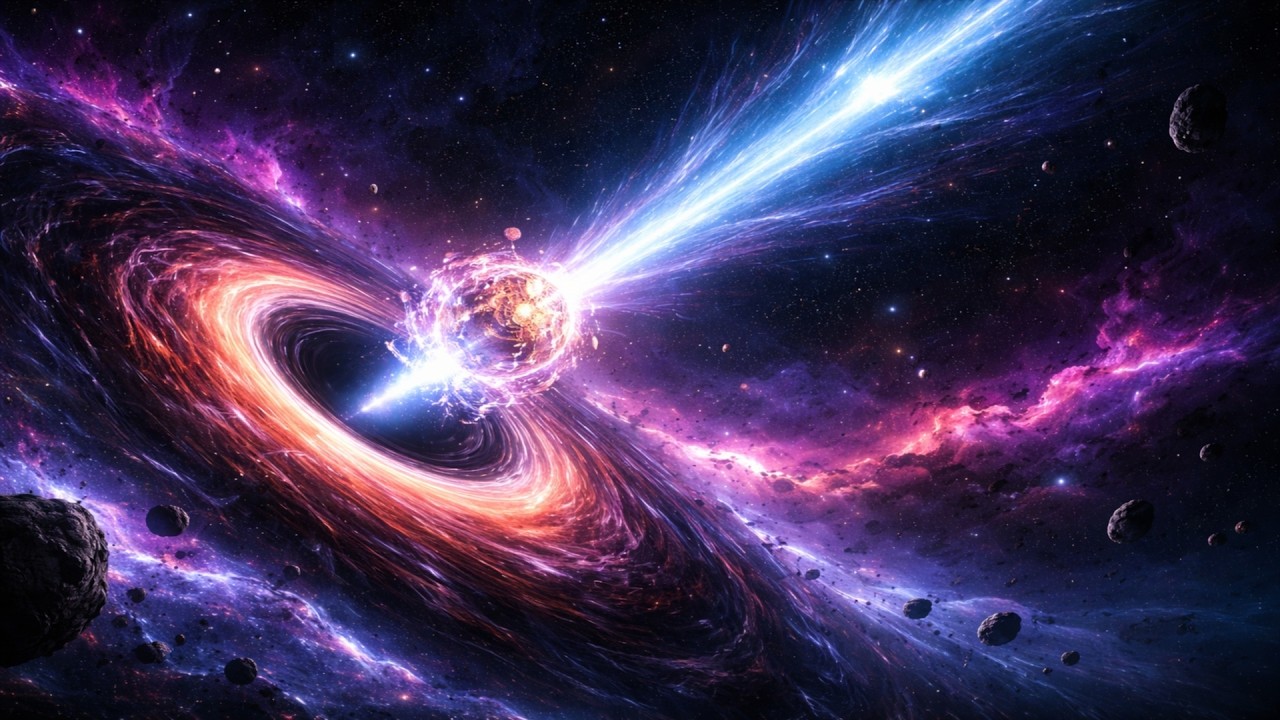
Einstein's general relativity explains that massive objects curve spacetime, creating phenomena like black holes where gravity is so strong that nothing, not even light, can escape beyond the event horizon. From an outside observer's perspective, objects falling into a black hole appear to slow down and freeze at the horizon due to extreme time dilation, while the falling object experiences no unusual effects at the horizon itself. The Schwarzschild solution to Einstein's field equations describes how spacetime curves around a spherical mass, predicting the existence of black holes with their characteristic event horizons and singularities.
The Weird Physics of Black Holes: A Nuclear Engineer's Analysis
Added:Einstein's Theory of General Relativity: Understanding how mass and energy curve the fabric of spacetime, moving beyond classical Newtonian gravity.
Basic Black Hole Anatomy: Familiarity with foundational concepts such as the event horizon, the Schwarzschild radius, and the gravitational singularity.
Stellar Evolution and Gravitational Collapse: How massive stars exhaust their nuclear fuel and collapse under their own gravity to form compact objects.
The Concept of Spacetime Dimensions: A fundamental grasp of how three dimensions of space and one dimension of time are unified into a four-dimensional continuum.
Kruskal-Szekeres Coordinates and Penrose Diagrams: Advanced mathematical frameworks used to map and visualize the global geometry of black holes, white holes, and wormholes.
Black Hole Thermodynamics and Hawking Radiation: Investigating how quantum field theory in curved spacetime describes black hole evaporation and the black hole information paradox.
Theoretical Wormhole Physics and Exotic Matter: Analyzing the mathematical solutions of Einstein's field equations (like Einstein-Rosen bridges) and the energy conditions required to stabilize them.
Quantum Gravity (String Theory and Loop Quantum Gravity): Exploring modern theoretical frameworks that attempt to reconcile general relativity with quantum mechanics to resolve the singularity problem.
282.3K views6.5Klikes55:12Original Release: 2024-05-04
Today we're going to be looking at another one of Veritassium's video.
Specifically, something strange happens when you follow Einstein's math. For those of you who don't know me, I'm Tyler Fol. I'm a nuclear engineer with a little over 10 years of experience in the commercial nuclear power industry.
From engineering operations to emergency response and quite a bit of math and physics. I don't claim to know everything there is nuclear, but I can certainly share some knowledge. Let's check this out.
You can never see anything enter a black hole.
Yeah, it just kind of fades away, gradually becomes more and more redshifted. It's It's one of those really weird things, though. It'd be a very expensive experiment to pull off to not only find a black hole, but to to send people to one or an object or to send an object to one.
Imagine you trap your nemesis in a rocket ship and blast him off towards a black hole.
He looks back at you, shaking his fist at a constant rate. As he zooms in, gravity gets stronger. So, and of course, your nemesis is a Saturday morning cartoon villain. That's That's awesome.
You would expect him to speed up, but that is not what you see. Instead, the rocket ship appears to be slowing [music] down. Not only that, he also appears to be shaking his fist slower and slower. Yes, that's because from your perspective, his time is slowing down. At the very instant when he should cross the event horizon, the point beyond which not even light can escape, he and his rocket ship do not disappear.
Instead, they seem to stop frozen in time. Could see that light. Then in theory, you would see everything that has ever fallen into the black hole frozen on its horizon, including the star that formed it.
Is there going to be a 37 Easter egg in every one of his videos ever since making that 37 video? I think there just might.
But in practice, photons are emitted at discrete intervals. So there will be a last photon emitted outside the horizon and therefore these images will fade after some time.
Oh yes. When light decides to behave as a photon, a particle rather than a wave on the electromagnetic spectrum. Though whether you look at it as a wave or as a particle, light is a form of radiation.
And one of the ways you measure it is with your eyes. So one thing a lot of people don't realize is you your eyeballs are radiation detectors, specifically in the invisible light spectrum. But everything you see is a result of radiation. And it gets really weird when you involve black holes.
This is just one of [music] the strange results that comes out of the general theory of relativity, our current best theory of gravity. The first solution of [music] Einstein's equations predicted not only black holes, but also their opposite, white holes. It also implied the existence of parallel universes. I don't think white holes have ever been observed directly. They're more of a theoretical construct. I mean, this video is talking about math, so yeah, everything's theoretical at this point, especially this kind of chart where you got you got a whole bunch of infinities bordering everything. Another thing is the definitions of black and white are a little different when referring to these objects. And black means no light can be emitted from it. And white means that light is escaping from it as in it's an object that ejects matter rather than drawing them in with a super strong gravitational pull. But I know we've seen in a bunch of dep black holes you see everything about to get sucked into it. They don't exactly appear black when you observe them. Though if nothing was actively being drawn into the black hole, I guess it would appear black.
Interesting how even terms like black and white can get a little weird in this sort of context. and even possibly a way to travel between them. This is a video about the real science of black holes, white holes, and wormholes. Awesome.
The general theory of relativity arose at least in part due to a fundamental flaw in Newtonian gravity. In the 1600s, Isaac Newton contemplated how an apple falls to the ground, how the moon orbits the earth and earth orbits the sun. And he concluded that every object with mass must attract every other. But Newton was troubled by his own theory. How could masses separated by such vast distances apply a force on each other? He wrote that one body may act upon another at a distance through a vacuum without the mediation of anything else is to me so great an absurdity that I believe no man who has a competent faculty of thinking could ever fall into it. I didn't realize that Newton ever said that.
That's that's that's fascinating. I like it when you can tell people um pioneers, scientific minds are just on the verge of something, but they're missing a few building blocks. They know that there's a big that there's a big gap. Kind of how in Lord Kelvin's time period, they were estimating the age of the sun just based on thermodynamic principles. And I believe the number they came up with was something on the order of tens or hundreds of millions of years. They didn't know about radioactive decay.
They just went with what they knew at the time. It's a bit like trying to measure the circumference of the Earth with a ruler. You can try to do it and you'll get a number, but you're probably going to be quite far off.
One man who definitely had a competent faculty of thinking was Albert Einstein.
And over 200 years later, he figured out how gravity is mediated. Bodies do not exert forces on each other directly.
Instead, a mass like the sun curves the spacetime in its immediate vicinity.
This then curves the spaceime around it and so on all the way to these animations.
So the earth orbits the sun because the spacetime earth is passing through is curved. Masses are affected by the local curvature of spaceime. So no action at a distance is required. Mathematically this is described by Einstein's field equations.
Can you write down the Einstein field equation? [laughter] This was the the result of Einstein's decade of hard work after special relativity. And essentially what we've got in the field equations on one side it says tell me about the distribution of matter and energy. The other side tells you what the resultant curvature of spaceime is from that distribution of matter and energy. And it's it's a a single line. It looks like oh this is a simple equation right but it's not really one equation it's a family of equations and to make life more difficult they are coupled equations so they depend upon each other and they are differential equations so it means that there are integrals that have to be done da da da so there's a whole bunch of steps that you need to do to solve the field equations yes because we're not exactly in one isolated field there's so many things in the universe that interact with one another it can get quite complicated quite quickly I remember having to use field equations for say a heat transfer profile, a radiation profile. Say when you're designing a reactor, you need to optimize its positioning of each fuel assembly so your regions are nice and uniform or as uniform as you can be within reason because you don't want to have more power being produced in one part of the core than the other. it can throw a lot of your systems out of whack and you're looking in three dimensions.
Well, in the case of reactor design, if you're looking in some crazy theoretical stuff, you might be looking in more than three dimensions, but the math can get quite complicated quickly that you're you basically just need software to solve it. Trying to do that by hand is a pain. So, it's not the same neat stuff you learned in your math or physics classes that you may have taken. To see what a solution to these equations would look like, we need a tool to understand spacetime.
So, imagine you're floating around in empty space. A flash of light goes off above your head and spreads out in all directions. Now, your entire future, anything that can and will ever happen to you will occur [music] within this bubble uniform because the only way to get out of it would be to travel faster than light. In two dimensions, this bubble is just a growing circle. If we allow time to run up the screen and take snapshots at regular intervals, then this light bubble traces out a cone, your future light cone. By convention, the axes are scaled so that light rays always travel at 45°.
This cone reveals the only re note that he's making a lot of simplistic assumptions here, and you can see how it can get even more complicated if you're actually doing something. But yeah, he's just moving on one axis and using and using cartisian coordinates here. A great way to introduce this concept.
Don't get the wrong idea, but just keep in mind that he's he's making a lot of simplifying assumptions here as as one would need to for the purpose of this video of spaceime that you can ever hope to explore and influence. Now imagine that instead of a flash of light above your head, those photons were actually traveling in from all corners of the universe and [music] they met at that instant and then continued traveling on in their separate directions.
Expansion.
In that case, then into the past, these photons also reveal a light cone, your past light cone. Only events that happened inside this cone could have affected you up to the present. drawing the planes and the we can simplify this diagram even further by plotting just one spatial and one time dimension. This is the space-time diagram of empty space. If you want to measure how far big assumption considering there are three spatial dimensions, this thing could get a pretty funny shape pretty quickly.
Part two events are in spacetime, you use something called the space-time interval. Okay, the interval squared is equal to minus dt ^2 + dx^2. Since spacetime is flat, the geometry is the same everywhere. And so this formula holds throughout the entire diagram, which makes it really easy to measure the separation between any two events for one dimension.
But around a mass, spacetime is curved and therefore you need to modify the equation to take into account the geometry.
This is what solution.
I love the little spiral curly cue he did there just to show that the object isn't stationary. It's in motion. And when you're orbiting it, when you're orbiting the Earth, for instance, you're going to be doing little swirlies as the Earth moves and have you move around the Earth. That's a great addition. One thing that a lot of people neglect in their models. And well, neglect is harsh. It's uh it's not the standard frame of reference where you show someone just or orbiting a planet in in a circle. I guess you're going from the Earth frame of reference into your single little curly cues. But that that's a very nice addition to Einstein's equations are like they tell you how spacetime curves and how to measure the separation between two events in that curved geometry.
Einstein published his equations in 1915 during the first world war but he couldn't find an exact solution. Luckily a copy of his paper made its way to the Eastern Front where Germany was fighting Russia. Stationed there was one of the best astrophysicists of the time, Carl Schwarzfield. Despite being 41 years old, he had volunteered to calculate artillery trajectories for the German army.
At least until a greater challenge caught his attention.
How to solve Einstein's field equations.
Schwarz Shield did the standard physicist thing and imagined the simplest possible scenario. An eternal static universe with nothing in it except a single spherically symmetric point [music] mass. You got to start somewhere. And I can I can see what he's doing when he started off with the really simple uh time cone model. That's that's that's pretty clever.
This mass was electrically neutral and not rotating. Since this was the only feature of his universe, he measured everything using spherical coordinates relative to the center of this mass. So r is the radius and theta and fi give the angles polar coordinates. For his time coordinate, he chose time as being measured by someone far away from the mass where [music] spacetime is essentially flat. Using this approach, Schwarzfield found the first [music] non-trivial solution to Einstein's equations, which nowadays we write like this. This Schwarz shield metric describes how space-time curves [music] outside of the mass. It's pretty simple and makes intuitive sense. Far away from the mass, spacetime is nearly flat. But as you get closer and closer to it, spacetime becomes more and more curved.
It attracts [music] objects in and time runs slower.
Schwarz Shield sent his solution to Einstein, concluding with the crazy him doing this in the middle of a war. That's it's just fascinating how all these discoveries were made and really cool.
War treated me kindly enough in spite of the heavy gunfire to allow me to get away from it all and take this walk in the land of your ideas.
Einstein replied, "I have read your paper with the utmost interest. I had not expected that one could formulate the exact solution to the problem in such a simple way."
Archam's razor.
But what seemed at first quite simple soon became more complicated. Shortly after Schwarz Shield's solution was published, people noticed two problem spots. At the center of the mass at R equals 0, this term is divided by 0. So it blows up to infinity and therefore this equation breaks down and it can no longer describe what's physically [music] happening. This is what's called a singularity.
Maybe that point could be excused because it's in the middle of the mass.
And that is where the things get weird when you're in the context of black holes because [snorts] what that means is you're going to have infinite mass and infinite density. So yeah, our understanding is out the window according to this equation. Not saying that's what actually happens in a singularity. It's more of that's how this equation fails at this scenario. I mean some quantum effects might get more significant as you get closer cuz you're in this ultra dense ultra high pressure environment where elementary particles might do weird things and therefore might not act so elementary anymore. But I don't think we really know [laughter] what would actually happen.
But there's another problem spot outside of it. At a special distance from the center known as the short shield radius, this term blows up. So there is a second singularity. What is going on here?
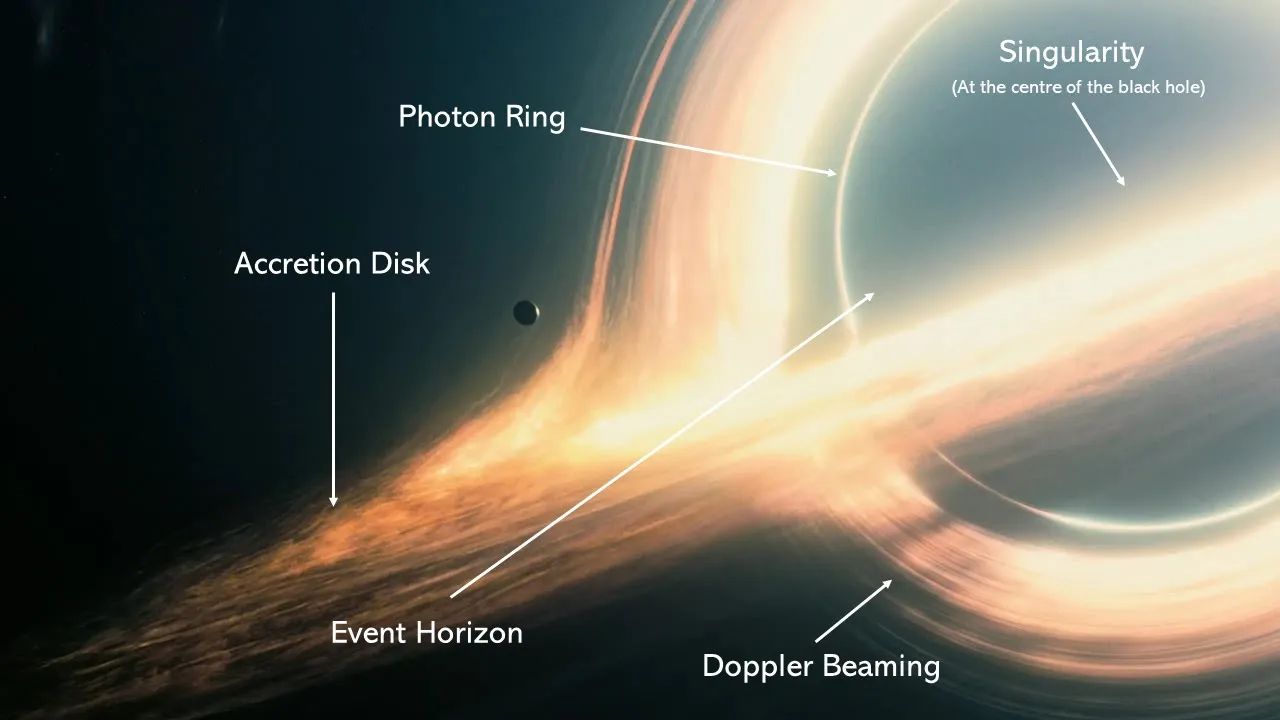
Oh, that's true. Well, at the Schwarz shield radius, the space-time curvature becomes so having singularities in your singularity steep that the escape velocity, the speed that anything would need to leave there, wouldn't that make it a ringularity cuz it's in a little ring, I'm sorry, that was terrible, is the speed of light and that would mean that inside the short shield radius, nothing, not even light, would be able to escape. So you'd have this dark object that swallows up matter and light, a black hole, if you will.
These artist renditions are so are so pretty. Reminds me of when I watched Interstellar. I know that movie had its issues with physics, but I still enjoyed it for what it was worth.
But most scientists doubted that such an object could exist because it would require a lot of mass to collapse down into a tiny space.
How could that possibly ever happen?
That's just making power plants from that.
Astronomers at the time were studying what happens at the end of a star's life. During its lifetime, the inward force of gravity is balanced by the outward radiation pressure created by the energy released through nuclear fusion. But when the fuel runs out, the radiation pressure drops. So, gravity pulls all the star material inwards. But how far? Most astronomers believed some physical process would hold it up. And in 1926, Ralph Some of the interesting things about stellarbased fusion is you can actually fuse things that are way heavier than people are attempting to fuse on Earth.
Most people are doing like super small things like hydrogen and helium is the most common using things like tyium and tridium which are just isotopes of hydrogen. For fusion, you need three basic things. really high temperature, really high pressure, and confinement time. Now, because of the sun or any stars gravity, you can have that pressure, and they're also very hot. You can have that really high temperature.
The sun's core is 15 million degrees C and that is kind of at the and that's cold compared to a lot of stars out there. So in a lot of heavier stars, you can see them fuse into heavier things such as carbon, oxygen, neon, argon, etc. A lot of heavy things get made not in the sun because the sun basically just has hydrogen and helium. And if you're trying to produce any of that heavier stuff, really anything heavier than helium, you're going to end up with such an energy loss, it's going to be even less scalable. And we're struggling enough to fuse things into helium on Earth. But when you have something that big, sure, you could make heavier stuff by a fusion. It's just a lot more expensive in terms of energy input yielding energy output. Fowler came up with a possible mechanism. Pali's exclusion principle states that firmians like electrons cannot occupy the same state. So as matter gets pushed closer and closer together, the electrons each occupy their own tiny volume.
Yeah, good luck using two electron. But Heisenberg's uncertainty principle says that you can't know the position and momentum of a particle with absolute certainty. So as the particles become more and more constrained in space, the uncertainty in their momentum and hence their velocity must go up. So the more a star is compressed, the faster electrons will wiggle around and that creates an outward pressure. This electron degeneracy pressure would prevent the star from collapsing completely.
Instead, it would form a white dwarf with a density much higher than a normal star.
Collapsing completely is very difficult to do. Which, well, here we're talking about white dwarfs. And now we're going to talk about I'm assuming he's getting ready to talk about the heavier 30 plus stellar mass stars that that do collapse into black holes. But all has to do with how much energy you have in the system or how much mass rather. We're talking about mass. And remarkably enough, astronomers had observed stars that fit this description. One of them was Sirius B.
But the relief from this discovery was short-lived. 4 years later, 19-year-old Submanion Chandra Secar traveled by boat to England to study with Fowler and Arthur Edington, one of the most revered scientists of the time. During his voyage, Shandraar realized that electron degeneracy pressure has its limits.
Electrons can wiggle faster and faster but only up to the speed of light. That means this effect can only support stars up to a certain mass. The Shandraar limit beyond this Shandraar believe actually never heard the term Shandraar limit. That's cool. Instead of 1.4 solar masses and the bigger ones you had there's also the neutron star phase I'm assuming we'll talk about now.
Believed not even electron degeneracy pressure could prevent a star from collapsing.
But Eddington was not impressed. He publicly blasted [music] Chandra Sakar saying there should be a law of nature to prevent a star from behaving in this absurd way.
And indeed [music] scientists did discover a way that stars heavier than the Shander interesting seeing scientists you know just you know grabbing on to things and just trying to fill in the gaps. That's one of the fascinating things about discovering sear limit could [music] support themselves. When a star collapses beyond a white dwarf, electrons and protons fuse together to form neutrinos and neutrons. There's one thing a lot of people don't realize. Neutrons are actually a little bigger than protons in terms of mass energy. And a free neutron by itself only has a halfife of about 15 minutes before it decays into a proton and electron. and nutrinos. Of course, nutrinos most in most engineering applications are often neglected mainly because they're just they're just mass energy and spin. They're not there's not really anything you can do with them as far as you know producing energy, heat or anything like that, but they do exist. I'm not denying the existence of them or anything like that. These neutrons are also firmians, but with nearly 2,000 times the mass of an electron, their degeneracy pressure is even stronger. So this is what holds up neutron stars. There was this conviction among scientists that [music] even if we didn't know the mechanism, something would prevent a star from collapsing [music] into a single point and forming a black hole.
Actually, I misspoke. Nutrinos do have mass, but it's it's very insignificant.
It's one of those things that I actually keep forgetting because I remember in some classes people saying that nutrinos don't have mass, some physics classes, but mainly just in the sense of you don't really have to worry about them when say, you know, from a practical standpoint, but they do actually have mass. There's just very, very little because black holes were just too preposterous to be real.
The big blow to this belief came in the late 1930s when J. Robert Oppenheimer and George Volkoff found that neutron stars also have a maximum mass. Shortly after Hartland Snder showed that for the heaviest stars, there is nothing left to save them when their fuel runs out.
[music] They wrote this contraction will continue indefinitely.
But Einstein still couldn't believe it.
Oenheimer was saying that stars can collapse indefinitely. But when Einstein looked at the math, he found that time freezes on the horizon. So it seemed like nothing could ever enter.
37 suggested that either there's something we don't understand or that black holes can't exist.
But Oenheimer offered a solution to the problem. He said to an outside observer, you could never see anything go in. But if you were traveling across the event horizon, you wouldn't notice anything unusual and you'd go right past it without even knowing it.
Huh?
So, how is this possible?
We need a space-time diagram of a black hole. On the left is the singularity at r= 0. The dotted line at r= 2mm is the event horizon. Since the black hole doesn't move, these lines go straight [music] up in time. Now, let's see how ingoing and outgoing light rays travel in this curved geometry.
I don't think I've seen this.
When you're really far away, the future light cones are at the usual 45°.
But as you get closer to the horizon, the light cones get narrower smash until [music] right at the event horizon, they're so narrow that they point straight up.
And inside the horizon, the cones tip [music] to the left.
But something strange happens with ingoing light rays. They fall in but they don't get to r= 2mm. They actually asmtote [music] to that value as time goes to infinity. But they don't end at infinity. Right? Mathematically they are connected and come back in and they're traveling in this direction.
And [music] this bothered a lot of people. It's bothered people like Einstein because it he looked at these questions and went, "Well, if nothing can cross this this sort of boundary, then how could there be black holes? How could black holes even form?"
So, what is going on here? Well, what's important to recognize is that this diagram is a projection. It's basically a 2D map of four-dimensional curved spaceime.
It's just like projecting the 3D Earth onto a 2D map. When you do that, you always get distortions. There is no perfectly accurate way to map the Earth onto a 2D surface. But different maps can be useful for different purposes.
For example, if you want to keep angles and shapes the same, like if you're sailing across the ocean and you need to find your bearings, you can use the Mercer projection. That's the one Google Maps uses. A downside is that it misrepresents sizes.
Oh, yeah. Remember this one where with Greenland being the same size as Africa when it's so much tinier compared to Africa.
Africa and Greenland look about the same size but Africa is actually around 14 times larger. The G peters projection keeps relative sizes accurate but as a result angles and shapes are distorted.
In a similar way we can make different projections of 4D spaceime to study different properties of a good analogy.
physical reality doesn't change, but the way the map describes it does.
He had chosen to put a particular coordinate system over space and have a time coordinate and off you go. It It's the most sensible thing to do, right?
People realize that if you choose a different coordinate system by doing a coordinate substitution, then the singularity at the event horizon disappears.
It goes away. That problem goes away and things can actually cross uh into the black hole. This is almost like an internal joke here because it's a we're all talking about physics, frame of reference, location, whether you're looking at the person going into the black hole or you are the person going into the black hole. And now we're just talking about how to explain something because just like the map example, our eyes looking at something in a plane, a two-dimensional on a on a drawing and now we're trying to interpret that in three or even four dimensions. and how that's going to be off. I wonder how much better understanding would be if we could somehow see in three or even four dimensions just to be able to visualize and understand some of these concepts.
Imagine how much easier like engineering projects would be if you can see in three dimensions and be able to convey that message. And I'm not just talking about um putting on looking at a 3D model, but being able to kind of see through something so you can really tell everything. And in the sense that how a though that might in that that would probably involve us having to be more than three-dimensional beings ourselves.
What this tells us is that there is no real physical singularity at the event horizon. It just resulted from a poor [music] choice of coordinate system.
Another way to visualize what's going on is by describing [music] space as flowing in towards the black hole like a waterfall. As you get closer, space starts flowing in faster and faster.
Photons emitted by the spaceship have to swim against this flow. And this becomes harder and harder the closer you get.
Photons emitted just outside the horizon can barely make it out, but it [music] takes longer and longer. At the horizon, space falls in as fast as the photons are swimming. So if the horizon had a finite width, then photons would get stuck here. Photons from everything that ever fell in. But the horizon is infinitely thin. So in reality, photons either eventually escape or fall in.
That would be interesting. I wonder what that would look like. You'd see this big layer of light, kind of like the accretion disc, except it would be a big thick chunky accretion disc. I don't know. Inside the horizon, space falls faster than the speed of light. And so [music] everything falls into the singularity.
So Oppenheimer was right. Someone outside a black hole can never see anything enter because the last photons they can see will always be from just outside the horizon. But if you yourself go, you will fall right across the event horizon and into the singularity. Now you can I guess it would depend on the size of the black hole, but with the tidal forces, the spaghettification, if you would even you would even make it to the event horizon because you would already be stretched so thin and pulled apart due to the difference in the gravitational force acting on your head versus on your legs or your vehicle would be destroyed and then presumably what's left of you would get pulled apart in that way. But I guess it would depend on it would depend on the size of the black hole and actually guess a larger black hole since there's there'd be less of that difference. You could probably pass the event horizon and yeah, you'll see a bunch of weird things, but you might be physically okay, but if the black hole is really small, you might not even make it to the event horizon.
Extend the waterfall model to cover [music] all three spatial dimensions.
And that gives you this, a real simulation of [music] space flowing into a static black hole made by my friend Alessandro from Science [music] Click.
Later, we'll use this model to see what it's like falling into a rotating black hole.
Nice.
If you take this map [music] and transform it so that incoming and outgoing light rays all travel at 45° like we're used to, then something fascinating happens. The black hole singularity on the left transforms into a curved line at the top.
And since the future always points up in this map, it tells us that the singularity is not actually a place in space. Instead, it's a moment in time. The very last moment in time for anything.
I was going to say it doesn't have a future, does it? Cuz it stops.
The map we've just created is a Cruser diagram. But this only represents a portion of the universe. The part inside the black holes event horizon [music] and the part of the universe closest to it. But what we can do is contract the whole universe, the infinite past, infinite distance, and infinite future and morph it into a single map. It's like using the universe's best fisheye lens. That gives us this Penrose diagram.
Cool. Again, light rays still always go at 45°. So, the future always points up.
The infinite past is in the bottom of the diagram, the infinite future at the top, and the sides on the right are infinitely far away. The black hole singularity is now a straight line at the top, a final moment in time.
I think all like concepts in physics should be when people are learning things or even like geometric proofs that people learn in in high school should be taught like this and this is how you derive it. It's a lot simpler than just a list of equations and some 10,000year-old instructor just saying just repeating stuff that's been regurgitated over generations. It's this is really really cool and would probably get a lot more people interested in math and physics that were otherwise kind of on the fence. These lines are all at the same distance from the black hole. So the singularity is at r= 0. The horizon is at r= 2m. This line is at r= 4m. And this is infinitely far away.
37.
All of these lines are at the same time.
What's great about this map is that it's very easy to see where you can still go and what could have affected you.
For example, when you're here, you've got a lot of freedom. You can enter the black hole or fly off to infinity and you can see and receive information diagram not to scale. Well, kind of not linear scale from this area.
But if you go beyond the horizon, your only possible future is to meet the singularity.
You can still however see and receive information [music] from the universe.
You just can't send any back out. Now think about being at this point in the map. This is at the event horizon. And now your entire future is within the black hole. But what is the past of this moment? Well, you can draw the past light cone and it reveals this new region. If you're inside this region, you can send signals to the universe.
But no matter where you are in the universe, nothing can ever enter this region because it will never be inside your light cone. So things can come out, never go in.
This is the opposite of a black hole. A white hole.
What color is a white hole?
[laughter] I mean, it's it's going to be the it's not going to have a color, right? It's it's it's going to be whatever is being spat out of it. It depends what color, right? It's it's it's going to be whatever is being spat out of it. It depends what what exactly. Just like a black hole is whatever's being getting sucked into it.
That's the color. Unless nothing's getting sucked into it, though. They would both be dark if nothing was going in or nothing was going out. Kind of goes back to your eyes being radiation detectors. If there was no radiation to detect, you can't see anything in there and gets thrown out. That's what you are going to see. So if it's got light in there, it's got mass in there, it's all going to be ejected. So the the white hole kind of picture is is the time reverse picture of a black hole.
Instead of things falling in, things get expelled outwards. And so whilst a black hole has a a membrane, the swatchial horizon, which once you cross, you can't get back out, the white hole has the opposite. If you're inside the event horizon, you have to be ejected. So, someone who speaks German, please um correct me down in the comments. But shield, doesn't that just mean black sign? So, somebody named black sign is studying black holes. Talk about a meaningful name. So, it kicks you out kind of thing, right? Relativity doesn't tell you which way time flows. There's nothing in there that says that that is the future and that is the past. When you're doing your mathematics and you're working out the behavior of objects, you make a choice about which direction is the future. But mathematically, you could in the other way, right? You could have had you make a choice about the direction of the future. Future that involves nuclear power plant time point in the opposite direction.
Any solution that you find in relativity mathematically, you can just flip it and get a time reverse solution and that's also a solution to the equations.
Now, we've been showing things being That's very That's a very mathematician way of looking at things. Like, what time do you want to go out for dinner?
At 6 or 7? Yes. I mean, that's technically correct cuz you could technically go out to eat at 6:00 and 7:00 depending on how fast your service is. But that's correct. Ejected to the right, but they could just as well be ejected to the left. So, what's over there? This line is not at infinity. So there should be something beyond it. If we eject things in this direction, you find that they enter a whole new universe, one parallel to our own.
We can I like the expression parallel universe cuz it involves parallel lines.
Fall into this black hole and somebody in this universe here could fall into this black hole in there. How could you have perpendicular universes? Universe at 90° to another. I guess that put you somewhere in the black hole or the white hole universe and we would find ourselves in the same black hole. [laughter] The only downside is that we'd both soon end up in the singularity. [laughter] I guess I'm just trying to understand where that universe appears in the mathematical.
You couldn't communicate to the other one.
Can you point to the part of the equation and be like, so that's that's our universe and then these terms here.
That's the other universe or do you know what I mean? Like well it's it's coordinates, right?
Imagine somebody right came up with a coordinates.
It's kind of like imaginary numbers actually if you're if you're using this same cartisian coordinate system though presumably when you know both beings merge into that black hole and are counting down their last seconds before they reach the singularity. I guess one of the things they could do is argue which universe is the standard universe and which universe is the parallel universe. I mean they're both right system for the earth but only the northern hemisphere. And you looked at that coordinate system right and you looked at it and you said ah I I can see the coordinate system. It looks fine but mathematically latitudes can be negative right you've only got positive latitudes in your solution. What about the negative ones?
And they said to you, negative [snorts] ones, no southern hemisphere, right? And you got to go, well, the mathematics says that you can have negative latitude.
Back to those map projections. I like the ones that show the southern hemisphere on top just to turn your world upside down, even though you're not really turning anything upside down.
It's the same idea.
Maybe we should go and look over the equator to see if there is something down there. [laughter] I and I know that's a kind of extreme example because we know we live on a grid, but we don't know the full geometry of what's going on here in the sense that Swatch lay down coordinates over part of the solution. It was like him only laying down coordinates on the northern hemisphere and other people have come along and said, "Hey, this is southern hemisphere and more than that there's two Earths." That's why it's called maximal extension. And it's like if I have I like implying that certain regions in the southern hemisphere are in an alternate universe this mathematical structure then what is the extent of the coordinates that I can consider and with the swatchill black hole you get a second universe that has its own independent set of coordinates from our universe. I want to emphasize right this is the simplest solution to the Einstein field equations and it already contains a black hole white hole and two universes that's what you get when you push this map to its limits so that every edge ends at a singularity now for the more complicated one and in fact there's another little feature in here which is that that little point there where they cross that is an Einstein Rosen bridge [music] to see it we need to change coordinates Now this line is at constant cruscal time and it connects the space of both universes. You can see what the spacetime is like by following this line from right to left. Far away from the event horizon, spacetime is basically flat. But as you get closer to the event horizon, spacetime starts to curve more and more. At this cross, you're at the event horizon. And if you go beyond it, you end up in the parallel universe.
That gives you a wormhole that looks like this.
So that is hypothetically how we could use a black hole to travel from one universe to another.
Hypothetically because these wormholes aren't actually stable in time.
It's a bit like a bridge, but it's a bridge that is long and then becomes shorter and then becomes long again.
And if you try to to traverse this bridge, at some point the bridge is only very short, right? And you say, "Oh, well, let me just cross this bridge."
But as the bridge goes out when you're crossing your your speed is finite, right? The speed of light roughly.
And then the bridge starts being becoming stretching and you never come out the other side.
Yeah.
This pinching off always happens too fast for anything to travel through. You can also see this if you look at the Penrose D.
Not sure how you'd put supports in there to prevent it from pinching off. It'd take a lot, but I guess it'd be the equivalent of two worlds getting close to each other and then they move infinitely apart. not not as simple as repairing a bridge that's out diagram because when you're inside one universe there isn't a light cone that can take you to the other universe. The only way to do that would be to travel faster than light.
Yeah, but there might be another [music] way.
Schwarz Shield solution describes a black hole that doesn't rotate. Yet every star does rotate and since angular momentum [music] must be conserved, every black hole must also be rotating.
You'd have to put some uh you'd have to generate enough enough angular force in the opposite direction to uh to slow it down. I guess good luck with that. It would take a lot. While Short Shield found his solution within weeks after Einstein published his equations, solving them for a spinning mass turned out to be much harder. Physicists tried, but 10 years after Short Shield's solution, they still hadn't solved it.
10 years turned into 20, which turned into [music] 40. And then in 1963, Roy Kerr found the solution to Einstein's equations for a [music] spinning black hole, which is far more complicated than Schwarz shield solution.
And this comes with a few dramatic changes.
The first is that the structure is completely different. The black hole now consists of several layers. It's also not spherically symmetric anymore. This happens because the rotation causes it to bulge around the equator. So it's only symmetric about its axis [music] of spin. Just like when the earth rotates, you get you get a bulge around the equator and it's not completely round.
It's I think Neil deGrasse Tyson referred to it as an oblate spheroid.
But I mean you got gravity and you got spin. So there you have it. Kind of hard to get things to be a nice neat geometrical shape.
Aleandro from Science Click simulated what happens around this spinning black hole.
Space gets dragged around with the black hole, taking you and the particles along with it. When you get closer, space gets dragged around faster and faster until it goes around faster than the speed of light. You've now entered into the first new region, the ergosphere.
No matter how hard you fire your rockets here, it's impossible to stay still relative to distant stars.
Y but because space doesn't flow directly inward, [music] you can still escape the black hole. When you travel in further, you go through the next layer, the outer horizon, the point of no return. Here you can only go inwards. But this might be the best demonstration of falling into a black hole I've seen. going through each individual phase like that and you can see the coordinates. It's it's beautifully done.
As you get dragged in deeper and [music] deeper, something crazy happens. You enter another region, one where you can move around freely again. So, you're not doomed to the singularity. You're now inside the inner event horizon. Here, you can actually see the singularity.
In a normal black hole, it's a point.
But in a rotating black hole, how is it not infinitely redshifted though when you're this close? And wouldn't the curvature also become infinitely large or approaching? At least from from your perspective, it might as well be infinite. It might not actually be infinite, but still, it actually expands out to be a ring.
And there are weird things inside the center of of a black hole, a rotating black hole, but it's thought that you can actually fly through the singularity.
We need a Penrose diagram of a spinning black hole. Where before the singularity was a horizontal line at the top, here the singularity lifts up and moves to the sides, revealing this new region inside the inner horizon.
It's a little boat. We can move around freely and avoid the singularity.
But these edges aren't at infinity or a singularity. So there must be something beyond them. Well, when you venture further, you could find yourself in a white hole, which would push you out into a whole another universe.
This is kind of funny. You can have these pictures whereby you're in one universe, you fall into a rotating black hole, you fly through [music] the singularity, and you pop out into a new universe from a white hole.
This is just continue playing this game, extending this diagram.
I'm I still don't see how you get in there, but this is this is a fun exercise.
Infinitely far. But there is still one thing we haven't done. Brave the singularity.
So you aim straight towards the center of the ring and head off towards it. But rather than time ending, you now find yourself in another universe. A strange universe, one where gravity pushes instead of pulls. This is known as an antiverse.
If that's too weird, I've never heard of that one. Antiverse. Really? Not just a different universe? Is everything backwards? Time go backwards? Is everything Benjamin Button itself? I don't know.
You can always jump back across the singularity and return to a universe with normal gravity. [laughter] You can always this is basically science fiction, right? But if you Okay, thank thank you for saying we're we're in the science fiction zone at this point. But I can understand saying it for the purpose of the little the little diagram they got. But all of this um once they got to the part about you know crossing the singularity or being able to even observe the singularity I think we've gone well into the realms of of science fiction but it's still really cool to attempt to visualize take the solutions of relativity at you know essentially at face value and add on a little bit [music] which is what Penrose does here says oh look these shapes are very similar uh I can just stick these together then this is the the conclusion that you get. Now we have effectively an infinite number of universes all connected with black hole white holes all the way through.
Now can you go backwards though?
You go to explore.
Where does it loop around?
But it'll be a very brave person who's the first one who's going to leap into a rotating black hole to find out if this is correct. [laughter] How would they communicate back to us to let us know that it was correct? Cuz according to this diagram, they're all going one direction. Or is does it form like a giant loop that they could loop back to our universe at some point?
Maybe. Or maybe our universe shows up again as they go into more and more universes.
Yeah, I would not sign up uh for that.
So could these you don't really knowing what we know about exploration, you don't really want to be the first person for any of these [laughter] cuz you need to wait until all the kinks get get worked out, all the lessons get learned, and all the safety knowledge is shared. The problem is in this particular situation, you're communicating back to the original universe becomes a problem. So for all we know, somebody who lived in this universe has already done all this stuff. They just weren't able to communicate back to us. And I know that's one of the key safety principles within the nuclear industry in particular is an extensive knowledge sharing. There are organizations such as the Institute of Nuclear Power Operations and the World Association of Nuclear Operators that share knowledge from a lot of I know most people know about say Chernobyl, Fukushima, even Three-Mile Island, but they share for a lot of low-level things that most people in the public aren't even aware of like little not even near misses, but like a slight degradation of one safety barrier. Not even a degradation, but a near potential degradation of one safety barrier that still wouldn't have caused anything really bad to happen, but it was noteworthy that, you know, one side of the nuclear industry was worth sharing with another. And there are so many of these things. And that's one of the reasons why the nuclear industry is one of the safest in the world for how much electricity is produced because they share all that knowledge. So doing something where you straight up can't talk to each other. I wouldn't sign up for that either.
Maximally extended short shield and cur solutions actually exist in nature.
Well, there are some issues. Both the extended short shield and cur solutions are solutions of eternal black holes in an empty universe. [laughter] You say it's an eternal solution. So it stretches the spherical chicken solution. Love it.
Infinitely far into the past and infinitely far into the future. Uh and so there's no formation mechanism in there. It's just a static solution. And I think that is part of the um part of the reason why black holes are realized in our universe and white holes aren't or might not be or might not be. Well, I I'm I'm reasonably personally I'm reasonably confident that that they don't exist.
Right.
That's true.
For the maximally extended cur solution, there's also another problem. If you're an immortal astronaut inside the universe, you can send light into the black hole. But because there's infinite time compressed in this top corner, you can pile up light along this edge, which creates an infinite flux of energy along the inner horizon. This concentration of energy then creates interesting talk about the infinite blue. So the other side, the infinite blue shift. I talked about the red shift as you get closer and closer. But I didn't even think about that because that sounded even sillier to me. But [laughter] sure, it's its own singularity sealing off the ring singularity and beyond.
My suspicion. And one thing I will clarify cuz I don't know how often people are taught this in regular physics about the Doppler effect. But red shift and blue shift are just phenomena about the Doppler effect in light. Red shift is when light moves away from from an observer. The waves get stretched out towards the red end of the spectrum. Here we're talking about light being a wave rather than a particle. And it's associated with objects moving away from us or in the case of this black hole the curvature of spaceime becoming you know infinitely curved away from us. And blue shift is the opposite when electromagnetic radiation moves toward the observer compressing the wavelengths so they look blue such as when objects are moving towards you. You can also observe it in with sound waves. It's really anything associated with waves and how say an ambulance that passes you, how it sounds, how the pitch is different when it's behind you versus when it's in front of you because it sounds different when it approaches you versus when it leaves you. It's it's fascinating.
The suspicion of some other people in the field is that um this inner horizon will become singular and you will not be able to go through these second copies.
So all the white holes, wormholes, other universes and anti-universes [music] disappear.
That was a fun model though. Does that mean that real wormholes are impossible?
In 1987, Michael Morris and Kip Thorne looked at wormholes that an advanced civilization could use for interstellar travel, ones that have no horizons, so you can travel back and forth, are stable in time, and have some other propert.
They found several geometries that are allowed by Einstein's general relativity.
In theory, these could connect different parts of the universe, making a sort of interstellar highway.
It's also a time machine. They might even be able to connect to different universes.
The only problem is that all these geometries require an exotic kind of matter with a negative energy density to prevent the wormhole from collapsing.
Good luck with that.
This is exotic.
First, you have to discover it and then you have to manipulate it. That will take quite a while. If fusion's always 20 years away, this one might be always 20,000 years away because fusion, we at least know how it works. It's in our star. We've done experiments with it.
Now it's just about making it cost effective. But for something we haven't even really discovered yet, it's going to add a few zeros onto our timeline there. The kind of matter is really against the laws of physics. So it's Yeah, that too.
I have the prejudice that it will not exist. I I'm bothered by the fact that we say that the science fiction wormholes are mathematically possible.
It's true. It's mathematically possible in the sense that it's some geometry that can exist. But Einstein's theory is not uh just geometries. It's geometries plus field equations.
Well, if you're just going by pure mathematics, um you can have as many dimensions in your universe as your computing software would allow you to do before it crashes your program and it can't solve your equations anymore. It doesn't mean they necessarily exist in reality, but it can be mathematically correct. Just like your infinitely dense and infinite mass singularity. I mean, yeah, that the math checks out kind of.
If you use the kinds of properties of matter that matter actually has, then they're not possible. So, I I feel that the reason they're not possible is very strong. So according to our current best understanding, it seems likely that white holes, traversible wormholes, and these parallel universes don't [music] exist. But we also used to think that black holes didn't exist. So maybe we'll be surprised again.
I want to be I want to be proven wrong on this stuff. I remember and going back to Lord Kelvin, he thought that heavier than air flying machines were impossible. And Lord Kelvin said that in 1895 and less than 10 years later the Wright brothers proved him wrong. So it's possible to get proven wrong quickly which is awesome. [laughter] This is something I'd love to be proven wrong on cuz it would be really cool.
There'd be so much cool fun sci-fi stuff we can do with that that wouldn't be sci-fi anymore.
I mean we have one universe, right?
Good. Why can't we have two?
Love that. Why not two? Why not a million of them? Exactly. This is probably my favorite video on this channel, though. I know it explores some out there concepts, but this was very well done. Maybe we will figure out exotic matter before commercial nuclear fusion. Thank you very much for watching. I'll see you next time.
Up Next

37:54
Cosmic Origins of Chemical Elements | Neutron Stars & Supernovae
@cosamauburn
224 views•2024-04-25

12:53
21cm Hyperfine Transition in Neutral Hydrogen: Radio Astronomy Basics
@AaronRobertParsons
12.4K views•2011-10-13

32:32
NMR Spin Physics I: Zeeman Effect, Resonance Condition & Larmor Frequency
@nptel-indianinstituteofsci8064
2.3K views•2024-01-17

27:14
Entropy and the Second Law of Thermodynamics Explained
@veritasium
27.5M views•2023-07-01
Related Study Plans & Knowledge Roadmaps
Structured learning paths in Physics
physics
Nuclear Physics (Decay, Fission & Reactors)
01Atomic Structure and the Binding Force
02Radioactive Decay and Half-Life
03Nuclear Fission Mechanics and Chain Reactions
+ 2 more learning modules
12h5 modules
Explore Roadmap
physics
Soft Matter (Polymers, Colloids & Rheology)
01Foundations of Soft Matter & Thermal Forces
02Polymer Physics and Macromolecules
03Colloids, Surfactants, and Self-Assembly
+ 2 more learning modules
38h5 modules
Explore Roadmap
physics
Analytical Mechanics: Lagrangian & Hamiltonian
01Mathematical Foundations: Calculus of Variations
02From Newtonian Mechanics to Constraint Dynamics
03The Principle of Least Action & Lagrangian Mechanics
+ 3 more learning modules
28h6 modules
Explore Roadmap
physics
General Relativity (Spacetime & Cosmology)
01Foundations of Relativity: Special Relativity
02The Geometry of Spacetime: Equivalence Principle & Curvature
03Einstein's Field Equations: The Mathematics of Gravity
+ 2 more learning modules
55h5 modules
Explore Roadmap