











![Learn hieroglyphics: di [hieroglyph-a-day in 4K]](https://i.ytimg.com/vi/2CGf9qtX5OA/hqdefault.jpg?v=5eea6fcb)



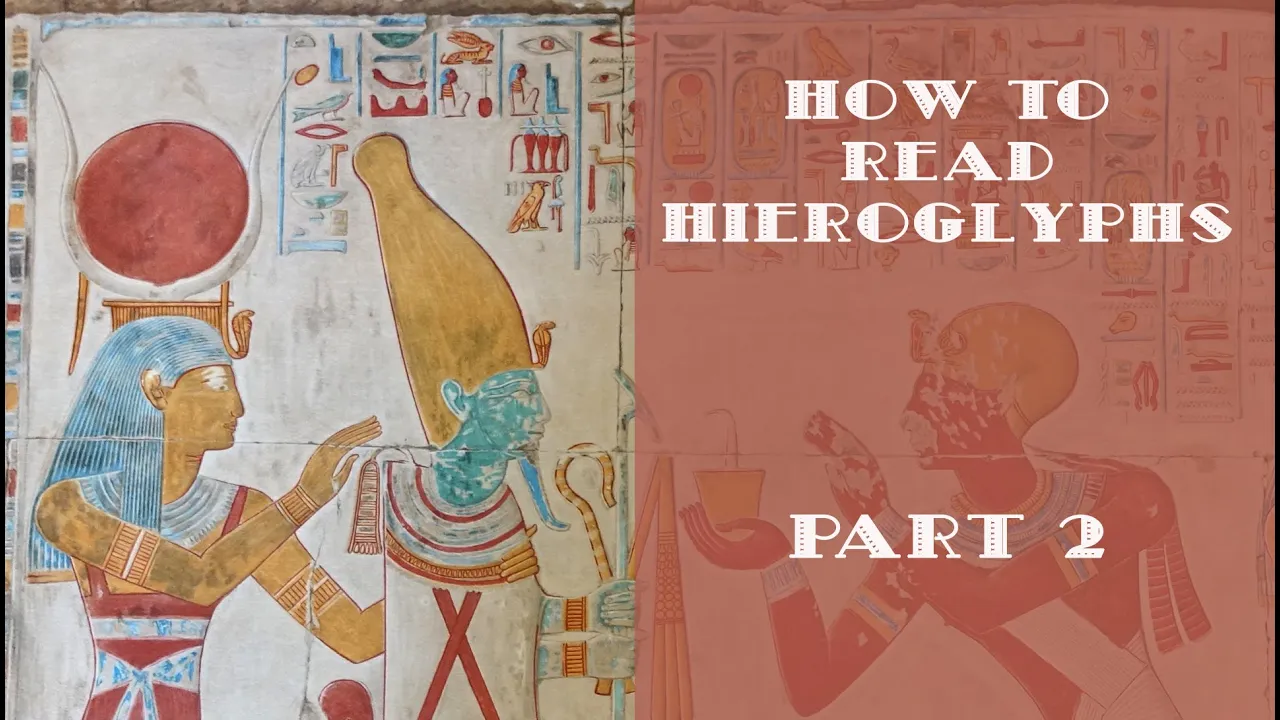
To read Egyptian hieroglyphs correctly, always read into the faces of the figures—when hieroglyphs of people and animals face left, read from left to right; when they face right, read from right to left. Reading should always start at the top and move downward, with stacked signs read from top to bottom before moving to the right.
How to Read Egyptian Hieroglyphs: Direction & Order
Added:Understanding the distinction between logograms (signs representing words), phonograms (signs representing sounds), and determinatives (semantic classifiers).
Basic familiarity with the history of the Ancient Egyptian language and the primary contexts in which hieroglyphs were used (religious, monumental, and funerary).
Awareness of how physical mediums, such as temple walls, sarcophagi, and papyri, dictated the aesthetic and spatial arrangement of Egyptian art and writing.
Mastery of the Egyptian uniliteral signs (the 'alphabet') and their corresponding phonetic transliteration values.
Understanding the concept of honorific transposition, where signs for divine or royal entities are written first out of respect, regardless of the standard reading order.
Learning to identify and translate common monumental formulae, such as the offering formula (ḥtp-di-nsw) found on stelae and tombs.
Studying basic Middle Egyptian grammar, including nominal sentence structures and the function of determinatives in defining word boundaries.
68.6K views1.6Klikes9:07Original Release: 2020-02-18
how do you know which direction to read ancient Egyptian hieroglyphs was it right to left left to right top to bottom in this video I'll walk you through what you need to know to be able to figure out which direction to read hieroglyphs welcome to voices of ancient Egypt where we demystify the words and lives of the ancient Egyptians through animated videos like this one if you're new here I'd love to have you subscribe and hit that Bell icon so you don't miss future videos like this one [Music] hi everyone so how do you know what direction ancient Egyptian hieroglyphs go in that's what we'll get into today but first if you haven't already watched my previous videos in this series on how to read hieroglyphs check out the links in the description below or what pops up in the cards in the top right hand corner now let's jump right in let's take a look at this stone slab which is called a steel ax this one belonged to a man named Haku and it has several rows of texts as well as a couple of columns to which direction do you think one should read these hieroglyphs should we go from left to right right to left top to bottom pause this video for a moment and think about it okay so now that you've had a chance to think about it I'll tell you that this is actually a bit of a trick question because the part on the right side is actually read from left to right while the part on the left side is read from right to left I know you're probably all going oh really right about now as my students always do when I pull this trick in the classroom but it's a good illustration of how flexible the ancient Egyptians were when it came to the direction of writing what mattered most when carving hieroglyphs into stone or painting them on a wall like this was the aesthetics that is how good they looked and how evenly they were spaced sometimes they wrote only in one direction on a monument but often they wrote in both directions in order to make something like this deal look more balanced to have a kind of symmetry and each side oftentimes looks like pretty much a mirror image of the other so how do you know which way to read take a look at the hieroglyphs particularly those of people and animals do you see how on one side they're all facing one way and then on the other side they're all facing the other way this is the key to reading in the correct direction the hieroglyphs always face towards where you should start reading in other words you read into the faces of the animals and people therefore if the figures all face towards the left then you should read from left to right if instead they face fall towards the right then you should read from right to left so let's go back to the steel of Haku take a look at the animals and people again this will tell us that we should start reading in the center for each line moving out towards the edge reading should always start at the top and then move down in this case each side of the line is its own separate text so you can really read them in any order either left first or right first but the ancient Egyptians probably intended you to start in the top left in this case because that's where the most important person that is Haku is both shown and named then you would read the right-hand side in the same manner starting in the center and then going from left to right then you would move down to the second row of text an interesting feature of the Stila is that in this case the artist seems to have not accounted for space properly and he actually ran out of space at the end of the rose particularly on the left hand side as you can see finished up with a few of the signs just below the line rather than in the line now usually Egyptian draftsman and sculptors planned out their compositions pretty well so that this wouldn't happen but occasionally they didn't and they ran into issues like this where things didn't quite fit and on the right hand side you can notice that the lines there they don't run down below the line but they still make the signs smaller at the end so like squeeze them in so they didn't plan quite right on that side either let's look at another example this is the wooden sarcophagus of a priestess of the goddess Hathor who is neem and a net which direction should we read the text on this sarcophagus first let's see what we have for animals and people among the hieroglyphs aha you can see here that they are all facing towards the left in this case so the entire text should be read from left to right reading into the faces of the hieroglyphs alright so now that we've established the basic direction to read it what do we do when hieroglyphs are stacked on top of each other in a line that we should read from left to right or right to left before getting into that I wanted to let you guys know that I have a free guide on how to read higher glyphs and how they basically work which you can pick up at my website voices of ancient Egypt calm / guide which is also linked in the description below so hit pause go grab the guide and then come right back okay so how do we read hieroglyphs that are stacked on top of each other in a line that we would normally read from left to right for example let's zoom in and take a closer look at Haku Stila by reading through the second line on the right hand side this bit of text includes what's called an offering prayer which in this case is for the woman who sits below the line and it also includes the name of the woman first let's look at which way the signs are facing here we have a seated woman hieroglyph and it's facing towards the left so where do we start reading at the left end of the line of course which is in the middle of the Stila this first group of signs at the beginning introduces what's called an offering prayer it basically says an offering which the king gives and this is a very formulaic beginning that you always see in these offering prayers however the signs are in a bit of a funny order but that's a topic for a future video let's move on to the next set of signs if you've watched my videos on the so called hieroglyphic alphabet you may already recognize some of these signs as we read from left to right some signs will also be stacked vertically because the each and Egyptians like to fit in all of the needed signs in the neatest most evenly spaced way that they could and they always wanted to avoid any awkward empty spaces when carving hieroglyphs aesthetics were important so when we see them stacked like this we read from top to bottom first before moving on to the right so with this group here for example we start at the top with this box which represents the sound of the letter P then we read down to the bread loaf which represents the sound of the letter T then we move to the right and have this twisted rope or wick which represents a kind of breath eh sound altogether this spells the name of the god Ptah next you may recognize this wavy water hieroglyph as representing the sound of the letter N in between the two ends is a sign that represents kha klf which is a word for an Egyptian type of spirit put together these three signs read for the cough following this we have the title and name of the woman it says Nebat pair neferu that is the lady of the house neferu the woman's name is nephew and she has this title lady of the house which indicates that she was a female head of household then the final part here reads ma Phyu that is true a voice now this lets us know that this woman neferu has either already or is expected to pass judgment and be able to enter the afterlife let's look at one final example this is a writing board that a scribe in training would have used to practice writing hieroglyphs in ink now since he was writing an ink these hieroglyphs are what we might call cursive hieroglyphs there's still full higher glyphs but they're not as detailed as the ones you would see carved in stone for example now with a writing board like this when the scribe was finished could either wash away the ink or put a new coating of whitewash on it so they could use the board over again lucky for us the last use of the board was not erased so if we wanted to read it which direction should we go in let's see we have a few seated people here some birds and even an ox all of them face towards the right so this entire board should be read starting at the top of course then from right to left in each row now that you've learned the basics of how hieroglyphs work and what direction to read them in let's learn to read and write some basic phrases in the next video which you can find here and if it's not out yet make sure to subscribe and hit that bell so you won't miss it see you in the next video you you
Up Next
23:28
Cuneiform Writing Tutorial with Dr Irving Finkel | British Museum Curator
@mattandtom
724.7K views•2017-07-22

12:54
Triumph of Orthodoxy Icon: Byzantine Art & History Explained
@BenCallan
2.1K views•2024-08-06

9:49
FastAPI vs Flask vs Django: Choosing the Right Python Web Framework
@TechWithTim
302.5K views•2024-05-26

1:42
Game of Thrones Opening Credits: A Cinematic Analysis
@gameofthrones
46.3M views•2011-04-18
Related Study Plans & Knowledge Roadmaps
Structured learning paths in General & Interdisciplinary Studies
general-studies
Elevator Engineering: History, Physics & Cities
01From Hoists to Safety Brakes: The Dawn of Vertical Lift
02Hydraulic vs. Traction: The Engineering Physics of Elevators
03Modern Speed, Safety, and Algorithms
+ 2 more learning modules
12h5 modules
Explore Roadmap
general-studies
Rubber: Material Science, History & Geopolitics
01Origins of Natural Rubber & Mesoamerican History
02The Chemistry of Natural Rubber & Vulcanization
03The Geopolitics of the Rubber Boom & Colonization
+ 2 more learning modules
12h5 modules
Explore Roadmap
general-studies
Containerization: Evolution, Logistics & Trade
01Ancient Trade & Bulk Cargo: Amphorae to Barrels
02The Industrial Revolution & Cardboard Packaging
03The Containerization Revolution: Malcom McLean
+ 2 more learning modules
12h5 modules
Explore Roadmap
general-studies
Textile Tech: Evolution, Labor & Global Impact
01Pre-Industrial Textiles: Handloom & Cottage Industry
02Mechanization: The Spinning Jenny to the Power Loom
03The Factory System & Global Labor Transformation
+ 2 more learning modules
10h5 modules
Explore Roadmap