






















![An Application of TDA to Navigation in Neuroscience [Jerome Roehm]](https://i.ytimg.com/vi/5UaVOpBwrTs/maxresdefault.jpg)
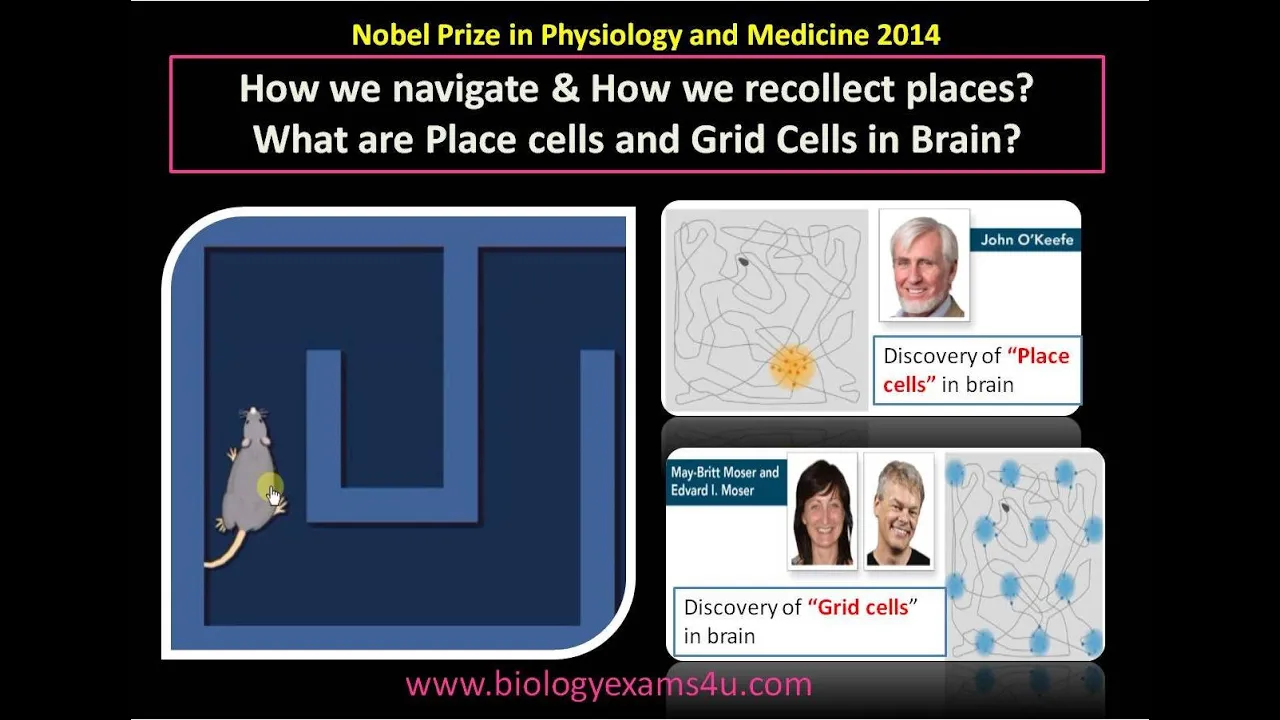
The hippocampus contains specialized neurons that work together to create a cognitive map of the environment: place cells fire when an animal is in specific locations, boundary cells represent distance from environmental walls, head direction cells indicate the animal's orientation, and grid cells provide a hexagonal spatial metric. These cells enable flexible navigation by encoding both environmental landmarks and self-motion cues, with research showing that spatial representations develop in a specific sequence (head direction cells first, then place cells, then grid cells) and that spatial navigation skills can induce structural changes in the hippocampus, such as increased volume in London taxi drivers.
John O'Keefe Nobel Lecture: The Brain's Cognitive Map in Hippocampus
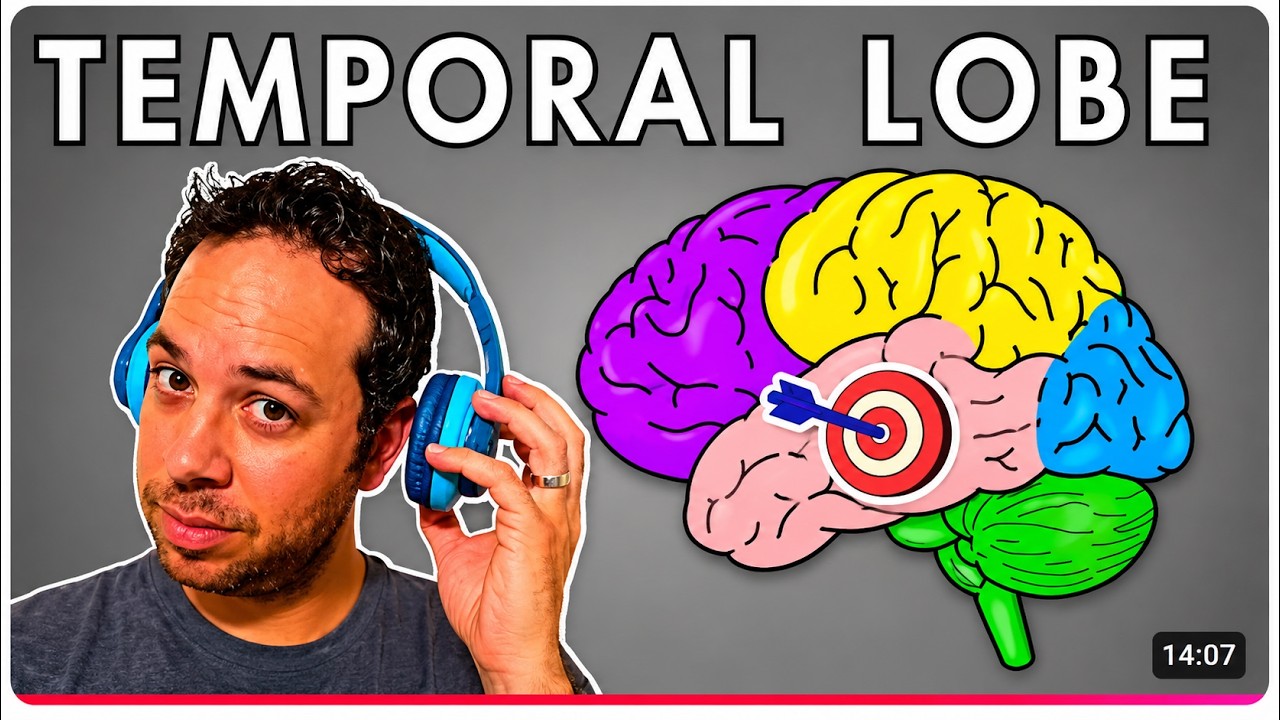
Added:Basic neuroanatomy of the mammalian brain, specifically the location and general function of the temporal lobe and the hippocampus.
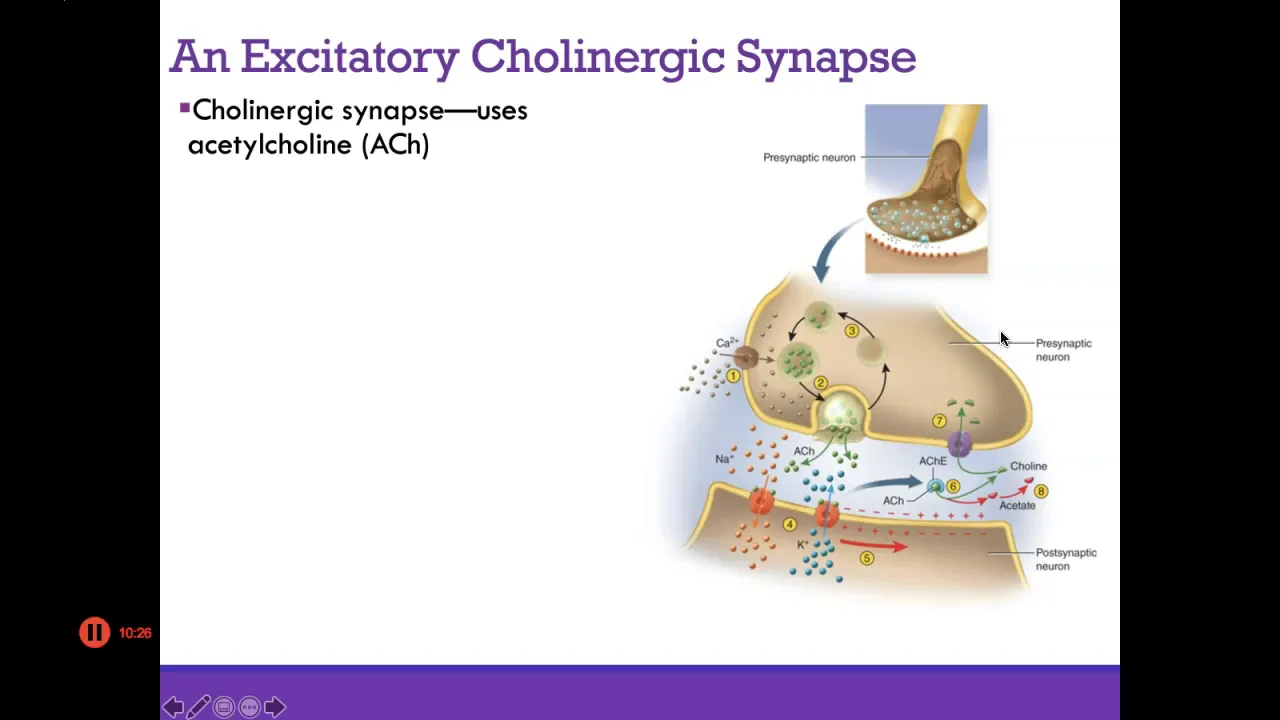
The concept of action potentials and how neural firing rates are used to encode sensory and spatial information.
Edward Tolman's psychological theory of 'cognitive maps' in spatial learning and animal behavior.
The fundamental distinction between different memory systems, particularly episodic memory versus procedural memory.
The discovery and function of grid cells in the entorhinal cortex by Edvard and May-Britt Moser, and how they interface with place cells.
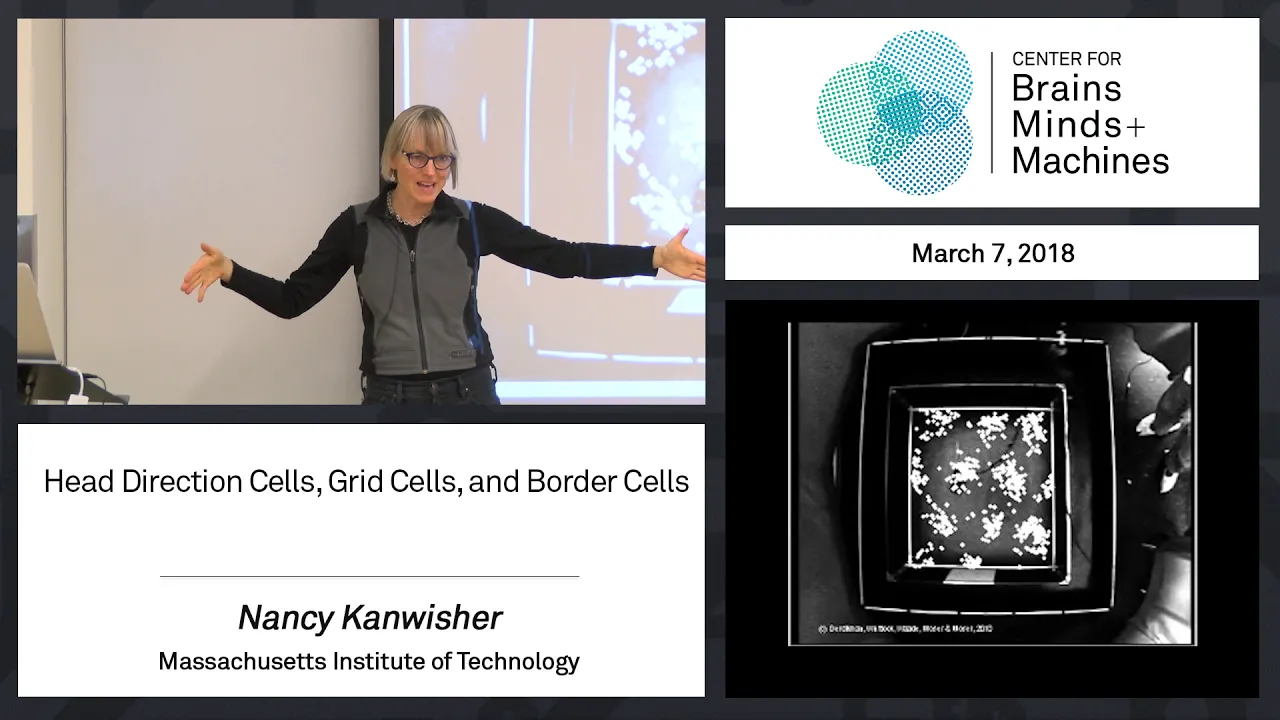
Other specialized spatial cells, including head direction cells, border cells, and speed cells, that complete the brain's navigation system.
How spatial representations in the hippocampus support episodic memory formation and the concept of 'mental time travel'.
The clinical relevance of hippocampal degradation in neurodegenerative diseases like Alzheimer's, where spatial disorientation is an early symptom.
Computational neuroscience models of navigation, such as how place cell activity inspires Simultaneous Localization and Mapping (SLAM) algorithms in robotics.
7.7K views183likes45:04Original Release: 2019-11-29
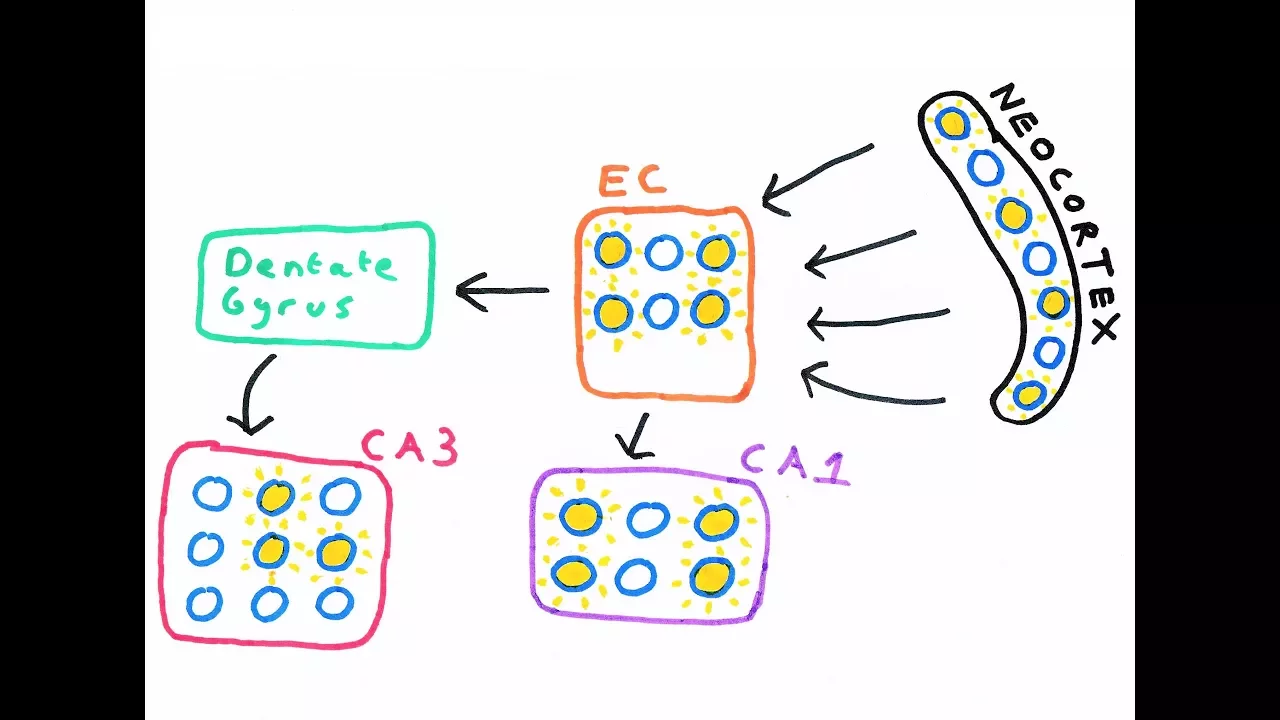
thank you very much dr. Frostburg and to the price Chancellor for that very kind introduction and let me begin by thanking the Nobel Committee and the Nobel assembly on behalf of myself and my colleagues the mousers for deeming our our research worthy of this very prestigious prize I think there's no doubt that the Nobel Prize is the most prestigious prize that you can earn in in medicine or physiology and let me also thank the committee and the Carolyn's the Institute for inviting us here to give these these lectures so my lecture today is on the special cells in the hippocampal formation and the intention is to take you bright back to the beginnings and give you some idea of what we were facing when we first started looking at these cells where we were drawing our inspirations from and to also give you some idea of the methods and the way in which we study these cells and also some of the things we know about these cells we can't obviously an inertia wort lecture like this tell you everything there's there's actually a fairly large industry out there now studying this earth T cells but I'll try to give you some idea of what we know about so my introduction to the hippocampus came when I was a PhD student at McGill where as Professor frost who says I was a student of ronald melzack and i was lucky enough to have very influential and and and tremendously generous mentors particularly Ken Casey and Herrmann Baumer who helped me develop many of the techniques which we which we eventually used to study the hippocampus at McGill we were introduced let me see if like does that work that's not working anyway is it okay we were introduced to the of the hippocampus by Brenda Milner and she told us that it was a memory system and she told us this on the basis of her studies of as he was known then hm as he is now known since his death Henry Morrison who was unfortunate to have acquired epilepsy at an early stage it was severe epilepsy which wasn't controlled by by anti epileptic drugs and for which he was elected for which he elected radical surgery which was the removal of structures in the mesial temple lobes here with this is the intact hippocampal region here and this is the removal in hm and following the the surgery HM had million of his epileptic fits but on the other hand he required a very dense and severe amnesia he no longer could remember the events of his day-to-day life and he could no longer remember events that had happened in the past and after many many years of study of HM and similar patients particularly by Suzanne korkin who is a student of Brenda Milner they concluded that the major deficit in hmm was that he cannot recall anything that relied on personal experience what we call autobiographical memory such as a specific Christmas gift his father had given him he retained only the gist of personally experienced events plain facts but no recollection of specific episodes he had what we now describe as an episodic memory deficit so let's just look a little bit about the structures that were removed in hmm here's the hippocampus in in the human and here it is in this very nice revolving three-dimensional display and you can see it sits right inside the temporal lobes quite varied in deep in in in the temporal lobes far away from either the sensory inputs or the motor output if we do a cross-section through it and we see this very nice in this multicolored stained section here this very nice laminated structure where all the cell bodies are lined up right next to each other in this beautiful beautiful arrangement which is very much beloved of anatomist and physiologist I won't go away very much into Anatomy but we can talk about three major sub components of the hippocampal formation and the related structures can talk about the hippocampus proper here where the CI feels and the dente we can talk about the internal cortex the area that the much beloved by the Moises my colleagues and where they found the grid cells and the intermediate structures in civic ulam here and I'll try to tell you a little bit about what the special cells in these different regions are doing so when we first started approaching the the hippocampus mindful of the fact that that we were probably looking at a memory system we decided to place probes micro electrodes into this region here in the ca1 field of the hippocampus and to see if we could see what the cells were interested in and particularly if they were interested in particular kinds of memory and I must say I was pretty Catholic at that stage Catholic with a small C I was prepared to see that the cells would to all sorts of memories all sorts of stimuli instead what we found as shown in this picture from our first paper here in 1971 is that the cells were only interested in a very specific type of behavior that the animal was engaged they weren't in fact interested in most types of memories they weren't in fact interested in most types of behaviors they were only interested in where the animal was in the environment the cells were coding for some aspect of space they didn't care why the animal went there they didn't care what the animal did there a by and large it was really where the animal went and you could see here from this very first picture here where the spiking occurs only sometimes here not here and not here and that's only as shown in this histogram when the animal goes over to this location here so not being of a very conservative bent I immediately thought wow this looks like the type of system that EC Tolman who has already been mentioned would have loved to believe existed in the rat brain and what I said or what we said was these findings suggest that the hippocampus provides the rest of the brain with a spatial reference map and if you didn't have this map the animal didn't have this map they couldn't learn to go from where it having to be in the environment to a particular place independently of any particular route it didn't have a flexible representation to produce flexible behavior as it was might be expected from Tolman's experiments so who's this Tolman as you've already heard Tolman was a very very important psychologist working on the west coast of america who in the 1930s and 1940s believed on the basis of fish's behavioral experiments on rats running in mazes that the way in which they solve a maze problem was by employing what he called a cognitive map and here's a quote from him we believe that in the course of learning in particularly learning mazes something like a field map of the environment gets established in the rats brain the stimuli I worked over into a tentative cognitive light map of the environment and it is this map including routes and paths and environmental relationships which finally determine what responses the animal will will finally release so that was the idea we had to put a little bit more bones a little bit more flesh on this idea and we suggested that essentially what you needed for a map was to have a set of place representations of the support that we had already found but that didn't that wouldn't be sufficient to have a map you need to not only know where you are in an environment what the place is where the places are but the relationship between the places so we suggested something of the sort that's shown in this cartoon that places might be related to each other by the distances and the directions between them essentially a set of vectors so that when an animal was in a it would know how to get to B by following the vector a B which represented the direction and the distance between them we also suggested that you could use this system for example to identify a location B so that if an animal knew that it was in a and it was heading along a B that would call up the representation of be independently of the information the sensory stimuli that were arriving at location B so is this a very flexible way of representing the environment and it was a very flexible way of allowing the animal to navigate in a familiar environment around this time lyndi Dell who's in the order in some place very grateful and I myself and this is taken from the mid 70s began to think more widely about how this could be used and to see if we could apply these ideas to the existing literature about the hippocampus not only the anatomy and physiology that was known then but so about whether we could explain the deficits that were produced by damage to the hippocampus would a hippocampal rash be able to navigate it was there evidence in the literature we were quite taken by the the idea that's already been expressed that space is a fundamental aspect of the mind of the human mind or even of the animal mind and we watched lyrical in the introduction to our book I've put in a poetry like fashion here we said space plays a part in all our behavior we live in it move through it explore it defended we find it easy enough to point to bits of it the room the mantel of the heavens the gap between two fingers the place left behind when they finally the the piano finally gets moved we made predictions we predicted that there will be other signals in the hippocampus or the broader hippocampal formation which represented those vectors directions distance and speed of movement and we also made predictions about the kind of deficits you would see following damage to the hippocampus and specifically we said animals shouldn't be able to do place learning they shouldn't be able to learn about places in the environment they shouldn't be able to navigate and particularly navigate flexibly so that if they learned to go by one route and that route were blocked they wouldn't be able to go by another and they wouldn't have exploration well if you make predictions in science and you're lucky enough to have good colleagues they'll test them for you and the first one to test these predictions was Richard Morris shown here and Richard said well if you really believe in this idea let's come up with a task where the animal has to flexibly navigate from different locations to one location in the environment and he came up with what's now called the Morris water maze and it's a very simple behavioral task it's a tank of water filled with cloudy water so that the animal can't see what's underneath the surface of the water and in which is located a sunken hidden platform and the animals task is very simple what it has to do and place down in any location in that bath is to find its way to this sunken platform very simple when they first placed in the into this swimming maze the animal wanders around until he finally eventually bumps into the platform and clients on it after a very small number of trials here's eight trials the animals normal animals run go very very straight form a very straight trajectory to the goal and they do that from any location in in in in in the in the water maze if you now inflict hippocampal damage on the animal what you find is that whereas normal controls and control animals go straight to the platform these animals look very much like they did at the early stages they wander around can't find the platform until they bump into it so very good evidence that at least one of the suggestions of the theory was in fact correct and I have to say that the water maze is still the most popular and most powerful test of hippocampal function that exists today so what about the cells well one of the predictions was that there would be some representation of speed of movement in the hippocampal formation because of course if an animal is moving around the environment at different speeds it has to take its own speed of movement into account and essentially offset it so that if it moves from one place to another rapidly the brain will be able to take that into account as well as if it moves from one place to another slowly and we were very fortunate to have Bruce McNaughton and Carol Barnes come to our lab as postdocs in the early 90s sorry in the early 80s and one of the things that they showed was that the firing of the place cells as an animal ran the environment actually changed as a function of how fast the animal is running and you can see here that as the animal ran faster the firing of the cells increased and we also have subsequently been able to show that there are specialized cells we haven't found very many of them but specialized cells in the hippocampal formation which looked for all in purposes as though they are in fact tracking the animal speed the faster the animal runs as shown here from zero to one meter the higher the frequency of these cells what about the other cells well we now know through the work of many laboratories including as you'll hear subsequently the work of the mousers that there are several other kinds of spatial cells in the hippocampus and together we think that we have all the elements to form a cognitive map so one of the things I'll do is I'll just give you a very quick run-through of the different kinds of special cells that have been found in our laboratory and in other people's laboratory and briefly what they are is their play cells which represent where the animal is their boundary cells which tell the animal how far it is from landscapes and particularly walls in the environment there are a head Direction cells which tell the animal what direction it's pointing in environment and finally there are the the grid cells which I'll say very little about because I'll leave it to the Moses to describe them in much much greater detail so let's go through and look at these cells in a bit more detail so first there is a place else if we place an animal this is a cartoon made by my colleague Julian if we place an animal into a circular environment we watch where it is using an overhead camera and we also register where it is one one of these place cells fired what we see is four by a large these cell is silent over most of the environments and it's only when the animal goes into the part of the environment which is preferred by that cell it's place fields that the cell fires and so you can see all of these red dots are adding up and what we typically use is a heat map to represent the firing rate of the cells so the heat map shows that this cell fires with a maximum firing rate of seven Hertz here and and successively lower rates as you move away from from the center and this is a typical type of way in which we represent these cells if we look and one thing that I should point out is that if an animal runs around in an environment like this in an open field it turns out that it doesn't make any difference which directionally animal runs through the place field if it runs no what the cell is happy to fire if it runs south it's equally happy if our it looks as though the cell is representing the location and not something about the sensory impressions that the animal is getting in that in in getting in that location well if we record from that one cell but many cells at the same time we see what is now the standard story about these cells which is that each cell has its own preferred location different cells have different preferred locations and if you take about thirty some-odd cells recorded at the same time you find that the entire environment is mapped there is always a cell firing whenever the animal is in a particular location so it looks as though you have the information about all of the locations in environment and you can imagine that what you're doing is looking at the neural substrate of a mapping structure the same cells are used over again so if you record from to the same cells in two environments you find this the following kind of a pattern of actually here we recording from animals in a circle and the square and you see that there are some cells which only fire in the circle and not in the square there are other cells which only fire in the circle and not fire in the square and not in the circle and there are some cells which fire in both but in different locations so it looks as though you need to look at a pattern of activity across a group of cells to actually know where where the animal the animal is now over the years we've always wondered whether these were really to the no representations or whether they were actually three-dimensional representations and if you want to actually study a three-dimensional representation then you should study them in an animal which is happy to move and or usually moves in three dimensions and that's what Olin RC and his colleagues have done in the bat so they've recorded technically very difficult they record manage to record from these cells in flying that and what you can see here is that each of these cells is now not a two-dimensional Gaussian or level Gaussian structure but in fact they look like they're three dimensional spheres and if you record from a group of them has shown here say ten of them at the same time what you see is again the ten cells essentially tessellate now the volume of space and represent the entire location so we know that these cells at least in bats and we're pretty sure in rats as well or three-dimensional representations now one thing about these cells is that they are in fact really quite clever cunning creatures one of the things I haven't mentioned is that if you look at the gross activity the LFP as we call it activity in the hippocampus which is seems to be representing the activity of large numbers of cells at the same time you see something rather striking in terms of brain research and that is that sometimes this LFP activity takes on a very nice sinusoidal rhythmic activity and when people first saw this they thought yeah that can't be right the brain doesn't give out sine waves but in fact it is a real activity and as I'll show you in a second it actually is very very important aspect of hippocampal function over the years so when the aunt was sitting quietly then you get this rather irregular activity but when the animal starts running around they're shown here then you get this very nice sinusoidal activity which has a frequency of about eight to ten Hertz in the rat over the years URI bouzouki who has spent his life studying this and other the hippocampus would meet me in various venues and say come on John what's the role of the fader activity as it's called in hippocampal function what are the place cells doing when the animal was in theta activity and I assured him for many years that there was no relationship between but some we were in the 1990s Michael Redd Sheena I decided we better look carefully and we saw something very interesting and I think of general significance for not only the hippocampus but other kinds of coding in the nervous system and this is that the cells in addition to using the rate of firing of the cells in the hippocampus also use the timing of the spikes they use the actual time at which the cells fire to provide information to other parts of the brain and that's shown in this figure here although I don't think you'll be able to see it actually if we record as an animal is running along the around an environment and look at when the cells fire they don't actually always stay locked to the same part of the failure wave they move around and they move around in a very systematic way and if you ask how that systematic movement a maps on to the environment indeed of the the the the actual location in the environment or do you see is there's a very systematic relationship here so a cell which fires here will show a very systematic change in its reference and relationship to the theta waves suggesting that position is coded not only by the rate of firing of the cell but also by the exact timing of the cell the time in which the cells fire relative to this wave are actually conveying information and that's probably a very important in general a property of cells in the cortex okay where does the information about the environment come from so we know that animals can tell where they are on the basis of where they are on the basis of sensory inputs coming from from the environment and the first clue about that came from experiment that Neal Burgess and I did in which we recorded from these play cells in boxes with different ratios between the size of the box so recorded in squares small squares large squares and in rectangles which had one side representing the one of the squares and the other side there are of the size of the other side other square so we essentially were taking squares and stretching them out into rectangles what would this do to the way in which the cells were firing and what we saw is that the cells were stretched out quite often so that the fields stretched along the distance that we were stretching the box the cells seem to be trying to represent the distance from a each of the walls so you can imagine that this cell is trying to stay close to firing next to this wall but also close to say next to this wall so that as you pull the walls apart the cell is trying to stay next to them and get stretched in in that direction well I won't go into it but we we suggested that maybe the inputs to the place where or at least one of the inputs of the play cells was actually of the sort of representation that you see in these Rothko paintings and of course what Roscoe is famous for is painting simple paintings in which there is a single stripe at a particular distance from one edge of the painting and you can imagine that the brain could use this kind of information to tell the animal you are now a certain distance from a particular edge of the environment the particular wall in the violet and you can imagine if you could have put a couple of these together they overlap between them might actually represent where the animals exact location is and that's what this little bit of mathematical computation here suggests well you have to be careful again what you predict because following that prediction call a lever in our lab went looking for these cells and you look not in the hippocampus but in a neighboring area the internal to see the circular and about the same time soul stat in the Moses lab was looking in the in Toronto cortex and seeing rather similar things and what they both saw is that there are in fact cells which have this Rothko like stripy representation some of them are close to one wall some to another wall some of verticals some are horizontal and if you put these together you can see that if you just take these two and overlay them what they will produce is in fact a place like representation so we now think that the information about where the animal is coming in from the environment is represented by these kinds of what we call boundary cells and what the Moses called border cells well how about the information about directions it took until about 1984 1985 before these cells were actually identified by Jim wrong layers Jim and his colleagues Jeff Toby and Bob Muller who did most of the early work on these cells they calls head Direction cells unfortunately of Bob my mother died two years ago and he's a great loss to the field but I thought I would just show you what one of these cells looks like so here's an animal again we're watching where where the cells fire and every time the cell fires we represent the animal's head and direction of pointing so as you see as it goes around it drops these arrows here and at the same time there is a Sun arrow representing the overall representation of distance and what you can see is that most of these arrows are pointing in the north or north slightly northwest direction the cells are representing the animals heading within the environment irrespective where it isn't even there is happy a fire here as the other these cells are found in an area just between the internal cortex here and they hit the campus and they called head Direction cells one of the interesting is about these cells is that if you look at a couple of they seem to be tied together their fates are bound together in a virtually ineluctable fashion if you have a cell which is representing a north direction here and two other ones which have other directions and then you manipulate something about the environment to get the cell to fire in the east direction here you find that the other cells modify their preferred directions to maintain the same angles between them it looks as though this whole system is wired together to represent a polar coordinate system which the animal can use wherever it is in the environment to tell the direction of hate okay well what about how distance is measured in addition to the direction we need to have a distance metric well his distance in the brain represented as we as William Blake would have here in his picture of Newton by a calipers which are then used to lay the the difference between two points along a one-dimensional ruler or is it something more complicated shown by the Lichtenstein yellow cliffs painting here which is this sort of have a Yi a mesh-like representation a two-dimensional representation where you could tell for example how far up the cliff you were by counting the number of of these dots these Bengal dots or how far in you were by the same technique well it's clear from the work of the Moses and you'll hear a lot more about that in the next two lectures that is the ladder representation because what they found in the internal cortex are a set of grid cells which look very much like those Benguet dots they represent the environment as a series of firing fields which are laid out in this beautiful symmetrical hexagonal pattern and which is reproducible from one trial to next in which in most environments can be use to represent distances in the earth I want to say much about these advantage my brick will tell you more about them the you can characterize each of these patterns by the distance between the two peaks by the angle of the one of the of the representation relative to the walls and the distance from the walls they'll tell you a lot more about that the only thing I need to tell you is that they come in different flavors and particularly for our for our talk today they come in different sizes so that different cells and particularly del cells in different parts of the internal cortex have different spacing between them and that's important because if you take cells to grid cells with different spacings and you simply add them together and do a little bit of mathematical computation you can also produce a place cell so we have two ways of of producing play cells thinking about the grid cells my colleague my colleague Neil Burgess Castleberry and I began to think that at least one possible way and I won't tell you how he came to this conclusion one possible way of producing a grid structure is by overlaying different striped patterns and you can see this from another Lichtenstein of painting here where he uses these dots again but he juxtaposes them to these stripes if you look at the pattern here what you see is that the each of these patterns of dots here actually is the extension of a stripe running down in this direction and you can imagine very easily that if you had stripes a different orientation say 60 degrees relative to each other that would effectively produce this grid pattern and this is one of the theories that we and others who are working on about how you produce the grid pattern well again you have to be careful about what you predict because following in that prediction one of our colleagues Euler cribbage actually went and looked for these ourselves and it sounds in fact cells which look very much like the stripy cells which were predicted by this by this theory and you can see here that these cells they're not complete stripes but they have this very strong striped orientation so we think there's at least some evidence for the idea that one way you could produce grid cells is by actually avoiding these these stripes so we have then on the basis of a lot of work in many many laboratories we have then a whole panoply of different kinds of spatial cells we have the original play cells we have these boundary cells we have the head Direction cells and the and the grid cells and we're still working on mathematical models there as are many many other people in the field and there are still many many questions that we need to answer about the exact way in which these cells are composed I want to tell you about two other aspects of our work before I give over to the Moses for professor frosh were actually mentioned in my new account and I'm a great fan of Immanuel Kant I have done more than my fair share of philosophical reading and thinking and I've always been taken by Kant's idea and it was one of the reasons I was really quite pleased to begin to study space and see these spatial representations I've been taken by his idea that space is one of the fundament Munda mental aspects of the human mind and what Kant said was that space is nothing but the form of all appearances of our essence if you want to think of something that's outside your body if you want to think of something outside of your mind then you really need to think of it as located in some space and it can be given prior to all actual perceptions and therefore exists in the mind a priori it can be prior to all experience he had this idea that you bring all the mind comes to the world with some machinery some cognitive machinery that it uses to make sense of this the information coming from the world and one of those was space and other was time so thinking about this Nadel and I said well yeah we accept that the representation we're looking at a three-dimensional Euclidean space and particularly that this is a spatial and cognitive structure which is a prerequisite to the experience of objects and and and and their motions this translates in modern neuroscience terms into the idea that maybe the spatial representation in the hippocampus is there before the animal has had any significant experience with the environment many people in the field will think that the way you build up cognitive representations is by taking experiences that you've had and do some manipulation on them compare them contrast them and so on so but it's possible that at least part of our cognitive representation and particularly the representation of space is actually given a priori and so recently my colleagues and I have followed this idea and particularly when I'm talking about Francesca Kikuchi Tom wills and and women 10 and tried to see if we could see when these representations became active in young animals as they were developing and we looked particularly at the early first couple of weeks in life to see when each of the representations appeared and if we could see if some of them appeared before others and if some of them appeared before the animal had had much experience of the world and what we found to make a long story short is that the head Direction cells are the ones which actually appear earliest they appear first they come before the play cells and they come before the grid cells so the order is head direction play cells and grid cells interestingly enough the directional cells the head Direction cells actually occur about the time that the animal's eyes are just open opening and that the animals just leaving the nest ie before its head any substantial sensory experience of the environment so we think that there's at least some merit in this argument and this idea that part of the spatial system is laid down genetically or epigenetically but certainly before and perhaps independent of any experience that the animal is had I think I'm going to do how am i doing for time okay fine I think I'm going to quickly jump over the next couple of that slide and just go directly to the implications of this for human hippocampus because I think as I've already told you the work of Brenda Miller and many other people have told us that the hippocampus of humans is perhaps a special system but has a broader function an episodic memory function so over the years people have always asked it can you demonstrate that what you're seeing in the rash has some implications for what we should be thinking about the human hippocampus and for a long time it was very difficult for us to think about how we would approach this task poorly because it was very difficult to test neuro scientifically the ability of humans to navigate in very large scale in environments and it was around the middle of the 1990s that we realized that the new games that were being produced for the entertainment of our youngsters these first-person shoot him up games where you find yourself in an alien world go around finding the monsters and shoot them up with incredible guns and so forth really would provide would provide us if we could get rid of the monsters and the guns and all the other politically incorrect aspects of the of the environment I won't tell you what they were but if we get rid of those we would have a wonderful platform for studying spatial navigation across large-scale environments in humans and we could do for example we could do imaging on on subjects while they were navigate and it was Neal Burgess who took apart one of these games and he got rid of most as I say the politically incorrect aspects of it but he left us with an environment which is about 60 70 by 70 meters and which it was reasonably easy to learn to navigate around and find your way around in about an hour for most subjects and here are a couple of screenshots which show you one of the rooms here's a bigger table here's a bar there's a broken-down cinema here's here's what's going on in the cinema I won't tell you what the original film was that we're showing in the film but there's something for every taste and so you can use this then to ask people to - to find their way around this environment and see how they navigate using a cognitive representation so we teamed up with Eleanor McGuire and ran an experiment in which we did just that we scan the brains of subjects and found that in fact the only two parts of the brain which were activated during cognitive representations as opposed to the more routine root-like representations where you just go to one corner and turn left is the hippocampus shown here and interesting enough there's me how much the hippocampus is activated how much blood flow there is going through the hippocampus depends on the actual route and success of that particular navigation so if people are taking a very straight navigation between two locations as shown here as opposed to a wandering navigation like this you got more activation the hippocampus as shown in this this graph here Eleanor's and of course realizing that they were a whole group of natural expert rat navigators in in London I use London taxi cab drivers then went on to investigate the London taxi cab drivers hippocampus and showed in fact that they were larger one part of the hippocampus is larger than you find in most most people and larger for example then in bus drivers interesting she also found that the longer you were a taxicab driver the bigger that part of the hippocampus grew so it's not as though you were born to be a taxi cab driver it's that the more you do taxicab drivers types of things exercise your spatial navigational skills the larger it gets so I'm finished now I just want to summarize hippocampal formation provides a cognitive map of a familiar environment and you can use this to identify the animal or our own current location and to navigate from one place to another the mapping system uses two very independent and we think very different strategies in order to guide the animals from one place to another one is based on the environmental landmark what you see what you sense in a particular location the other on what's called a past integration system which is an information about distances traveled in particular directions and we take the similar set of situations system operates in humans and we think it can be elaborated particularly by the addition of linear time and other cognitive abilities to produce this episodic or spatio-temporal memory system which is the hallmark of the and these X in drums and finally I would like to to thank many of the people who've been involved in this this adventure it's it's it's it's been an exciting adventure I'd like to thank as you can see the many talented colleagues that I've had from starting from our initial observations we've been able to interest and excitement very very talented people and I've named many of them as I found on of course you will hear from two of them in a moment the Moses who who are certainly some of the talent most talented people in the field I'd also like to thank my family and my wife Eileen it's probably obvious that in order to do this kind of work you really do need a very strong support at home I've been very lucky to be in this being a world-class institution UCL which has given me the freedom and the support to do this work and I've also been the beneficiary of considerable and continuous funding over the years I would particularly like to point out the Gaspee Foundation and the Wellcome Trust who recently have combined to provide UCL with the money to build the Sainsbury Welcome Center which is a new center for the study of neural circuits and behavior we're trying to do for the other parts of the brain what we have done we think partly successfully for the hippocampus so thank you very much for your attention [Applause] [Music]
Up Next

95:50
Julie Jensen: The Letter Part 2 | Antifreeze Poisoning Murder Case
@CrimeWeeklyPodcast
184.9K views•2024-06-16

48:47
Graphic Medicine: Comics for Collaborative Healthcare Communication
@nationalpatientadvocate
189 views•2023-12-04

34:30
RNA Interference: Nobel Lecture by Fire & Mello | Gene Silencing
@NobelPrize
6K views•2022-04-29
3:05
Stages of Labor and Vaginal Birth | Childbirth Animation
@nucleusmedicalmedia
52.1M views•2017-08-18
Related Study Plans & Knowledge Roadmaps
Structured learning paths in Medicine
medicine
Abnormal LFTs: Diagnostic Workup & Pathology
01Liver Anatomy and Basic Physiology
02Introduction to Liver Function Tests (LFTs)
03Hepatocellular vs. Cholestatic Patterns
+ 3 more learning modules
12h6 modules
Explore Roadmap
medicine
Analyzing Blood Smears: RBC, WBC & Platelets
01Introduction to Blood Components & Smear Preparation
02Normal Morphology of Blood Cells
03Erythrocyte Pathologies & Morphological Variants
+ 2 more learning modules
12h5 modules
Explore Roadmap
medicine
Mechanical Ventilation: Waveforms & Alarms
01Anatomy and Physiology of Breathing
02Introduction to Mechanical Ventilation & Core Modes
03Ventilator Settings and Waveform Interpretation
+ 2 more learning modules
12h5 modules
Explore Roadmap
medicine
Neuro Exam: Localization & Stroke Syndromes
01Foundations of Neuroanatomy and Vascular Supply
02The Neurological Examination: Step-by-Step
03Principles of Neurological Localization
+ 3 more learning modules
18h6 modules
Explore Roadmap