Mastering Mechanical Ventilation: Interpreting Ventilator Waveforms, Troubleshooting Alarms, and Managing Acute Respiratory Failure
Learning Goal: Master the clinical application of mechanical ventilation. By the end of this curriculum, you will be able to interpret pressure, flow, and volume waveforms/loops, systematically troubleshoot ventilator alarms (specifically differentiating airway resistance from compliance issues), avoid patient-ventilator asynchrony, and confidently implement lung-protective ventilation strategies (such as the ARDSNet protocol) for patients experiencing acute respiratory failure.
- Prerequisites: Basic knowledge of human cardiovascular physiology and systemic circulation.
- Estimated Total Study Time: 12 Hours
Module 1: Respiratory Mechanics and Physiology
This foundational module transitions your knowledge from general respiratory anatomy to the applied physics of breathing under mechanical conditions. You will explore compliance, airway resistance, dynamic versus static respiratory states, and the pressure gradients (transpulmonary, alveolar, and pleural) that govern gas exchange and the work of breathing.

- Why this video is valuable: This comprehensive lecture provides an in-depth exploration of respiratory physiology. It breaks down the system of interconnected pressure gradients (airway pressure, alveolar pressure, pleural pressure, and transpulmonary pressure) that clinicians must understand before applying positive pressure. It bridges the gap between passive breathing physics and active mechanical support.
- Knowledge Checkpoint:
- Explain the difference between alveolar pressure (plateau pressure) and transpulmonary pressure.
- Define the elastic and resistive components of the respiratory load.
- Describe how pleural pressure changes during spontaneous breathing versus positive-pressure mechanical ventilation.

- Why this video is valuable: This segment provides a clear, high-yield clinical breakdown of how Peak Inspiratory Pressure (PIP) and Plateau Pressure () correlate directly with dynamic and static compliance. The whiteboard explanation visualizes how physiological changes in the airways versus the alveoli alter these pressures and compliance calculations.
- Knowledge Checkpoint:
- State the mathematical formula used to calculate static lung compliance.
- Differentiate between physiological issues that degrade dynamic compliance versus those that degrade static compliance.
- Explain why a narrowing of the endotracheal tube changes the relationship between peak and plateau pressures.
Module 2: Introduction to Mechanical Ventilation & Core Modes
Here, you will learn the fundamental operations of a mechanical ventilator. This module covers the core clinical objectives of mechanical ventilation (oxygenation and ventilation), distinguishes between invasive and non-invasive applications, and dissects the core operating modes, including Assist-Control (AC) and Pressure Support Ventilation (PSV).
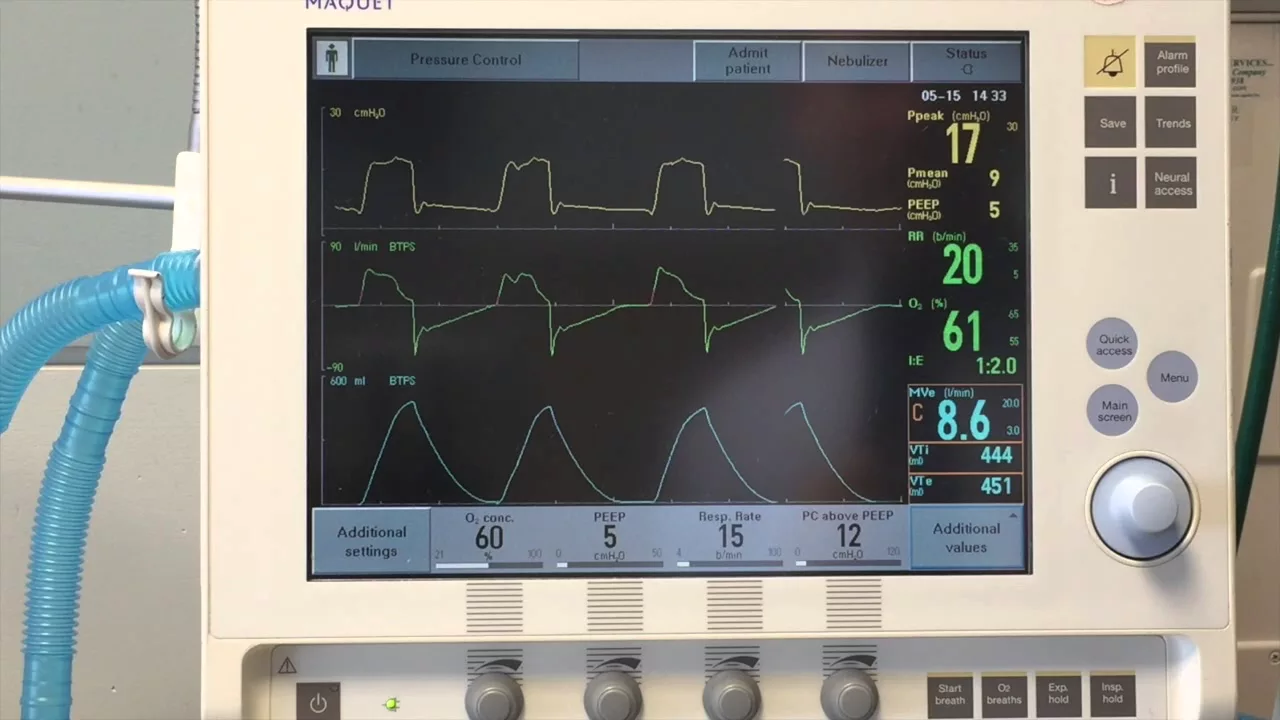
- Why this video is valuable: A classic introductory resource that simplifies the categorizations of mechanical ventilation. It guides you through fully supported modes (like Assist/Control) and contrastingly compares them with spontaneous weaning modes (like Pressure Support). It provides the exact parameters set by the clinician versus those determined by the patient.
- Knowledge Checkpoint:
- Identify the variables that are set by the clinician in Volume Control (VC) mode vs. Pressure Control (PC) mode.
- Explain how a patient triggers a breath in Assist-Control (AC) mode.
- Differentiate between "fully supported" modes of ventilation and "weaning" modes.
- Why this video is valuable: This video serves as an exhaustive baseline primer, ensuring absolute clarity on core settings: Tidal Volume (), Respiratory Rate (RR), Fraction of Inspired Oxygen (), and Positive End-Expiratory Pressure (PEEP). It explains their roles in optimizing the dual goals of oxygenation and carbon dioxide elimination.
- Knowledge Checkpoint:
- Define the physiological purpose of PEEP and its effect on functional residual capacity (FRC).
- Explain which primary ventilator setting directly regulates arterial carbon dioxide ().
- Describe the differences in circuit setup and patient interfaces for invasive vs. non-invasive positive pressure ventilation.
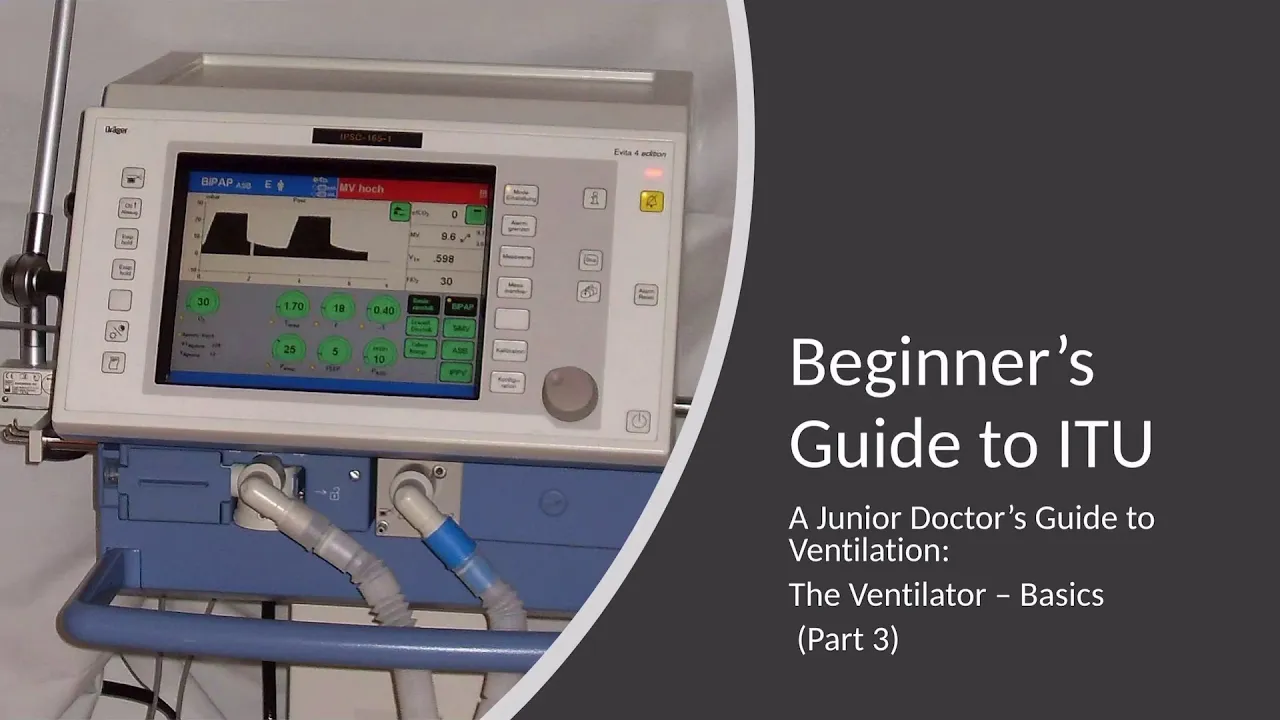
- Why this video is valuable: This video clearly distinguishes between Volume Control and Pressure Control. It provides a visual walk-through of the pressure curves generated by both modes, detailing how the ventilator delivers gas flow to meet a target volume versus a target pressure limit.
- Knowledge Checkpoint:
- Explain why peak airway pressures are variable in Volume Control ventilation.
- Explain why tidal volumes are variable in Pressure Control ventilation.
- Identify which mode offers better protection against high peak airway pressures and why.
Module 3: Ventilator Settings and Waveform Interpretation
This module addresses a major clinical training gap: transforming abstract numbers into visual graphics. You will master the interpretation of the three scalar waveforms (Pressure vs. Time, Flow vs. Time, and Volume vs. Time) and learn to read respiratory loops (Pressure-Volume and Flow-Volume) to assess compliance, resistance, and leak states.

- Why this video is valuable: An excellent technical walkthrough of scalar graphics. This video isolates the phases of inspiration and exhalation on the ventilator monitor. It shows you how to read real-time peak inspiratory pressure, assess changes in inspiratory flow patterns, and visually locate PEEP baseline offsets.
- Knowledge Checkpoint:
- Identify the exact point on a Flow vs. Time waveform where inspiration ends and exhalation begins.
- Distinguish between a constant (square) flow waveform and a decelerating flow waveform, noting which mode typically uses each.
- Explain how a leak in the patient circuit alters the Volume vs. Time scalar waveform.

- Why this video is valuable: Standard scalar graphics plot variables against time; loops plot respiratory variables against one another. This clinical presentation details how Flow-Volume loops and Pressure-Volume loops are generated, showing you how to detect compliance changes (changes in loop slope/angle) and identify circuit issues or air trapping.
- Knowledge Checkpoint:
- Describe the typical appearance of a Flow-Volume loop in a patient with severe airway obstruction.
- Identify how a decrease in static lung compliance affects the slope of a static Pressure-Volume loop.
- Determine how to visually spot circuit condensation or a water trap obstruction on a ventilator loop.
- Why this video is valuable: Led by experts from the Cleveland Clinic, this intensive session introduces a systematic approach to reading ventilator settings. It teaches the "tag" concept (identifying whether volume or pressure is the primary target control variable) and walks you through analyzing patient waveforms to assess lung mechanics.
- Knowledge Checkpoint:
- Describe the "tagging" process for systematically identifying the mode of mechanical ventilation from real-time waveforms.
- Explain how to determine if a patient is actively assisting breathing or if breaths are purely machine-triggered based on the Pressure-Time graphic.
- Identify the specific waveform clues that distinguish between a flow-limited breath and a pressure-limited breath.
Module 4: Troubleshooting Ventilator Alarms & Asynchrony
This module focuses on clinical troubleshooting. You will learn to differentiate high peak airway pressure from high plateau pressure to pinpoint airway versus alveolar issues. Additionally, you will master the detection of patient-ventilator asynchrony (trigger, flow, and cycling mismatches) and learn how to identify and resolve Auto-PEEP and air trapping.
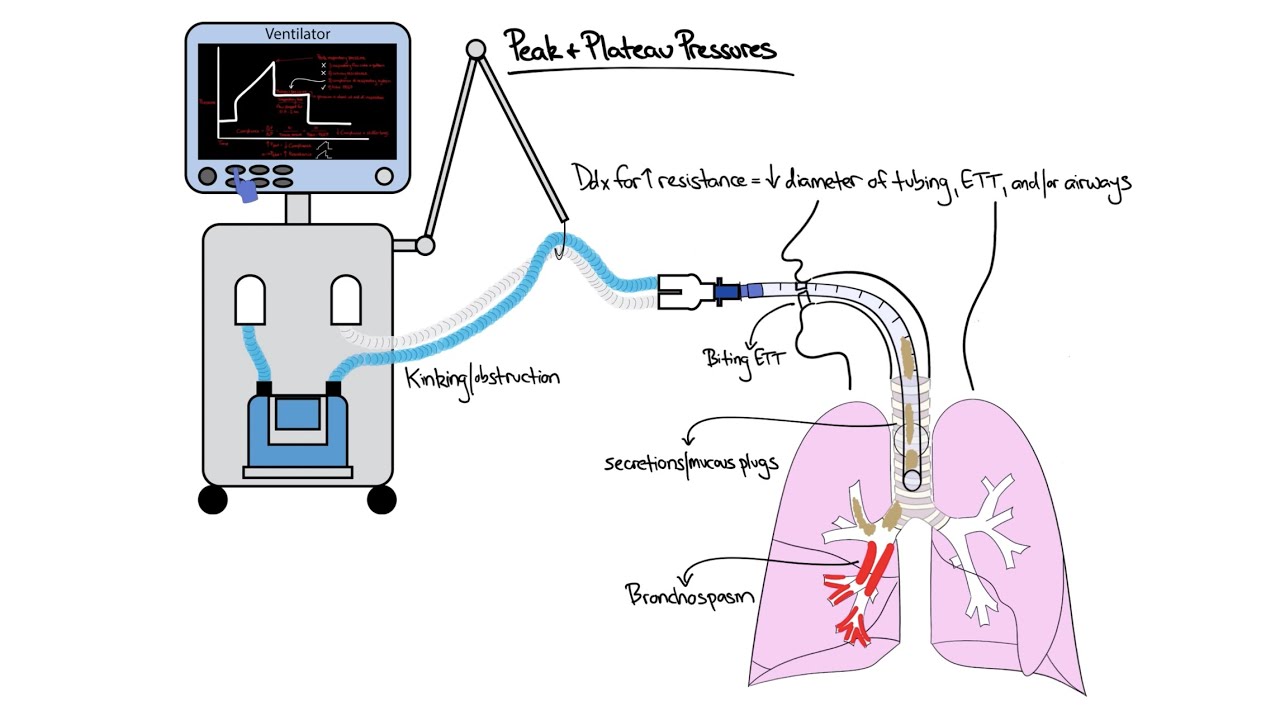
- Why this video is valuable: This video explains how to troubleshoot elevated pressure alarms. It details how the relationship between Peak Inspiratory Pressure (PIP) and Plateau Pressure () isolates airway resistance issues (like secretions, bronchospasm, or biting the tube) from compliance issues (like pneumothorax, pulmonary edema, or ARDS).
- Knowledge Checkpoint:
-
Perform the clinical maneuver required on a ventilator to measure the plateau pressure.
-
State the diagnostic significance of a high PIP with a normal .
-
State the diagnostic significance of a simultaneously elevated PIP and elevated .
                  ┌────────────────────────┐
                  │   High Airway Pressure │
                  │       Alarm Sounds     │
                  └───────────┬────────────┘
                              │
                 [Perform Inspiratory Hold]
                              │
                              ▼
                Is Plateau Pressure Elevated?
                          (> 30 cmH2O)
                         /            \
                        /              \
                    YES                 NO
                    /                     \
                   ▼                       ▼
       【Alveolar Compliance Issue】   【Airway Resistance Issue】
       - ARDS                          - Secretions / Mucus Plug
       - Pneumothorax                  - Bronchospasm (Asthma)
       - Mainstem Intubation           - Patient Biting Tube
       - Pulmonary Edema               - Kinked Ventilator Circuit
-

- Why this video is valuable: A practical guide detailing common ventilator alarms (high pressure, low pressure, low minute volume, low PEEP) and their causes. It teaches you how to respond to these alarms in order to maintain patient safety.
- Knowledge Checkpoint:
- Identify three common causes of a "low pressure" or "low volume" alarm.
- Outline the immediate clinical actions to take if a ventilator alarm is sounding and the patient is in acute respiratory distress.
- Describe the physiological dangers associated with persistent unaddressed low-PEEP alarms.
- Why this video is valuable: Mismatches between patient neural drive and ventilator breath delivery increase the work of breathing, worsen oxygenation, and prolong ICU stays. This video categorizes asynchrony into trigger, flow, and cycling mismatches, teaching you how to spot these issues on scalar graphics.
- Knowledge Checkpoint:
- Define "double triggering" and explain its underlying physiological cause.
- Explain how to identify "ineffective triggering" on the flow-time and pressure-time curves.
- Describe "flow starvation" and outline how to adjust ventilator settings to resolve it.
- Why this video is valuable: This video focuses on managing obstructive lung diseases like COPD and asthma. It details the mechanics of expiratory air trapping, explains how to identify Auto-PEEP on a flow waveform, and outlines strategies (such as altering the I:E ratio and increasing expiratory time) to prevent dynamic hyperinflation.
- Knowledge Checkpoint:
- Identify Auto-PEEP on a Flow vs. Time waveform (specifically looking at the end-expiratory flow value).
- Explain why a low respiratory rate and a prolonged expiratory time are essential for patients with severe bronchospasm.
- Describe how adjusting the ventilator's applied PEEP can help a patient trigger breaths in the presence of Auto-PEEP.
Module 5: Clinical Management: Acute Respiratory Failure & ARDS
This final module focuses on clinical application, specifically managing Acute Respiratory Distress Syndrome (ARDS) and obstructive lung disease. You will learn to calculate Predicted Body Weight (PBW) to set lung-protective tidal volumes (), apply the ARDSNet PEEP/ titration tables, maintain safe plateau pressures, and manage ventilation in obstructive conditions.

- Why this video is valuable: A quick clinical overview of ARDS management in the ICU. It explains the pathophysiology of diffuse alveolar damage and details why lung-protective mechanical ventilation is the primary intervention for reducing mortality in these patients.
- Knowledge Checkpoint:
- State the diagnostic criteria for ARDS (including the ratio threshold).
- Explain the concepts of "baby lung" and alveolar recruitment in ARDS.
- Describe the main clinical goals of lung-protective ventilation in acute respiratory failure.
- Why this video is valuable: This case discussion details the practical application of the ARDSNet protocol. It shows you how to use a patient's gender and height to calculate Predicted Body Weight (PBW) rather than actual body weight, ensuring the patient receives a safe, lung-protective tidal volume.
- Knowledge Checkpoint:
- Calculate the Predicted Body Weight (PBW) and target tidal volume () for a (168 cm) female patient.
- Explain why using actual body weight instead of predicted body weight to calculate tidal volumes increases the risk of volutrauma in ARDS patients.
- Explain how to manage a clinical scenario where the plateau pressure exceeds while following the ARDSNet protocol.

- Why this video is valuable: This lecture provides an in-depth review of the landmark ARMA clinical trial, which established the benefits of low tidal volume ventilation ( vs. ). It covers the physiology of ventilator-induced lung injury (VILI) and explains how to balance oxygenation targets using PEEP/ tables.
- Knowledge Checkpoint:
- List the four primary mechanisms of Ventilator-Induced Lung Injury (VILI): volutrauma, barotrauma, atelectrauma, and biotrauma.
- Explain how to use the ARDSNet PEEP/ titration table to manage a patient with persistent hypoxemia.
- Define "permissive hypercapnia" and state the typical arterial pH limit tolerated under this strategy.
Course Map
This map outlines the recommended learning order and module dependencies.
Key People Index
- Dr. Robert Kacmarek: A key figure in respiratory care and mechanical ventilation research, recognized for his work on patient-ventilator synchrony and lung-protective strategies.
- Dr. Luigi Camporota: A clinical expert in intensive care medicine who has published extensively on patient-ventilator asynchrony, neuromechanical coupling, and advanced respiratory monitoring.
- The ARDS Network (ARDSNet) Investigators: The collaborative research group that designed and conducted the landmark ARMA trial (published in 2000), which established low tidal volume ventilation ( PBW) as the standard of care for ARDS.
Final Self-Assessment
Complete this comprehensive self-assessment checklist to verify your mastery of mechanical ventilation:
- Alveolar vs. Airway Pressures: I can explain how Peak Inspiratory Pressure (PIP) and Plateau Pressure () reflect airway resistance and alveolar compliance, respectively.
- Static Compliance Calculation: I can perform a ventilator inspiratory pause to measure plateau pressure and calculate static lung compliance.
- Volume vs. Pressure Control: I can contrast the independent and dependent variables in Volume Control and Pressure Control ventilation.
- Scalar Waveform Analysis: I can identify inspiration, exhalation, and flow patterns on Pressure, Flow, and Volume scalars.
- Loop Interpretation: I can identify abnormalities, circuit leaks, and compliance changes on Flow-Volume and Pressure-Volume loops.
- PIP vs. Plateau Troubleshooting: I can systematically determine if a high airway pressure alarm is caused by an airway resistance problem (e.g., bronchospasm) or an alveolar compliance issue (e.g., pneumothorax).
- DOPE Mnemonic: I can apply the DOPE mnemonic (Displacement, Obstruction, Pneumothorax, Equipment failure) to troubleshoot sudden patient deterioration.
- Asynchrony Detection: I can spot double triggering, ineffective triggering, and flow starvation on scalar graphics.
- Auto-PEEP Identification: I can identify incomplete exhalation and air trapping on a Flow vs. Time waveform.
- ARDSNet Calculations: I can calculate Predicted Body Weight (PBW) using a patient's height and gender to set a lung-protective tidal volume of .
- Lung-Protective Ventilation Targets: I can manage a patient's ventilator settings to maintain a plateau pressure of and target a using permissive hypercapnia.