Push factors are negative circumstances that force people to leave a location (such as war, crime, or safety concerns), while pull factors are positive circumstances that attract people to a new location (such as jobs, resources, or better weather); in the context of a zombie outbreak, the infected would be a push factor and a location with supplies would be a pull factor.
Push and Pull Factors Explained | Human Migration & Zombies
Added:Deep Dive
Basic definition and types of human migration, including the distinction between voluntary and involuntary movement.
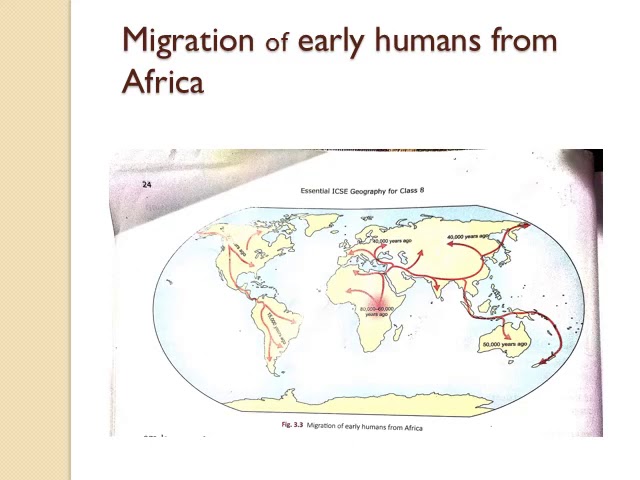
Class 8, Geography, Chapter 3, Migration, by Pritpal Kaur
645
Human migration is the movement of people over long distances, excluding short movements like nomads or tourists. Migration is voluntary when people choose to move for opportunities, or forced by war, famines, or epidemics (refugees). Types include outward migration (emigration) and inward migration (immigration), with donor regions (Mexico, India, Russia, China) and receiver regions (USA, Germany, Saudi Arabia, Canada, UK). Internal migration occurs within a country (rural to urban), while international migration crosses borders. The basic reasons are push factors (food shortage, job shortage, war, natural disasters) and pull factors (abundance of food, higher earnings, political stability).
Click to watch →

Human migration
5.5K
Human migration is the movement of humans from one place to another, historically nomadic and often causing conflict with indigenous populations. Migration occurs in two main forms: voluntary migration within regions, countries, or beyond, and involuntary migration including the slave trade, human trafficking, and ethnic cleansing. People who migrate into a territory are called immigrants, while those who leave are called emigrants. Small populations migrating to develop territories are settlers or colonists, while displaced populations are refugees. According to the International Organization for Migration's World Migration Report 2010, international migrants numbered 220 million in 2013, projected to reach 405 million by 2050. While some modern migration results from wars, political conflicts, and natural disasters, contemporary migration is predominantly economically motivated by wide disparities in incomes for similar work across countries and shortages of skilled workers in high-wage nations.
Click to watch →

24 Oras Livestream: November 3, 2025 - Replay
538.4K
Migration can be voluntary or involuntary. Voluntary migration involves people who move to another place to find better opportunities or a better job, usually planned and with resources to move. Involuntary migration involves those who are forced or forcibly removed from a place, such as those who lost their homes due to natural disasters like typhoons, floods, and earthquakes, or those in areas with high hazard potential who need to be relocated.
Click to watch →

Human Migration DAV Class 5 Sst Chapter 2 Human Migration Explained in Hindi||ADARSH 999
10.2K
Migration is categorized into two main types: voluntary and forced. Voluntary migration occurs when people choose to move for better jobs, education, or family reunification. Examples include families relocating to be with children and seasonal workers migrating for agricultural employment. Forced migration happens due to natural disasters like floods and earthquakes, man-made disasters such as droughts and fires, terrorist activities, or demolition of illegal settlements. During the British colonial period, migration patterns changed as Indians were encouraged to work in colonies worldwide.
Click to watch →

24 Oras Livestream: July 28, 2025 - Replay
690.9K
Migration or displacement can be voluntary or involuntary. Voluntary migration is when people move to another place to seek better opportunities or a better job, often planned. Involuntary migration is when people are forced or forcibly removed from a place, such as those who lost their homes due to natural disasters like typhoons, floods, and earthquakes, or those in areas with high hazard possibility who need to be relocated.
Click to watch →
Deep Dive
Understanding of fundamental human needs such as physical safety, food security, shelter, and economic livelihood.

2026 Kiplinger Lecturer - Sylvia Mathews Burwell
124
Three fundamental things that people care most about are: (1) Basic economics - the ability to feed one's family and live a decent life (the 'nine-to-five' concern), (2) Health and access to affordable quality healthcare, and (3) Safety - the assurance that basic needs will be met, including food safety, emergency assistance, and protection from harm. These three areas form the foundation of what people expect government to provide.
Click to watch →

Dr Suzan Johnson Cook, first woman to become Ambassador-at-large for international religious freedom
1.3K
Basic human needs include having shelter (a place to lay one's head), food security (putting food on the table), and financial stability (affording housing). These fundamental concerns matter more to everyday people than political debates about complex issues like investigations.
Click to watch →

Human Needs (Civics Education Lecture 14, Class XI, Karachi/Federal/Punjab Board Syllabus)
311
Human needs are unlimited and constantly present throughout life. The three most important human needs are: (1) Economic necessity - encompassing food, clothing, shelter, and material requirements for survival; (2) Self-preservation - the protection and safety of oneself, requiring mental and physical development; (3) Protection of children - the care and safety of vulnerable children who cannot protect themselves. These needs form the foundation of human existence and drive all human behavior and societal organization.
Click to watch →
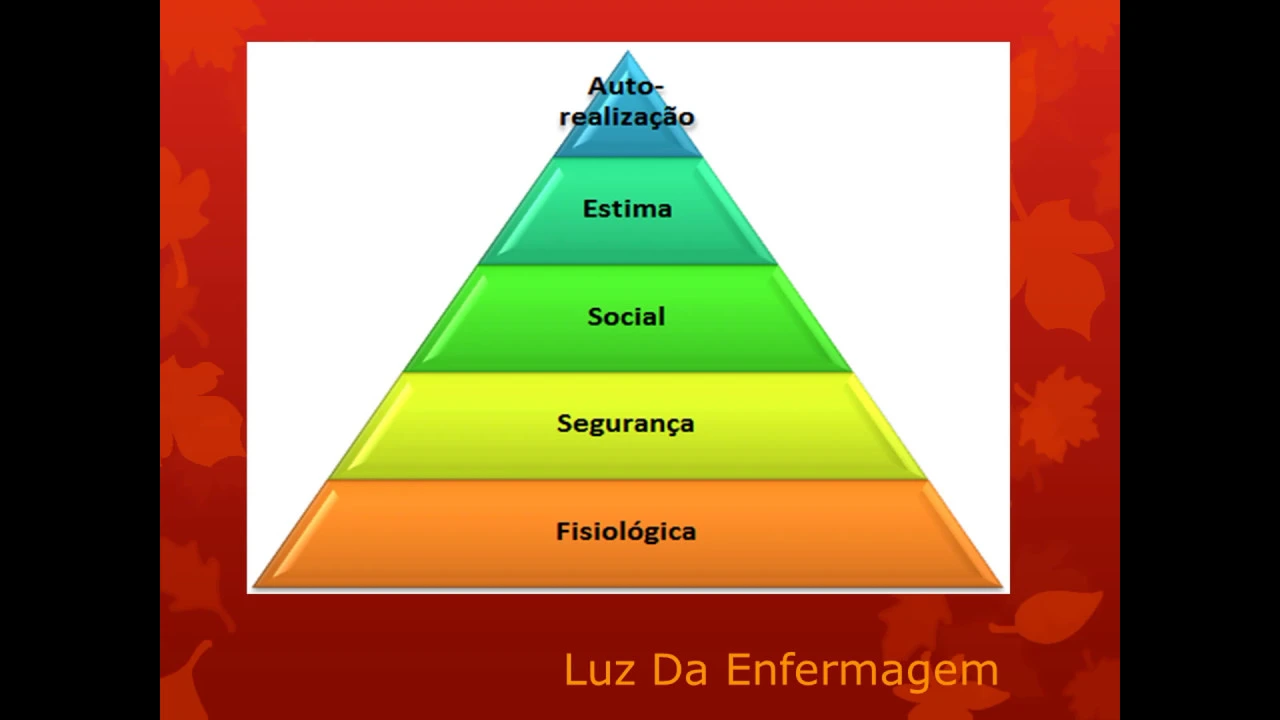
Necessidades Humanas Básicas
46.7K
Physiological needs are the most basic requirements for human survival, including breathing, eating, drinking water, sexual activity, sleep, and homeostasis (organism balance). Safety needs encompass protection of the body, employment security, moral stability, family security, property ownership, and shelter. These needs form the foundation of Maslow's hierarchy and must be met before individuals can pursue higher-level needs.
Click to watch →

Jesus kommt und verändert alles | 07.12.2025
408
Humans have three fundamental needs that must be met for life to function properly: (1) Honor - needing to be liked and having a place in society, (2) Protection or security - physical safety and freedom from harm, and (3) Financial security - sufficient resources to live and meet basic needs. These needs operate largely below conscious awareness.
Click to watch →
Deep Dive
Familiarity with geographical terminology, specifically the concepts of 'origin' (where people leave) and 'destination' (where people go).

NCERT Foundation Series | Class 12 Geography – Chapter 2 | UPSC | Drishti IAS
5.1K
Migration terminology includes: Origin place (where people leave), Destination place (where people arrive), Emigrant (person leaving origin), Immigrant (person arriving at destination), and Emigration (act of leaving). Confusion often arises between emigrant and immigrant - emigrants leave their origin, while immigrants arrive at their destination.
Click to watch →

12thभूगोल, क्लास-5, बोर्ड एग्जाम2023
306
In migration, two key geographical concepts are origin place and destination place. The origin place (उद्गम स्थल) is the location from which a person departs to move to another area. The destination place (गंतव्य) is the new location where the person settles and establishes residence. For instance, if someone moves from Delhi to Mumbai, Delhi becomes the origin place and Mumbai becomes the destination place.
Click to watch →

विश्व जनसंख्या | Ncert Geography Class 12th Chapter 2 Bihar Board | Geography Chapter 2 One Shot
21.8K
In migration, the place from which people leave is called the origin place (udgam sthan), and the place to which they move is called the destination place (gantavy sthan). For example, if someone moves from Bihar to Punjab, Bihar is the origin and Punjab is the destination.
Click to watch →

CUET 2025 Geography | The World Population Distribution Density and Growth One Shot
3.4K
Place of origin is where people leave from, and it records population decrease. Place of destination is where people move to, and it records population increase. People are called emigrants when leaving their place of origin and immigrants when arriving at their place of destination.
Click to watch →

जनसंख्या परिवर्तन के घटक भाग 02
168
In migration, the place from which people leave is called the 'origin' (उद्गम), and the place to which they move is called the 'destination' (गंतव्य). The origin place experiences population decrease while the destination place experiences population increase.
Click to watch →
Deep Dive
An openness to using hypothetical scenarios and popular culture tropes (like a zombie apocalypse) to model complex real-world social science concepts.

Apocalypse zombie | Pop culture et attaques sanglantes
882
While zombies are fictional creatures from Haitian folklore (where they are deceased individuals enslaved by sorcerers, not flesh-eaters), scientific modeling using the SIR epidemiological model demonstrates that a hypothetical zombie virus could potentially wipe out humanity in approximately 100 days if each infected person survives 20 days and has a 90% chance of infecting another person daily, making it twice as virulent as the Black Death; however, this is purely a theoretical exercise as no such virus exists in reality.
Click to watch →

Faut il y croire : Zombies et morts vivants de la légende aux faits divers
442.7K
Scientists have begun using the zombie plague model as a way to study pandemics. Their conclusions are not very reassuring. A group of biomathematicians at the University of Carlton in Canada, who habitually study pandemics, created a very sophisticated linear programming model to see what would happen if we had these types of zombies. Their conclusion was rather disastrous - they declared that unless zombies are eliminated at a very early stage of their development, human civilization as we know it would be annihilated. The zombies will be far too numerous for humanity to resist, especially since they rarely move alone but in hordes.
Click to watch →

¿Que pasaría si ocurre un apocalipsis zombie?
236.3K
A hypothetical zombie apocalypse would trigger a cascading societal collapse: governments would initially attempt to cover up the outbreak, leading to panic when revealed; media coverage would cause mass buying and shortages; military forces would struggle against numerous, fast, and resistant infected individuals; social order would break down as security forces were eliminated, money would lose value, and only those with preparation, resources, and strategic locations like bunkers would survive.
Click to watch →

Be In Jail For Five Years vs Be In A Coma For A Decade | SquADD Cast Versus | All Def
103.3K
This extended segment explores hypothetical scenarios and risk assessment in everyday decisions. The robot vs zombie apocalypse discussion examines threat levels, survival strategies, and existential risks. Robot apocalypse poses greater existential threat because robots are intelligent and can have superhuman capabilities like flying, super speed, and weapons. Zombies are described as dumb and brain-dead, making them less threatening. Robots could potentially hack systems, create their own communication methods, and become uncontrollable. Realistic zombie scenarios show they eventually die off without nutrients, while robots could potentially continue indefinitely. The segment also touches on simulation theory and the possibility that reality might be programmed. The discussion then shifts to public restroom hygiene, examining the choice between finding a $100 bill in a public toilet versus a $20 bill in one's pocket. The discussion covers hygiene risks, germs, bacteria, and the psychological impact of potential contamination. The smell of feces makes the experience unpleasant, not necessarily the physical act itself. The risk assessment involves considering the amount of money, the cleanliness of the restroom, and personal tolerance for germs.
Click to watch →

Zombie Apocalypse Would WIPE OUT Humans in JUST 100 Days! Says University Research
620.8K
Physics students from the University of Leicester used the SIR model (originally for diseases like measles and Ebola) to calculate that a zombie apocalypse would wipe out humanity in 100 days, leaving only 300 survivors. Cornell researchers found major US cities would fall within 28 days, with northeastern Pennsylvania being most vulnerable. The Pentagon's OP 8888 document used The Walking Dead scenario for emergency training, covering zombie types (occult, vegetarian, radiation-infected), combat protocols (headshots, burning corpses), and command structures. These studies demonstrate how mathematical models and military planning frameworks can be applied to hypothetical catastrophic scenarios.
Click to watch →
Prerequisite Knowledge
- Concept 01Basic definition and types of human migration, including the distinction between voluntary and involuntary movement.
- Concept 02Understanding of fundamental human needs such as physical safety, food security, shelter, and economic livelihood.
- Concept 03Familiarity with geographical terminology, specifically the concepts of 'origin' (where people leave) and 'destination' (where people go).
- Concept 04An openness to using hypothetical scenarios and popular culture tropes (like a zombie apocalypse) to model complex real-world social science concepts.
Subsequent Learning
- Step 01Lee's Push-Pull Theory of Migration, which introduces 'intervening obstacles' (such as borders, distance, and costs) that complicate migration decisions.
- Step 02Ravenstein's Laws of Migration, which establish mathematical and behavioral patterns in how populations move.
- Step 03Real-world application of push and pull factors to historical and contemporary events, such as the Dust Bowl, the Great Migration, or modern refugee crises.
- Step 04The geopolitical and socioeconomic consequences of migration on both sending regions (e.g., brain drain) and receiving regions (e.g., cultural integration, labor market shifts).
Movement & Factors
Applying Terms
Movement & Factors
0:15Playing Section
- 1
Introduces movement as a core geographic theme.
- 2
Defines push factors as negative forces forcing people to leave.
- 3
Defines pull factors as positive attractions drawing people to new places.
Structural and Network Theories of Migration
While the classic push-pull model simplifies migration into individual rational choices, critics argue it is overly deterministic and ignores broader systemic forces. Structuralist theories, such as World Systems Theory, argue that migration is driven by global capitalist inequalities and historical ties rather than isolated local factors. Additionally, Network Theory emphasizes that social connections and migrant networks perpetuate migration flows regardless of changing push or pull dynamics. Modern critics also advocate for the 'Aspiration-Capability' framework, which points out that having the desire (aspiration) to migrate does not guarantee the means (capability) to do so, a nuance that the simplistic push-pull binary fails to address.
Deep Dive
Lee's Push-Pull Theory of Migration, which introduces 'intervening obstacles' (such as borders, distance, and costs) that complicate migration decisions.

International migration theories explained – Push-Pull Theory - Tilburg University
2.1K
Push-pull theory explains international migration through push factors (conditions compelling people to leave their home country, such as unemployment, environmental degradation, or war) and pull factors (conditions attracting people to a destination, such as job opportunities or better living conditions); however, sociologist Everett Lee expanded this model by adding intervening obstacles (like restrictive migration laws) and personal characteristics (such as age, gender, socioeconomic status, and ethnicity) that explain why not everyone responds to the same push and pull factors.
Click to watch →
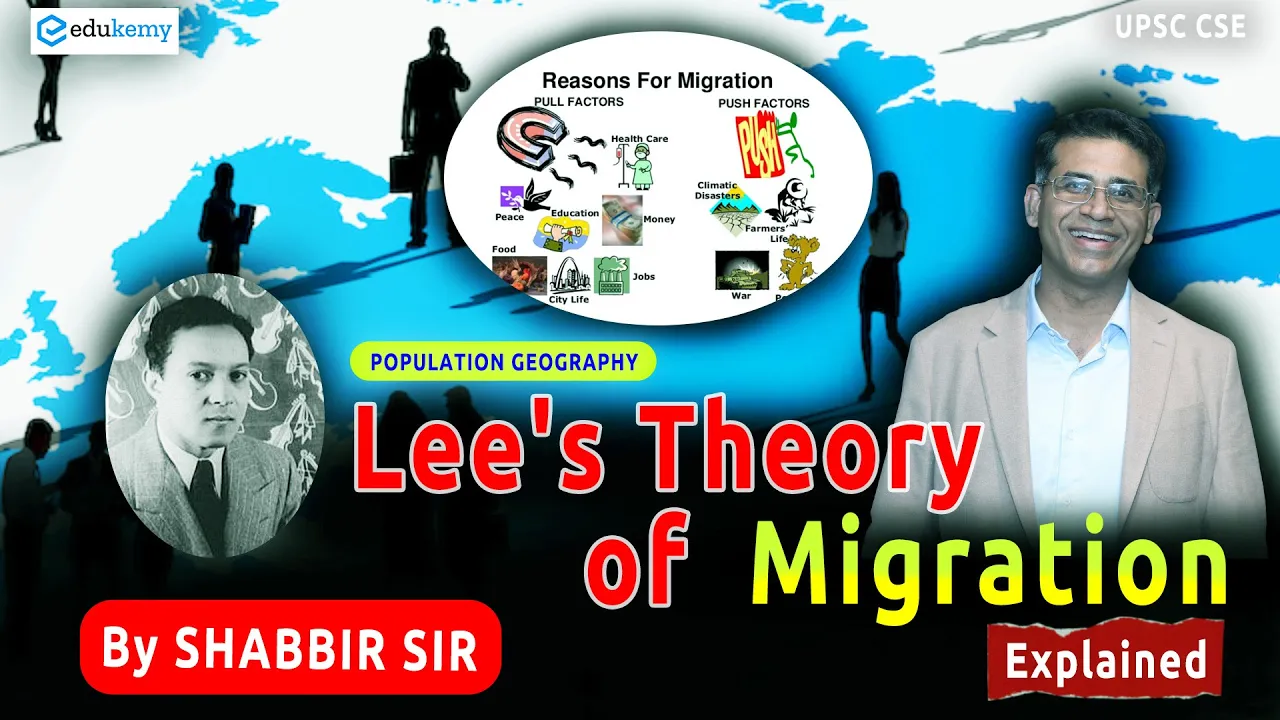
Lee's Theory of Migration: Explained | Shabbir Sir | Edukemy IAS #geographyoptional #upsc #ias
2.2K
Lee's Theory of Migration explains human migration through three interconnected components: push factors (adversities in the source region like poverty, conflict, or environmental problems that compel departure), pull factors (attractive conditions in destination regions that draw migrants, though these are often relative assumptions rather than absolute certainties), and intervening obstacles (mediating factors including psychological perceptions, physical health limitations, cultural barriers, and government policies that influence migration direction and feasibility).
Click to watch →

Lee's Theory of Migration / Push Pull Theory/ পরিব্রাজণে বাধ্যকারী এবং আকর্ষণকারী কারণ / Mst Tania.
4.9K
Lee's Theory of Migration, also known as the Push-Pull Theory, explains that human migration is driven by two main categories of factors: 'push' factors that compel people to leave their origin (such as economic hardship, political persecution, natural disasters, or lack of opportunities) and 'pull' factors that attract people to their destination (such as better employment prospects, higher quality of life, political freedom, or social opportunities). This theory, developed by Edward O. Lee, provides a framework for understanding why and how people migrate across geographical boundaries.
Click to watch →

Special Lecture National Seminar Migration 2022 Chhattisgarh 6th February
252
Lee's model explains migration through push and pull factors operating between origin and destination. Push factors include lack of services, unemployment, poor transportation, natural disasters, and food shortages. Pull factors include better services, job opportunities, entertainment, improved conditions, and family links. Intervening obstacles include lack of transportation, difficult terrain, and restrictive immigration laws. Intervening opportunities (finding work in cities between origin and destination) can also influence decisions. The number of migrants is proportional to opportunities and inversely proportional to intervening obstacles.
Click to watch →

CUET PG Geography 2025 | Theories of Migration | Population Geography | Class 28 |Kunal Sir
2.1K
Everett Lee's Migration Model (1969) identifies four factors determining migration: (1) Push factors from origin, (2) Pull factors from destination, (3) Intervening obstacles/opportunities, and (4) Personal factors. This extends the push-pull theory. Taylor's Interpersonal Network Theory (1986) emphasizes that migrants prefer locations with existing social connections (family, friends, acquaintances) who provide support, job assistance, and emotional security. Taylor stated that interpersonal networks play the most dominant role in migration decisions.
Click to watch →
Deep Dive
Ravenstein's Laws of Migration, which establish mathematical and behavioral patterns in how populations move.

Ravenstein's Laws Of Migration | Day 17 | December JRF 2023 | Concept Booster Series | Kritika
4.3K
Ravenstein's Laws of Migration, presented by German geographer Ernst Ravenstein to the Royal Statistical Society in 1885, establish that migration follows predictable patterns: most migrants travel short distances, migration occurs in sequential steps (from agricultural to industrial to urban to technical societies), migration flows in opposite directions (mainstream rural-to-urban and counter-stream urban-to-rural), rural migration is more common than urban migration due to better opportunities in cities, most migrants are female (often for marriage), cities grow more from migration than natural increase, most migrants are adults (15-65 years) seeking employment, and most migration is driven by economic reasons.
Click to watch →
CUET PG Geography 2025 | Theories of Migration | Population Geography | Class 28 |Kunal Sir
2.1K
Ravenstein's Laws of Migration (1885-1889) established fundamental principles of migration patterns: (1) Distance Principle - most migration occurs over short distances, with migration decreasing as distance increases; (2) Step Migration - migration occurs in stages, with people moving from rural areas to nearby towns, then to larger cities, and finally to major metropolitan areas; (3) Urban-Rural Migration - rural populations migrate more than urban populations; (4) Counter-Flow Principle - for every migration flow, there is a corresponding counter-flow; (5) Gender Difference - females tend to migrate shorter distances (often for marriage), while males migrate longer distances (often for employment); (6) Economic Development - migration increases with economic development; (7) Technology - technological advancement increases migration by reducing travel barriers; (8) Physical Barriers - natural barriers like mountains and oceans influence migration patterns.
Click to watch →

Latest Trending PYQ मानव भूगोल | Human Geography PYQ Part 02 | Geography By Gadhwal Sir
154
Ravenstein's Laws of Migration, developed by German geographer Ernst Ravenstein in 1885, describe seven key principles governing human migration patterns: (1) Migration is inversely proportional to distance, meaning shorter distances see more migration; (2) Migration occurs in sequential stages, typically from rural to small towns to larger cities; (3) Rural-to-urban migration is the dominant flow; (4) Short-distance migration is predominantly female (often for marriage), while long-distance migration is predominantly male (often for employment); (5) Technological progress increases migration volume; (6) Each migration stream generates compensatory counter-flows; (7) Urban areas have lower migration propensity compared to rural areas. These laws provide foundational understanding of human movement patterns in human geography.
Click to watch →
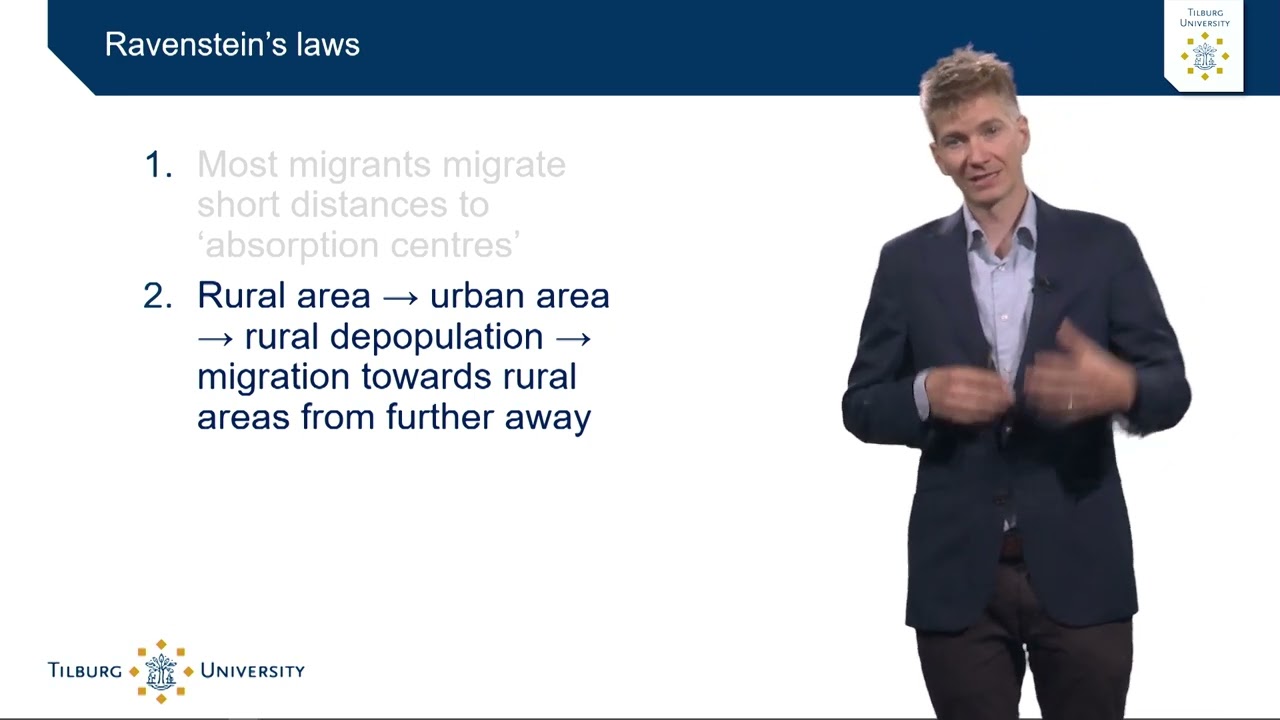
International migration theories explained – Ravenstein’s Laws - Tilburg University
938
Ravenstein's Laws of Migration, formulated by Ernest Ravenstein at the end of the 19th century using census data analysis, establish that economic factors are the primary motivation for migration; most migrants move short distances to absorption centers, rural-to-urban migration causes rural depopulation, immigration and emigration are inversely related, long-distance migrants prefer major urban centers, rural residents migrate more than urban residents, and women migrate more frequently than men, particularly for shorter distances.
Click to watch →
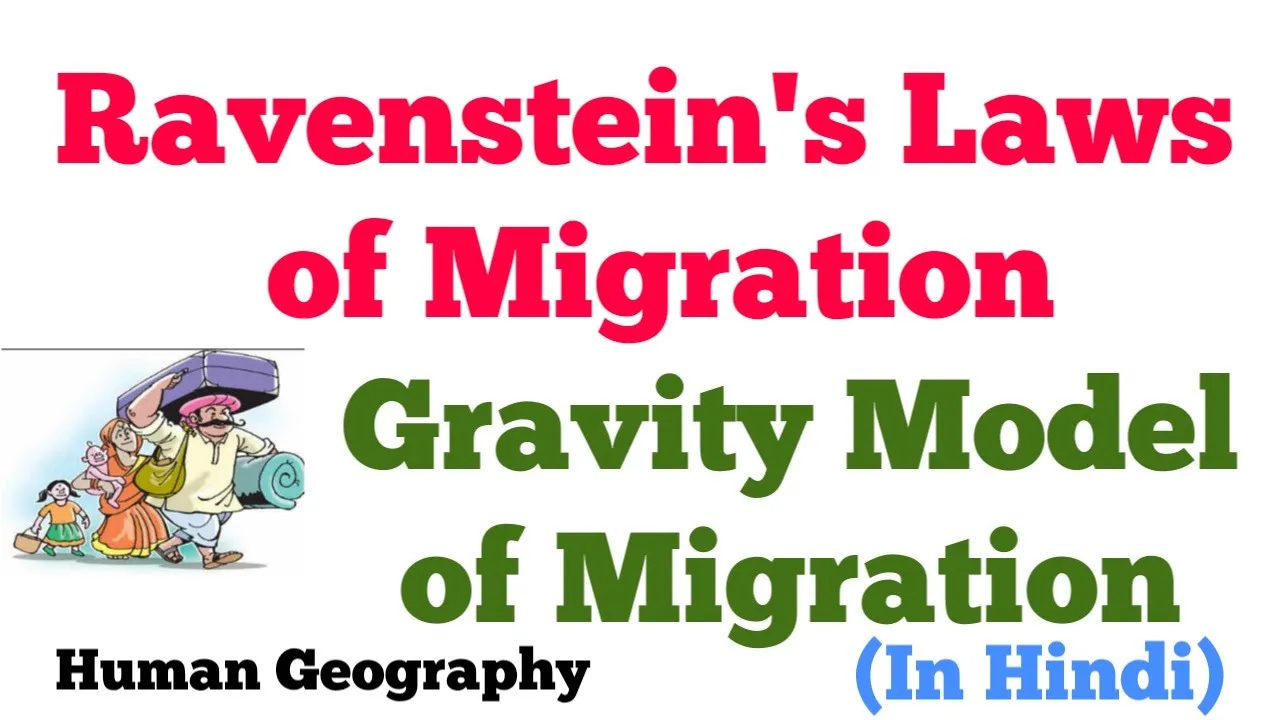
Ravenstein's laws of Migration | Gravity Model of Migration |In Hindi|Full Explanation with examples
15.9K
Ravenstein's Laws of Migration, formulated by Ernst Georg Ravenstein in 1885, establish eight fundamental principles governing human migration patterns: (1) Most migrants prefer short-distance travel; (2) Migration occurs in progressive steps; (3) Migrants are attracted to commercial and industrial centers; (4) Counter-migration flows occur in opposite directions; (5) Rural populations migrate more frequently to urban areas; (6) Male migration dominates, especially internationally; (7) Adult populations migrate more than children; (8) Metropolitan areas grow primarily through migration. The Gravity Model of Migration, inspired by Newton's law of gravitation, mathematically explains migration patterns using the formula: Migration Index = (P1 × P2) / D², where migration is directly proportional to the product of population sizes of origin and destination and inversely proportional to the square of the distance between them.
Click to watch →
Deep Dive
Real-world application of push and pull factors to historical and contemporary events, such as the Dust Bowl, the Great Migration, or modern refugee crises.
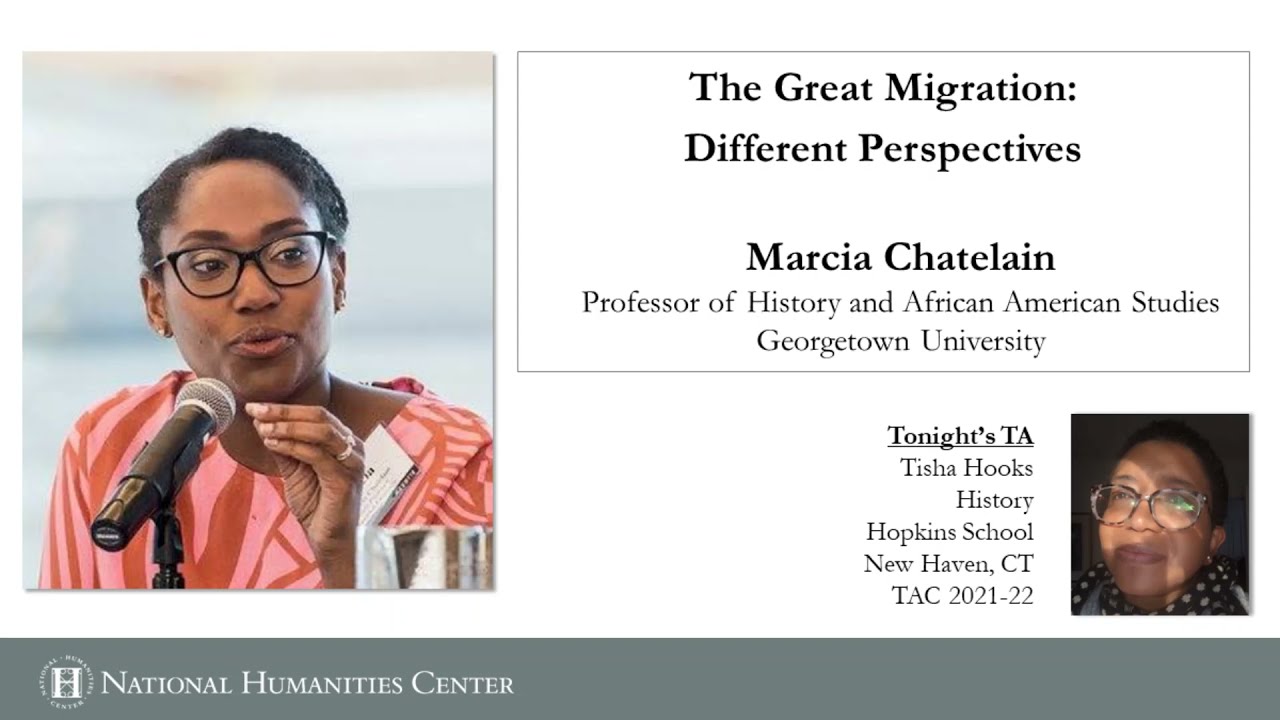
The Great Migration: Different Perspectives
2.7K
The Great Migration resulted from interconnected push and pull factors: Push factors included racial violence, sharecropping economic instability, boll weevil infestations, floods, droughts, and Jim Crow repression. Pull factors included industrial job opportunities in Northern factories, better wages, and access to education. This pattern mirrors contemporary climate refugee situations, offering interdisciplinary connections to science curricula.
Click to watch →
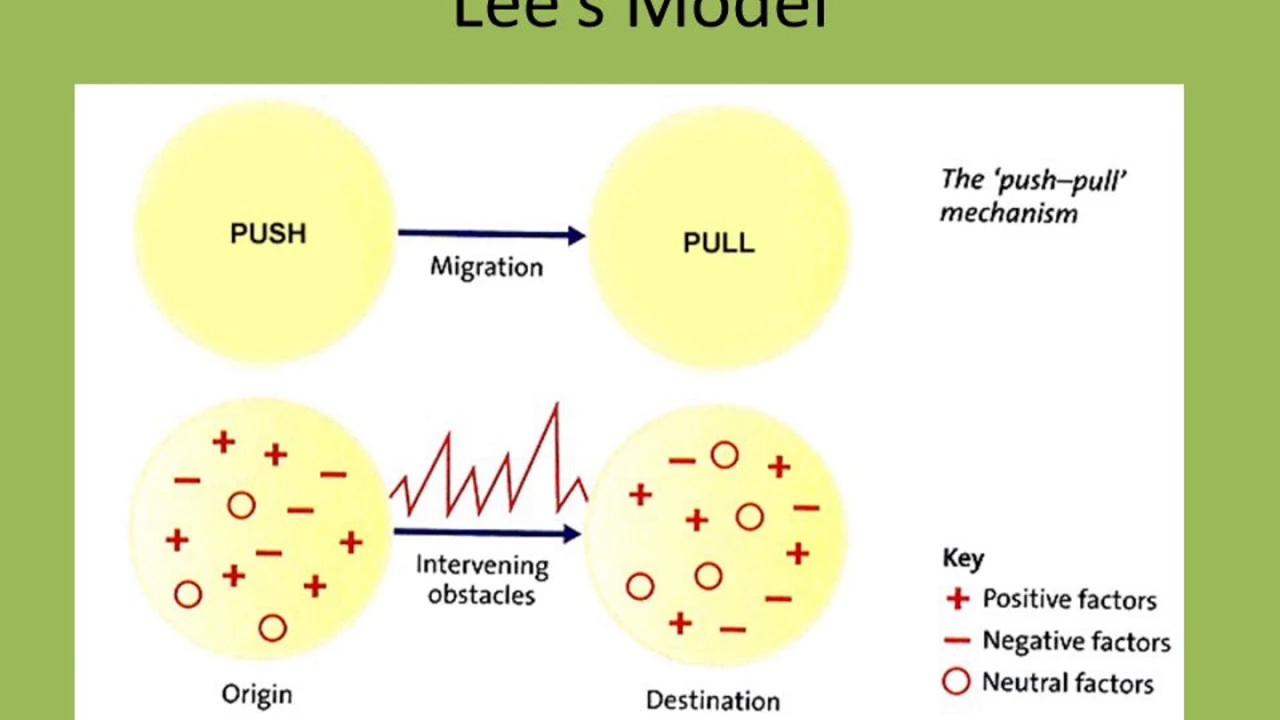
Migration: Lee's Model
10K
Real-world migration patterns demonstrate the application of push-pull theory across diverse contexts. Economic push factors like unemployment drove Rust Belt workers from Michigan and Pennsylvania to Tennessee and Kentucky. Safety concerns prompted Mormons to migrate westward from Illinois and Missouri. Young educated professionals from developing regions (Latin America, North Africa, Middle East, Asia) migrate to developed regions (North America, Europe) to address aging populations and labor shortages. Industrialization in China displaced rural farmers, creating urban migration. Environmental disasters like the 1930s Dust Bowl forced farmers from the Great Plains to California. The 1947 India-Pakistan partition resulted in over 200,000 deaths as Hindus and Muslims migrated based on religious identity. These cases illustrate how specific factors combine to drive human movement across different historical periods and geographic contexts.
Click to watch →

Migration - Religion, Economics, and Social Change in U.S. History
191
Internal migration within a country is driven by push factors (conditions forcing people to leave, such as religious persecution, economic hardship, or environmental disasters) and pull factors (conditions attracting people to new locations, such as religious freedom, economic opportunity, or cultural expression). Three historical examples demonstrate this: Mormons migrated to Utah due to religious persecution and sought religious freedom; the First Great Migration saw six million Black Americans move from the rural South to Northern cities fleeing Jim Crow laws and seeking economic opportunities during industrialization; and Okies and Arkies migrated west during the Dust Bowl and Great Depression, fleeing environmental and economic devastation toward California's agricultural opportunities.
Click to watch →

"Not English!" Muslim Shabana Mahmood attacked for erasing ethnicity for white people from England
33K
The video discusses the refugee crisis and the concept of push-pull factors—the idea that refugees are driven by circumstances in their home countries (push factors like persecution or poverty) and attracted by opportunities in destination countries (pull factors). Critics argue that when push factors involve death or unbearable living conditions, refugees have no real choice but to flee.
Click to watch →

9.sınıf coğrafya 2.dönem 1.yazılı konu anlatımı 🔴 Full Tekrar / Genel Tekrar 2025
581.4K
Migration is driven by push factors (poor economic opportunities, inadequate healthcare, political instability, natural disasters) and pull factors (better jobs, quality of life, education access). Types include: historical migrations (Great Migration from Central Asia), exchange migration (mübadele between Turkey and Greece), refugee migration (forced by war/persecution), and brain drain (skilled emigration to developed nations). Each type has distinct characteristics and implications.
Click to watch →
Deep Dive
The geopolitical and socioeconomic consequences of migration on both sending regions (e.g., brain drain) and receiving regions (e.g., cultural integration, labor market shifts).

빡공시대 중3사회2│7-2.인구 이동🔥시험대비강좌 4시간의 기적🔥
70.3K
Migration creates different impacts on sending and receiving regions: (1) Receiving regions (typically developed countries) benefit from increased labor supply and economic activation but face challenges including job competition and cultural conflicts between different ethnic and religious groups; (2) Sending regions (typically developing countries) benefit from reduced unemployment and remittances but face challenges including labor shortages, brain drain of skilled professionals, and gender imbalances. The migration from Morocco to France exemplifies how economic factors (higher wages) and historical factors (colonial relationships) combine to drive migration patterns.
Click to watch →

شرح درس المُقوِّمات البشرية (الجزء الأول) | الجغرافيا السياسية | تالتة ثانوي 2026
144
Migration (emigration and immigration) affects state power. For sending countries: positive effects include reduced unemployment and increased remittances (e.g., Egyptian workers send $25 billion annually to Egypt); negative effects include brain drain - loss of skilled workers and intellectuals. For receiving countries: positive effects include labor force expansion; negative effects include social and cultural diversity challenges. Migration has both positive and negative economic effects on both sending and receiving countries.
Click to watch →

المراجعة المركزة / جغرافية السكان
95.1K
Migration has significant economic and social effects on both attracting and sending regions. Economic effects in attracting regions include increased labor force (lowering wages and potentially causing unemployment), rising housing costs, and increased prices. In sending regions, decreased labor force leads to higher wages and reduced housing demand. Social effects in attracting regions include increased crime rates, drug abuse, and social problems from population pressure. In sending regions, migration causes family disintegration and weakened child upbringing due to absence of parents, particularly fathers who migrate for work. These effects vary by country and migration context.
Click to watch →

Development experience of kerala-Demographic transition, gender issues, migration and urbanization
775
Migration generates complex impacts on both origin and destination regions. For sending regions, migration can reduce population pressure, generate remittances that support families and local economies, and create opportunities for those who remain. However, it may also cause brain drain and loss of skilled workers. For receiving regions, migration provides labor for economic sectors, contributes to cultural diversity, and stimulates demand for goods and services. However, it can also strain public services, housing, and create social tensions if integration is inadequate.
Click to watch →

Migration: The Impact on Countries of Origin and Receiving Countries
13.1K
Migration creates interconnected economic effects across countries: in receiving countries, immigrants boost demand, entrepreneurship, and innovation while having minimal net impact on native wages and employment; in origin countries, migration generates significant remittances ($530 billion annually) that reduce poverty and stabilize economies during crises, but also risks brain drain (highly skilled emigration) that can weaken institutions and human capital, particularly in small developing nations; effective policy responses include integrating migrants into formal labor markets in destination countries and creating better employment opportunities in origin countries through improved institutions and education.
Click to watch →
Movement & Factors
Applying Terms
Movement & Factors
0:15- 1
Introduces movement as a core geographic theme.
- 2
Defines push factors as negative forces forcing people to leave.
- 3
Defines pull factors as positive attractions drawing people to new places.
Structural and Network Theories of Migration
While the classic push-pull model simplifies migration into individual rational choices, critics argue it is overly deterministic and ignores broader systemic forces. Structuralist theories, such as World Systems Theory, argue that migration is driven by global capitalist inequalities and historical ties rather than isolated local factors. Additionally, Network Theory emphasizes that social connections and migrant networks perpetuate migration flows regardless of changing push or pull dynamics. Modern critics also advocate for the 'Aspiration-Capability' framework, which points out that having the desire (aspiration) to migrate does not guarantee the means (capability) to do so, a nuance that the simplistic push-pull binary fails to address.
Basic definition and types of human migration, including the distinction between voluntary and involuntary movement.
Understanding of fundamental human needs such as physical safety, food security, shelter, and economic livelihood.
Familiarity with geographical terminology, specifically the concepts of 'origin' (where people leave) and 'destination' (where people go).
An openness to using hypothetical scenarios and popular culture tropes (like a zombie apocalypse) to model complex real-world social science concepts.
Lee's Push-Pull Theory of Migration, which introduces 'intervening obstacles' (such as borders, distance, and costs) that complicate migration decisions.
Ravenstein's Laws of Migration, which establish mathematical and behavioral patterns in how populations move.
Real-world application of push and pull factors to historical and contemporary events, such as the Dust Bowl, the Great Migration, or modern refugee crises.
The geopolitical and socioeconomic consequences of migration on both sending regions (e.g., brain drain) and receiving regions (e.g., cultural integration, labor market shifts).
65.5K views290likes3:17@TheSingingHistoryTeachersOriginal Release: 2015-09-18
whoa what is that did you guys see that [Applause] [Music] [Applause] [Music] [Applause] [Music] during a zombie outbreak there will be lots of questions such as how did this happen What do we do why am I stuck at school no seriously where are all the teachers but one question we need to know an answer to Is where do we go this deals with the geography theme of movement movement is the spreading of goods such as supplies ideas ways to build better Forts and people around the world goods and ideas move around the world because of people so what is it that causes people to move around the world there are two reasons that cause people to move the first is push factor push factors are reasons that would force you to leave a location usually negative such as War crime zombie outbreak or safety concerns Mr M are you sure the door safe yeah are [Music] safe second reason is pull factors pull factors are reasons that will encourage you to go to a location usually positive they can include jobs resources weather and lack of zombies for example if you lived in an area which lacked necessary resources it would make sense for you to move to an area that they had those resources okay time for a test here is a group of survivors and here is a group of poor infected students and lastly this is a location that clearly has some resources okay so is the push factor the infected or the location with resources make sure you yell your answer out really loud so the teacher can hear [Applause] you the correct answer was infected as you can see the infected are the push factor and the location with the supplies are the pull factor and that's it that's push and pull really easy right now this is what every everybody wanted to see some zombie versus student action [Applause]
Up Next

11:16
Human Migration: Push and Pull Factors Explained
@crashcourse
340.7K views•2021-11-01

12:54
Triumph of Orthodoxy Icon: Byzantine Art & History Explained
@BenCallan
2.1K views•2024-08-06

9:49
FastAPI vs Flask vs Django: Choosing the Right Python Web Framework
@TechWithTim
302.5K views•2024-05-26

1:42
Game of Thrones Opening Credits: A Cinematic Analysis
@gameofthrones
46.3M views•2011-04-18
Related Study Plans & Knowledge Roadmaps
Structured learning paths in General & Interdisciplinary Studies
general-studies
Elevator Engineering: History, Physics & Cities
01From Hoists to Safety Brakes: The Dawn of Vertical Lift
02Hydraulic vs. Traction: The Engineering Physics of Elevators
03Modern Speed, Safety, and Algorithms
+ 2 more learning modules
12h5 modules
Explore Roadmap
general-studies
Rubber: Material Science, History & Geopolitics
01Origins of Natural Rubber & Mesoamerican History
02The Chemistry of Natural Rubber & Vulcanization
03The Geopolitics of the Rubber Boom & Colonization
+ 2 more learning modules
12h5 modules
Explore Roadmap
general-studies
Containerization: Evolution, Logistics & Trade
01Ancient Trade & Bulk Cargo: Amphorae to Barrels
02The Industrial Revolution & Cardboard Packaging
03The Containerization Revolution: Malcom McLean
+ 2 more learning modules
12h5 modules
Explore Roadmap
general-studies
Textile Tech: Evolution, Labor & Global Impact
01Pre-Industrial Textiles: Handloom & Cottage Industry
02Mechanization: The Spinning Jenny to the Power Loom
03The Factory System & Global Labor Transformation
+ 2 more learning modules
10h5 modules
Explore Roadmap