




















Debt is not a natural or inevitable feature of human society but a historically constructed concept that has been used to justify both oppression and liberation throughout human history; the standard economic narrative that economies evolved from barter to money to credit is incorrect, as credit systems actually preceded coinage by approximately 5,000 years, and debt has consistently served as a powerful moral framework that can either perpetuate inequality or enable revolutionary change depending on how it is framed and applied.
Debt: The First 5,000 Years | David Graeber | Author Talk
Added:The standard economic theory of money's origins, specifically the 'barter myth' associated with classical economists like Adam Smith.
Basic anthropological concepts of reciprocity, social currencies, and Marcel Mauss's theory of the gift economy.
The conceptual distinction between commodity money (specie/bullion) and credit money (debt-based systems).
A foundational understanding of ancient historical epochs, particularly early Mesopotamian civilizations and the Axial Age.
Modern Monetary Theory (MMT), which explores how sovereign states issue currency and manage public debt in alignment with the credit theory of money.
The history of debt relief mechanisms, sovereign defaults, and the socio-political implications of the 'Debt Jubilee' from antiquity to the modern era.
Economic anthropology and heterodox economics, analyzing how power dynamics, violence, and state institutions shape markets.
The economic philosophy of modern decentralized currencies (like Bitcoin) and whether they represent virtual credit or a new digital commodity money.
857.5K views15Klikes1:21:10Original Release: 2012-02-09
>> Male Presenter: Welcome everybody on behalf of Authors@Google to another Authors@Google talk.
Today's guest David Graeber, his new book DEBT: The First 5,000 Years of it.
Please welcome David Graeber.
[applause] >>David Graeber: Thank you, thanks so much for having me here.
I guess I wanted to talk a little bit about how I came to write the book.
It's an odd book, in a way, because it starts from trying to grapple with kind of a moral and political problem.
Just what is this hold that the idea of debt has over people's imaginations, that morality itself comes to be thought of as a matter of paying one's debts?
I guess I was first really confronted with it, started to conceive the notion of writing this book when I was, for some reason or another, I was at a garden party at Westminster Abbey and won't go into how I got there, but it was a curious experience.
The priest was a very nice man named Father Graeme was sort of introducing me to everyone there but he had this very annoying way of doing it, he would sort of bring me up to people and say, "Hello I'd like you to meet David Graeber.
He's an anarchist," [chuckles] which kind of limited conversations -- [laughter] possibilities a lot.
But after a while he introduced me to this person who he said was I'd have a lot in common with, activist lawyer who's involved in a lot of community work and various things like that.
So I chatted with her and she was talking about her activism and asked me about mine and I was talking about campaigns that I'd been involved with, involved in the Global Justice Movement for many years, about the IMF Structural Adjustment Policies and our effects on various parts of the world.
I had spent two years in Madagascar and Madagascar had undergone all sorts of IMF structural adjustment over the years with various confusing effects; some of them were actually kind of ironically quite good like the state basically sort of pulled up stakes and left large parts of the countryside because they figure they weren't getting any taxes out of the countryside anyway and people sort of managing their own affairs completely autonomously and that was cool.
But they also did things like withdraw support for mosquito eradication programs, the idea being IMF would set the terms for debt rescheduling and demand various budget cuts.
In this case, there was a program that had been put in 50 years before to wipe out malaria in the highlands which had been very successful, people had all lost their immunity but they couldn't afford to keep it up anymore when they had to cut the budget.
And as a result -- [pause] I believe, 15,000 people died, 10 or 15 depending on the accounts because the epidemic came back, everyone had lost their immunity.
At least 5,000 of those were children and this had happened right before I came to Madagascar.
A lot of people were naturally quite devastated by the experience.
And I was telling this story and she was very sympathetic and she said, "Well, yes, but what were, as an activist what were you proposing to do about this?
And I said, "Well we were involved in the Drop the Debt campaign this thing called Jubilee 2000,' I said the debt of the global south should be forgiven.
Her reaction was -- [pause] somewhat shocked and mortified.
She was like, "Well, they borrowed the money, I mean, surely people have to pay their debts."
There was something about the way it was just so commonsensical and as an activist your first reaction when you say this you say, "Uh-oh, that conversation, alright.
And I thought this was a friend.
Okay, wait, which one do I do?
There's like 12 different responses you can do.
Do I say, "Well they didn't really borrow the money, some dictator who put it in a Swiss bank account."
Do you say, "Well, actually, they paid the money about 20 times over at this point just through the miracle of compounded interest; they'll never get out."
There's a million different responses.
Actually, the response I think I came up with, what would be most effective in that context was the economical one which is if profits are your reward for taking risk, well, you're supposed to be taking a risk.
So I mean the whole point of a financial system is to guide money towards wise investments and if you have a system like the IMF imposed on most of the world where you're going to get paid back no matter what you do, there's absolutely no incentive to make intelligent loans.
But what really struck me was that sort of commonsensical like, "You have to pay your debts."
I mean, I thought, "Well, this is a very nice person she just heard a story which involved 7,000 dead babies how, what other circumstance would she try to justify killing 7,000 babies?” Probably none.
So what is it about the idea of debt that it can justify things in peoples' minds that you'd almost never – [pause] imagine defending otherwise?
And it set me off and I started thinking about debt itself; the history of debt, what is debt, where does it come from, how long have we been thinking in these terms, how long has it had this moral power?
And I quickly, when I started doing the initial research, discovered a number of rather surprising things.
One of them was that no one has ever written the history of debt which is kind of shocking because really there aren't that many things that no one's ever written a history of.
Think about it, people have written histories of salt, people have written histories of different types of fish.
There's a French historian who wrote a history of shit, it's actually in a -- [laughter] human waste disposal over the years.
[laughs] Pretty much anything you can think of there is a guy who's written a history of that.
How is it that no one's ever written a history of debt?
And people have written lots of histories of money, but the histories of money almost invariably turn out when you look at it to be histories of coinage which itself is interesting when you consider that most transactions over world history have been credit transactions.
And you can find histories of credit but it's not exactly the same thing.
So here's this thing which pervades every aspect of our lives.
Modern nations run on deficit financing; consumer economies run on debt; international relationships are all about debt.
Yet no one's quite sure what it is and no one has written a history of the phenomena.
So I started to work and one of the first things I found was that most of our sort of basic common sense reigning assumptions about this are completely wrong.
The other thing I found out is that this moral ambivalence, which was interesting, that sort of commonsensical but of course you have to pay your debt and then the argument but actually really no that doesn't make sense.
That conversation has been happening for about 5,000 years itself.
Throughout the history of debt, conversations like that keep happening.
It seems that there's almost no time and place where you can't find people, on the one hand, treating the payment of debts as simple morality or even treating simple morality as the paying of debts.
[pause] But at the same time, then concluding there's something very wrong with this and they need to imagine some other way to think of it but it not being clear what that is.
[pause] I could multiply examples endlessly but one or two will just give you the idea: Plato's Republic.
Plato's Republic begins, "What is justice?"
It's the founding work of Western political philosophy, right?
And from wealthy arms manufacturer, Kefalos, who's name actually means capital.
He says, "That's simple just pay your debts and don't lie," and that's justice.
Socrates blows that one out of the water right away, of course, he says, "Well, okay, some guy lends me his sword and then he goes violently insane and wants it back to kill people.
Like, do I give it back?
Of course not and probably I'll make up some lie as to why I can't."
So they start with that and so right well right not that something else, maybe I mean it metaphorically.
And the rest of the book is basically the okay not that maybe something else then.
But that -- [pause] it's debt right and no actually it's not.
[laughter] [chuckles] That shows up over and over and over again.
In a way all the world religions start that way too.
You have the Brahmans, sort of first grade theological text of Hinduism after the Rig Veda, they're discussing debt and debt and sin are actually the same, debt and guilt and sin are really the same word in the Sanskrit.
So they start with this idea of cosmic debt: what is life, life is a debt we owe to the gods.
So we owe our lives to the gods, we pay interest in the form of animal sacrifice and other rituals and then gradually we pay the principal back when we die.
So they pose this as this sort of, human existence itself is a debt, all morality is debt.
And when they, but as soon as they start extending it, it becomes clear that that's not really what they mean because they say, "Well you also have a existential debt not only to the gods and to the cosmos but you have an existential debt to your parents.
How do you pay them back?
You become a parent.
You owe a debt to the sages who created wisdom like you're reading now.
How do you pay that back?
You become a sage; you learn things.
You owe a debt to humanity as a whole for making your life possible.
How do you pay back that, you're hospitable to strangers.
But in every case what you're doing is you are undermining the basis for saying there even is a debt, you're not paying it back 'cause after all, as in the example of parents, somebody lends you money and you give the money to someone else, you're not actually paying it back.
But what you are doing is you owe a debt to your parents and then you become a parent so your annihilating the difference.
You owe a debt to the sages you become a sage; you owe a debt to humanity you become humane.
[pause] Could that apply to the cosmos?
Well, yes, according to most Hindu scripture that's exactly what's happening because you are the cosmos.
And if you think about it the idea that you owe a debt to the cosmos, and this crops up again and again, debt to nature, debt to society, debt to these huge institutions larger than yourself, is kind of absurd because a debt is a business transaction.
And a business transaction is by definition an arrangement between two legally equivalent entities; they make a deal.
Now how would you enter into a business transaction with the entire universe, everything that is or has ever been including yourself?
You kinda make a deal with them.
Well, it's absurd.
The only way to actually sort of undo the debt is what they're saying you realize and rituals if you're doing them right is that you are the cosmos, there is no difference.
So there's no basis to say there's a debt at all.
So again it's the same thing: you start morality is just debt, everything is a debt but they say it in such a way that once you figure out what they're really saying, they're really saying, "No, actually it's not; debt is absurd."
Same thing happens in the Bible.
In Aramaic – [pause] the word for debt and sin is also the same word.
Actually the Lord's Prayer which we always remember through the Anglican translation which is, "Forgive us our trespasses just as we forgive those who trespass against us," sort of translated into this odd private property terms.
But the original Aramaic and the original John Wycliffe translation is debt.
"Forgive us our debts just as we forgive those who owe us money."
But, of course, there's kind of a message there right because we don't actually forgive those who owe us money generally speaking.
So in a way it's a way of saying like you are a sinner, [chuckles] you don't deserve anything, but, in fact, grace will come and [chuckles] you'll be forgiven.
But so what is sacred isn't actually paying debts it's forgiveness of debts which was a tradition going back to ancient Mesopotamia and debt forgiveness and the biblical to believe which is adopted from that where periodically debts are canceled.
And that is a divine act.
So what's divine is not paying debts, what's divine is forgiving debts; cancellation.
So over and over you have that same situation where people start with an assumption that morality and debt are the same and they, immediately, say except really they aren't and sort of cast around for some other basis on which to think of a universal morality, often having a great deal of difficulty in doing so.
It's even more complicated because when you do think of debt as sin -- [pause] there's a question of who is the sinner.
This crops up over and over again, too, just about everywhere.
The person who borrows the money has probably done something wrong, especially if they haven't paid it right away; the person who lent is not doing much better.
In fact one thing that happens over and over again in so many different traditions is you find that borrowing money or -- [pause] they frame morality as the obligation of the borrower to pay it back.
So obligation and debt are considered the same thing; morality is just doing your obligations as paying your debts.
On the other hand in almost every one of those traditions, money lenders are assumed to be evil.
Well, it's kinda hard to square those.
And sometimes in the same text they'll just be sort of jockeying back and forth trying to figure out who's the bad guy.
There's a great Buddhist story from medieval Japan I use in the first chapter because just brings it home some clearly, it's kind of a case of premature reincarnation.
There is a Buddhist monk telling this story about some book about strange events in Japan in my day, which is maybe like 700 A.D.
There's some woman who's wife of the governor is notorious local loan shark and she terrorizes people and is always chasing them down and were fleeing the province in droves from her depredation.
And she dies and after three days of saying prayer over the body something horror happened, the coffin opens and she jumps out but she's half an ox and this horrible monster sort of lingers for a few days and the family panics and is trying to give back all the money that they'd extracted from people hoping she'll just mercifully die and the whole episode will be over, which eventually she does.
But the monk is reflecting on this and he says, "Well, you know it says in the Sutras that if you owe somebody money and you don't pay, well, now this is bad because you're in mortal danger you could be reborn as an ox in their barn."
It's what happens to debtors a lot.
But he says, "I guess, well, if somebody owes you money and you're really giving them a hard time then you could get reborn an ox in their barn."
And that must be what was about to happen to her but she was so bad it wasn't even clear who's ox she was gonna be born in so she kind of turned into this monster.
I thought about this and I thought, well, yeah, a perfect example like because nobody's, you're not gonna be shakin' somebody down unless they didn't pay.
But if they didn't pay then they're in danger of being born an ox in your barn.
So, like, who's gonna get, you can't both get born an ox in the other guy's barn.
[chuckles] Somebody's gotta be worse so who decides?
There's some sort of Karmic balance, its touch and go, either one could actually end up an ox.
And I think that [chuckles] really brings home the problem you always have in debt: one party is in moral peril definitely, the other one probably.
And when you imagine all human relations as exchange, that's what crops up.
[pause] There's a terrible ambivalence there for about the very nature of human sociality.
Yet sometimes people do it in a positive way.
I should point out that one of the points I make in the book is that human relations are not all exchange, there are many different moral registers in which we interact with one another and exchange is just one.
But when you have exchange, exchange is a relationship between two equal partners where they, based on reciprocity, they should actually give each other an equivalent, maybe on the spot, maybe over time.
If the transaction is not complete, there's a debt, but once it is complete they're equal once again and they walk away.
But the curious thing about that is it means that you only – [pause] if you're working on the level of exchange, then you only have relationships with one another when the exchange is incomplete in which case one party is definitely to blame because they haven't paid back what they owe, the other one might well be.
It implies that sociality itself, human relations only exist when somebody's done something wrong.
If you have deeply commercial philosophies of life often that's the conclusion.
Other places debt becomes good, it becomes the basis of sociality.
It's very, very common in a lot of places -- it's a great story always like sort of brings us home about these people called the Tiv who live in Central Nigeria and this anthropologist named Laura Bohannan who wrote up of her experiences when she first did field work there.
So she shows up, gets a house, doesn't really know the language very well.
People immediately start appearing with gifts and somebody'll bring a little basket of okra, somebody'll bring some fish, some grain, potatoes, and she doesn't know what to do, of course, she's an anthropologist, she gets out her little notebook and writes everything down; her living room gradually filling up with baskets and various types of goods.
And eventually someone takes pity on her and says, "Okay, look this is the deal.
Those are gifts but you have to give people something back.
Figure out what they're worth, but the key is you can't give them back something of the exact same value of what they just gave you.
So that okra's worth three shillings.
Give them something worth two shillings or give them something worth four shillings.
Never give them something worth three shillings because if you do you're saying, "I don't want to have anything more to do with you.'"
So people have to be in each others' debt just a little bit and that way you always have an excuse to like, "Oh, by the way, I still owe you a shilling."
So everybody has an excuse to see each other.
So in a way, sociality is dead, everybody has to be just a little bit in debt to everybody else.
And if you look at the way communities work over the course of history where they do have money very often that's what's like being a neighborhood means.
Everybody's a little bit in debt to everybody else.
Medieval England, I think somebody calculated that 97 percent of all transactions in a typical English village, and this is true through to at least the 1700's, were by credit.
Partly there just isn't a lot of money floating around, partly people don't like to use it with neighbors.
As we'll see actual physical money is associated with war, violence, soldiers, people you really don't wanna hang out with, criminals.
People, nice people operate on credit and trust.
So everybody's doing these credit transactions and everybody's keeping track in their heads, "Oh, I owe him five shillings, he owes him three," and every six months to a year they have what they call communal reckoning.
So, everybody sits down in a big circle and they say, "Alright I owe you seven shillings, he owes him seven shillings, he owes him, he owes me, okay big circle we can cancel that one out."
And they just do a bunch of loops and they gradually whittle it down until they figure out there's about three shillings left over between this guy and that guy, what is actually owed, and then somebody gives somebody a pig -- [laughter] some cheese [chuckles] whatever it might be and they settle it and go back to zero again and start.
And that's community, community means everybody owes everybody something else, everybody remembers what they owe and eventually they all settle it and start over again.
Now, so in that sense, debt isn't a terrible thing.
But there's always that shadow, like sin, floating over it.
[pause] And there's that terrible ambivalence, that way of saying one party's guilty and the other one might be.
Where does that come from?
And -- [pause] when I began explaining this one of the first things I looked at was the history of money itself.
Because, we have to say, okay, what is a debt?
A debt is essentially a promise which you can phrase in exactly quantifiable terms, because you can quantify it it's impersonal, if I, because it's impersonal, it's transferable.
So if I promise you that I will meet you at five o'clock, you can't actually transfer that to someone else normally speaking, I guess, in some circumstances you could.
But a promise which is quantifiable, "I promise to give you exactly this amount of things," you actually can turn over to someone else and in way, according to many theories, that's money actually is is a transferable promise to render a certain amount of goods.
[pause] One of the great questions is how that comes about, why the need to quantify promises happens or quantify them precisely.
And we've had a story about why this happens, that you're readin' your basic Economic 101 textbook actually invented by Adam Smith in 1776, The Wealth of Nations, is the first time you see someone really making the argument in detail.
[coughs] And it continues to be the story that everybody knows and learns and they pick up somewhere or another, that becomes common sense, it's, and if you're, as an anthropologist, I must say, that I have a kind of a pet peeve in this respect because, well it's a professional pet peeve on the part of anthropologists, because this story was told over 200 years ago -- [pause] almost immediately, we started going out in the world trying to find examples of people who do it and we couldn't.
It's not true.
[laughs] But they never changed the textbooks.
We just can't get them to come up with a different story.
But alright here's the story, you've all heard it before.
Once upon a time people lived in villages and they used to swap things, there was barter.
Say I wanted somebody's cow; well, I said, "Alright hey I need a cow, tell you what I'll give you 30 chickens for that cow."
And the guy's like, "Well, I don't know, 30's not much, 40 chickens, 45, alright sold."
So you come to some sort of arrangement, swap, go home.
But the problem is maybe the guy doesn't want chickens, maybe you don't happen to have anything he wants right now.
What happens?
Well, you can't make a deal, right?
So the only way out of this problem, as it crops up more and more over time, is to settle on something that everybody usually wants, like gold for some reason; shiny metal but it's kind of handy and it's pretty.
And there's a virtuous circle the moment you start using it as a general equivalent, everybody needs it all the time, it turns into money.
So barter's inconvenient, you get money, government gets involved and starts stamping the stuff, through uniform weights and quality, although it started cheating all the time and debasing the currency because governments are bad in this version.
Gradually, you invent credit systems and it's an evolutionary series: barter, money, credit, securitized derivatives of whatnot are just sort of the last link of the chain, it follows logically.
Alright, so that's the story.
As I say there's one big problem we've been scouring the world for over 200 years now and we have never found a single community where everyday transactions take the form of "I'll give you 40 chickens for that cow."
They don't exist.
And Adam Smith himself had no way to know this he was just speculating, but now we do and they keep on telling this story.
I mean if you look at contemporary economic textbooks, the old ones used to say, "Well primitive people do this," and now that they kinda know it's not true they don't wanna stop so instead they say, "Well imagine you didn't have money what would you have to do?
How would you get breakfast?
Well you'd have to barter wouldn't you?"
And they tell this story as a kind of parable which is basically what it is.
There's an obvious reason, if you think about it, there's obviously problem with this story, why it wouldn't happen, which is you're taking a Neolithic village here a bunch of people who are neighbors and you are assuming that they will only deal with each other with what economists like to call the spot trade.
"Here, I'm gonna give you this, you're gonna give me that," we walk away.
But, of course, why would they do that right?
I mean, they're neighbors.
If the guy doesn't want my chickens he knows I'm gonna have something he wants because I'm his neighbor, in fact, it's rather nice to have your neighbor in your debt, it's useful for all sorts of things.
So even if you take this imaginary scenario here these two guys in a Neolithic village, one wants a cow, what would really happen?
Well, in fact in many human societies it is the case that if you praise somebody else's possession it's almost impossible not to give it to the person who praises it.
This is another one of those things which has a very, very strange moral power; so much so that you really can't break out of it.
I mean there's a great story I always tell from New Zealand, a Maori story about a guy named Te Ringa who is a sort of a notorious glutton.
He rarely did much fishing himself, everybody else in the neighborhood was a fisherman, he would sort of walk up and down the beach lookin' for people coming back from fishing and check out their catch and say, "Oh looky that's squid, oh I love squid, that's my favorite."
Or, "Wow that's a beautiful fish," and they would be like, "Okay, here's a fish, okay, here's a squid."
So [chuckles] they just have to give it to him.
After about two years of this people got fed up so they formed a war party and they killed him.
[chuckles] [laughter] It was actually easier to just bash the guy's head in than to say, "No, I'm not gonna give you the fish."
So, such is the moral power of some customs.
At any rate, so here you have so if you praise someone's, I have a friend from Lebanon where she grew up it was the same thing somebody praises your scarf or piece of jewelry you just have to say, "Take it."
There's only one way out actually which is to say, "Oh you like, it was a gift."
[laughs] [laughter] At any rate, so alright here you have this situation so I wanna cow, I go up I say, "Wow that is one magnificent cow, that's a really beautiful cow you got there."
So the guy there's only one thing he can do he says, "Oh, you want the cow, well, please take the cow it's a really stupid cow but if you like it you should really have it.
No, no don't even think about giving anything back, it's a gift of course, we're neighbors, we love each other just take the cow."
Now, he owes you one.
[chuckles] [laughter] And everybody knows that, nobody'll say it.
But what does he owe?
He owes you something roughly like a cow.
And that's what you get in communities like this you get this sort of rank type system of types of things.
So a cow, a canoe, a very nice necklace are roughly the same, or you could give one back for the other.
Or it's not necessarily bad because you could give something back to him or he could just show up because you owe him one and he could just say, "Well, wow, that's a beautiful necklace you have.” Or he could say, “You know, my son is deeply in love with your daughter.” It could be a lot of things, doesn't necessarily a material good, “I really need help with something”.
So, but you have this sort of quantified rank system.
And there's all sorts of ways you can head it off.
You can play games you could like say, "Oh, I hate owing that guy a cow, I know, I just got a whole bunch of yams, I'll give them to him.
I'll be off the hook," and he'll be like, "Oh, yams; great, thanks."
[chuckles] [laughter] But so he might mock you as a cheapskate which is a devastating thing in a small community.
But here's the thing, he's very unlikely to come up with a mathematical formula for exactly how cheap he thinks you were, right?
And that's the problem: how do you get from like a cow is roughly like this to 27 yams equals one cow but not three, how many chickens equals a cow.
In the barter story there's a mechanism but if there's this sort of rough credit system is what you'd actually have and what you actually do observe in places about money, well, how does that turn into something where you can figure out exact proportional equivalents?
The answer to that seems to be when somebody's very angry.
Now when people are being nice to each other there's really no need to calculate but occasionally it will happen that people, violence ensues.
Say I am mocking someone for giving me these yams and he's drunk, I'm drunk, violence ensues, somebody's ear gets cut off.
Well then there's numbers.
Very often it is the case that even in places where you don't have markets for goods, you do have incredibly elaborate series of fines and penalties for damaged limbs, if you lose a finger it's worth this much, if you lose a thumb it's worth that much, if you lose an eye, if you have a gash like this large and they'll measure the gash, and how many chickens or heifers or silver plates or whatever it might be.
What they call the Barbarian Law Code, seemed like every society in early medieval Europe wrote up a schedule of fines like this and some of them are incredibly detailed.
The early Welsh and Irish ones are especially interesting because we know they didn't have markets, you couldn't buy or sell things, most things.
But they did have prices on everything.
In fact, they specified the exact value of every single object likely to be found in a person's house, ranging from the silverware to the roof beams, everything, the curtains.
Why?
Because you will end up in a situation often where the law says you owe me 27 heifers or this means war, swords are pulled, people are not willing to compromise, you killed my brothers, you insulted my mother, whatever it might be.
You need to pay penalties and you don't have heifers.
Well, then you actually need to figure out exactly what's equivalent to what.
So in those circumstances and in legal situations, particularly where there's a danger of a feud or outbreak of violence, in fact people do need to quantify and it seems like that's the first circumstance where you have something like money emerging.
That association then of money and violence is a constant, and it helps to explain a lot about why debt, particular tends to take on this incredibly powerful moral hold.
One way I like to put it is that if you are in a situation of inequality – [pause] of violent inequality.
Probably the more effective technique ever invented to make, not only make that seem moral but to make it seems like victim is to blame, is to frame it in the language of debt.
Mafiosi understand this perfectly well, right?
But sort of heads of conquering armies, you come in you say, "Alright, I've just conquered you guys," and it's actually important to bear in mind here that there's a famous line from Benjamin Franklin, "There's nothing certain in life but death and taxes."
That's not actually true, it's only death.
In many societies they did ancient Sumer communities didn't tax themselves, taxes were just placed on conquered populations.
The same was true in Athens, in fact, they had negative taxes in Athens, the government gave you money, you were paid to vote, just gave periodic handouts from government resources, Rome had bread and circuses.
So citizens didn't actually have to pay taxes, taxes was tribute placed on people who'd been conquered.
But the general excuse was debt, "You owe me your lives.
Why do you owe me your lives because I coulda killed you and I didn't so -- [pause] of course, I expect payment for this, compensation.
I'm a nice guy; I'm gonna let you off the hook for six months and if you're in trouble we can negotiate something but I do expect payment."
Voila, you've turned a relationship of violent inequality into a relation where the victims are running around feeling inadequate all the time, making terrible apologies for themselves and you get to be the magnanimous nice guy.
It happens over and over again in world history and it's very, very effective.
The problem is it tends to blow up in your face because from the prospective of power there's that little worm in the bud which is this is you're translating things into the language of the business deal which implies that you should be equal, you are equal on some level if you owe a debt to someone, there's a contract here, but one party has failed to live up to their end of the contract.
[pause] Now if you think about it there's a real explosive potential there and if you look at world history, in fact, the vast majority of rebellions, revolutions, insurrections, peasant revolts that you see are not about the kind of thing you'd probably think it would be.
They're not about slavery, I mean, slave revolts happen but they're pretty rare, they're not about caste systems, they're not about serfdom, absolute declared systems of inequality.
They're always about debt.
Moses Finley, the great classicist once said that there was basically one revolutionary program throughout antiquity: just cancel the debts and redistribute the land; in that order.
When peasants, like, take over a town the first thing they do is they find the debt records and burn them.
After that they go after the land registers and maybe the tax documents.
And this remains true throughout history.
I mean, I was actually going through just recently some of the writings of John Adams and others of the founding fathers, their reflections on democracy, which, of course, they were totally against; those guys hated democracy.
And John Adams has this quote saying, "Well we can't have majority vote.
If we had majority vote then we'd have two million people with property, nine million people without property, you know what's gonna happen?
The moment we allow everybody to vote first thing that's gonna happen is they'll cancel the debts, after that they'll redistribute the land."
[laughter] It's just common sense.
So this is the program and why debt, why does debt mobilize people in this way?
Because it implies that you're equal.
So if you say you are inferior, you're a peasant, you're a serf, I'm a lord, well, it's not gonna make people very happy but you can live with that.
But if you say, "Well, you're supposed to be my equal but you messed up.
You are morally inadequate."
Well, it's kind of hard not to take that and say, "Now wait a minute if we're equal like why are you saying I messed up?
I mean who owes what to who here really?"
And that is, of course, what people have said for the last 5,000 years when confronted with that almost invariably the response is who owes what to who.
But once you do that, you're using the language of debt, right?
You are saying that debt is morality, you're saying, "Well, wait a minute we make your food.
In terms of any reasonably morality, I'm the guy, you should be owing me rather than me owing you."
But suddenly the language of debt does become all pervasive 'cause you have to use the master's language.
And I think that's what we're dealing with with all this religious text, with all this philosophical text which start by saying debt is just morality and then say except actually it's not.
You're stuck with the language of debt as a way of arguing about politics.
We don't know if this is 2000 D.C. in Mesopotamia and two guys are sitting around the tavern arguing about politics what kind of phrases and language they're using.
But we can be pretty certain that debt is a big one in there.
And we can also be pretty certain that when we're reading all these great religious texts that language of ordinary, everyday, political argument is in there.
The thing is we don't have this anymore so we're probably reading all these sort of Mesopotamian equivalent of “it's the economy stupid” or all these various catch phrases that everybody knew at the time that we just don't know anymore.
So they're just throwing them around in this lodge and this is why all this moral language becomes this financial language and you talk about redemption and reckoning, and so forth and debt and sin and so forth and so on.
So you're stuck with this language of debt except it periodically blows up.
Next, when I started looking the broad sweep of history I thought, "Well, you can look at social movements and organization of society in those terms and perhaps one of the most revealing ways of doing that is looking at the history of money itself."
Remember we have this paradigm: first there is barter, then there's money, then comes credit, and that's wrong.
Not only it is wrong, it's actually backwards; credit comes first.
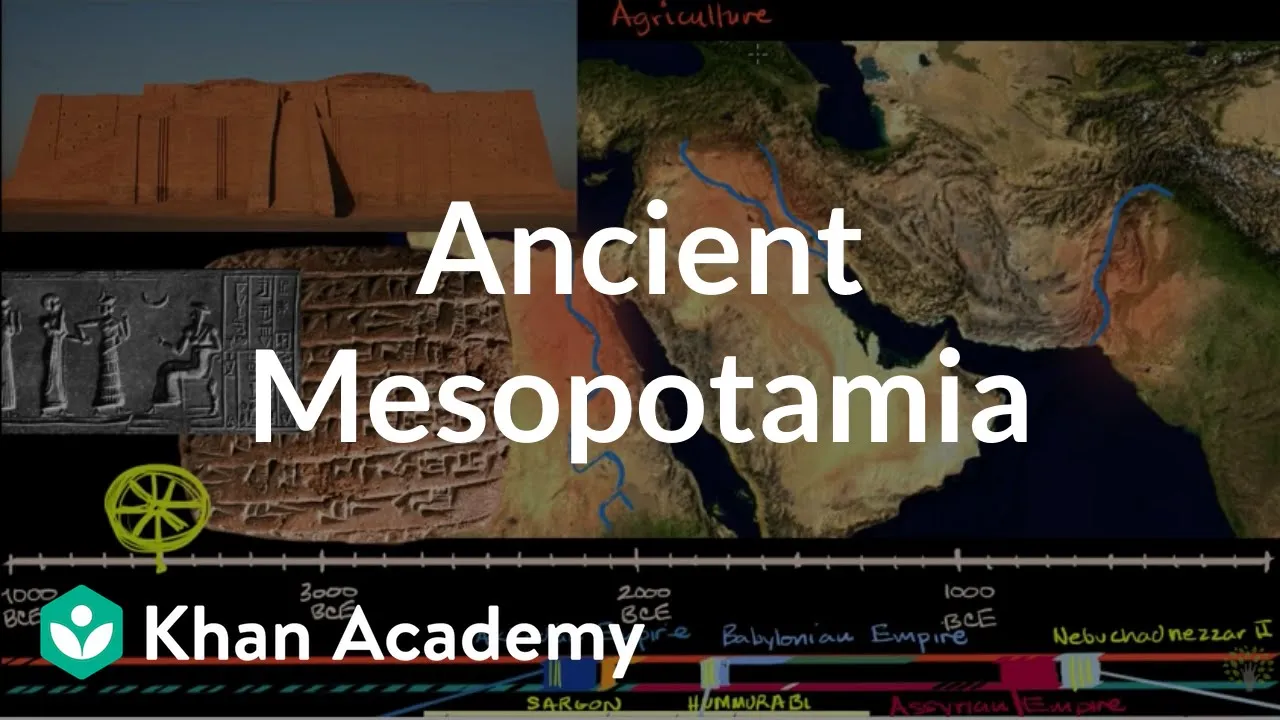
Somehow or other, by the time the sort of curtain comes up around 3500 B.C., in Mesopotamia you already have very elaborate credit systems.
Actually the very first document we have which talks about interest rates is a political document by a King [inaudible ] I believe his name is, a Sumerian King who's complaining about his neighbors like occupying a stretch of territory which is rightfully his and he says, "Well you know, they've been occupying this land for 20 years.
If we calculate the rent we would have charged them had they been renting this same land and then add a compounded interest rate, I calculate that they would actually owe us 13 trillion shekels or whatever, [chuckles] some insanely sum that no one could possibly pay.
Obviously this means war.
[chuckles] So you've already got compounded interest rates and so forth going on in the very, very first records that we have people have expense accounts, bar tabs.
It seems like almost all everyday transactions are on credit.
And the evidence for that is scales, because they were denominating debts in silver but they didn't actually make scales accurate enough to weigh out the tiny amounts of silver that would have been required to buy like a shirt or a hammer or something like that in the marketplace.
I mean, they had the technology to do so they just didn't bother.
So clearly, people weren't actually using silver to buy this stuff they were running up a tab.
Alright, so you've got the Sumerian situation, but the same King you know what he does after he declared war on Legash or the rival place wins, and what does he do after that he declares a debt cancellation – [pause] for everybody in the kingdom because it seems that the problem when you have these credit systems, money is basically in a set of IOU's, denominated in silver unless you're merchants dealing with large transactions rarely actually changes hands.
The problem is in bad years people fall into debt – [pause] because also the silver and grain are fixed in relation to each other; that's what money actually is but that a pretty problem if you, if there's a bad harvest, the price doesn't go up.
You're stuck, the farmers fall terribly into debt.
As a result people start taking away their flocks, taking away their fields, taking away members of their family.
Debt peonage becomes a huge phenomena, they start running away joining nomad bands outside the city, society seems to be breaking down so kings will normally come in and sort of declare a clean slate.
"Alright, commercial debts can stay on the books usually but consumer debt, we'll wipe them out and start over again."
This becomes a habit and become systematized in the Biblical Jubilee every 7 to 49 years depending on your reading.
Debts are wiped out; everybody gets to go home.
In fact the first recorded word for freedom in any human language is the Sumerian word "amargi" which literally means return to mother because that's what happens.
They declare debt cancellation, all the debt peons get to go home.
[pause] So, this virtual money systems comes first which is always very entertaining because people have this tendency to write about virtual money as a new phenomena; we're in this brave new world.
Actually it's the original form of money.
Coins come later.
Barter, incidentally, tends to only really show up when you have people who are used to using money but actually can't get their hands on any.
So you do have documented places where people do say, "I'll give you 20 chickens for that cow," but in almost every case it's something like Russia in the 90's where the economy falls apart where the money supply vanishes and people are trying to carry on as if they had money without money.
Or in a prison, they turn cigarettes into money because they're all used to using money.
[pause] Now, here's the interesting thing: coins are invented nearly simultaneously, it happens first in Lydian in the Eastern Mediterranean, but shortly thereafter at least in broad historical terms it happens in the Ganges Plain in Northern India and in the plains of Northern China, Ganges Valley, I'm sorry.
And -- [pause] in every case there were different physical techniques; in one case stamped, in one case cast, but – [pause] social situation seems to be the same which is that money, in the physical sense, currency, is actually invented to pay soldiers.
And it makes perfect sense if you think about it because gold and silver are what money's denominated with and you can use it for exchange but it just isn't usually done.
But soldiers are exactly the sort of people who are most likely to be doing this, first of all from the perspective of a soldier, gold and silver has a huge advantage over a credit arrangement because you can't actually steal a credit arrangement; you can't run off with it.
On the other hand, gold and silver it's kind of your equivalent of the suitcase full of hundred dollar bills and nobody knows where it's from, nobody asks, anybody'll take it.
So for soldiers that's very nice, you can also melt it down whatever, divide it up into small portions.
So soldiers are likely to be carrying around loot.
And second of all, if you have elaborate credit arrangements as the major way of transacting, well, a heavily armed guy who's just passing through is probably the person you'd least like to extend credit to if you can possibly avoid it, if he's carrying around little bits of gold and silver, well, good.
So cash markets insofar as they seem to first emerge will tend to emerge right around where ever armies are parked or where they have recently looted things and are trying to get rid of the little bits of gold and silver and acquire the wine, women, and song, and various other things that they like.
[pause] Governments very quickly get in on the deal and, in fact, one interesting thing is, by the Adam Smith account, if money just sort of emerges from the need to get over the inconveniences of barter, well it would be very hard to understand why governments demanded taxes in money.
It might seem self evident but the moment you think about it it isn't because if gold and silver are just money well why not just grab the gold and silver mines?
And in fact governments would do that.
I mean, ancient kings would normally grab the gold and silver mines and, in theory, you have all the gold and silver you want, you've got all the money.
Why would you then take the stuff, stamp your picture on it, give it to people, and say, "Okay, everybody in the kingdom has to give me one of these back again?"
Think about it, it's kind of odd.
But it makes perfect sense if you're trying to feed an army.
Here you have this army of 100,000 people, they're sittin' in a town on the border, well, how are you gonna get food to them?
Under ancient conditions unless they're next to the ocean where it's easy, relatively easy to move stuff around, it's extremely difficult to move around large amounts of grain, they're gonna eat everything within walking distance in a matter of weeks.
So what are you gonna do?
Either you have to employ another 100,000 people just bringing them stuff or you can give them all tiny little pieces of metal with your picture on it and say, "Okay, everybody in the kingdom has to give me one back."
Voila you've just employed your entire population getting soldiers things they want.
[laughter] And that's [chuckles] essentially what taxation systems have done throughout world history.
I mean, colonial empires did this very, very self consciously like in Madagascar where I was, first thing the French did they said, "Okay we've just conquered you, that was very expensive outfitting an army, you're going to have to pay us back for the cost of having conquered you.
We will issue paper money and you will have to give 10 of those back to us every year."
It was a way of creating a market.
Somehow or another you're gonna have, they actually called it the moralizing tax to teach people the value of work.
So money and taxes have been used throughout the centuries as ways of creating markets which is very interesting because we have this assumption that markets and governments and particularly war-making governments are opposed principles and that political choice for the last century or so has largely revolved around which one we're gonna slant to.
Are we gonna go more on the government side, more on the market side?
Those are the two sort of logical human possibilities.
Ever since people like Herbert Spencer early 19th century we've always assumed there's an opposition between these things, historically in fact no.
Markets tend to be created by governments as a side effect of military operations.
They sometimes take on a life of their own but the origins have very closely linked.
So to go back to these periods of history: so you have this first period of virtual money, coinage is invented around 600 B.C., Karl Jaspers, the German existential philosopher who coined the phrase, "the Axial Age" for this period and he pointed out that almost all major schools, both of world philosophy and the great world religions, crop up in a relatively short period of time.
If you extend it from 600 B.C. to 600 A.D.
it's exactly, it starts happening exactly the times and places where they invent coinage; uncanny.
It's even in the same city, it's in Greece, Miletus, which is a place where they, the first Greek city, where they're using coins in everyday transactions, is where they invent Greek philosophy at exactly the same time.
In China it happens, in India it happens, world religions arise.
World religions arise largely as peace movements against these empires that are using the coins and people have talked about Axial Ages as being characterized by a military coinage slavery complex, actually they say military coinage, but I'll throw in slavery because the chattel slavery which isn't a major institution either before or after, in Indian and Chinese history, for example, becomes really big in just in this little slice of time.
People take these standing armies, they pay them in cash.
Alexander's Army for example I think it took half a ton of silver a day to pay the army.
Where did they get the silver?
Well the armies would besiege cities, take lots of prisoners, enslave them, send to the mines, and they made more metal to feed the army again.
So, it became this giant cycle.
So, coins are actually found pretty much where armies are throughout the ancient world.
In Rome it was in Italy, I mean, 90 percent of all finds of Roman coins are in Italy and along the border where the armies were stationed.
Alright, so Axial Age you have this rise of world religions, they start as peace movements, there's this kind of mutual division of social territory in a way because before you don't really have impersonal markets, you have credit markets.
When you have impersonal markets based on cash the idea is well, it's almost like saying, "Well, here's a space where, well just think about material goods and getting as much of them for yourself as possible."
And it almost makes sense that if you do that someone else will also say, "Alright and here's a space we'll call it religion where we think about why material things are not important and why it's better to give than to receive," and charity and things like that always crop up as an idea that never really existed before as a conception in human history, exactly the same place as you get these impersonal markets as part of these religions.
So you get that but gradually the empires come to a crisis, they start crumbling, they adopt the world religions, Confucianism in China, Ashoka adopts Buddhism, Constantine goes for Christianity at exactly the moment the empire's starting to fall apart, doesn't really work, empires dissolve.
And you get the Middle Ages where once the armies, standing armies dissolve, all the gold and silver basically gets put back in churches and monasteries, people go back to credit systems and the world religions take over the regulation of these large, elaborate credit systems.
And so, for example, in the Middle East checks are invented and widely used.
Already in Basra around 800 or 900 people were reporting majority of transactions in the marketplace are by check.
Check is actually an Arab word meaning check.
[chuckles] [laughter] Yeah, I always like to point out to people when they talk about financial globalization as if this is somehow a new phenomena.
Like, think about the terms "cash" and "checks," cash or a check, like, check is an Arab word meaning check and cash, well, has a double etymology but one of them apparently is originally a Tamil for Chinese money.
How did that happen?
Alright, so you have this world where people are going back to use of credit and we say, "Oh, in the Middle Ages, the Europe reverted to barter."
Not true.
In fact, if you look at the records they're not bartering things they're actually using money but they're using money that doesn't physically exist.
So, they're still using Roman currency and denominating everything in Roman currency until Charlemagne and then they're using Carolingian currency.
But the Carolingian currency only actually exists for maybe 20 years and some of it doesn't exist at all.
It's like pounds, shillings, and pence originally come from Charlemagne's system.
He never actually made pounds, he never got around to it, but they were using it to measure things and they actually called this imaginary money.
So whatever the king was actually putting out that was one thing, but you had this sort of ideal system which spanned Europe, everybody knew what it was so you could trade and do it on the basis of this money that didn't actually exist.
And they even had a phenomena they used to call crying up or crying down the currency.
So a king could say, "Alright, whatever we're using right now, it used to be 17 of these pennies were a shilling; I'm gonna change it, now it'll be 13."
If he--, so he could inflate the currency if he was in debt or if he wanted to raise taxes he lowered it.
So, he just rearranged whatever the currency was being used which was only used for occasionally things because again most transactions were on credit in relation to, or they could recall it.
I mean, the king said, "Okay let's recall the money and I'll give it back again next year."
And commerce would not stop because everything was based on credit systems.
Similarly in China they invent paper money which originally comes out of the government taking credit instruments that people are using and adopting it themselves.
That's what they do in China anytime there's innovation first they try to suppress it and they say, "Okay, okay we'll do it for you."
So it's all privatized in the Islamic world and it becomes public in China.
Actually they are very opposite principles but – [pause] in Islam, in particular, in this period, you get the first real free market ideology.
And this is a fascinating thing I mean a lot of people will be very annoyed to learn this, but Adam Smith actually got most of his best ideas and best lines from medieval Islam.
Like the pin factory actually comes from al-Ghazali in 1100 he had a needle factory.
Okay.
And it's made possible by what?
By Sharia, because [chuckles] Sharia is civil law that operates outside the purview of state, and, as a result, you can have markets and since they get rid of usury, that's the other thing that happens, instead of debt cancellation, which has continued in China but in other places they, instead, just get rid of interest taking, it's illegal, debt peonage becomes illegal.
And so in Islam, since they don't have that, they can these markets that operate completely outside of the purview of the state and you could write a check in Mali and cash it in Indonesia and it's all civil courts that take care of it.
So it's the first time you really get an idea that markets run by themselves and don't really need governments.
But since they had a real free market which isn't enforced by the state, they don't assume it's all about competition, that's like a minor element.
The assumption is that it's all really an extension of mutual aid.
Alright, so be this as it may you get that world in the Middle Ages which looks surprisingly good, slavery largely disappears.
I mean it's kind of rough in Western Europe but Western Europe is kind of a barbarian backwater anyway.
[chuckles] Alright, so what happens?
Around 1450 it starts to go bad, then by 1492 you get the all this gold and silver coming in from America.
As you go back to gold and silver currency, slavery comes back in a big way, standing armies and giant empires come back in a big way.
And that's the period that's ending now; [pause] 1971 is the date that most people set for when we go off the gold standard and Nixon sort of takes the dollar off the gold standard as this sort of key point of transition.
And very rapidly after that you see a whole series of changes.
Of course, we get credit cards which hardly anybody's using in '71, very quickly taking over so that you had cashless transactions become the rule within a generation or two.
You have financialization of capital, most profits for American companies no longer come from making or selling anything, but largely from financial speculation.
You have credit's gonna save the world, microcredit will save the Third World, 401k's and mortgages, all that stuff that blows up in 2008.
And the question is why?
Why it seems to have gone so horribly wrong?
Because we have a series of terrible debt crises, first the Third World debt crisis, now the debt crisis that's hitting everybody other than the Third World right now -- [pause] have happened ever since.
And the reason, I would say, is because in a way we're doing things backwards.
If we do look at this in broad historical perspective what we learn is that whenever you have a system of virtual money where people don't assume that money is a thing but assume it's a promise, it's an IOU, it's a social arrangement such as in ancient Mesopotamia, such as in the Middle Ages, well, you have to set up some sort of mechanism to make sure the thing doesn't go crazy.
Usually that means, invariably that means, setting up some mechanism to protect debtors.
So you could have periodic debt cancellation, you can have anti-usury laws where interest taking is banned entirely and instead you have profit sharing, there's a number of things you can do.
Usually it's some giant overarching, cosmological system beyond the purview of any state, whether it's sacred kings or biblical prophets, or the world religions, canon law, Sharia.
Be it as it may it has to be something big.
Now we do set up giant, overarching institutions like that nowadays but what do we do?
We set up the IMF to protect creditors against debtors.
Basically, we did it backwards.
S&P all these other institutions like that they come up with this idea that nobody should ever default which is absurd.
And sure enough we have endless series of debt crises.
In fact, I like to say I mean when I'm being provocative, which is often, I like to say that that sort of idea that people had in most of world history of the worse case scenarios everybody falls so deeply into debt that they start having to sell themselves into slavery.
It's like nightmare scenario, this is what we always wanna prevent and that's why we have all these laws.
Well, you know if Aristotle were here today he would probably think that the distinction between being so indebted that you are selling yourself to work for others all day long, 12 hours a day, or being so indebted that you are renting yourself to work for others all day long, 12 hours a day, as something of a legalistic distinction.
He would think this is it, this is the nightmare debt trap and most people in the world are falling into it.
But if you look at this in broad historical terms, you'll also see that 30 years or 40 years is nothing; we're talking about 500 year cycles here, and people are beginning to wake up to this.
We still have time to get it right.
And I think the social movements that are coming out since 2008 around issues of debt are precisely recognizing that.
If we're moving into a period of virtual money, money is just a promise that we make to each other, it's just a set of IOU's and social arraignments, arrangements; those can always be rearranged.
Make a promise to someone, circumstances change, you negotiate and the big players always do that with each other as we've discovered in 2008 when trillions of dollars of debt was made to disappear by the waving of various types of magical wands.
[chuckles] [laughter] So what people are saying is if democracy is to mean anything now it means that everybody gets to weigh in on what sort of promises are made, what sort of promises are kept, and when circumstances change what sort are renegotiated and I think that's the political moment that we're in right now.
[pause] [applause] [pause] Ah, a question, yes.
>>Male #1: So when this, I have to say it's fascinating and along the same lines, in this era if you have currency with runaway debt explosions what, if I can ask you to speculate, what do you think would be a good way to look at, what would be a good rate of risk, what would be a good pre-rate of return on investment as an adjustment to?
>>David Graeber: Risk free rate of return, go on.
>>Male #1: If we had a fair society -- >>David Graeber: Um-hum.
>>Male #1: if you could define a fair society by edict -- >>David Graeber: Okay, I'm now the dictator.
>>Male #1: how, we used to have, you say we used to have jubilees and cancel debts -- >>David Graeber: Um-hum.
>>Male #1: so short of having a jubilee, debt is a strange thing, somebody mentioned exactly if you have idle grain and it gets eaten by rodents and slowly diminished and rots -- >>David Graeber: Um-hum.
>>Male #1: but debt is funny because it accumulates over time rather than -- >>David Graeber: Yeah, um-hum.
>>Male #1: diminishing over time.
Would you argue for us having a negative free rate of return on investment?
>>David Graeber: I would argue actually -- >>Male #2: David, could you please repeat the question?
>>David Graeber: The question, what's that?
>>Male #3: [unintelligible] >>David Graeber: Oh I understand, yes.
So the question is if I could dictate my own economic policy what sort of rate of return would I dictate?
A negative one such as occurred through natural spoilage equivalent rather than imposing an idea that money necessarily has to grow.
That's an interesting question.
I mean it's interesting that our entire sort of perspective on what money should do and has to do goes back to arguments about this in the Middle Ages.
Since usury was illegal the way they got around it was to come up with the notion of interest which was originally a late fee.
So the idea is you're not paying interest, you're not renting money which is wrong, you're just charging people for failure to return it on the basis of the idea that money would grow because this is all between merchants at first, if you were investing it.
So you can ask for five percent rate of return because money would normally, you'd get about a five percent investment rate.
And that five percent number has kind of stuck with us, in a way, because it's about the number that like any economy is expected it really ought to grow, if it doesn't there's a problem.
And it's interesting it is exactly the amount of the originally stipulated rate of return.
And there were usury laws until quite recent, I guess 1980 they actually got rid of them, which held it down to a fairly reasonable rate or what was considered so at the time.
I mean, myself, I actually do think a Jubilee would be reasonable [chuckles] so in a way I would jump forward from this.
I end the book by throwing that out and I'm a radical so I'm not gonna be like stipulating rates of return.
I'm gonna say like we just need to wipe the slate clean conceptually altogether and come up with a new way of thinking about the system.
So I think a Jubilee is useful as an idea because it, not only would it be nice because a lot of people could really us debt forgiveness right now, a lot of the big players got it and everybody else didn't.
But because it would allow us to reconceptualize what we're doing here and realize that money isn't what we thought it was.
So what kind of system we'd come up with in the wake of that, I've got a lot of ideas but I wanna leave that as open as possible so I just sort of ended the book by saying rather than come up with a plan like that, we just sort of create this sort of cataclysmic event which will sort of allow us to start asking those questions.
I've heard recently, I didn't know this, somebody told me that the Boston Consulting Group which is guess if Jeffrey Sachs' people, ran a model to see what would happen if they actually did a Jubilee.
And they said that it would cause severe economic disruption but rather less than you would get if you don't have a Jubilee.
[chuckles] [laughter] So either way we're screwed but you'd be a little less screwed if we did it that way.
So it turns out that it might not be a bad idea.
I mean I think that we should start thinking about completely radically different forms of money entirely.
Interest free systems would be possible.
The reason why things like Islamic banking don't work is because not everybody's doing it.
If you force people to do profit sharing rather than interest taking, if everybody did it, it would work.
[pause] >>Male #3: One, two, three.
Is money [unintelligible] amount to the debt we're seeing today, governmentally and personally in America and how it's all over the globe at sometime [unintelligible]?
>>David Graeber: Yeah it's really odd because -- >>Male #4: Could you repeat the question?
>>David Graeber: Yeah, okay me repeat the question: is there any precedent for the sheer amount of debt?
I would say probably not but I mean unless you wanna count the South Sea bubble or something like that.
You do have these speculative crises that crop up periodically, but the mystery is just how many people owe things to each other and you have to start asking yourself, "Well, who's it all owed to?
Everybody seems to be in debt, this is sort of puzzling in a way."
And I would say, no, and one reason why is because there seems to be this feeling since the 70's that basically all social problems can be solved through debt.
One theory I saw, which is kind of interesting, it's the autonomist reading, Midnight Notes Collective, it's a group of Italian autonomist Marxists.
But they had this very interesting reading of the two phases of post-war capitalism.
What they basically said is that after World War II they kinda gave a deal to the North Atlantic white working class and they said, "Okay, if you guys don't become commies we'll give you free education, free health care in most places anyway, we'll give you social benefits of various kinds."
And social struggles between 1945 and 1975 where more and more people asking in on the deal.
And there is a tie between productivity and wages.
So whenever, and the lines go up together, increases of productivity are met with increases of wages.
Since the 70's the deal is clearly off and one reason is because they reached kind of crisis of inclusion that you can't actually give that deal to everybody without fundamentally changing the nature of the system.
So first minorities, so you have the Civil Rights Movement, other people who've been left out of the deal want in, people in the Global South want in, women want in, feminist movement.
It reaches a point where it just sort of snaps and you have this fiscal crisis, oil crunch, ecological crisis and they say, "Alright, deal off, we'll give you another deal.
No longer will wages be connected with productivity, you can all have political rights because political rights don't necessarily give you any economic benefits, but you can have credit."
So the credit solves everything, everybody's being, that's why you have microcredit saves the Third World, why you have 401k's and mortgages and there's this huge extension of credit.
And you could say the same thing happened, right?
More and more people want in on the deal and more and more people are getting credit to the point where people they're just doing these crazy sub-prime scams and things like that are beginning to run the system.
And when it cracks it looks almost exactly the same, you get the oil shock, you get the financial crisis, you get the visions of ecological catastrophe.
It's the same thing all over again except at this point it's not clear what they're [chuckles] gonna come up with next.
So, in that sense, yeah, you have this unprecedented series of bubbles, built on bubbles, built on bubbles.
And I'm speaking as someone who's working the Global Justice Movement and we were like doing our studies for the G20 as part of like several intellectual collectives where they kind of, the activists kind of told us, "Alright, well, they're all meeting to come up with their evil plan and tell us what their evil plan is likely to do so we can oppose it."
And so we figure it and I guess they're gonna have to do green capitalism, declare an emergency, we had various ideas for what would be a viable solution.
And they kept not doing it; they just fight each other.
In fact one of the reasons why the Global Justice Movement fell into such a problem is, like, at least in 2000 we knew what their evil plan was [laughs] and we could oppose it.
And now they don't seem to be able to come up with one, we had better ideas for their evil plan than they did.
[chuckles] So we were sitting around and saying, "Well, come on guys come up with your formula and we can fight you."
And they wouldn't so they were sort of stuck on this credit like bubble system that fell apart and they haven't quite come up with what they're gonna do next.
So I'm waitin'.
[laughter] [pause] >>Male #4: So taking the other side of the coin [unintelligible] extra help why should anybody pay their debt at all?
>>David Graeber: Why should anybody pay debt at all?
Well, I mean you could say the same question of all those guys who were bailed out, the bankers, I mean, moral hazard works on both sides.
[pause] >>Male #4: Well, I mean, it's the same case.
>>David Graeber: Yeah, I mean -- >>Male #4: I don't think that they should have been helped either.
>>David Graeber: Hum.
Yeah I know a lot of people think that but it's interesting that they got helped because as a lot of people point out all this mortgage debt if they just paid off the mortgages that would have bailed out the banks in itself, but they chose to give it to the banks and not to the mortgage holders.
And this is a pattern that you do see throughout world history is that debt means something totally different; depends on who it's between.
When you have debt between two poor people like somebody wants to make a loan to their brother, it's usually because they wanna give them a gift but they don't wanna say that, save face, say it's a loan.
If he can pay you back, he will.
Between equals, between people who know and like and trust each other, debt is just a broad moral feeling that you should come through for somebody.
And between the big players it's the same, too.
I mean you see this all throughout history.
Like, even the earliest Sumerian documents you have people saying, "Oh well of course you're not gonna charge me interest because we're both gentlemen," this sort of thing.
And when the big players are in trouble, debt can always be renegotiated, too.
What seems to be sacred or treated as if it were sacred is not debts between equals but debts between the people on top and the people on the bottom because all of a sudden it takes on a completely different color.
So, yeah, I suppose you could come up with a morality saying like, "Even equals should treat debt as exact [ inaudible ] quantifiable and unforgivable."
But it seems that you're not going to convince people who actually like each other to not forgive each other when they're in trouble.
Instead it seems more reasonable to expect everybody to do it, apply that uniformly rather because that philosophy of debt as something that can never be forgiven, as something that is sacred, really only crops up in situations of sort of structural coercion of extreme inequality.
[pause] >>Male #5: How much of our sense of debt is biological, how much of it is from society and how much of it is regulatory?
>>David Graeber: Okay, so the question is how much of our sense of debt is biological and how much of it is from society and how much is regulatory.
By regulatory you mean just sort of imposed by -- >>Male #5: In order to make everything work right.
>>David Graeber: Right, I see.
Well I mean in terms of biological, my argument in terms of biological instincts is it's not like they don't exist, clearly they do.
I think it's pretty naive when people say, "Oh we're just Tabula Rasa," written on by society.
No, we're not, we have all sorts of urges, but that I would emphasize the all sorts.
Generally speaking in any situation we have biological drives like making us do a thousand different contradictory things.
So freedom is deciding which one to act on.
In the book, I sort of map out three different sort of ways of thinking about the morality of giving and taking of things, one of which I call communism from each according to their ability to each according to their needs; one of which I call exchange; and one of which I call hierarchy.
Exchange is based on principles of reciprocity, but hierarchy is based not, on the opposite.
It's like if you do something you're expected to do it again.
And all of these things are operative at any moment and you could, like, call, and usually what you're doing is kind of a mix of these different types of principles.
So biologically and even that kind of fundamental sociality, yeah, there is a degree to which you're always gonna be able to think of things in terms of debt, but it's never the only way.
So you're always playing around with all these sort of different ways you could frame it.
And in terms of regulation – [pause] well, what's interesting is when you try to justify things in the big picture very often that's when you fall back on language of debt and reciprocity.
You see this all the time dealing with feudal lords in the Middles Ages.
If you give somebody a gift you're expected to do the same thing again next year.
In fact you need a special document, like, if I give a gift to a king I have to make him sign a paper saying I don't have to do that next year because anything you do between unequals the precedent, you have to do it again.
However, then when they wanna talk about what is justice, why is our society just, they'll say, "Well it's all reciprocity, lords fight for everyone and priests pray for everyone and peasants make food for everyone and it's all this sort of equal swap."
It's a completely, it has nothing to do with the way things actually operate on the ground.
Somebody might call this a sort of like overall social regulatory or justification level where people are saying, nobody actually says, "Well, you haven't really been fighting for me very much this year so I'm gonna give you less food" [chuckles] or "You're prayer level is down or you've been praying more so we're gonna give you more."
It's nothing to do with the way people actually interact but they like to think of this idea of debt and reciprocity as a language to justify social relations that often operate on completely different principles.
[pause] Uh, yes.
>>Male #6: I live in San Francisco and there's 14,000 people since 2008 who have either had their houses foreclosed or are in the process -- >>David Graeber: Um-hum.
>>Male #6: as a [unintelligible] houses [unintelligible] mortgages paid.
>>David Graeber: Um-hum.
>>Male #6: and in Northern California.
Are there historical precedents or what would it look like to build a movement for a Jubilee to relieve our debt instead of bankers?
>>David Graeber: Well there's a huge history of that.
Peter Linebaugh has -- >>Male #7: Could you repeat the question?
>>David Graeber: Oh I'm sorry, the question is, there's massive foreclosures going on here in California including San Francisco, people are being kicked out of their homes by banks that have themselves been bailed out by the public including those people who've been kicked out from their homes and what would it take to create a mass movement?
Are there historical precedents for that?
The answer is yeah.
As I say the vast majority of social movements that have existed in history have been about debt.
There have been debt strikes, there have been seizing and destroying the records which of course electronically is now harder to do.
In the Depression there was a systematic policy of disrupting sales when they'd foreclose on farms all the farmers in the neighborhood would show up at the auction with guns and somebody would bid one dollar [chuckles] and no dared to say anything else and they'd give it back to the farmer again.
So there is a [chuckles] huge amount of precedent for that sort thing, but you can never do it the same way twice.
The problem with organizing debtors politically is that debt is very alienating; it's must easier to organize people when you have a bunch of farmers in a neighborhood they know each other.
But what we have now is most people who have student loan debt, mortgage debt, don't actually know people in the same situation or people are even ashamed to admit it.
There's really no forum in which people can compare notes and come up with common strategies.
So one strategy that people have been using has been some sort of pledge, some people are doing a student loan project where they're saying, "Alright, if we get a million signatures we'll all stop paying simultaneously."
But it has to be something like that because it's very, very difficult to build, you're taking such a risk when you default or when you threaten to.
You're taking such a risk that it's very difficult to do that based on trust of other people you don't know.
[pause] So that's the question how you organize people to be and what to do.
Um -- >>Male presenter: commentator: Let's take one more question and then we have stuff to do.
>>David Graeber: Okay you can decide who then.
[laughter] >>Female #1: Is there [unintelligible] how debt is handled for those who are [unintelligible] and those who are not such parents and children, such as very traditionally men and women?
>>David Graeber: Okay, the question is in traditional societies or other societies are their differences between how debt is handled in the paid labor force and unpaid relations like -- >>Female #1: Like the debt between those two groups.
>>David Graeber: Debts, oh, oh, how debt between.
So you're talking, give me an example.
>>Female #1: What children owe their parents -- >>David Graeber: Which I thought you meant that.
>>Female #1: or before you could only work inside the home you couldn't really [unintelligible] go outside of that [unintelligible].
>>David Graeber: Right so how do you deal with the relationship between, right, debts between people within a household or where there's a community of property between you and outsiders?
It's an interesting question because, in fact, it's a perfect example of what I was talking about how we try to frame everything in terms of exchange or some need to do so, even things that don't work that way at all.
And the other point that I was making about how we try to frame things morally in terms of debt.
'Cause you'll often find people saying, "Well, this is how we repay our parents for the pains of childbirth and what they do."
But in almost every case it's a metaphor, it has nothing to do with how people actually related to each other.
So often when you see how people are actually interacting it's on a principle that has nothing to do with debt, you're not calculating equivalents at all.
But then when you want to think about it in a bigger picture, suddenly you're trying to figure out some way to say it's all about debt.
So I actually use this story about this famous Canadian naturalist whose father presented him with a bill for everything he owed him up to the age of 21.
He said, "Okay, here's how much it cost to pay the doctor to deliver you, here's your primary education."
He had it all worked out and he gave him the bill and the guy paid it and said, "Fine, the hell with you, I'm never going to speak to you again," and walked off.
But that's what it basically means because when you're paying a debt it implies we need have no further relations.
So the idea of actually paying a debt between people that you love is utterly insulting; you'd only do it if you really wanna have nothing further to do with each other.
But nonetheless people like to frame it in those terms.
One of the most fascinating concepts I discovered when researching this was the notion of the milk debt.
This is a medieval Chinese Buddhist concept.
What they did was they calculated what they thought was the exact number of pecks of milk you absorb from your mother [chuckles] in the first years of your life and that's a fundamental debt you owe to your mother and said, "Okay, you owe exactly 37 pecks of milk."
But then they would say, "Alright, to pay back even like one day's worth of milk would in fact take 400,000 years of feeding her off your own personal flesh.
[laughs] I mean so it was a way of saying, "You could not conceivably pay this debt."
So why are they calculating as a debt at all?
It's again that same tension if you wanna frame debt as morality and they say they're the same thing, but as soon as you do you say, "Except not really, it's completely ridiculous isn't it?"
So that tension like the need to pretend that it's a debt but then once you say it, like, it's actually not a debt at all.
It's absurd to even think of a debt, why are we saying this, recurs over and over and over again.
And it's because commerce gives us this idea that we wanna frame everything in commercial terms, that we really ought to, that we start doing that and then we say, "No, actually, we can't."
[pause] >>Male Presenter: Let's thank David.
[applause]
Up Next

4:11
Understanding the Potlatch Ceremony | Indigenous Cultural Teachings
@culturallycommitted
14.5K views•2021-02-12

26:41
Sensory Ethnography Explained by Sarah Pink | Research Methods
@NCRMUK
26.1K views•2015-03-27
4:45
Proxemics Explained: The Study of Personal Space
@Vox
536K views•2016-07-05

10:38
Psychology of Internet Trolling and Pranks Explained
@AzzyLand
10.7M views•2017-12-20
Related Study Plans & Knowledge Roadmaps
Structured learning paths in Anthropology
anthropology
Sensory Anthropology (Culture & Perception)
01Foundations of Sensory Anthropology
02Soundscapes and Acoustic Ecology
03Smellscapes and the Anthropology of Odor
+ 3 more learning modules
14h6 modules
Explore Roadmap
anthropology
Space Anthropology: Analogs, Culture & Habitats
01Foundations of Space Anthropology & Cosmic Imaginaries
02Extreme Isolation & Micro-Societies in Orbit
03Space Analog Habitats & Earth-Based Simulations
+ 2 more learning modules
15h5 modules
Explore Roadmap
anthropology
Legal Anthropology: Customary Law & Pluralism
01Foundations of Legal Anthropology and Social Justice
02Legal Pluralism: Coexisting Legal Systems
03Customary Law and Indigenous Dispute Resolution
+ 2 more learning modules
15h5 modules
Explore Roadmap
anthropology
Global Tourism: Gaze, Authenticity & Heritage
01Introduction to the Sociology of Tourism
02The 'Tourist Gaze' (John Urry)
03Staged Authenticity in Tourism
+ 3 more learning modules
14h6 modules
Explore Roadmap