




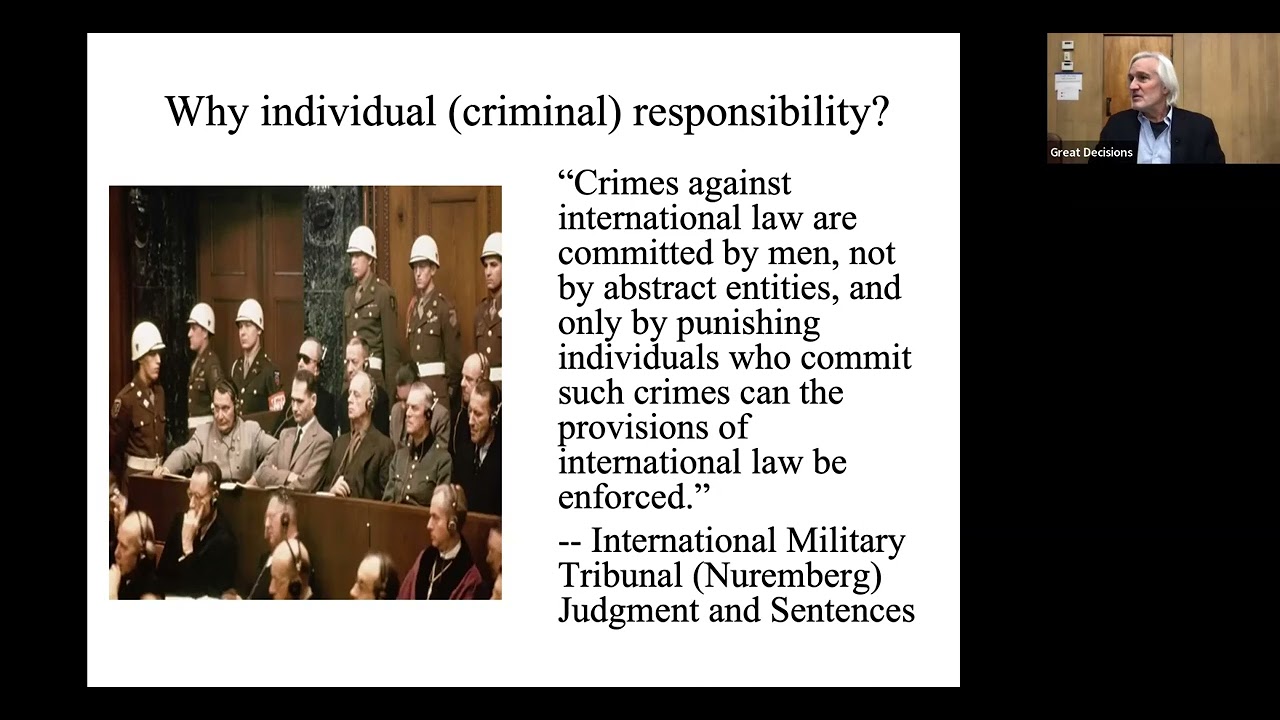













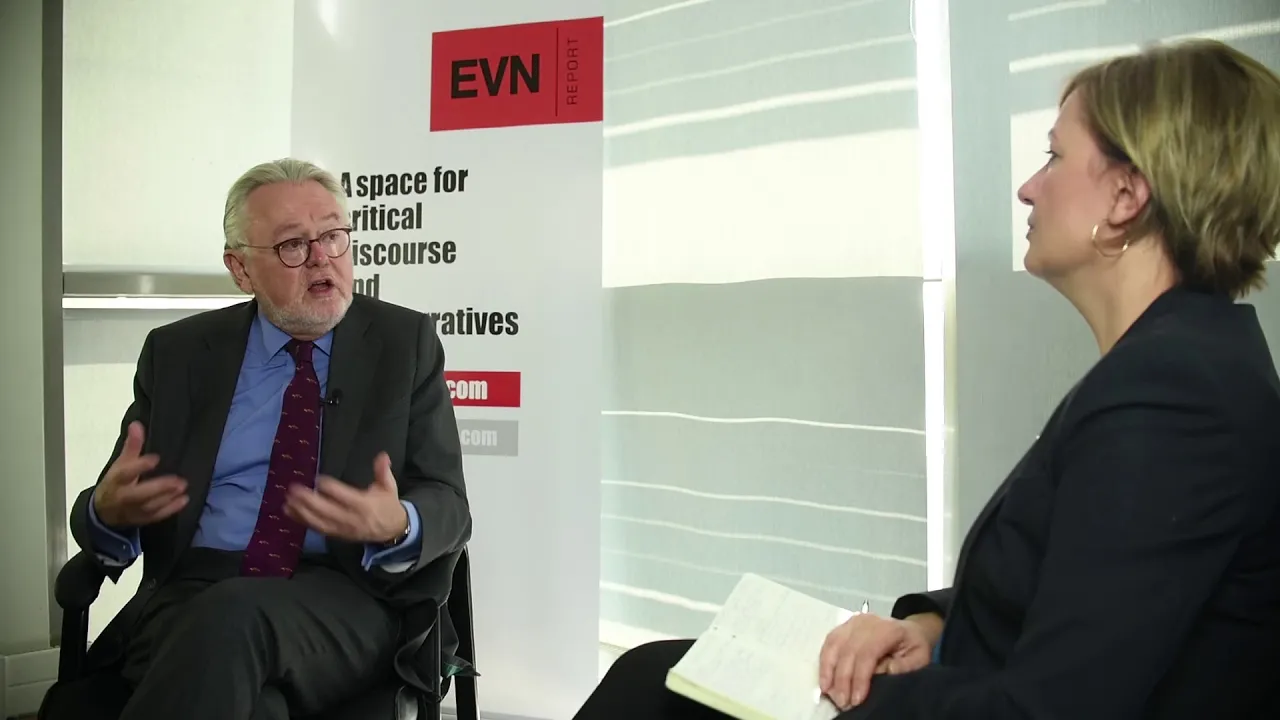


International criminal tribunals, including ad hoc courts for Yugoslavia and Rwanda, hybrid tribunals for Lebanon, East Timor, Sierra Leone, and Cambodia, and the permanent International Criminal Court, face significant challenges in achieving justice due to political constraints, selective prosecution, and the inherent limitations of international law, which remains distant from ordinary citizens compared to national legal systems.
International Criminal Tribunals Explained by Sir Geoffrey Nice QC
Added:Basic principles of international law, including the concepts of state sovereignty, treaties, and the distinction between national and international jurisdictions.
The historical context and outcomes of the post-WWII Nuremberg and Tokyo Trials, which laid the foundational jurisprudence for modern international criminal law.
The definitions and legal distinctions of the core international crimes: genocide, crimes against humanity, war crimes, and the crime of aggression.
The organizational structure of the United Nations, specifically the role and powers of the UN Security Council in relation to international peace and security.
The principle of complementarity and how the International Criminal Court (ICC) interacts with, and defers to, national judicial systems.
Critical geopolitical analyses of international justice, focusing on debates surrounding 'victor's justice' and the political pressures exerted by global superpowers.
Detailed case studies of specific ad hoc tribunals, such as the International Criminal Tribunal for the former Yugoslavia (ICTY) and the International Criminal Tribunal for Rwanda (ICTR).
The study of transitional justice mechanisms, including the role of Truth and Reconciliation Commissions (TRCs) and restorative justice in post-conflict societal healing.
12.7K views93likes57:40Original Release: 2012-09-19
gram College presents international criminal tribunals by Sir Jeffrey nice QC gesan professor of law war crimes courts established over the last 20 years have had one quite remarkable success The Ordinary World citizen contemplating someone who may have committed crimes in in war will say send him or occasionally her to the hag something he or she could never have done 21 years ago even when the world citizen says that he has in mind probably one of three types of tribunals there are the two ad hoc oneoff trib established for the conflicts in Yugoslavia and Rwanda by the United Nations there are other ad hoc but hybrid tribunals which combine local lawyers and judges and international lawyers and judges typically held in the country of the conflict that deal with Lebanon East te War sier Leone and Cambodia and then there is the international criminal court permanent Court established not by the UN but by States parties whatever it is 121 of them um and having permanent jurisdiction but of a somewhat qualified type the trials these tribunals run resemble National trials in many ways and the world citizen might think that they are part of and reflect a coherent comprehensive International crime and justice system nothing could be further from the truth a national Jud judicial system is of course very familiar to the citizen of the nation concerned he understands the law he understands the procedure on a daily basis he reads about it and you will be surprised if you open your newspaper whatever newspaper it is to see how much time is spent pressing on the law to see that it's behaving that judges are behaving that sentencing is right that the law does or doesn't need changing and the ordinary National citizen can contribute to that by his vote by becoming a legislator or simply by reading and having his views expressed in the media uh television or or newspaper he has in the modern vernacular ownership of the law and the legal system by which his day-to-day conduct is regulated he has no such proprietary rights over the international law under which he may live or die now World War II showed us by the atomic bomb and by the Holocaust both that we have the power to destroy ourselves and of course that we have the power to get ourselves and each other to do the most terrible things and so perhaps a period of time considering the international criminal law is Justified differences between National systems such as the one with which you're familiar and international systems may be quite informative let's approach it in stages first of all how do you select a crime or an international crime for treatment given that of course the citizen of our country knows that if he commits a crime or if a crime is committed against him it can be investigated and disposed of this year next decade or probably until the end of the lives of the people to whom the crime relates it's with him the legal system forever and there is no real selection I started preparation but have not completed um a chart that covers and this is just you won't be able to read the detail that covers conflicts where at least a thousand people were killed starting in 1900 so that we can see something about whether such conflicts have been selected for for trial or for truth commissions or for some other process and it's enough if I just run through 1899 the B War you'll see the columns no and no meaning nothing was done nothing was done and you move on to 1904 through to 1909 again almost nothing was done um and then you come eventually to The Armenian Genocide something was done and then to World War I let me uh come back to him in a second and then deal with World War I because it like World War II was a natural candidate for selection of some kind of inquiry or some kind of prosecution you may think there were other conflicts that simply couldn't be missed Cambodia because of the number killed an obvious candidate although it took some time to happen what about Rwanda well of course Rwanda was also a hugely serious terrible Massacre but many people particularly at the time said the only reason it was selected for treatment along with the Yugoslav conflict was because the UN had guilt about its failings and because neither of these countries had patrons strong enough to stop them being investigated the president process of selection of conflicts for treatment is a curious one you may hear it said and correctly that the African cases the Democratic Republic of the Congo Uganda uh and even Kenya far from being selected by someone else to be dealt with at the international criminal court the new court actually selected themselves they referred themselves to an extent that's true but people knowing of these things may also say to you the reason the country selected a trial for their conflict was in order to have the opposition tried turned into the international Pariah and for them to remain in the clear in short and completely differently from anything that would ever happen in a national system the alleged victims and they may be victims and in the modern terminology instrumentalized the court to which they referred their own conflict so that's some of the problems of positive selection what about negative selection the conflicts that are not selected well nobody was going to have the courage to challenge Stalin even after his death over the millions killed between the first and second World War war and since the Korean war no one has had the courage actually to deal with the gross violations committed by North Korea something to do with the neighbors North Korea has and what about Burma of course the generals have eased up a bit and as anui has been allowed a world tour with maximum publicity has this led to an increased interest in looking at the very grave offenses apparently committed in Burma sorry no the neighbors are a bit too strong the minerals are a bit too rich and Burma is one of those countries that perhaps it's a good idea not to investigate there are other examples what about the Russian inv the Russian invasion of Georgia Afghanistan Iraq all conflicts which should now or could now be subject to consideration by the permanent international criminal court but they're not something to do with the parties involved you might think and here's the slide that I took you to a bit too quickly but it's worth remembering Robin Cook when foreign secretary observed the international criminal court was not a court set up to bring to book Prime Ministers of the United Kingdom or presidents of the United States that Court incidentally suffers one other IR remediable defect that's particularly apparent in the selection of conflicts that it may or may not investigate the 121 signed up members do not include Russia China or the United States three of the permanent five members of the security Council and the security Council can refer non-members countries that have not ratified this treaty to the court that they disdain some find that quite extraordinary but the result is that there are in truth four levels of international Justice operating through the court countries like us compliant ratified completely under its jurisdiction countries like well the three countries America Russia China who will never refer themselves to the court completely free unless they get caught in Iraq or something like that or Afghanistan then there's the third band of countries like Sudan Libya who are not ratified members of the court but America China Russia might choose to refer to the court as they have done and the fourth category um is Israel it's in the same technical category as Sudan or or Libya but it is of course protected by a patron on the security Council who will never see it being referred does this mean that that Court will eventually fade away and die I don't know but you can see that there's a problem facing it well let's return here what should we call it to liliput where we all are how would you feel living in a society if you knew that this conflict this crime was going to be committed because it's in in that City but not if it's done in that City London yes Manchester no what confidence would that give you in your society and what confidence does this problem that I have just explained give you in the international criminal justice system but you may all say understandably political choice of which conflicts to investigate is inevitable the world simply cannot try them all so once a a conflict has been selected for investigation how is it then dealt with on the record to date and let's start with the analogy how would you feel let's take the riots in peka if you live nearby how would you feel if you knew that the riots were going to be investigated but only so far as as the capulets were concerned the montagues were never going to be pursued even if they ran up and down your streets in paramilitary uniforms I'm not sure that would give you a great sense of confidence and how does that analogy work for the world system well let us move rapidly to the first world war the first world war there was an appetite to try leaders Armenian leaders were the subject of uh Pursuit and there was a plan to try the Kaiser for Supreme offenses against International morality and the sanctity of um inter sorry Sol International uh morality and the sanctity of treaties but he was uh uh in Holland and queen Willamina would not allow him to be extradited the same uh vers treaty article 228 allowed there to be Trials of individual soldiers we'll see what happened about that although um some sought to have the Kaiser extradited US President Wilson rejected the idea arguing that punishing him for Waging War would dest iiz order and lose the peace and right then you see the problem facing International trials for crimes of war the issue of political leadership the issue of the sanctity of a sanctuary and most important the political risks associated with criminal trials that might outweigh the advantages of an amnesty or of a criminal trial and yet trying to keep things in order how interesting might it have been for the Kaiser to be tried here is one of the things he said in a letter to the Austrian Kaiser at the beginning of the war taking it the highlighted passages but never mind everything must be put to Fire and sword men women and children and old men must be slaughtered with these methods of terrorism the war will be over in 2 months whereas if I admit considerations of humanity it will be prolonged for years now that deals with his mental state lawyer's Latin men's rare something that has to be dealt with in every criminal case had he been tried and had this articulated mental state being found to provide him with no defense how would President Truman have felt when he was about to drop the atomic bomb or Winston Churchill when about to approve of Dres rapidly the other war criminals tried after the first world war were rather Limited in number there they are sentences few months two years two people for four years and many acquittal that was it and so far as the Allied and Associated forces were concerned I've been unable even to find I'm not saying there aren't any a record of Allied soldiers being court marshaled for crimes that were the equivalent of war crimes um and indeed mistreatment of German prisoners in World War I is still only written about as if it's something of a novelty we know of course um sadly that the Allied Forces were comparatively willing to execute their own side for desertion and matters of that sort but as to being tried for other offenses so far I've found no evidence of it well now tribunals established after World War II in Germany and Japan described often enough as Victor's Justice reflected National systems as far as they could but they also manifested the intent that you saw in the Treaty of versil they were only ever going to try one side the Germans or the Japanese and the trials were extremely unusual in one sense only try a few people at the top of the tree the tribunals only continued for a limited period of time there may be an explanation for that in the changing politics of the uh Cold War but in fact only for a short period of time and most important no tribunal set up to look at the war overall to try all sides there were some Court Marshals after the second world war for mistreatment of uh Germans and I not sure about Japanese but I suppose the problem arises and the question has to be asked will we all future Generations find that we will have to face uncomfortable discoveries of unprosecuted Horrors of the second world war that we will have to integrate into our heroic history just as many of you will know the colonial administrators of Kenya or rather their descendants are now having to face the discovery of dreadful things done in the name or in the the apparent interest of their mother country dealing with the Malo in the absence of judicial appraisal by the Allied Forces in the Second World War I think the best we managed to get at least the best I've been able to find of any form of judicial review of the atomic bomb um comes there's an entry in a district court case in Tokyo in 19 I can't remember but it doesn't matter which says the attacks upon Hiroshima and Nagasaki caused in 1963 I think such severe and indiscriminate suffering that they did violate the most basic principles governing the conduct of war and an informal people's tribunal in 2007 found that atomic bombs were indiscriminate extermination of all life forms illegal in the light of principles and rules of international humanitarian law and there we are the Allies in the second world war got away with very little formal examination of any criminal responsibility and they were never selected as defendants to be tried now modern international courts could not so easily fall into the Trap of Prosecuting only one side of a conflict but even there you will find difficulties of a seemingly political nature I will deal with them briefly in Rwanda it was the Toots who were the subject of genocide as often accepted by the hutus but there's a massive evidence that the tootsies committed really serious offenses efforts to have them Tried by the tribunal established for that particular conflict faced political opposition from Rwanda itself the government of Rwanda or indeed its prime minister saying that attempts to prosecute both sides were attempts to appease those who wanted to see some kind of moral equivalence in the form of um ethnically balanced Justice the prosecutor at the time of that Court made her position as clear as she could but very rapidly the government won and the toes have not been prosecuted Charles Taylor recently convicted resigned as president of Liberia under us pressure in 2003 pursuant to an agreement that was broken and which had him going into Exile a little later the USA and Western Europe Europe wanted him to be handed over but the court the Hybrid Court established for the Sierra Leon um conflict was not a court of the kind that had the power to order a person subject to the the sanct in the sanctuary that he was in Nigeria didn't have the power to do that well that didn't stop the appeals chamber of that Court when it found itself under extr ex political pressure deciding that it could order him to be handed over and so he was to be tried and as you know now sentenced that's a decision heavily criticized a further and rather ironic example of the difficulties these courts encounter when they try to deal fairly if they do with who to pursue and on which side is President Gaddafi some time ago now the same court Sierra Leon had its prosecutor seeking to indict Gaddafi for his participation in Sierra Leona and Liberia he was said to be one of the masterminds but the USA was concerning itself more with chemical weapons the French wanted to do business and Tony Blair as you know broke at a deal uh for oil exploration on the coast the US reestablished diplomatic relations with Libya and he was not tried favored then at one international criminal court was he later disfavored last year when as you may recall the international criminal court indicted him at unprecedented speed almost as if to assist in the recognition of the transitional Council it itself an operation pursued with what some people believ to be unlawful enthusiasm and speed was he his Pursuit by the ICC now politically based well the regime did finally change and this may become historic question Cambodia hard ly a more serious series of crimes since the second world war has a Hybrid Court subject to Great pressure from the Prime Minister hunen the local judges and prosecutors are all members of his party are nearly all he didn't want cases to be pursued so he shut them down forced them to be shut down a un official joined in in against the high probability that his motives were to stop the investigation reaching back up to implicate serving members of his regime the international co-prosecutor made clear in public what was going on that led to the investigating judges trying to pursue him for contempt of court unsuccessfully one of the judges left uh specifically on grounds of the political pressure he was subject to and to a large extent I think Hansen has had his way so even when you've selected your Conflict for consideration it's not easy to try people fairly political considerations coming before I turn to a few personal experiences a word or so about the law itself in any Democratic country the citizen can theoretically Trace his responsibility for say a treaty the law of a treaty through an MP and government bodies and one thing and another bit remote but he can in theory trace it in reality the law of inter International conflict is very very remote from the citizen tracing the law of conflict by the way Al we won't dwell on it you can go to Deuteronomy I think it's 20 I'm not sure about that which says what you shouldn't do with women and children you can also find some references to it in the Liber code of the American Civil War a rather long document quite an interesting read as it sought to codify the conduct of conflict we then have to race through the hay conventions of 1899 and 1907 before we may eventually arrive the drafting of the statutes for nurenberg that did much to Define and indeed to lead to further definition of the modern law but may that exercise have had a political calculation to it to understand an argument that's been Advanced by Professor William shabas it's necessary just to remind ourselves that crimes are not absolute murder in this country is differently defined from that crimes are simply selections of human activity defined as Crimes by The Authority concerned whatever the country may be and once defined crimes can be further subdivided or expanded in the way that for example in England we've divided up crimes like assault into those that are and those that are not racially motivated focusing on genocide as the public does it is now clearly a subset of crimes against humanity what do we know about the term crimes against humanity around for a couple of hundred years one early use is attributed to rospar who described Louis the 16th as a criminal Against Humanity the term featured in Abraham Lincoln's 1860 electoral platform when which branded the reopening of the American of the African slave trade as a crime against humanity the term started to shrink into onto or into legal use in the 197 hay convention Preamble but made its first formal appearance as a law in the Armenian massacres or in a declaration about the Armenian Massac because in 1915 when um the crimes when a declaration by France Great Britain and Russia said that the presence of crimes of turkey Against Humanity and then went on to deal with other things um the countries I identified did not include America and in light of what's going to follow America's attitude was interesting us Secretary of State Robert Lancing declined to endorse these crimes against humanity condemnation and and said that it was there was a more or less justifiable right of the Turkish government to deport Armenians to the extent that they lived within the zone of military operations he wasn't going to have an extensive use of crimes against humanity in any event in the event as it happened the Treaty of Serra that might have created the first tribunal to try crimes of Against Humanity was I think overturned by the Treaty of lazan and very little came of it but post World War II nurenberg trials included crimes against humanity and revealingly in 1945 Justice Jackson at the conference that preceded the trials echoed what laning the secretary of state had said making it clear it was no part of the USA's fun function to interfere with the internal affairs of another country even if they were Exterminating their citizens and so when crimes against humanity was defined for World War II it was important to the Americans as um Jackson candidly acknowledged that they should not allow the crime to cover countries like America for acts that they may may have performed in their own past and it was essential to confine um the use in World War II of crimes against humanity to what was within War by the phrase that you can see there persecutions on political racial or religious grounds in execution of or in connection with war Professor shabas argues that it was perhaps as a result of this that Raphael lkin I think we've got a picture of him most important wonderful man who coined the term genocide in 1943 and brought it into some general use by the time of the um uh the nurenberg tribunals realized that what had happened in the tribunal meant that pre-war action against the Jews or postwar was not going to be justiciable so he hurried himself to the United Nations and ensured that the genocide convention was passed which it was and that would allow for the pursuit of countries that committed genocide as defined even out of the context of War his own definition we don't have time for it was very different from the genocide Convention of 48 and for those of you not familiar with it the critical thing to know about genocide is that it the acts killing causing Grievous bodily harm have to be committed with intent to destroy in whole or in part ethnical racial or religious groups as such thus it can be at least argued but for the Americans concern for themselves no doubt a concern with which the British at the 1944 1945 conference agreed both as to uh reasoning and outcome but for that genes side might have been a term of common parlance just like crimes against humanity was for in 200 years of development and everything that's happened Now cast as genocide would have been a crime against humanity and it wouldn't have been necessary to have findings against the bosnians against the rwandans and retrospectively by opinion against the Ottomans where the Armenians were concerned and to attach this word although once the ter term is available for use as it now is it's critical that resolutions for example the resolution whether shitza was or was not a genocide is properly and conclusively dealt with because to leave an inadequate record even of a crime that may to some degree be seen as a crime of choice is completely unsatisfactory well I must have an ey on the clock and inform you of a couple more things before I start to draw things to a conclusion the judges and staff operating in these International courts operate in a difficult environment um under pressure of various kinds large institutions never attracting perhaps the very most highly qualified of people there being something of a default to mediocrity some people might think and in particular the judges being somewhat over refined in the views of some and underqualified in the views of others happy with their Ambassador status and perhaps not as inclined as I might have liked to go down to the region the former Yugoslavia and sit in suits not robes day after day hearing evidence so that the in Halls so that individuals could pop in to see how their suffering in Conflict was being dealt with that's not going to work too far away from the hubs of communication that the judges need to pursue their other lives but nevertheless a different approach to conflicts less Grand might have assisted in the process of reconciliation but perhaps here I tend to dream when you get into the conf into the trials themselves you will find I'm afraid in in the printed version of this lecture many examples of political pressure imposed on lawyers such as me that had to be resisted if the process was to be remotely fair I just race through one at least one example here's a series of documents the best documents we ever got in the milosovic case covered nine years had the precise words of mosovich as he spoke them stenographically recorded and tape recorded here they are oh sorry here they're not um because the serves made a deal with the prosecutor a completely unnecessary deal which excluded this from public view the judges and the lawyers could see it but not the public and when the international court of justice Ice uh the Civil Court trying the civil case of Bosnia against Serbia for genocide for some odd reason that's what they worked on another example a little example of the sort of problems that you can face concerned one particular entry that is now in fact public on these records and it has mosich saying in 14th of August 1995 which some of you will remember is very shortly after reiter worst massacre in Europe since the second world war saying Momo well remembers my conversation with madich on the occasion of the attack on jeer and S BR so so we know from milich's own recorded words he was in conversation with madich the military commander we also know or we're inclined entitled at least to have some strong suspicion this is from the Dutch um uh Institute for documentation very authoritative report we know that a western Diplomat uh reported if you see the bit at the bottom that in a meeting that vice president Gore responded to certain statements by Carl built by saying Oh by reading from us intercepts of those conversations so the conversations happened and there were probably intercepts captured of them well you won't be surprised to know that I did everything I could to try and get hold of those inter I thought I had one entity that might have had them the entity was waiting to go to court but another entity popped its head around the door and insisted on the um prosecutor withdrawing the application well that of course would serve the interests of Serbia but it would also serve the interest of anybody who didn't want it to be known how much was known outside of what was happening in in Serbia because that might have changed the views of responsibility there's another very interesting example um and then I will really start to wrap up about a man called Ramos haradini who was prime minister of that small entity of Kosovo gaining its independence at the time and the prosecutor at the time wanted to indict him uh where the pressure came from I can't say and it wasn't my case I can tell you that qualified lawyers in the court refused to indict haradini there was not enough evidence so in a sense non-qualified lawyers did as they were told frightened though they looked and they indicted him he's been tried and acquitted he's being retried again almost in contradiction of the Double Jeopardy rules um and the evidence looks the same again and if you find these things interesting when the verdict is out it'll be interesting to see if he's acquitted again having served what four years in custody or whether maybe there will be a verdict gross miscarriage though it would be perhaps to say oh guilty of something rather small and by the way four years is exactly the right period of time this I fear is or are these are some of the realities of the process of international criminal courts is the trial of War by law a process the citizen can trust or is it in reality a process whereby selections of conflicts and individuals within a conflict are political or politicized decisions is the very law by which those selected for trial will be tried itself politicized in a way that is out of the reach of the citizen affected suppose the very worst of interpretations can be put on the developments of the last 20 years to which I've referred do we face a return to the reality explained by Shakespeare in Henry V 6 when Northumberland says to York just before he's killed it is War's Pride to take all advantage and 10 to one is no impeach of Valor meaning as I take it that you only not only do you have The Spoils of War but you have the privilege of writing the record nobody else will do it for you I think not and although I can provide no question answers to the questions by which this lecture is titled I would suggest that there are in fact immense L positive outcomes of war crimes tribunals first they leave an immense record of evidence that would never have come to light or never have come to light so soon further something for which the adversarial system can be praised the evidence is usually tested in cross-examination on behalf of or even in person by the very person against whom the evidence is aimed in court and future Generations who may wish to abuse history for cynical purposes um may be able to complain about verdicts which actually may count for far less than some people think when they are rendered but they will have to be able to cement a wall of more or less unbreakable evidence before they can abuse history second individual Nations and many of them have been compelled by the in by the existence of the ICC statute to add to their own statute books laws that will cover crimes of War just as the UK has done with genocide third States involved in Conflict such as Rwanda Serbia Bosnia Croatia have found themselves conducting domestic trials for war crimes that are beyond the finite capacity of International courts to try and this reality on the ground together with the expectation that it should happen adds in a very practical way to that General raised expectation of the world's citizen when saying send him or her to the hag and if you think this is perhaps encouraging I believe it is only the start African countries are beginning to resist the reach of the IC you might think this is a bad thing and maybe it is but recently the African Union took steps to establish a criminal component of its African court of justice and human rights now this may be aimed at keeping Africans out of ICC international criminal court jurisdiction but it's worth uh noting if I can find it is here it's worth noting that the scope of their law is going to be greater than the scope of the ICC law and in several interesting ways for example they are going to introduce a uh if if it happens a crime of unconstitutional change linking that together with mercenarism then also with corruption money laundering trafficking in persons genocide they're going to expand to include genocide you'll remember the definition in the mental state where the ACT concerns is an act of rape intended to change the identity of a particular group conscript conscripting or enlisting children under the age of 18 is AR Rising the age from either 15 or 16 so this is um a more expansive law even than the icc's law at present and may it be that Regional local Al Universal courts all Africa all South America all the Far East could easily Mark a more realistic Way Forward than the non-universal Fortier you remember IC that not too subtly sometimes seeks to impose Western standards in a political way on countries not strong enough to resist if so these Regional courts could en large the present understanding of the criminal law and an African country for example might be reluctant to send one of its citizens to the hag for trial but might be far less reluctant if the place of trial was Addis Ababa even this optimism that I express is not I think all the work of the courts however flawed an in entally I should say that the that the Yugoslav tribunal in particular is probably the most successful court with something like 150 people tried and few of the trials subject to real controversy but the work of the courts and all of them has added to the citizens of understanding of how to react to conflict research shows that it is the existence of courts that have made citizens less cowed by Grand ins institutions and governments and more aware of their ability to act and react within political systems turning to the law when they need it a pressure group called the mothers of srena who test the conduct of the Yugoslav tribunal are a prime example but we must remember that this is all happening in a 20-year period which is an age of previously unimaginable scien ific advance in computers the Internet social networks Skype and this may be significant I've never been the victim of conflict violence and can't know how important it is to have verdict and Punishment and I don't diminish their importance but it may well be that one of the most important functions of any form of trial or inquiry is to leave behind the best possible account of events the best narrative a belief that this can or should be done through any form of criminal trial was held by Harley shawcross you may have seen the slide I won't go back to it a different view being taken by Hannah aand who thought that the criminal process was just for the trial nothing else and of course neither they nor Bertrand Russell who established an informal Tribunal for Vietnam I think in the 1950s had any experience with the worldwide web and let me tell you this the citizen no longer has to show respect for the institutions if they fail to serve him or her world and by way of recent example an international group of diaspora Iranians created a lord Russell style tribunal to deal with massacres of Iranians during the 1980s when over 20,000 political prisoners were killed the tribunal's two-stage process leaves a record or will leave a record and will attempt to hold the Iranian Islamic regime accountable for its crimes internationally respected figures agreed to serve unpaid as Commissioners and judges and at modest cost with Skype unknown to shawcross and all the others 75 Witnesses were heard from all around the world at a center in London and the report on their evidence together with other uh crucial witnesses will be heard by highly reputable Pro berno judges in the ha in October and thus to go back to where I started this for example the Iranian conflict is a conflict that the International Community would never select but uh that doesn't necessarily matter because this tribunal that may be matched by many others and by other internet and computer assisted processes of far not imagined shows that the world citizen can hope courts will serve him well but can easily find the means to do much of the job himself if they don't courts in particular particular the international criminal court are more to be seen as part of larger projects not so much as ends in themselves this may encourage them to reality to perform with less attention to political interests to recognize that the courts that are genuin respected are those that simply perform to a high quality without seeking to engage in politics along the way it is these courts that have stimulated expectations for the future and they can now benefit from the criticisms of them that exposure has created whether they come to be seen as experiments or Works in progress May matter less than the title of my lecture suggests and we should all remember particularly International courts and legal systems that protest they will end impunity making crimes of murder or rape never ended murder or rape may have reduced the number of times those events occurred and deterrence is a great ambition but it is quite possibly or probably the product of politicians social science is and many other parts of our open societies working hand inand sometimes with lawyers and building on Knowledge from wherever generated these courts have added to knowledge immeasurably and May and may properly deployed and when functioning at their best increase the prospects of a reduction in future conflicts the immense honor of being aggression professor is enhanced by succeeding baroness Ruth deech who has devoted her life to many difficult facets of our modern society Guided by law and inspired by the confidence she has felt in it and in the lawyers who deliver it it is a great privilege as a Gresham Professor to be able to give public lectures in this first one I may have dreamed a little if so then it is only because S Thomas gram whether he dreamt or not was a man of action and a businessman of great Acumen and success having the freedom to dream and speak can depend on the ability of more practical men and women to make it possible for the freedom given to me I salute our benefactors thank you hello uh Sir Jeffrey thank you very much for that very interesting talk um I was interested that you didn't mention uh the peace and Reconciliation uh Council in uh South Africa and I wondered whether you thought that that was an initiative that was unique to its situation or a potential competing model to International tribunals or local tribunals in finding resolutions to conflict only admitted for want of time I think many people involved in these courts we look to it admiringly uh the received view probably of academics in the field is that all these different measures retributive trials peace commissions um compensatory programs and so best when they work together but there's certainly no rejection of the idea that truth commissions are a good thing they undoubtedly can be withough I can see how the major powers can escape prosecution because they're not signatories of the IC there is one conflict where it came under the aaces of the United Nations the Korean War and my own brother was a witness to some of the horrors that the Americans carried out against the North Koreans is there a convention which could still bring the Americans to Justice considering the there's no peace treaty yet in that war well I I think the only way they could be brought to Justice would be by an ad tribunal because the international criminal court is only forward from the date of its creation and the reality is that uh in the political world in which we live no such ad hoc tribunal will be created and I go back to what I said at the beginning about the ad hoc tribunals that were created and probably will never be recreated because they're so expensive they were created for small countries that had no patrons and also as a matter of fact no oil do you think there's a danger of viewing past events with the attitudes of today Matha stopped World War II in its tracks dropping the atom bomb largely because the Japanese suicide bombers were so effective at sinking Allied warships they were probably unable to make a landing in Kenya you said that cases are being brought against the colonial Administration yet if you drive by a road in Kenia I did at that time and see a head hanging up by the side of the road because it was in the home guard killed by the malar the Secretary of your golf club disembed in the clubhouse um is it not surprising that rather positive action was taken against those miscreant I I don't think there's any thing wrong with applying modern standards in a review of history but it has to come with what you are explaining which is an understanding of the overall social setting or political social setting in which bad things were done Albert Shar for example uh who escaped hanging at nurenberg in prison said and I don't have it the quote immediately with me that everyone gets caught up and then after it's all over you say how on Earth could I the process of being caught up maybe one that has to be understood and understood and explained by modern experience not just legal but also social historical and um and other so it has to be understood but I don't think that's a reason for abandoning modern values in looking at history another example might be Henry V at aenor killing all the prisoners was it a war crime was it a justifiable act one way or another we are entitled to recognize that it would have not would now count probably as a war crime we also do quite able to understand how in the circumstances prevailing he did it for all information please visit www.g gram. ac.uk
Up Next

29:20
UK Police Vetting Failures Exposed in New Report Analysis
@gmb
18.7K views•2026-01-08

4:27
US Secondary Sanctions Impact on EU Businesses and Blocking Legislation
@Bureauvandijk
1.6K views•2019-03-20
5:27
Forensic Phonetics: Speaker Identification in Legal Cases
@nptel-nociitm9240
539 views•2025-03-19

24:42
Police Interrogation Tactics: False Confessions & Legal Reform
@LastWeekTonight
7M views•2022-04-18
Related Study Plans & Knowledge Roadmaps
Structured learning paths in Law
law
Self-Defense Law: Imminence & Castle Doctrine
01Foundations of Self-Defense Law
02Imminent Threat & Reasonable Belief
03The Principle of Proportionality
+ 3 more learning modules
12h6 modules
Explore Roadmap
law
Defamation Law: First Amendment & Actual Malice
01Introduction to civil torts and the First Amendment
02Elements of Defamation: Libel and Slander
03Public Figures vs. Private Individuals
+ 2 more learning modules
8h5 modules
Explore Roadmap
law
Hearsay Rule: Trial Evidence & Exceptions
01Introduction to Trial Evidence & Courtroom Basics
02Demystifying Hearsay: The Core Definition
03Non-Hearsay: Exclusions Under FRE 801(d)
+ 3 more learning modules
14h6 modules
Explore Roadmap
law
Medical Malpractice: Law, Liability & Care
01Foundations of Tort Law and Civil Liability
02The Four Elements of Medical Malpractice
03Defining and Proving the Standard of Care
+ 2 more learning modules
12h5 modules
Explore Roadmap