































Slavery was central to the evolution and modernization of the United States in the 18th and 19th centuries, catapulting the nation into a modern, industrial, and capitalist economy. The forced migration of approximately one million enslaved Africans from older Southern states to new territories in the West provided the labor force that enabled the South to become the dominant producer of cotton, which was the world's most widely traded commodity during the 19th century. This system of slavery generated massive export earnings (accounting for 50% of US exports annually from 1800-1860) and attracted significant British investment, while simultaneously creating extreme wealth concentration among slaveholders. The productivity of enslaved labor increased dramatically through a coercive system of measurement, quota-setting, and punishment, with enslaved workers picking up to four times more cotton by 1860 compared to 1805. This system demonstrates how slavery was not merely a pre-capitalist institution but actively contributed to the development of modern capitalism through innovation in business practices, market-making, and financial institutions.
How Slavery Shaped American Capitalism | Edward E. Baptist
Added:MALE SPEAKER: Good afternoon.
Welcome to "Talks at Google" in Cambridge.
Today it's my great pleasure to introduce Dr. Edward Baptist, associate professor of history at Cornell.
In addition to today's book, he is the author of "Creating an Old South-- Middle Florida's Plantation Frontier Before the Civil War," and, with Louis Hyman, "American Capitalism-- A Reader," an ebook just released by Simon and Schuster.
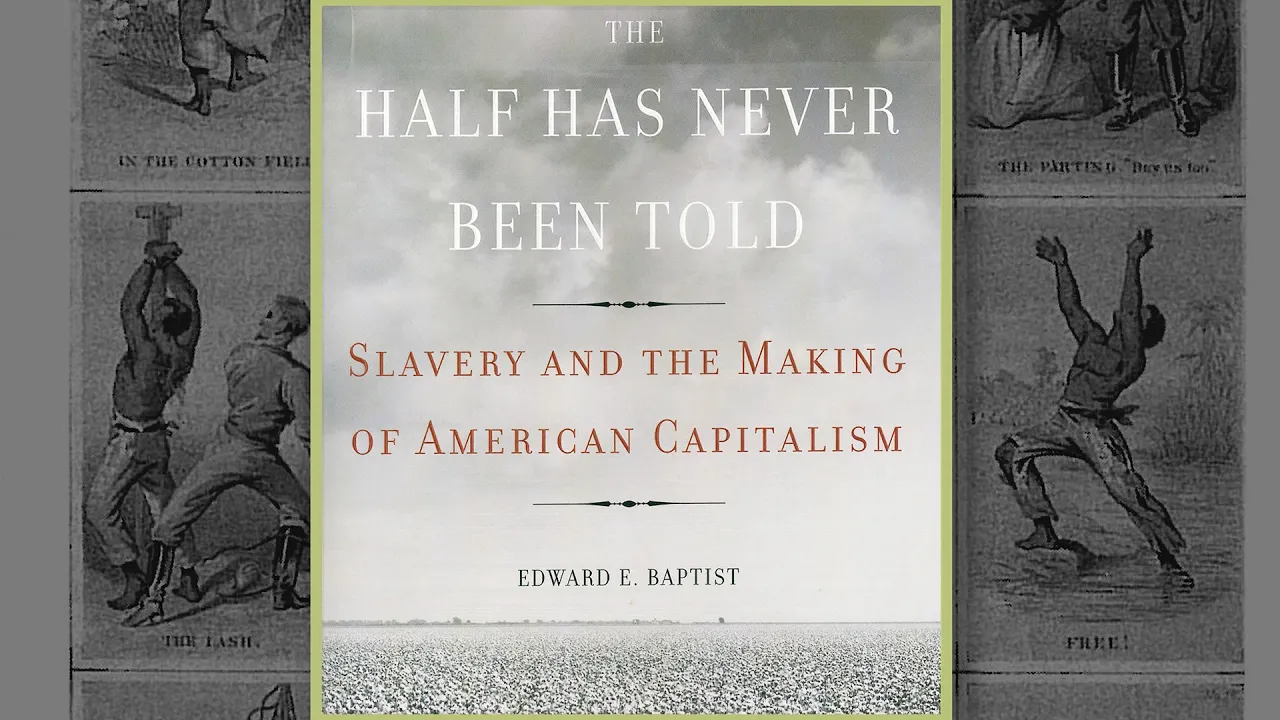
Today marks the beginning of his tour to discuss his new book, "The Half Has Never Been Told-- Slavery and the Making of American Capitalism."
Publishers Weekly has said that this book is, "an unapologetic, damming, and grisly account of slavery's foundational place in the emergence of America as a global superpower, balancing the macro lens of statistics and national trends with intimate slave narratives.
Delivered in a voice that fluidly incorporates both academic objectivity and coarse language, Baptist's chronicle exposes the taint of blood in virtually all of the wealthiest Americans have inherited from their forebearers."
Please join me in welcoming Edward Baptist.
EDWARD BAPTIST: Alright, thanks, and thanks to Google for having me, and thank you for showing up.
I appreciate it and I'm not going to talk about The Economist yet, but if you have questions, I don't think I can avoid them.
I also noticed I think I might be the only person in the building with a tie.
I expected that was going to be the case, but my wife just got this for me, so I didn't really have a choice.
Alright, so I think what I'm going to do is read a passage and then talk a little bit, and then read a passage and have a few more things to say.
And then, maybe, either one or two more passages after that, but I want to leave plenty of time for questions and answers.
So let me start.
"On a bright spring Maryland morning in 1805, Charles Ball rode comfortably on the board seat of a wagon, the lead rope of his owner's yoke of oxen in his hands.
He was driving the team to a little town on the bank of Patuxent River.
Ball's latest owner-- he had five in his 25 years-- was a hard man.
Mr. Ballard would make a slave work in the woods on the snowiest of days with no boots.
But Ball had hopes.
All through the neighborhood he was known as a strong intelligent worker with a steady temper, unlike is irascible African grandfather or as runaway father.
Charles Ball had been hired out to the Washington Navy Yard and had come back instead of running away like so many others had done when they had worked abroad.
Ball could figure out faster, smarter ways to do any job.
And he had incentives-- a wife and children owned by another white man.
Balls extra hours supplied his family with food and clothing, and though he would later to laugh at his younger self, the 25-year-old Charles Ball hoped for his own and his family's freedom.
He was not alone.
In Maryland's decaying tobacco economy, enslavers we're allowing many African Americans to buy their freedom.
The free constituted 5% of the state's 111,000 people of African descent in 1790 and they'd be 22% of 145,000 by 1810.
Maryland was becoming a middle ground between the slave state and a free one."
I go on to explain that Ball gets to the town where he's bringing the team of oxen, ties up the oxen, and goes to get a little bit of breakfast, but he sees his owner standing outside the stable talking with another white man.
"Uneasily swallowing a last mouthful, Ball stood up and walked slowly out.
He began hitching up the oxen fumbling with the leather rope, suddenly he felt the presence of several people looming around him.
He turned as, out of nowhere, a dozen white men had surrounded him.
Before his eyes had time to flicker from one hard face to another, his head jerked back as someone seized him by the collar from behind.
You are my property now, a voice shouted in Ball's ear.
And, as he whipped his head around, he saw the man with whom Ballard had been whispering.
You must go to you must go with me to Georgia, the stranger snarled."
So I then set what's happening to Ball in the context of the larger migration that's just beginning-- a forced migration they would, ultimately, move a million a enslaved African Americans from older parts of the South to what would become increasingly larger new parts of the South as the US acquired more territory.
And I talk over the course is a book about how the slave trade to develops, changes, and grows and becomes, in fact, the breeding ground for a lot of innovative business practices-- for a lot of market making, some economists might say, for a lot of institutions.
They bring buyers and sellers together, they make information flow more freely, they make credit flow more freely, all in the name of moving enslaved human beings.
And I continue to follow the story of Charles Ball.
I talk about how he is actually locked into a series of chains called a cothal, and how the march South, with 51 other people to whom is chained, begins.
And I try to take the reader into his mind as he described it many, many years later-- as these events were happening.
How he dreamed that night, as he lay in chains, that his son came to try to break the chains but could not.
And how he then dreamed about his grandfather, who I mentioned just now, his African grandfather who had, in fact, helped Charles's own father, the grandfather's son, to escape from slavery so that he could not be sold.
I follow this story of Charles Ball all the way down the South Carolina where he sold to a man named Wade Hampton.
Wade Hampton, who was at that point already one of the wealthiest men in the United States, and Wade Hampton put Charles Ball on his cotton plantation.
Now at this point, 1805, cotton is a relatively new crop in the United States and it is just moving into the position that it eventually comes to hold in the world economy.
And it holds that position for a large part of the 19th century.
That position is that of the world's most widely traded commodity.
Through most a 20th century, that position would have been held by oil.
Through most of the 19th century, that was held by cotton.
Cotton was the raw material that was used in the factories of the new industrial system that was emerging in England and later in New England.
It was turned into textiles, textiles that could be turned out at a quantity a of a variety previously impossible with traditional modes of hand manufacture.
And they would slowly push out other kinds of textile manufacturing around the world and themselves become a massively important kind of trade, massively important commodity that's shopped all around the world.
In other words, the cotton is the raw material of the Industrial Revolution.
It is the raw material in the early modernization of the global economy.
And Charles Ball would be forced to make it.
So, what's significant about how African Americans make cotton, starting in the 1790s and going all the way up into the Civil War, is the fact that the cotton they made pushed other producers out of the market.
It gradually became the dominant-- the US South gradually became the dominant producer of cotton on the world market.
Whereas it made almost none at the start of the Industrial Revolution.
So as the market for the raw material is growing dramatically, not only the ability of the US South to produce it, but their market share is growing dramatically.
And one of the historical problems that I try to address in the book is why that was the case.
One reason is that huge amounts of land were taken from Native Americans, huge amounts of land were taken, were bought, from other European powers.
Later from North American powers were seized, like the territory that's taken from Mexico.
Another piece of it, of how this comes to pass-- of how this massive upsurge in US cotton production comes to pass-- is the forced migration of large numbers of African Americans.
A million people are moved and most of them go into making cotton.
And the children, if the children are born and survive, go on to making cotton in places like Alabama, Mississippi, Louisiana, Texas and so on.
But, another piece of it is the fact that the labor process changes, and it changes continuously and dynamically on the cotton frontier.
So in 1805, when Charles Ball learns how to pick cotton, he picks about 50 pounds a day.
A few decades later, the average amount picked would be two to four times that.
And one of the historical problems I try to address is why that increase happens, and this is something that I imagine is going to be continued subject of debate between historians and economists.
But my explanation ultimately is that enslavers create a system of measurement-- they measure the day's picking of cotton-- and recording information-- they write down the number of pounds the enslaved person has picked-- and they then compare it to a quota, a quota that is individually determined based on their past performance.
If they have not met that quota on that particular day, they're whipped.
If you've seen the film "12 Years a Slave," you've seen a little bit of this dramatized on the screen.
And then another piece of it, when enslaved people learn how to meet that quota, that quota is raised.
And so over time, the average quota of the average slave gets higher and higher.
The average slave has to learn how to meet those higher and higher quotas.
And that explains why the price of cotton in real dollars, raw cotton, is 15% in 1860 what it was an 1800, even though the demand for it has increased dramatically.
Alright, how did enslaved people describe that process that they went through, the process of being forced, of being moved-- and we've heard a little bit of that from Charles Ball-- and then the process of being forced to raise their own ability to produce this crucial raw material for the Industrial Revolution?
Well, at the heart of my book, I tried to put the voices of enslaved people themselves.
This can be hard to do because, as you may be aware, literacy was essentially forbidden for most slaves in most states, and, of course, they didn't have the tools ready at hand to write and record their thoughts.
But, despite that, we do have access to the experiences and the thoughts of formerly enslaved people because as people like Charles Ball-- who was not unique, but very unusual in that he successfully escaped from slavery in the deep South, but there were other people like him-- as people like Charles Ball escape, many of them were able to find people to help them write down their memoirs, create their autobiographies, and publish them.
And this became the basis, in many ways, for the abolitionist movement that would ultimately oppose slavery.
They're about hundreds of those published autobiographies from the 19th century of formally enslaved people, and they're a great source for studying what the experience of slavery was actually like.
On the other hand, in the 1930s, there were still thousands of formally enslaved people alive, and the federal government, as part of the Works Progress Administration, one of these agencies of the New Deal that was trying to put people back to work hires different individuals-- some of them graduate students, some of them unemployed teachers, some of them locally prominent spouses of judges, and so on and so forth-- anybody who had the ability to go and make connections with former slaves was sent out into different neighborhoods and communities around the country.
And all in all, about 2,200 interviews were done with formerly enslaved people, and these narratives are also crucial to the story that I tell.
I try to put those things at the center of the story and, as we can talk about later, that is in itself, as it turns out, something of a controversial act.
Alright, so there was one person who gave his testimony to a WPA interview named Henry Clay-- probably named after the famous American politician, born about 1840-- and he told his story to his interviewer in the 1930s and I think it's really interesting.
And he claimed he'd been born into slavery in the Carolinas and moved to Louisiana has as a boy.
And he grew up on a cotton plantation in Louisiana, being forced to work faster and faster.
And he claimed to his interviewer that his owner once possessed a machine, which by his own account made cotton cultivation and harvesting mechanical and rapid and efficient.
And, by the way, there was no mechanical cotton picker, no machine that would do the job slaves did until the 130s.
It turned out to be a very difficult engineering problem to solve, but his owner supposedly had a machine that solved the problem to some extent, the problem of how to pick more cotton.
Because, of course, the more cotton your slaves picked, the more pounds of cotton would sell, the higher your total revenue would be as a slave owner.
So "this machine was a big wooden wheel, as Clay remembered, with a treadle on it.
And when you tromped on the treadle, the big wheel goes around.
On that wheel was four or five leather straps with holes cut in them to make blisters.
And you lay the Negro down on his face, on a bench, and tie to it.
Now, when the operator pumped the treadle to turn the wheel, the straps thrashed the back of the man or woman tied to the bench into bloody jelly.
According to Clay, the mere threat of the whipping machine was enough to speed his own hands."
Now, the contraption might have actually existed, but I actually think it did not.
I think it was not a material thing, but it was actually a metaphor.
I think he saying that every cotton labor camp carved out of the Southwestern woods used torture, used whipping as it central technology.
And so every day-- with measurement, with recourse to the information that was already recorded about people's production, and then with whipping of those who didn't actually succeed in meeting their quota-- calibrated pain was being used to push enslaved people to exceed their previous day's gains in production.
This was a kind of technology, a technology of whips, and measuring weights, and slate-- where the pounds would be recorded-- which forced people to focus their minds on inventing new ways to perform repetitive and mind numbing labor at nearly impossible speed.
Fingertips hardened, but also became more subtle and swift.
Enslaved people developed different tricks, ways to get down the row with as little wasted movement as possible.
Some of their new discoveries they could teach each other, but, ultimately, one also had to-- and you get some of this from some of the ex-slave interviews-- they had to split their own consciousness in half in some ways-- to be present but not be present, to generate unseen creativity in movement, new graces of speed.
And this was the key, I would argue, to the astonishing increase of cotton production over time, which is extremely important to the creation of the modern economy.
Because, of course, raw cotton, at 15% of its earlier price, enables the factory owners, who are processing that into one of the most important commodities that they sell-- the cotton textiles which go all over the world and invade all kinds of markets from India, to China, to Africa, to Latin America-- it allows them to lower the price of their product.
It allows them to skim off revenues and reinvest them new machines.
It allows them to pay slightly higher wages to workers, which dampens down industrial unrest.
And so the increase productivity on the cotton plantation is one of the keys, one of the keys that makes all of those things possible.
Let me transition to one more reading.
And this reading brings us to Boston.
This reading brings us from Maryland, South Carolina, and Louisiana, specifically, to Boston.
Boston was closely linked to the things that were happening on the cotton frontier.
And not just because the textile factories that boomed, that were so important to the Massachusetts economy in Lowell and other parts of the state, were-- most of them-- were owned by men and women who lived here in Boston.
Well, one of the members of the class of people who owned those factories had a particularly direct relationship to Louisiana cotton fields.
And this was a man named John Gorham Palfry, and he actually lived in Louisiana briefly because his father John Palfry, the elder, had been a merchant in Boston, but then had bought Louisiana plantation-- about 1804-- and move down there.
And he moved his five sons, one of them, John Gorham Palfry, was the oldest.
And he left Louisiana when he turned 18 and moved back up here to go to Harvard.
And at Harvard he was ordained as Unitarian minister.
He ran a church for awhile, became a professor of theology.
So he was a Harvard professor.
And then, late in the 1830s, he took over a magazine called "The North American Review."
And the "North American Review" was a sort of "New York Review of Books" or "Atlantic" or something along those lines of the '30s.
It was the magazine of a national, educated middle class-- published authors of America's emerging literature, James Fenimore Cooper, William Cullen Bryant, et cetera, et cetera.
His four brothers were still in Louisiana and they gradually took over their father's cotton operation as he older.
The brothers stayed in contact and John Gorham Palfry sometimes went down to Louisiana to visit.
In the 1830s, he came down, went back up to Boston, and he wrote letters that asked ironically after individual enslaved people in terms of racist parody, "How are my sooty friends?" he wrote.
When William contemplated, one of his brother's, contemplated visiting Boston, John the younger told him to bring his own slave.
"The free black servants you can hire here are good for nothing," he said.
The Palfry's agreed, it seemed, on slavery and race as they did on national politics.
They were both part of the Whig party.
Well, as John the elder aged-- this is John Gorham's father-- the Louisiana Palfry's took care to advise their Massachusetts brothers that under the terms of the Louisiana civil code-- that's a Napoleonic form of law-- he would inherit, automatically, one third of his father's property.
One of the brothers had died in the meantime.
Most of the value of that property was in slaves.
The best way to turn that share into money usable in Massachusetts would be to sell the people he inherited.
"But you might incur the risk," wrote one of his brothers, "of some busy abolitionist reporting that the Reverend Dr, Palfry had been selling human flesh, et cetera, et cetera.
Or living on the income of slave labor."
So Boston at this time was also becoming, not just the bed of textile money and textile innovation, but abolitionist critique of slavery in the South.
In the autumn of 1843, one of the season's first cotton ships arriving in Boston to offload cotton for Lowell also brought news from New Orleans.
Old John Palfry had died and John Gorham Palfry now owned 20 human beings.
And so at this point, something unexpectedly happens.
John the younger decides he doesn't want any more money from slavery.
And so he tells his brother that he wants to free all of the slaves, but Louisiana law at that point will not allow him to do that.
At least not if they remain in Louisiana itself.
The brothers, the other brothers, try to talk about it and they're becoming increasingly angry at him.
In fact, when they disagree with him, he goes around them, sends a petition to the Louisiana state legislature for an exemption to the law, forbidding the freeing of slaves who would then remain in Louisiana near their families and so on.
One of the brothers writes angrily back to John, "The whole story would be published in the local paper on Saturday."
Local planters, their neighbors, would hear it.
They would get questions.
Their neighbors would think that they were from a family of abolitionists.
Meanwhile, proposing emancipation for 20 of the people at their father slave labor camp would render the other 40 unmanageable.
They would talk back to overseers or run to New Orleans to find a lawyer for a freedom suit.
Better to let them remain quietly at work and time will gradually settle all difficulties, one of the brothers insisted.
Don't rock the boat.
But John rocks the boat.
And, eventually, he travels down the Ohio River and brings back 17 of the 20 people who then become part of Boston's free black community.
And I want to end with this because it's a complicated story.
Palfry doesn't seem-- even after his conversion to not wanting the profit of slaves anymore, and being willing to fight his brothers in this way to free those 20 slaves-- he doesn't seem to be particularly anti-racist by any terms that we would understand today.
But, despite that, he does carry out this act, which was very difficult for him.
It was costly to him-- not just in monetary terms, but in terms of his relationship to his family.
And even in terms of his relationship to other Boston elites, who are by no means abolitionist in the early 1840s.
There are people in his social circle who stop talking to him, who stopped inviting him to the best parties.
He paid a price, certainly not the kind of price that Charles Ball paid for slavery for opposing slavery, but a significant price all the same.
And in the book I try to explore some of the reasons why that might be, the gradual resentment of some northern elites against southern political power which protected slavery.
But I think the essence of what happened here, that I want to pull out in the case of John Palfry, is that despite the multiple kinds of cost-- and we have to acknowledge the kinds of cost you pay-- despite the multiple kinds of cost, he made a choice in his own time to forgo those things and do something that had an impact that went beyond the 17 people who were freed.
It was a political act.
It was a political act that, in its own way, as I explore the book, helped to change the nature of anti-slavery in Massachusetts.
So I think the lesson here is, don't be evil, which you may have heard before.
But, it's a tough choice.
It's a tough choice when you're going up against deeply embedded social and economic realities.
Deeply embedded social and economic interests.
And John Palfrey, to his credit, made that choice.
So I'll stop, and do we do Q&A at this point?
Thank you, by the way.
AUDIENCE: My curiosity-- so John Palfry came back up with 17 of his 20 slaves.
What happened to the other three?
EDWARD BAPTIST: Yeah, that's a good question.
So part of the story that I left out is this-- He goes down to Louisiana to bring slaves back, to bring them back as emancipated people.
And they convinced him-- and this is all 20 of them, really-- convinced him that he needs to wait-- I think it's July when he goes down there-- he needs to wait to the end of the year.
Because they had their own little gardens that they were able to spend some time on at the end of Saturday workday and over Sunday working on.
And the 1840s cotton prices are not so good, and so sometimes they would be allowed-- not just half the day on Saturday, but maybe from 10 AM on-- to work there because there's not so much of an interest in producing as much cotton when the prices is so low.
So they have these crops they're growing in these little gardens.
And some of them have cows, some of them have planted little patches of cotton that they're going to try to sell as well.
And typically enslaved people did this so they could get a little bit of cash to supplement their rations, which we usually pretty bad-- maybe to buy some ribbon, some buttons, something like that that went beyond the sort of standard issue clothes.
But these folks want to sell what they've raised at the end of the year when it's ready to harvest and bring the money back up to Boston with them, because they don't totally trust John Palfry, the son of their slave owner.
They want to have a little bit of a cash reserve so that they can stake themselves to some kind of independence when they get up to Boston.
And, in fact, he tries to place most of them in different jobs, usually very menial jobs.
And their tendency is more to slip off and do their own thing-- in some cases, start their businesses.
Well, in that intervening time period-- and this gets back your question-- three of the oldest slaves decide that they want to stay in Louisiana.
They're all, I think, over 50, which is quite old for enslaved people Louisiana at that point in time.
And they have children and grandchildren there.
And those children and grandchildren had not been freed, had not been willed to John Palfrey.
So essentially, the other brothers cut a deal.
They say, we will let them live on the fringes of our plantations, will understand that they're free, but we just won't talk about that to our neighbors too much.
AUDIENCE: So there's an argument that South was held back because of slavery from industrializing like the North did and so on and so forth.
But, based on the subtitle, is sounds like your thesis is that slavery is very important in American capitalism.
How do you kind of draw those two together?
EDWARD BAPTIST: So are at least two different questions, I think, embedded in that.
I mean, one is, was the South held back?
And the other-- was slavery a plus or minus for American capitalism in general?
I think for the second one, I think I would argue unquestionably yes.
It brought massive export earnings into the United States.
It was 50% of all the export earnings of US and, virtually, every year from 1800 to 1860-- 50% came from cotton, I should say.
And then, if you added some of the other crops, it even creeps a little higher when you look at slavery share.
Also, because it was exporting all of these relatively high value commodities, or high demand commodities-- let's put it that way-- created a circuit of payment and repayment that brought huge amounts of credit into the American economy on an annual basis.
British investors, in particular, and a lot of the world savings were pulling in Britain at that point in time.
British investors were very eager to invest in that whole circuit of trade and repayment.
And so other industries piggybacked on that stream of credit.
And we could go on about this, but I think that there are multiple ways in which slavery helps American capitalism in general.
But, it does so at a tremendous cost.
First of all, to enslave people.
Second of all, I'd argue, you could argue, creates winners and losers in both the North and the South among free people.
And, potentially, the whole South ends up being a loser because of the commitment to slavery and to the production, ultimately, of one major commodity.
And over the long run, I think that's true.
I think that's pretty consistent with the experience of most regions that invest themselves so heavily in producing one commodity no matter how important that is to the world economy.
But, as long as the ride is going well, it can be a great ride for the people who are sitting at the top of that process.
And when you look at the way wealth is distributed among whites and the United States in 1865, five of the six highest states in terms of per capita wealth for white people are cotton states.
I always forget the order.
I know Louisiana's first, and then you also have-- in that number you have Mississippi, and Alabama, Florida, and I think George's the other one.
But, this produces a very prosperous upper, and even a very prosperous middle class.
And they don't have an incentive to change the system.
Even if over the long run, we can look back and say the choices that were made, the choice to invest in cash commodity production, didn't lead to a sort of complex local economy that you saw in Boston, that you saw in New England more generally.
You also have to reckon with in fact that the Civil War happened, which not only stripped the southern states of 20% of the accounting wealth, the wealth on the books of the country-- which is enslaved people-- and thus left them at a much lower position financially than they had been before.
But, in addition to that, creates a lot of physical devastation throughout the south as well.
I don't say that to say we should feel sorry for Southern planters because of Sherman's March.
They started the war.
They, to my lights, committed treason against the government, but it does have a long term effect on the future development of the South.
AUDIENCE: You started off at the very beginning by referring, inevitably, to "The Economist" review.
Obviously, the book is going to have a certain reception in the world where there are established agendas, but I'm curious in academia.
Among economists and historians, there's probably been a lot of research, an ongoing dialogue over years and decades that most of us are unaware of.
Where does this book and your research fall then in an ongoing dialogue and debate?
EDWARD BAPTIST: Now, that's a really good question.
I think that there are certainly things about my book that I, as the author would argue, are new and innovative.
And I could talk about them in just a second.
But, at the same time, there is this long debate about was slavery capitalists?
To what extent, if it was capitalistic, did it contribute to the larger development of capitalism?
Or perhaps, alternatively, it was something that put the brakes on the development of the modern economy-- not just in the South, but elsewhere.
I've laid out where I stand on the last point, certainly.
But I'm not the only person who would make the argument that there are key things about slavery-- as a set of institutions and practices, as a culture-- that make it more like the rest of the emerging Western capitalist complex in the early 19th century than it is less like.
More alike, more part of, than it is different, than it is separate.
That it is just one flavor in a larger banquet of capitalism, and it contributes to the overall whole.
And there are number of historians who would argue that.
There are also some economists, but I think that I've already gotten some push back from economists who-- whether they're saying this because it's sort of a fundamental position that capitalism must include free wage labor, must be based on free wage labor or not.
But they're arguing that, in fact, the contribution of enslaved people's labor to the development of capitalism is not so significant as I make it out to be.
One point in particular where there's some debate and some divergence is, what is the cause of that massive increase in productivity that I mentioned?
Productivity, of course, is defined here as the quantity of labor-- or the quantity of output, I should say-- the quantity of output generated in a given amount of time.
So the number of pounds picked in a day by one laborer.
And some economists argue that the source of that is improved cotton seeds, and that this produces a bigger yield of more pickable cotton.
And I would argue, and I say this in the book, that that is definitely part of it, but somebody still has to pick the cotton.
There's more cotton out there, and it's easier to pick.
It's probably not four times easier to pick.
There's still a lot of moving, a lot of grabbing, a lot of pulling.
And, in fact, slave owners also seem to think that it's not the seed that they need to focus on, but it's actually extracting the labor from individuals.
So every day, and this goes back to the description of the sort of calibrated system that I mentioned before, every day they're weighing.
Every day they're recording the amount of weighed.
And every day, if you listen to what formally enslaved people say, they're whipping those who come up short.
And this is a big complicated system to put in place if what's really making a difference is seeds.
Enslavers really believe that it is the pushing, the weighing, the whipping that is making the difference in output and increasing productivity over time.
But you don't know that if you don't look at what formally enslaved people say.
If you just look at what the owners are saying, you just look at output-- and some economists have had a tendency-- then you don't really understand what the labor system is like from the inside, from the perspective of those who experienced it.
AUDIENCE: I'm curious when you started out, what was your aspiration, what did you have in mind?
Do you feel like you achieved that, and where would you go from here?
EDWARD BAPTIST: So that's a good question.
Yeah, it was a while ago when I started really working on this project.
Google was one of many search engines.
I wasn't familiar with Google Maps, it might have existed.
One of my students was trying to convince me to use a search engine called "Dog Pile."
I don't think, I mean, maybe that's still out there on the way back machine or something.
But it was a long time ago.
And the project really grew over time because I wanted to look just at the experience of people like Charles Ball.
And I just wanted to tell their story of moving from point A to point B. But, as I dug into that, I realized that that was connected to virtually everything else that happened in the South from 1790 to 1860, which is a long time.
And everything that happened there, it turned out, was connected to US politics, national expansion, to the growing cultural sense of the United States-- with a separate culture that people like John Palfry were a part of.
There were many, many connections, of course.
That's a wonderful thing.
That's a kind of experience of wealth and excitement, right?
You're seeing all of the connections in the world.
And, at the same time, you have tell a story behind two covers, right?
And has some kind of coherent structure.
So that was the struggle that I went through-- not just reading all the sources, of which there were many, but figuring out how to not read some sources, if you will, that maybe in some alternate universe where I have infinite time could be part of an infinitely large story.
So what's next?
I have a couple of projects that I'm working on, but, I think-- I was talking to a couple friends of mine.
I said, well I'm going to go talk to Google.
And they said, well, maybe you don't say capitalism comes from slavery.
And I said, well, I don't know.
I'm not quite sure what people at Google think about those kinds of questions so I'll just talk about it.
But, they did urged me to talk about another project I'm working on because it directly connects the amazing digital tools that we all have now to the study history.
So one of the things that when I was doing research on this project I always wanted to have, one of things always wanted to have was a collection of runaway slave ads, a full collection.
I don't know if you've ever seen these things, if you've read Frederick Douglass's autobiography, he discusses them.
Other fugitive slaves talk about them.
Even "Huckelberry Finn" sort of tangentially talks about them.
So when an enslaved person ran away in the antebellum South, often the owner would place an ad in a local newspaper.
And this ad was very frank in many cases, because it had to physically describe the person.
So, Jim-- five foot nine, 27 years old.
That description not only is richer than a lot of the description we have in any sort of systematic way about large numbers of slaves, but it might then also go on to say, Jim-- three of whose fingers on his right hand were cut off, whose back is much scarred with whips, et cetera, et cetera.
And it might describe their clothes, where they came from.
Jim was just moved from South Carolina to Alabama a year ago, may be trying to get back.
Things like that.
So there's amazing detail and there are amazingly large numbers of the sources.
My vague estimate is that there are probably about 100,000 of them out there in newspapers that survived, because the early 1800s is the era of another new technology-- the steam powered press.
And newspapers proliferate.
They stop being weeklies and become two or three times a week, and they become dailies.
Newspapers are everywhere.
And runaway ads are in most of the Southern ones.
So my mind guesstimate is that there are about 100,000.
I don't think I'm off by a whole order of magnitude.
I know not on the low end, anyway.
We already have gathered over 10,000 of them.
But what I want to do is not just gather them and put them in digital form-- collect them as a whole bunch of PDFs-- but, what I also want to do is create a database that categorizes the information.
And we're going to use a relational database as sort of an underlying structure there-- categorizes the information that's in those ads.
The name, the height, where they ran from, how many times this ad ran, and so on.
So that you can do all kinds of interesting analysis.
And we will also record all the text, which will allow us, hopefully, if we get enough text, to do some very interesting text mining with it.
And, in fact, one of the people that I'm working with at Cornell's library wants to run-- this has probably already occurred to a lot you-- but basically the same kind of analysis with a relational database as with the text mining, and see if you've got radically different kinds of results-- see if the difference might tell you anything about the ability or the usefulness of different text mining tools and techniques.
And then the other piece of this database is that I want a large part of it to be crowdsourced.
So we're building a site where hopefully, if we continue to get funding over the next couple of years, we'll be able to create an experience for users-- students, in particular, are one of our targets-- where they will go to the site and then be presented with a runaway slave ad, and their job will be to do the detective work of pulling information out of that ad, recording it for us in the relational database, maybe correcting a transcription of the text.
And as they do that, they will be building and deepening our database.
And we think the kinds of historical analysis we can do with this will be significantly more effective and more interesting than a lot of the work we've been able to do so far in slavery studies.
So that's the next project.
AUDIENCE: That's pretty interesting.
I have a question that's on a different subject though.
I'm wondering if you've done much comparative analysis of slavery in the South with slavery elsewhere.
I'm thinking, in particular, of, I guess, the two most obvious examples would be the slavery in the Caribbean for the purpose of harvesting sugar and also the slavery of Indians, in particular, say Peru earlier by the Spanish, too, for mainly for the purpose of mining-- those, in particular the Spanish system, seems pretty different.
Also seems, pretty clearly, not too have led to any sort of industrial capitalism at all.
I guess, for the British system in the West Indies, you'll probably have to look at how that related to industrialization in Britain more, and I know there's a lot of literature on that already.
But, anyway, I'm just wondering, just in general, do these kind of comparisons tell you anything about your own theory?
Do they support it?
Do they tend to not support it?
how do you look at that?
EDWARD BAPTIST: Now that's a great question.
And I don't know so much about the systems of forced labor that are used on native peoples in the Andes, for instance, to get silver.
But, my basic understanding is that they're not, strictly speaking, chattel slavery.
That they're sort of labor requisition processes.
The difference If you were working in the silver mine might have been pretty hard, you know, to parse out.
And there were African slaves working in Peru, sometimes in the mines, in a sort of more chattel slavery formulation.
Slavery in the British West Indies, which ends in 1834, is already, I would say, moribund by the early 1800s.
And one reason is that the productivity of sugar production is not increasing.
It hasn't increased in a while.
And there's always been a sort of a historical problem or debate about why that is.
Does it have to be do with labor supply?
The Atlantic slave trade is cut off in 1808 by Parliament.
Maybe it's easier to force Africans into harder kinds of labor because they're not able to build the kind of networks that allow group and individual resistance to locally born enslaved people.
There are a lot of questions still about that.
But, one thing's for sure, both the mechanics of sugar processing and the way that sugar labor is extracted from individuals are different in Cuba in the 19th century than what prevailed in Britain and some other colonies in the 18th century.
So new machinery comes in, and sugar is, mechanically speaking, the most complex of any commodity production process before-- I mean, you could argue it's actually more complex than the Bessemer process for making steel-- but it's more complex than any sort of chemical process-- so its any non medical process-- than anything that happens before the late 19th century.
It's very important for sugar slavers to have a lot of credit so that they can invest in this kind of machinery, and the kind of machinery they have is very important.
Well, they're lot of key inventions in the 1810s, '20s and '30s which allow a speedup in the processing of sugar.
This is significant because there's kind of a bottleneck-- if you don't mill sugar, if you don't then refine the juice you get from the mill within about 24 to 48 hours it starts to go bad.
So unless you have many, many sugar mills, there's a limit to how much labor you can actually profitably use on one sugar plantation.
The change that's driven by these mechanical, technological innovations leads to a dramatic increase in the size of sugar plantations once they're created on Cuba.
And that primarily begins to happen after 1834, after the British emancipation.
So in Cuba, the sugar plantations get much bigger, get much more sped up, and labor is then behind the processing.
So labor in the fields is slower than what's happening in the processing centers.
So labor in the fields is then sped up, and they actually, the enslavers is Cuba, actually use some techniques that are very similar to what happens in cotton fields to get people to plant, and to cut, and to harvest more rapidly.
And at the same time, similar things are happening in Brazilian coffee where you have a massive increase in production in new territory, often with new slaves who had been moved a very long way away.
It's very similar to cotton.
And the weighing and the recording of how much slaves individual slaves have picked in terms of weight of coffee beans is very important to pushing an increase in production.
It might seem like coffee's not really related to industrialization, but I bet I can walk you through that process really quickly when you think about the espresso machine, right?
I mean, I'm serious.
The transition from drinking alcohol at work to drinking coffee work is key to industrialization as well.
So the Jamaican example, for instance, is a little-- it fits into a longer story of slavery and industrialization.
It's bigger than just the USA.
AUDIENCE: I've got a couple more questions.
First, on the topic of not being evil, you suggested-- what you're saying-- I'm sure, what you written-- that in the early 1800s if you were opposed to slavery, it would have been very difficult in the US, and maybe in the world, to unplug from the slave economy from the economics effects of it.
Can you think of examples, other than the Civil War itself, of course, that were effective at that time in bringing an end to slavery in the US.
Particularly, things that were effective on an economical level.
And then, my second question, is can you actually talk about "The Economist" review, the response to that, and so forth?
EDWARD BAPTIST: I can try to answer both of those, but when you ask effective at ending slavery in the US, do you mean in, let's say local emancipation-- like what you have in the Northern states-- or do you mean effective in ending slavery in other societies beyond the US?
AUDIENCE: Well, I think both in a sense, in that if what you found offensive was the act of slavery itself and it was offensive in your country and elsewhere.
EDWARD BAPTIST: OK.
So explaining abolition and explaining why the British abolished slavery has launched all sorts of history books, right?
It's spilled a lot of ink, and there's still a lot of debate about that.
And there's two points of view.
One is that it was an act of what one historian calls, "econocide," right?
So it was economically very healthy for Britain to have sugar plantation colonies where the labor was done by slaves, and they abolished slavery as a sort of act of generosity, of moral goodness, if you will.
And you can nuance that and say, well they weren't really so good after all.
They actually were hoping for something else, but that's the essential point.
The other is to argue-- and this goes all the way back certainly to the 1940s, but maybe even before-- to argue that capitalism in Britain was changing dramatically by the early 1800s, as evidenced by the Industrial Revolution.
And a heavy investment in the slave trade, in Atlantic slave trade-- it was necessary to populate sugar plantations because people died at an astonishing rate on sugar plantation, so you had to go more slaves-- and the investments in the sort of institutional power, that you had the seed to sugar planters.
That this was a limiting force, a sort of parking brake on the development of industrial capitalism in Britain itself.
And so it's not an act of econocide, it's an act of economic self love on the part of the British ruling class to abolish slavery.
The story, I think, is-- there's a little bit of both, and it's much more complicated at the same time.
If you look at other societies, what you typically find is that they abolish slavery because they had to, because they were forced to do so.
So African countries, or African societies, where slavery actually grows in the 1800s because the European market for the products those slaves make is all of a sudden getting much larger because of industrialization-- those societies only abolish slavery in the late 19th century because they're forced to.
They're forced to by the British, in particular.
Brazil abolishes slavery very late, 1888, and it does so because it's been effectively isolated-- it's been isolated by the fall of the South-- and pressure from its main trading partners, Britain and the US.
And, at the same time, Brazil also has sort of lucked into a really, really good stream of labor coming in the form of essentially indentured servants who are traveling from Italy-- Italy which is, at that point, impoverished.
So they don't completely have to at that point, they're not 100% backed into it, but there's some pretty strong incentives, pretty strong pressures, being put on them.
And then, of course, in the case the US, slavery ends because of war-- and a war that's started by enslavers themselves.
Now, one question that always comes up is, well, would slavery have ended without the Civil War?
And, on that point, people who have tried to answer that question often say, well, of course.
Slavery would've ended.
It's just so premodern, it would have had to end.
Well, it's 2014 and there are slaves in our world.
There are people who are enslaved.
There are people who are enslaved in Boston.
They're not legally enslaved, but they're effectively enslaved.
And their labor, which is primarily domestic labor, is very profitable.
And then when you go beyond the United States and beyond the West, you find places where forced labor is pretty open-- in parts of Africa, and Central Asia, and so on.
So, I'm not ready to concede that slavery would have simply had to end because it was so premodern, or whatever.
It seemed to be pretty well integrated into the modern economy.
Maybe after the invention of mechanical cotton picker we would've seen an end to slavery, but, of course, slavery had been adapted to a new product in the past.
Now, alright, "The Economist."
I learned that "The Economist" would be reviewing my book a couple weeks ago, and I didn't anticipate that it would be a rave.
But I anticipated it would be a kind of a thoughtful engagement that looked at the recent scholarship as well as mine, and tried to put my book in the context of that.
That's, for instance, what "The Wall Street Journal" did and it reviewed-- it came out this week.
And it put my book in the context of other people who are writing about slavery and capitalism, like Walter Johnson here at Harvard-- here in town at Harvard-- who's written a great book, essentially, on slavery capitalism-- came out last year.
That's not what "The Economists" did.
"The Economist" chose to charge me with writing a history that was advocacy and not objective.
We could debate about what objectivity in history is.
I'm not sure what they think I'm advocating, but-- if I'm advocating anything-- I think I'm advocating that at the center of any story about slavery should be sources-- and we're lucky in the US that they're pretty voluminous-- these sources that are created by the survivors of slavery, that are the testimony of the survivors of slavery.
It doesn't mean that's the only source we look at.
It's not the only source I look at, but it's a source that can't be dismissed, and too often, in the writing of slavery history, has been pushed to the side and made secondary.
And this-- if I can read "The Economist" review correctly-- seemed to be the thing that enraged the reviewer the most.
I seemed, to their mind, to be privileging those stories, and that, because I put African American testimony about slavery at the center of the story, that made it a kind of advocacy.
I also think that's the sort of chain of criticisms that enraged a lot of respondents to the review, because I got the review on Thursday-- about one or two o'clock Eastern time-- and by late that night, I think, we were five full pages of comments on "The Economist" site, and every single one of them that I saw was profoundly negative.
And some of them were quite incisive and quite smart and by the next morning, "The Economist" had pulled the review with a partial apology.
I could say some things about how they used the image of Lupita Nyong'o, which, I think, was pretty reprehensible, the way that they did it.
And they haven't apologize for that either.
But it turned out to be great publicity for any discussion of capitalism and slavery.
I mean, I got-- the phone was ringing off the hook.
They sold a lot of books, and I hope they sold a lot of other books about slavery for some of my friends.
And I hope people are going to talk about these issues more, because, I think, the reaction of "The Economist" showed that the issue is still alive in a lot of quarters.
And discussion of the influence of slavery on how we live today is something that's going to provoke some deep, searching questions, I think, for all of us.
So, hopefully, that's-- hopefully questions will be deepen and searching.
Not everybody thought that "The Economist" review was deep and searching.
There you go.
AUDIENCE: So I've been reading Piketty's "Capitalism in the 21st Century."
It strikes me that part of Piketty's thesis is that capitalism seems to be, under some circumstances, you produce greater and greater wealth for a smaller and smaller number of people and the working class ends up getting poorer and poorer-- at which point, slavery kind of seems like the limiting case of that.
I was trying to formulate a question and I have failed utterly, but any thoughts about how that pertains to models of capitalism and how it evolves over time?
EDWARD BAPTIST: Yeah, I'm not sure if you fail to formulate a question or not.
I think what you did was open up a whole area, right.
Which is really, really interesting.
And I read-- I can claim with full truthfulness to have slogged through the whole book, but I wouldn't actually say it was a slog.
If you read-- if you get into, like, the last 200 pages, he's got some really interesting things to say about the US.
And I'm pretty sure all of we're pretty successful at US or other universities, and there's some really interesting things to say about the kinds of universities that a lot of you all went to and that I teach at and so on, which are rough.
I mean, they are rough criticisms and, I think, ones we have to take seriously about the role of wealth and governing them in certain ways.
But anyway, I think one of the points he makes is that most human societies, and certainly most Western societies since the Industrial Revolution, seem to be arenas for the concentration of wealth rather than the democratization of wealth.
Yes, standards of living on the whole rise, but they don't rise nearly as quickly as they do in those brief windows where the democratisation of wealth is really sort of running wild.
And there are really only two moments where he sees that happening.
One is most of the West between World War II and 1968, or maybe between some point the Great Depression and 1968.
And the other-- and that's sort of a high inflation period, which is part of his argument, too-- but the other one is the US North between the Revolution and the Civil War.
And that's also unusual.
It's an unusual time and place, just like the West as it goes through the Depression, World War II, and then the Great Rebuild-- well at the same time you had this confrontation with the Eastern Bloc, which is not incidental to the story.
But the US North is also weird because, on the one hand, it can draw a lot of sustenance, I would argue, from the slave South.
It partakes in the circulation of credit that is partly driven by the South and by the willingness of British investors, especially, to send money into the US because it'll come back multiplied through the cotton trade.
But the North, of course, isn't weighed down in the ways or isn't limited in the ways that slavery clearly can limit and constrain choices for an economy.
And then, there's all that cheap land.
There's all that free land, right?
It's not really free because it has to be taken from the people who already live on it, but its there.
So these are two unusual cases, OK?
So what does this mean for thinking about the slave South?
What it means is that the slave South is more like 2014 US, 2014 Western Europe, 1914 Europe than the free North is like those societies, in some measures, right?
In some ways.
Certainly when we look at the way wealth is concentrated.
The profile of the South is much more like we are today than the antebellum North is like the United States today.
And that's a sobering thought, right?
And I think there are a lot of places we could go and there are ways to take that analysis a little further, but I think what it means is that-- certainly I read Piketty, and I find a lot of richness there, a lot of interesting thoughts for thinking about the slave South and for maybe building future analyses.
Thank you.
Thanks for your questions.
Up Next

Globalization's Upside: The Story of a T-Shirt | World History
@crashcourse
4.8M views•2012-11-02

The Great Schism of 1054: Causes and Consequences
@SacredCathedrals
113.5K views•2026-02-19

DARPA's Secret History: Weapons, Espionage & Technology
@talksatgoogle
558.8K views•2015-10-01

Understanding the Cold War: Superpower Conflicts and the Road to Détente
@OverSimplified
46.1M views•2019-01-24
Related Study Plans & Knowledge Roadmaps
Structured learning paths in History