









![Основы сетей передачи данных. Модель OSI и стек протоколов TCP IP. Основы Ethernet. [GeekBrains]](https://i.ytimg.com/vi_webp/Z-a7MNStFQs/maxresdefault.webp)























DARPA (Defense Advanced Research Projects Agency) operates on a dual-use technology philosophy where all innovations serve both civilian and military purposes, exemplified by prosthetic limbs developed for wounded veterans that also advance robotics and AI research; this approach enables rapid technological advancement while maintaining national security, though it raises ethical concerns about autonomous weapons and brain-computer interfaces that blur the line between human and machine capabilities.
DARPA's Secret History: Weapons, Espionage & Technology
Added:The geopolitical context of the Cold War, particularly the 'Sputnik crisis' that catalyzed rapid US military-scientific innovation.
The concept of the Military-Industrial-Academic Complex and how government funding drives scientific research.
Basic networking concepts, specifically the transition from circuit-switched networks to packet-switching (ARPANET).
The fundamentals of nuclear physics and the strategy of Mutually Assured Destruction (MAD) during the mid-20th century.
The ethical and philosophical dilemmas of dual-use technology (innovations designed for defense that reshape civilian life).
Advanced military technologies currently under development, such as brain-computer interfaces, autonomous swarm robotics, and hypersonic weapons.
The dynamics of modern cyber warfare, state-sponsored espionage, and the weaponization of information networks.
Investigative journalism methodologies for researching declassified government archives and national security history.
558.8K views6.6Klikes46:20Original Release: 2015-10-01
[APPLAUSE] ANNIE JACOBSEN: Thank you so much.
Can everyone hear me all right?
And thank you so much to Google for having me and the tech guys for trying to make this work.
We'll do a little test here.
I'll [INAUDIBLE] work.
OK.
So I am Annie Jacobsen.
Thank you for the intro.
And this book is about the Pentagon's Brain, which is sometimes how DARPA is referred to at the Pentagon.
One of the most frequent questions that I am asked is how do I get these guys to talk to me?
So I just wanted to begin for a moment with that, because I do write about these seemingly impenetrable areas, whether it's Area 51 or the old Nazi scientists program, which was still very classified up until recently, to DARPA.
And what I would like to mention is that one of my Area 51 sources, a physicist who invented stealth technology for the government going back to when Eisenhower was president told me, he said, Annie, there's two things to always remember.
One, "fortune favors the prepared mind," and he was quoting Pasteur, but the idea is that we should just be as knowledgeable as we can and be prepared for amazing things to happen.
And the other thing that he told me was look up, not down, and he said that because physicists, as I have learned, are always looking up to understand the mysteries of whatever it is they have in front of them.
And the physicists that I work with are dealing with weapons related issues, but looking up, whether it's at bees, birds, bats, the moon, or the cosmos, that is where so many of the answers lie to this kind of a scientist's mind.
But he also meant look up, meaning go up.
If you get a no, [? Lavik?] told me, then go to that guy's boss, and if that guy gives you a no, then go to his boss.
Because, he told me-- and I have found this to be true-- that the most knowledgeable people among us often want to share their information.
They do not want to hoard the information.
Particularly as they get older, they find that it's important for this country that they love.
All of the national security scientists I work with are real patriots, and they talk about how even if they worked on classified programs, they stay abreast of what is unclassified as they get older so that they can then share that information.
And so that is how I approach these things, and three of the scientists that I was most happy to work with on this book-- Charles Townes invented the laser, and he recently passed at the age of 99.
And the way that I got to Townes was I was at the Pentagon trying to learn about laser beam weapons.
They're called directed energy weapons, DEW weapons.
They're among the most classified systems in the government and no one would tell me anything.
They wouldn't even tell me basic technology about how it worked.
I followed [? Lavik's?] lead.
I looked up and not down, and ultimately I found my way to Charles Townes, still giving interviews at age 98 when we spoke at the University of California, Berkeley.
And he told me some amazing stories about the laser and about early laser development, which I write about in the book, which give you a real clear idea of why these weapons are so important, why they're so secret, and it has to do with accuracy and precision.
In the middle there is Murph Goldberger, and he worked in the Manhattan Project.
He too passed this last year.
He was the co-founder of the Jason scientists.
So if anyone has heard of the Jason scientists, they are perhaps the most elite, most secretive defense scientists in the nation, and have been since they created their organization in 1960, specifically to work for DARPA, which was then called ARPA.
It did not yet have the D.
And Joseph Zasloff also died recently, but I was able to interview him.
And he was a social scientist, and he ran the program during the Vietnam War, specifically for ARPA, which was called the Viet Cong Motivation and Morale Program.
You could do a whole linguistic study on that title.
But it was interesting to see how social science played a role in the Vietnam War, and then again played a role in the Iraq war, and even more interesting for a reporter like me to realize that DARPA, who is an organization that is so involved in the highest technology weapons of the present and of the future, is also in the business of social science.
I also say that-- I like to say that the truth has many points of view, and the reason why is this document, which is this is one of my sources, and it says at the top Francis Murray.
It says he's at headquarters, US Air Force.
That's at the Pentagon.
And it gives the dates and everything, and it gives them grade marks and whatnot.
But Frank Murray was also one of my Area 51 sources, and he was in fact out at Area 51 during this entire time that he was allegedly at the Pentagon, even though this documentation says he was there.
So I like to say that as a point that the truth has many parts to it.
It has many points of view, and whenever you're dealing with government secrecy there's always the sense that more will be revealed.
This here, which is the DARPA Cheetah robot runs.
It starts at zero miles an hour, and it begins to gain momentum through like 10, 11, 12, and suddenly it's going so fast you can barely see its legs moving, and then you cannot see its legs moving anymore.
It's going 28 miles an hour, and then suddenly it crashes by sort of falling back on itself, and it's tethered to a rope, so it doesn't really crash.
The reason why this is so astonishing is this is, you know, this incredible thing to look at to watch, and you realize this is where our weapons are heading.
Our weapons are heading toward autonomous robotics.
And I write about this at the end of the book, but I wanted to give you an idea of what they look like now.
So we'll jump way back in time, when-- Because computers and computing are so much of a part of where we are today and where the Pentagon is with its weapons systems, it's important to realize-- or at least it was for me-- to realize that back in this day-- this is around 1946.
That's John von Neumann and Robert Oppenheimer, and they're at the Princeton Institute for Advanced Study, and they're down in the basement, and that's the MANIAC computer.
And at the time, a little before this, during the war, John von Neumann was what I call the first Pentagon's brain.
He was the smartest man in Washington, DC, and the Pentagon looked to him to solve solutions.
For example, when the decision was made to drop the atomic bomb on Hiroshima, scientists wondered whether or not they should have it explode when it hit the ground.
Well, von Neumann, in his ability to do math calculations in his head at an extraordinary speed said no, and with a little bit of pen to paper he determined that actually the bomb should be dropped at 1,800 feet above Hiroshima for the largest kill rate.
So that's how von Neumann's mind worked.
He was what was called a human computer.
That's what computers were then.
He built this computer, a machine computer, and he was one of the first people in the United States who had this idea that one day computers could think.
And he actually called what we now call software, he called it the computer's organs, just like a human being.
von Neumann died of cancer the year before DARPA was started, most likely from a speck of plutonium that he inhaled while he was working on the Manhattan Project.
But he is the first Pentagon's brain that I write about.
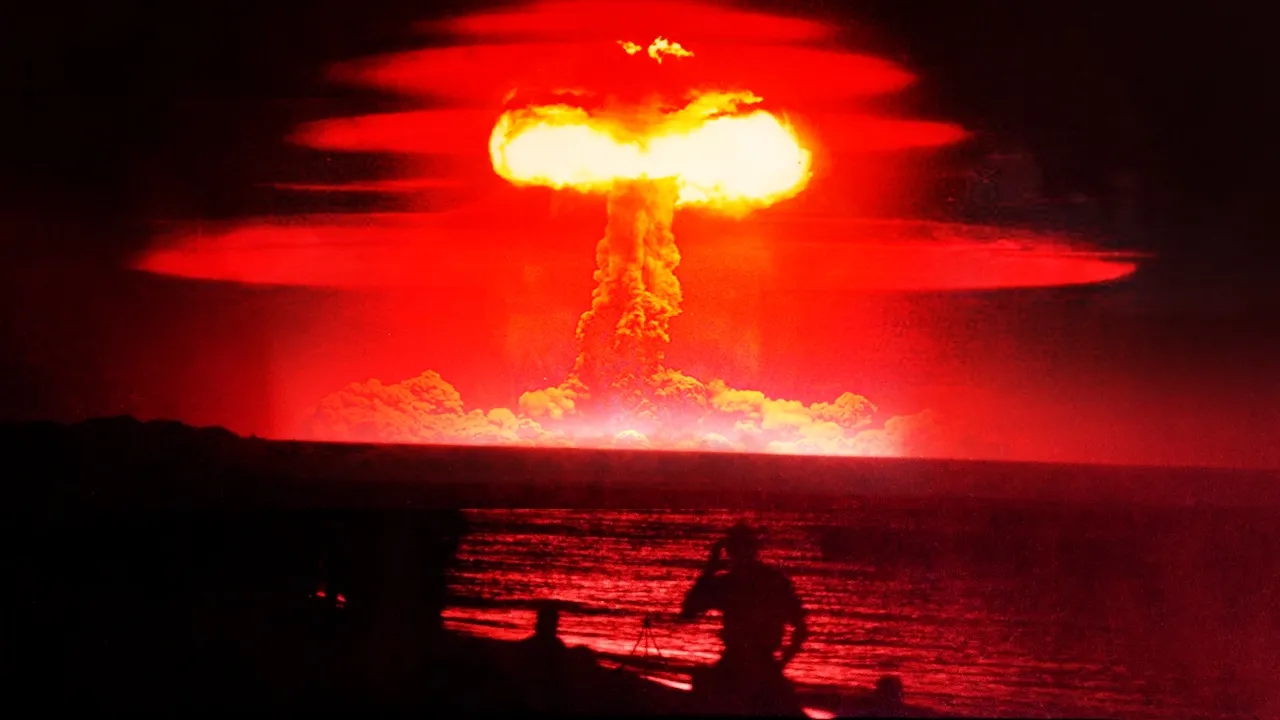
So why did I begin the book here where I did, which this is the thermonuclear bomb going off in the Marshall Islands.
It's a 15 megaton bomb, and what I found astounding was for a while when I first used to look at this photograph, I thought that those images there at the bottom were the waves in the sea, because I interviewed many of the scientists who worked on this bomb program and they would talk to me about being on boats and whatnot watching it, and then I realized those are actually clouds.
That's how high up that mushroom cloud is, and it's 70 miles across.
It was a 15 megaton explosion.
It was supposed to be six megatons, and the science got away with itself, so to speak.
But this is why DARPA was created.
Scientists had created a weapon against which there is no defense, and there still is no defense today, by the way.
One of the first jobs that DARPA did was-- and this was a very classified program.
I don't think it's ever been revealed before.
I certainly couldn't find it in the public domain, but I did find in an archive.
One of the first things that the DARPA scientists did was calculate down to the second how many seconds it takes for a nuclear weapon like this to leave the Soviet Union and travel to Washington, DC.
Does anyone have a guess?
How many seconds?
I'll tell you.
It's 1,600.
1,600 seconds.
So that's not very much time.
That is still a fact today, by the way, and something that the nuclear agency of the day will neither confirm nor deny.
But it is a fact.
So this is why DARPA was created.
How do we defend against these weapons that there is no defense against?
And then the idea was, well, we'll just go into the offensive.
So we'll create more and bigger weapons.
This little slide I like to show, just because it's so astonishing to me.
I was able to interview one of the men who was in this bunker.
There were 10 scientists and engineers 19 miles from ground zero where that thermonuclear weapon went off.
And the idea was the Defense Department wanted to see, well, since we can't defend against it, maybe we can create these bunkers and we can all live underground for a while.
If we have enough time, 1,600 seconds, if we can all get in a bunker before then.
So they built this-- I mean, I have all the specs in the book.
It's just a crazy bunker.
The men lived.
They barely lived.
But they had to be airlifted out of it hours later because the radiation was so intense no one could go in.
So unless you had one of these built to these wild specifications, there's no way to survive a nuclear bomb.
Sputnik came along.
This is a replica of that 23 inch diameter sphere that made the American public go wild in October of 1957, thinking my god, the Soviets are coming.
"Time" magazine had this on its cover.
And the idea-- You know, Sputnik.
Just a satellite.
How bad could it be?
But of course, this ICBM would be the launch vehicle for that satellite, and you can see this interesting anthropomorphization of that nuclear weapon.
It's got a brain, and it has a finger pointed at the East Coast.
So competition creates excellence, and this is how DARPA began.
Here you have the weapons directors at the big two laboratories which were created specifically to compete with one another so that America could maintain technological superiority over the Soviet Union and never again be beaten by the Soviets after Sputnik.
And here's what's interesting.
DARPA is a double edged sword.
On the one hand, there are very serious concerns that I raise in the book about where weapons technology is going.
On the other hand, one must keep on balance this idea that the United States has never been taken by technological surprise, and that is owing to DARPA.
That's Murph Goldberger, and it was-- he was the Jason founder, and there he is at his home looking-- he's also served as a presidential science adviser-- looking at one of the photographs of when he was in his heyday, and talking with me about what it was like working on nuclear-- what it was like working on these major DARPA programs in the very beginning of DARPA.
But of course, it all changed.
These big nuclear ballistic missile related defense technologies that DARPA was pursuing-- By the way, it was called ARPA up until 1972.
For ease, I'm just going to always call it DARPA.
Along came Kennedy.
He had a very different attitude than Eisenhower.
And you see LBJ in the background there.
Both of these men would authorize some of the most controversial DARPA weapons ever to exist.
We had a problem in Vietnam.
That is how it was seen.
And ARPA was sent in to take care of this.
In President Diem there in the front, we had a person who was very interested in technology, and Johnson was sent by Kennedy to make a deal with Diem that we would create some weapons facilities in Saigon and begin manufacturing the most state of the art weaponry to give them to the Vietnamese soldiers.
Diem thought this was a fabulous idea, and that's where it all began.
Now what's fascinating is these are in the early years of the Kennedy presidency.
Here's an example.
So the small in stature Vietnamese were having trouble handling these semiautomatic weapons, and so DARPA pushed through the AR-15 rifle.
And what was interesting, when you can see how swift and agile DARPA is-- And by the way, the whole entire Vietnam program was called Project Agile.
It was like, we're going to get things done, and we're going to get them done fast.
There had been a debate going on at the Pentagon ever since the end of World War II about what rifle would be the standard rifle.
DARPA made it happen.
They ordered 1,000 AR-15s.
They sent them to Saigon.
They gave them to the soldiers.
And today that has become the M16, and that is the standard bearer of what all our soldiers carry.
This is another example of what DARPA got into.
Because they had their hands now in so many different pieces of the pie, chemical warfare became a DARPA program, and this is of course Agent Orange being sprayed over the jungles.
It was perceived to be the magic bullet that might end the war, and that's not what happened.
So where was technology in 1960?
I mean, stop for a moment.
There is Secretary of Defense Robert McNamara with a pointer and a slideshow.
Even more astonishing, this is where technology was.
This was a bright red telephone that was installed in the Secretary of Defense's house and also in the President's house.
And that analog idea-- So if-- In the event of a nuclear decision needing to be made, that dreaded go/no go decision, Khrushchev or Kennedy, this is what they had.
First it had to go through a White House operator on our end, then it had to go like this, and then imagine dialing.
And the Pentagon said, this is-- Actually, Congress said this is unacceptable, assigned DARPA to the job, which meant the arrival of this fellow at ARPA in 1962.
This is JCR Licklider.
Many people consider him the father of the internet.
When he arrived at ARPA, his job was to deal with command and control, also called C2, this idea that we must be better in command and control of our technology than a red phone.
And he had this crazy idea of creating something called an intergalactic network, and that is what we now know as the internet.
It started out first as the ARPANET at ARPA.
The Jason scientist-- Another interesting way in which I write about the Pentagon's brain and how it works is that these different programs are kind of falling into the background and then coming back into the fore again, and that is what happened with nuclear weapons in Vietnam.
The Secretary-- This was a very, very little known fact until recently that Secretary McNamara, Secretary of Defense McNamara, really considered using nuclear weapons on this, the Ho Chi Minh trail, which was the trail in the jungle that all the jungle fighters travelled from the north to the south.
And he gathered the Jason scientists together and said, is this possible?
And they conducted a report as they always did.
They would meet in the summers.
They were full time academics and part time defense contractors.
They met and they said dropping a nuclear weapon on the Ho Chi Minh trail is a bad idea, because the Viet Cong are so crafty, they will just figure out a way to create a trail that goes around it.
And so instead the idea that the Jason scientists came up with was something called McNamara's electronic fence.
And pause for a moment and consider this, if you will.
This is really where all sensor technology began.
All the programs of the present day, the prison programs, et cetera, et cetera, the NSA, that people worry about and wonder about and are curious about, they all began right here in Vietnam, and they began with this idea of McNamara's electronic fence.
That large, weird, dart looking thing with the antennas coming out of that, that's what's called an ADSID, and it's actually an audio detection device.
And the guys who I interviewed for this book, the VO-67 Navy crew, would get into that aircraft and they would fly low and slow over some of the most dangerous parts of the Ho Chi Minh trail, and they would drop those sensors out in a string.
And they would come hurtling out of the aircraft and they would sort of land in the ground, hopefully.
A lot of them fell on the side.
And the idea was to create this string of sensors with audio technology.
The information would be sent up to an aircraft that's flying around in a racetrack formation.
Then it goes back to an information center at an airbase, a US airbase, in Thailand.
And then everyone's using these new things called computers to try to make sense of this information, basically to hear some fighters say, yes, there are some trucks coming down the trail tomorrow.
They're bringing lots of X, Y, and Z weapons.
At which point, a targeting strip would be made, and the aircraft would go out and strike those targets.
It was an idea that was ridiculed at the Pentagon by the generals.
No one liked this idea.
There you see another.
That's a different version of things being thrown out of a helicopter.
There were also seismic sensors that were going out, magnetic sensors.
This was early sensor technology.
You can see how big it is.
I mean, now these sensors are so small.
DARPA even has some new technology I've been told about, but I could not verify, because it might still be in the classified department, sensors that actually cannot be seen, but they go on people's fingertips unwittingly.
So when they're typing everything is going back.
And when you think about that concept, that this all began on the Ho Chi Minh trail, it's pretty remarkable.
No amount of technology could go up against this, which was student protesters, and it had a great impact on the Vietnam War, and ultimately we did get the hell out of Vietnam.
But it was a fascinating time at DARPA.
And there was the Mansfield Amendment, and suddenly weapons, any kind of new weapons technology was seen as thumbs down, and Congress jumped and screamed and said we don't want any of these pre-requirement research projects.
We just want good old military projects.
But it was interesting, because this fellow came in, Harold Brown, and he came up with a new strategy, which was making science and technology an industry at the Pentagon.
And he put into play long term research projects with all of that sensor technology I was just talking about, and it would build all the way to the Gulf War.
I'll stop for a minute and tell you quickly about this guy.
This is Allen Macy Dulles.
He was an infantry lieutenant in the Korean War.
And the reason he was important to me-- his father was the director of the CIA, Allen Dulles.
And Allen Macy Dulles was a young soldier in Korea, and he went out in November of 1952 to check a perimeter fence, as soldiers have been doing forever.
And he was hit by a mortar, and he suffered a traumatic brain injury that made him have something called retrograde amnesia.
He can't remember any-- He can speak eloquently, but he could not remember anything that happened to him 10 minutes before.
So this idea of a perimeter fence was something that existed.
In Vietnam we were creating an electronic fence, and then now with Harold Brown in the Pentagon, this movement came toward creating a system where it wasn't a fence.
It's an area network, and we can watch and survey that.
So they began-- they being the Pentagon, DARPA-- began looking at some of the technology from the Vietnam War and rebundling it and working with the fact that all technology was becoming nanotechnology.
Not quite yet.
But in other words, things were getting smaller.
And as things got smaller, they could be more effective in the war theater.
And these are two of the earliest drones from the Vietnam War.
This is like a reconfigured helicopter that used to fly off of a submarine.
And then the guy in the Jeep is driving around with all that technology, gathering the information, video and audio.
And they really had very little effect on winning the Vietnam War, but it's certainly a different story now.
So the Pentagon spent all the way until the late '80s pushing technology, pushing sensor technology, pushing drone technology, building entire industries.
The ARPANET became the internet, and there was a movement toward what is now called network-centric warfare.
And in the Gulf War with Secretary of Defense Cheney in charge, the idea that technology could win a war like that became evident instantly, and you can see that.
This was called the highway of death, and this is just the results of that kind of technology.
That stealth fighter back there, the F-117, which was another DARPA project-- Again, stealth, early workings in Vietnam.
20 years secretly in the making.
10,000 Lockheed employees, by the way, were cleared for the Skunk Works program.
Not one single leak ever in that 18, 19 years, until it made its debut in the Gulf War.
But that took a lot of the limelight, when in fact there was so much other DARPA technology going on in that Gulf War.
I write about it in the book.
And most importantly, something called JSTARS.
So that old idea from Vietnam of having an aircraft flying around in circles trying to gather the technology from those giant sensors had gotten shrunk down.
So you had this computer in the sky-- it had 600,000 lines of code-- gathering up the technology during the Gulf War and relaying information, early drone technology.
The Pentagon had a big problem in urban warfare, and they knew it.
But this was what their idea of what urban warfare would look like, which is really laughable.
They had, like, a little drawing here, what looks to me like a German village.
So DARPA again got pulled away when this happened, Mogadishu, Somalia, 1992.
And there was lots of activity at DARPA talking about how America was going to deal with the possibility of having to fight wars in urban environments.
They would quote Sun Tzu a lot, from 2,500 years ago.
Sun Tzu said the worst idea is to attack cities.
And there was a lot of debate at DARPA.
Like, the worst idea is to attack cities, but what are we going to do about it?
Another interesting thing happened at DARPA right around this same time, which is the Berlin Wall fell.
And when the Berlin Wall fell, a number of very serious Soviet scientists who had been working on biological weapons programs defected to the United States and they began working for DARPA.
And this is Ken Alibek, whom I interviewed.
He's back in Uzbekistan now.
But he was a major player in the biological weapons program, and was very controversial, because some say that he created the problem that then needed to be solved.
So again, you see that conundrum, which is a bit like the nuclear weapon issue, the thermonuclear weapon issue, that you create a weapon that then you must defend against.
But Alibek worked for us for a long time before he left the country.
And what was interesting about these Soviet scientists is-- in terms of the big picture of DARPA-- was that before then there were no biologists at the Pentagon.
And that's kind of a term that scientists will throw around loosely, but it's pretty accurate.
DARPA was interested in what I call the Superman of science, the Murph Goldbergers, the Jason scientists, the physicists, the engineers.
Biology was considered soft science.
That all changed, and that has taken us in a very different direction, because we are now looking inside the body.
And again, things took a very big change after 9/11, because suddenly we had to deal with urban warfare and we had to deal with this biological weapons threat.
But you cannot prepare for everything, and what happened to DARPA in the early days of the Gulf War was that a $25 homemade bomb called a IED was very quickly became responsible for 63% of coalition deaths.
And suddenly we were spending-- We spent $6 billion trying to create technology called Defeat the IED technology, and this involved computers.
We created jammers to try to jam the IEDs, and then the terrorists would create anti-jamming devices, and this went on and on, and many, many people died.
I write about different technologies that were looked at during the war on terror by DARPA in this process.
So then the-- Finally one of the solutions was the robots.
And that is a Talon robot, and it's an example of-- at least to the EOD techs that I spoke with-- of how robots are saving lives in warfare.
These robots can go in and do a lot with looking at the IEDs and sending back information to operators and even remotely dismantling some of them.
But another idea that sprang forth was this idea-- from the electronic fence.
DARPA pumped an enormous amount of money into its urban operation programs, and it created a system called Combat Zones That See.
And that little WASP drone there being shot off the arm of an operator is-- it weighs just a few pounds, and it has some of the most incredible technology.
All the specs are in the book.
It flies in a swarm.
If one of them is lost, the others will reconfigure.
And what they're doing is taking an audio of an area.
So for example, if the unit goes into the war theater and they understand that there's a terrorist hideout over there, they'll send the WASPs in, and they will be taking video and audio in real time and painting the picture for the operators on the ground.
The robots have moved so quickly into a kind of advanced technology world where it's really impossible to even consider how fast things are moving.
This is called the Modular Advanced Armed Robotic System.
It can kill a human target two miles away.
It has everything that was ever designed in Vietnam shrunken down to the size of my fingernail, and more.
It also has encryption software, so that no one can get a hold of it.
But this is where our defense systems are going.
And there we have the Atlas robot.
Same thing.
Looking more and more like people for a very important reason.
These are actually the L3 robots.
They carry the load.
But what's also fascinating about the L3 is that it works on an operator's voice command.
So the commanding officer talks to the robot through a headpiece and it follows.
And if you've ever seen these in video, it's astonishing what they can do.
I mean, they can fall over and get back up.
They can climb terrain.
But again, these are just the DARPA robots that we know about.
I went to Los Alamos to look at the synthetic brain that DARPA is creating out there.
This was the only picture I could get.
It just shows the force protection outside.
Inside, DARPA's using what's left of this IBM Roadrunner supercomputer, which in 2008 was the fastest computer in the world.
It has since become obsolete.
It was $100 million to build.
But of course, Los Alamos needs the best computer that there is, so-- And they can't reuse it, because it has the nuclear codes on it.
So they're incinerating it.
But in the meantime, little pieces of it are being used to help power this synthetic brain, which really begged the question for me-- I was, like, is that a good idea?
But you know, what I really think, and what I write about in the end of the book-- And I'm going to leave you with this thought, which is that the idea of dual use.
All technology has dual use.
And you often hear-- You know, the Iranians are always getting in trouble for dual use technologies.
But DARPA does this too, and here's an example.
This is this incredible prosthetic that DARPA makes.
But from the guys I spoke to who actually use this limb, it's really not as incredible as it's often cracked up to be.
There are problems with it.
And so most of the guys who use this, or who appear on "60 Minutes" or whatnot showing how great the prosthetic is, they go home and they put back on their Dorrance hook, which is that hook from 1922 technology.
So this looks good.
But is it really working?
And what I believe is going on at DARPA is that this dual use technology, the synthetic brain, the robots, we're moving-- I found a document at the Defense Department that talks about human-robot interaction, and that that is the movement that the Pentagon is taking us toward, which is where robots and humans learn to sort of love each other.
And the idea that we are creating cyborg drones, which we are.
We now have rats that we can control.
We have moths that we can steer at DARPA.
Getting, you know, humans to be ultimately turning over the reins to autonomous weapons.
And one of the ways in which-- that I find difficulty in wrapping my head around this-- and DARPA was one of the few places they absolutely would not let me go, which was interviewing soldiers who now have come back from that war in Iraq, the wars in Iraq and Afghanistan, with traumatic brain injuries.
There are 300,000 of these soldiers.
And the programs that DARPA has put brain chips in the brain and are working with sending electronic signals.
In some cases, if the soldiers have PTSD, it's a kind of electroshock therapy on the go.
In other cases, they're trying to repair cognitive functioning.
But it really does beg the question, what is the dual use?
And from the scientists that I have interviewed, it appears that DARPA now believes that that brain-computer interface technology there will push us toward that artificial intelligence which has long been sought and coveted and has not yet been attainable.
And the Jason scientists who I spoke to-- these are old men who passed on some words of wisdom, said that they-- and showed me this report.
They had written a report saying DARPA should not be doing this.
This is a dangerous area to get into, because it is leading us toward brain control.
And so DARPA has just in the past few years pushed the Jason scientists aside, and now takes their advice from an in-house Pentagon organization called the Defense Science Board.
My final image I'm going to leave you with is this.
This is actually Allen Macy Dulles, the CIA director's only son.
He's 84 years old.
There he is.
He was the brain-- He had a brain injury in Korea.
He disappeared.
No one knew he was alive.
I tracked him down.
That's his sister, a delightful woman, Joan Dulles.
She's been taking care of him all this time.
She was a Jungian analyst.
But he cannot remember anything from 10 minutes before.
His entire life he only remembers up to November 1952.
And because he was this brilliant man when he was young, or boy when he was young-- He went to Princeton and he studied warfare, and then he went to Oxford and got a PhD.
And I sat with him in his home and talked about the most incredible historical ideas about warfare.
I mean, it was like speaking to the most erudite person you could imagine.
But then I said to him, Allen, will you remember this conversation in 10 minutes?
And he said no, and he wouldn't.
And I asked him what he had for breakfast, and he doesn't remember.
And he won't remember having been with me after I left.
And the reason why I bring him up is because it was astonishing to me, because this-- And by the way, he lost hearing in one ear.
So he talks through this device that's like 1980s technology.
He's got an earpiece, and Joan holds this little thing out and I talk into it.
And he was amazed at this high technology, right, because all of the technology he knows is from before 1952.
And he can apparently remember a little bit about this technology because it's with him every day.
But what I would like to remind you of is this, is that Carl Sagan once said, if you're going to create a world-- and I'm paraphrasing-- where science and technology is beyond anyone's understanding, that's suicide.
And Allen Dulles gets a pass on that, because he doesn't remember and he can't remember.
But I believe the rest of us, what President Eisenhower called an alert and knowledgeable citizenry, we have a responsibility to remain alert and knowledgeable, and to know what's going on, and to be aware of it.
And that is where, in the words of Eisenhower, the military-industrial complex and democracy can live together and flourish.
Thank you so much.
I'll now take some questions.
[APPLAUSE] AUDIENCE: What proportion of ARPA's work is public and what proportion is not?
If I were to [INAUDIBLE]?
ANNIE JACOBSEN: You mean in the present day?
AUDIENCE: No.
Let's say when we worked-- well, when I worked on it was a long time ago.
But over time, how many projects have been secret and how maybe have been public?
ANNIE JACOBSEN: Well, for starters, DARPA's working on 100 of projects at any given time, and thousands of scientists, probably tens of thousands of scientists.
So I look at it from a reverse point of view, which is looking back at history and looking at documents.
I'm only seeing declassified documents that are stamped in a certain manner-- Top Secret, Secret, or No Dissemination.
So I don't know that it's possible to be able to know, you know, on a pie chart of how much of its work is classified.
But my guess is it would be more like a Titanic structure.
You know, that the tip is what we know about at any given time, and the real research is going on down here.
Because scientists that I interview often work-- the ones that work on declassified programs-- For example, I read about a limb regeneration lab in Irvine, California, which is fascinating.
And their project is all unclassified, but they give the technology to DARPA, and then DARPA takes that technology and puts it into classified programs.
Yes.
AUDIENCE: So I know that an area of concern for a lot of people in military technology is whether we should take human beings out of the fire control loop.
I worked in the 1990s on training for the Aegis-class cruisers, and in the training we told people basically that the computer is much smarter than you are, it understands the combat theater better than you, and when the computer says shoot, just shoot, which was troubling to me.
You talk about the notion that a responsible citizenry needs to sort of apply checks and balances.
But given the history of DARPA and other organizations-- so perhaps your Manhattan's another good example-- to do very large scale things over non-trivial timeframes with near-absolute secrecy, how does a responsible citizenry stop something like weapons that are in a combat theater that have autonomous fire control and have serious fire control bugs, which is, I think, one of the major concerns about the autonomy of the fire control.
So what do we do so we avoid that happening?
ANNIE JACOBSEN: So that's a great question.
And I'm going to add one little detail which you might find interesting, which is that when the Pentagon came out with its roadmap for weapons through 2038, autonomous weapons, drones, unmanned technologies, it created kind of a problem inside the Pentagon, in that many of the generals, and also drone operators on down, did not want to move in that direction.
There was a lot of what Ashton Carter, who was then the Undersecretary of Defense, called unfortunate negative feedback.
And so they created a program called robot ethics, and this was taught at the Pentagon.
And the result of that was exactly the problem that you're indicating, even more dissent from generals down to drone operators saying we don't trust this, and the reason why had to do with what was called robot ethics, that robots don't have ethics, that they don't have morality.
So then the Pentagon created a program called the robot ethics program to educate people about it, and the problem persisted.
So I found out that DARPA is now working on the answer to that, in my estimation.
DARPA's working on a new program called Narrative Networks.
It's a very innocuous sounding program title.
But what it is working with a chemical in the brain called oxytocin, which manipulates a person's trust and loses their sense of fear.
And so when you look at that that might be the answer, then an alert and knowledgeable citizenry can draw their own conclusions.
Both of those subject matters are unclassified.
But by being knowledgeable, you can put A and B together, and in that example, I had never seen A and B together.
I had read some things about what the heck is DARPA doing with a narrative program.
Well, let's find out what the narrative program really is.
Questions?
All these smart people in the room.
There have to be some questions.
Or you know everything.
Everything I said was already known.
AUDIENCE: So tell us a little bit about the management style.
When I worked on ARPA projects, it was typically called a program director or program manager.
I forget what the title was.
We seemed to have a lot of autonomy, and we seemed to have-- seemed to count a lot on his personal relationships with principal investigators, PIs.
Is that the style of management everywhere?
Is that only in the academia-facing side of ARPA?
ANNIE JACOBSEN: From what I've heard, that is exactly the same.
There are about 120 program managers at DARPA today, as there have been through its history.
And you're absolutely right.
Those program managers have serious autonomy.
I mean, they have $50 or $150 million budgets at their discretion.
They hire university labs.
They hire military labs.
And then they begin to put their programs in effect, and they can really start and stop just about anything they want.
So it is one of-- The organization is almost entirely free from red tape in that regard.
And I was actually interviewing one of the CIA fellows who set up the early design for IARPA, which is the CIA's DARPA, in essence.
And you know, the two organizations don't always compliment one another, to put it politely.
But in this situation, the Agency was very complementary about how flexible and how financially swift DARPA was, how they were able to do that.
AUDIENCE: All right.
I guess, to sort of follow up here.
That's part of the answer.
The other issue was the ones I saw, they weren't bureaucrats, these program managers.
They would say, I want this done, and they would have an idea of is this going well.
Well, you know, no.
I don't like the way it's going.
Change it around.
It wasn't at all what you see in a more formal contract structure, where you say, OK, you have a year to do this, here are the milestones, again, we'll review it.
It was, we're three months in.
I'm not seeing what I want to see.
I'm going to pull the plug and go to someone else.
ANNIE JACOBSEN: You're absolutely right.
And the program managers themselves are often-- or most of the time are-- very gifted scientists and engineers.
That's who they put in charge.
In the book, I write about someone who I can think of no better example, Doctor Jack Thorpe, who created the first training program for DARPA using internet technology, called SIMNET, and "Wired" magazine called Thorpe the father of cyberspace.
And you see his own talents applied in exactly that manner you're talking about.
He's having a problem with this technology, so he bends and moves and brings other people on board that can solve it, which is unusual for government.
You normally have these long tags of things that get pushed through a system.
So to have these people-- most of them men-- who are able to just make decisions happen like that is astonishing.
I think that'll do it for us.
Thank you all so much for coming, and I hope you have a great rest of the day.
[APPLAUSE]
Up Next

4:47
The Space Race: Cold War Rivalry and Scientific Progress
@TEDEd
1.7M views•2013-08-14

33:02
The Great Schism of 1054: Causes and Consequences
@SacredCathedrals
113.5K views•2026-02-19

64:44
How Slavery Shaped American Capitalism | Edward E. Baptist
@talksatgoogle
51.2K views•2014-09-14

17:05
Understanding the Cold War: Superpower Conflicts and the Road to Détente
@OverSimplified
46.1M views•2019-01-24
Related Study Plans & Knowledge Roadmaps
Structured learning paths in History
history
Byzantine Iconoclasm: Theology, Art & Politics
01Foundations of Byzantium and Early Christian Images
02The First Iconoclasm: Leo III and the Crisis of Images
03Empress Irene, Nicaea II, and the Second Iconoclasm
+ 2 more learning modules
9h5 modules
Explore Roadmap
history
Iranian Revolution (Causes, Events & Legacy)
01The Pahlavi Dynasty and the Roots of Discontent
02The Spark of Rebellion and the Rise of Khomeini
031979: The Fall of the Shah and the Climax of the Revolution
+ 2 more learning modules
8h5 modules
Explore Roadmap
history
Mali Empire: Mansa Musa, Trade & Timbuktu
01Foundations of the Mali Empire
02The Trans-Saharan Gold and Salt Trade
03The Reign and Pilgrimage of Mansa Musa
+ 1 more learning modules
6h4 modules
Explore Roadmap
history
1947 Partition: Politics, Borders & Legacies
01Foundations of British India and the Divide
02The Political Negotiations and the Mountbatten Plan
03Drawing the Boundary: The Radcliffe Line
+ 2 more learning modules
8h5 modules
Explore Roadmap