





















The space race between the United States and the Soviet Union, spanning from Sputnik's launch in 1957 to the Apollo-Soyuz mission in 1975, was primarily driven by Cold War competition, but its greatest legacy lies in the scientific and technological advancements that emerged from the rivalry, including innovations like memory foam, freeze-dried food, LED technology, and satellite communications that now benefit everyday life worldwide.
The Space Race: Cold War Rivalry and Scientific Progress
Added:The geopolitical context of the Cold War, specifically the ideological rivalry and military tensions between the United States and the Soviet Union post-WWII.
Basic rocketry and propulsion principles, including the historical significance of the German V-2 rocket program and Operation Paperclip.
The concept of propaganda and soft power, and how technological milestones were used as tools for geopolitical dominance without direct military conflict.
Basic orbital mechanics, such as what it means for an artificial satellite to achieve and maintain low Earth orbit.
The evolution of international cooperation in space, leading from the Apollo-Soyuz Test Project to the development and operation of the International Space Station (ISS).
The transition of space exploration from government-exclusive programs to the rise of commercial space enterprises and private-public partnerships (the 'New Space' era).
The technological spin-offs of the Space Race and how Cold War aerospace research revolutionized modern daily life (e.g., GPS, advanced materials, computing, and telecommunications).
Modern space geopolitics and law, including the Outer Space Treaty, the militarization of space, and current international competitions to return to the Moon and reach Mars.
1.7M views14.7Klikes4:47Original Release: 2013-08-14
On October 4, 1957, the world watched in awe and fear as the Soviet Union launched Sputnik, the world's first man-made satellite, into space.
This little metal ball, smaller than two feet in diameter, launched a space race between the U.S. and U.S.S.R.
that would last for eighteen years and change the world as we know it.
Sputnik was actually not the first piece of human technology to enter space.
That superlative goes to the V-2 rocket used by Germany in missile attacks against Allied cities as a last-ditch effort in the final years of World War II.
It wasn't very effective, but, at the end of the war, both the U.S. and U.S.S.R. had captured the technology and the scientists that had developed it and began using them for their own projects.
And by August 1957, the Soviet's successfully tested the first intercontinental ballistic missile, the R-7, the same rocket that would be used to launch Sputnik two months later.
So, the scary thing about Sputnik was not the orbiting ball itself, but the fact that the same technology could be used to launch a nuclear warhead at any city.
Not wanting to fall too far behind, President Eisenhower ordered the Navy to speed up its own project and launch a satellite as soon as possible.
So, on December 6, 1957, excited people across the nation tuned in to watch the live broadcast as the Vanguard TV3 satellite took off and crashed to the ground two seconds later.
The Vanguard failure was a huge embarassment for the United States.
Newspapers printed headlines like, "Flopnik" and "Kaputnik."
And a Soviet delegate at the U.N. mockingly suggested that the U.S. should receive foreign aid for developing nations.
Fortunately, the Army had been working on their own parallel project, The Explorer, which was successfully launched in January 1958, but the U.S. had barely managed to catch up before they were surpassed again as Yuri Gargarin became the first man in space in April 1961.
Almost a year passed and several more Soviet astronauts completed their missions before Project Mercury succeeded in making John Glenn the first American in orbit in February 1962.
By this time, President Kennedy had realized that simply catching up to each Soviet advance a few months later wasn't going to cut it.
The U.S. had to do something first, and in May 1961, a month after Gargarin's flight, he announced the goal of putting a man on the moon by the end of the 1960s.
They succeeded in this through the Apollo program with Neil Armstrong taking his famous step on July 20, 1969.
With both countries' next turning their attention to orbital space stations, there's no telling how much longer the space race could have gone on.
But because of improving relations negotiated by Soviet Premier Leonid Breshnev and U.S. President Nixon, the U.S.S.R. and U.S. moved toward cooperation rather than competition.
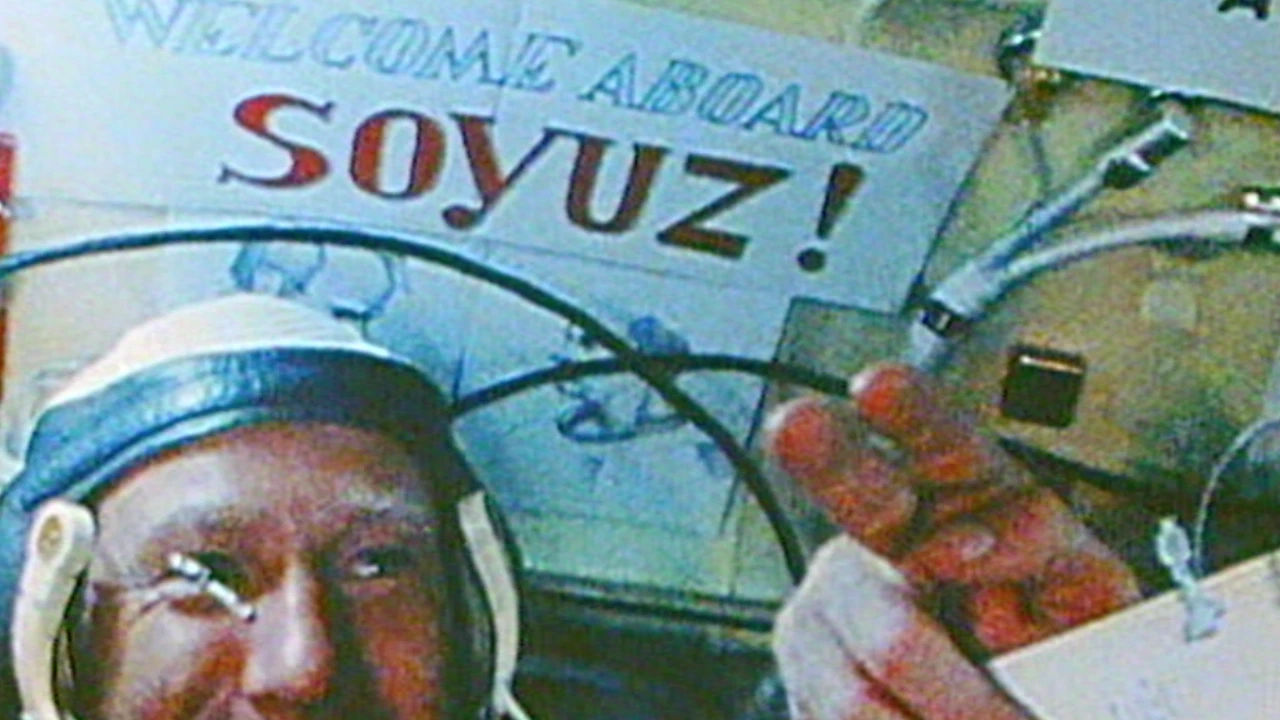
The successful joint mission, known as Apollo-Soyuz, in which an American Apollo spacecraft docked with a Soviet Soyuz craft and the two crews met, shook hands, and exchanged gifts, marked the end of the space race in 1975.
So, in the end, what was the point of this whole space race?
Was it just a massive waste of time?
Two major superpowers trying to outdo each other by pursuing symbolic projects that were both dangerous and expensive, using resources that could have been better spent elsewhere?
Well, sure, sort of, but the biggest benefits of the space program had nothing to do with one country beating another.
During the space race, funding for research and education, in general, increased dramatically, leading to many advances that may not have otherwise been made.
Many NASA technologies developed for space are now widely used in civilian life, from memory foam in mattresses to freeze-dried food, to LEDs in cancer treatment.
And, of course, the satellites that we rely on for our GPS and mobile phone signals would not have been there without the space program.
All of which goes to show that the rewards of scientific research and advancement are often far more vast than even the people pursuing them can imagine.
Up Next
13:46
Augustus vs Antony: The Final War of the Roman Republic
@OverlySarcasticProductions
566.4K views•2018-04-06

33:02
The Great Schism of 1054: Causes and Consequences
@SacredCathedrals
113.5K views•2026-02-19
5:49
The 1947 Partition of India: Causes and Lasting Legacies
@TEDEd
4.6M views•2021-06-21
17:05
Understanding the Cold War: Superpower Conflicts and the Road to Détente
@OverSimplified
46.1M views•2019-01-24
Related Study Plans & Knowledge Roadmaps
Structured learning paths in History
history
Byzantine Iconoclasm: Theology, Art & Politics
01Foundations of Byzantium and Early Christian Images
02The First Iconoclasm: Leo III and the Crisis of Images
03Empress Irene, Nicaea II, and the Second Iconoclasm
+ 2 more learning modules
9h5 modules
Explore Roadmap
history
Iranian Revolution (Causes, Events & Legacy)
01The Pahlavi Dynasty and the Roots of Discontent
02The Spark of Rebellion and the Rise of Khomeini
031979: The Fall of the Shah and the Climax of the Revolution
+ 2 more learning modules
8h5 modules
Explore Roadmap
history
Mali Empire: Mansa Musa, Trade & Timbuktu
01Foundations of the Mali Empire
02The Trans-Saharan Gold and Salt Trade
03The Reign and Pilgrimage of Mansa Musa
+ 1 more learning modules
6h4 modules
Explore Roadmap
history
1947 Partition: Politics, Borders & Legacies
01Foundations of British India and the Divide
02The Political Negotiations and the Mountbatten Plan
03Drawing the Boundary: The Radcliffe Line
+ 2 more learning modules
8h5 modules
Explore Roadmap