






















The Kronig-Penney model demonstrates that electrons in a one-dimensional periodic potential form alternating allowed energy bands and forbidden energy gaps; the width of allowed bands increases with energy while forbidden gaps decrease with increasing potential strength, and as the potential barrier height approaches infinity, the continuous energy bands compress into discrete energy levels.
Kronig-Penney Model: Energy Bands in Periodic Potentials
Added:The 1D Time-Independent Schrödinger Equation and its application to simple potential barriers.
Bloch's Theorem, which describes the wavefunctions of particles in a periodic potential.
The concept of a crystal lattice and periodic boundary conditions in one dimension.
Basic matrix algebra and boundary condition matching for solving systems of differential equations.
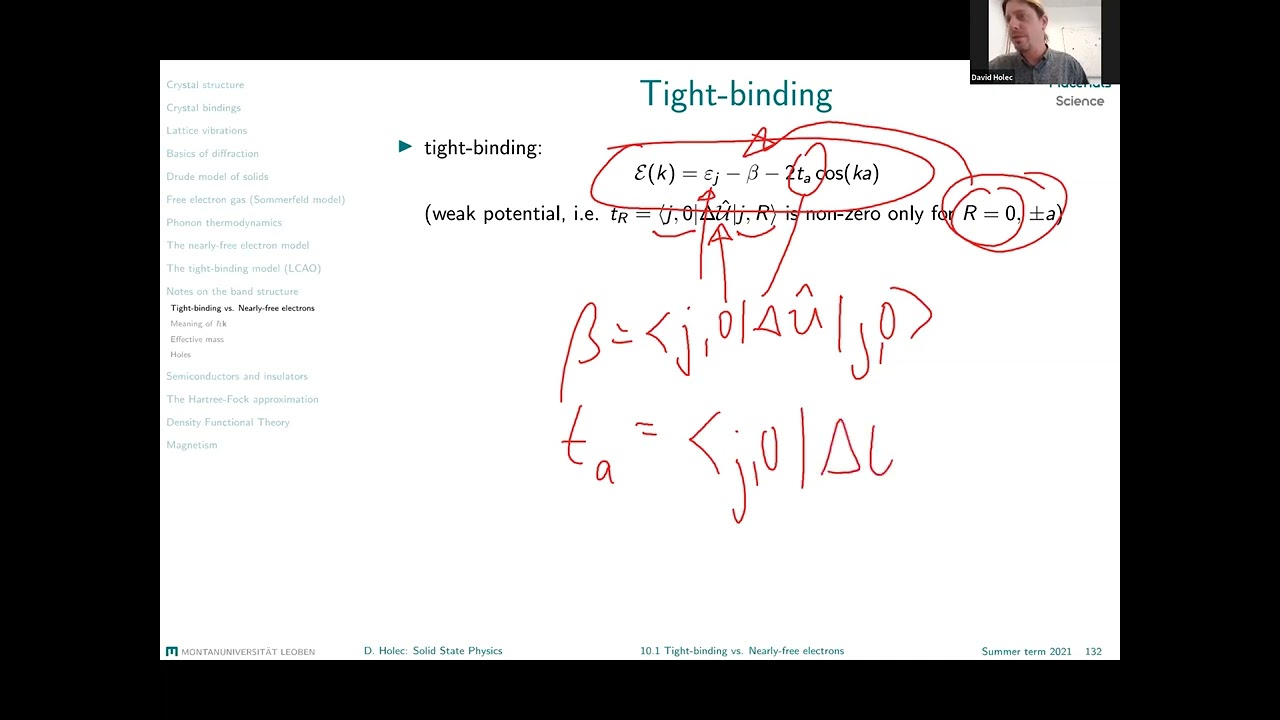
The Nearly Free Electron Model and the Tight-Binding Approximation as alternative methods for band structure calculation.
The concept of electron 'effective mass' derived from the curvature of E-k dispersion curves.
The classification of materials into conductors, semiconductors, and insulators based on band occupancy and band gap size.
Extension of periodic potential analysis to 2D and 3D lattices, including Brillouin Zones and Fermi surfaces.
37K views363likes6:50Original Release: 2019-01-04
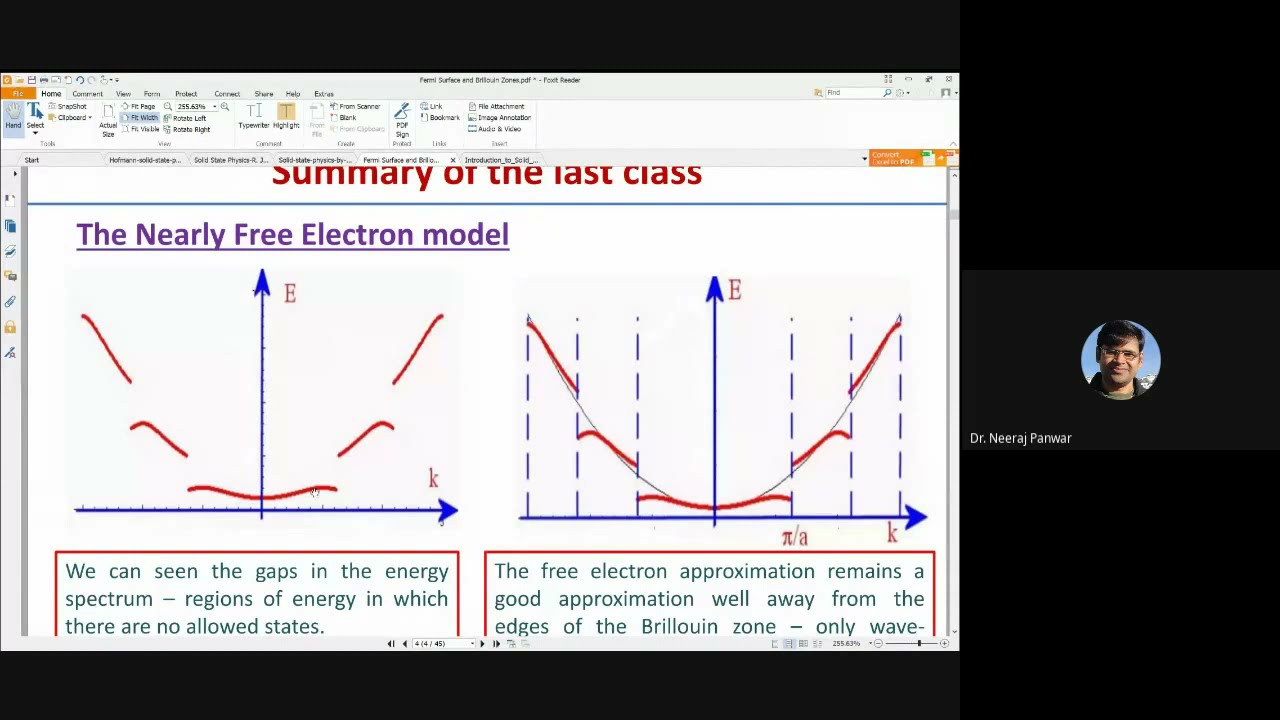
[Music] we will discuss about the chronic penny model band theory of solids this model illustrates the behavior of electron in a periodic potential by assuming a relatively simple one dimensional model of periodic potential as shown in this figure the potential energy of an electron in a linear array of positive nuclei is assumed to have the form of a periodic array of square well with period of a plus B at the bottom of the well that is at the region X greater than 0 less than in the electron is assumed to be in the vicinity of nucleus and the potential energy is taken as 0 whereas outside the well for X greater than minus B less than 0 the potential energy is assumed to be V naught although this model implies a very crude approximation to the type of periodic potential existing inside the lattice yet it is very useful to illustrate various important features of the quantum behavior of the electrons in the periodic lattice toy function are obtained by the writing Hollinger equation for the two regions as this assuming that the energy capital e of the electron is less than V naught we define two real quantities alpha and beta as therefore these two equation becomes like this since the potentially periodic the wave function must be on the bottom of the block function that is high X goes to e to the power ikx UK x where UK x is the periodic function in eggs with periodicity of a plus b from here we can calculate the value of psi DX and then d2 side TX 2 now substituting the equation in the previous page we get those equation like this for u 1 and u 2 represents the value of UK function of X in the interval X greater than 0 less than a and X greater than minus B less than 0 respectively the general solution of this equation are u 1 and u 2 like this where ABC T are constants which can be determined from the following boundary condition if we take some boundary condition irrigate the four boundary condition as this four equation applying these boundary conditions this four boundary condition to equation previous these two equation we obtain the following for linear homogeneous equation like this and these equations are used to determine the constants a B C and T a nonzero solution of this equation exists only if the determinant of the coefficient of ABCD is vanishes on solving the determinant we obtain the following equation beta square plus alpha square by 2 beta alpha sine Harvell hyperbolic beta B sine alpha A plus cos hyperbolic beta B cos alpha the course K is a function of a plus B to simplify this equation chronic and pain I considered that this K in this case when V naught tends to infinity and P are purchased with zero but the product V naught B divins finite and after some simplification an assumption we get the final equation like this P sine alpha by alpha A plus cos alpha equals two cos K a where P equals 2mv not PA by H cross square which is the measure of the area V naught B of the potential barrier now if you plot P by alpha sine alpha I plus cos alpha but says alpha a using P equals to 3 PI by 2 then this graph like this the Sala T and the broken lines on the ab c correspond took allowed and forbidden energy medians respectively now the energy spectrum of the electron consists of the alternate regions of allowed energy bands and forbidden energy events the wiith of the allowed energy bands increases with alpha or the energy the width of the particular allowed and an Sheba and decreases with increase in the Hanwha P that is the increase in the binding energy of the electrons experience to infinity the allowed energy bands are compressed into energy levels and the nine spectrum is resulted so this is the derivation and the grab of the chronic penny model in the chapter parent theory of solid [Music] you
Up Next
31:45
Fundamentals of Semiconductor Devices: Course Introduction
@nptel-indianinstituteofsci8064
256.6K views•2019-01-11

12:53
21cm Hyperfine Transition in Neutral Hydrogen: Radio Astronomy Basics
@AaronRobertParsons
12.4K views•2011-10-13

32:32
NMR Spin Physics I: Zeeman Effect, Resonance Condition & Larmor Frequency
@nptel-indianinstituteofsci8064
2.3K views•2024-01-17

27:14
Entropy and the Second Law of Thermodynamics Explained
@veritasium
27.5M views•2023-07-01
Related Study Plans & Knowledge Roadmaps
Structured learning paths in Physics
physics
Nuclear Physics (Decay, Fission & Reactors)
01Atomic Structure and the Binding Force
02Radioactive Decay and Half-Life
03Nuclear Fission Mechanics and Chain Reactions
+ 2 more learning modules
12h5 modules
Explore Roadmap
physics
Soft Matter (Polymers, Colloids & Rheology)
01Foundations of Soft Matter & Thermal Forces
02Polymer Physics and Macromolecules
03Colloids, Surfactants, and Self-Assembly
+ 2 more learning modules
38h5 modules
Explore Roadmap
physics
Analytical Mechanics: Lagrangian & Hamiltonian
01Mathematical Foundations: Calculus of Variations
02From Newtonian Mechanics to Constraint Dynamics
03The Principle of Least Action & Lagrangian Mechanics
+ 3 more learning modules
28h6 modules
Explore Roadmap
physics
General Relativity (Spacetime & Cosmology)
01Foundations of Relativity: Special Relativity
02The Geometry of Spacetime: Equivalence Principle & Curvature
03Einstein's Field Equations: The Mathematics of Gravity
+ 2 more learning modules
55h5 modules
Explore Roadmap