

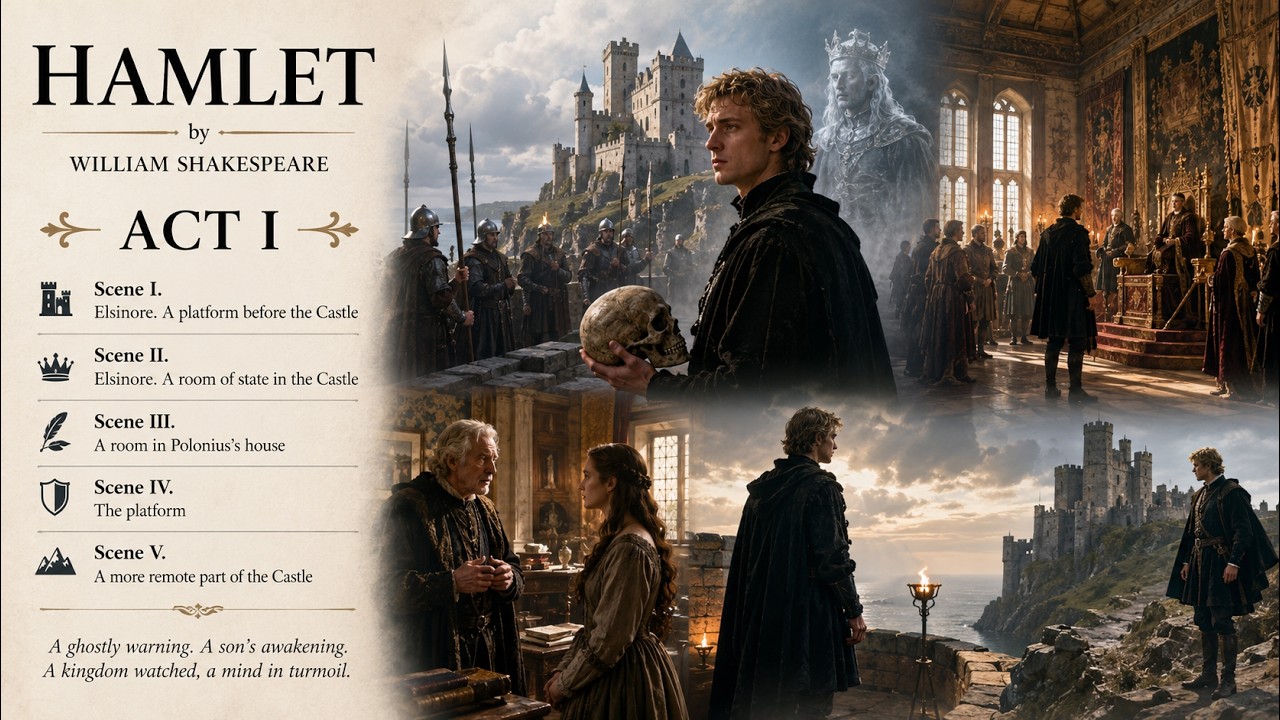














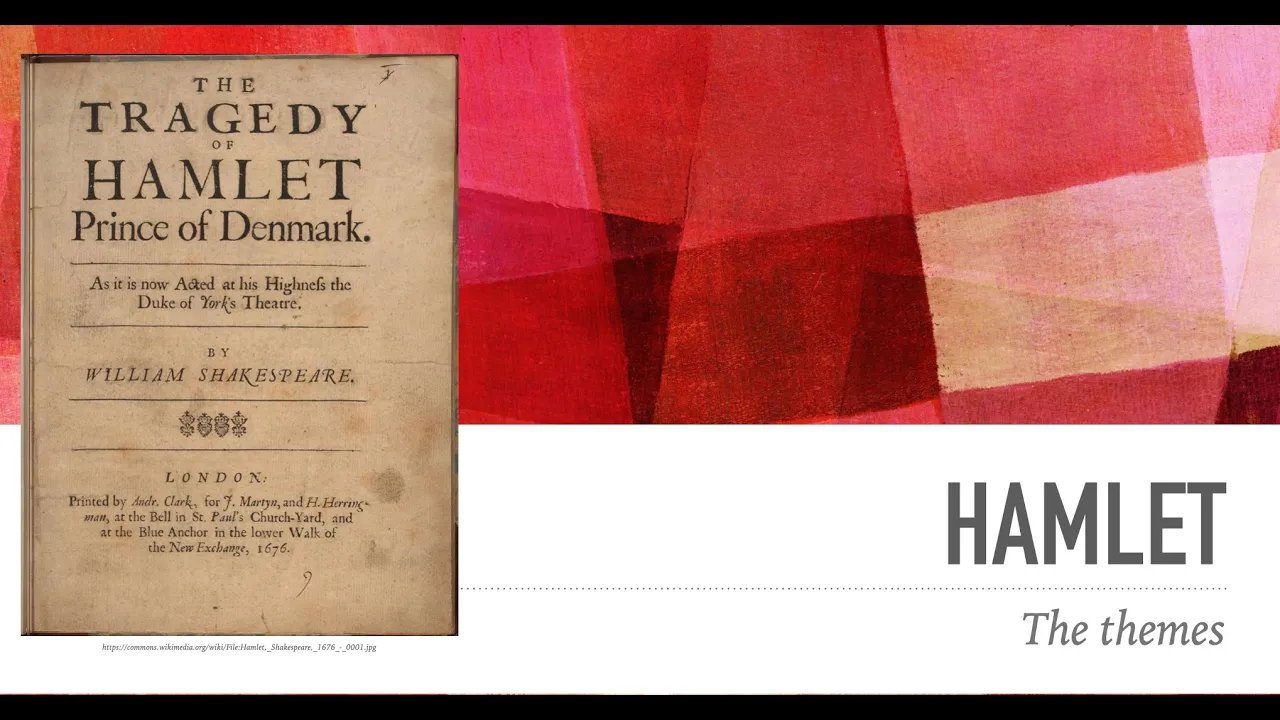






In Act 1 Scene 5 of Shakespeare's Hamlet, the ghost of King Hamlet reveals to his son that he was murdered by Claudius, his own brother, through poison poured into his ear while sleeping; the ghost implores Hamlet to seek revenge for this 'most foul, most unnatural' murder, setting the central plot in motion.
Hamlet Act 1 Scene 5 | Ghost's Revelation & Revenge | Shakespeare at Play
Added:Familiarity with the preceding events of Hamlet (Act 1, Scenes 1-4), including the sudden death of King Hamlet, Claudius's quick marriage to Gertrude, and the initial sightings of the Ghost by the watchmen.
Understanding of Elizabethan cultural beliefs regarding the supernatural, purgatory, and the moral ambiguity of ghosts (whether they are honest spirits or demonic temptations).
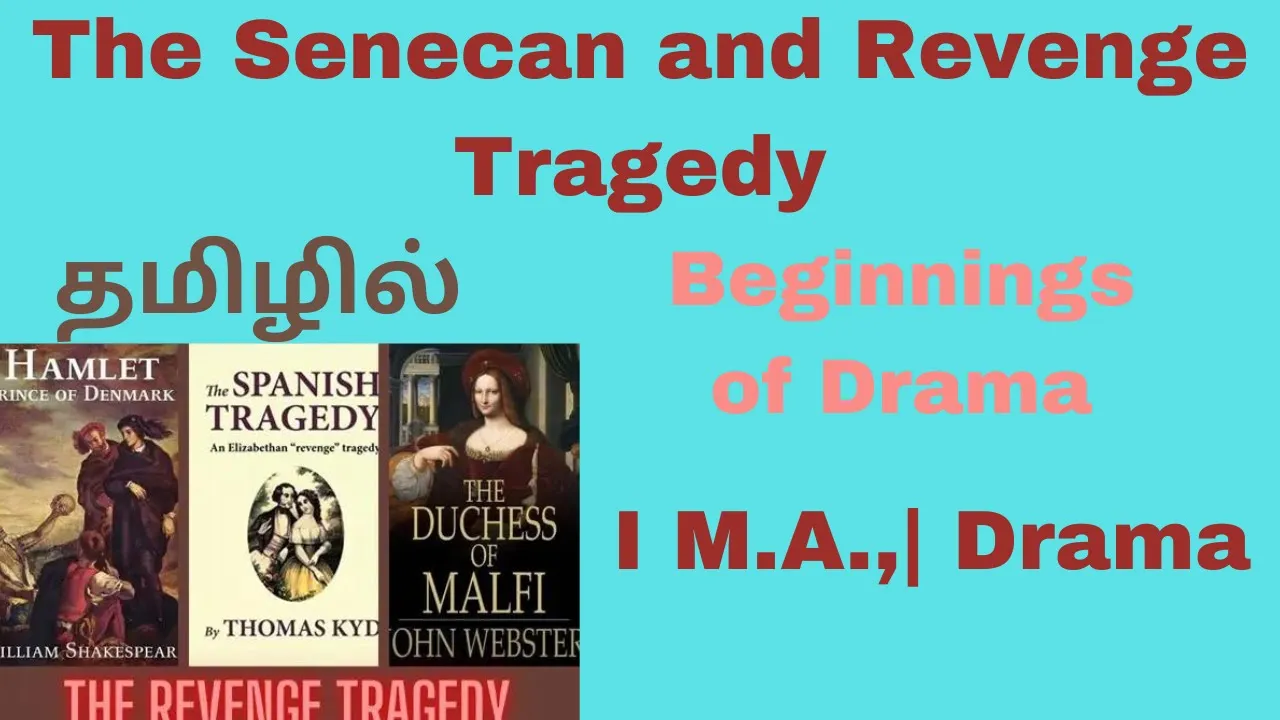
An introduction to the conventions of the 'Revenge Tragedy' genre, which typically features a secret murder, a ghostly visitation demanding justice, and a protagonist's pursuit of vengeance.
A basic grasp of Shakespearean dramatic techniques, particularly the use of soliloquy, aside, and blank verse to reveal a character's inner psyche.
Analysis of Hamlet's 'antic disposition' (feigned madness) which he plans immediately after this encounter, and how it affects his relationships in the subsequent acts.
Exploration of the theme of inaction versus action, examining the psychological barriers that lead to Hamlet's famous delay in executing the Ghost's command.
In-depth study of the moral and religious conflicts of revenge, contrasting Christian doctrines against the ancient codes of honor and personal retribution.
Comparison of various theatrical and cinematic interpretations of the Ghost's appearance, analyzing how different directors choose to represent the Ghost's physical reality versus Hamlet's subjective psychological state.
25.4K views159likes11:26Original Release: 2023-01-06
where both thou Lead Me speak I'll go no further mark I will my hours almost come when I sulfurous and tormenting Flames must render up myself Alas poor ghost Pity Me Not lend thy serious hearing to what I shall unfold speak I am bound to hear so art thou to Revenge when thou shalt here what I am thy father's spirit doomed for a certain term to walk the night and for the day you can find her fasting fires to the foul crimes done in my days of nature are burnt and purged away but that I'm forbidden to tell the secrets of my prison house could a tail unfold whose lightest word would Harrow up thy Soul freeze thou Young Blood make thy two eyes like Stars start from their spheres if I knotted and combined it locks apart and each particular hair to stand on end like quills upon the fretful porpentine this eternal blazing must not be to ears of flesh and blood list all lists if thou did stare at thy dear father alone oh God Revenge his foul and most unnatural murder murder murder most foul as in the best it is in this most foul strange and unnatural haste me to know it that I with wings as Swift as meditation or the thoughts of love may sweep to my revenge and I find the APT and dollar should thou B than the fat weed which Roots itself in ease in Lethy Wharf Woods thou not stir in this now Hamlet here it has given out that sleeping in my Orchard a serpent stung me so the whole year of Denmark is by a forged process of my death frankly abused but know thou Noble youth the serpent that did Sting thy father's life now where's his crown oh my oh my soul my uncle I that incestuous that adulterate Beast with witchcraft of his wit with traitorous gifts oh Wicked wet and gifts that have the power so to seduce one to his shameful lust the will of my most seeming virtuous Queen what a falling off was there from me whose love was of that dignity that it went hand in hand even with a vow I made to her in marriage to decline upon a wretch whose natural gifts report to those of mine and virtue as it never will be moved though lewdness corded in a shape of heaven so lust though to already an angel linked will save itself in a Celestial bed and prey on garbage soft he thinks I sent the morning air brief let me be sleeping within my Orchard my custom always of the afternoon upon my secure hour thy Uncle stole with juice of cursed Heaven on in a vial and in the porches of my ears did pour the leprous distillment whose effect holds such an enmity with blood of man that Swift is Quicksilver it courses through the natural Gates and alleys of the body and with a sudden Vigor does pass it and occurred like eager droppings in the milk the thin and wholesome blood so did it mine and our most instant Tetter barked about most lazar-like with vile and Lonesome crust oh my smooth body thus was I sleeping by her brother's hand a life of crown of Queen at once dispatched cut off even in the blossoms of my sin on household disappointed underneath no Reckoning made but sent to my account with all my imperfections on my head horrible oh horrible most horrible is thou Hast nature in the Barrett not let not the Royal bed of Denmark be a couch for luxury and damn good incest howsoever thou pursue is this act take not their mind nor let thy soak and Thrive against thy mother ought leave her to Heaven into those Thorns that entered bosom lodged Frick and stinger fairly well at once the globe shows the mountain to be near begins to pale his uneffectual fire I do I do Hamlet remember me oh all you host of Heaven oh Earth what else and shall I couple hell bye hold hold my heart and you my sinews grown out instant old but bear me stiffly up remember Thee the poor ghost while memory holds a seat in this distracted Globe remember thee yay from a table of my memory I'll wipe away all trivial fond records all saws of books all forms all pressures past that used an observation copied there and thy commandment all alone shall live within the book and volume of my brain unmixed with base or matter yes by heaven oh most pernicious woman oh villain villain smiling damn it villain my tables meet it is I set it down that one may smile and smile and be a villain at least I'm sure it may be so in Denmark so uncle there you are now to my word it is had you had you remember me I have sworn so be it hello ho ho boy come Bird come how is it what news my Lord oh wonderful good my Lord tell it no he'll reveal it my Lord by Heaven Nor I my Lord I see you then what heart of man once think it but you'll be secret aye by Heaven my Lord there's never a villain dwelling in Old Denmark but he's an errant Nave there needs no ghost my Lord come from the grave to tell us this well I write you are the right and so without more circumstance at all I hold it faith that we shake hands and part you as your business and desire shall point you for Every Man Has business and desires such as it is and for my own part look you all go pray these are but wild and whirling words my Lord I'm sorry they offend you heartily yes Faith there's no offense my Lord yes by Saint Patrick but there is Horatio and much offense too touching this Vision here it is an honest ghost that let me tell you for your desire to know what is between us or Master it as you may and now good friends as you are friends Scholars and soldiers give me one poor request what is to my Lord we will never make known what you have seen tonight my Lord we will not nay but swear it in faith my Lord not I nor I my Lord in faith upon my sword we have sworn my Lord already indeed upon my sword indeed boy say stuff so they're a true penny come on you hear this fellow in the celerage consent to swear propose the oath my Lord never to speak of this that you have seen swear by my sword then we'll shift our grounds come hither gentlemen and lay your hands again upon my sword never to speak of this that you have heard swear by my sword said oh mole against work of the earth so fast oh worthy pioneer who wants more remove good friends oh day and night but this is Wondrous Strange and therefore as a stranger give it welcome there are more things in Heaven and Earth Horatio than our Dream tough in your philosophy but come here as before never so help you Mercy how strange or odds so air I bear myself as I perchance Hereafter shall think meat to put an antic disposition on that you at such time seeing me never shall with arms encumbered us or this head shake or by pronouncing of some doubtful phrase as well we know or we could and if we would or if we list to speak or there be and if they might or such ambiguous giving out to note that you know art of me this not to do so grace and mercy at your most needs help you swear rest rest perturbate spirit so gentlemen with all my love I do commend me to you and what's so poor a man is Hamlet is May do to express his love and friending God willing shall not lack let us go in together and still your fingers on your lips I pray the time is out of joint oh curse it's spite that ever I was born to set it right nay come let's go together
Up Next

20:47
Senecan Tragedy Origin, Themes, and Literary Influence Explained
@drmuthumeenalosiniarmstron6227
193 views•2025-05-14

40:06
Street Haunting: Virginia Woolf’s London Essay Analysis
@ExtraLiteraryAffairs
146 views•2025-01-24

6:08
Point of View in Fiction: First Person vs. Third Person
@magicalthriftyteacher
153.8K views•2014-03-31

15:25
1984: Orwell's Dystopian World and the Mechanisms of Totalitarianism
@AlternateHistoryHub
7M views•2017-03-04
Related Study Plans & Knowledge Roadmaps
Structured learning paths in Literature
literature
Graphic Memoirs: Visual Art, Trauma & History
01Foundations of Sequential Art and Visual Language
02Autographics and Processing Historical Trauma
03Visualizing Personal Trauma, Grief, and Graphic Medicine
+ 2 more learning modules
14h5 modules
Explore Roadmap
literature
Campus Novels: Evolution, Themes & Critique
01Introduction to the Campus Novel Genre
02Mid-Century Satire and the Post-War Academy
03Dark Academia and the Critique of Privilege
+ 2 more learning modules
14h5 modules
Explore Roadmap
literature
Theater of the Absurd: Philosophy & Plays
01Postwar Existentialism & Historical Roots
02Dismantling Narrative: Esslin & Absurdist Conventions
03Samuel Beckett and Tragicomic Existentialism
+ 2 more learning modules
12h5 modules
Explore Roadmap
literature
Revenge Tragedy: Justice, Madness & State
01Foundations of Early Modern English Theatre
02Anatomy of Revenge: Structural Conventions
03Psychological Complexity: Madness and Melancholy
+ 2 more learning modules
15h5 modules
Explore Roadmap