



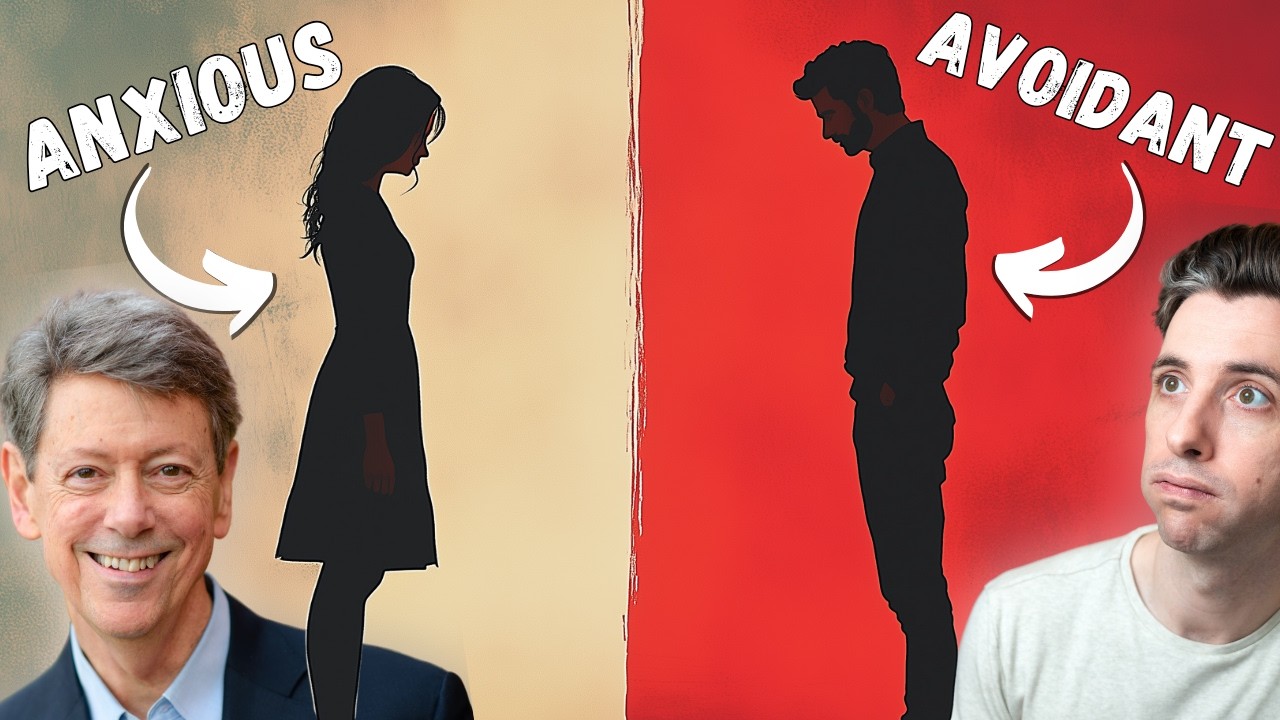













The Anxious-Avoidant Trap is a cyclical relationship pattern where individuals with anxious attachment (who crave connection and fear abandonment) are drawn to avoidant partners (who fear intimacy and withdraw), creating a push-pull dynamic where both partners unconsciously choose partners who won't meet their core needs, perpetuating a cycle of validation-seeking and defensive behaviors; however, these relationships can be transformed through understanding attachment styles, practicing effective communication (mirroring, validation, empathy), using positive action language, and avoiding trigger statements based on each partner's attachment style.
Anxious-Avoidant Relationship Fix: Effective Communication Strategies
Added:Introduction to Bowlby and Ainsworth's Attachment Theory, specifically defining Secure, Anxious, and Avoidant attachment styles.
The concept of the 'Pursuer-Distancer' dynamic (also known as the demand-withdraw pattern) in interpersonal communication.
Basic emotional regulation concepts, including how hyperactivation and deactivation strategies manifest under relational stress.
Fundamental active listening and assertive communication principles as contrasted with defensive or passive-aggressive patterns.
The process of developing 'Earned Security' and transitioning from insecure to secure attachment patterns over time through targeted self-work.
Key concepts of Emotionally Focused Therapy (EFT) and how clinical professionals de-escalate the anxious-avoidant cycle in couples counseling.
The psychology of healthy boundary setting, limit enforcement, and navigating conscious uncoupling or relationship dissolution.
Intergenerational attachment patterns: Analyzing how early childhood dynamics influence adult partnerships and how to break these cycles for future generations.
328.9K views12.8Klikes30:08Original Release: 2021-10-06
- If you always seem to find yourself back in the same old relationship patterns with partners that you love to hate, and hate to love, you may be caught in the roller-coaster relationship, which I refer to as the Anxious-Avoidant Trap.
(chimes tinkling) The Anxious-Avoidant Trap is a situation in which we find ourselves caught in, push-pull, on-again-off-again rollercoaster relationship dynamics.
Now on the surface most people seem to view these relationships as a case of opposites attract, but truly it is a case of like-sees-like.
In this video I'm going to share a clip of a live-stream event with my online students, in which we explore why anxious and avoidant partners are drawn to each other, how they both attract and repel each other through activating and deactivating strategies, how to know if the relationship has a chance and common triggers and tips for communicating in the Anxious-Avoidant Trap.
By the end of this video the chemistry between you won't be such a mystery anymore.
You'll know exactly how and why you are pushing your partner away, you'll have a good idea if it really is salvageable, and you'll have the tools to give it a real shot if it is.
There is so much good content in this video, you are definitely going to want to save it and come back to it later so you can let it sink in.
I would also love to read your thoughts, experiences, and comments below, but first, if you are new to my channel, welcome, my name is Briana MacWilliam and I am a licensed and Board-Certified Creative Arts Therapist with more than 15 years in the field, helping adults struggling with insecure attachment, go from self-doubting to self-sovereign so they can attract the soul shaking passionate partnerships that they want.
And I do this using a psycho-spiritual approach to creative arts interventions, which I call, The MacWilliam Method.
The content on my YouTube channel is derived from my online courses, which you can learn more about through the link in the caption of this video.
If you would like to learn more about your attachment style, you can take the four-question quiz.
If you like what you see in here, and you want to learn more, make sure you like, subscribe, and ring the bell for notifications.
I put up videos once a week and I wouldn't- (bell dinging) Want you to miss out.
Okay, so let's dive into our topic for today.
Now, as I mentioned, the Anxious-Avoidant Trap is a situation in which we find ourselves caught in these kinds of unhealthy push-pull, on-again-off-again relationships.
Now on the surface a lot of people think this is a case of opposites attract, but I really think it's a case of like-sees-like, and I'm gonna talk more about why that is.
For example, have you ever thought to yourself, I know this relationship is unhealthy, but I can't leave this person, why am I so afraid of being alone?
I mean, this is probably the best I could do, I just know there's so much potential here.
Sometimes we're so good together, if only my partner would just get with the program and stop being so afraid of love then everything would be fine.
I know if I stay strong, and I love them well-enough they'll come around, no one else could love them as unconditionally as I do.
And so then you start falling into relationships with people who don't appreciate you and they take your generosity for granted, or they show up with fireworks one day and then disappear without explanation the next.
They treat you like an intimate partner, but they don't give you any physical intimacy, or they only seem interested in sex and then exclude you from other aspects of their lives.
Maybe they avoid labeling the relationship and make me feel kind of neurotic for needing that, they behave in a needlessly secretive fashion.
Maybe they ignore you for weeks and then text, miss you, at 2:00 a.m.
Now, if so, it's likely that you have anxious-avoidant, or anxious attachment, which I call an, Open Heart, and you have attracted a dismissively avoidant partner, which I call a Rolling Stone.
Now on the other hand, perhaps you have thought, I'm attracted to my partner and I think I love them, but every time we get close I start to feel suffocated and like they're trying to control me.
They start telling me that they'll be there for me no matter what and it only makes me feel bored, or it lessens my attraction to them.
I just need someone with an edge, someone who's a bit of a challenge.
You know they really deserve someone better, someone who can return that kind of selflessness, they'll just end up disappointed.
I'd be doing them a favor if I bow out now, maybe then we can still be friends, I just don't think I'm cut out for relationships And then you find yourself falling into relationships with people who are intrusive and over-controlling, tend to monitor every move you make, they have high demands and never seem to be satisfied, they take everything personally and over analyze everything you say.
They might interpret most situations in the negative and they press for too much too fast, they don't respect your boundaries, or your need for space, they expect you to kinda read their mind and then they blow up when you don't.
They show up as hot one minute and then cold the next, right.
And if that sounds more like you, then you may be the one on the avoidant end of the spectrum, what I call an avoidant Rolling Stone, and your partner may be the one who's more anxiously preoccupied.
Now, if you've harbored both of these sentiments at one time or another, or even simultaneously, then you may have what's called, Disorganized Attachment, Fearful Avoidance, Anxious Avoidant it sometimes called, I refer to these folks as, Spice of Lifers.
So these statements really illustrate two extreme ends of a spectrum of ambivalence, which in the context of interpersonal romantic relationship, we are gonna define as the Anxious-Avoidant Trap.
Now, when we are in the Anxious-Avoidant Trap, we are living in an addictive state of take, or get mode.
When we passionately want someone it stimulates a feeling similar to hunger, and I call this, Attachment Hunger, and we want to take or get the object of that hunger however and whenever we can.
So in essence we are trying to get what we did not as children, from a developmental perspective, and so our wounded inner child is often aroused and stimulated in these situations.
So, for example, both anxious and avoidant individuals they tend to have partners that are too available, or too consistent, or too predictable, they label these partners as too boring, or too nice.
Frequently I hear people saying, "I want someone with an edge to them," meaning they want someone that is gonna make them earn love and respect, they are aroused by that kind of challenge.
Well, why is that so sexy?
Because otherwise they don't feel worthy of the love they receive.
They want to have to work for it, to earn it, because they don't believe they are lovable enough as they are and love that is given too freely is therefore suspect, it has little or no value therefore it cannot be true.
So relationships then typically devolve into power plays in which lovers get caught up in this love-hate, push-pull dynamic, and emotional token economy.
(bell dinging) So, why are anxious and avoidant partners so attracted to each other?
Well, really it's for two reasons, the good and the bad (chuckling).
Now on the good side, anxious Open Hearts tend to admire the autonomy, the strength, the directiveness, the decisiveness, and the charisma of our avoidant Rolling Stones.
And avoidant Rolling Stones admire the passion, the creativity, the sensitivity, and the availability of our anxious Open Hearts.
They compliment each other in these ways, kind of like the yin-yang symbol.
Now, on the other hand, when it comes to our insecurities, we tend to pair with people who also confirm our preexisting beliefs about relationships, and that is called, a confirmation bias, and that can be bad for relationships, okay, especially insecure ones.
So that means that anxious types tend to pair with avoidant individuals because avoidant individuals behave in a dismissive way.
In the same sense avoidant people attract, and are attracted to anxious partners who make them feel smothered because both of those paradigms confirm their beliefs about what a relationship should look like.
However, that doesn't mean that this is a case of opposites attract, it's a case of like-sees-like, because anxious people choose partners that won't give them what they want.
When they are chasing down an avoidant partner, they are chasing down someone that will not give them what they want and as a result they are clinging to them, which means that they never have to surrender to the act of receiving.
And the act of receiving requires a letting go of control and embracing the unknown.
They also never have to confront the fear of being seen for who they truly are and then being rejected for their unworthiness, or not good enough-ness.
So in other words, they are choosing partners that don't look too closely.
Now, in my opinion, this is truly the attachment paradox.
Even anxious people are avoidant because they are choosing partners that they sense, or just flat out know through experience, won't give them what they want and then they cling to them which means they themselves never have to surrender to the act of receiving, why would they do this?
Well, because usually on an unconscious level, they perceive a surrender to receiving as akin to a loss of control and these are statements from people in my community.
I want this closeness so bad, but deep down I worry if I got it I would become completely lost and dependent.
Whoever I am, or whatever I am, will disappear, or I worry that if I finally got what I wanted, I would become, I would be the one that becomes bored, or withholding, and that seems cruel and I would rather play the role of the victim than to hurt somebody else, or if I was with someone that actually wanted to look closely enough, I'm terrified that they won't like what they find and then they'd abandoned and reject me anyway and then I'd feel twice as stupid and humiliated.
Now the thing I wanna point out here is this is exactly the same mechanism as the Rolling Stone, the avoidant partners inner monologue, and typically the unconscious one.
So, a Rolling Stone cannot allow themselves to receive either because it stimulates the anxiety and attachment hunger that they have buried down and repressed for so long.
It threatens to dismantle the sense of independence and equilibrium that they have accomplished in their lives and it also stimulates worthiness issues.
They're too good for me, they deserve better, I could never give them what they need, better to end it now at least we have good memories before it goes sour, no harm, no foul.
And so when it comes to the Anxious-Avoidant Trap, I would emphasize that while on the surface, this may seem like opposites attract, this is a case of like-sees-like.
Both partners are safely spinning their wheels in relationship patterns that they are familiar with and I call this, The Validation Trap.
(bell dinging) So let's talk about The Validation Trap.
The Validation Trap is a cyclical pattern of needing to prove yourself to someone else in order to gain approval and experience some kind of affirmation of your worthiness, which you probably never received as a child.
And it's really hard to break out of this pattern because if you do, you don't know who you are, or how to defend your right to be who you are, to need what you need, or want what you want.
So in other words it requires an overhaul of your sense of self and identity and that is no easy task.
Now, on the other hand, avoidant individuals are truly anxious.
If they didn't feel anxious there wouldn't be anything to avoid would there.
But avoidant individuals have varying degrees of awareness surrounding their anxiety, what they think it actually is and how they arrived at it.
Usually their anxiety stems from one of two experiences, which is emotional dismissal, or emotional confusion.
Now, if a Rolling Stone, a dismissive avoidant Rolling Stone, these folks are usually taught to systematically repress and cut themselves off from their emotions and so they struggle with accessing them, which makes them unaware of them.
So these dismissive folks tend to fear and avoid self-reflection they attribute most of their inner conflict to physical ailments, or external circumstances and people.
Now fearfully-avoidant folks, these are, Spice of Lifers, are usually more aware of their inner conflicts and they experience a lot of confusion around their emotions and they struggle to control them.
And that's because they likely experienced trauma as a child, or experienced a lot of mixed signals, around how to deal with their emotions, identify them, know what they are growing up, so they swing from one end of the spectrum to the other.
They can be emotionally explosive, but then rigidly withdraw and lockdown.
Now, ultimately we are trying to accomplish, to achieve, to experience, the relationship that we didn't get as children and our wounded inner child is often aroused and stimulated by these types of relationships because it's a form of bonding that we are familiar with, even if it's painful.
So well-known relationship expert, Harville Hendrix, explains this spark of attraction as meeting your Imago Match.
So an Imago partner is someone whom you instinctively know is gonna replicate your past relationships to relive in order to revise them, but instead of fixing anything you end up perpetuating the cycle.
And if it goes on long enough, unchecked, that becomes toxic to both parties with each partner employing these activating, or deactivating strategies.
(bell dinging) Okay, so what are Activating and Deactivating Strategies?
So let's look at what this means in terms of the anxious and avoidant partner's behavior in relationships and how they show up.
So anxious Open Hearts tend to implement what are called, protest behaviors, and these are behaviors that protest the separation from their attachment figure and they're aimed at establishing, or re-establishing, a connection in an insecure relationship and we refer to these as activating strategies.
Unfortunately, they usually only wind up pushing their partner away.
So examples of this include; excessive contact followed by a punitive withdrawal; keeping score in the relationship; acting hostile and various forms of emotional manipulation.
Now avoidant Rolling Stones on the other hand, tend to exert a sense of control by practicing detachment and these are deactivating strategies.
So these behaviors might look like they're words not matching up with their actions so they might verbally express an avoidance of commitment, but then act committed, or vice versa; maybe they focus on their partners flaws; they pine for the one that got away rather than being fully present in the moment; they avoid emotional intimacy in a current relationship by avoiding labeling the relationship; they might also be hyper or hypo sexual.
So for example, maybe they're hot and heavy with you, but you don't get to access any other part of their life, or maybe you're sort of stuck in the friend zone, but it seems like the chemistry would be amazing.
However, these emotional defenses usually don't work instead they feed that cycle of defensiveness and insecurity between you.
(bell dinging) So can anxious and avoidant relationships succeed?
Well, yes they can, but it does require intentional effort and it only works if both parties are equally willing to prioritize each other's needs as highly as their own, not more and not less.
It also requires being able to accomplish three things in communication: number one, implementing effective communication skills; number two, incorporating the use of positive action language; and number three, avoiding trigger statements according to attachment style.
Now, knowing your attachment style, and your partner's attachment style, greatly informs your ability to cultivate all three of these skills with ease.
So number one, effective communication skills.
This involves mirroring, validation, and empathy, okay.
So mirroring is basically paraphrasing what your partner has said to you in your own words.
Validating them means that you are saying I hear you and I can understand why that would be upsetting.
and empathy is connecting with them on an emotional level, right, it's more about connecting to their emotions.
So, knowing your partner's attachment style kind of clues you into how they see and perceive the world and even what they value most.
That means that you can perform all three of these mirroring, validation, and empathy, all three of these, you can perform these a lot more effectively.
Now positive-action language is a term borrowed from Marshall Rosenberg's book on "Nonviolent Communication," and he points out that we often use vague language to express our needs because it's a cover up for more vulnerable feelings underneath, feelings that we may not have the right to express, right.
We may also not have the right vocabulary to express them, or maybe we're purposefully obscuring this 'cause we're too afraid of being emotionally vulnerable and then being rejected.
So when we make vague defensive statements it tends to exacerbate conflict, but when we use emotional honesty, with positive action language, we create the possibility for connecting with our partners on a heart-centered level and that can also give them a roadmap to repair with us.
So for example, here's a vague statement, "You always ignore me."
Now, here's a more emotionally honest way of expressing that emotional experience.
"I'm feeling unappreciated and unimportant and I could use a gesture of love and reassurance."
Now here's that sentiment again, adding in the positive action language, "I'm feeling unappreciated and unimportant and could use a gesture of love from you."
"Like maybe if you surprised me with flowers once in a while, or something like that, that would make me feel attractive and loved and I love feeling that way, it's important for me to feel that way more often."
Now, in this case you are expressing how you really feel, versus criticizing someone else's behavior, you are explaining what you are needing with specificity, you are even making suggestions for what would help you to feel better and get your needs met, and you are letting them know how big of a priority that is for you.
Now, many people respond to an example like this by saying, "Uh, but if I have to ask it doesn't count," but this raise reflects an expectation of omnipotence on the part of your partner and it also keeps your own needs hidden from reproach.
It skirts around the possibility of saying what you want and need and feeling rejected if you find out that your partner doesn't care, or doesn't wanna attempt to help you meet your needs.
Why would that be a threat?
Well, because now you have proof that they're not as invested as you are and your attachment system flares up recognizing that as a threat to your connection to them and so it seems better to use vague language so you never have to be confronted with the truth in such a crystal clear fashion.
Now lastly, even when we are being emotionally honest, there are specific trigger statements that might mean very little to you, but maybe they mean quite a lot to your partner.
And those meanings are surprisingly predictable based on attachment style and that is gonna bring me to my last point, which is tips for communicating in the Anxious-Avoidant Trap based on attachment style.
(bell dinging) Okay, so let's talk about these tips for communication.
Now, a little while ago I surveyed my mailing list and online community asking them specific questions regarding communication and their attachment style.
So the following trigger statements and recommendations I'm going to make are based on the answers of over 200 respondents.
Now first, for anxious Open Hearts they might be triggered, or rattled, when a partner says things like, "Love is not enough, but I still love you."
"I'm sorry you feel that way."
"I don't know what you're so upset about, it's not that big of a deal."
"I need time alone to think about it, but I don't know how much, or when I'll be able to get back to you."
"I don't know why I feel that way, oh, the chemistry must just be off," or just giving you the silent treatment.
Now, if your partner is an open-heart, you may feel like they are coming at you, looking for you to fix the problem or find a solution, but really that's just how they have been trained to ask for reassurance.
So usually an open-heart can be easily reassured if you pay attention to the emotional energy of their communications, rather than the surface-level content of their words.
So here are a few tips for offering reassurances to Open Hearts.
So you wanna let them know that you are available for co-creative solutions.
"All right, you know what, we're gonna get through this and we will find a way together."
You wanna empathize with what they are feeling, versus what they are saying.
So, for example, "I don't know if I feel the same way about that, but I do know what it's like to feel that way about something that is important to me and I can relate to you on that level."
You might just pull them close into a hug, sometimes words are not what's needed at all.
You can use a calming voice when you listen to them and show that you're not afraid of their feelings.
You can reaffirm that whatever it is that they are saying and let them know that if it's important to them, it's important to you.
And when they cry, just let them, and let them know that it is okay to be sad and that they have a right to their feelings.
Now, remember Rolling Stones want more space because it helps them preserve their connections, but they are also afraid that you're not gonna understand this and be really unhappy and dissatisfied if they need space, but you can help them feel reassured by avoiding triggering statements and approaching your communication in a particular way as well.
So these are trigger statements you wanna avoid if your partner is more avoidant.
"I know you better than you know yourself."
"You wouldn't say, need, or do that, if you really loved me," "Nothing's wrong, I'm fine."
"If I have to ask it doesn't count."
"Keeping, insert anything, private means that you are lying or cheating on me."
"If you can't figure it out by now, then you don't know me well at all."
Now, instead you might offer reassuring statements that sound something like, "You've told me the ways in which being in a relationship can be difficult for you and I understand this is not about me, do what you need to do, I'll be here."
"If you can let me know when you're likely to check in, that would put me at ease."
Okay, now these tips might also help.
Ask if they could express themselves and their needs more clearly while trying to hold a more loving mindset, body language, tone of voice, and attitude.
You wanna help them feel reassured that the relationship does matter and it is worth the effort.
You can find some common ground around whatever the issue, or the situation is at hand.
You want to show respect and acknowledge what behaviors they are offering you as a show of their affection.
You wanna understand that the avoidance stems from feeling rejected and unloved in some way in their past, and you wanna be consistent by following up with them.
But this is a little bit tricky 'cause you don't wanna chase them down because too many messages can also freeze them up.
You wanna be there for them with a more gentle and balanced way and even if they need space, let them know you're not going anywhere, and you wanna prove that you're not trying to change or control them by pointing out specific things that you love about them especially.
So a lot of Rolling Stones are triggered by people who use the word, love, too quickly, okay, because they feel like love is a generic term and they often feel like when you say that you're in love with some fantasy, some idealized version of them, you're not really seeing them for who they really are, you're plugging them into some role that you've given them.
So if you do really love them, and you're not doing that, because let's be honest, sometimes you are, we wanna make sure that you are pointing out to the Rolling Stone, no, it's you that I see, it is you that I see and it is you that I love because of, bop-bop-bop, no vague language.
The more specificity you can use here the more they are gonna believe you and the more they will be open to receiving that.
Now for the Fearful Avoidant, or disorganized, Spice of Lifer, they can also feel annoyed by any or all of the triggered statements above, the difference is that they also express frustration around statements that hint at taking away their control, or questioning it.
They might also really hate statements that are intentionally ambiguous because that can leave them questioning their own intuition and reality.
Of course, that said, Spice of Lifers, also happen to be the folks that tend to utter ambiguous statements more than others.
So, they might feel triggered by statements like, "You're way too intense, you've lost control of yourself."
"You have no idea what you're talking about, I know what's going on here."
"You'll just mess it up, let me do it for you."
"You love me, you just don't know it yet."
"Maybe one day we'll be together for real, but right now I just don't know."
"You're so amazing, but I don't think you'll ever be satisfied."
"You haven't given us a real chance you're just responding to your old baggage."
"I love you, but I could never truly be with you."
Now unfortunately, reassuring a, Spice of Lifer, is very difficult.
Their attachment style is defined by an inability to self-soothe, and an inability to receive soothing from others, and that is because their attachment style is typically the result of trauma, which means that they need to be doing their own individual healing work while working on a relationship with someone.
That involves rewiring the limbic brain and nervous system, becoming aware of triggered responses so that they can mitigate the impact of their insecurities on your relationship instead of enacting trauma reenactments with you.
(bell dinging) Okay, so let's tie all of this together in summary.
The Anxious-Avoidant Trap is a situation in which we are caught in unhealthy push-pull relationships, where individuals have experienced similar wounding in their attachment relationships and have chosen opposite ways of coping with it.
A need for validation typically keeps us caught in these vicious defensive cycles of communicating and relating to each other and this is exacerbated by our activating and deactivating strategies, which are behaviors that ultimately push each other away while we are trying to hang on to the relationship.
Now, these relationships can evolve into a healthier dynamic, but only with partners that are willing and wanting to prioritize your needs as highly as their own.
And if you have such a partner the relationship would be benefited by three essential elements in communication.
And that is effective communication skills; the use of positive action language; and avoiding known trigger statements based on attachment style.
(chimes tinkling) Now let's say that you have followed all the good advice on how to communicate better, and it only seems to push your partner away, or maybe you even feel like all the good advice has actually intensified the toxicity between you and your partner.
In this case it's important to remember that emotionally honest and direct communication only works with individuals that are motivated to be and to grow in emotionally honest relationships.
If you attempt to express yourself with emotional honesty, positive action language, and avoid non-trigger statements, and your partner only responds by overreacting and accusing you of trying to make everything all about you, feeling ostracized, and claiming that you're trying to be emotionally manipulative simply by expressing how you feel, passively-aggressively going along with your ideas, whatever, just tell me what you wanna do and I'll do it, and then sabotaging your success, or walking out giving you the silent treatment, or otherwise behaving in a petulant manner, "Fine, I guess I'll go find comfort with somebody else."
Then it means your partner has likely experienced a trauma, developmental or otherwise, that has potentially resulted in damage to certain areas of the brain and nervous system and this has led to the formation of a rigid but fragile ego, which is basically someone's waking concept of themselves, what they think of as their own personality.
Now individuals that struggle with this may adopt intentionally cruel, vindictive, and manipulative attitudes.
Because they are emotionally immature, but can still be very emotionally perceptive, and they have not developed a healthy, mature sense of self, everything in their life experience will be filtered through the psychic lens that perpetuates unhealthy adrenaline highs through trauma reenactments, and endless attachment proximity negotiations, primarily involving strategies that position for power and control, whether that is aggressively, or passive-aggressively, overtly, or covertly, and potentially involving severe sadistic or masochistic tendencies.
Now individuals that fall into this category might also fit the diagnostic criteria for a personality disorder, for example.
For these folks emotional honesty, and a specificity of needs, is very threatening and exposing and often stimulates a very highly-defended and even offended response.
If this is your situation, you must realize that your partner has to be doing the work on themselves if they are ever gonna be able to meet you in an emotionally honest place.
That is the only way in which you will be able to grow with them in the context of this relationship, all you can do is create the possibility for change.
Improving your communication is one big step that you can take to create the opportunity for deepening intimacy, but you cannot force a partner to join you there.
And if they choose not to, that is really good information for you and it means you are now free to make the decision to make yourself available to someone who will.
Thank you for watching.
I look forward to seeing you here again next week.
Up Next

32:30
Anxious Attachment and Avoidant Dynamics: The Trap Explained
@MariannaTurovPhD
8.7K views•2022-03-06

12:54
Triumph of Orthodoxy Icon: Byzantine Art & History Explained
@BenCallan
2.1K views•2024-08-06

9:49
FastAPI vs Flask vs Django: Choosing the Right Python Web Framework
@TechWithTim
302.5K views•2024-05-26

1:42
Game of Thrones Opening Credits: A Cinematic Analysis
@gameofthrones
46.3M views•2011-04-18
Related Study Plans & Knowledge Roadmaps
Structured learning paths in General & Interdisciplinary Studies
general-studies
Elevator Engineering: History, Physics & Cities
01From Hoists to Safety Brakes: The Dawn of Vertical Lift
02Hydraulic vs. Traction: The Engineering Physics of Elevators
03Modern Speed, Safety, and Algorithms
+ 2 more learning modules
12h5 modules
Explore Roadmap
general-studies
Rubber: Material Science, History & Geopolitics
01Origins of Natural Rubber & Mesoamerican History
02The Chemistry of Natural Rubber & Vulcanization
03The Geopolitics of the Rubber Boom & Colonization
+ 2 more learning modules
12h5 modules
Explore Roadmap
general-studies
Containerization: Evolution, Logistics & Trade
01Ancient Trade & Bulk Cargo: Amphorae to Barrels
02The Industrial Revolution & Cardboard Packaging
03The Containerization Revolution: Malcom McLean
+ 2 more learning modules
12h5 modules
Explore Roadmap
general-studies
Textile Tech: Evolution, Labor & Global Impact
01Pre-Industrial Textiles: Handloom & Cottage Industry
02Mechanization: The Spinning Jenny to the Power Loom
03The Factory System & Global Labor Transformation
+ 2 more learning modules
10h5 modules
Explore Roadmap