













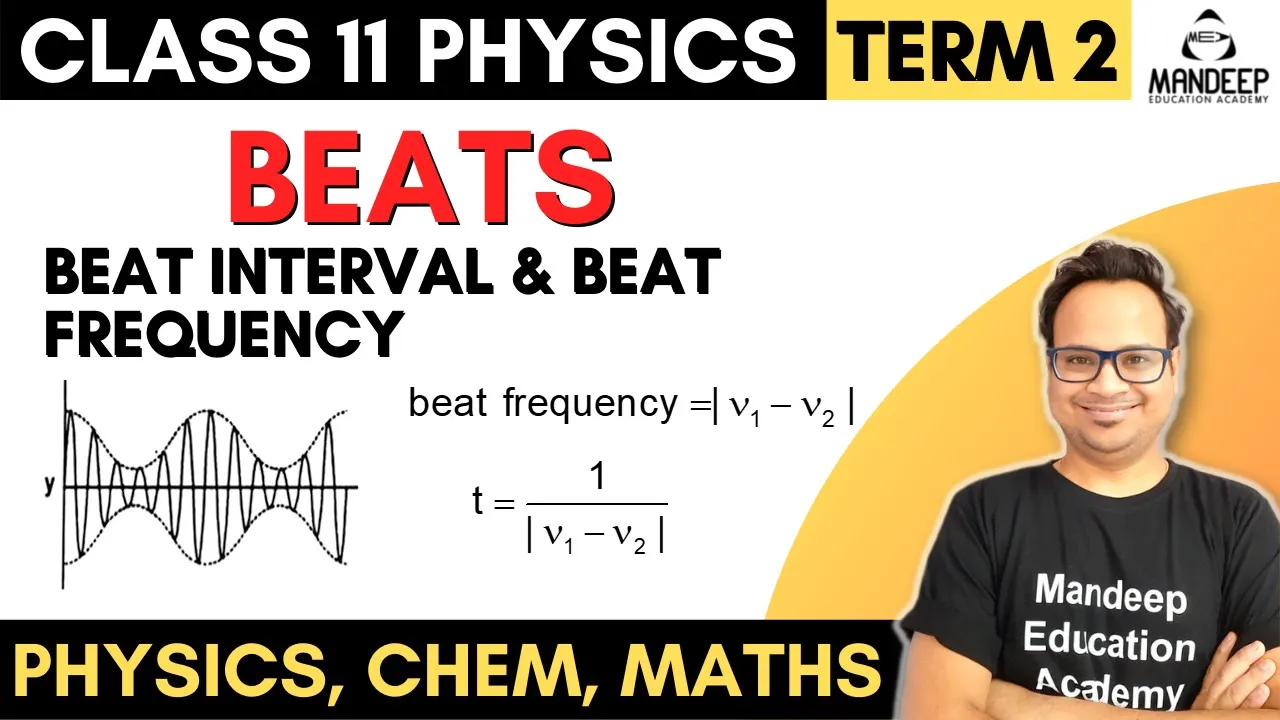



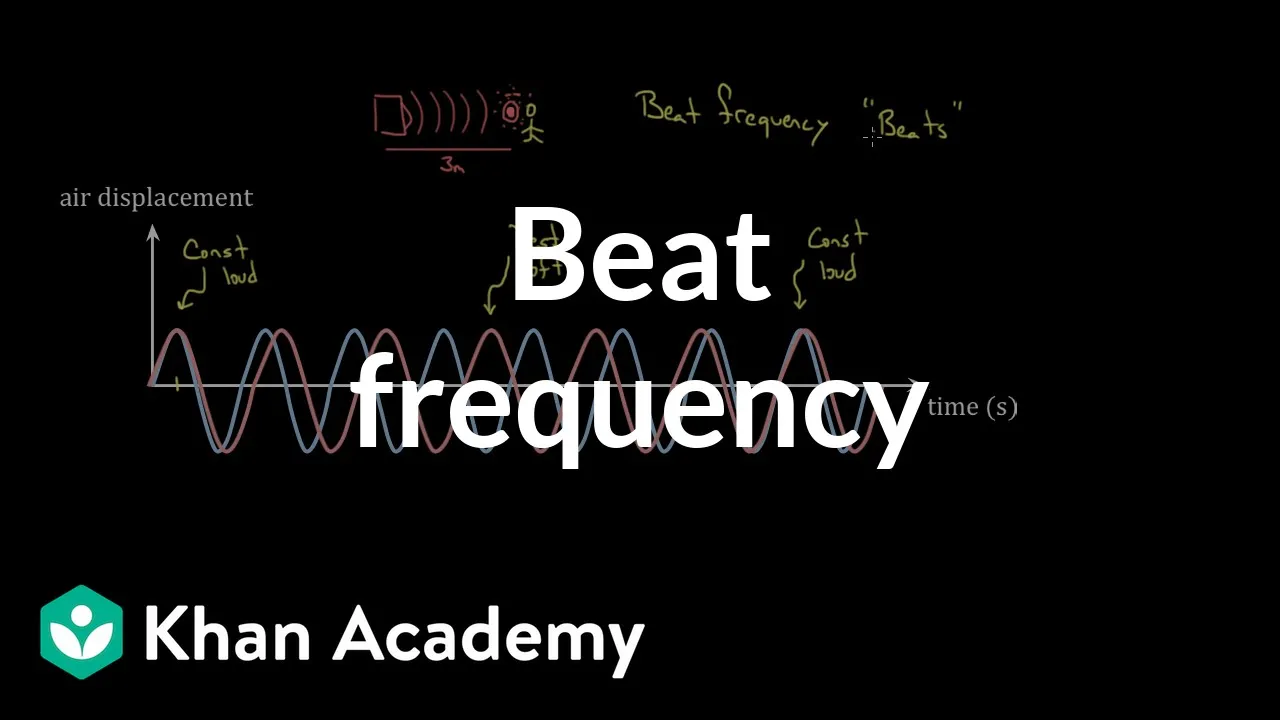








When two sound waves with different frequencies interfere, they produce alternating constructive and destructive interference patterns called beats, where the beat frequency equals the absolute difference between the two original frequencies (f_beat = |f1 - f2|). In this lab, tuning forks at 256 Hz and 320 Hz produced a beat frequency of 64 Hz, demonstrating how waves can pass through each other while interfering, with constructive interference creating larger amplitudes and destructive interference causing cancellation.
Wave Interference and Beats: Lab Demonstration
Added:Basic wave properties, including frequency, amplitude, wavelength, and phase.
The Principle of Superposition, explaining how overlapping waves combine mathematically and physically.
The nature of sound waves as longitudinal pressure waves propagated through a medium.
The fundamental differences between constructive and destructive interference.
The mathematical derivation of beat frequency using trigonometric wave equations.
Practical applications of beat frequencies in acoustic engineering and musical instrument tuning.
The study of standing waves, nodes, antinodes, and resonance in air columns and strings.
Exploration of wave interference in other domains, such as optical thin-film interference and double-slit diffraction.
125 views0likes12:47Original Release: 2013-04-04
yesterday you guys started working on this lab I'm not sure how far you got but I wanted to run through a couple things real quick and see what we got okay so this is just an introduction right this is what a sound level looks like versus time and over here it says sound level and volts basically the microphone is responding to the vibration of the air and it changes uh the resistance value of this little diaphragm anyways it's measuring pressure differences so we've got high pressure low pressure high pressure low pressure that course responds with the sound wave being produced a compression and a rare faction okay now prelab question given that a sound wave consists of of pressure increases and decreases what would happen if one increase was at the same spot as another decrease well they should cancel each other out right something's trying to squish something together at the same time another thing's trying to pulled apart it should be canceled no effect okay well we want to test that we want to see what happens okay so we actually used two tuning Forks today and and the microphone to measure these waves and we did it individually and then together okay and so I have some of this data here let me go ahead and pull it up okay the waveform for uh one of the tuning Forks looks like looks like this and you can see it's a sine wave right uh and so if we do an analysis of this if we say okay well let's just see what its frequency is or what its period is if I drag from the high point of one wave to the high point of another wave several crests later okay and so I've got 1 2 3 4 five 6 7 eight Cycles in here eight Cycles in 0.25 or 025 seconds that allows me to go ahead and get the uh frequency and period for this okay so I had eight Cycles I was like an eight eight Cycles in 00251 seconds and of course cycles per second 8 divided 0251 would get me its frequency and that's in hertz and then the period would be the inverse of frequency okay repeated the process for another wave now um this one that I just did okay how does it compare to the stamped frequency well when I did it in class it was really really close in fact there was one of them that was right on um so I expect these to be fairly close to the frequency that's stamped on the box um mine say 318 and I believe it was supposed to be 320 okay so remember a percent difference would be something like uh 38 minus the 320 it's supposed to be divided by the 320 it's supposed to be the absolute value and then multiply it by 100% make it a percent okay um I'm guessing it's fairly close less than a 2% thing so whatever okay uh I did collect for another tuning fork as well so I'm going to cancel out of this analysis and so run two was a different tuning fork and you can see this wave is a little bit longer it's not as frequent and if we analyze this one with the Delta um then I can drag from a high to a high Crest to Crest okay and I see one two 3 4 five 6 7 Cycles in 0273 seconds okay 7 0273 and again I can take 7 divid 0273 and get my frequency and I think this one should be close to 256 um so let me check the math there 7 / 0273 uh and I get 26.4 okay so again that's pretty close to exactly what I wanted 256 Hertz again the really good numbers now the question here is what would happen if we put these two waves together okay um so I want to show you both waves at the same time and I'll get these displayed so that we can look at both of them at once okay so here we see both graphs at the same time and I'm going to superimpose them I'm put them right on top of each other in a minute but you can see um this red one at the top happens a little bit more frequently this blue one at the bottom a little bit less frequently um but they're both oscillations that go up and down in time now I'm going to go ahead I'm going to superimpose these onto the same graph with both of these on the same graph you can see a little bit more clearly what happens like right at the beginning this green line and this red line they're complete opposites of each other and so I've got a peak up here and and a peak up here and then as time goes by they get closer and closer to in line with each other until you can see right here they line up almost exactly and then they start to misalign again and then in here we see that they misalign almost exactly but then by the time we get over here they're lining back up again okay so this was two waves recorded at two different times what happens if we play the tuning Forks together and measure the resulting wave when we do that we get this graph okay this graph shows two patterns it shows a sine wave inside a sine wave W okay so you've got a quick vibration but then you've also got this uh bigger vibration where you have this peak and Valley Peak and Valley Peak and Valley okay and so this is what happens when two waves interfere they move through each other and when they're going in the same direction they add together and get bigger when they're vibrating in opposite directions they add together and get smaller okay so if I go ahead and I superimpose one more time all three graphs together okay you got to kind of pay attention to what you're looking at um and these didn't necessarily start at the same time in fact I see that they did not um so yeah that's a that's a mess so let's look at this a different way okay I'm going to bring in a wave simulator and we've looked at this before okay um and so I'm going to have an end on this one so that I actually get a reflection that comes back and I'm going to change it to pulse I'm going to turn damping down and I'm going to send two pulses then I'm going to pause it now this wave is going to get to the end and it's going to start to come back and so I'm going to step this through okay so that wave got to the end and now it's reflecting back on the other side so now this wave at the bottom is coming back to the left this wave is at the top is moving towards the right and they're about to hit so let's see what happens when I step through okay it looks like there's no waves anymore looks like they cancel each other out so those two waves got together and got smaller okay well but then they keep moving okay so this is the wave that was on the bottom and it's coming back to the left it's still on the bottom still coming back to the left this wave that was at the top right is still going over there and so now both waves are coming back okay now what if I've got two waves that are uh going to go in the same direction so I'm going to change this end to a loose end which changes how it reflects pulse pulse and again pause and play now this one instead of reflecting back on the bottom is going to reflect back on the top so now they're coming together okay but they're both on the top now so they're both vibrating in the same direction if I step through this and those two waves hit and they make one really really big wave and then they move through each other and then I'm back to having one small wave again or two small waves okay so I can play this back and forth and we can see sometimes they add up and interfere constructively and sometimes they add up and interfere destructively which is exactly what happens when you play two tuning Forks at different frequencies sometimes they add up and and interfere constructively and sometimes they add up and interfere destructively okay and so the beat frequency the last part of this lab is to go through and say well how many how many beats did we get okay so I'm going to pull up this lab again and I'm just going to go uh run for which was my single beat frequency and if I'm going to do the analysis on this one okay I'm going to do the Delta and I'm going to go from Peak to Peak but um it's going to be the major Peak so here's one major Peak and then there's another there's another there's another there's another so I'm going to grow from here to here and I'm not counting all the waves in between I'm just counting the the bigger outside wave okay so this is what's called beats when they misalign in a line so I've got 1 2 3 four four beats in 0626 seconds okay so my number of Cycles over here is four and my time time I have a delta T so I don't have to do the beginning and end I'm just going to give a delta T of 0626 um 0626 so the beat um in in seconds that's really the period for this thing okay um I'm just going to go ahead and get the frequency that's really what I'm interested in um four Cycles divided by 0626 seconds 4 divided 0626 is about 64 okay give or take a little bit how does the beat frequency appear to be related to the frequency of the tuning Forks that made them well I add a 256 okay for one of them and I got to scroll back and look to see what my other one was the other one was uh 320 I think uh 08 divided by 2.25 yes 320 okay uh or 318 so close enough 256 to 320 well that's 44 to get to 300 and then 20 more is 64 the difference between these two frequencies is the beat frequency okay that's how many times they align and misalign per second okay they align and misalign 64 times so test your prediction by measuring the beat frequency of another combination you don't have to do that since the tuning Forks are only on the one box you can't really do that um the Beats occur because of wave interference okay wave interference sometimes they add up and get bigger sometimes they add up and get smaller um when two waves interfere what are the possible results well just like I said we could either get a bigger wave or smaller okay they can either help each other out or they can cancel each other out but after interfering they keep going they continue which is interesting because usually you know you think of two things smashing into each other they don't get to just keep going afterwards but a wave is not matter a wave is is the transfer of energy so it can actually have two waves in the same spot at the same time they interfere with each other and then they move past each other okay um hopefully this lab made sense there's one more thing we're going to look at today uh it's another lab we want to look at what happens when waves reflect off of of one surface and hit another and then um there might be a quiz tomorrow on some wave behaviors so uh it might be a good idea to review this content in the book I will get you guys the lab sheets today
Up Next

4:38
Standing Waves on a String: Harmonics and Nodes | Physics Demo
@jamdann21
1.1M views•2010-08-13

12:53
21cm Hyperfine Transition in Neutral Hydrogen: Radio Astronomy Basics
@AaronRobertParsons
12.4K views•2011-10-13

32:32
NMR Spin Physics I: Zeeman Effect, Resonance Condition & Larmor Frequency
@nptel-indianinstituteofsci8064
2.3K views•2024-01-17

27:14
Entropy and the Second Law of Thermodynamics Explained
@veritasium
27.5M views•2023-07-01
Related Study Plans & Knowledge Roadmaps
Structured learning paths in Physics
physics
Nuclear Physics (Decay, Fission & Reactors)
01Atomic Structure and the Binding Force
02Radioactive Decay and Half-Life
03Nuclear Fission Mechanics and Chain Reactions
+ 2 more learning modules
12h5 modules
Explore Roadmap
physics
Soft Matter (Polymers, Colloids & Rheology)
01Foundations of Soft Matter & Thermal Forces
02Polymer Physics and Macromolecules
03Colloids, Surfactants, and Self-Assembly
+ 2 more learning modules
38h5 modules
Explore Roadmap
physics
Analytical Mechanics: Lagrangian & Hamiltonian
01Mathematical Foundations: Calculus of Variations
02From Newtonian Mechanics to Constraint Dynamics
03The Principle of Least Action & Lagrangian Mechanics
+ 3 more learning modules
28h6 modules
Explore Roadmap
physics
General Relativity (Spacetime & Cosmology)
01Foundations of Relativity: Special Relativity
02The Geometry of Spacetime: Equivalence Principle & Curvature
03Einstein's Field Equations: The Mathematics of Gravity
+ 2 more learning modules
55h5 modules
Explore Roadmap