














![[Review Phim] Thiên Tài Toán Học Vĩ Đại Nhất Của Thế Kỷ 20 | A Beautiful Mind](https://i.ytimg.com/vi_webp/EumJi7gilm8/maxresdefault.webp)
















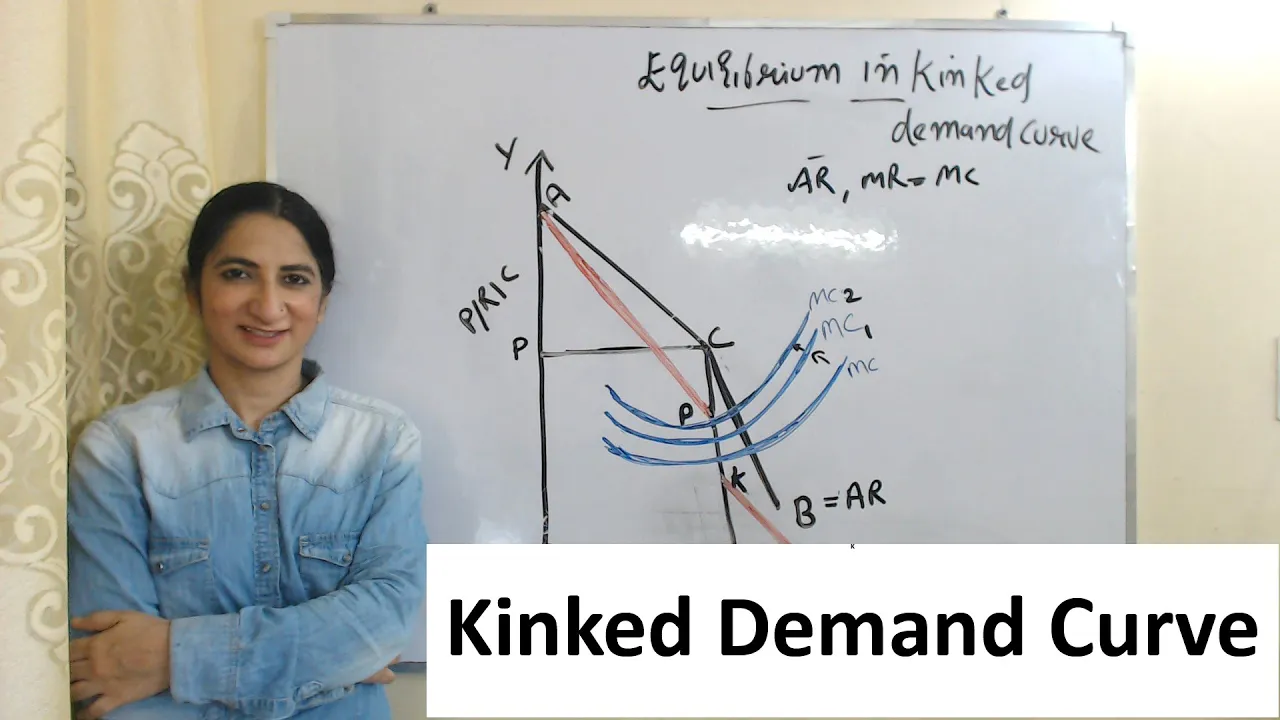
An oligopoly is a market structure characterized by a small number of sellers where each firm's actions significantly impact competitors, resulting in a kinked demand curve where price increases lead to elastic demand (rivals don't follow) while price decreases lead to inelastic demand (rivals match), allowing firms to maintain profits in the long run due to high entry barriers.
Oligopoly Market Structure: Kinked Demand Curve Explained | Economics
Added:Understanding of basic market structures, specifically the defining characteristics of an oligopoly such as high barriers to entry and mutual interdependence.
The concept of price elasticity of demand, particularly how demand responsiveness differs between elastic and inelastic states.
The fundamental profit-maximization rule where Marginal Revenue (MR) equals Marginal Cost (MC).
How to construct and interpret standard demand, marginal revenue, and marginal cost curves on a graph.
Game Theory and the Nash Equilibrium, which mathematically model strategic decision-making and interdependence among competing firms.
Collusive behavior and Cartels (e.g., OPEC), exploring how firms might cooperate to act like a monopoly rather than compete.
Non-price competition strategies, such as advertising, product differentiation, and quality improvements, which become vital when prices are rigid.
Alternative oligopoly models, such as the Cournot, Bertrand, and Stackelberg models, to understand different competitive assumptions.
Limitations of the Kinked Demand Curve model, specifically its inability to explain how the original benchmark price (the 'kink') is determined in the first place.
432.9K views2.4Klikes5:38Original Release: 2011-07-09
We've reached our final, and our most complex, market structure: Oligopoly.
Do you remember the characteristics from the overview in Episode 25?
In an oligopoly, you would find only a small number of sellers, that is, few enough so that any individual seller can affect the market, and the firm's actions will have an impact on all the other sellers.
The product can be either the same, like oil, or differentiated, like automobiles, and there are fairly high barriers to entry.
TIME TO THINK: having seen the other market structures, you should be able to make some predictions about the implications of the oligopoly characteristics.
What will prices and output look like?
What is the potential for profit?
As you'd expect, the oligopoly market structure will result in a higher price than either competitive market, although not so high as a monopoly, and will be able to maintain some profit, if it exists, into the long run because of the barriers to entry.
At the beginning of this video I said that the oligopoly is the most complex market structure.
Well that's because the actions of any one firm will have an impact on all of the other players in the market.
This mutual interdependence among firms means that each firm keeps an eye on everyone else, trying not only to anticipate moves but also to have their own reaction plan in place.
Will the other guy raise his price?
Lower his price?
If he makes a move, what will I do?
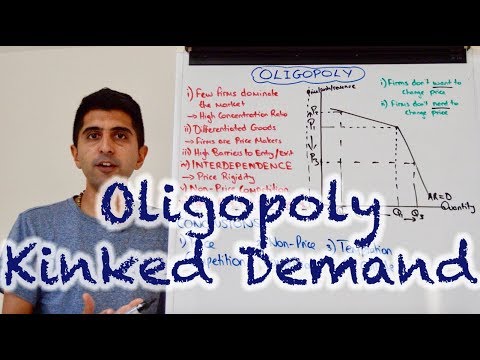
You can see the increased complexity of this market just by looking at the oligopolistic firm's demand -- a kinked demand curve.
We've never encountered a demand curve that looks like this before so, what gives?
Well, this demand is effectively composed of two different demand curves, because the game-playing behavior, if you will, of the firms in this industry will change depending on whether the firm is implementing a price increase, or a price decrease.
When the oligopolistic firm goes to increase its price, the rivals will not follow; they will let that one firm increase its price, and then they will gain the customers as buyers are driven away by the initiating firm's higher prices.
What this means for the firm is that, if it raises its price, and no other producer follows suit, then the initiating firm will see a large decrease in quantity demanded, i.e., the demand is more elastic when the firm attempts to increase its price.
Well, what if the firm lowers its price?
The rivals are aware that they could lose substantial market share if they do not follow along and lower their prices as well, but what happens if everyone lowers prices?
The firm that initiated the price decrease would see very little change in quantity demanded because, for the most part, customers stay where they are; that is, the demand faced by the firm is inelastic when there is a price decrease.
So if the firm raises price, no rivals follow, it loses a lot of customers, and the demand is elastic; but if it lowers its price, everyone follows, and not much is gained by that firm in terms of sales, or you have inelastic demand.
This will also result in a very unusual marginal revenue curve.
Think about the marginal revenue that would be associated with the more elastic price increase scenario.
Then, consider the marginal revenue that would be associated with the more inelastic price decrease demand.
The marginal revenue associated with a kinked demand curve would look like this: It's important at this point to be confident in what you know about a firm's profit-maximizing behavior.
Is this the weirdest-looking demand/marginal revenue graph you've ever seen?
Sure.
Can you still figure out the profit-maximizing output?
Definitely.
You have the profit-maximizing rule burned into your brain by now, don't you?
All you need is the output where marginal revenue equals marginal cost.
Marginal cost looks the same regardless of the market structure, so you just add it to the oligopolistic firm's demand diagram.
You can find Q*, the output where marginal revenue equals marginal cost, and then use the demand curve to determine the highest price the firm can get the consumers to pay for those Q* units.
From here, the analysis is the same as any other market structure.
In the short run, the firm could make money, lose money, or break even depending on the position of the average cost curves.
If the firm makes money in the short run, the barriers to entry help to protect these profits, even in the long run.
Remember, in an oligopoly market structure it is difficult, but not impossible, to enter the market, so there may be some loss of profit to new rivals over time.
If the firm loses money in the short run, it will exit the industry in the long run, leaving behind more customers for the rival firms.
So, in the end, how does the oligopoly compare to the other market structures?
As expected the oligopolistic firm can maintain profit into the long run, but the profits earned aren't quite as high as the monopoly could earn.
In the next episode, weÕll see what happens when the firms of an oligopoly get together and attempt to act like a single large firm -- a monopoly -- in order to boost their profits.
NEXT TIME: Collusion, mergers and antitrust.
TRANSCRIPT00(MICRO) EPISODE 30: OLIGOPOLY
Up Next

67:08
Game Theory: Strategic Decision-Making Explained
@yale
670.2K views•2013-10-30
5:07
Impact of Yuan in Indo-Russian Trade Amid Sanctions
@WION
261.9K views•2022-07-01

5:33
Aggregate Demand and Aggregate Supply Explained | Macroeconomic Equilibrium
@mjmfoodie
315.5K views•2009-10-10

113:18
The Age of Easy Money: Fed & Inflation | Full Documentary
@frontline
21.2M views•2023-03-15
Related Study Plans & Knowledge Roadmaps
Structured learning paths in Economics
economics
Sovereign Debt: Defaults, IMF & Restructuring
01Introduction to Sovereign Debt & Government Bonds
02Debt Sustainability & Credit Ratings
03Anatomy and History of Debt Crises
+ 2 more learning modules
12h5 modules
Explore Roadmap
economics
Market Design: Matching Theory & Gale-Shapley
01Introduction to Market Design and Price-Free Markets
02Two-Sided Matching & The Gale-Shapley Algorithm
03School Choice Systems and Mechanism Design
+ 2 more learning modules
10h5 modules
Explore Roadmap
economics
Impossible Trinity: Forex, Capital & Policy
01Introduction to Monetary Policy and Central Banking
02Exchange Rates and International Capital Flows
03The Mundell-Fleming Model
+ 2 more learning modules
8h5 modules
Explore Roadmap
economics
Healthcare Economics: Market Failures & Systems
01Introduction to Healthcare Markets and Market Failure
02Asymmetric Information and Adverse Selection
03Moral Hazard and Insurance Design
+ 2 more learning modules
12h5 modules
Explore Roadmap