
![[노동경제학] 경제학짱박사의 공인노무사2차_노동경제학_기초입문특강 (1)](https://i.ytimg.com/vi/ga0m6eO-qU4/maxresdefault.jpg)















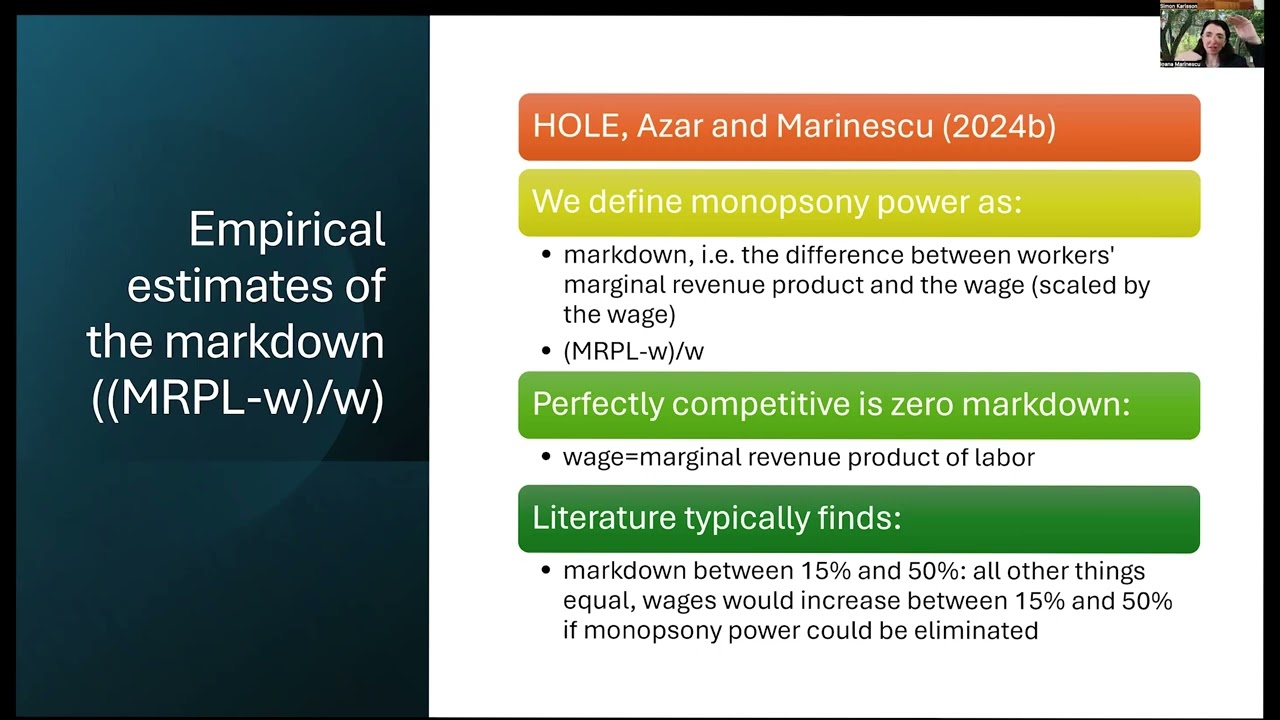










Dr. Anna Stansbury, an MIT economist specializing in labor and macroeconomics, explains that the decline in workers' share of income since the 1980s can be attributed to declining worker power rather than rising corporate power. Her research identifies three key empirical regularities: (1) the labor share of income has fallen by approximately five percentage points in the US corporate sector, (2) corporate profitability and markups have risen, and (3) unemployment has declined without corresponding inflation. While some attribute these trends to technology, globalization, or monopolistic product markets, Stansbury argues that declining worker power—particularly the decline of unions and weakened collective bargaining—provides a more consistent explanation. She frames this through the lens of Nash bargaining theory, where workers' outside options (ability to find alternative employment) have diminished due to factors like automation, globalization, and non-compete agreements, even as job search technology has improved. This 'exposure' of latent monopsony in labor markets means that without strong worker power mechanisms, firms can suppress wages more effectively. The implications extend to current debates about remote work, which may increase switching costs and further erode worker power, potentially allowing firms to extract more rents from workers.
Anna Stansbury: Labor Market Power and Inequality | MIT Economist
Added:some people just move really far out and there are some parts that are more or less affordable than others based on how far out you are and how inconvenient the train is [Music] in this week's episode of the mixtape I had the pleasure of interviewing Dr Anna Stansbury an assistant professor at mit's work and organization studies Department Anna is a PhD Economist working at the intersection of two Fields macroeconomics and labor economics and in our interview we did basically two things we learned I learned more about her personal story where she came from how she got where she is and I learned more about her thoughts and ideas about what's going on with workers in the United States today and I grew up in England uh her parents were both lawyers who ended up leaving their professions to go work on problems with corruption in the construction industry and I don't think I was reading too much into it to see this theme of interest in social justice and her parents as well as how Anna has what appears to be sort of sorted into that herself she came to the United States after graduating from Cambridge University with a degree in economics to study at Harvard Kennedy schools masters of public policy program rather than going into something directly related to public policy though she stayed at Harvard and got her PhD in economics because in her own words she wanted to have impact and realized that she could do that best as an academic Economist this is not an unusual motivation at all within economics and my experience if you go back and listen to my interview with Susan Athey from earlier this year you will hear many types of similar things with what Susan said Drew her to economics too but Susan Susan and Anna while they specialize in different areas within economics they're very similar in that they think economics can help improve the world and because they want to improve the world they decided to become an economist I know of Anna only from arm's length we follow each other on Twitter and are part of a larger Network dubbed hashtag econ Twitter this is our first time to actually talk and in preparing for the talk I realized I read through a bunch of her papers kind of at a topical level uh but the more I began to read them the more intrigued I was by her research and decided to start an independent readings this semester with a PhD student to go through her labor papers as well as a bunch of other papers that I've been meaning to read she works in Topics in labor that I think are really critically important that if you kind of want if you're paying attention labor you're watching kind of this Resurgence of interest in an area called monopsony as well as just um uh issues regarding policies that can help workers the overall well-being of workers is clearly something that Anna is very interested in and the overall well-being of workers is not just simply about employment but it's also about real income the reason why real income is really important wages in particular is really important because most Americans most people in the world buy goods and services which go into their lives to make their lives better uh using their wages they don't use profits from a firm that they own and they don't use dividends from capital or stocks or savings or anything like that they're workers many of them live paycheck to paycheck very low savings trying to make ends meet she's part a large of a group of people active in labor economics that's kind of forced me to really go back and look more closely at my priors about the role that minimum wages may or may not be playing in helping workers uh the role that unions have traditionally played in helping workers whether these things are effective policies or not uh and um also just making me realize again that uh the gains from trade that happen between the worker and the employer are not always distributed the same over time it's a bunch of puzzles that Anaconda has pointed to it's made me really want to go back to the books and the drawing board and think more deeply about what exactly is going on with workers in the labor markets and the product markets over time to start thinking through what policies may be helpful and it was great I'm going to be spending the fall reading more of her papers highly encourage you do too hope you enjoy this as much as I did thanks so much my name is Scott Cunningham and this is mixtape podcast okay it is my pleasure to have uh Anniston Dr Anna Stansbury uh on the the podcast this week Anna thank you so much for being on the podcast yeah thanks for having me well before we start can you just tell me uh for the sake of the reader your name your title and where you're employed yeah absolutely so I'm Anna Stansbury um I'm an assistant professor of work and organization studies at MIT Sloan School of Management and I'm part of um eyewear at MIT which is the institute for work and employment research so it's a sort of interdisciplinary group of Scholars studying issues to do with work and economic inequality as it relates to work employment employment relations ah okay cool all right let's start with an icebreaker all right great so uh uh what was the first concert that you ever attended how old were you and uh who'd you go with when you went so that's a that's a hard question the first one ever and I don't know if I remember the first one ever which maybe says less about more about me but um an early concert I went to which I remember was a battle of the bands at high school so I was at school during the kind of Indie emo era so everyone who as anyone was in in some kind of an amateur indie rock band so we would have these Battle of the Bands when we were 12 or 13 and if you were in a band you got to be very cool and be on stage and if you weren't in a band you were sort of in the mosh pit wearing your black and pig stripy pullover or whatever it was we wore so I remember that one very vividly that's awesome wait were you in a band or were you in the Martian I was not I was in the mosh pit you were in the mosh pit that's awesome uh my first one was Van Halen uh for unlawful carnal knowledge tour they came to uh Memphis Tennessee and it was in uh Memphis had just built this massive pyramid uh downtown on the river River on the Mississippi River and so I got to see uh Van Halen um I did not like Van Halen though so I I was in the thing where my I was unfortunate all my friends liked uh heavy metal and I only liked um The Smiths and the Cure and REM and so but of course like they don't tour uh because they're from the 80s and it's it's in so uh anyway but it was still a lot of fun it was it was fun in a different way it was fun because you were with your friends yeah as an experience right having seen Van Halen as an experience yeah totally so tell me where you where did you grow up um I grew up in buckinghamshire which is kind of when I'm when I'm talking to non-british people I say London but any real London are listening would be really upset if I said London so I won't so it's kind of between London and Oxford in the UK in the countryside but still close enough to the city that we sort of you know feel part of the London World more generally but I mean I grew up next to a farm so it was very Countryside oh wow did where did your parents do um my parents run an anti-corruption non-profit together oh construction yeah so they focused on um preventing preventing corruption in all its forms fraud bribery extortion everything else in the construction infrastructure sector worldwide so I I grew up with a lot of a lot of discussion of bribery at the dinner table oh wow yeah what are they like how did they how'd they get into something like that um they were they were lawyers my mom worked as a lawyer as a litigator in construction and my dad was trained as a lawyer and then worked in-house for you know big engineering and construction companies and they met when they were both doing that and they were actually doing that in Hong Kong and um I guess at some point decided that it was time to transition and having been in that world for a long time had seen or heard of a lot of you know not seen directly like you know heard of being in the world of but understood how nefarious Behavior can happen in these big projects because big construction projects you know there's so much money going around and there's so much scope for problems the class of examples being you're a government procuring a massive power station or a massive Bridge there's so many opportunities for a small bride here or there as to which contractor gets the gig or whether you approve a project that shouldn't really have been approved or the safety standards are relaxed then bribes change hands and those are the kinds of things that you know where there's a lot of Scopes so my parents haven't been in that sector for many years sort of understood how it worked and thought that this was an area that really needs to be tackled so in the early 2000s they quit that and went for went for the anti-corruption stuff wow that's crazy I didn't even really think about that huh uh I think that's that's a whole other conversation that's really yeah uh so so you grew up in the country yeah yeah okay what was that like did you enjoy that yeah I mean I loved it I feel like it's a different thing in the English Countryside near London than it would be in the kind of proper proper Countryside because I was still near enough City you know like we were on the train and I could get the train into London in an hour and so that very different experience I'm being very far from everything but I really liked it it was a kind of nice mix of you've got quite a you know sheltered existence you can spend a lot of time outside you can spend a lot of time doing sports um I used to do a lot of running so I do a lot of cross-country running but you've still got the city there when you want to go to the movies or go out with friends or feel like you're having a bit of an adult life as a teenager yeah yeah oh you know and I grew up in Mississippi which is oh yeah quote the country but I have a feeling it was very different it gets highlight it's probably a little more yeah it's interesting so like I guess I guess where you grew up is almost like a suburb of London but it's like rural well so actually that's a great point so in London we have the Greenbelt which is in the 50s I think but I could be wrong on the timing they they legislated that no new development could happen in a circle around London which they called the greenhouse and it was in order to prevent urban sprawl but what it really meant is that we have a very dense City and then I guess a Suburban ring which is quite Countryside and full of farms and parks and woodlands and things and then we're building around the outside of that but they they don't it does it doesn't get suburbanized the way they're not allowed to it's got incredibly strict planning restrictions and one of the big debates in policy in the UK at the moment is whether to relax that should we be able to hold the green belt yeah but right now you're not allowed to and so that's how I grew up in a house by quite a large town but next to a farm what did that do to housing prices in those areas oh yeah no not good yeah I mean in London for sure and then even in the areas outside of London just because we've had incredibly restrictive house building out you can't sprawl but we also have really restrictive house building restrictions up so you can't go to Paul in London in almost any places because there are very strict restrictions on skylines and on Shadow you know tall buildings cast Shadow onto other buildings and you're not allowed to do that without a lot of approval so house prices are astronomically high as a result of these restrictions yeah oh so where do people go I mean how does how does a how does a poor per how does a lower income person survive in London if they can't even move far away on the train line yeah it's not it's not good it's awesome okay there's some there's some affordable housing but not enough some people just move really far out and there are some parts that are more or less affordable than others based on how far out you are and how inconvenient the train is um but it's funny I'm actually doing some work right now on Regional economic inequality in the UK and we're one of the aspects we're looking at is um paid Premier in London versus in other parts of the country and we find that there's a big London pay premium even for lower income people of the same kind of qualification level relative to the rest of the country but that's completely eroded by housing costs so there's actually a net a net Financial disadvantage for London versus almost anywhere else in the country unless you're in a really highly paid job um you get you you pay your your compensation is higher in London your net compensation is lower yeah exactly if you're a vendor if you're on owner obviously it's very different because yeah you got that data over time has that changed over time um we don't have it over a super long time series unfortunately I think we've only got it since about 2012 and you do see it worsening since 2012 because there's been a big increase in house prices but we ideally we'd have it for 40 years and we don't have that yet yeah but it exists you've got to make it that day we're trying to we're trying to figure this out right now hopefully okay I don't want to take your project later we're not taking it away I'm just hesitating because I'm getting anxiety at the thought of whether it does exist because we do one well so when you were a kid in high school uh what what would you have been doing um you know what were your hobbies that you enjoyed outside of academics oh yeah I did a lot of hobbies I did a lot of sport um did a lot of music and I did a lot of theater so you know like oh well musical theater so I don't know what I'm you know that's got a particular reputation in the US but I was you know in all the school musicals and in the orchestra and in the choir and I did um track and field and field hockey and netball which is a British game like basketball but you don't dribble oh yeah netball yeah netball it's a great game and I really wish it was played more widely but um yeah it's you just passed so it's a very and then you you pass pass pass and shoot so it's basically very similar to basketball and that there are two Nets and there's a ball um but you don't drink more is there a professional League I think so but only a few countries play so there's definitely a national team in the UK and there's national team and a lot of other countries primarily that were former British colonies because I guess that's how the sports you don't have any layups you probably don't have any layups no layouts right um no there are like wrong shots yeah yeah exactly right right penalty shot type things oh that's interesting so you can't move no so you've got to just be it's like it's almost like Ultimate Frisbee almost yeah I think it is like ultimate frizzy with a ball and obviously it can bounce the ball so you can still catch it on a balance oh I see oh that's interesting can you find can you find it online I guess you can find it on YouTube yeah yeah it's a good game it's fast I'll have to look on I bet there's like a thousand tick tocks of netball all right no yeah okay well so uh so what subjects did you what what were what were your academic interests when you were in like your grade school high school years um um so I was into languages quite a lot I said a lot I love languages um so we had to in England everyone studies French pretty much in school everyone has to because I guess because they're next door and then my school also you had to study another language um but then I also I did German and then I also did some Spanish and did a bit of Italian and a tiny bit of Russian which I've forgotten all of um but I love languages so I did a lot of that and um also economics honestly from quite an early stage really so we had um in the UK the you take a set of exams at 16 which you take sort of 10 to 12 subjects at 16 and then you take only three or four subjects after 16 and those are the a levels and economics was one of my a levels so I love the economics maths and languages and that's what I sort of specialized in wait so y'all had economics in yeah you had good economics in your high school your teachers were good yeah not all schools offer it my school had economics as one of the a levels and actually honestly you know it formed a lot of how I thought about econ because it was it was good you know we did a lot of Supply it was it wasn't any it wasn't hard math it was graphs we did it graphically with local intuition but it was good intuition so we thought about perfect competition versus Monopoly versus oligopoly and you know you have the different different curves and you think about dead weight loss you think about price and marginal cost we had a bunch of interesting macro and I remember because this was a um I was in high in those last two years of high school 2008 to 10 which is obviously what a time to be studying macro right yeah it was the beginning of the Great Recession it was the finance crisis you know during this period we had bank bailouts in the UK we had the UK Chancellor talking about got massive increases in government debt which reversed the whole macro consensus of how much um what the debt to GDP ratio should be and what government should be spending um spending on so it was a really cool time to be studying it and my teachers were really good at bringing it in and bringing in what's going on in the world and how should we think about that through the lens of what we're learning in our textbooks it was a fun course yeah that's amazing so did you go when you went to so then you go to Cambridge was economics immediately something that you were interested in it had to be because in our um system you have to pick the subject you study before you go to university oh so yeah so we don't we don't kind of choose our major when we're there in almost all UK degrees you apply with your subject already so you apply in the in the fall of the year before you go to college and that application you've picked your subject and you've written an essay about the subject and your teacher's recommendation or whatever is about your capacity nobody can change their major it's hard it's hard so I'd apply to study already when I was 17 so I got to see any any British economics major that I observe compared to an American economics major I'm looking at someone that is known even before they started college yeah college and also for most economics degrees has only done economics has only done it because you can't in most Unis you can't take other courses which I was actually was quite for tips but it was very difficult to take across from another department and have it count for credit so you're doing you're doing you know economic history or you can do like the politics political economy you can do the Maths for economists but you're within the economics Department you're within the framework of the economics degree your whole time wow wow that's really interesting because the thing that I feel like I get really frustrated with and I was that I get really frustrated with is be is that if you know that you're going if you ever decide to get a PhD in economics it almost really is better for somebody like you who knew from the very beginning because they have to practically you know get a math major you know and so so many people like I I didn't learn about it I didn't decide I wanted to become an economist so after I graduated college and so yeah you know it's just it it's great it sounds great you get all this fluidity to self-select but you know for something like econ uh that has so many fixed costs for graduate training uh I bet you know that kind of structure I mean I guess it's the whole thing is that a lot of people know in Britain just you know they don't they still don't know that they would love being an economist yeah I think that's true and I think it it sort of cuts both ways because I agree with you the way the system works right now it's it's not as it's a very windy path from undergrad to an econ PhD um especially with these courses that you have to have taken and got good grades in in math basically um and in the UK system I think it cuts both ways econ is a very big major so a lot of people will just take it and then if you've done it it's trained you quite well to apply for a PhD at least I mean the one at Cambridge for example there was a lot of math it was very mathematical it was very Theory heavy um and so it sort of trained you well that if you then decided in your third year of your degree I want to do a PhD you're quite well on the other hand if you didn't know about economics at 17 and didn't apply to take it yeah it's very unlikely that you'll ever be able to take it because it's very unlikely that your shifts may use once you're already at college so there's a bit of it cuts both ways there so which means the system has got to build a lot more of all these Majors into High School I think like I mean you if you're having to do this for everything then it seems like you've just got to somehow pump all of the different Majors really earlier earlier and earlier I mean are you like what if you wanted to do like archeology or anthropology you just you graduated high school knowing it just like you did it yeah you go to pick it I know it's funny I mean I like I like the US system's flexibility that you get to explore a little bit more before you specialize because for us I mean we already specialize at 16 you pick three or four a levels or 16.
so you're already cutting off almost all of your other intellectual interests so I mean it's good in the sense that if you know what you love which I did yeah in retrospect I would have liked to have done more science but I didn't like it at the time so I was like glad to stop and just do history and econ and maths and languages but um but if you are a bit more of a journalist so you're not sure what you like yet it can be quite restrictive quite early yeah yeah yeah so you majored in econ would you like what what were the classes that you liked at Cambridge and which professors did you like who are some professors you remember that really fondly yeah so my my she was uh she is a Dutch macroeconomist at Cambridge who focuses on monetary policy and particularly Central Bank transparency and she was one of my main um professors because at Cambridge we had lectures but we also have uh tutorials which are supervisions which are small group sessions so she was my macro supervisor for three years and she was just incredibly good at drilling into kind of how macro works and thinking about the intuition and should always say you know don't describe it through the graph describe it as you would to your Aunt Betty who doesn't know anything about graphs or derivations and so she was really good at getting us to think about what is the intuition behind a fiscal stimulus a monetary stimulus how how do we think about monetary policy and how it works I feel like that just set the groundwork for me for years about how to think about macro and another another professor who I loved and whose class I loved was um Victoria Bateman who's an economic historian so one of the unusual things about the Cambridge undergrad in econ is there's a mandatory economic history of the United Kingdom course in your first year and it's from 1750 or something until 19 39 so you have three blocks you have kind of early Industrial Revolution late Industrial Revolution up to World War one and then the interwar period And so you do so much interesting economic history and Victoria Bateman was my supervisor for that course and you're doing why did the Industrial Revolution take off why in the UK not elsewhere how was it stimulated and then you're doing in the interwar period what happened at the Treaty of Versailles like what happened with the gold standard international debt defaults globalization so you get this amazing overview of kind of world economic history and the big debates and that was just so fun as an 18 year old to dive into oh I bet yeah that was wonderful who are some of the famous like I'm embarrassed was Keynes was Keynes at Cambridge was it Cambridge yep it's so neat to just like walk around where he was it was crazy I know and also um my college at Cambridge was where Alfred Marshall was who was you know the founder of so much a modern economics and then there was you know people like Caldor and Hicks and Robinson and it's really had a lot of the great economists coming out of it which was cool I bet that was neat just kind of feeling like I bet taking a class like that history of English economics being in this school where all of these great economists had been that just must be I mean I guess you get used to anything but that still just seems really cool um yeah I think it is and I think you know I look back at my self at 18 and think you should have appreciated a little bit more how unusual this was also just being in a place that was 800 years old and being in a you I think you just sort of you go okay this is cool this is pretty yeah and I wish I'd absorbed a little bit more what that weight of that history meant um but it was amazing yeah wow that's cool so then you leave so then you grab so I I take it macro sounds like macro has goes back kind of far you've been sort of you've sort of been drawn to macro questions a little bit for a while yeah but also labor was Labor also stuff in at Cambridge that you were finding yourself kind of drawn to that's a good question I feel like that was a later interest of mine honestly I was always interested in macro because I was always interested in well really what drove my interest in economics from the beginning was being interested in questions of poverty and inequality and unemployment and fairness and those kinds of questions so I was really interested in development for a long time development economics um and I was interested in in macro and finance really very much shaped by the financial crisis being the defining event of my you know like public social economic event of my teenage years so you know you grow up reading about recessions and bank bailouts and you see pictures of people taking their boxes of stuff out of Lehman Brothers after it went bankrupt and this becomes what you're really interested in investigating and then I think I got more into labor as I was thinking about inequality and unemployment and and poverty in the context of advanced economies particularly the US and the UK and thinking about well how how is this portion of inequality determined where does where do these massive gaps and pay for different groups come from to what extent is this determined by the market and that's high so we've got more and more interested in that side of things yeah yeah yeah yeah I mean even sort of I mean I don't want to draw too much out of this but I mean it's like you know even your parents being so interested in corruption I mean within within a sector I'm sure that you're thinking about I mean I guess like it's like that's not really consistent with perfect competition exactly or it does call for you know interventions or like you know it calls for people it's interesting that your parents choose to go in and try to address that I don't know I mean it just seems like kind of I get I don't want to overstay it but it's like I could see that kind of social justice ethos kind of in your story a little bit no I think that's right I think that's right as I reflected on my kind of where I came from a little bit more I think that's a big part of it and a big part of it is a sort of skepticism and concentrations of power right uh belief in the power of society civil society and government regulation to combat it somewhat which probably is the through line right right yeah yeah uh so okay I I want to keep talking about that but I got to save that stuff for a minute so so then you so you end up taking a route into your PhD that is not as typical you go to uh and get your masters of public policy at Harvard Kennedy School can you tell me why you ended up doing that did you know that you were going to end up doing a PhD eventually no no okay so I never wanted to be an academic uh it was just never on my radar as a career path I don't know if it was on my radar because I didn't really know what it was like or I didn't want to do it but it just wasn't um I was always really interested in the public policy side of things sort of going back to this right just as I guess social justice type um streak so when I was at Cambridge as well as I mean I I studied economics because I wanted to make the world better and I thought economics was a way we could understand how to do that and then while I was at Cambridge I was very involved in a student society called the Wilberforce society which is a student think tank so we wrote It's called Wilberforce yeah yeah that's the guy that ended slavery yeah exactly and he was a Cambridge alarm and so the people that founded this group named it after him as sort of someone that you know thoughts a lot about important things and then did good things with it so we we were a student Think Tank and so I spent a lot of time writing policy papers engaging trying to engage with policy and media on this stuff and I really wanted to go into public policy into some kind of job maybe in government or maybe in a international organization maybe doing some kind of thing in the private sector but as a social Enterprise or a social impact Finance type thing so I went to the Kennedy School with that in mind thinking I love public policy I have a very strong academic training in economics and I feel like I would like to be complemented with more of the Practical staff more politics more soft skills and that's what the MPP was going to offer um and also just getting the experience to live in the US and go to Harvard and meet people from all over the world I mean it just seemed amazing so I went straight there after my undergrad thinking that I would do this to your Masters and use that as an opportunity to explore different career options in probably International Development social impact stop right but while I was at the Kennedy School I did some of that exploration and loved it but um wasn't necessarily sure that those were my comparative advantage that you know I did some I did some internships I did some classes and also ended up doing some econ classes um with Ricardo Houseman with Larry Summers um and loved them and realized that maybe yeah what what would it have looked like do you think if you would have said my comparative advantage is to sort of not be an academic like like at at Kennedy School what was it what was it what's the signal that you noticed that you weren't getting that what would it have looked like yeah it's a great question and I don't know if maybe it was just my idiosyncratic experiences that didn't give me and I thought I've had different ly I hadn't found I hadn't found a day-to-day work set of tasks that I I loved I was quite happy to do a lot of the tests that I was doing but I didn't I didn't love it on a day-to-day basis I also felt and this was just me and just personal to me but I also felt quite strongly that when I was doing some of my internships in International Development I was learning a lot but I wasn't sure how much I was contributing and I I worried that um that there's a surfeit of somewhat educated well-intentioned people from rich countries who want to help but maybe don't actually have that much to add relative to a lot of expertise in developing countries and it's really that expertise in that local capacity that should be supported rather than piloting you know flying in in foreign experts and I just I wasn't sure how how I could fit into that being part of the solution there so that was kind of causing me to question what exactly how exactly I wanted to contribute what exactly I wanted to do and then I think I saw positive signals of my comparative advantage from taking econ classes and realizing that I loved the analytical process I love the kind of figuring out some big puzzle about the world and thinking it through and um I realized that I loved teaching because I did it I was a teaching assistant and found that I loved that and I had this moment when I was on my bike once I was biking home from teaching being a teaching assistant I was like I love teaching I love doing this I was I was a research assistant for Larry Summers a little bit on a project on the UK I love doing this research I'm so interested I wish there was a job that I could do this and then realized there was so right right right that sort of yeah helped me Orient my career a little bit yeah I mean I guess one of the signals that I just heard you say which I don't think everybody it is even meaningful to a lot of people is this desire to have impact right yeah yeah yeah like you like almost I mean some people would be like impact I don't know I do it because I like it or I do it because XYZ but you're kind of wanting to have impact is that that's what you're saying yeah I think that's that's a good point that's exactly I wouldn't be doing this I like the process but I don't like it enough to do it on its own without a kind of a reason for me the reason is that I hope to have positive impact with my research and my teaching yeah yeah okay so so you're you're seeing some economists because there's a bunch of economists that are teaching in the at Kennedy in the Masters of public policy and to him is is Houseman Ricardo Houseman yeah he's still alive is that right yeah okay Ricardo Houseman and then uh Larry Summers yeah so so you end up continuing you end up so you end up having conversations with them or something kind of in those classes that is kind of pushing you forward a little bit Yeah so I love the classes and then honestly um Larry Summers uh was an amazing mentor to me I'm still it's but like pulled me essentially he had this policy had a small seminar class at the time on it was called inside government it was sort of interesting Economic Policy Topics in U.S government policy financial crisis Auto bailout um health insurance whatever they were and we would write essays for the class I remember writing essays on advocating an 80 top marginal tax rate and advocating four percent inflation Target I don't know I was feeling quite radical with my proposal when I wrote these these essays and he had some policy of getting his ta to to contact all the people that did well in the class and say hey when you have a meeting with Professor Summers so if that had if that contact hadn't happened I wouldn't have ever met with him because I've not I didn't I'm not the kind of person that and I wish I had been that reaches out to professors to meet with them so I did I went and met with him and you know as he did with all the students chatted what's your aspirations what's your background what do you hope to do he said to me have you considered doing a PhD in economics you know you sound like you're qualified for it done but great great in the class and that suggestion planted the seed and then he said well if you are interested in this be my R.A be a TA for the class that I teach with Marty feldstein and Jeff Liebman and Kate Baker which is a great class that I ended up TA in a couple of years and see if you like it yeah so it was that intervention really that that changed my trajectory oh wow wow yeah great that's neat so um so so did Larry Summers become your advisor when you were at Harvard so you end up going and getting your PhD at Harvard how many years were you there exactly so I was two years in the MVP then I worked for a year as an RA and ta for Larry for ricotta Houseman and famati feldstein between my MVP and PhD and then I did my PhD wow that's really yeah that was amazing it was a wonderful year um and then I did my PhD 2016 to 21 so five years in the econ department and Larry Summers and Larry Katz were my main advisors oh wow that's great so you just graduated yeah yeah graduated a year ago a year ago so you've been at MIT a year that's awesome yeah so what did you end up writing your dissertation on my dissertation was on um it was called essays on power in labor markets it was the technical so I had three essays and it was really all topics to do with kind of power and institutions so one was a paper on employer concentration um so there are a few Employers in a given labor market how much does that suppress wages does that give them monopsony power second paper was with Larry Summers on the decline of worker power in the US and trying to quantify its macroeconomic implications and then the third paper was pivoting a little bit and was about minimum wages and Union organizing protections and firms incentives to comply with the law basically and thinking about how the financial penalties are applied in practice and do they incentivize firms to break the law or comply with the law yeah okay perfect now that we're moving into research this is great I loved all of this but this is a perfect I couldn't have planned it better so so here's what I was sort of thinking you know the the major themes I was looking across your papers and reading three things is is inequality uh in the labor markets appears to be a big part of it uh monopsony the minimum wage but then there's also this macro Focus I can't quite put it into words so I'm hoping like that we'll be able to kind of it'll be clear to me the the way all these things work together as we're talking but um so this paper with Larry Summers I don't I don't want to summarize it because I in the past on the podcast have talked too much but but um you've kind of got these it seems like you start with some strange empirical regularities I I've been to call them strange because you're gonna explain them usually that's the way I always think of it work these empirical regularities between worker compensation firm profitability over a 30-year period of time can you tell me a little bit about before we even get into the explanation there's a set of facts over a long stretch of time what are they yeah absolutely so the big facts that we're sort of trying to reconcile are number one a big rise in income inequality um in the US since uh early 70s early 80s depending how you time it one day one dimension of which is the decline in the labor share of income so share of income going to work is falling share of income going to Capital illnesses Rising fact number two is the rise how big is it how big is that change over 30. um depending exactly how you measure it and from when you measure it it could be about um five percentage points of of so we our measure is the non-financial corporate sector compensation share so we're just looking at the corporate non-financial private sector basically the share of compensation the share of value added in compensation fell by about five percentage points from the early 1980s to the early the late 2010s is is uh our real real wages are rising but the share is falling the average average real compensation hasn't kept up with total productivity yeah yeah yeah right right right let me ask something if you have Rising labor productivity can you also just in a traditional neoclassical model if you've got Rising Factor productivity in labor markets could you get that decline in the share or is it guaranteed that it would also keep Concepts something to do with the production function right it's exactly it's how you specify the production functions so one of the Caldo facts was that kind of motivated our use of a Cobb Douglas production function as the Baseline was that the shares of income of Labor and capital had been roughly constant over the previous decades when he was sort of establishing the Caldwell facts yeah and so in your Club Douglas production function um the the factor Shares are set by the coefficients you know K to the alpha L to the one minus Alpha but if you have a production function which is you can specify a production function where that's not the case and the factor shares can change and then they can change as a result of non-factor neutral technological change so it could be that factor neutral yeah as in like um as in technological change that augments one factor rather than the other if you have a production function that's um that's not uh Cobb Douglas then that can change the factor shares okay okay okay so you've got this so number one you've got uh workers are getting less of the total Surplus associated with output yes that's the way I think about it exactly exactly that's fact number one you and I met we got together we make some we make some Gadget we sell it on the market it was you know it was historically 50 50 and now it's like 60 40.
you're watching it fall and we're watching it full and the debate about how it's Fallen is pretty pretty vibrant but I think it's more than at least a little bit um and it was pretty stable before that for a number of decades so essential accounts began in the in the 40s yeah so Anna is is this a completely different debate than inequality before we get into the more of these Stars facts like I usually think of inequality as just like the distribution of wages across the population or like one percent the you know the one percent growing or something like that but it seems like I haven't really thought as much about the capital labor shares yeah so I think when we talk about inequality we're often talking about different aspects of the Beast so I would think I like to think about it that there are two big picture inequality questions one is within labor income inequality and how that's changed and that's been huge because we've seen the rise of very top income earners in uh what we've seen two two Dynamics going on within labor we've seen the kind of college and on College Divergence particularly in the 80s and 90s and then we've also seen the top one percent or top X percent of Labor earners really Skyrocket your Chief Executives and other top Executives your lawyers your other Professional Services so those are the two within labor Dynamics and then you've also got the labor on average versus Capital which is mostly shareholders Dynamics yeah and then you've got something going on with top one percent people which is a bit of both because a lot of top one percent income is labor but a lot of it is capital some of it is not entirely clear if it's labor or Capital because they're an owner manager of a large company or they're a partner in a hedge fund and how much of that is labor and how much is capital yeah so now I can kind of see a little bit better like the all the things that macro economic theory is bringing into you focusing on these labor questions these all sound like I can see I I definitely I definitely see this like merging of the two fields in the way yeah I think so and I think there's a lot of people doing really interesting work at this intersection because it's I mean to understand any of the to understand any of the big social questions about what you do about Labor markets you need the general equilibrium and the general equilibrium is what macro as a field is about and so having that having that interplay is really important I think right right okay so following labor shares and then so what was the other regular some other one falling labor shares as a part of Mobile is rising inequality right fact number two um Rising corporate profitability and valuations so ways you might measure that are without a corresponding rise in the kind of safe safe interest rate so you've got um Rising stock market values you've got Tobin's Q which is a measure of the market value over the replacement value of capital Rising you've got um corporate profitability as measured is is rising relative to the safe rate of return and you've also got this big stylus fact of rising markups that a lot of people were talking about and still are talking about in macro in IO where you've seen the markup of price over marginal cost for a lot of Industries has risen and so all of these are tied up in the same phenomenon of the rising possibility the third fact said effects was and this is before the current ERA um was the decline in average unemployment in the US without any noticeable uptick in inflation find an average unemployment without any noticeable uptick in inflation so if you believe in some kind of theory of the world where there's a natural rate or a narrow you know you expect that low unemployment at some point will lead to higher inflation like almost like a kind of a Phillips type reasoning exactly like a kind of Phillips relationship but we we saw this big decline in average unemployment from the early 1980s to the late 2010s and there was no meaningful inflation throughout the 2000s and 2010s you know now we're in a little bit of a different world we can debate whether that's some other Dynamic but right aspect we saw that declining employment because we saw a lot of male labor force participation rates falling is that not accurate yes so we're talking about the declining average unemployment rates oh unemployment rates but you're right that the employment rate Dynamic muddies the waters a little bit so you saw average unemployment in the 80s you know eight seven percent you saw average unemployment by the late 2010s in the threes and fours yeah but you did have this big decline in mail employment at the same time and so the question of whether that was concealing unemployment is an important one so okay okay I keep interrupting you was there are there more facts there's more right no that's okay those are the ones so uh before we get into your explanation well yeah let's just so what the heck is going on you you have some opinions so what what is going on with this yeah so I'll frame it as their number of theories as to what explains each of these facts or these facts together so if you're looking just at the later share the decline in labor share of income some people attribute that to sort of um technology and automation or a race between technology and education some people attribute it to globalization some people attribute it to um Rising corporate power and some people attributes to declining worker power those are the four big theories could you get that with just like increased Factor productivity of capital like computers or something something that's just like I don't know I don't know what the exactly that would be but like just sort of like it's exploding productivity of capital wouldn't that give you some of this like you don't you're seeing anything else yeah in under some production functions and it depends on your assumption about about that production function because again if you've got a cop Douglas then Capital getting way more productive is actually also good for labor because the marginal products of Labor is also higher so it depends what you're assuming about the elasticity of substitution between labor and capital essentially but yeah there are some worlds in which that could be the driving force exactly so there's a big debate about that and then there was there was an is a a number of papers that argue they take the labor share fact declining labor share then they also take the rising corporate profitability facts and they say look this rise this declining labor share stuff this could be compatible with globalization technological change automation all these sort of Market forces type things that change the marginal product to different groups and therefore change their pay right that's essentially change the marginal products of Labor relative to Capital under some assumptions about production functions it changes their pay there's a competitive explanations but we've seen this big rise in profitability and markups and valuations that can't be explained competitively therefore the explanation must be a rise in corporate power and product markets and we saw this big rise in corporate concentration over this period you know the number of firms in a given industry has decreased so maybe what's going on is Market power and markups and that's explaining the declining labor share because capitalism you know they're becoming more more profitable because they're becoming more monopolistic right and that's also explaining these profits and so then our paper came in and said actually all these facts can be reconciled just as easily with a decline in worker power as it could be the rising corporate power but we think there's a whole bunch of other evidence that is more consistent with the decline in worker power than it is with a rising corporate power so we we're sort of saying the focus on power is probably right yeah public should be shifting our focus on power to the labor market side of things rather than the product Market side of things oh so when you're talking about worker power you are beginning to tap into the the monopsony theory you're saying other people were almost more focused on Monopoly and you're saying you you because because they were sort of saying is this Monopoly issue that might be explaining some of this and you're saying we think it's actually a it's got elements of monopsony is that what you mean yeah almost except that I'm a little wary about calling it exactly monopsony and the reason for that is we definitely want to focus on the work of power side of things and I think monopsony has a lot to do with it as a baseline characterization of the labor market but I think even if you had a world where the labor market was not monopsonistic it was some kind of perfectly competitive labor market and you had a product Market that was monopolistic yeah and the Monopoly power didn't change in the product Market but there were strong unions in the past and the unions declined you can imagine a world where okay past world was monopolistic product markets generates lots of rents lots of profits and these profits these Monopoly profits are shared between unions and capital owners yeah unions then decline nothing changes about the underlying yeah so that's not a monopsony story but it's a kind of worker power story or it could be I'm an absolute story yeah oh that's all I was kind of wondering as I actually didn't know how you moved between the the concentrated product market and it wouldn't automatically imply some kind of symmetry in the input Market I don't know it's so funny it's like I feel like embarrassed like how how much of micro I constantly am forgetting you know as you like like I'm I don't know it's like I taught it for 15 years the rad micro and it's like I I just it's so yeah so much of Economics you have to hold all this stuff simultaneously right how all these people are working together I forget I just constantly am forgetting um so so the when I think about worker power I always am thinking of it as like these uh these These Old Nash bargaining models I don't know how helpful they are but I'll just kind of tell you like you know I always think about uh worker power in terms of like well if you don't pay me I'm going to quit and that's credible in so far as the employer can observe your outside option and usually that requires a credible threat position yes God at all going on here there's some declining credible threat like is it helpful to use is that a helpful way to think about any of this or is that's not really helpful so I think it is and I think I'm I'm still open about exactly where the work of power is fitting in and we're trying to work about fitting where but I like having a bargain framework as a kind of intellectual architecture um I think there are two areas where worker power can fit into it one is um well actually in some sense it's three one is if you've got the firm's outside option is the max they're willing to pay right the workers outside option is the Min they're willing to receive yeah and then maybe there's some Surplus between the two so one aspect that determines pay is the workers outside option and that could be getting worse or getting better but that's the one you're talking about if I if I don't get what I want I quit um the the Threshold at which I quit is my outside option yeah then there's the firm outside option which is how easy is it for the firm to replace me in some sense and so I think one aspect of changing worker power that's been induced by Automation and globalization is it's easier for firms to replace some kinds of workers than it was before yeah option changes and then if there's any surplus in the middle that's where I think your things like Union bargaining power Mata because they might not affect your outside options but they might affect how that Surplus that's created by the match is split so I think actually the Nash framework is quite useful just to think about which types of worker power fit where um and which ones have changed and I think the Surplus splitting power has clearly changed because unionization has declined so much the firm outside options side may have changed as a result of technology and globalization and then the work outside option I think it's not super clear if it's improved or got worse because you could think of the rise of the internet and things as making job search easier that's our main thing it's my 14th question you can think about that as having my job search easier right right it's much better to find a good outside option now um if you can look on LinkedIn or look on exactly one of these boards yeah but it's not yeah because you've got this paper with Schubert and Taska or Taska on employer concentration and outside options um or so it says I wrote down it seems like your paper on employer concentration and outside options is actually getting at this worker power hypothesis is that all right um so we're looking at it at the really the kind of monotony outside you're looking at the Monopoly part yeah if we're thinking about it being determined you know these three these three portions we're looking there at the what what is happening to the workers outside option piece rather than the rent splitting piece induced by unions or something like that so this is this is exactly my this is what I find so difficult to understand although honestly I don't find it difficult to understand but like I kind of feel like my reasons can't be the real my personal reasons can't be the explanation so like so it why is monopsony relevant if I can just move like I don't understand this like late like we talk about the labor market as though it's like this local area but then we have like platforms like LinkedIn and the search costs are the search costs for looking for a job they seem like they're kind of low I mean maybe I'm completely wrong and they're like somehow LinkedIn has made it harder and there's all this congestion but it's like it seems like it's like I know about jobs all the time right yeah I got Joe I got LinkedIn I got like a billion ways I hear about things I got my network all this internet stuff and all I got to do is move to another place right it's like I mean I had an opportunity to do that I did not ultimately take it because of family stuff but like but a lot of people that's what they do so why isn't all of this stuff making monopsony less relevant because I kind of get the feeling it's like either a bunch of economists are focusing on the wrong topic but there's an awful lot of attention to monopsony going on yeah like it seems like there's something going on I'm just curious what what you think about what I what you think about that yeah no I mean I think this is a really big debate and so yes like clearly people can move employees and they can move places and so there must that must impose a limit on the degree to which a firm can suppress wages for any given worker and the more mobile a worker is that the smaller that that limit is I think what I would say is what I think the the bulk of Empirical research is is adding up to tell us is that even though search costs are relatively low switching costs are relatively high it's the switching cost as you said you know you're not going to move if you've got it's hard to move if you've got family commitments it's hard to move if you've got a mortgage it's hard even to move employers if you've got a kind of care schedule that you need to switch around and that's changed over time like this part I don't understand like some of this stuff feels like those are constants so when you're telling me something's changing over time and those are the explanations I think well that's always been hard right it's harder now though this is where I was going to say the second point is I don't think monopsony has changed over time I don't think there's any evidence to say it's got worse I think and my my I take on the labor market is very similar to a paper by Erickson and Mitchell in 2007 where they had a great explanation which is that the decline in worker power has exposed the latent monopsony of the labor market so there's this some there's some underlying nature of the labor market that is intrinsically kind of frictional kind of monopsonistic you know that that Mobility allows you to move at a given degree but there's a cost and so yeah between between the salary and the cost of moving there's some wiggle room for firms to exert some kind of Monopoly power generated by these frictions and switching costs and search costs and everything else I have no reason to believe that's changed much over time you can construct a little some stories where non-competes and occupational licensing have made things more frictional you can construct other stories where the internet has made things less frictional so hard to say I think it's a toss-up but I think what has happened is uh you know 40 years ago a quarter of private sector workers were in unions and a whole bunch others had a credible threat of being in unions and there were other mechanisms that gave workers more bargaining power in their workplace and their firm they hadn't been the fissuring of the workplace as much and all this kind of stuff and so there was more formal and informal power for workers inside companies which uh which exerted a countervailing force to this underlying latest Monopoly power and as that work of power declined it sort of exposed the latent unchanging monopsonistic nature of the the labor market so that's my personal take on the time series yeah yeah yeah unions that's oh and it's so cool all right so so then um so then I'll be cynical so yeah remote remote work from home yeah right so uh here's a here's a completely cynical take if I am if I am watching firms gleefully promoting work from home I almost am inclined to think that it's they've figured out a way to use it to create higher switching costs so that they don't leave so that they can extract more of the rents I was curious you know to what degree you know to what degree do you think that this remote work from home might appear to be uh advantageous to the worker and in fact may actually just kind of be like kind of like what you were saying a little bit with the London premium which is like on this one margin there's this Improvement but you know on this other margin is there something about it that I'm not guessing because it looks like a free lunch a little bit to the worker I mean it's like you think about London right it's like it's so expensive to live in London well I'm gonna live like really far out beyond the green area that you said where it's really cheap and I'm like you know get that London pay that premium and work from home the fact that any firm actually wants to do this is just kind of giving me a little bit of some alarms interesting well I I'm not sure I I understand what the mechanism will be how they extract the rent so maybe you can no I don't know either I just like this is kind of the the the the horror story kind of thing like yeah there's some there's something nefarious like why would they want to do it why are they I think I think I'm more optimistic on remote work for most people um in that I think it's a benefit people really value and if you look at where Nick Bloom's work and other people's work on remote work my colleague Erin Kelly people really value remote work and they're willing to pay a lot in terms of salary equivalent for having the option for remote work and for flexible work and if you add on then the cost of living in big cities versus outside big cities um you're going to Value it even more if you're able to leave because then you're not paying a whole bunch of money and rent for something you don't intrinsically value assuming that there are a lot of people for whom living so here's the mechanism you get the same productivity happier workers and you pay them less right so then the question is are you extracting rent or are you creating value are you are you leaving the if the workers are better off and the firm is better off in some sense it's a value-creating transaction but maybe a share market if the work is left the same and you know you cut their pay by the exactly the increase in the welfare from the remote work then I think the rents will go to the first that's interesting right right and then the question is do they get passed on to a consumer or do they sit in the firm and that's where the product Market competition becomes important so I I think it'll be really interesting to see how it plays out because also different companies are taking different stances right now about what they're doing with pay for remote work yeah so some of them are saying they're adjusting pay to local cost of living and some of them are saying they're not and that that's going to have to shake out at some point I don't know how it's going to shake out but my sense is for the companies that are able to go fully remote um unless they're in very monopolistic product markets a big share of that cost decrease must inevitably passed on at some point to Consumers so we're going to see three interesting Dynamics into which Industries can do fully remote and which kind and how that plays out I think yeah yeah I bet you get a bunch of cost fallacy stuff with the firm though like apple they're like man we just built this giant you know yeah it's like City uh headquarters y'all better come in yeah we can't play I can't rent this out to the local church or something it's like you know no it's true actually once you've got that kind of infrastructure physical infrastructure in a place yeah yeah it's very very important to go back from that yeah well it is so uh nice to meet in person and to to learn more about to talk more with you about your interesting work um uh thank you for being on the the episode oh it's so nice to talk I really appreciate it thank you for inviting me yeah okay [Music]
Up Next
Global Trumpism: Neoliberalism's End and Economic Future | Mark Blyth
@mcmasterhumanities
310.1K views•2019-07-16

Impact of Yuan in Indo-Russian Trade Amid Sanctions
@WION
261.9K views•2022-07-01
Behavioral Economics Explained: Rationality, Nudges, and Risk
@crashcourse
1.1M views•2016-03-12

The Age of Easy Money: Fed & Inflation | Full Documentary
@frontline
21.2M views•2023-03-15
Related Study Plans & Knowledge Roadmaps
Structured learning paths in Economics