










![Supreme Court Landmark Case [Miranda v. Arizona]](https://i.ytimg.com/vi/9GY1kahjPkw/maxresdefault.jpg)



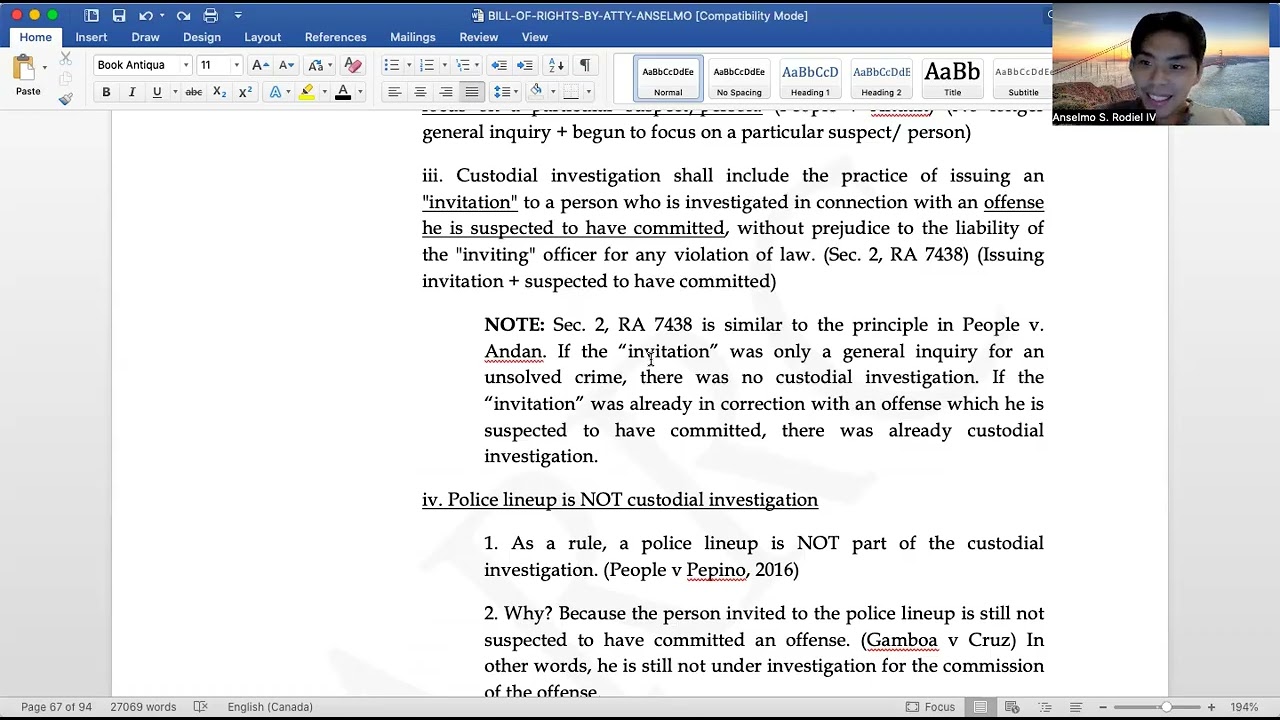




The Miranda rights originate from the landmark 1966 Supreme Court case Miranda v. Arizona, which established that law enforcement must inform suspects of their Fifth Amendment right to remain silent and Sixth Amendment right to counsel before interrogation; this ruling emerged after Ernesto Miranda was convicted based on an involuntary confession obtained without being told he could refuse to answer questions or consult with a lawyer, leading the Court to mandate that suspects must be clearly informed of their constitutional rights prior to any questioning.
Miranda v. Arizona: The Origin of Your Rights | US Law Explained
Added:Understanding of the Fifth Amendment of the US Constitution, particularly the clause protecting individuals against self-incrimination.
Understanding of the Sixth Amendment of the US Constitution, specifically regarding the right to legal counsel in criminal prosecutions.
Basic knowledge of the US Supreme Court's authority of judicial review and its role in interpreting constitutional law.
Familiarity with standard law enforcement procedures, including the distinction between investigative detention and custodial arrest.
Analysis of legal exceptions to the Miranda warning requirements, such as the 'public safety exception' established in New York v. Quarles.
Study of subsequent Supreme Court cases that refined or limited Miranda rights, such as Dickerson v. United States and Berghuis v. Thompkins.
Examination of the 'Exclusionary Rule' and the 'Fruit of the Poisonous Tree' doctrine, which dictate how illegally obtained confessions affect court trials.
Comparison of custodial interrogation rights in the United States with criminal procedure laws in other constitutional democracies.
349.7K views6.1Klikes5:12Original Release: 2017-04-07
Mr beat presents Supreme Court briefs Phoenix Arizona March 13th 1963 police arrest Ernesto Miranda a suspect linked to the kidnapping and rape of an 18-year-old woman 10 days earlier in a police lineup the victim identified Miranda as the attacker for 2 hours officers aggressively interrogated Miranda about the attack the officers did not tell Miranda that he did not have to answer the questions nor did they allow him to call a lawyer hm I guess Miranda didn't pay attention when his teacher taught him about the Bill of Rights in government class anyway the officers broke Miranda down and he confessed to the crime even signing a statement that described the details of the attack when this confession was later used in court of course Miranda was found guilty even though his lawyer argued that the police pressured him to confess Miranda was sentenced up to 30 years in prison he appealed to the Arizona Supreme Court based on the fifth and sixth amendments you know the part of the fifth amendment that says you cannot be forced to testify against yourself aka the right to remain silent and the part of the sixth amendment that says you have a right to an attorney but the Arizona Supreme Court agreed with the lower court well Miranda appealed again and the Supreme Court reviewed the case in June 1966 and this was a tough one in a 5 to4 decision the court ruled that Miranda's confession could not be used as evidence because the officers had denied his fifth and sixth amendment rights chief justice Earl Warren gave the opinion of the Court Warren brought up that the police done messed up by misleading Miranda and not making it clear to him his rights Warren said quote the person in custody must prior to interrogation be clearly informed that he has the right to remain silent and that anything he says will be used against him in court he must bear clearly informed that he has the right to consult with a lawyer and to have the lawyer with him during interrogation and that if he is Indigent a lawyer will be appointed to represent him hm that kind of sounds familiar the justices on the court who disagreed with the majority generally argued that the constitution didn't say anything about making a suspect aware about his or her rights they also argued this gave too much power to suspects and would make police interrogation work much more difficult they were afraid it might be more difficult to convict criminals after the decision police across the country had to inform suspects of their rights after they arrested them they became known as the Miranda Rights or Miranda warnings you're under arrest sir suspicion of murder thank you Sergeant oh gee I almost forgot got to read you your rights course uh want to make sure we don't make any mistake [Music] you have the right to remain silent you know anything ni they you say they could hold that against you you have the right to retain a lawyer you have the right the hell is that after the Miranda case the court tried to strike a balance between Public Safety and the rights of the accused several later decisions ended up granting exceptions to the Miranda warnings some of these EX ctions were big exceptions actually still Miranda v Arizona has had a huge impact on law enforcement in the United States by empowering those accused of a crime and according to several studies the decision hasn't affected detective's abilities to solve crime much so whatever happened to Ernesto Miranda well even though the Supreme Court threw out his original trial he was once again placed on trial in Arizona using different evidence that evidence a woman who lived with Miranda during the time of the offense testified that he had confessed to her about committing the crime in 1967 he was again found guilty and sentenced up to 30 years in prison however he was released early due to good behavior in 1972 Miranda returned to his old neighborhood and made a living autographing what became known as Miranda cards which contained the text of the warning read to suspects by police tragically he was stabbed to death in a bar fight on January 31st 1976 police police arrested a dude suspected of murdering Miranda ironically that dude unlike Miranda exercised his right to remain silent and was later released after there was no evidence to prove that he did [Music] it I'll see you for the next Supreme Court case jury you have the right to remain silent and you also have the right to comment and share and like this video thanks for watching a shout out to my two newest patreon supporters Jake and Matthew you have a video on a topic of your choice coming soon and the next episode is Texas V Johnson I'll see you then
Up Next
13:59
Legal Implications of the Fifth Amendment: Miranda Rights Ruling
@ArmedAttorneys
309.5K views•2024-12-04

4:27
US Secondary Sanctions Impact on EU Businesses and Blocking Legislation
@Bureauvandijk
1.6K views•2019-03-20
5:03
Recorded Testimony in Court: Crawford v. Washington Explained
@iammrbeat
68.6K views•2018-01-26

24:42
Police Interrogation Tactics: False Confessions & Legal Reform
@LastWeekTonight
7M views•2022-04-18
Related Study Plans & Knowledge Roadmaps
Structured learning paths in Law
law
Self-Defense Law: Imminence & Castle Doctrine
01Foundations of Self-Defense Law
02Imminent Threat & Reasonable Belief
03The Principle of Proportionality
+ 3 more learning modules
12h6 modules
Explore Roadmap
law
Defamation Law: First Amendment & Actual Malice
01Introduction to civil torts and the First Amendment
02Elements of Defamation: Libel and Slander
03Public Figures vs. Private Individuals
+ 2 more learning modules
8h5 modules
Explore Roadmap
law
Hearsay Rule: Trial Evidence & Exceptions
01Introduction to Trial Evidence & Courtroom Basics
02Demystifying Hearsay: The Core Definition
03Non-Hearsay: Exclusions Under FRE 801(d)
+ 3 more learning modules
14h6 modules
Explore Roadmap
law
Medical Malpractice: Law, Liability & Care
01Foundations of Tort Law and Civil Liability
02The Four Elements of Medical Malpractice
03Defining and Proving the Standard of Care
+ 2 more learning modules
12h5 modules
Explore Roadmap