





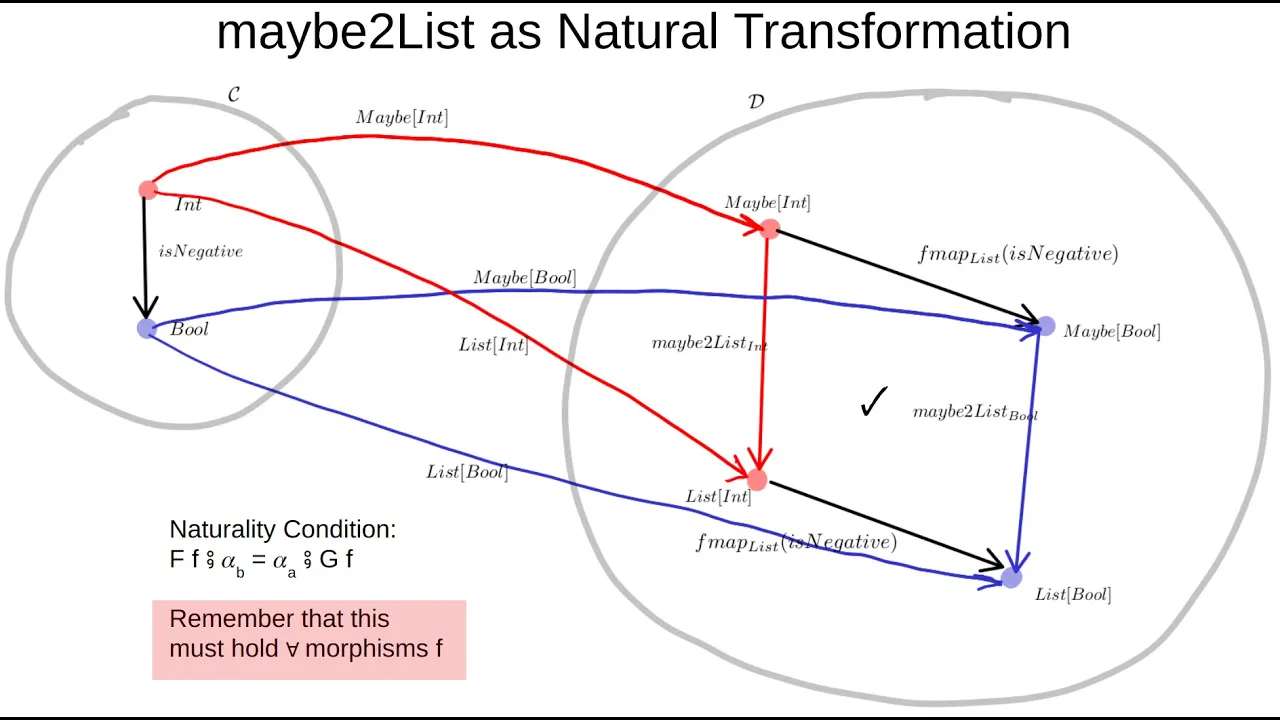











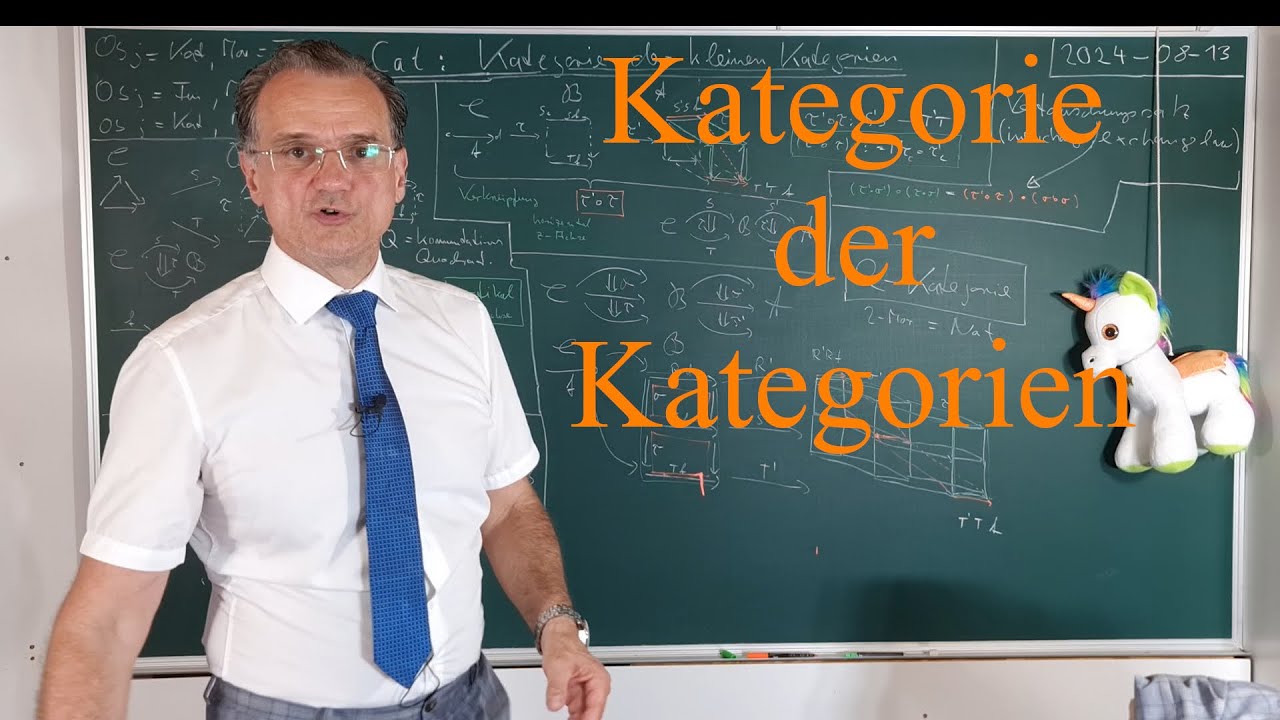


A natural transformation between two functors F and G from category C to category D is defined by a collection of morphisms α_X: F(X) → G(X) for each object X in C, such that for every morphism f: X → Y in C, the naturality square commutes, meaning that applying α_Y after F(f) equals applying G(f) after α_X; this definition can be understood through an analogy with homotopy, where a natural transformation corresponds to a continuous deformation between maps, and can be viewed as a functor from the product category C × I to D, where I is the categorical interval consisting of two objects with a single morphism between them.
Natural Transformations: Definition and Homotopy Analogy in Category Theory
Added:Definition of a Category, including objects, morphisms, identity, and composition laws.
The concept of Functors, including how they map objects and morphisms between categories while preserving structure.
Basic understanding of commutative diagrams, as the naturality condition is defined using commutative squares.
Elementary concepts in topology, specifically the definition of a homotopy as a continuous deformation between two continuous maps.
Natural Isomorphisms and the concept of Equivalence of Categories.
The Yoneda Lemma, which relates a category to the category of functors from it to the category of sets.
Adjoint Functors, which formalize a weak form of equivalence between categories using natural transformations.
Limits and Colimits, understood through the lens of universal properties and natural transformations.
Introduction to 2-Categories, where natural transformations serve as 2-cells between 1-cells (functors).
19.8K views191likes9:37Original Release: 2007-09-25
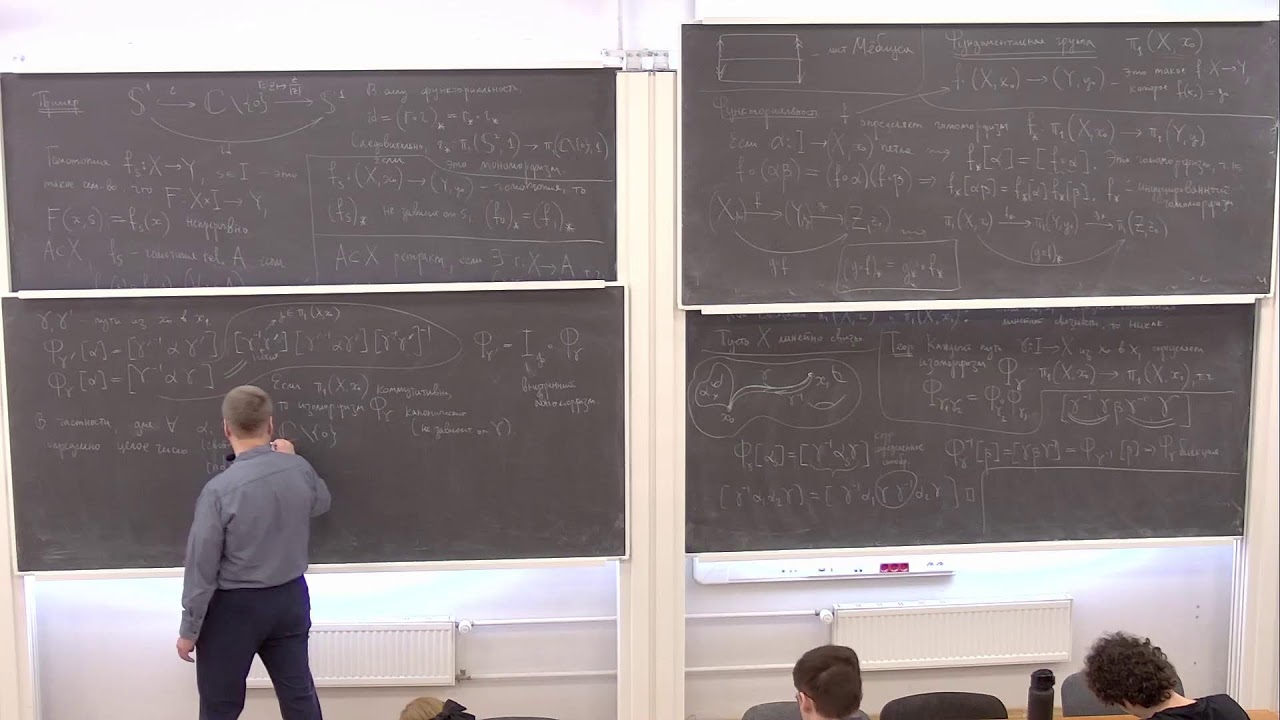
today we're going to talk about natural Transformations natural Transformations are like morphisms between functors and as category theorist of course we like morphisms morphisms are practically the entire point of category Theory it's that true never mind that's what I'm going to say for now because they are the things that we use to express structure we start with objects and then in our category we have morphisms that enable us to talk about uh different kinds of sameness between objects other than just equality and other kind of more exciting structures so when we're thinking about categories we then think about morphisms between categories and those as we know are functors and then we might start thinking about morphisms between OCT and those are natural Transformations so here's the definition definition uh a natural transformation well first of all we have to decide where a natural transformation is allow to live given categories and functors like this so we've got categories c and d and we've got a funter going from C to D and another fun going from C to D so they really have to start and finish in the same place otherwise we're not allowed to even think about having a natural transformation there um oh now I can't make this I can't make this grammatically work it's going to be a dynamic definition or something um a natural transformation the natural transformation is going to live there a natural transformation natural transformation Alpha what someone in my audience is eating chocolate cake during this lecture do you think that's acceptable okay a natural transformation Alpha is given by now what we have to have and I do remember when I first saw the definition of natural transformation I thought it was very very strange what we have to have is for every object in C A morphism in D for all objects X and C a morphism alpha subx that goes from F ofx to G of X and that's going to be called we're going to refer to that in general as a component of this natural transformation so this is called the component of alpha at X X and of course it's not just any old collection of morphisms like that there has to be some aium satisfying naturality what does naturality say well it says given any morphism in C something has to be true over here so we're talking about we're talking about categories and function so we're probably thinking about objects and morphisms and the point is that a natural transformation says for every object in C we get something over here and for every morphism in C we get something else over here so for the morphisms what is it that we get over there so all morphisms F going from X to Y in C the following diagram commutes hopefully you can still see it at the bottom of the board here uh so what could we do there are two possible things we can do we can either start from F ofx use our natural transformation to get to G of X and then do G of our morphism to get ourselves to G of Y or alternatively we can do F of f down here oops that takes us to F of Y and then we can do our component of the natural transformation afterwards alpha y so that rather small this is the this is the this is really the key thing and I don't know what I can do to make it more key given that I've squished it at the bottom of the Border maybe I'll just draw a big red circle around it that is the naturality square so these are the and there's one of them for every morphism in C so these are the naturality squares and these are really the things that make this entire definition tick so next time probably we'll look at how we can compose natural Transformations because I just said that there was some kind of morphism between functors and if there are kind of morphism between functors then you really want to be able to compose them but before I do that I want to try and shed a little bit of light on what this definition is about with which will make sense to anybody who's ever seen the notion of homotopy so let's just have a s of thought experiment about hopy if you think about spaces X and Y and continuous map between them f and g we know what now I've made this diagram of an awful look like the other one for a reason we know what the notion of a homotopy from F to G is because what it is is a continuous map from X cross I to Y such that when this is zero you get F and when this is one you get G but what that in particular gives you is that so if you fix an object of X right then what you're going to get as as as you vary yourself along this I part is a path from F ofx to G of X in y so for all what you get here is that if you fix X we get uh h of x blank which is a path from F ofx to G of X and this is really a bit like what's going on here for every X in the source part we have the categorical notion of path from F ofx to G ofx and the categorical notion of path in this case is just a morphism going from there to there and so what's this commuting naturality conditions say well let's imagine that we're looking at a hometop between two paths in space so here's here's a space and here's one path maybe that's F and here's another path and maybe that's G and homotopy between them says for every Point T somewhere along this path we're going to get some path that takes us from one place to the other and for every other point T Prime we're also going to have a path from F of T Prime to G of T Prime so we've got this kind of square right and given that this is supposed to be like the component of the natural transformation in one place and this is supposed to be like the component of the natural transformation in the other place you sort of think well this naturality Square somehow ought to to correspond to this Square commuting now what does it mean for a square of parts to commute in a space thought experiment thought experiment well it sort of ought to mean that there isn't some great gaping hole in the middle here if there's a great gaping hole here then there isn't any sense in which this PA is the same as this part but if there's no great gaping hole in the middle then there is a sense in which this part is the same as this part and if you think about it that's kind of what it means to this path that be homotopic to this one right you can you can get your way all the way down here without running into some enal whole so that's sort of like what this naturality condition is saying so you might say to ourselves well is there some way of getting that natural transformations in this way and the answer is yes there is I won't have time to go into it this time but you could look at a natural transformation as being a functor a functor from C cross I to D where this I has to be a bit like the categorical version of this I now what's this I up here it's the topological interval so this I ought to be the categorical interval whatever that is well what do you think the categorical interval is the categorical interval is a very small category that consists of an object at the beginning an object in the end and the morphism going in between them so an exercise before next time is to work out what part of this definition gives the naturality condition here
Up Next
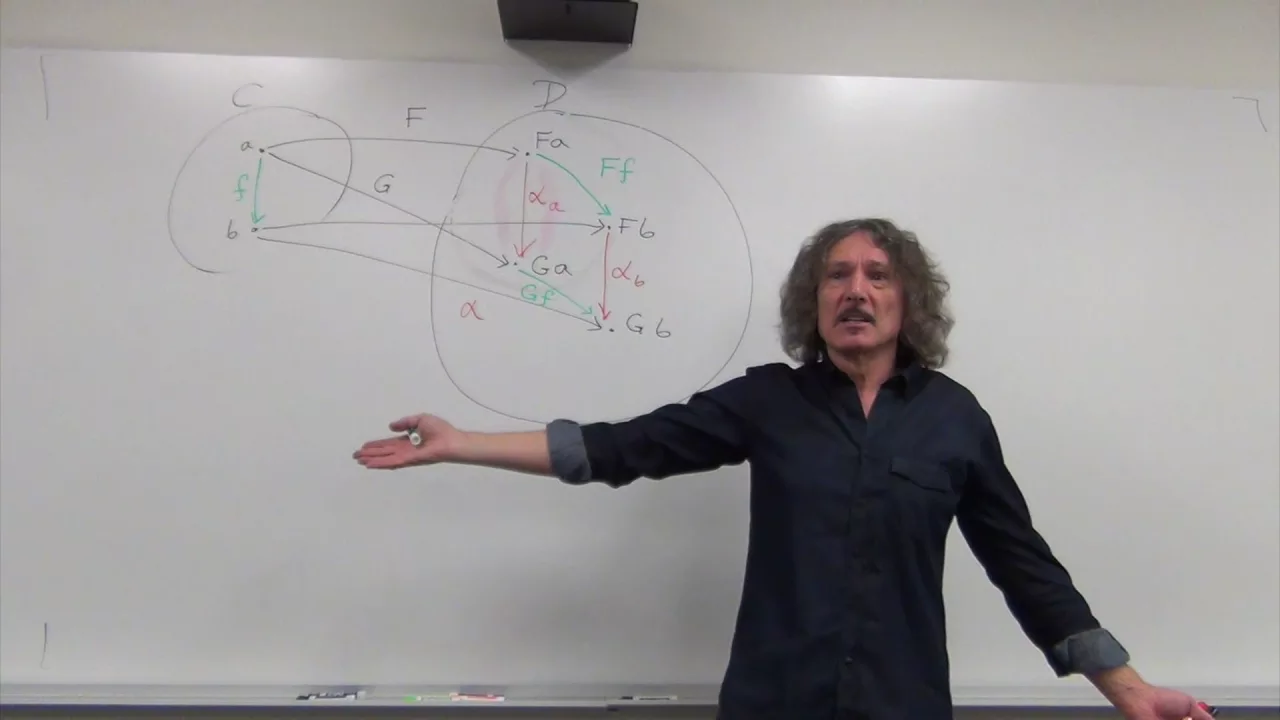
51:27
Natural Transformations in Category Theory Explained
@DrBartosz
37.7K views•2016-10-20

4:43
Elliptic Curve Cryptography Explained: ECC, ECDSA, ECDH
@PracticalNetworking
28.5K views•2024-10-21
10:44
Fourier Series Introduction: The Big Idea Explained
@DrTrefor
387K views•2021-05-03
6:00
The Mathematical Impossibility of Accurate World Maps
@Vox
23.3M views•2016-12-02
Related Study Plans & Knowledge Roadmaps
Structured learning paths in Mathematics
mathematics
Tensor Calculus: Vectors to Riemann Curvature
01Mathematical Foundations: Linear Algebra & Calculus
02Covectors, Dual Spaces, and Tensor Basics
03The Metric Tensor and Index Gymnastics
+ 2 more learning modules
40h5 modules
Explore Roadmap
mathematics
Gödel's Incompleteness: Logic, Proofs & Limits
01Introduction to Formal Systems & Hilbert's Dream
02Set Theory, Cardinality, and Cantor's Diagonal Argument
03Arithmetization and Gödel Numbering
+ 2 more learning modules
14h5 modules
Explore Roadmap
mathematics
Galois Theory: Fields, Groups & Solvability
01Foundations of Abstract Algebra: Groups & Fields
02Polynomials & Field Extensions
03Splitting Fields & Symmetries
+ 2 more learning modules
24h5 modules
Explore Roadmap
mathematics
Non-Euclidean Geometry: Models & Geodesics
01Euclid's Fifth Postulate and the Birth of New Geometries
02Hyperbolic Space and the Poincaré Disk Model
03Geodesics: Defining Straight Lines in Curved Spaces
+ 2 more learning modules
15h5 modules
Explore Roadmap