














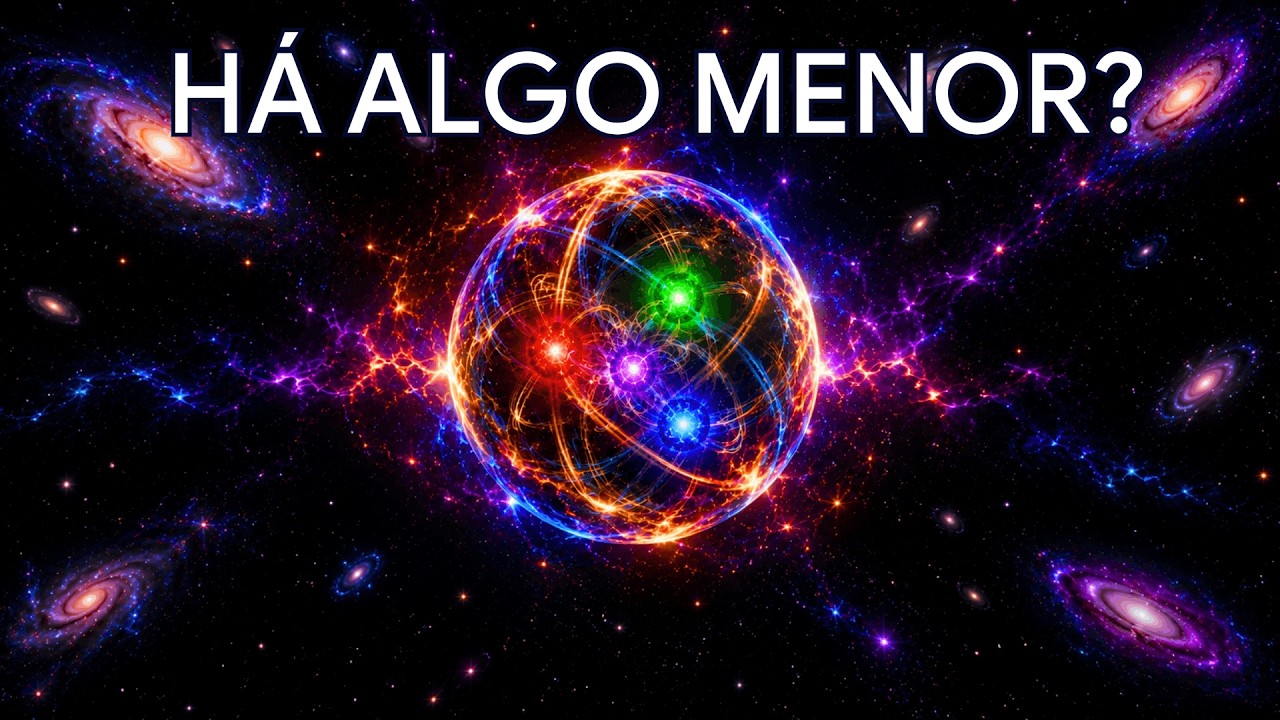
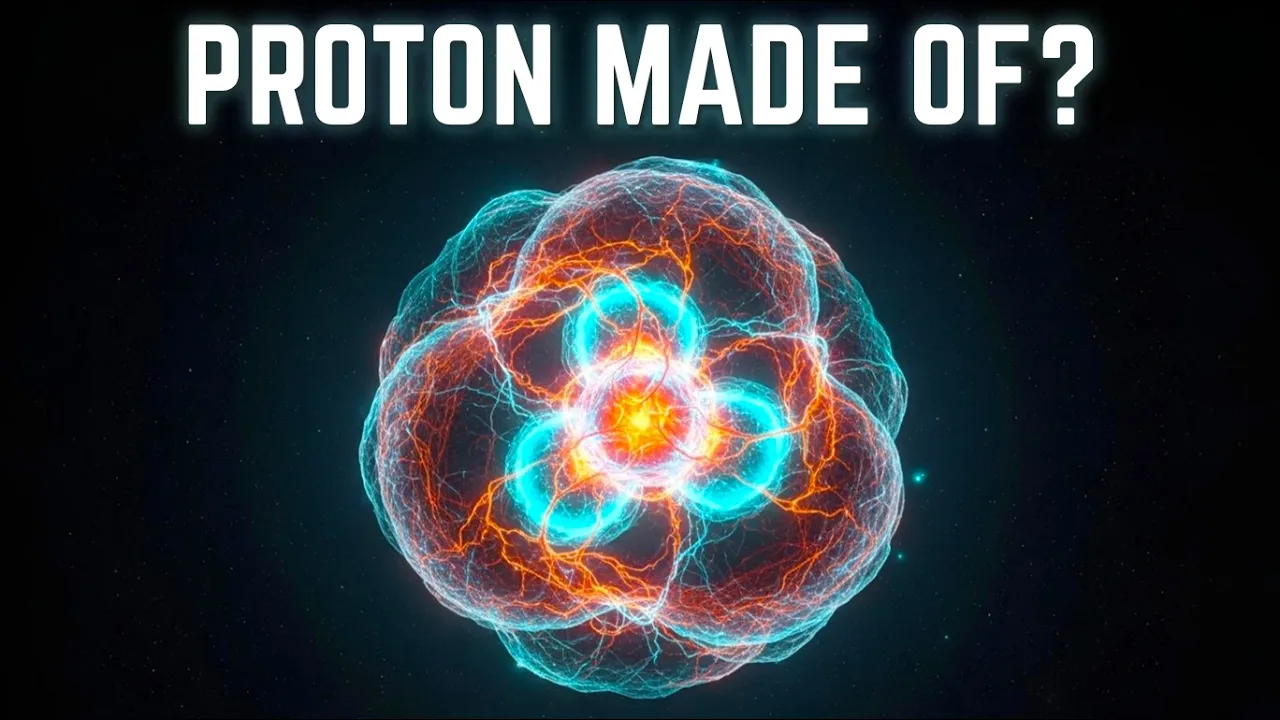
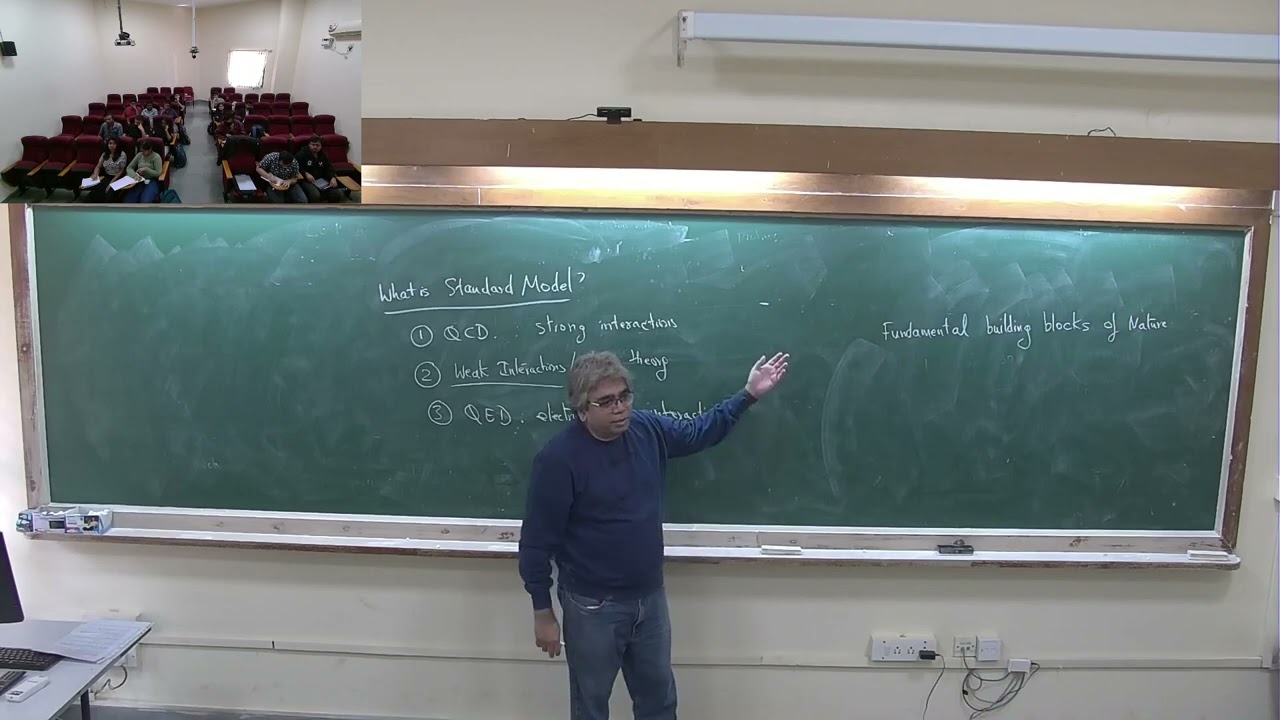


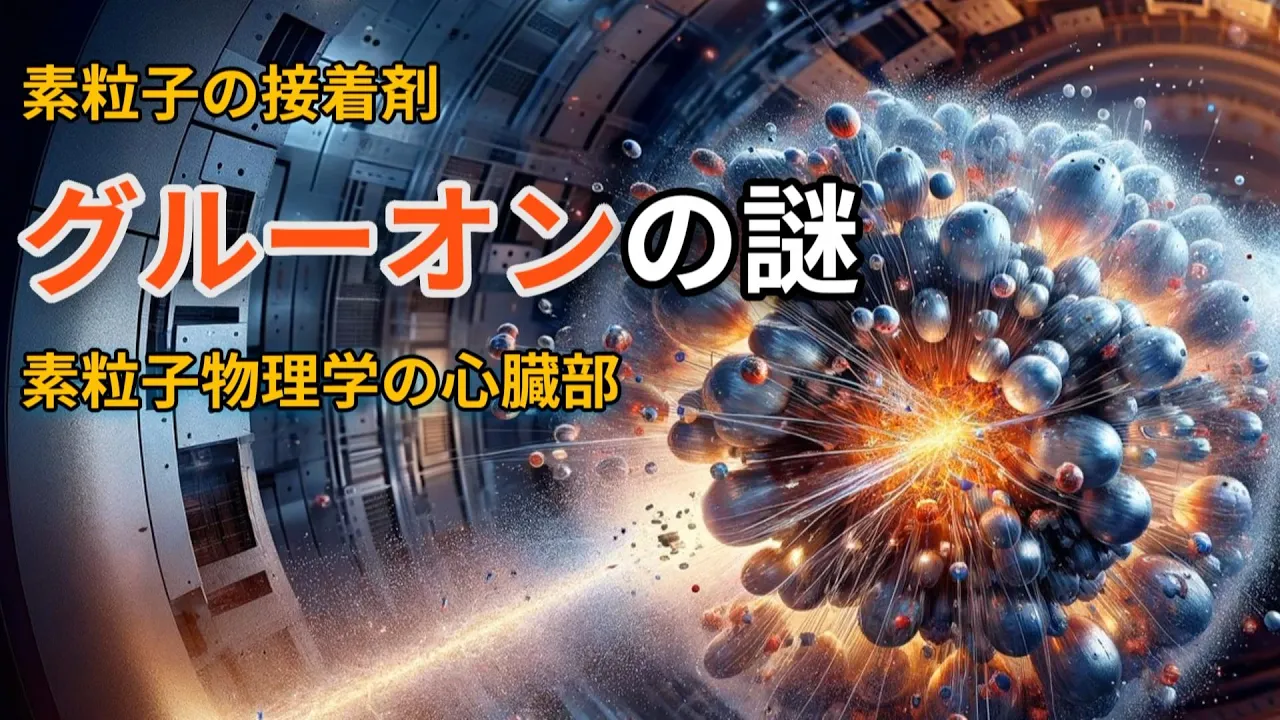

Quantum Chromodynamics (QCD) describes the strong nuclear force through 'color' charge, a fundamental property of quarks and gluons that differs from electric charge; unlike electromagnetism where particles exchange neutral photons, the strong force involves quarks exchanging gluons (which themselves carry color charge), causing gluons to attract each other and preventing individual quarks from existing in isolation—instead, all observable matter consists of color-neutral composite particles like protons and neutrons.
Quarks, Gluons, and the Strong Nuclear Force: QCD Explained
Added:The basic structure of an atom, including the distinction between fundamental particles (like electrons) and composite particles (like protons and neutrons).
The four fundamental forces of nature (gravity, electromagnetism, weak nuclear force, and strong nuclear force) at a conceptual level.
An introductory understanding of the Standard Model of particle physics, specifically the classification of particles into fermions (matter) and bosons (force carriers).
Basic quantum mechanics principles, such as electric charge, spin, and the concept of fields.
Asymptotic Freedom: Understanding why the strong force becomes weaker at extremely short distances or high energy scales, allowing quarks to behave almost like free particles.
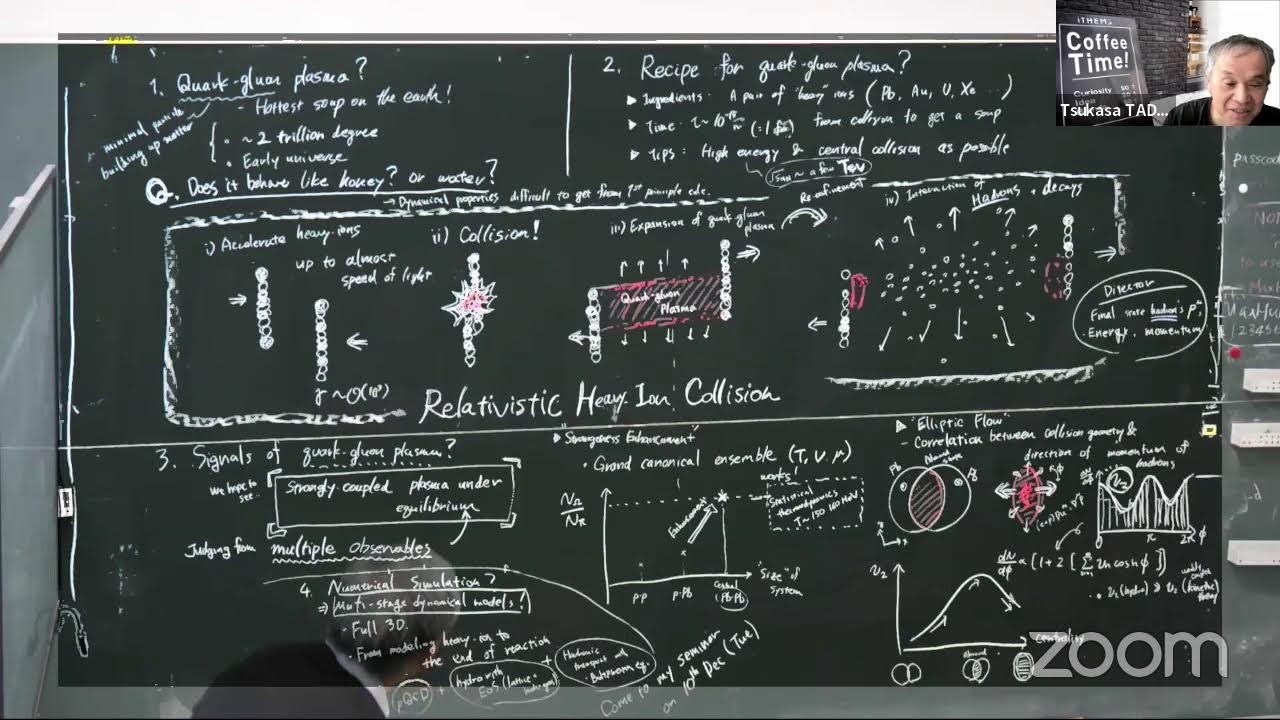
Quark-Gluon Plasma (QGP): Exploring the high-temperature, high-density state of matter where quarks and gluons are deconfined, mimicking conditions of the early universe.
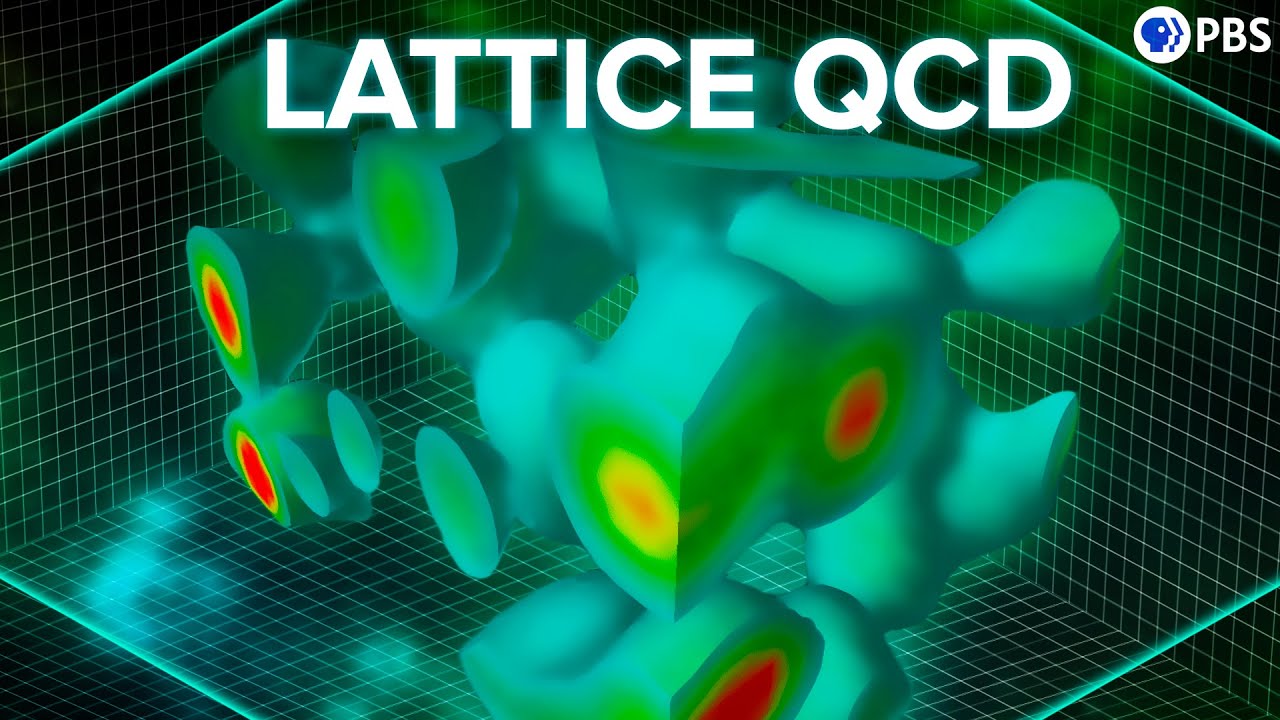
Lattice QCD: Investigating how physicists use non-perturbative, computational grid-based simulations to solve complex quantum chromodynamics equations.
Hadronization and Jet Physics: Learning how quarks and gluons produced in high-energy particle colliders (like the LHC) transition into observable streams of hadrons.
478K views14.6Klikes12:39Original Release: 2018-07-07
It is often said that a proton contains two “up” quarks and one “down” quark… And that a neutron contains two “down” quarks and one “up” quark… But this is not entirely true.
There are six different flavors of quarks, which we have decided to call “up”, “down”, “charm”, “strange”, “top”, and “bottom.” If we define the electric charge of a proton as +1, then three of the quarks each have an electric charge of +2/3, and the other three quarks each have an electric charge of -1/3.
Each quark has an associated anti-matter equivalent, called an “anti-quark”, containing the same mass but the opposite electric charge.
The electric charge is responsible for the electromagnetic force.
On the other hand, the Strong Nuclear force is due to a new phenomena, which has no analogy in classical physics.
We call this new phenomena the “color” charge, even though it has no relationship to visible color in classical physics.
The color charge of each quark can take three possible values.
Let us invent labels for these three values and call them "Green", "Red", and "Blue."
Green… Red… and Blue.
The color charge of an anti-quark can also take three possible values, which we will call, "anti-Blue", "anti-Red", and "anti-Green."
anti-Blue… anti-Red… and anti-Green.
Besides quarks and anti-quarks, the only other type of particles that contain this so called “color” charge are particles called “gluons.” Each gluon possess two color charges: One “Color” and one “anti-Color” of a different type, such as “Red” and “anti-Green.” Gluons do not possess any electric charge.
We now know that electric and magnetic fields do not actually exist, and that the electromagnetic force is really the result of the fact that particles with an “electric” charge exchange photons with one another.
Similarly, the strong nuclear force is the result of the fact that particles with a “color” charge exchange gluons with one another.
It is this exchange of gluons that holds the quarks together inside protons and neutrons.
When a quark emits or absorbs a gluon, its flavor does not change, meaning that an “up” quark stays an “up” quark, and a “down” quark stays a “down” quark.
But, the color of the quark changes.
A color is cancelled out by its associated anti-color, and the total amount of “color” charge is always conserved, just as the total amount of “electric” charge is always conserved.
All composite particles, such as protons and neutrons, are what we call “color neutral.” This means that if we count the colors of all the quarks and gluons inside, we will always find the amounts of red, green, and blue to be exactly equal to one another.
Although this is not shown in the animations, each system is in a quantum superposition of different possible states, and each quark and each gluon is in a quantum superposition of different possible colors.
A gluon can split up into a quark and its associated “anti-quark”, provided that the total color charge is conserved.
These events can also happen in reverse, with a quark and its associated anti-quark annihilating each other to produce a gluon.
Therefore, neutrons and protons don’t just each have three quarks, since many virtual “quarks” and “anti-quarks” are constantly being created and annihilated inside both neutrons and protons.
But, for simplicity, neutrons and protons are typically drawn as just having three quarks each.
Protons and Neutrons have the ability to emit a virtual composite particle consisting of one quark and one anti-quark, which can then be absorbed by another Proton or Neutron.
It is the exchange of these virtual composite particles, consisting of one quark and one anti-quark, that creates the force binding Protons to Neutrons inside the nucleus of an atom.
However, these virtual composite particles consisting of one “quark” and one “anti-quark” can not exist for very long, which is why the force binding Protons to Neutrons works only over a very short distance.
The Protons and Neutrons in a nucleus therefore have to be very close together for this binding force to work, and to overcome the repulsion from the electromagnetic force.
The electromagnetic force acts on all objects with an electric charge, through the exchange of photons.
Photons do not themselves possess an electric charge, and photons will just pass through each other.
On the other hand, gluons do possess a color charge, which means that unlike photons, gluons can absorb and emit other gluons, allowing gluons to attract one another.
Therefore, whereas the imaginary “electric” field flux looks like this… If we were to imagine a “gluon” flux, the gluon flux lines would attract each other to look like this.
A consequence of the shapes of these lines is that whereas the electromagnetic force decreases as we increase the distance between charged particles… The strong nuclear force between quarks and anti-quarks does not decrease as we increase the distance between them.
If we try to separate quarks by applying a large amount of energy, then this energy will be converted into the creation of a new “quark” and an “anti-quark.” But each quark and each anti-quark we create will still be bound to another quark or to another anti-quark, and we will not observe individual quarks in isolation.
To understand why we don’t observe individual quarks in isolation, hypothetically suppose we lived in a Universe where the electromagnetic force was much, much stronger.
In this Universe, all electrically charged particles would clump together in a way such that we would get accustomed to the idea that all composite particles must always be electrically neutral.
This is the situation we have in our own universe with regards to the strong nuclear force, and we have gotten used to the idea that all composite particles must always be “color” neutral.
A composite particle, such as a proton or neutron, is color neutral if it contains the same amount of “red”, “green”, and “blue.” A composite anti-matter particle, such as an anti-proton or anti-neutron, is color neutral if it contains the same amount of “anti-red”, “anti-green”, and “anti-blue.” And a composite particle consisting of one quark and one anti-quark is color neutral if it contains the same amount of a “color” and its associated “anti-color.” An individual quark can’t be color neutral, and therefore we have never seen an individual quark by itself.
An individual gluon also can’t be color neutral, and an individual gluon also can’t exist on its own, as it would never escape the attraction of other gluons.
But, a combination of two or more gluons could be color neutral, and could therefore exist independently of quarks as what we call a “glue-ball.” Many exotic composite particles consisting of quarks and gluons can be created, provided that they are color neutral, as we do not need to be limited to just the familiar “up” and “down” quarks.
Though, these exotic particles are not very stable.
More information is available in the other videos on this channel and please subscribe for notifications when new videos are ready.
Up Next
10:32
Why the Weak Nuclear Force Is So Much Weaker Than Electromagnetism
@fermilab
822.1K views•2017-04-14

12:53
21cm Hyperfine Transition in Neutral Hydrogen: Radio Astronomy Basics
@AaronRobertParsons
12.4K views•2011-10-13
18:22
Euler-Lagrange Equation Explained Intuitively | Lagrangian Mechanics
@EugeneKhutoryansky
444.8K views•2018-11-18

27:14
Entropy and the Second Law of Thermodynamics Explained
@veritasium
27.5M views•2023-07-01
Related Study Plans & Knowledge Roadmaps
Structured learning paths in Physics
physics
Nuclear Physics (Decay, Fission & Reactors)
01Atomic Structure and the Binding Force
02Radioactive Decay and Half-Life
03Nuclear Fission Mechanics and Chain Reactions
+ 2 more learning modules
12h5 modules
Explore Roadmap
physics
Soft Matter (Polymers, Colloids & Rheology)
01Foundations of Soft Matter & Thermal Forces
02Polymer Physics and Macromolecules
03Colloids, Surfactants, and Self-Assembly
+ 2 more learning modules
38h5 modules
Explore Roadmap
physics
Analytical Mechanics: Lagrangian & Hamiltonian
01Mathematical Foundations: Calculus of Variations
02From Newtonian Mechanics to Constraint Dynamics
03The Principle of Least Action & Lagrangian Mechanics
+ 3 more learning modules
28h6 modules
Explore Roadmap
physics
General Relativity (Spacetime & Cosmology)
01Foundations of Relativity: Special Relativity
02The Geometry of Spacetime: Equivalence Principle & Curvature
03Einstein's Field Equations: The Mathematics of Gravity
+ 2 more learning modules
55h5 modules
Explore Roadmap