
















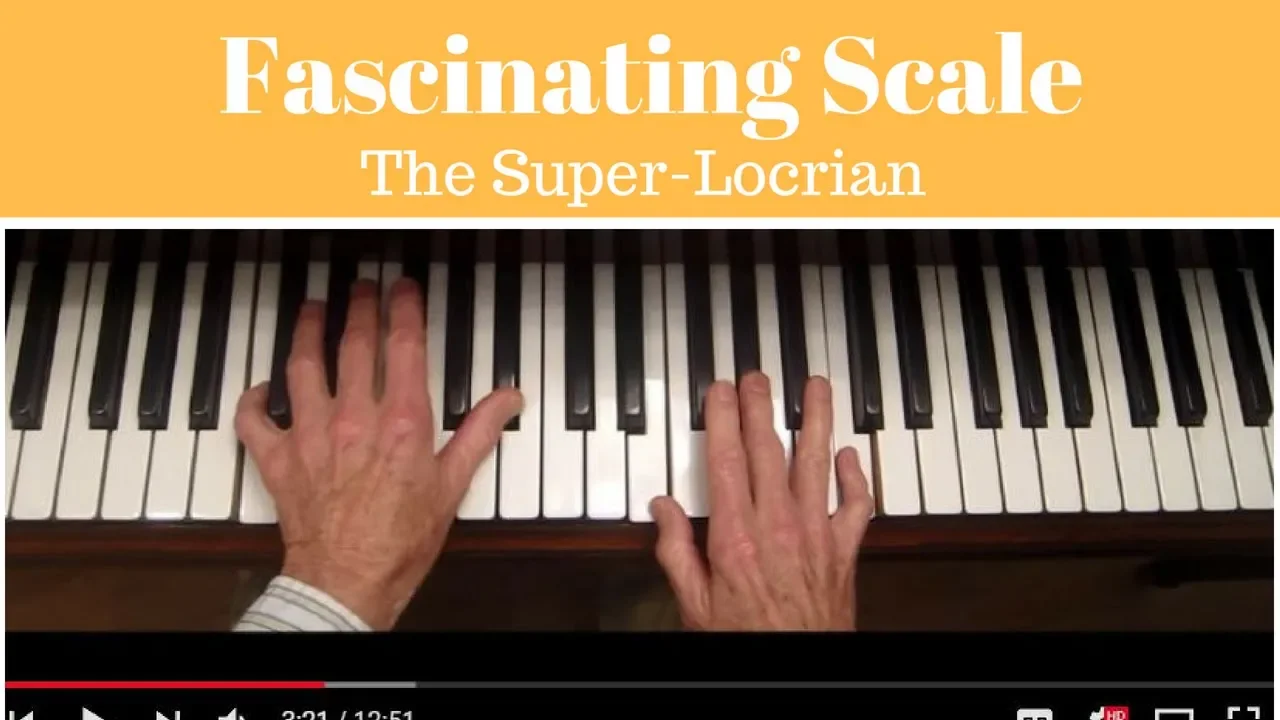









The whole tone scale, consisting of six whole steps (e.g., C-D-E-F#-G#-A#), creates a distinctive dreamy sound and contains two hidden augmented chords; it can be applied in four ways: creating a dream sound effect by playing thirds or triads high on the piano, improvising over augmented chords (as the scale contains six different augmented chords), improvising over dominant seventh chords (hitting extensions like 9th, #11, and b13), and performing whole tone runs that resolve to related chords.
4 Whole Tone Scale Tricks for Piano Improvisation
Added:Basic understanding of intervals, specifically the difference between half steps (semitones) and whole steps (whole tones).
Familiarity with the construction of the Whole Tone Scale (a symmetrical six-note scale built entirely of whole steps).
Fundamental piano technique, including basic scales, hand posture, and finger independence for playing runs.
An understanding of basic chord construction, particularly major triads, augmented triads, and dominant 7th chords.
Analyzing Impressionist piano literature (e.g., Claude Debussy's 'Voiles') to see whole tone scales used in classical composition.
Applying the whole tone scale over altered dominant chords (like 7flat5 or 7sharp5) in jazz improvisation and II-V-I progressions.
Studying other symmetrical scales, such as the diminished (octatonic) scale, to expand improvisational color palettes.
Developing advanced fingering patterns and speed for extended, multi-octave whole tone runs across the keyboard.
Exploring non-functional harmony and modal jazz composition techniques that break away from traditional major/minor tonality.
36.1K views1.7Klikes12:39Original Release: 2022-07-22
have you heard about the whole tone scale but you're not really sure how to use it in your playing well in today's lesson i'm going to show you four amazing things that you can do with the whole tone scale i'm going to show you how to get the dream sound effect with a scale how to improvise with it plus how to play some really cool runs down the piano it's going to be a ton of fun so let's go ahead and dive in all right first i want to do a quick review on the whole tone scale if you already know this scale you can skip ahead in the video to learn the four tricks so the whole tone scale is a very simple scale it is a scale made up of whole steps so if you start on c and go up a whole step to d whole step to e whole step to f sharp g sharp and a sharp you have what's called the c whole tone scale and it has a very cool sound now there's a second whole tone scale if you go up a half step to the d flat and you play whole steps up the piano you end up with the d flat whole tone scale and it's the same formation you're going to play whole steps up the piano and you have this very cool sounding scale now there are only two whole tone scales at the piano and that's because if you went up another half step to d and you played the whole tone scale starting on d well guess what it's the same scale as the c whole tone scale so there are only two whole tone scales at the piano i call them the c whole tone scale and the d flat whole tone scale now quick note on fingering if you're playing the c whole tone scale i recommend you start thumb index thumb and then use the rest of your fingers so two three and four and then you'll come back to your thumb if you wanted to play the scale all the way up the piano if you wanted to play this scale in your left hand the fingering i recommend is to start on your thumb and you're gonna go two one and then four ring finger and play all the way up until you get back to your thumb and then you could continue up the piano if you wanted to play it in multiple octaves for the d flat whole tone scale fingering i recommend that you start on your two finger your index go three and then go thumb to the f and then go two three and then go thumb to the b and then you're back on two for your d flat if you want to practice it in your left hand i recommend that you start on your third finger on the d-flat you're gonna come up to your thumb and then third finger on the g and then you're gonna go back to your third finger on your d-flat all right the last thing i want to say about the whole tone scale before i show you how to use it in your playing is that there are actually two augmented chords hidden in your whole tone scale if you look at your first whole tone scale the c whole tone scale you might notice that you have a c augmented and you also have a d augmented isn't that cool and so this is a great trick to helping you remember these scales you can actually think and think of them as two augmented chords likewise the d flat whole tone scale has two augmented chords hidden in the scale you have a d-flat augmented chord and you have an e-flat augmented chord all right are you ready to use the whole tone scale in your playing well before i teach you these four tricks if you're enjoying the video please hit the like button and if you're new to the channel be sure to subscribe for more videos just like this all right trick number one is the dream sound effect and this is a sound effect that's used in lots of films and television shows when it goes into like a dreamy sort of sequence and it has this sound to it [Music] that sound cool and we're just using the notes of the c whole tone scale so how do you get this sound well the first thing is to come way up high on the piano you don't want to play a dream sound you know down here it's going to sound a lot more realistic if you're going to be up here on the piano okay now you can play any of the notes of the c whole tone scale and get this sound okay and basically what i'm doing i'm playing like a c augmented chord and i'm just playing the c whole tone scale up and down and it creates a really nice sound but the way i like to play the dream sound effect is to actually play thirds in the right hand okay i'm just basically taking the c whole tone scale and i'm playing thirds and just kind of harmonizing the top note with a third interval you can also do the triad dream effect which sounds like this then that sound cool and for this i'm basically taking chords three note chords which we call triads and i'm playing the scale using three note chords so i'm starting here and i'm just bringing it up right like this and then taking it down again these are all three note chords and then i come back up see that and then for this one you got to kind of skip down like this and then i come back up and then i might finish [Music] finally on the e augmented all right technique number two that you can do with your whole tone scale is that you can use the whole tone scale to improvise over an augmented chord in your left hand so check this out if i'm playing a c augmented in my left hand i can actually use the c whole tone scale to improvise over this chord okay and it sounds nice that sound really cool and i'm just using these six notes from the whole tone scale now the amazing thing is that i can actually use the c whole tone scale over six different augmented chords because there are actually six different augmented chords contained in the c whole tone scale so i have a c augmented i have a d augmented so i could improvise over the d augmented with this scale i have e augmented i have the f sharp augmented right g sharp augmented and then the b flat augmented similarly you can use your d-flat whole-tone scale over your other six augmented chords so if you play a d-flat augmented guess what right you can use the d-flat augmented scale e flat augmented right f augmented right g augmented right a augmented right and then be augmented all right trick number three that you can use with your whole tone scale is that you can use it to improvise some very cool lines on a dominant seven chord doesn't that sound cool and so basically what i'm doing is i'm taking a c7 chord this is a chord that you'll oftentimes use in a jazz chord progression it oftentimes will end on like an f chord and if you want to play a really cool scale on this c7 chord you can actually use your c whole tone scale and this scale had some really cool colors of your c7 chord you've got the root in there you've got the third and your seventh but then you're also hitting the d which we call the nine the f sharp which we call the flat five or the sharp 11 and then the a flat which we call the sharp 5 or the flat 13. in fact you can use your c whole tone scale on six different dominant seven chords so for example let's say you played a dominant 7 chord on your d and you played the c whole tone scale or you could think of it as starting on the d well guess what you're hitting some really cool colors on your d7 chord same thing with your e7 right i'm gonna play the same scale in my right hand and i hit some really nice colors right same thing with f sharp doesn't that sound nice uh g sharp and then b flat you can also do the same thing on your d flat whole tone scale if you played this scale on your d flat seven chord guess what you're going to hit all of the same really cool colors so you've got the root you've got the nine the third the sharp 11 really cool sound the flat 13 and the seven okay so check this out that sound amazing and once again you can play your d-flat whole-tone scale over six different dominant seven chords so i said you could play on the d flat seven well you could put on the e flat seven you could put it on the f7 it's the same scale i'm just starting on a different note that sound cool a7 and then your b7 all right before i teach you technique number four if you want to do a deep dive and you want to learn basically all of the scales that i like to use when i'm improvising on seventh chords check out our course scales for soloing on seventh chords you'll learn 15 of my favorite skills that i use on seventh chords and all the techniques that i like to use with these scales to create some really cool jazz lines i'll put a link to that below alright the fourth and final technique i'm going to show you today with your whole tone scale is the whole tone run and if you like guys like oscar peterson and you hear him play this really cool run down the piano he's probably playing a whole tone run it sounds something like this didn't that sound cool so what i'm doing is i'm starting really high on my whole tone scale i like to use this position up here so maybe like the pinky on c and you basically come down the notes of the whole tone scale so like this two finger on the d and then your fourth finger on the b flat okay so the fingering is really important two on the d four on the b flat and then usually you're going to resolve this chord to an f chord so you might resolve it there now a little trick to make it sound kind of like authentic stride piano is guys like oscar they'll harmonize the top note so they might do something like where they grab two notes from the whole tone scale and then come up and then back down like this okay or you could do it you know like that but you want to harmonize the top note of your run another really cool run you can do with the whole tone scale sounds like this that sound cool and so this run is actually very simple to play we're playing a c7 chord and what i'm doing is i'm basically playing these triads down the whole tone scale you see this so these are basically three note chords i'm just skipping every other note from the whole tone scale to create these chords and then what i'm doing is i'm just arpeggiating each chord so and then see what i'm doing i'm just arpeggiating the whole tone chords down the piano and it has a pretty cool sound by the way if you want to learn more runs like this check out our course jazz intro and outro runs you'll learn six amazing sounding runs that you can use at the beginning and ends of jazz tunes i'll put a link to that below hey thanks for watching and if you enjoyed the lesson please let me know in the comments also be sure to check out pianowithjohnny.com we have over 1 000 step-by-step lessons for all playing levels where you'll learn your favorite songs styles and how to improvise at the piano thanks for watching and i'll see you in the next one
Up Next

14:32
Minimalist Piano Composition: The Contrary Motion Exercise for Beginners
@BitesizePiano
41.3K views•2021-05-21

105:00
The Internet's Own Boy: Aaron Swartz Documentary (2014) | Digital Rights & Activism
@moviemaniacs
2.4M views•2014-07-01

12:12
How to Play Funk Piano Solos: Funky 4ths Tutorial
@PianoWithJonny
117.4K views•2020-10-02

1:42
Game of Thrones Opening Credits: A Cinematic Analysis
@gameofthrones
46.3M views•2011-04-18
Related Study Plans & Knowledge Roadmaps
Structured learning paths in General & Interdisciplinary Studies
general-studies
Elevator Engineering: History, Physics & Cities
01From Hoists to Safety Brakes: The Dawn of Vertical Lift
02Hydraulic vs. Traction: The Engineering Physics of Elevators
03Modern Speed, Safety, and Algorithms
+ 2 more learning modules
12h5 modules
Explore Roadmap
general-studies
Rubber: Material Science, History & Geopolitics
01Origins of Natural Rubber & Mesoamerican History
02The Chemistry of Natural Rubber & Vulcanization
03The Geopolitics of the Rubber Boom & Colonization
+ 2 more learning modules
12h5 modules
Explore Roadmap
general-studies
Containerization: Evolution, Logistics & Trade
01Ancient Trade & Bulk Cargo: Amphorae to Barrels
02The Industrial Revolution & Cardboard Packaging
03The Containerization Revolution: Malcom McLean
+ 2 more learning modules
12h5 modules
Explore Roadmap
general-studies
Textile Tech: Evolution, Labor & Global Impact
01Pre-Industrial Textiles: Handloom & Cottage Industry
02Mechanization: The Spinning Jenny to the Power Loom
03The Factory System & Global Labor Transformation
+ 2 more learning modules
10h5 modules
Explore Roadmap